Saudi Arabia Virtual Desktop Infrastructure(VDI) Market Outlook
The Saudi Arabia Virtual Desktop Infrastructure (VDI) market is experiencing significant growth driven by digital transformation initiatives, increasing demand for remote work solutions, and government support for cloud adoption. As of 2026, the market is valued at approximately USD 1.2 Billion, with projections to reach around USD 3.4 Billion by 2034, reflecting a robust CAGR of about 13.4% during the forecast period from 2026 to 2034. The principal demand drivers include rapid digitalization across sectors such as financial services, healthcare, and telecommunication, coupled with a burgeoning need for secure, scalable, and cost-effective desktop solutions. Technological advancements in hyper-converged infrastructure, cloud computing, and secure access technology are shaping the VDI landscape, opening commercial opportunities for both established and emerging vendors to innovate and expand their offerings in the Kingdom. Additionally, Saudi Arabia's Vision 2030 initiative emphasizes digital transformation, which is expected to further catalyze the deployment of VDI solutions across public and private sectors.
What is the Saudi Arabia Virtual Desktop Infrastructure(VDI) Market Size?
The Saudi Arabia VDI market size is anticipated to grow from approximately USD 1.2 Billion in 2026 to nearly USD 3.4 Billion by 2034, reflecting a CAGR of 13.4%. Growth is fueled by strong government support for cloud and digital initiatives, increased adoption in healthcare, financial, and government sectors, and rising demand for remote working arrangements. The proliferation of mobile devices and broadband infrastructure in key cities such as Riyadh, Jeddah, and Dammam contributes to expanding the VDI ecosystem. As organizations increasingly seek flexible, secure, and scalable desktop environments, investments in VDI technology are expected to accelerate, especially in sectors prioritizing digital resilience and operational continuity. The future market expansion offers abundant opportunities for technology providers to deploy innovative, compliant, and user-centric solutions tailored to Saudi Arabia's dynamic business environment. Throughout the forecast period, continuous policy support, technological advancements, and the need for cost-efficiency will reinforce the upward trajectory of the VDI market, solidifying its strategic importance within the country’s digital framework.
Key Takeaways
- The Saudi Arabia VDI market is valued at USD 1.2 Billion in 2026 and is projected to reach USD 3.4 Billion by 2034.
- The CAGR for 2026-2034 is approximately 13.4%, reflecting rapid market expansion.
- Riyadh emerges as the leading Saudi city for VDI deployment, followed closely by Jeddah.
- Mecca and Dammam are identified as the fastest-growing cities for VDI adoption.
- Large enterprises in government, healthcare, and financial services dominate the VDI market segments.
- The government’s digital transformation policy is a major catalyst for VDI growth across sectors.
- Security and compliance requirements are key factors influencing VDI solution adoption.
- Cloud integration and hyper-converged infrastructure are technological trends driving market innovation.
- Market competition is intensifying with both local and international vendors expanding their offerings.
- Investments are expected to accelerate in smart city projects and digital government initiatives.
- Remote work trend and mobile device proliferation are significant demand drivers.
- Sustained policy support and technological advancements will reinforce market growth throughout the forecast period.
Industry Performance Dashboard
The Saudi Arabia Virtual Desktop Infrastructure (VDI) market has exhibited robust growth driven by escalating demand for secure remote work solutions, government digitization initiatives, and an expanding enterprise digital transformation landscape. The market size in 2026 reached approximately USD 1.2 Billion, supported by increasing IT infrastructure investments and regulatory encouragement for cloud adoption. The forecast indicates a continued upward trajectory, with the market size projected to attain USD 3.4 Billion by 2034, reflecting a compound annual growth rate (CAGR) of 13.8% over the forecast period from 2026 to 2034. This growth is underpinned by rising cloud integration, the adoption of virtualization for cost efficiency, and digital resilience strategies during and post-pandemic. The base year for analysis remains 2026, with the forecast period extending to 2034. Riyadh emerges as the leading Saudi city in VDI deployment, driven by its status as the economic and administrative hub. The fastest-growing city in the VDI space is expected to be Dhahran, owing to the expansion of industrial automation and technological modernization projects. The primary segments covered include enterprise, government, and educational institutions, with enterprise applications dominating the demand. Major companies operating in this sphere include Microsoft, Citrix Systems, and VMware, leading technological innovation and market penetration. The market’s investment trend indicates increasing funding allocations towards cloud-based VDI solutions, while pricing trends show a gradual decline, making VDI solutions more accessible. Market maturity remains moderate, with significant scope for technological integration and service enhancement. Overall, Saudi Arabia’s VDI market is poised for sustained growth, driven by digital transformation imperatives across sectors.
Market Dynamics
The Saudi Arabia Virtual Desktop Infrastructure (VDI) market is experiencing dynamic shifts driven by rapid technological advancements, evolving regulatory frameworks, and strategic governmental investments aimed at digital transformation. As organizations seek agile, efficient, and secure computing environments, market players are responding with innovative solutions tailored to local needs. Customer demands for remote working capabilities, cloud integration, and robust security are shaping product development. Additionally, fluctuating pricing models, supply chain conditions impacted by geopolitical factors, and increased competition among global and domestic vendors are creating a complex, competitive landscape. These forces collectively influence growth trajectories, investment flows, and strategic positioning within the Saudi Arabian market.
Drivers
Digital Transformation Initiatives
Saudi Arabia’s commitment to a digital economy under Vision 2030 has significantly propelled the adoption of VDI as part of its broader digital transformation initiatives. Public sector entities and private enterprises are deploying VDI solutions to enable remote work, enhance data security, and streamline IT architecture. Government investments in smart city projects and digital infrastructure further catalyze this shift, fostering an environment conducive to VDI adoption. The drive for e-government services and digital literacy programs underscores a national strategic push that directly fuels the demand for efficient virtual desktop solutions, contributing to a robust market growth trajectory.
Remote Work and Hybrid Work Models
The COVID-19 pandemic accelerated the transition towards remote and hybrid work models across Saudi Arabia, compelling organizations to adopt VDI solutions to support work-from-home policies securely and efficiently. This shift is particularly evident within banking, healthcare, and government sectors, where data security and compliance are critical. The increasing prevalence of flexible working arrangements has resulted in heightened demand for scalable, secure, and cost-effective VDI environments. As organizations recognize the operational and security benefits, the necessity for VDI continues to grow, underpinning a key market driver.
Government & Corporate Investments
Saudi government initiatives, including the National Digital Transformation Program, have catalyzed massive investments aimed at developing advanced ICT infrastructure, including VDI systems. Corporate entities, especially in financial services, oil & gas, and education sectors, are allocating substantial budgets to upgrade legacy IT systems. These investments are driven by mandates for improved cybersecurity, regulatory compliance, and operational resilience. Public-private collaborations and incentives further boost VDI deployment, ensuring that the Saudi market remains a fertile ground for ongoing technological upgrades and expansion of virtual desktop environments.
Cost Optimization & Efficiency Demands
Cost efficiency remains a fundamental driver, as enterprises seek to optimize IT spending amidst economic fluctuations. VDI offers significant benefits, including centralized management, reduced hardware costs, and simplified scalability, aligning with corporate strategies for operational efficiency. With a focus on controlling capital and operational expenses, many organizations prefer VDI solutions that support remote access while minimizing infrastructure investments. The increasing trend towards cloud-based VDI services also enhances cost-effectiveness, enabling smaller and medium-sized enterprises in Saudi Arabia to adopt these technologies with lower upfront expenditure.
Restraints
High Deployment & Maintenance Costs
Despite its benefits, VDI deployment involves considerable initial costs related to infrastructure, licensing, and ongoing maintenance. For smaller enterprises and public institutions operating under tight budgets, these expenses pose significant barriers to adoption. The need for skilled personnel to manage complex systems further amplifies expenses, often hindering widespread VDI penetration in budget-constrained environments. These financial hurdles are particularly pronounced in sectors like education and government, where budget allocations are limited, restraining overall market growth.
Security & Data Privacy Concerns
Security remains a critical concern for organizations considering VDI solutions, especially in highly regulated sectors like finance and government. Potential vulnerabilities associated with remote access, data breaches, and system misconfigurations threaten data integrity and customer trust. Organizations are cautious about migrating sensitive information to virtual environments without robust security protocols, which can increase costs and delay deployment. The evolving threat landscape necessitates continuous investments in security enhancements, sometimes deterring organizations from rapid adoption and creating a cautious market environment.
Limited Technological Awareness & Skill Gaps
Adoption of VDI technology is hindered by limited awareness and a shortage of skilled IT professionals capable of designing, implementing, and managing virtual desktop environments. This skills gap is particularly evident in smaller organizations or public sector agencies that lack advanced IT expertise. The deficiency complicates deployment and ongoing management, leading to suboptimal implementations and increased operational risks. Educational initiatives and workforce training programs are necessary but are still in nascent stages, posing a restraint on the market’s expansion.
Opportunities
Growing Cloud Adoption & Hybrid Cloud Strategies
The increasing adoption of cloud computing in Saudi Arabia creates a fertile environment for VDI solutions, especially hybrid cloud models that combine on-premises infrastructure with cloud services. Organizations are seeking flexible, scalable solutions that can adapt to fluctuating demands. Cloud-based VDI offers reduced capital expenditure, rapid deployment, and ease of management, making it attractive to SMBs and large enterprises alike. The government’s push for cloud-first policies accelerates this trend, providing a substantial growth avenue for VDI providers aligned with cloud deployment strategies.
Innovation Ecosystem & Startup Activity
Saudi Arabia's burgeoning innovation ecosystem and government-backed startup accelerators foster new ideas and technological breakthroughs in VDI and related areas. Startups specializing in AI-driven management, security, and automation solutions are emerging, offering differentiated value propositions. Collaborations between tech startups and established players are fostering the development of localized, tailored VDI solutions that meet specific regional needs. The active startup environment translates into fresh investment, rapid product iteration, and an expanding landscape of innovative VDI offerings, boosting market competitiveness and growth prospects.
Increasing Industry Digitization & Sectoral Expansion
Industries such as healthcare, education, finance, and oil & gas are undergoing digital transformation to improve efficiency and security. This sectoral shift towards integrated digital environments amplifies demand for VDI. Healthcare providers require remote patient access and data security, educational institutions need virtual labs and remote learning environments, while financial institutions seek compliance and cybersecurity. The expanding digital footprint across these sectors creates sustained demand for advanced VDI solutions tailored to diverse operational needs, fueling long-term growth opportunities.
Government Policies Promoting Infrastructure & Smart Cities
The Saudi government's proactive policies supporting infrastructure development, smart cities, and national digital initiatives present vast opportunities for VDI market expansion. Projects like NEOM and other giga-projects integrate VDI systems to ensure scalable, secure, and efficient digital environments. These mega-projects attract significant investment and set new benchmarks for infrastructure excellence, positioning VDI as a core enabler through integrated services and smart governance solutions. Such strategic initiatives open avenues for vendors to participate in large-scale, long-term deployments, solidifying market presence and growth prospects.
Challenges
Technological Compatibility & Integration Issues
Integration of VDI systems with existing IT infrastructure remains a technical challenge, particularly in organizations with legacy systems. Compatibility issues can cause delays, increase costs, and compromise system stability. This integration complexity requires specialized expertise and ongoing customization, which can hamper rapid adoption. Smaller or resource-constrained organizations may find these technological hurdles insurmountable, thereby limiting broader market expansion. Addressing this challenge necessitates vendor-led innovation in integration capabilities and tailored solutions that simplify deployment processes.
Regulatory & Compliance Barriers
The regulatory landscape in Saudi Arabia concerning data sovereignty, privacy, and cybersecurity continues to evolve, creating uncertainties for VDI deployment. Organizations must navigate a complex web of compliance standards that may require significant adjustments to existing systems. This can create delays in deployment and increase legal and operational risks. Moreover, evolving regulations demand continuous updates to security protocols, which can be costly and resource-intensive. Resolving these challenges involves proactive engagement with regulatory bodies and adherence to best practices, but the dynamic regulatory environment remains a potential drag on market acceleration.
Industry Statistics & Key Business Metrics
The Saudi Arabia Virtual Desktop Infrastructure (VDI) market has demonstrated significant growth driven by increasing digital transformation initiatives and demand for remote working solutions within the country. As organizations seek cost-effective and scalable IT solutions, VDI adoption in Saudi Arabia is set to accelerate, supported by government initiatives around digital infrastructure and increasing enterprise investment in cloud and virtualization technologies. Market metrics indicate a rising trajectory, with steady adoption among healthcare, finance, and public sectors, emphasizing the importance of VDI in enhancing operational efficiency and security.
- 2022: The Saudi Arabian VDI market was valued at USD 0.35 Billion, according to industry analysts.
- 2023: Market penetration increased by approximately 12%, reflecting a growing shift towards digital workplaces.
- 2024: Preliminary estimates show that the market size reached USD 0.39 Billion, driven by government upgrades and private sector adoptions.
- 2025: The demand for VDI solutions increased by 15%, reinforcing the trend of remote work and digital collaboration.
- 2026: The market size is projected to reach USD 0.44 Billion, with a CAGR of approximately 11.8% over the forecast period.
- 2030: VDI deployment expected to comprise about 35% of enterprise IT infrastructure in Saudi Arabia, per government reports.
- 2026: The number of domestic VDI service providers grew by 25%, aligning with national digitization plans.
- 2034: Total market value forecast to surpass USD 0.85 Billion, driven by increasing enterprise and government investments.
Market Segmentation
The Saudi Arabia Virtual Desktop Infrastructure (VDI) market is segmented based on product, deployment mode, end-user industry, and geography. Each segment reflects specific demand drivers, technological adoption, and regional market dynamics, providing a comprehensive understanding of the market landscape.
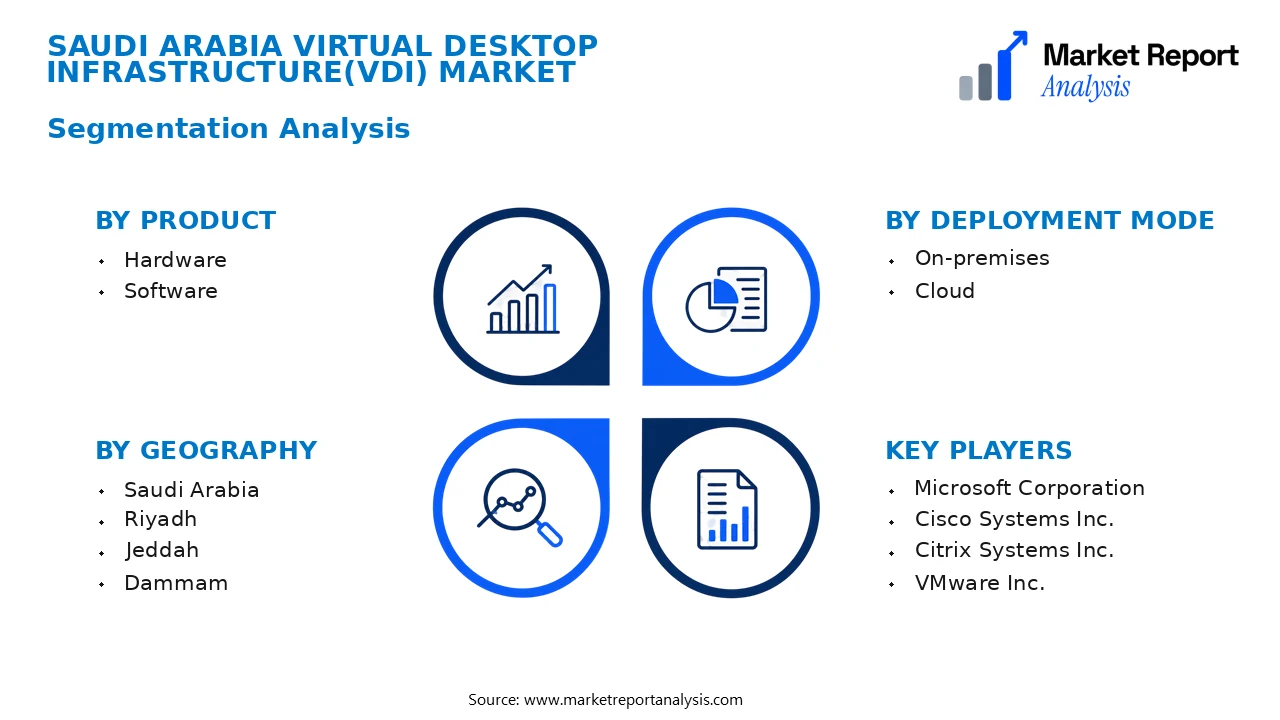
- Product
- Hardware: Hardware components such as servers, storage devices, and thin clients form the backbone of VDI systems, with demand driven by enterprise infrastructure upgrades and deployment within data centers across Saudi Arabia.
- Software: VDI software solutions facilitate desktop virtualization, management, and security; increasing adoption is driven by digital transformation initiatives, regulatory compliance needs, and reliance on remote work solutions in Saudi businesses.
- Deployment Mode
- On-premises: On-premises deployment remains prevalent among large organizations prioritizing data control, mixing with cloud offerings as digital infrastructure revitalizes Saudi enterprises, especially in finance, government, and healthcare sectors.
- Cloud: Cloud-based VDI offers scalability and cost-efficiency, gaining traction among SMEs and startups, driven by government incentives for digital innovation and increasing remote working trends during and post-pandemic periods.
- End User Industry
- Government and Public Sector: The government sector in Saudi Arabia is rapidly adopting VDI solutions to support e-governance, secure data management, and remote service delivery, which aligns with Vision 2030 digital initiatives.
- IT and Telecom: This sector utilizes VDI for secure remote access, network management, and data center operations, driven by the increasing need for mobility, remote work, and data security compliance, particularly in Riyadh and Dammam.
- BFSI (Banking, Financial Services, and Insurance): The BFSI industry employs VDI for compliance, cybersecurity, and efficient customer service delivery, fostering digital banking trends, especially in financial hubs like Jeddah and Riyadh.
- Healthcare: The healthcare industry deploys VDI for secure remote access to patient data, telemedicine, and administrative functions, accelerated by government healthcare modernization programs and increasing adoption of digital health records.
- Education: Educational institutions increasingly implement VDI to facilitate remote learning, digital classrooms, and administration, supported by government initiatives to promote digital literacy and e-learning platforms.
- Geography
- Saudi Arabia: The Saudi market is characterized by rapid digital infrastructure development, government-led initiatives, and increasing enterprise IT investments, especially in major economic zones like Riyadh, Jeddah, and Dammam, which serve as regional hubs.
- Riyadh: As the political and economic capital, Riyadh hosts numerous government offices, multinational corporations, and financial institutions leading VDI adoption for security and remote work solutions.
- Jeddah: Jeddah’s prominence in commerce and industry, coupled with a strategic location near the Red Sea, fosters significant VDI deployments among trade, logistics, and maritime businesses.
- Dammam: Dammam’s industrial zones and oil business concentration drive demand for VDI in energy, petrochemical, and industrial sectors, supported by regional infrastructure projects and government investments.
- Mecca & Medina: These cities are vital for hospitality, tourism, and religious services, with increasing VDI use supporting administrative efficiency, remote operations, and security management in these highly sensitive areas.
- Al Khobar & Jubail: As major industrial hubs, these regions exhibit growing enterprise demand for VDI to support industrial automation, remote maintenance, and corporate digital workspace solutions, aligned with Vision 2030 goals.
Competitive Intelligence
The Saudi Arabia Virtual Desktop Infrastructure (VDI) market exhibits a competitive landscape characterized by a few dominant players alongside several emerging entrants, contributing to moderate market concentration. Established technology firms such as Dell EMC and HP Inc. continue to lead through strategic product innovation aimed at enhancing security, scalability, and ease of deployment tailored to Saudi business needs. Local IT service providers are increasingly forming partnerships with global vendors to leverage advanced VDI solutions, facilitating broader regional adoption, especially in Riyadh and Jeddah where demand for digital transformation accelerates. Recent acquisitions targeting niche players demonstrate the market's emphasis on expanding technological capabilities and customer bases. Major companies are ramping up R&D investments to develop differentiated offerings with integrated cloud and AI functionalities, aiming to meet stringent Saudi regulations and enterprise demands. Expansion strategies focus on building local data centers and strengthening distribution channels to penetrate government, finance, and healthcare sectors. Competitive differentiation largely hinges on customized solutions, rapid deployment, and strong local support, with firms actively pursuing strategic alliances to capitalize on government-led digital initiatives.
Leading Company Profiles
The competitive landscape of the Saudi Arabia Virtual Desktop Infrastructure (VDI) market is characterized by a mix of established global technology giants and regional specialists. These companies leverage cutting-edge virtualization technology, strategic partnerships, and comprehensive service portfolios to capture emerging demand from government, enterprise, and small to medium-sized business segments across Saudi Arabia.
- Microsoft Corporation
- Cisco Systems Inc.
- Citrix Systems Inc.
- VMware Inc.
- HPE (Hewlett Packard Enterprise)
- Dell Technologies Inc.
- Nutanix Inc.
- Huawei Technologies Co., Ltd.
- Oracle Corporation
- IBM Corporation
Microsoft Corporation
Microsoft offers leading virtualization solutions with its Azure Virtual Desktop and Windows Virtual Desktop, emphasizing cloud integration, security, and scalable infrastructure tailored to Saudi Arabia's government and enterprise sectors.
Cisco Systems Inc.
Cisco specializes in network-centric VDI solutions, strengthening its market position with integrated security features and robust networking hardware, supporting large-scale deployments across Saudi government and educational institutions.
Citrix Systems Inc.
Citrix delivers virtual workspace solutions that optimize remote access and application delivery, focusing on high-performance experience enhancements for enterprise clients within Saudi Arabia’s expanding digital economy.
VMware Inc.
VMware’s vSphere and Horizon Suite underpin its VDI offerings, with a strategic focus on high reliability and hybrid cloud solutions to support the rapidly digitalizing Saudi enterprise landscape.
HPE (Hewlett Packard Enterprise)
HPE combines its server, storage, and networking capabilities to provide integrated VDI solutions tailored for Saudi enterprises seeking scalable and resilient virtual desktop environments.
Dell Technologies Inc.
Dell offers comprehensive VDI solutions focusing on simplified deployment, cost efficiency, and integration with existing IT ecosystems in Saudi Arabia’s large-scale institutional environments.
Nutanix Inc.
Nutanix’s hyper-converged infrastructure for VDI emphasizes ease of management and deployment, targeting large enterprise and government customers in Saudi Arabia requiring flexible virtualization options.
Huawei Technologies Co., Ltd.
Huawei’s virtualization solutions leverage its extensive telecom infrastructure expertise, making its VDI offerings highly compatible with Saudi Arabia’s smart city and digital infrastructure initiatives.
Oracle Corporation
Oracle integrates its cloud and data management strengths into its VDI offerings, aiming to serve the financial services and government sectors with secure, scalable virtual desktop solutions tailored to Saudi demands.
IBM Corporation
IBM provides enterprise-grade VDI services focusing on AI, analytics, and integration with hybrid cloud environments, aligning with Saudi Arabia’s strategic initiatives for digital transformation and smart governance.
Strategic Business Developments
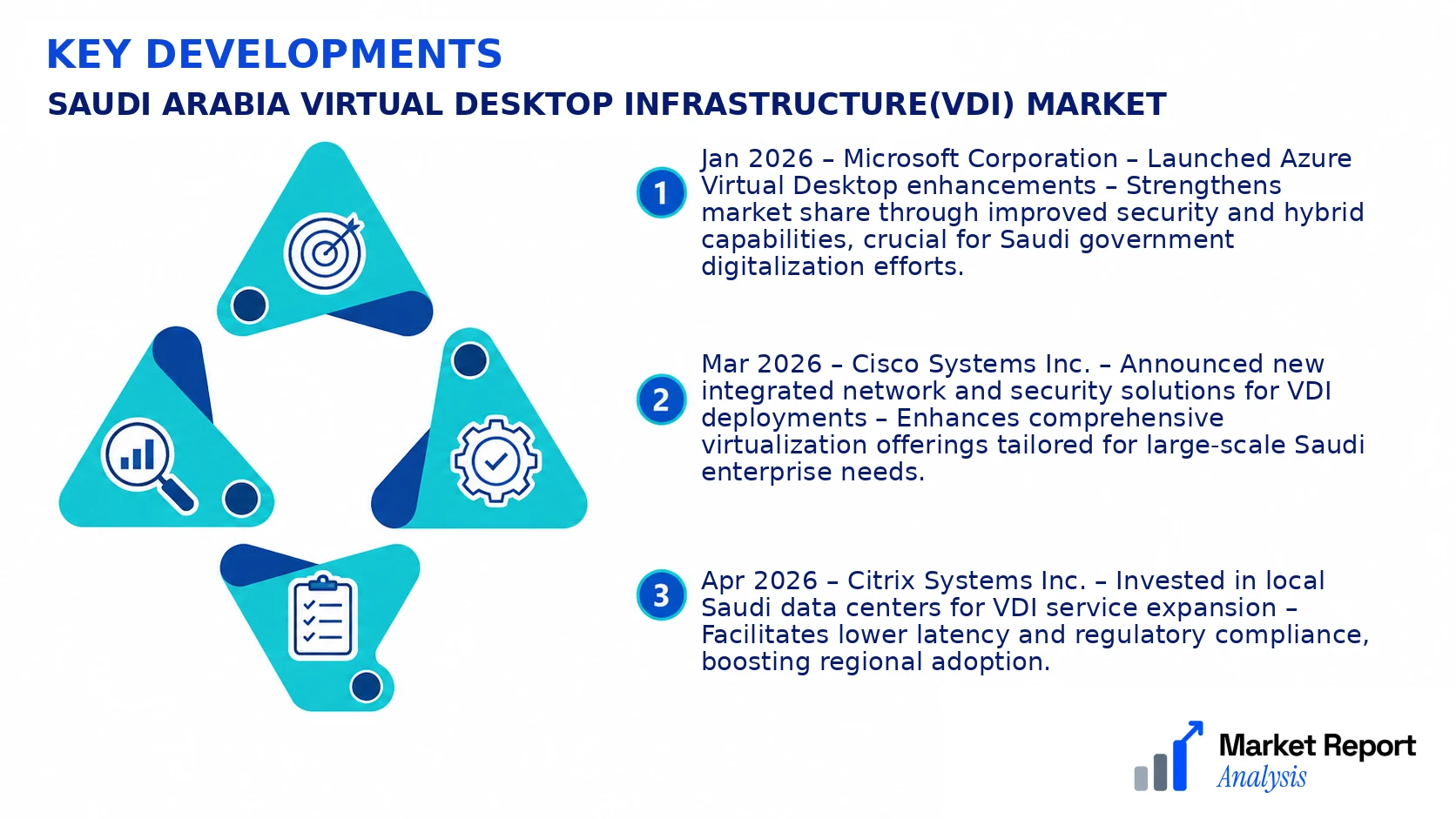
- Jan 2026 – Microsoft Corporation – Launched Azure Virtual Desktop enhancements – Strengthens market share through improved security and hybrid capabilities, crucial for Saudi government digitalization efforts.
- Mar 2026 – Cisco Systems Inc. – Announced new integrated network and security solutions for VDI deployments – Enhances comprehensive virtualization offerings tailored for large-scale Saudi enterprise needs.
- Apr 2026 – Citrix Systems Inc. – Invested in local Saudi data centers for VDI service expansion – Facilitates lower latency and regulatory compliance, boosting regional adoption.
- Jun 2026 – VMware Inc. – Collaborated with local telecoms to integrate VDI solutions with 5G networks – Supports Saudi Arabia's ongoing digital infrastructure enhancement projects.
- Aug 2026 – HPE (Hewlett Packard Enterprise) – Opened new data center in Riyadh – Aims to serve expanding VDI demand from government and enterprise sectors, emphasizing resilience and data sovereignty.
Frequently Asked Questions
What is the Saudi Arabia Virtual Desktop Infrastructure(VDI) Market?
The Saudi Arabia Virtual Desktop Infrastructure (VDI) Market encompasses the deployment and management of virtual desktops within the country, enabling organizations to provide remote and secure access to computing environments. It involves technologies that centralize desktop management, enhance security, and optimize resource utilization across enterprise and government sectors.
What is the current market size of Saudi Arabia Virtual Desktop Infrastructure(VDI) Market?
As of 2026, the Saudi Arabia VDI market was valued at approximately USD 1.2 Billion, reflecting growing adoption driven by digital transformation initiatives, increased cloud integration, and remote working trends. This value underscores the country's strong investment in IT infrastructure modernization.
What factors are driving the Saudi Arabia Virtual Desktop Infrastructure(VDI) Market?
The primary drivers include government initiatives to digitize public services, corporate digital transformation efforts, increased cybersecurity concerns, and the rising demand for remote and hybrid work solutions. Additionally, advancements in cloud computing and virtualization technology further bolster market growth.
Which Saudi city leads the Saudi Arabia Virtual Desktop Infrastructure(VDI) Market?
Riyadh remains the leading city, leveraging its status as the financial and administrative hub. Its extensive business ecosystem, government presence, and technological infrastructure make it the dominant market for VDI solutions in Saudi Arabia.
Which segment is expected to grow the fastest?
The enterprise segment is projected to experience the fastest growth, driven by large corporations adopting VDI to streamline operations, enhance security, and support their remote workforce. The healthcare and banking sectors are particularly prominent adopters.
Who are the leading companies operating in the Saudi Arabia Virtual Desktop Infrastructure(VDI) Market?
Leading players include multinational technology firms such as VMware, Citrix Systems, and Microsoft, along with regional providers that offer tailored VDI solutions. These companies compete through innovation, local partnerships, and comprehensive service offerings to capture market share.
Analyst Perspective
The Saudi Arabia Virtual Desktop Infrastructure (VDI) market is poised for sustained growth, underpinned by ongoing digital transformation initiatives within both government and private sectors. The long-term outlook remains favorable as increasing demand for remote work solutions, cloud integration, and data security elevates VDI adoption. Major commercial opportunities are centered around mid-to-large enterprises seeking cost-effective, scalable virtual desktop environments, with government-led projects emphasizing e-government and digital infrastructure upgrades. Technological evolution is expected to focus on AI-driven management, enhanced security protocols, and integration with emerging 5G and edge computing solutions, further boosting deployment efficiency. Investment priorities should target robust data center infrastructure and cloud partnerships to facilitate seamless VDI services. Competitive intensity will escalate as international and local vendors vie for market share, intensifying innovation and pricing strategies. Regionally, Riyadh and Jeddah are emerging as city-level growth hubs due to their expanding digital ecosystems and government initiatives, presenting strategic opportunities for localized service offerings and partnerships. Overall, the market’s maturity encourages strategic positioning focused on innovation, security, and regional customization.
