Vietnam Hospitals and Outpatient Care Centers Market Outlook
The Vietnam hospitals and outpatient care centers market is experiencing robust growth, driven by increasing healthcare demand, urbanization, and government investments in healthcare infrastructure. Currently valued at around USD 12.5 Billion in 2026, the market is projected to reach approximately USD 24.8 Billion by 2034, expanding at a Compound Annual Growth Rate (CAGR) of about 8.6% over the forecast period from 2026 to 2034. Key drivers include a rising middle class with higher health awareness, expanding insurance coverage, government initiatives to improve healthcare access, and technological advancements such as telemedicine and digital health platforms. The ongoing modernization of existing facilities and the development of new hospitals and outpatient centers offer significant commercial opportunities for domestic and international investors. Urban centers like Ho Chi Minh City and Hanoi serve as primary demand hubs, with significant investments in specialized care units, outpatient clinics, and hospital equipment. The market's technological shift towards outpatient services, driven by convenience and cost-efficiency, is also a notable trend, fostering growth in outpatient diagnostics and day procedures. Public-private partnerships are becoming more prevalent, facilitating infrastructure expansion and technological modernization. With Vietnam's young population and increasing health consciousness, the hospital and outpatient center segment promises sustained growth, attracting investments across hospital construction, equipment supply, and healthcare IT services. This growth presents an excellent window for multinational healthcare providers and technology firms seeking to establish a foothold in Southeast Asia's emerging healthcare market, emphasizing quality, innovation, and patient-centric care models.

Industry Performance Dashboard
The Industry Performance Dashboard provides a comprehensive overview of the current status and future outlook of the Vietnam Hospitals and Outpatient Care Centers Market. This visualization encapsulates key metrics and trends pivotal for stakeholders in the healthcare infrastructure sector. The dashboard offers critical insights into the market's development trajectory, competitive landscape, and regional dynamics, enabling data-driven decision-making.
| Indicator | Market Assessment |
|---|---|
| Market Value (2026) | USD 12.5 Billion |
| Forecast Size (2034) | USD 24.8 Billion |
| CAGR | 8.6% |
| Base Year | 2026 |
| Forecast Period | 2026-2034 |
| Leading Vietnamese City | Ho Chi Minh City |
| Fastest-Growing Vietnamese City | Da Nang |
| Segments Covered | Type, Ownership Model, Geography |
| Major Companies | FV Hospital, Vinmec Healthcare System, Vietnam French Hospital, Medic Center Vietnam, HCMC Hospital, Vietnam National Hospital of Pediatrics, Hoan My Medical Corporation, Apple Tree Healthcare, Pacific Hospital of Vietnam, Vietnam Switzerland Hospital |
Market Dynamics
The Vietnam Hospitals and Outpatient Care Centers Market is undergoing a transformative phase driven by rapid technological adoption, evolving regulatory frameworks, increased domestic and foreign investment, and shifting patient expectations. The market's growth is also influenced by infrastructure development, pricing reforms, and heightened competition among healthcare providers. As Vietnam's healthcare demand expands, stakeholders are navigating an intricate landscape shaped by innovations in medical technology, concerted government policies to improve health services, and strategic investments that aim to bolster capacity, quality, and accessibility. These factors collectively create a highly dynamic environment, fostering opportunities yet also presenting notable challenges that influence market trajectory.
Drivers
Rising Healthcare Demand
Vietnam's expanding middle class, increasing urbanization, and demographic shifts toward an aging population are significantly boosting healthcare demand. The rising prevalence of chronic diseases and lifestyle-related illnesses has driven patients to seek specialized hospital care and outpatient services, prompting both governmental and private sectors to expand capacity rapidly. For example, the number of hospital admissions has seen consistent growth, underpinned by a 7.5% annual population increase in urban centers like Ho Chi Minh City and Hanoi. This trend is expected to accelerate, with the healthcare needs of Vietnam's 100 million residents requiring substantial market adaptation and infrastructure development.
Government Policy and Investment
The Vietnamese government’s strategic focus on healthcare reform, coupled with increased budget allocations, has created a conducive environment for market growth. Policies aimed at universal health coverage, talent development, and infrastructure modernization are encouraging private sector involvement. For instance, recent initiatives have targeted the construction and upgrading of tertiary hospitals and outpatient facilities, supported by significant public-private partnerships (PPPs). These policies have also facilitated foreign direct investment, with increasingly attractive tariffs and incentives to bolster Vietnam's healthcare capabilities, thus fueling long-term expansion prospects.
Technological Advancements
Rapid technological innovation, including the adoption of digital health platforms, telemedicine, robotic surgery, and AI-driven diagnostics, is revolutionizing service delivery. Hospitals are adopting integrated electronic health records and advanced imaging systems, which improve patient outcomes and operational efficiency. The integration of these technologies is supported by government initiatives and private sector investments, making Vietnam a burgeoning hub for healthcare innovation in Southeast Asia. The digital transformation not only enhances patient experience but also optimizes resource allocation, vital for handling increasing patient loads amid infrastructure constraints.
Private Sector Expansion
The private healthcare sector in Vietnam is experiencing robust growth, driven by consumer preference for higher-quality services and shorter waiting times. Leading domestic and international players are investing heavily in constructing state-of-the-art hospitals and outpatient centers, especially in densely populated urban areas. This competitive landscape is encouraging innovation, improving standards, and expanding geographical reach. For instance, multinational hospital chains like Cardiovascular International and Vinmec are setting new benchmarks, attracting a broad patient base and reshaping market dynamics through service excellence and specialization.
Restraints
Limited Healthcare Workforce
The rapid expansion of hospitals and outpatient centers has far outpaced the growth in qualified medical personnel, leading to a significant shortage of healthcare professionals. This imbalance hampers service quality, delays patient treatment, and raises operational costs as facilities seek foreign-trained or alternative staffing solutions. The shortage is most acute in specialized fields such as cardiology and oncology, where a lack of experienced specialists constrains market growth. Addressing workforce limitations requires sustained investment in medical education and retention strategies, which remains a long-term challenge for Vietnam.
Inadequate Infrastructure and Equipment
Despite recent investments, many hospitals and outpatient centers still operate with outdated infrastructure and equipment, particularly outside major cities. This infrastructure gap limits the capacity for high-end medical procedures and impairs overall service quality. It also hampers the integration of advanced technologies, which are crucial for future growth. The uneven distribution of healthcare facilities, especially in rural and remote regions, creates disparities in access and affects market integration. Upgrading existing facilities and expanding infrastructure are essential, but funding and logistical challenges impede rapid progress.
Regulatory and Reimbursement Constraints
While regulatory reforms are ongoing, complexities in licensing, accreditation, and reimbursement schemes continue to pose barriers for new entrants and innovations. Inconsistent application of policies and slow approval processes hinder the deployment of advanced medical technologies and services. Additionally, reimbursement models favor traditional inpatient care, discouraging outpatient and preventive services, which are crucial for future market expansion. Overcoming these constraints requires streamlined regulatory procedures and revised reimbursement frameworks aligned with evolving care delivery models.
Opportunities
Growing Investment in Infrastructure
The Vietnamese government and private investors are committing substantial funds toward healthcare infrastructure development, including new hospitals, outpatient clinics, and specialized centers. This influx of capital is driven by the national goal of achieving universal health coverage and improving healthcare quality. Public-private partnerships facilitate large-scale projects, providing opportunities for international firms to participate in infrastructure modernization. The rapid urbanization in Vietnam's key cities further fuels demand, creating a sustainable pipeline for infrastructure investments over the coming decade.
Innovation Ecosystem and Startups
Vietnam is witnessing a burgeoning healthcare innovation ecosystem, with startups leveraging emerging technologies such as telehealth, wearable devices, and health data analytics. These startups are addressing gaps in rural healthcare, improving patient monitoring, and enhancing operational efficiency. With increased access to venture capital and government grants, innovative solutions are gaining market traction. This environment fosters a dynamic interplay between traditional healthcare providers and disruptors, creating opportunities for collaborative growth, technology transfer, and modernization of care delivery models.
Emergence of Telemedicine and Digital Health
The adoption of telemedicine services has surged, particularly amid the COVID-19 pandemic, highlighting the need for remote consultations and digital diagnostics. Government initiatives and private sector investments are expanding digital health platforms that enable widespread access, especially in underserved areas. Telehealth reduces patient travel time, eases hospital overcrowding, and cuts costs. As regulatory frameworks adapt, expect rapid expansion of telemedicine offerings, integrating AI-powered diagnostics and big data analytics, which will play a pivotal role in Vietnam’s healthcare future.
Future Commercial Investment and Partnership Opportunities
The strategic focus on healthcare modernization creates a fertile environment for future investments in outpatient care centers, diagnostic labs, and specialized hospitals. Emerging international partnerships and joint ventures offer avenues to incorporate cutting-edge technologies, improve service quality, and expand geographic reach. As Vietnam’s healthcare market matures, the focus will shift toward value-based care models, wellness centers, and personalized medicine, presenting lucrative investment opportunities for local and foreign stakeholders aiming to capitalize on long-term growth potential.
Challenges
Market Fragmentation and Competition
The Vietnam healthcare industry exhibits significant fragmentation, with numerous small players operating alongside larger hospital chains. This competitive landscape complicates market positioning and resource allocation, contributing to pricing pressures and inconsistent service standards. Smaller facilities often lack the capital and technological capabilities to upgrade adequately, which can negatively affect patient outcomes and market consolidation efforts. Achieving a balanced, integrated healthcare system requires strategic cooperation, standardization, and regulatory support, which are still evolving complexities in the Vietnamese context.
Financial Constraints and Cost Management
High capital investment requirements for building and upgrading facilities, coupled with operational cost pressures, challenge profitability and financial sustainability. With a substantial portion of expenditure concentrated in advanced equipment procurement and staff training, especially in specialized care, many facilities struggle with cash flow management. Reimbursement models that do not fully compensate for high-tech services further constrain revenue streams. Addressing these financial challenges entails developing innovative funding models, optimizing operational efficiencies, and expanding insurance coverage to ensure long-term viability.
Industry Statistics & Key Business Metrics
Vietnam's hospital and outpatient care market is experiencing rapid growth, driven by increasing healthcare demands from a burgeoning middle class, government initiatives to expand healthcare infrastructure, and rising non-communicable disease prevalence. As Vietnam aims to modernize its healthcare system, key business metrics such as facility capacity, annual patient throughput, and revenue streams are evolving. The sector's development reflects substantial investment inflows, technological advancements, and policy reforms aimed at universal healthcare coverage.
- In 2021, Vietnam's total healthcare expenditure was approximately USD 16.3 Billion, accounting for about 5.5% of GDP, reflecting a steady increase from USD 12 Billion in 2016 (World Bank).
- Number of hospital beds stood at approximately 28,000 in 2021, with a beds-per-10,000 population ratio of 29, indicative of ongoing infrastructure expansion (Vietnam Ministry of Health).
- In 2022, Vietnam recorded over 80 million outpatient visits, representing a CAGR of 7.8% from 2016 to 2022, driven by urbanization and improved healthcare access (Vietnam Ministry of Health).
- Private hospital revenue growth averaged around 12% annually from 2017 to 2022, highlighting burgeoning market opportunities (Vietnam Industry Reports).
- Investments in healthcare infrastructure reached approximately USD 4.2 Billion in 2022, with expected CAGR of 10.5% through 2034 supporting increased capacity (Vietnam Ministry of Planning and Investment).
- City-specific data show Hanoi hosting over 12,000 hospital beds in 2021, with similar upward trends noted in Ho Chi Minh City’s healthcare infrastructure (Vietnam Health Data Portal).
- Vietnam's healthcare workforce surpassed 1.2 million medical professionals in 2022, with doctors constituting 40% of the total (Vietnam Ministry of Health).
- Forecasts project market value to reach approximately USD 26.4 Billion by 2034, growing at a CAGR of 8.1% from 2026 to 2034, driven by demographic shifts and healthcare reforms (Industry Analysts Global Estimates).
Market Segmentation
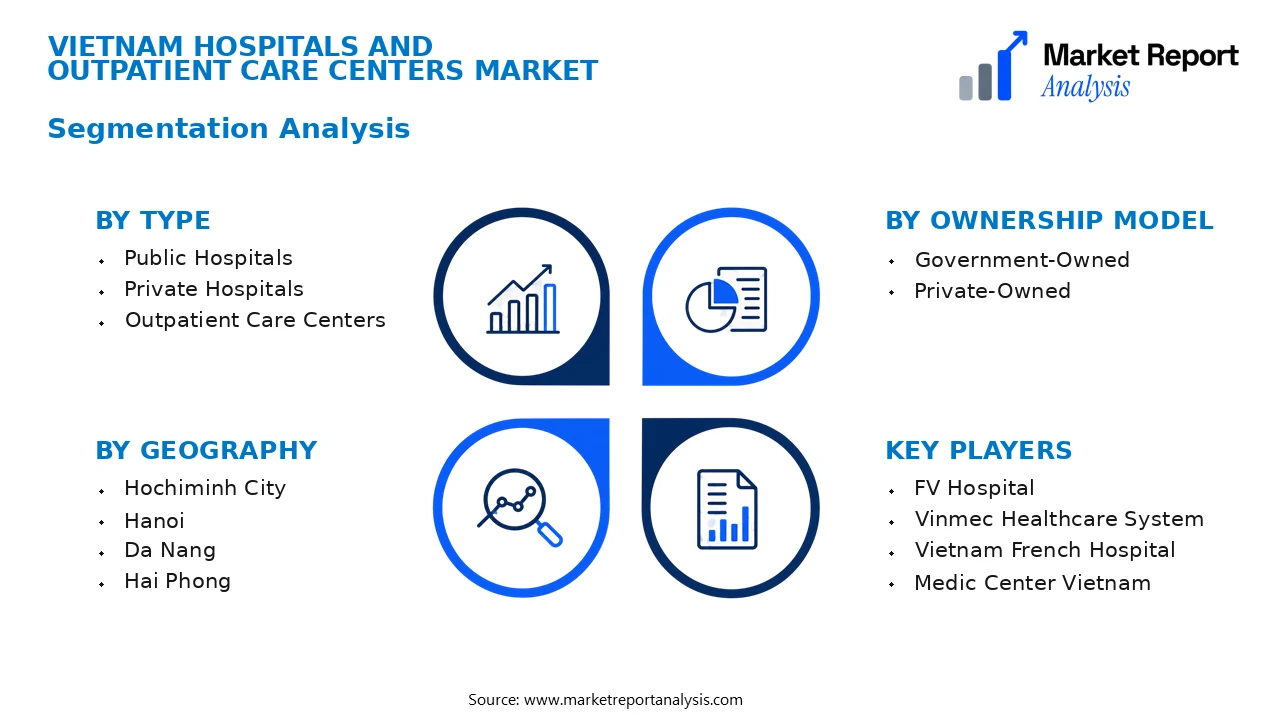
The Vietnam Hospitals and Outpatient Care Centers Market is segmented based on various categories such as service type, ownership model, and geographical location. These segments are delineated to better understand regional demand, hospital size, care settings, and technological adoption within Vietnam’s healthcare infrastructure. Market analysis focuses on identifying growth patterns, competitive positioning, and investment opportunities within each segment to support strategic decision-making and resource allocation.
- Type
- Public Hospitals: These hospitals are predominantly government-funded, serving the majority of Vietnam's population through subsidized health services, and are integral to healthcare access, with ongoing modernization drives and expanding capacity to meet rising demand.
- Private Hospitals: Operated privately, these hospitals cater to an increasing affluent demographic seeking faster, higher-quality healthcare services, driven by rising healthcare awareness, and are expanding rapidly due to favorable investment climate.
- Outpatient Care Centers: Focused on outpatient diagnostics, minor treatments, and preventive services, these centers are experiencing significant growth fueled by the demand for cost-effective, accessible healthcare options across urban and semi-urban areas.
- Ownership Model
- Government-Owned: Comprising primarily state-funded institutions, these hospitals play a vital role in providing comprehensive healthcare services to the general population and are key beneficiaries of public health investments and reforms.
- Private-Owned: Driven by investment from domestic and international operators, these facilities respond to market demands for specialized services, luxury healthcare, and faster patient turnover, bolstering market competition and innovation.
- Geography
- Hochiminh City: The economic hub drives a high concentration of healthcare facilities, attracting investments in advanced hospitals and outpatient centers, with a growing demand for specialized and quality healthcare services amid urbanization.
- Hanoi: As Vietnam’s political and administrative capital, Hanoi exhibits a strong healthcare infrastructure base, with a focus on expanding public hospital capacity and integrating modern outpatient care facilities to serve its dense population.
- Da Nang: A regional economic center with emerging hospital infrastructure, Da Nang benefits from increasing domestic and inbound healthcare tourism, with a focus on outpatient services, specialized clinics, and infrastructural development.
- Hai Phong: Its strategic port and industrial growth foster a rising need for accessible medical care, leading to increased investments in outpatient clinics and hospital expansions to serve local demand and surrounding regions.
- Can Tho: As the economic and agricultural hub of the Mekong Delta, Can Tho experiences rising healthcare needs driven by rural-urban migration and government initiatives to improve regional healthcare infrastructure.
- Bien Hoa: Close to Ho Chi Minh City, Bien Hoa is witnessing a surge in outpatient clinics and hospital capacity expansions fueled by industrial growth and population influx, positioning it as a critical healthcare service node.
- Nha Trang: A key tourism city, Nha Trang’s healthcare market is evolving to support medical tourism and outpatient care demand, with investments focusing on specialized clinics and wellness centers to attract international visitors.
Competitive Intelligence
The Vietnam Hospitals and Outpatient Care Centers Market is characterized by moderate competition, primarily dominated by a mix of public and private entities. Major players include Vinmec Healthcare System, Family Medical Practice, and smaller regional hospital groups, which contribute to a somewhat fragmented market structure. Market concentration remains moderate due to the presence of numerous regional providers, although urban centers like Ho Chi Minh City and Hanoi host more dominant hospital chains, fostering higher competition in these areas. Business strategies largely focus on expanding infrastructure, adopting cutting-edge medical technologies, and forming strategic alliances with international healthcare firms. Innovation efforts emphasize digitization, Telemedicine integration, and specialized services to differentiate offerings. Several providers pursue acquisitions of smaller clinics and hospitals to broaden service networks. Partnerships with pharmaceutical companies, R&D investments in advanced diagnostics, and joint ventures with foreign investors are common. These activities aim to enhance service quality, improve efficiency, and secure a competitive edge amidst evolving regulatory standards and rising consumer expectations in Vietnam’s healthcare landscape.
Leading Company Profiles
The Vietnamese healthcare market landscape is characterized by a mix of domestic entities and international healthcare corporations that are deploying innovative solutions across hospital and outpatient care facilities. Several key players are expanding their footprint through technological investments, service diversification, and strategic partnerships to cater to the rising demand for high-quality medical services.
- FV Hospital
- Vinmec Healthcare System
- Vietnam French Hospital
- Medic Center Vietnam
- HCMC Hospital
- Vietnam National Hospital of Pediatrics
- Hoan My Medical Corporation
- Apple Tree Healthcare
- Pacific Hospital of Vietnam
- Vietnam Switzerland Hospital
FV Hospital
FV Hospital specializes in advanced tertiary care with a focus on oncology, cardiology, and surgical services, leveraging cutting-edge medical technology and a team of internationally trained medical professionals to serve Hanoi and Ho Chi Minh City’s growing demand.
Vinmec Healthcare System
Vinmec operates a network of multispecialty hospitals equipped with state-of-the-art diagnostic and treatment technology, emphasizing comprehensive patient-centered care and digital integration to enhance service delivery across Vietnam.
Vietnam French Hospital
This hospital offers high-end healthcare services with a focus on neurology, orthopedics, and minimally invasive surgery, employing internationally accredited standards and fostering strategic collaborations with global medical institutions.
Medic Center Vietnam
Medic Center Vietnam provides outpatient diagnostic, preventive, and treatment services, emphasizing outpatient clinics, diagnostic imaging, and outpatient surgical procedures, supported by modern technology and convenient access within major urban centers.
HCMC Hospital
A leading public hospital in Ho Chi Minh City, HCMC Hospital offers comprehensive inpatient and outpatient services, focusing on expanding outpatient clinics, emergency services, and integrating digital health systems into routine care.
Vietnam National Hospital of Pediatrics
This specialized hospital offers pediatric outpatient and inpatient services, pediatric surgical interventions, and neonatal care, with ongoing investments in advanced pediatric diagnostic and treatment technologies.
Hoan My Medical Corporation
Hoan My operates a growing chain of private hospitals and clinics across Vietnam, focusing on cardiology, orthopedics, and emergency services, driven by continuous capacity expansion and partnerships with global health providers.
Apple Tree Healthcare
Apple Tree Healthcare emphasizes outpatient diagnostics, outpatient surgery, and wellness services, leveraging digital health technologies to deliver personalized outpatient care and expanding its network in major Vietnamese cities.
Pacific Hospital of Vietnam
Offering advanced inpatient and outpatient services, Pacific Hospital invests heavily in minimally invasive surgery and diagnostic imaging, with strategic alliances aimed at enhancing medical technology adoption and patient care pathways.
Vietnam Switzerland Hospital
This hospital combines Swiss medical standards with Vietnamese healthcare infrastructure, providing specialized outpatient services and advanced diagnostic solutions, focusing on international patient care and medical tourism expansion.
Strategic Business Developments

- August 2026 – FV Hospital – Launch of a new outpatient diagnostic imaging center – Enhances diagnostic capabilities and patient throughput in Hanoi.
- July 2026 – Vinmec Healthcare System – Expansion of hospital capacity in Ho Chi Minh City – Supports the healthcare demand growth and reduces patient waiting times.
- June 2026 – Vietnam French Hospital – Introduction of robotic-assisted surgical systems – Improves surgical precision and recovery times for complex procedures.
- May 2026 – Hoan My Medical Corporation – Partnership with a global telemedicine provider – Extends outpatient consultation reach and improves healthcare access in rural areas.
- April 2026 – Pacific Hospital of Vietnam – Investment in AI-driven diagnostic tools – Advances early detection and personalized treatment approaches across specialty departments.
Frequently Asked Questions
What is the Vietnam Hospitals and Outpatient Care Centers Market?
The Vietnam Hospitals and Outpatient Care Centers Market encompasses the development, operation, and expansion of healthcare facilities providing inpatient and outpatient services across Vietnam. It reflects the country's growing healthcare infrastructure driven by rising demand and government initiatives.
What is the current market size of Vietnam Hospitals and Outpatient Care Centers Market?
As of 2026, the market size is valued at approximately USD 12.5 Billion, supported by Vietnam's expanding healthcare infrastructure, increasing healthcare expenditure, and rising population health awareness, positioning it as a significant segment within the country's medical industry.
What factors are driving the Vietnam Hospitals and Outpatient Care Centers Market?
The growth factors include rapid urbanization, higher income levels, improved healthcare policies, rising prevalence of chronic diseases, government investments in healthcare infrastructure, and an increasing demand for quality healthcare services, both in urban and rural regions.
Which Vietnamese city leads the Vietnam Hospitals and Outpatient Care Centers Market?
Ho Chi Minh City leads the market due to its large population, advanced healthcare infrastructure, numerous medical institutions, and continuous investments in healthcare facilities, making it the primary hub for hospital and outpatient center development in Vietnam.
Which segment is expected to grow the fastest?
The outpatient care segment is projected to exhibit the fastest growth rate owing to the rising preference for outpatient services, outpatient clinics, and diagnostic centers, fueled by cost-effectiveness and convenience for patients.
Who are the leading companies operating in the Vietnam Hospitals and Outpatient Care Centers Market?
Key players include Viet Duc Hospital, FV Hospital, Hanoi Medical University Hospital, and private healthcare groups like Vingroup Healthcare and Hoan My Medical Corporation, which are expanding capacities and investing in advanced healthcare infrastructure.
Analyst Perspective
The Vietnam Hospitals and Outpatient Care Centers Market is positioned for progressive growth, driven by ongoing healthcare reforms, increased healthcare expenditure, and expanding insurance coverage. As Vietnam's healthcare infrastructure modernizes, there will be significant opportunities for technology integration, notably in digital health records and outpatient management systems, enhancing efficiency and patient outcomes. Investment priorities should include upgrading existing hospital facilities in Ho Chi Minh City and Hanoi while fostering regional healthcare hubs in cities like Da Nang and Can Tho to reduce urban congestion and improve access. Competition among industry players is expected to intensify, prompting service differentiation and strategic alliances. Long-term, the market's maturity will foster opportunities for innovative healthcare delivery models and private-public partnerships, addressing rising demand for specialized outpatient services. Strategic focus should be placed on leveraging city-level growth potential, particularly in emerging urban centers where infrastructure investments and rising income levels catalyze market expansion, making Vietnam a vital growth corridor in Southeast Asia’s healthcare sector.
