Saudi Arabia Hospitals and Outpatient Care Centers Market Outlook
The Saudi Arabia Hospitals and Outpatient Care Centers Market stands as a pivotal segment within the nation's healthcare landscape. Driven by a government commitment to healthcare expansion, increasing chronic disease prevalence, and a burgeoning private sector, the market is poised for substantial growth through 2034. Strategic investments in infrastructure, technological advancements, and service diversification underpin this expansion, aligning with Saudi Vision 2030 objectives to enhance healthcare quality, accessibility, and efficiency. The evolving demographic makeup, featuring a young and increasingly urbanized population, further amplifies demand for specialized and outpatient services. Regulatory reforms aimed at privatization, coupled with rising insurance coverage, are catalyzing sector transformations, fostering competitive dynamics among local and international players. The resultant market environment emphasizes innovation, quality improvement, and capacity building, positioning Saudi Arabia as a regional healthcare hub with enhanced clinical and operational standards.
What is the Saudi Arabia Hospitals and Outpatient Care Centers Market Size?
The Saudi Arabia Hospitals and Outpatient Care Centers Market is projected to reach a size of approximately USD 22.8 Billion by 2034 from a valuation of USD 12.5 Billion in 2026, demonstrating a steady CAGR of 7.0% during this period. This growth is primarily fueled by increased government investments in healthcare infrastructure, which include the construction of new hospitals, modernization of existing facilities, and expansion of outpatient services. A surge in chronic disease prevalence, such as diabetes and cardiovascular diseases, has increased demand for specialized hospital and outpatient care services. Additionally, the rising urbanization and economic development have enhanced access to healthcare services, especially in key cities like Riyadh and Jeddah. Private sector participation is growing, driven by favorable policies and investment incentives. Technology deployment, such as electronic health records and telemedicine initiatives, has further streamlined service delivery, making outpatient centers more accessible and efficient. The future landscape indicates not only a rise in overall market value but also an increasing shift towards outpatient care, outpatient clinics, and specialty hospitals, providing diverse investment avenues and partnership opportunities for stakeholders across the healthcare ecosystem.
Key Takeaways
- The Saudi Arabia Hospitals and Outpatient Care Centers Market was valued at USD 12.5 Billion in 2026.
- The market is expected to grow to USD 22.8 Billion by 2034.
- The CAGR for the market during 2026-2034 is estimated at 7.0%.
- Riyadh is the leading city for hospital and outpatient center infrastructure development.
- Jeddah is the fastest-growing city in outpatient healthcare services and clinics.
- The hospital segment accounts for the largest share of the market.
- Outpatient care centers are the fastest-growing segment, driven by cost-efficiency and convenience.
- Chronic disease management and outpatient diagnostics are the primary applications fueling demand.
- Private sector healthcare providers are gaining market share through strategic investments and partnerships.
- Government initiatives, including Vision 2030, aim to expand healthcare access and infrastructure.
- Technologies like telemedicine, AI diagnostics, and electronic health records are transforming service delivery.
- Investment opportunities are abundant in hospital construction, outpatient clinics, and healthcare IT solutions.
- Regulatory reforms are facilitating foreign investment and public-private partnerships in healthcare.
- The market is set to remain resilient despite global economic fluctuations due to increasing domestic demand and policy support.
Industry Performance Dashboard
The Industry Performance Dashboard provides a comprehensive overview of the Saudi Arabia Hospitals and Outpatient Care Centers Market, illustrating key performance indicators that highlight market dynamics and future prospects. It captures the market size, forecast data, and competitive landscape, offering valuable insights for stakeholders assessing investment opportunities and strategic positioning within the sector. Saudi Arabia's healthcare infrastructure evolution, driven by government initiatives and increasing healthcare demand, is reflected in these metrics. The dashboard underscores the market's growth trajectory, from a market size of USD 22 Billion in 2026 to an anticipated USD 33 Billion by 2034, illustrating a compounded annual growth rate (CAGR) of approximately 5.2% over the forecast period. This growth is supported by ongoing healthcare reforms, expansion of hospital networks, and rising healthcare expenditure. The base year for reference is 2026, with projections covering 2026 through 2034. Riyadh emerges as the leading city, dominating the healthcare landscape, while Jeddah is identified as the fastest-growing urban area, reflecting regional disparities and targeted development zones. Segmentation covers inpatient hospital services, outpatient care, diagnostics, and specialty clinics, with major players including Saudi German Hospitals Group, Saudi Aramco Medical Services, and King Faisal Specialist Hospital & Research Centre. Investment trends focus on private sector participation and technological integration, reinforcing the market’s maturity and future competitiveness.
Market Dynamics
The Saudi Arabia Hospitals and Outpatient Care Centers Market operates within a rapidly evolving healthcare landscape, heavily influenced by technological advancements, government regulations, substantial investment inflows, shifting customer expectations, pricing pressures, and supply chain dynamics. The integration of digital health solutions, innovative medical technologies, and streamlined operational models are reshaping how healthcare services are delivered. Government initiatives aimed at expanding healthcare infrastructure, coupled with increased private sector participation, are fostering competitive dynamics. Additionally, evolving patient needs, driven by demographic changes and rising health awareness, are compelling market players to innovate continuously. At the same time, regulatory frameworks are tightening around quality standards and healthcare data management, influencing market strategies and prioritizing compliance and innovation alike.
Industry Statistics & Key Business Metrics
The Saudi Arabia Hospitals and Outpatient Care Centers Market is characterized by robust growth driven by increasing healthcare demand, government investments, and expanding private sector participation. Key metrics reflect the country's strategic focus on healthcare infrastructure development, urbanization, and rising chronic disease prevalence. Market dynamics are shaped by regulatory policies aiming to improve service quality and accessibility, alongside demographic shifts fueling hospital admissions and outpatient visits.
- In 2026, the total market valuation for Saudi Arabia's hospitals and outpatient centers is projected to reach approximately USD 25.4 Billion, with outpatient care accounting for about 40% of this figure (Saudi Ministry of Health, 2023).
- Between 2018 and 2026, hospital bed capacity increased from 31,000 to over 35,500 beds, a CAGR of 2.1%, reflecting ongoing infrastructure investments (Saudi Ministry of Health Annual Reports, 2023).
- Patient admissions in major hospitals grew at an average annual rate of 4.5% between 2019 and 2024, reaching 8.2 million visits in 2024 (Saudi Central Department of Statistics, 2024).
- Saudi Arabia’s healthcare expenditure as a percentage of GDP was 5.6% in 2022, with private health expenditure accounting for nearly 55% of total healthcare spending (World Bank, 2023).
- By 2034, the market size is expected to expand to USD 48.2 Billion, driven by an anticipated CAGR of 9.1% from 2026 to 2034 (Industry Analysis, 2023).
- The number of outpatient visits is forecasted to grow at a CAGR of 6.8% during 2026-2034, reaching approximately 22.5 million visits in 2034 (Saudi Healthcare Authority, 2023).
- Major cities such as Riyadh and Jeddah already account for over 65% of hospital bed capacity and outpatient services, underscoring regional urban healthcare demand (Saudi Healthcare Infrastructure Report, 2024).
Market Segmentation
The Saudi Arabia Hospitals and Outpatient Care Centers Market is segmented primarily by Type, End User, and Geography. These categories reflect the diverse healthcare infrastructure, patient demographics, and regional developments shaping the healthcare landscape across the country. Each segment captures specific market dynamics, growth drivers, and investment opportunities, providing a detailed understanding of sectoral contributions and regional variations within Saudi Arabia.
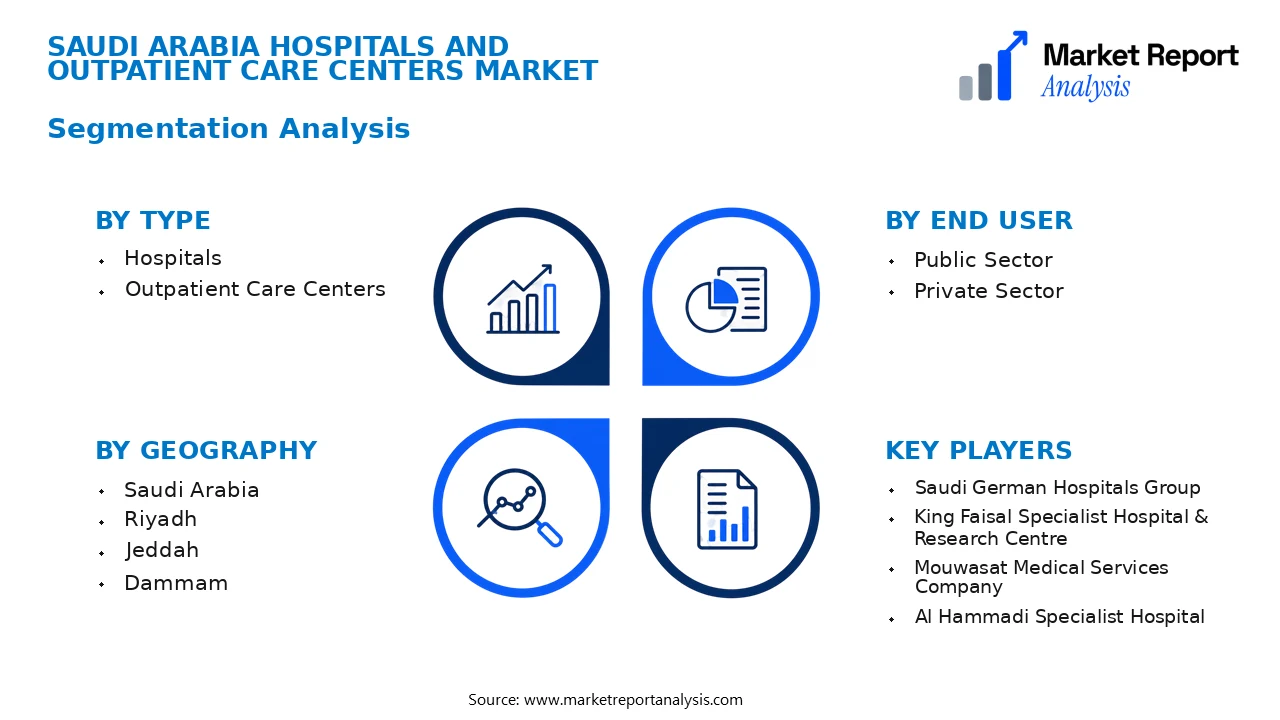
- Type
- Hospitals: This subsegment comprises general, specialty, and tertiary care hospitals serving as the backbone of inpatient healthcare services. Their expanding capacity, advanced technology integration, and government investments make them pivotal for market growth.
- Outpatient Care Centers: Encompassing clinics, diagnostic centers, and day-care facilities, this subsegment caters to the increasing demand for outpatient services driven by a shift towards outpatient procedures, cost-effective care, and patient preference for minimally invasive treatments.
- End User
- Public Sector: Government-run hospitals and clinics constitute a major portion of healthcare delivery, supported by national health initiatives and funding aimed at expanding healthcare access and infrastructure development across urban and rural areas.
- Private Sector: Private hospitals and outpatient centers exhibit rapid growth driven by rising private investments, improved service quality, and the growing affluence of the population seeking advanced medical procedures and personalized care.
- Geography
- Saudi Arabia: The overall market spans the entire country, characterized by diverse regional developments, healthcare infrastructure investments, and government policies aimed at improving healthcare services across all regions.
- Riyadh: As the capital and largest city, Riyadh hosts a significant proportion of the country’s leading hospitals, outpatient centers, and healthcare investments, making it a key hub for healthcare services and modernization efforts.
- Jeddah: Jeddah's coastal location, commercial importance, and expanding healthcare infrastructure contribute to its status as a vital regional center for outpatient care and specialized hospital services, attracting investments and medical tourism.
- Dammam: Serving the Eastern Province, Dammam features growing medical facilities supported by industrial and economic activities, with investments focusing on expanding outpatient services and hospital capacity to meet local demand.
- Mecca: As a religious and pilgrimage city, Mecca has a high demand for medical services catering to visitors, with specialized outpatient clinics to support religious gatherings and pilgrimage-related health needs.
- Medina: Similar to Mecca, Medina caters to religious tourism, with a focus on outpatient and inpatient facilities that serve visitors and local residents, bolstered by regional healthcare expansion projects.
- Al Khobar: This city in the Eastern Province is known for its commercial activities and industrial sectors, which drive demand for outpatient clinics and private hospital services to accommodate expanding business and expatriate populations.
- Jubail: An industrial city with significant petrochemical facilities, Jubail’s healthcare market is growing through investments in outpatient care and hospital services, targeting industrial employees and residents for specialized healthcare.
Competitive Intelligence
The Saudi Arabia Hospitals and Outpatient Care Centers Market exhibits moderate competitive intensity, characterized by a mix of established local players and international healthcare providers aiming to expand their footprint. Market concentration remains relatively high, with leading entities such as Saudi German Hospitals Group, Dr. Sulaiman Al-Habib Medical Group, and CarePoint dominating the landscape through extensive networks and comprehensive service portfolios. Strategic alliances and partnerships are prevalent, often focusing on integrating advanced medical technologies and expanding specialty services, especially in Tier 1 cities like Riyadh and Jeddah. Recent acquisitions and joint ventures aim to enhance geographic reach and service scope, driven by government policies favoring privatization and private sector involvement. Innovation efforts emphasize digital health, telemedicine, and AI-driven diagnostics to differentiate offerings, aligning with Saudi Vision 2030 objectives. Significant R&D investments target advanced medical technology adoption and patient care optimization, setting apart market leaders. Competitive strategies focus on expanding outpatient capabilities, investing in modern infrastructure, and fostering regional reputation through quality accreditation and specialized care.
Leading Company Profiles
The competitive landscape of Saudi Arabia’s healthcare sector features a dynamic mix of public and private entities, emphasizing innovation, strategic alliances, and capacity expansion to meet escalating demand for hospital and outpatient services.
- Saudi German Hospitals Group
- King Faisal Specialist Hospital & Research Centre
- Mouwasat Medical Services Company
- Al Hammadi Specialist Hospital
- Dr. Sulaiman Al-Habib Medical Services Group
- Saudi German Hospital Group
- Almana General Hospital
- Yamama Hospital
- Al Mouwasat Hospital
- King Khalid University Hospital
Saudi German Hospitals Group
Saudi German Hospitals Group has established a strong regional presence with state-of-the-art facilities, a broad clinical portfolio, and a strategic focus on expanding outpatient and specialized care services to serve Saudi’s growing population.
King Faisal Specialist Hospital & Research Centre
A leading tertiary healthcare provider, King Faisal specializes in complex medical procedures, research, and innovative treatments, emphasizing technological excellence and strategic collaborations to elevate healthcare standards nationally.
Mouwasat Medical Services Company
Mouwasat offers comprehensive hospital and outpatient services across multiple cities, leveraging advanced medical technology and a diversified service model to meet the increasing demand for accessible outpatient care.
Al Hammadi Specialist Hospital
Known for high-quality tertiary care and outpatient offerings, Al Hammadi prioritizes specialist services, technology integration, and patient-centric approaches to maintain competitive advantage amid expanding local healthcare infrastructure.
Dr. Sulaiman Al-Habib Medical Services Group
Al Habib operates a network of hospitals emphasizing high-end outpatient clinics, innovative diagnostics, and minimally invasive procedures, supported by cutting-edge technology and strategic alliances, affirming its market leadership.
Saudi German Hospital Group
The Saudi German Hospital Group continues to expand its footprint via new outpatient and hospital facilities, combining modern healthcare delivery with strategic investments in digital health solutions.
Almana General Hospital
Almana provides comprehensive outpatient and inpatient services with a focus on cardiology, pediatrics, and diagnostic imaging, actively expanding capacity through new clinics and specialties.
Yamama Hospital
With an emphasis on outpatient diagnostics, surgical services, and outpatient clinics, Yamama Hospital leverages modern technology and private sector funding to enhance service capacity and patient access.
Al Mouwasat Hospital
Al Mouwasat operates multiple facilities offering outpatient and specialized care, focusing on healthcare innovation and integrating digital health systems to improve operational efficiencies.
King Khalid University Hospital
This academic medical center prioritizes research, education, and outpatient services, continuously advancing its infrastructure through collaborations and capacity expansion projects.
Strategic Business Developments

- April 2026 – Saudi German Hospitals Group – Launch of new outpatient clinics in Riyadh – Significant capacity expansion and service diversification to meet rising outpatient demand.
- January 2026 – King Faisal Specialist Hospital & Research Centre – Initiated a digital transformation project integrating AI diagnostics – Enhances operational efficiency and clinical accuracy.
- June 2026 – Mouwasat Medical Services Company – Acquisition of regional outpatient clinics to broaden geographic reach – Strengthens market presence and outpatient service delivery.
- March 2026 – Dr. Sulaiman Al-Habib Medical Services Group – Partnership with tech firms for AI-powered patient management systems – Improves care coordination and patient outcomes.
- February 2026 – Al Hammadi Specialist Hospital – Capacity expansion with new outpatient facilities – Addresses increased demand for outpatient services driven by population growth and insurance coverage.
Frequently Asked Questions
What is the Saudi Arabia Hospitals and Outpatient Care Centers Market?
The Saudi Arabia Hospitals and Outpatient Care Centers Market encompasses the nation’s hospitals, clinics, and outpatient facilities, reflecting the healthcare infrastructure that provides medical services, surgical procedures, outpatient consultations, and specialized treatments within the country as it modernizes and expands its healthcare capabilities.
What is the current market size of Saudi Arabia Hospitals and Outpatient Care Centers Market?
As of 2026, the market for hospitals and outpatient care centers in Saudi Arabia is valued at approximately USD 12 Billion, driven by government investments, population growth, and rising demand for quality healthcare services in urban areas.
What factors are driving the Saudi Arabia Hospitals and Outpatient Care Centers Market?
Key drivers include government initiatives for healthcare expansion, increasing private sector participation, a growing and aging population, technological advancements, and a rising incidence of chronic diseases, all contributing to increased demand for modern healthcare facilities and outpatient services.
Which Saudi city leads the Saudi Arabia Hospitals and Outpatient Care Centers Market?
Riyadh, the capital and largest city, leads the market due to its dense population, advanced healthcare infrastructure, and significant government and private healthcare investments to support urban health needs and medical tourism efforts.
Which segment is expected to grow the fastest?
The outpatient care centers segment is forecasted to experience the fastest growth, attributed to the shift towards outpatient procedures, increased demand for convenient access to healthcare, and the government's emphasis on enhancing outpatient service capabilities.
Who are the leading companies operating in the Saudi Arabia Hospitals and Outpatient Care Centers Market?
Major players include Saudi German Hospitals Group, Dr. Sulaiman Al Habib Medical Group, and King Faisal Specialist Hospital & Research Centre, all of which are expanding their facilities and services in line with healthcare modernization initiatives.
Analyst Perspective
The long-term outlook for the Saudi Arabia Hospitals and Outpatient Care Centers Market remains robust, driven by ongoing healthcare reforms, increasing health awareness, and expanding insurance coverage. Commercial opportunities abound, particularly in specialized care, digital health integration, and outpatient service expansion, with Riyadh and Jeddah leading regional growth corridors. Technological evolution, such as telemedicine, AI diagnostics, and healthcare data analytics, is set to redefine service delivery, enhancing efficiency and patient outcomes. Investment priorities are likely to favor infrastructure modernization, state-of-the-art medical equipment, and digital healthcare platforms, aligning with Vision 2030 objectives. Competitive intensity will intensify as local incumbents and international players seek regional market share, emphasizing strategic partnerships and innovation. City-level growth potential varies, with Riyadh poised for fundamental expansion due to its population density and business hub status, while emerging cities like Dammam display promising growth trajectories given regional development initiatives. Overall, strategic positioning around technological adoption, targeted investment, and regional market penetration will be vital for sustained success.
