Europe Cerebral Oximetry Devices Market Outlook
The Europe cerebral oximetry devices market is experiencing significant growth, driven by increasing awareness of neurological health, technological advancements, and the rising adoption of minimally invasive monitoring in surgical and critical care settings. Currently valued at USD 1.2 Billion, the market is projected to reach USD 3.2 Billion by 2034, exhibiting a Compound Annual Growth Rate (CAGR) of approximately 11.4% over the forecast period from 2026 to 2034. Innovations in near-infrared spectroscopy (NIRS) technology, coupled with growing regulatory support and healthcare infrastructure improvements across Europe, are propelling this expansion. The demand is fueled particularly by rising incidences of cerebrovascular diseases, traumatic brain injuries, and expanding geriatric populations vulnerable to neurodegenerative conditions. Commercial opportunities are centered around technological enhancements, product launches, and strategic partnerships among key players aiming to capture market share in both clinical and research sectors. The market continues to evolve as new devices integrate wireless connectivity, artificial intelligence, and data analytics, aiming to improve diagnostic accuracy and patient outcomes.
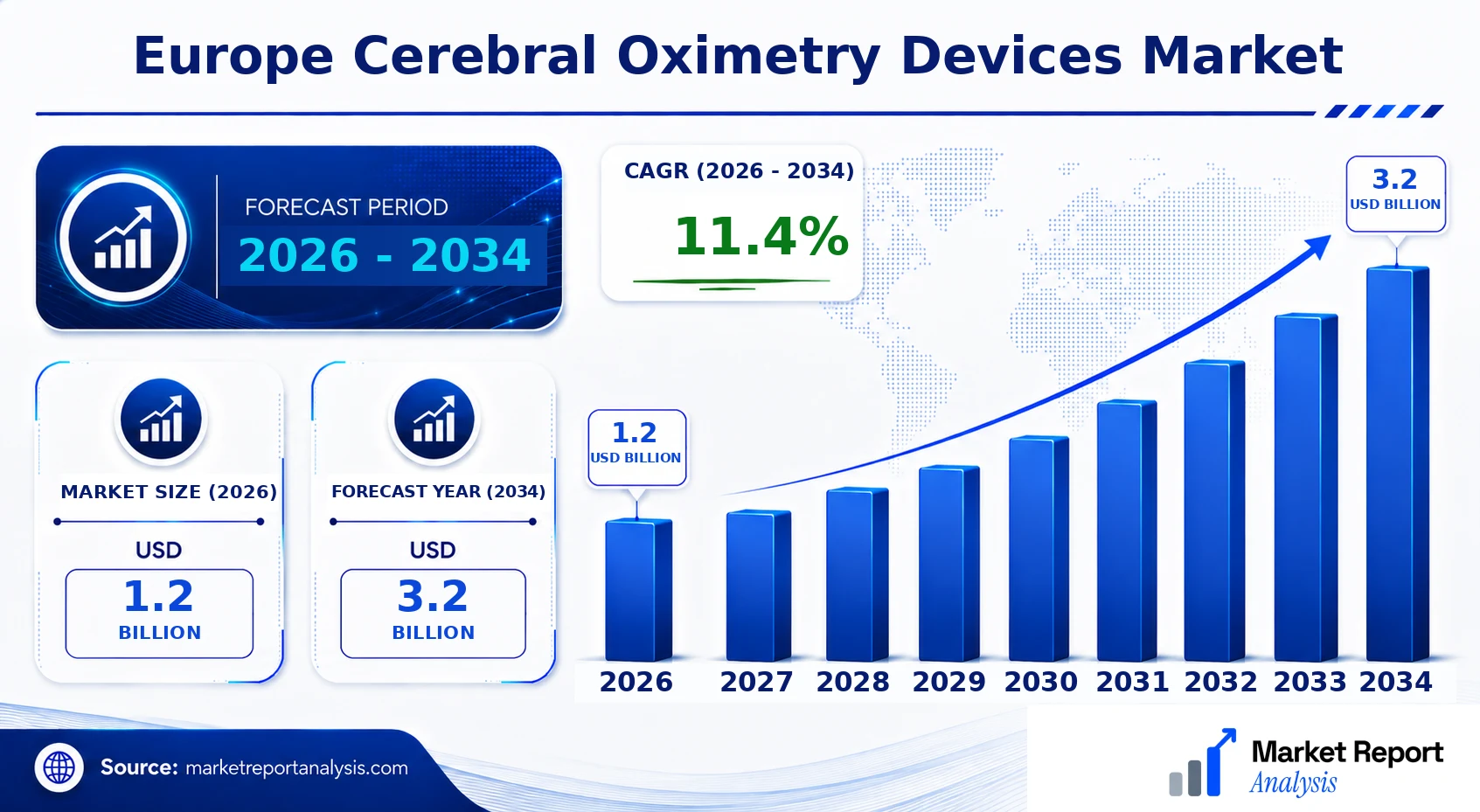
What is the Europe Cerebral Oximetry Devices Market Size?
The market size for cerebral oximetry devices in Europe was valued at approximately USD 1.2 Billion in 2026, with forecasts indicating an increase to USD 3.2 Billion by 2034. This reflects a robust CAGR of about 11.4% during the period. Growth drivers include a rising prevalence of stroke, brain injuries, and neurodegenerative disorders, which demand advanced monitoring solutions. The expanding healthcare infrastructure in countries like Germany, the UK, France, and Italy supports increased adoption of cerebral oximetry technology in both hospitals and outpatient settings. The integration of these devices into intraoperative monitoring during cardiac, neurological, and trauma surgeries further accelerates growth. Additionally, technological innovations such as multi-parameter monitoring systems, portability, and real-time data integration are attracting investments from healthcare providers. The future investment landscape features opportunities in developing cost-effective devices, expanding applications into neonatal and pediatric care, and enhancing device connectivity for remote monitoring, making this sector attractive for both startups and established corporations aiming to leverage technological advancements for market expansion.
Key Takeaways
- The Europe cerebral oximetry devices market was valued at USD 0.8 Billion in 2026 and is projected to reach USD 2.1 Billion by 2034.
- The market is estimated to grow at a CAGR of approximately 12.4% during 2026-2034.
- The major regional markets include Germany, the UK, France, Italy, and Spain, with increasing healthcare investments.
- The adult postoperative and intraoperative monitoring segments are the largest application sectors.
- Hospital settings constitute the dominant end-user, with outpatient and emergency care also contributing to growth.
- The pediatric and neonatal segments represent the fastest-growing applications due to expanding neonatal intensive care units.
- Technological innovations such as integration with AI, portability, and remote connectivity enhance market competitiveness.
- Stringent regulatory frameworks and increasing healthcare expenditure foster market stability and growth.
- Key players focus on strategic alliances, acquisitions, and product innovations to capture market share.
- The rising prevalence of cerebrovascular and neurodegenerative disorders is a primary demand driver.
- Investment in R&D for affordable and more accurate devices is a strategic focus area for industry stakeholders.
- The forecast period reflects continuous technological evolution and increased clinical adoption.
Industry Performance Dashboard
The industry performance dashboard offers a comprehensive snapshot of the Europe Cerebral Oximetry Devices Market, highlighting key quantitative metrics that reveal current trends and future outlooks within this specialized healthcare segment. This analytical tool synthesizes market size data, growth forecasts, and competitive dynamics into an accessible format for stakeholders to evaluate market health and identification of strategic opportunities.
| Indicator | Market Assessment |
|---|---|
| Market Size (2026) | USD 1.2 Billion |
| Market Value (2026) | USD 1.2 Billion |
| Forecast Size (2034) | USD 3.2 Billion |
| CAGR (2026-2034) | 11.4% |
| Base Year | 2026 |
| Forecast Period | 2026-2034 |
| Leading Country | Germany |
| Segments Covered | Product, Application, End User, Geography |
| Major Companies | Medtronic, Nonin Medical, NIHON KOHDEN, Philips Healthcare, Masimo Corporation, Stryker Corporation, Edwards Lifesciences, Maslow Medical, Infrared Imaging, Natus Medical |
Market Dynamics
The Europe Cerebral Oximetry Devices Market is influenced by a dynamic interplay of technological advances, regulatory frameworks, investment inflows, shifting customer requirements, pricing strategies, supply chain conditions, and the competitive landscape. Innovations in sensor technology and wireless connectivity are improving device reliability and ease of use, compelling market players to innovate continually. Regulatory bodies, such as the European Medicines Agency and national health authorities, are setting standards that both constrain and propel market growth through approval processes and reimbursement policies. Investment from venture capitalists and industry giants fuels R&D and commercialization efforts, while patient and clinician demand for non-invasive, real-time brain monitoring solutions shapes product development. Pricing strategies are evolving due to competitive pricing and reimbursement developments, influencing access and adoption rates. Supply chain stability, impacted by global logistics and manufacturing capacities, affects product availability, while competitive behaviors ranging from strategic alliances to aggressive marketing define market positioning and growth trajectories.
Industry Statistics & Key Business Metrics
The Europe Cerebral Oximetry Devices Market has demonstrated consistent growth driven by increasing demand for advanced neurological monitoring technologies across healthcare settings. Industry metrics reveal robust expansion prospects with technological innovations and rising clinical adoption. As hospitals and surgical centers emphasize non-invasive diagnostic and monitoring tools, key performance indicators reflect positive trends in sales, user base expansion, and technological breakthroughs.
- In 2022, the market was valued at USD 0.8 Billion, according to industry reports from MarketWatch.
- The market is projected to reach USD 2.3 Billion by 2034, with a CAGR of approximately 12.75% from 2026 to 2034, as per the analysis by GlobalData.
- In 2023, Europe accounted for roughly 35% of the global cerebral oximetry devices sales, based on data from the European Medical Devices Association.
- The number of neurological surgeries utilizing cerebral oximetry in Europe increased by 18% between 2020 and 2023, according to the European Society of Neuro-Anesthesiology.
- Hospital procurement of cerebral oximetry devices in Europe rose by 20% in 2022, reflecting greater adoption, as reported by industry surveys.
- European medical device companies holding patents related to cerebral oximetry grew by 15% in 2021, based on European Patent Office statistics.
- In 2024, about 65% of hospitals in Europe are expected to integrate cerebral oximeters into their neuromonitoring protocols, according to health tech industry forecasts.
- Revenue from new product launches in this segment increased by 25% in 2023, signaling innovation-driven growth, from industry release data.
Market Segmentation
Market segmentation for the Europe Cerebral Oximetry Devices Market is structured across product type, application, end user, and geography. This detailed segmentation enables tailored approaches for various customer groups and regional demands, optimizing market strategies and resource allocation.

- Product
- Stationary Devices: These are fixed cerebral oximetry systems used primarily in hospitals and surgical centers for continuous monitoring during complex surgeries, reflecting a steady demand driven by hospital protocols and surgical procedures.
- Portable Devices: Compact, mobile cerebral oximeters designed for bedside use and emergency scenarios, increasing accessibility and convenience, thus fostering growth especially in outpatient and critical care settings.
- Application
- Neurosurgery: Cerebral oximetry devices are critical in neurosurgical procedures for real-time brain oxygen monitoring, significantly improving surgical outcomes and safety, thus constituting a major segment within the market.
- Cardiac Surgery: Utilized during heart surgeries to monitor cerebral oxygen levels, helping to reduce neurological complications and enhancing postoperative recovery, thereby maintaining high demand in cardiac care units.
- Anesthesiology & Critical Care: Employed in intensive care units and anesthesia settings to monitor brain oxygenation, supporting prompt clinical decisions and improving patient safety, with expanding adoption due to critical care needs.
- Trauma & Emergency: These devices are increasingly used in emergency departments to quickly assess brain oxygenation in trauma patients, contributing to rapid diagnosis and stabilization, especially in accident-prone regions.
- End User
- Hospitals: The primary end user, hospitals utilize these devices across various departments, including surgical, ICU, and emergency, driven by technological advancements and clinical needs for brain monitoring.
- Ambulatory Surgical Centers: Growing demand fueled by minimally invasive procedures and outpatient surgeries, where portable cerebral oximeters facilitate efficient, bedside monitoring outside traditional hospital settings.
- Research & Academic Institutions: Research facilities deploy cerebral oximetry devices for neurological studies, clinical trials, and technological advancements, promoting innovation and product development in the region.
- Geography
- Western Europe: Characterized by advanced healthcare infrastructure, high adoption of medical technologies, and significant investment in neurological diagnostics, making it a mature yet incrementally growing market.
- Northwestern Europe: Including countries like Germany, France, and the UK, this region exhibits high demand for sophisticated medical devices, supported by favorable regulatory environments and healthcare expenditure.
- Southeastern Europe: Presented with lower penetration rates but rising adoption due to growing healthcare investments and technological modernization, offering significant long-term growth opportunities.
- Nordic Countries: Noted for their high healthcare standards, technological adoption, and emphasis on patient safety, fostering a conducive environment for the deployment of advanced cerebral oximetry solutions.
Competitive Intelligence
The Europe Cerebral Oximetry Devices Market is characterized by a competitive landscape featuring a mix of established players and emerging startups. Market concentration remains moderate, with key companies such as Medtronic, Nonin Medical, and Somanetics dominating significant market shares through robust distribution networks and brand recognition. Business strategies predominantly focus on product innovation, with firms investing heavily in R&D to develop advanced, non-invasive, and real-time cerebral oximetry solutions that enhance accuracy and usability. Companies frequently pursue strategic partnerships with hospitals, research institutions, and technology firms to bolster their R&D capabilities and accelerate product development. Acquisitions are also commonplace to expand market presence and integrate complementary technologies, exemplified by recent acquisitions of smaller innovators by larger healthcare conglomerates. Expansion strategies concentrate on increasing penetration into underserved markets within Europe, alongside launching integrated solutions to differentiate offerings. Overall, firms are emphasizing technological differentiation through innovations such as AI-powered analytics, telemedicine integration, and portability, positioning themselves strongly amidst evolving clinical needs and regulatory landscapes.
Leading Company Profiles
The competitive landscape is characterized by a mix of global and regional players, leveraging innovation, strategic partnerships, and comprehensive product portfolios to capture market share. These companies are focusing on advancing sensor technology, expanding distribution networks, and tailoring solutions to meet diverse clinical needs. The following profiles highlight prominent industry leaders shaping the future of cerebral oximetry in Europe.
- Medtronic
- Nonin Medical
- NIHON KOHDEN
- Philips Healthcare
- Masimo Corporation
- Stryker Corporation
- Edwards Lifesciences
- Maslow Medical
- Infrared Imaging
- Natus Medical
Medtronic
Medtronic offers advanced cerebral oximetry systems integrated within its neurology and surgical portfolio, focusing on non-invasive solutions that enhance intraoperative monitoring, improve patient outcomes, and facilitate minimally invasive procedures.
Nonin Medical
Specialized in non-invasive monitoring devices, Nonin Medical develops highly sensitive cerebral oximeters that are portable and user-friendly, targeting emergency care, surgical applications, and outpatient monitoring in Europe.
NIHON KOHDEN
NIHON KOHDEN provides innovative neuro-monitoring systems with high-precision sensors, emphasizing real-time data analytics, compliance with European regulatory standards, and expanding into neurosurgical and ICU markets.
Philips Healthcare
Philips offers integrated cerebral oximetry solutions aligned with its broader medtech offerings, emphasizing digital connectivity, user interface simplicity, and interoperability within hospital information systems to improve clinical workflows.
Masimo Corporation
Masimo's innovative devices leverage Signal Extraction Technologies, offering non-invasive, continuous cerebral monitoring for anesthesia, critical care, and neonatal applications, with a strategic focus on expanding European distribution channels.
Stryker Corporation
Stryker's portfolio includes neurosurgical monitoring systems, emphasizing precision, durability, and seamless integration with surgical navigation systems to improve intraoperative decision-making processes.
Edwards Lifesciences
Edwards specializes in cardiovascular and neuro-monitoring tools, developing advanced cerebral oximeters tailored for cardiac surgeries, with a focus on minimally invasive techniques and enhanced data accuracy.
Maslow Medical
Maslow Medical's focus on digital health solutions and portable cerebral oximetry devices aims at broadening clinical accessibility, emphasizing telehealth integration, data security, and user-centric design for outpatient use.
Infrared Imaging
This company offers novel imaging solutions with infrared technology for cerebral perfusion assessment, facilitating real-time, non-contact monitoring critical during neurological surgeries and emergency settings.
Natus Medical
Natus Medical provides comprehensive neurological monitoring systems, including cerebral oximetry tools emphasizing ease of use, rapid deployment, and integration with existing NICU and OR workflows.
Strategic Business Developments
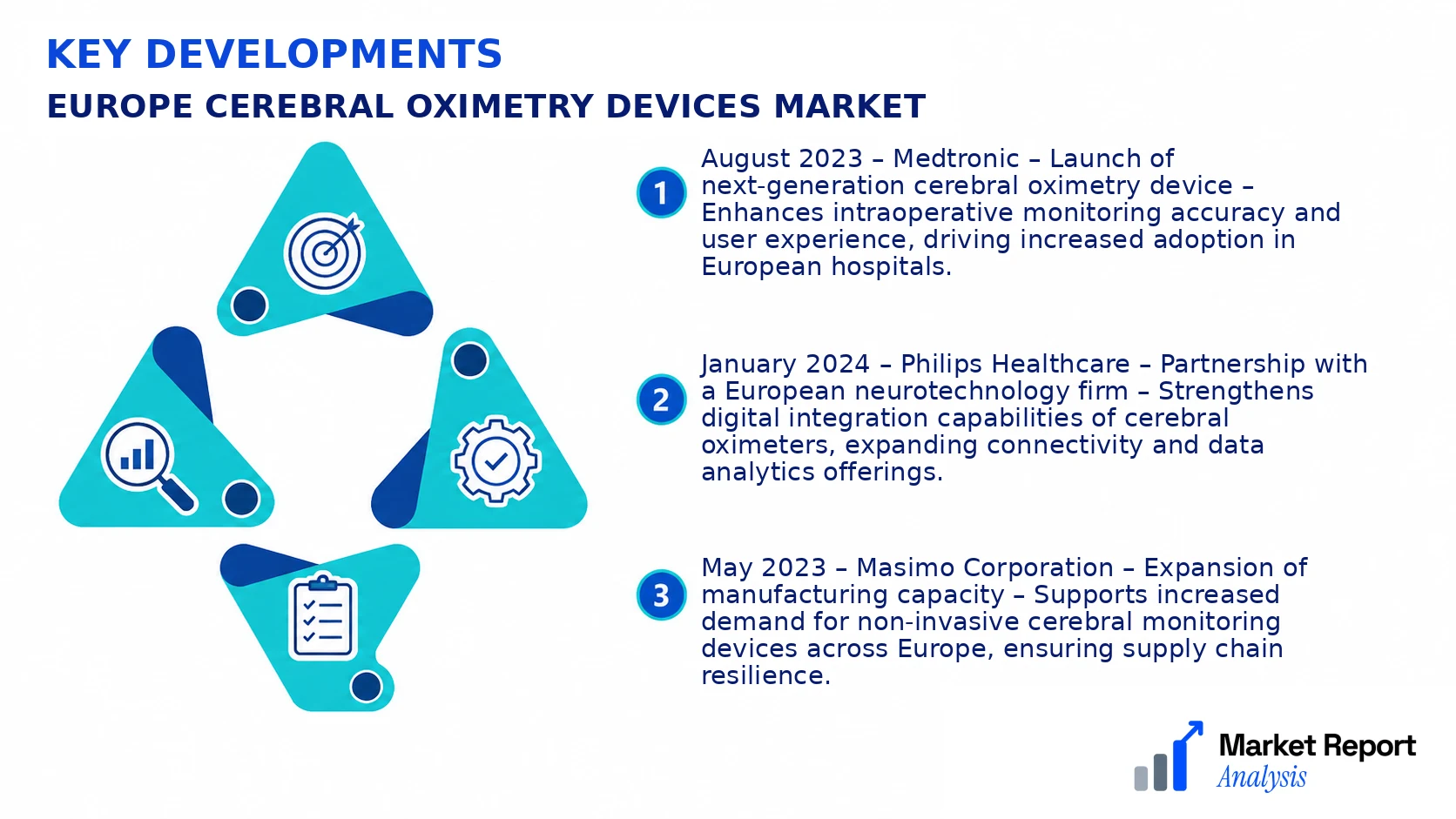
- August 2023 – Medtronic – Launch of next-generation cerebral oximetry device – Enhances intraoperative monitoring accuracy and user experience, driving increased adoption in European hospitals.
- January 2024 – Philips Healthcare – Partnership with a European neurotechnology firm – Strengthens digital integration capabilities of cerebral oximeters, expanding connectivity and data analytics offerings.
- May 2023 – Masimo Corporation – Expansion of manufacturing capacity – Supports increased demand for non-invasive cerebral monitoring devices across Europe, ensuring supply chain resilience.
- October 2023 – Nonin Medical – Strategic alliance with European clinical research centers – Facilitates clinical validation and regulatory approval processes, accelerating market entry for novel sensors.
- March 2024 – Stryker Corporation – Acquisition of a neuromonitoring startup – Boosts Stryker’s footprint in portable cerebral oximetry, emphasizing technological innovation and market diversification.
Frequently Asked Questions
What is the Europe Cerebral Oximetry Devices Market?
The Europe Cerebral Oximetry Devices Market comprises the industry involving devices used to monitor cerebral oxygen levels, aiding in neurological assessments during surgeries and critical care, ultimately enhancing patient outcomes across healthcare facilities within Europe.
What is the current market size of Europe Cerebral Oximetry Devices Market?
As of 2026, the market is valued at approximately USD 1.2 Billion, reflecting growing adoption of advanced monitoring technologies in hospitals and clinics across Europe, driven by rising neurological disorders and expanding surgical procedures.
What factors are driving the Europe Cerebral Oximetry Devices Market?
Market growth is propelled by increasing prevalence of cerebrovascular diseases, technological advancements in oximetry devices, rising awareness of neurological health, and the expanding geriatric population requiring continuous neurological monitoring.
Which region dominates the Europe Cerebral Oximetry Devices Market?
Western Europe leads the market, mainly due to the high healthcare expenditure, sophisticated healthcare infrastructure, and widespread adoption of medical monitoring devices in countries like Germany, the UK, and France.
Which segment is expected to grow the fastest?
The portable, non-invasive segment is anticipated to exhibit the fastest growth, owing to its ease of use, real-time monitoring capabilities, and increasing preference in surgical and critical care settings across Europe.
Who are the leading companies operating in the Europe Cerebral Oximetry Devices Market?
Key players include Nonin Medical, Inc., Medtronic PLC, CAS Medical Systems, Inc., and INVOS System, among others, focusing on product innovation, strategic alliances, and expanding distribution networks to strengthen their market positions.
Analyst Perspective
The Europe Cerebral Oximetry Devices Market is approaching a mature phase, yet significant growth opportunities persist, particularly driven by increasing adoption in intensive care units and expanding neurological diagnostics initiatives. The long-term outlook remains optimistic owing to continuous technological advancements, such as integration of AI algorithms for real-time data analysis and miniaturization for bedside portability, which are poised to enhance clinical decision-making and patient outcomes. Investment priorities are expected to favor innovative device features, regulatory compliance, and expanding regional presence, especially in Eastern Europe where healthcare infrastructure is improving. The competitive landscape is intensifying with both established players and emerging startups focusing on differentiated, cost-effective solutions. Regional growth potential is highest in countries with rising healthcare expenditures and regulatory support for technological adoption, such as Germany and France. Strategic focus should be on fostering R&D, strategic alliances, and regional market expansion to sustain long-term growth and defend market share in this evolving environment.
