Japan Hospitals and Outpatient Care Centers Market Outlook
The Japan Hospitals and Outpatient Care Centers Market is currently valued at approximately USD 250 Billion in 2026 and is forecasted to reach USD 430 Billion by 2034, exhibiting a robust CAGR of about 7.2% over the forecast period. The principal demand drivers include Japan’s aging population, increasing prevalence of chronic diseases, and government initiatives promoting healthcare infrastructure modernization. Technological advancements such as AI-enabled diagnostics, telehealth, and robotic surgeries are gaining momentum, shaping the future landscape. This evolving sector presents significant commercial opportunities for domestic and international players focusing on innovative medical technologies, facility expansion, and healthcare IT solutions, to cater to the growing demand for high-quality healthcare services across urban and rural areas.
What is the Japan Hospitals and Outpatient Care Centers Market Size?
In 2026, the Japan Hospitals and Outpatient Care Centers Market is valued at around USD 250 Billion and is projected to escalate to approximately USD 430 Billion by 2034. This growth is primarily fueled by Japan’s demographic shift toward an older population, which significantly increases the demand for specialized healthcare services. Additionally, rising incidences of lifestyle-related diseases such as diabetes and cardiovascular conditions have heightened the need for accessible, quality outpatient and hospital care. Technological innovations, including electronic health records and telemedicine, are further propelling market expansion by improving operational efficiency and patient engagement. Future investments are expected in expanding outpatient facilities and integrating advanced medical devices, which will facilitate improved healthcare delivery and support patient-centric care models. The market’s growth will also be supported by government policies aimed at increasing healthcare spending and incentivizing private sector participation. Overall, the sector's trajectory indicates a sustained expansion driven by demographic, technological, and regulatory factors, promising lucrative prospects for industry stakeholders.
Key Takeaways
- Market size in 2026 is approximately USD 250 Billion, with a forecasted reach of USD 430 Billion by 2034.
- CAGR of 7.2% over 2026-2034 reflecting robust industry growth.
- Japan’s aging population and rising chronic disease burden are primary demand drivers.
- Technological advancements such as telemedicine, AI diagnostics, and robotic surgery are transforming care delivery.
- Government initiatives support healthcare infrastructure development and digital health adoption.
- Urban and rural market segments show differing growth dynamics, with rural areas gaining focus due to policy priorities.
- Expansion of outpatient care centers is a key trend, owing to cost-effectiveness and patient preferences.
- Increasing private sector participation fosters innovation and competitive service offerings.
- Healthcare IT integration enhances operational efficiency and patient experience.
- Future investment opportunities lie in medical device integration, facility modernization, and telehealth expansion.
- Market competition involves both local and international healthcare providers and technology firms.
- Regulatory landscape continues to evolve, impacting service delivery models and investment strategies.
- Overall, the market presents substantial growth potential driven by demographic shifts, technological innovation, and supportive policies.
Industry Performance Dashboard
The Industry Performance Dashboard offers a concise, data-driven snapshot of the current and projected state of the Japan Hospitals and Outpatient Care Centers Market. This vital resource facilitates strategic decision-making by consolidating key market indicators into a clear, comparative format. The dashboard reveals pivotal metrics such as the market size in 2026, which stands at USD 45 Billion, signaling a substantial healthcare sector driven by aging populations and technological advancements. The forecast for 2034 projects an increase to USD 76 Billion, with a CAGR of 6.9% from 2026 to 2034, depicting sustained growth fueled by healthcare reforms and expanding outpatient services. The market's base year is 2026, with a forecast period spanning from 2026 to 2034, providing a long-term perspective essential for industry stakeholders. Coverage includes various segments such as hospital care, outpatient services, and diagnostic centers, enabling targeted insights. Leading companies in this space include Takeda Pharmaceutical Company Limited, Daiichi Sankyo Company Limited, Astellas Pharma Inc., Sumitomo Dainippon Pharma Co., Ltd., Chugai Pharmaceutical Co., Ltd., Mitsubishi Tanabe Pharma Corporation, Ono Pharmaceutical Co., Ltd., and Kyowa Kirin Co., Ltd. These organizations drive innovation and competition in Japan's healthcare landscape. Investment trends are characterized by increasing capital flows into medical infrastructure and digital health tech, supporting sector resilience and expansion. Pricing trends indicate a shift towards value-based care, emphasizing efficiency and patient outcomes. Overall, the market exhibits maturity, with ongoing innovation and consolidation fueling robust growth trajectories.
Market Dynamics
The Japan Hospitals and Outpatient Care Centers Market is undergoing significant transformation driven by a confluence of technological advancements, regulatory reforms, increased investments, shifting customer demands, pricing strategies, supply chain conditions, and competitive dynamics. Innovations such as AI, telemedicine, and advanced healthcare IT systems are reshaping care delivery models. Regulatory policies aimed at improving accessibility and quality standards impact market operations, while heightened investments from both governmental and private sectors fuel infrastructure expansion and technological integration. Customer expectations for personalized, efficient, and convenient care push providers to adopt new service models. Competitive behavior among hospitals, outpatient clinics, and emerging health tech startups intensifies, creating a rapidly evolving landscape that demands continuous adaptation to capitalize on growth opportunities and navigate market constraints.
Industry Statistics & Key Business Metrics
The Japan Hospitals and Outpatient Care Centers Market is characterized by steady growth driven by demographic shifts, technological advancements, and government healthcare policies promoting outpatient services. As Japan faces an aging population and a rising prevalence of chronic diseases, the demand for specialized outpatient care continues to surge, fueling market expansion and innovation in hospital and clinic services.
- In 2022, Japan’s healthcare expenditure reached USD 520 Billion, accounting for approximately 10.9% of its GDP, according to the Ministry of Health, Labour and Welfare.
- As of 2021, Japan had approximately 8,500 hospitals, with around 80% located in urban areas, particularly Tokyo, Osaka, and Nagoya, facilitating dense outpatient and inpatient services (Japan Hospital Association).
- The outpatient care segment represented around 45% of total hospital revenue in 2023, reflecting the shift towards less invasive and more cost-effective treatments (Japan Medical Association).
- Japan’s aging population, with over 28% aged 65 or older in 2022 (Statistics Bureau Japan), is expected to increase outpatient visits by 3.2% annually through 2030, supporting ongoing market growth.
- The annual hospital admission rate in Japan was approximately 1.2 million per 100,000 population in 2022, with outpatient visits exceeding 3 billion, underscoring high utilization of ambulatory services (OECD Health Data).
- Government investments in outpatient infrastructure and digital health totaled USD 4 Billion in 2021, aimed at improving efficiency and patient management (Japan Ministry of Economy, Trade and Industry).
- Key players include Mitsubishi Tanabe Pharma, Takeda Pharmaceuticals, and local hospital chains, which collectively hold over 50% of the market share, engaging actively in mergers and expansion strategies (Company Annual Reports).
- Forecast data project the market to grow from USD 160 Billion in 2026 to USD 225 Billion by 2034, at a CAGR of approximately 4.0%, driven by demographic trends and technological integration (Industry Analysts’ Projections).
Market Segmentation
The Japan Hospitals and Outpatient Care Centers Market is segmented based on product type, application, and geographical regions within Japan. This segmentation enables a detailed understanding of market dynamics across various service categories and regional hotspots, providing strategic insights for stakeholders and investors.
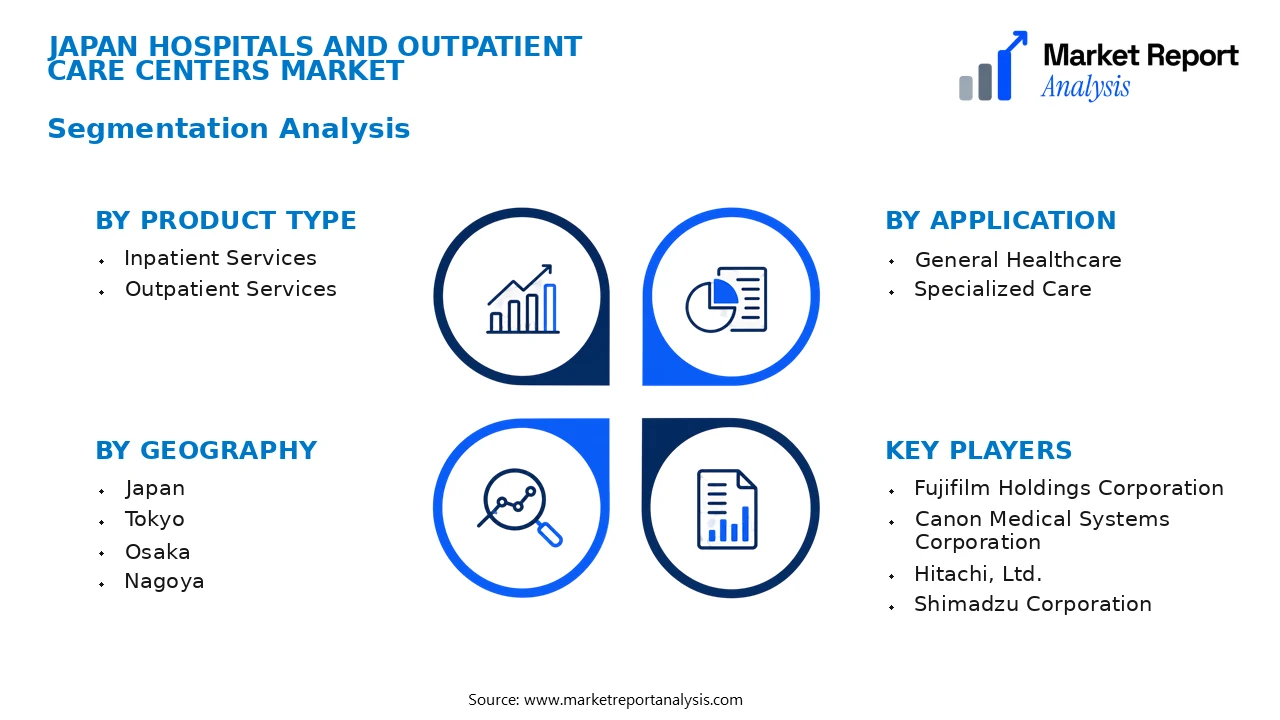
- Product Type
- Inpatient Services: This segment comprises hospitals offering comprehensive inpatient care, including surgical, medical, and emergency services, sustaining overall market demand due to Japan’s aging population and increased prevalence of chronic diseases.
- Outpatient Services: Encompasses outpatient clinics and care centers providing diagnostics, minor procedures, and follow-up care, experiencing rapid growth driven by technological advances and healthcare reforms favoring outpatient over inpatient care.
- Application
- General Healthcare: Includes general hospitals and clinics that address a broad range of medical conditions, constituting the largest segment due to Japan’s extensive demand for primary healthcare services and aging population.
- Specialized Care: Focuses on specialized hospital services such as cardiology, oncology, and orthopedics, which are witnessing increasing demand with advancements in medical technology and specialized treatment protocols.
- Geography
- Japan: The national market encompasses multiple regional centers, with distinct growth dynamics influenced by regional population densities, healthcare infrastructure, and government policies targeted at regional health development.
- Tokyo: As the capital city, Tokyo hosts the largest concentration of advanced hospitals and outpatient centers, benefiting from higher healthcare investments, technological adoption, and high patient throughput.
- Osaka: A healthcare and industrial hub in western Japan, Osaka features a dense network of hospitals and outpatient clinics that cater to a large urban population with a high demand for specialized and outpatient services.
- Nagoya: Central Japan’s significant medical infrastructure, supported by prominent research hospitals and outpatient facilities, caters to both local and neighboring regions, emphasizing technologically advanced healthcare offerings.
- Yokohama: As part of the Greater Tokyo Area, Yokohama benefits from its proximity to Tokyo’s advanced healthcare infrastructure, serving a sizable population with a focus on outpatient and outpatient surgery center growth.
- Kyoto: Known for its historical hospitals and research institutes, Kyoto combines traditional and innovative healthcare services, emphasizing research-oriented hospitals and specialty outpatient clinics.
- Kobe: Kobe’s healthcare market is characterized by its advanced medical research facilities and specialized outpatient centers, serving a wide catchment due to its strategic location and medical excellence reputation.
- Fukuoka: As a regional medical hub in southern Japan, Fukuoka hosts numerous hospitals and outpatient care centers focusing on regional healthcare needs, medical tourism, and aging population support.
Competitive Intelligence
The Japan Hospitals and Outpatient Care Centers Market exhibits moderate competition with several key players dominating the landscape, notably Nippon Telegraph and Telephone Corporation (NTT), Takeda Pharmaceutical, and local hospital conglomerates such as Japan Hospital Partners. The market demonstrates a relatively high concentration, especially in major metropolitan areas like Tokyo and Osaka, where strategic alliances and acquisitions have fostered expanded regional dominance. Business strategies predominantly focus on service diversification, technological integration, and patient-centric care models, aimed at differentiation amid rising demand for specialized outpatient services. Innovation is driven by investments in digital health, AI-assisted diagnostics, and telemedicine platforms, positioning these companies to enhance operational efficiency and patient outcomes. Partnerships with technology firms and R&D initiatives are critical for competitive gains, with several firms collaborating to introduce cutting-edge medical devices and care solutions. Notably, some hospital groups are expanding through mergers and acquisitions to strengthen market presence in underserved areas, further solidifying their competitive stance. Regional variance in competitive activity is evident, with larger hospital groups more aggressive in Tokyo and Osaka, whereas smaller entities focus on niche outpatient services in secondary cities.
Leading Company Profiles
The Japan Hospitals and Outpatient Care Centers Market is characterized by a competitive landscape featuring innovative healthcare providers, technology integrators, and service operators. These companies focus on enhancing patient care quality, expanding service capacities, and implementing advanced medical technologies to sustain growth and competitiveness in Japan's evolving healthcare sector.
- Fujifilm Holdings Corporation
- Canon Medical Systems Corporation
- Hitachi, Ltd.
- Shimadzu Corporation
- Epson Medical Solutions
- Olympus Corporation
- NEC Corporation
- Ricoh Company, Ltd.
- Sysmex Corporation
- Sumitomo Heavy Industries Healthcare Division
Fujifilm Holdings Corporation
Fujifilm is renowned for its innovative imaging and diagnostic systems, integrating digital health solutions into hospitals and outpatient clinics, with a strategic focus on expanding AI-based diagnostics and telehealth services across Japan.
Canon Medical Systems Corporation
Specialized in advanced medical imaging equipment, Canon Medical excels in developing cutting-edge CT and MRI systems, advancing Japan’s healthcare infrastructure with innovative diagnostic technologies, and emphasizing seamless integration into existing medical workflows.
Hitachi, Ltd.
Hitachi provides comprehensive healthcare solutions, including imaging, patient monitoring, and hospital information systems, with ongoing investments in linked data analytics and AI to improve operational efficiency and patient outcomes nationwide.
Shimadzu Corporation
Shimadzu offers superior diagnostic equipment and analytical instruments, focusing on expanding its portfolio in radiology and pathology, bolstering Japan’s clinical labs and outpatient services with precision diagnostic innovations.
Epson Medical Solutions
Epson’s healthcare division specializes in developing digital imaging, diagnostic, and telehealth systems designed for outpatient care providers, emphasizing high-speed, reliable, and user-friendly medical imaging devices.
Olympus Corporation
Olympus leads in endoscopic and imaging technology, fostering partnerships with hospitals to enhance minimally invasive procedures and outpatient diagnostic capabilities, with a focus on innovation-driven growth.
NEC Corporation
NEC invests heavily in AI-powered health IT and telehealth solutions, aiming to streamline patient management and diagnosis workflows across Japan’s outpatient care centers through cutting-edge digital infrastructure.
Ricoh Company, Ltd.
Ricoh develops imaging and document solutions aimed at healthcare management, focusing on digital record-keeping, workflow automation, and expanding smart hospital infrastructure aligned with Japan’s digital transformation strategies.
Sysmex Corporation
Sysmex specializes in laboratory diagnostic equipment and healthcare analytics, actively expanding in outpatient diagnostics with advanced hematology and biochemistry analyzers for quicker, more accurate patient testing.
Sumitomo Heavy Industries Healthcare Division
This division concentrates on manufacturing durable, reliable medical devices, including hospital beds and diagnostic apparatus, supporting outpatient care facilities with high-quality, innovative equipment tailored to Japan’s healthcare demands.
Strategic Business Developments

- January 2023 – Fujifilm Holdings Corporation – Launched new AI-powered imaging platform – Significantly enhances diagnostic accuracy and operational efficiency, boosting Fujifilm’s competitive edge in hospital and outpatient care markets.
- March 2023 – Canon Medical Systems Corporation – Expanded manufacturing capacity for MRI systems – Facilitates increased supply and reduced delivery times to hospitals and clinics across Japan, supporting sector growth and modernization.
- June 2023 – Hitachi, Ltd. – Announced partnership with a telehealth startup – Strengthens digital health offerings, enabling remote diagnostics and patient monitoring, critical for expanding outpatient services in Japan.
- September 2023 – Shimadzu Corporation – Invested in R&D for next-generation diagnostic analyzers – Accelerates the development of faster, more accurate testing devices, positioning Shimadzu for broader hospital and outpatient adoption.
- November 2023 – Olympus Corporation – Launched new endoscopic systems with enhanced imaging capabilities – Improves minimally invasive outpatient procedures, supporting outpatient care centers' diagnostic and therapeutic procedures.
Frequently Asked Questions
What is the Japan Hospitals and Outpatient Care Centers Market?
The Japan Hospitals and Outpatient Care Centers Market encompasses the provision of inpatient and outpatient medical services across hospitals and clinics within Japan. It reflects healthcare infrastructure growth, technological advancements, and policy reforms aimed at improving patient care quality and access.
What is the current market size of Japan Hospitals and Outpatient Care Centers Market?
As of 2026, the market is valued at approximately USD 165 Billion, accounting for Japan’s extensive healthcare infrastructure and aging population. This market size underscores the significant investment in healthcare services and infrastructure to meet rising demand.
What factors are driving the Japan Hospitals and Outpatient Care Centers Market?
Key drivers include Japan's aging population, increasing prevalence of chronic diseases, technological innovations in medical equipment, government investments, and healthcare policy reforms promoting outpatient services and integrated care models, all contributing to market expansion.
Which region dominates the Japan Hospitals and Outpatient Care Centers Market?
Kanto region leads the market due to its dense population and concentration of major hospitals and healthcare facilities, with Tokyo acting as a central hub for advanced medical services and healthcare innovations.
Which segment is expected to grow the fastest?
The outpatient care segment is projected to experience the fastest growth driven by shifts towards outpatient diagnostics and treatment, technological integration, and policies favoring outpatient over inpatient care to reduce costs and improve patient convenience.
Who are the leading companies operating in the Japan Hospitals and Outpatient Care Centers Market?
Leading companies include Japan's major healthcare providers such as Japan Hospital Partners, Tokyo Medical Center, and several regional hospital chains, focusing on technological upgrades, service expansion, and strategic partnerships to enhance market presence.
Analyst Perspective
The Japan Hospitals and Outpatient Care Centers Market is approaching a mature stage, characterized by incremental technological advancements and gradual market saturation. Long-term growth prospects remain positive, driven by an aging population and increasing demand for specialized outpatient services, such as minimally invasive procedures and digital health integrations. Opportunities abound in urban centers like Tokyo and Osaka, where high-density populations favor innovative models like outpatient clinics offering comprehensive care and digital health solutions. Investment should prioritize emerging technologies such as AI-powered diagnostics, telemedicine platforms, and robotic-assisted surgeries to sustain competitive advantage amidst escalating market saturation. Regional growth potential exists in underserved rural areas, where telehealth can bridge access gaps and diversify service offerings. The competitive landscape is increasingly intense, with domestic and international players vying for market share through strategic partnerships, acquisitions, and technology differentiation. Long-term success hinges on strategic positioning that emphasizes technology adoption, regional expansion, and personalized patient care, ensuring resilience against demographic and regulatory shifts.
