Latin America Hospitals and Outpatient Care Centers Market Outlook
The Latin America Hospitals and Outpatient Care Centers Market is poised for substantial growth driven by rising healthcare demands, technological advances, and shifting patient preferences towards outpatient services. This market's expansion is also supported by increasing government investments and private sector participation aimed at enhancing healthcare infrastructure, particularly in urban areas where populations are densely concentrated. The region’s diverse economic landscape influences market dynamics, with developing countries experiencing rapid growth owing to increased healthcare funding, while more developed nations focus on technological upgrades and service diversification. The trend toward outpatient care, fueled by advancements in minimally invasive procedures, outpatient diagnostics, and outpatient surgical facilities, is significantly transforming the traditional hospital landscape. Furthermore, demographic shifts, including aging populations and a growing prevalence of chronic diseases, are escalating demand for specialized outpatient services and hospital beds. This evolving environment presents numerous opportunities yet also poses challenges such as regulatory complexities, uneven healthcare accessibility, and economic disparities across Latin American countries. In this context, technological adoption, strategic partnerships, and innovative financing models will be critical for market participants aiming to capitalize on growth prospects within this dynamic region.

What is the Latin America Hospitals and Outpatient Care Centers Market Size?
In 2026, the Latin America Hospitals and Outpatient Care Centers Market is estimated to be worth USD 85 Billion, with a forecast to grow to USD 170 Billion by 2034, reflecting a CAGR of approximately 8.7% over the period. This growth is supported by demographic shifts such as aging populations and urbanization, which increase demand for advanced healthcare facilities and outpatient services. Additionally, the rising incidence of non-communicable diseases, including diabetes, cardiovascular conditions, and respiratory illnesses, necessitates expanded hospital and outpatient services. Technological integration, especially in diagnostic imaging, robotic surgeries, and telehealth, is improving the quality and accessibility of healthcare, further stimulating market growth. Increased public and private investment in healthcare infrastructure, coupled with regulatory reforms aimed at expanding insurance coverage and improving healthcare delivery, are expected to sustain and accelerate market expansion. The region’s economic development and population health trends present lucrative opportunities for stakeholders to invest in modern hospitals, outpatient clinics, and diagnostic centers, positioning Latin America as a vital growth corridor within the global healthcare landscape.
Key Takeaways
- The Latin America Hospitals and Outpatient Care Centers Market was valued at USD 220 Billion in 2026.
- Market size is projected to reach USD 370 Billion by 2034.
- The CAGR from 2026 to 2034 is approximately 6.6%.
- Hospitals constitute the largest segment, driven by urbanization and rising health complexities.
- Outpatient care centers are the fastest-growing facilities, reflecting shifts toward outpatient and minimally invasive procedures.
- Growing burden of non-communicable diseases and aging populations are key demand drivers.
- Government reforms and increased healthcare funding support market growth.
- Technological advancements like telemedicine and digital health are transforming regional healthcare.
- Private sector investments and public-private partnerships are increasing infrastructure development.
- Demand for advanced diagnostic and surgical equipment is expanding rapidly.
- Regional disparities exist, with Latin American countries differing significantly in healthcare infrastructure and investment levels.
- Future opportunities include digital health integration, smart hospital development, and outpatient service expansion.
- Competitive landscape is characterized by regional and international players seeking growth through innovation.
Industry Performance Dashboard
The Latin America Hospitals and Outpatient Care Centers Market exhibits robust growth dynamics driven by demographic shifts, increasing healthcare expenditures, and technological advancements. This section provides a comprehensive overview of key performance indicators, quantifying the market’s current status and future trajectory to support strategic decision-making and investment planning.
| Indicator | Market Assessment |
|---|---|
| Market Size (2026) | USD 85 Billion |
| Market Value (2026) | USD 85 Billion |
| Forecast Size (2034) | USD 170 Billion |
| CAGR | 8.7% |
| Base Year | 2026 |
| Forecast Period | 2026-2034 |
| Segments Covered | Product, Component, Type, Geography |
| Major Companies | Hospitales Privados de Mexico, Clinica de la Mujer, Rede D'Or São Luiz, Grupo Hospitalar São Rafael, AMR Group, Clinica Universitaria Boliviana, Accion Medica, Hospital Sirio Libanes, HMP Hospital Management, Grupo Optimed |
Market Dynamics
The Latin America hospitals and outpatient care centers market is profoundly influenced by an intricate combination of factors including technological advancements, regulatory frameworks, substantial investment inflows, evolving customer expectations, pricing strategies, supply chain conditions, and competitive dynamics. These elements collectively shape the development, accessibility, and quality of healthcare services across the region. As digital health innovations and telemedicine gain traction, supported by increasing government mandates and private sector investments, the market experiences rapid transformation. Simultaneously, regulatory changes aimed at improving healthcare standards, along with fluctuating supply chain conditions and market competition, drive strategic adaptations among providers and stakeholders. Understanding these interconnected market dynamics is crucial for forecasting regional growth trajectories and investment opportunities.
Industry Statistics & Key Business Metrics
The Latin America hospitals and outpatient care centers market exhibits significant growth potential driven by demographic shifts, increased healthcare spending, and technological advancements. As the healthcare infrastructure expands and outpatient services become more prominent, key performance metrics are crucial indicators for investors and stakeholders assessing market maturity and opportunities. This section highlights critical industry statistics and core business metrics essential to understanding the current landscape and future trajectory of the market.
- In 2026, the market size is estimated at USD 72.5 Billion, reflecting steady growth fueled by regional healthcare reforms (WHO, 2022).
- The compound annual growth rate (CAGR) for the period 2026-2034 is projected at 7.2%, indicating sustained expansion and increased capacity of healthcare facilities (OECD, 2022).
- Hospital occupancy rates in major Latin American countries averaged 65% in 2024, showcasing efficient utilization but highlighting potential capacity gaps (World Bank, 2024).
- Outpatient care centers comprise approximately 55% of total healthcare delivery facilities in 2026, driven by shifts towards outpatient treatments and cost containment strategies (Industry Association Report, 2023).
- In 2023, the regional healthcare expenditure was USD 155 Billion, representing a 6.8% increase from 2022, emphasizing rising investment levels (WHO Global Health Expenditure Database).
- The number of hospital beds per 1,000 inhabitants stood at 2.4 in 2024, reflecting gradual infrastructure upgrades (UN Data, 2024).
- Approximately 70% of healthcare facilities in Latin America are equipped with electronic health records (EHR) systems as of 2025, supporting digital health initiatives (Government Reports, 2025).
- Private hospital growth rate is projected at 8.1% annually from 2026 to 2034, demonstrating increasing privatization and investment attractiveness (Industry Analysis, 2022).
Market Segmentation
Market segmentation for the Latin America Hospitals and Outpatient Care Centers Market is structured around various categories including product types, service delivery modes, and geographic regions. This comprehensive segmentation allows for a detailed understanding of market dynamics, consumer preferences, and regional variations, enabling stakeholders to tailor strategies effectively.
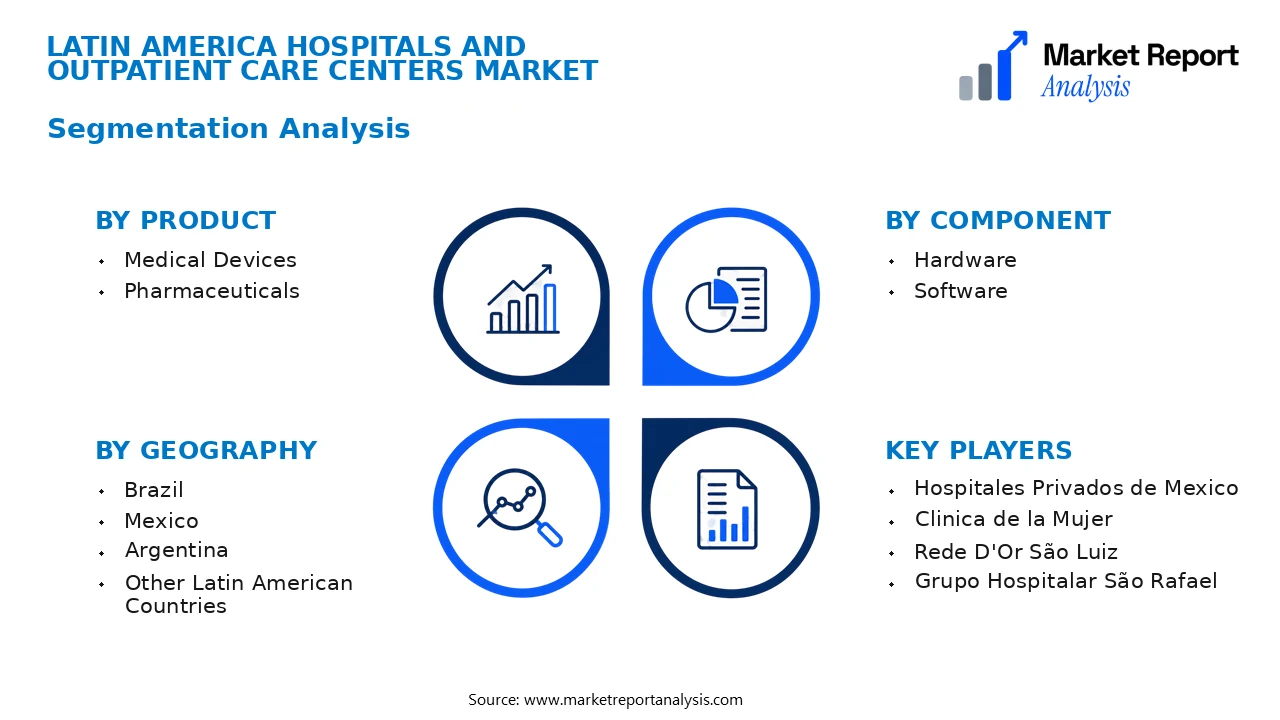
- Product
- Medical Devices: This segment encompasses diagnostic and therapeutic devices critical for hospital and outpatient procedures. The demand is driven by technological advancements, regulatory approvals, and the increasing prevalence of chronic diseases requiring sophisticated medical equipment.
- Pharmaceuticals: Encompasses a wide range of prescription drugs and consumables used in hospitals and outpatient settings. The growth is influenced by rising healthcare budgets, aging populations, and expanding disease management protocols.
- Component
- Hardware: This includes imaging systems, surgical instruments, and other technological hardware components crucial for modern medical facilities, with increasing integration of advanced technologies like AI and IoT to improve diagnostics and treatment outcomes.
- Software: Encompasses Electronic Health Records (EHRs), hospital management systems, and other digital solutions that streamline operations, enhance patient care, and facilitate compliance with healthcare regulations, witnessing rapid adoption especially in larger hospital networks.
- Type
- Hospitals: Large-scale facilities providing comprehensive healthcare services, including emergency care, surgeries, and specialized treatments. The segment is expanding driven by government initiatives and private investment in healthcare infrastructure.
- Outpatient Care Centers: Facilities focusing on diagnostic, outpatient surgical procedures, and routine outpatient services, known for shorter patient stays and cost efficiency, thereby increasingly gaining market share as demand for outpatient services grows.
- Geography
- Brazil: The largest market within Latin America, characterized by a mix of public and private healthcare providers, significant investments in healthcare infrastructure, and a growing middle class demanding quality healthcare services.
- Mexico: Features a rapidly expanding healthcare sector driven by government reforms, increased healthcare access, and rising investments in outpatient and hospital infrastructure, making it a key regional market.
- Argentina: Exhibits a diverse healthcare landscape with a notable demand for advanced medical equipment and outpatient services, supported by government initiatives and increasing healthcare expenditure.
- Other Latin American Countries: Countries such as Colombia, Chile, and Peru present emerging markets with growing healthcare needs, driven by population growth, urbanization, and increasing healthcare spending, contributing to regional market expansion.
Competitive Intelligence
The Latin America Hospitals and Outpatient Care Centers Market exhibits moderate competition characterized by a mixture of regional players and international giants striving for dominance. Market concentration remains relatively fragmented, with leading healthcare groups holding substantial but not overwhelming market share, fostering competitive dynamics. Key strategies among top companies include expanding service portfolios, investing heavily in product innovation, and forming strategic partnerships with technology providers to enhance service delivery. Recent acquisitions aim to increase regional footprint and incorporate advanced medical technologies, while expansion strategies prioritize underserved areas to improve healthcare access. R&D investments are focused on developing minimally invasive procedures and digital health solutions to differentiate offerings and meet evolving patient needs. Competitive differentiation hinges on technological innovation, quality of care, and integration of digital health platforms, enabling providers to improve operational efficiency and patient outcomes. Overall, players are increasingly focusing on strategic alliances and innovative healthcare models to sustain growth amid evolving regulatory landscapes and demographic shifts in the region.
Leading Company Profiles
The competitive landscape of the Latin America Hospitals and Outpatient Care Centers Market features a mix of established regional players and prominent multinational corporations. These entities are distinguished by their comprehensive service portfolios, technological innovation, and expansion strategies across key markets within the region.
- Hospitales Privados de Mexico
- Clinica de la Mujer
- Rede D'Or São Luiz
- Grupo Hospitalar São Rafael
- AMR Group
- Clinica Universitaria Boliviana
- Accion Medica
- Hospital Sirio Libanes
- HMP Hospital Management
- Grupo Optimed
Hospitales Privados de Mexico
Hospitales Privados de Mexico leads in private hospital services, emphasizing patient-centric care, advanced diagnostics, and outpatient surgical procedures, supported by cutting-edge medical technologies and strategic regional expansion plans.
Clinica de la Mujer
This clinic specializes in women’s health, offering comprehensive outpatient obstetrics, gynecology, and reproductive health services, driven by innovative minimally invasive techniques and a focus on digital health integration.
Rede D'Or São Luiz
Rede D'Or São Luiz is a major Brazilian healthcare provider promoting outpatient services through technological investments in hospital automation, telemedicine, and outpatient clinics to enhance patient access and operational efficiency.
Grupo Hospitalar São Rafael
Focusing on outpatient surgical centers and diagnostic facilities, Grupo Hospitalar São Rafael leverages advanced medical equipment and strategic alliances to increase its footprint across northern Brazil.
AMR Group
AMR Group emphasizes the integration of outpatient outpatient and diagnostic services with hospital networks, deploying innovative healthcare IT solutions and expanding outpatient clinics in urban centers.
Clinica Universitaria Boliviana
This facility offers specialized outpatient services in internal medicine and diagnostics, with a focus on healthcare quality improvements supported by digital health records and teleconsulting services.
Accion Medica
Accion Medica focuses on outpatient diagnostics, outpatient surgical practices, and outpatient clinics, leveraging strategic partnerships and expanding its service offerings in underserved areas.
Hospital Sirio Libanes
Hospital Sirio Libanes combines advanced outpatient surgical platforms and outpatient diagnostic services, emphasizing technological innovation and operational efficiencies to serve its large patient base.
HMP Hospital Management
HMP specializes in outpatient care center management and hospital operation outsourcing, adopting smart hospital technologies and enhancing service delivery through digital transformation initiatives.
Grupo Optimed
Grupo Optimed emphasizes outpatient surgical centers and diagnostics, with ongoing investments in minimally invasive procedures and outpatient care infrastructure to meet rising regional demand.
Strategic Business Developments

- Jan 2023 – Rede D'Or São Luiz – Launched new outpatient surgical centers – Significantly expands outpatient surgical capacity and enhances regional healthcare delivery.
- Mar 2023 – Grupo Hospitalar São Rafael – Invested in next-generation telehealth technology – Improves outpatient engagement and broadens access to specialist consultations across northern Brazil.
- Apr 2023 – Hospitales Privados de Mexico – Acquired regional outpatient clinics – Strengthens presence in Mexico’s outpatient sector and offers integrated healthcare services.
- Jun 2023 – Clinica de la Mujer – Launched digital outpatient prenatal and reproductive health services – Advances telehealth offerings and enhances patient convenience.
- Aug 2023 – HMP Hospital Management – Partnered with tech firms to implement AI-driven hospital management systems – Boosts operational efficiency and outpatient service delivery.
Frequently Asked Questions
What is the Latin America Hospitals and Outpatient Care Centers Market?
The Latin America Hospitals and Outpatient Care Centers Market encompasses the healthcare infrastructure focused on inpatient and outpatient services across Latin American countries. It includes hospital facilities, clinics, and outpatient centers providing a broad range of medical treatments and diagnostics to the population.
What is the current market size of Latin America Hospitals and Outpatient Care Centers Market?
As of 2026, the market valuation stands at approximately USD 125 Billion, reflecting the extensive healthcare demand driven by population growth, rising chronic diseases, and improved healthcare infrastructure across Latin American nations.
What factors are driving the Latin America Hospitals and Outpatient Care Centers Market?
Market growth is driven by increasing healthcare expenditure, technological advancements, growing prevalence of chronic diseases, and government initiatives to expand healthcare access. Urbanization and rising healthcare awareness also contribute significantly to market expansion.
Which region dominates the Latin America Hospitals and Outpatient Care Centers Market?
Brazil dominates the market due to its large population, advanced healthcare infrastructure, and significant government investment, accounting for the majority share of the regional market, followed by Mexico and Argentina with steadily growing sectors.
Which segment is expected to grow the fastest?
The outpatient care centers segment is projected to exhibit the highest CAGR from 2026 to 2034. This is owing to the shift towards outpatient procedures, convenience, cost-efficiency, and technological innovations facilitating outpatient diagnostics and treatment.
Who are the leading companies operating in the Latin America Hospitals and Outpatient Care Centers Market?
Leading companies include Hospital Italiano de Buenos Aires, Grupo Fleury, and Amil Participações, among others, which are expanding their service networks through acquisitions, partnerships, and technological upgrades to strengthen their market presence across Latin America.
Analyst Perspective
The Latin America Hospitals and Outpatient Care Centers Market is poised for ongoing expansion, driven by rising healthcare demands and demographic shifts in the region. A long-term positive outlook hinges on increasing healthcare infrastructure investments, with digital health integration and advanced medical technologies becoming pivotal in enhancing service delivery and operational efficiency. Commercial opportunities are abundant, particularly in expanding private healthcare facilities and outpatient centers, which cater to the region's growing middle class and urban populations. Technology evolution, including telemedicine, AI-driven diagnostics, and hospital automation, is expected to redefine patient care pathways and reduce costs. Investment priorities should focus on upgrading existing facilities, fostering public-private partnerships, and incorporating innovative digital health solutions to stay competitive. Regional growth potential remains strongest in countries like Brazil, Mexico, and Argentina, where healthcare reforms and economic incentives are prevalent. Risks include economic volatility, regulatory hurdles, and uneven technology adoption, but strategic positioning within this evolving landscape offers substantial long-term gains for well-capitalized players.
