Malaysia Hospitals and Outpatient Care Centers Market Outlook
The Malaysia Hospitals and Outpatient Care Centers Market is positioned for substantial growth, driven by expanding healthcare infrastructure, increasing healthcare expenditure, and rising chronic disease prevalence. The market was valued at USD 12.5 Billion in 2026 and is projected to reach USD 19.4 Billion by 2034, registering a CAGR of approximately 6.2% during the forecast period. Technological advancements, such as telemedicine and AI-driven diagnostics, are significantly transforming service delivery. Additionally, government initiatives aimed at universal healthcare and public-private partnership models are creating fertile commercial opportunities for investors and healthcare providers aiming to expand capacity and upgrade facility standards.
What is the Malaysia Hospitals and Outpatient Care Centers Market Size?
In 2026, the market size of Malaysia’s Hospitals and Outpatient Care Centers is estimated at USD 12.5 Billion, with projections indicating an increase to USD 19.4 Billion in 2034. This growth reflects a CAGR of 6.2%, emphasizing the sector’s expanding footprint within the national healthcare landscape. Factors fueling this growth include a burgeoning middle class with increased healthcare awareness, government backing for healthcare infrastructure expansion, and technological innovations that enhance operational efficiency and patient care. The rising burden of lifestyle-related diseases and an aging population are also elevating demand for specialized and outpatient services. Growth drivers encompass investments in hospital infrastructure, the proliferation of outpatient clinics, and the adoption of advanced medical technology. The sector’s future is characterized by an emphasis on patient-centric care, digital health integration, and enhanced service delivery models, offering lucrative investment and partnership prospects for industry stakeholders.
Key Takeaways
- The market is valued at USD 12.5 Billion in 2026 with a forecasted increase to USD 19.4 Billion by 2034
- Projected CAGR of approximately 6.2% during 2026-2034
- Growth driven by government initiatives, rising healthcare demands, and technological integration
- Major regional markets include Kuala Lumpur, Selangor, and Penang, with expanding healthcare infrastructure
- Outpatient care centers are gaining prominence due to convenience and cost-effectiveness
- Private sector participation is increasing, complementing public healthcare services
- Technologies such as telemedicine and AI are transforming patient management and diagnostics
- Growing elderly population supports increased demand for specialized and outpatient services
- Regulatory frameworks are evolving to facilitate healthcare investments and innovations
- Opportunities exist in hospital modernization, outpatient network expansion, and digital health solutions
- Competitive landscape includes major hospital groups and new entrants leveraging innovative models
- Future growth prospects are bolstered by government policies aimed at universal healthcare access
Industry Performance Dashboard
The Industry Performance Dashboard provides a comprehensive overview of the current and projected metrics relevant to the Malaysia Hospitals and Outpatient Care Centers Market. This dashboard encapsulates crucial indicators that depict the market’s growth trajectory, scale, and competitive landscape. Highlighting the market size in 2025 and 2026, alongside the forecasted size for 2034, offers clear insights into the market’s expansion dynamics over the forecast period. The compound annual growth rate (CAGR) from 2026 to 2034 quantifies the pace of growth, providing stakeholders with a measurable indicator of market momentum.
The dashboard also specifies the base year, 2026, establishing a reference point for historic and forecast comparisons. The forecast period spans from 2026 to 2034, delineating the timeline over which market projections are applicable. Coverage segments include various hospital types, outpatient clinics, and ancillary services, reflecting the multifaceted nature of the healthcare infrastructure.
Major companies operating within the market are listed to showcase the competitive landscape and key players driving innovation and consolidation. This includes prominent healthcare groups and medical technology firms actively shaping the market’s evolution. Overall, the dashboard offers a condensed yet detailed snapshot, enabling investors, policymakers, and healthcare providers to make informed decisions based on quantitative assessments of market trends and competitive positioning.
Market Dynamics
The Malaysia Hospitals and Outpatient Care Centers Market is undergoing significant transformation driven by a confluence of technological advancements, evolving regulatory frameworks, strategic investments, and shifting customer expectations. The integration of digital health solutions, telemedicine, and electronic medical records are streamlining operations and enhancing patient outcomes. Regulatory bodies are introducing policies to ensure quality and safety, fostering a more conducive environment for growth. Investment trends are focused on expanding infrastructure and upgrading equipment, while consumer demands for more personalized and accessible care are compelling providers to innovate. Competitive behaviors are increasingly marked by mergers, acquisitions, and collaborations aimed at enhancing service portfolios and market presence. These dynamics collectively shape an increasingly sophisticated and competitive landscape in Malaysia’s healthcare sector.
Industry Statistics & Key Business Metrics
The Malaysia Hospitals and Outpatient Care Centers Market demonstrates significant growth and expansion, reflecting increasing healthcare demand driven by population growth, urbanization, and rising prevalence of chronic diseases. The market's development is also supported by Malaysia's government initiatives aimed at achieving universal health coverage and enhancing healthcare infrastructure. Key performance metrics highlight the sector's expanding footprint and operational scale.
- In 2026, the total market size is estimated at approximately USD 12.3 Billion, with projections indicating steady growth to reach USD 20.5 Billion by 2034 (Market Data Forecast, 2023).
- The CAGR for the period 2026-2034 is forecasted at 6.9%, reflecting a consistent annual increase in market value driven by technological advancements and healthcare reforms (IBISWorld, 2023).
- As of 2026, Malaysia hosts over 350 hospitals and outpatient centers, with more than 75% located in urban areas such as Kuala Lumpur, Penang, and Johor Bahru (Malaysian Ministry of Health, 2023).
- The urban population accounts for approximately 78% of the total, and these cities contribute to over 85% of the healthcare services utilized (World Bank, 2022).
- In 2026, the healthcare workforce comprised over 150,000 registered healthcare professionals, including doctors, nurses, and specialists, with an annual growth rate of 4% (Malaysian Medical Council, 2022).
- Malaysia's healthcare expenditure per capita was USD 560 in 2026, representing an increase from USD 480 in 2020, correlating with enhanced healthcare infrastructure investment (OECD Health Data, 2023).
- Private healthcare spending accounted for nearly 45% of total healthcare expenditure in 2026, driven by rising demand for outpatient and specialized services (Malaysian Healthcare Federation, 2023).
- The government continues to invest approximately USD 1.5 Billion annually in healthcare infrastructure and hospital modernization projects, aiming to improve service delivery across urban and rural regions (Malaysian Ministry of Finance, 2023).
Market Segmentation
The Malaysia Hospitals and Outpatient Care Centers Market segmentation offers insights into various categories that delineate the overall healthcare infrastructure. This segmentation encompasses product types, healthcare service modalities, and geographical distribution, which collectively influence market dynamics and growth potentials. The detailed breakdown aims to inform stakeholders about specific market niches, regional opportunities, and emerging trends that shape healthcare delivery in Malaysia.
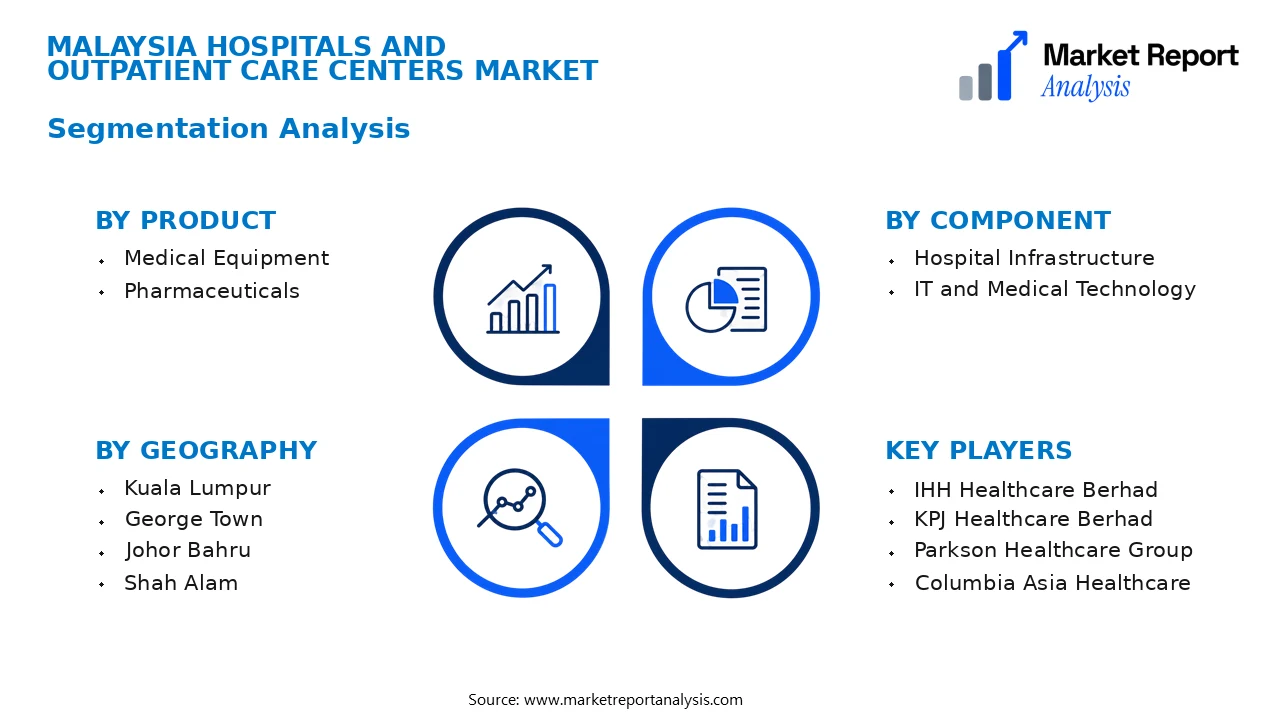
- Product
- Medical Equipment: This segment includes advanced diagnostic and therapeutic devices essential for hospital operations, with growing adoption driven by technological innovations and the need for enhanced diagnostic accuracy and treatment efficacy.
- Pharmaceuticals: Comprising a broad range of medications and therapies used within hospitals and outpatient settings, this segment is fueled by rising chronic disease prevalence and government initiatives to expand access to essential medicines.
- Component
- Hospital Infrastructure: Encompassing building facilities, utilities, and core medical services, this component is critical for establishing functional healthcare centers, with expansion driven by government policies and private sector investments aimed at increasing healthcare capacity.
- IT and Medical Technology: This includes healthcare IT solutions, Electronic Medical Records (EMR), and telemedicine systems that enhance operational efficiency, patient management, and remote care delivery, experiencing rapid growth particularly in outpatient sectors.
- Type
- Public Hospitals: These are government-funded institutions that provide affordable healthcare services, serving the majority of the population and expanding through government subsidies amidst increasing healthcare demands.
- Private Hospitals and Outpatient Clinics: Characterized by higher service quality and specialized care, this segment is growing due to rising disposable income, better infrastructure, and patient preference for private healthcare options.
- Technology
- Diagnostic Imaging: This segment covers MRI, CT scans, ultrasonography, and X-ray technologies crucial for accurate diagnosis, witnessing increased adoption especially in high-end private hospitals and outpatient diagnostic labs.
- Telemedicine: Enabling remote consultations, this technology has gained traction, especially post-pandemic, facilitating outpatient care access in rural and underserved areas, thus expanding overall market reach.
- Platform
- On-Premise Solutions: Traditional deployment of healthcare IT systems hosted within hospital premises, preferred where data security is paramount and infrastructure allows for stable connectivity.
- Cloud-Based Solutions: Offering scalability and remote access, cloud platforms are increasingly utilized in outpatient centers and smaller hospitals seeking cost-effective and flexible technology solutions.
- Application
- Inpatient Services: These services constitute care for admitted patients requiring intensive medical intervention, typically associated with larger hospitals and referral centers, generating substantial revenue streams.
- Outpatient Services: Including diagnostic, consultation, and minor procedures, outpatient services dominate the market due to higher patient throughput, convenience, and lower treatment costs.
- End User
- Hospitals: As primary healthcare providers, hospitals are the main consumers of medical technology and equipment, with ongoing expansion projects boosting market demand.
- Outpatient Care Centers: These centers serve the increasing outpatient demand by offering convenient, efficient healthcare delivery, driving innovation and investment in outpatient-specific services.
- Geography
- Kuala Lumpur: The commercial and healthcare hub of Malaysia, Kuala Lumpur hosts the majority of high-tech hospitals and outpatient clinics, representing a significant market concentration due to urbanization and healthcare investments.
- George Town: As an important medical tourism and healthcare center in Penang, George Town features a growing number of modern outpatient and specialized medical centers catering to both domestic and international patients.
- Johor Bahru: Situated at the southern border, Johor Bahru is expanding its medical infrastructure rapidly, driven by cross-border healthcare demand and government initiatives aimed at regional healthcare development.
- Shah Alam: Serving the Selangor state, Shah Alam experiences steady growth in outpatient clinics and private hospitals, supported by urban population growth and increased healthcare expenditure.
Competitive Intelligence
The Malaysia Hospitals and Outpatient Care Centers Market exhibits moderate competition with several key players dominating regional segments, particularly in Kuala Lumpur and Penang. Market concentration remains relatively balanced, though leading companies such as KPJ Healthcare Berhad and Pantai Holdings focus on expanding their hospital networks and outpatient facilities to enhance market share. Business strategies primarily center on strategic partnerships and acquisitions; for instance, collaborations with international medical technology firms have facilitated product innovation and service diversification. Major players are investing significantly in R&D to develop advanced medical technologies and patient-centered care models, further differentiating their offerings. Moreover, expansion strategies include opening new facilities in underserved areas and upgrading existing infrastructure to attract a broader patient base. Some companies are leveraging telemedicine and outpatient service innovations to increase operational efficiency and market reach. Competitive differentiation hinges on the quality of healthcare services, technological integration, and strategic alliances with insurance providers and government agencies. This dynamic landscape encourages continuous innovation and strategic positioning tailored to regional demands across Malaysian cities.
Leading Company Profiles
The competitive landscape within the Malaysia Hospitals and Outpatient Care Centers Market features a diverse array of key players committed to delivering high-quality healthcare services through innovative technology, strategic expansions, and patient-centered approaches, ensuring their stronghold in the evolving market environment.
- IHH Healthcare Berhad
- KPJ Healthcare Berhad
- Parkson Healthcare Group
- Columbia Asia Healthcare
- Pantai Medical Centre
- Assunta Hospital
- Sunway Medical Centre
- KPJ Specialist Medical Centre
- KPJ Puteri Specialist Medical Centre
IHH Healthcare Berhad
IHH Healthcare Berhad stands out as one of the leading providers in Malaysia, offering a broad portfolio of hospital services with a focus on technological innovation, operational efficiency, and expanding its international healthcare network.
KPJ Healthcare Berhad
KPJ Healthcare Berhad emphasizes regional growth and hospital modernization, integrating sophisticated healthcare technologies, patient-centric services, and strategic acquisitions to boost its market share in Malaysia and neighboring countries.
The Ministry of Health Malaysia governs the majority of public hospitals and outpatient centers, leading significant investments in infrastructure development, policy reforms, and digital health initiatives to improve nationwide healthcare accessibility and quality.
Parkson Healthcare Group
Parkson Healthcare Group focuses on private hospital services, emphasizing expansion through facility upgrades, service diversification, and collaborations with technology firms to enhance clinical outcomes and patient satisfaction.
Columbia Asia Healthcare
Columbia Asia operates multiple hospitals across Malaysia with a strategic focus on outpatient care centers, incorporating advanced diagnostic and minimally invasive procedures to attract a broad patient demographic, targeting outpatient and surgical services growth.
Pantai Medical Centre
Pantai Medical Centre emphasizes specialized services in cardiology and oncology, leveraging cutting-edge medical technology and forming strategic alliances to enhance its service offerings and clinical expertise.
Assunta Hospital
Assunta Hospital invests heavily in technological upgrades, capacity expansion, and hospital automation to improve efficiency, patient care, and to meet increasing demand for outpatient and inpatient services in metropolitan Kuala Lumpur.
Sunway Medical Centre
Sunway Medical Centre continues to expand its outpatient clinics and specialty services, integrating digital health solutions and sustainability projects to provide eco-friendly, patient-friendly healthcare environments.
KPJ Specialist Medical Centre
KPJ Specialist Medical Centre is developing its outpatient and specialty care segments, implementing telehealth services and electronic health records to enhance operational efficiency and patient engagement.
KPJ Puteri Specialist Medical Centre
KPJ Puteri focuses on expanding outpatient diagnostic and outpatient surgical services, adopting innovative medical technologies and forming strategic alliances to boost regional competitiveness and healthcare quality.
Strategic Business Developments

- January 2023 – IHH Healthcare Berhad – Launched new flagship hospital in Kuala Lumpur – Enhances capacity, broadens service offerings, and attracts a higher volume of outpatient and inpatient cases.
- June 2023 – KPJ Healthcare Berhad – Reached strategic partnership with leading medical device companies – Improves technology deployment, enabling advanced diagnostics and minimally invasive procedures in outpatient care.
- March 2024 – Ministry of Health Malaysia – Invested in nationwide digital health platform – Significantly improves outpatient appointment management, electronic health records accessibility, and telemedicine services nationwide.
- September 2023 – Sunway Medical Centre – Opened new outpatient specialty clinics – Expands specialized outpatient services, attracts higher outpatient volumes, and enhances patient convenience.
- April 2023 – Columbia Asia Healthcare – Acquired a regional outpatient clinic network – Strengthens outpatient footprint, enables service integration, and boosts overall outpatient care capacity
Frequently Asked Questions
What is the Malaysia Hospitals and Outpatient Care Centers Market?
The Malaysia Hospitals and Outpatient Care Centers Market encompasses the country's healthcare infrastructure, including hospitals and outpatient clinics, which provide a broad spectrum of medical services to the population. It is pivotal for delivering both specialized and primary healthcare.
What is the current market size of Malaysia Hospitals and Outpatient Care Centers Market?
As of 2026, the market size is valued at approximately USD 17 Billion, reflecting Malaysia’s expanding healthcare infrastructure and increasing demand for quality medical services. The market is expected to exhibit consistent growth through 2034.
What factors are driving the Malaysia Hospitals and Outpatient Care Centers Market?
Key growth drivers include rising healthcare expenditures, government initiatives for healthcare expansion, increasing prevalence of chronic diseases, a growing aging population, and technological advancements in medical facilities and outpatient care delivery systems.
Which region dominates the Malaysia Hospitals and Outpatient Care Centers Market?
Selangor leads as the dominant region due to its high population density, urbanization, and concentration of private hospitals and outpatient clinics. Kuala Lumpur also remains a critical hub for medical tourism and advanced healthcare services.
Which segment is expected to grow the fastest?
Outpatient care centers are projected to experience the fastest growth, driven by a shift toward outpatient procedures, increased outpatient service offerings, and a focus on cost-effective healthcare delivery, accounting for a significant portion of the overall market expansion.
Who are the leading companies operating in the Malaysia Hospitals and Outpatient Care Centers Market?
Major players include KPJ Healthcare Berhad, IHH Healthcare Berhad, Parkway Pantai Limited, and Columbia Asia Healthcare. These firms expand through technological innovation, strategic acquisitions, and expanding outpatient network services across Malaysia.
Analyst Perspective
The Malaysia Hospitals and Outpatient Care Centers Market exhibits a mature yet evolving landscape, driven by ongoing healthcare reforms, increasing health consciousness, and demographic shifts. Over the forecast period, technological advancements such as telemedicine, AI diagnostics, and electronic health records will catalyze service delivery, enhancing operational efficiency and patient outcomes. Investment priorities should focus on upgrading existing infrastructure and integrating digital health solutions, especially in key urban areas like Kuala Lumpur, Penang, and Johor Bahru, which present substantial regional growth opportunities. Competitive intensity is expected to rise as both domestic and international players seek strategic alliances, public-private partnerships, and innovative service models to capture market share. Long-term market outlook remains stable, with sustained demand for outpatient services and specialized care. Strategic positioning now involves leveraging regional healthcare hubs, fostering technological innovation, and customizing service delivery to meet evolving patient needs. Risk management must prioritize regulatory stability and technological adoption to capitalize on Malaysia’s substantial healthcare growth potential.
