Vietnam Contaminant Remediation Market Outlook
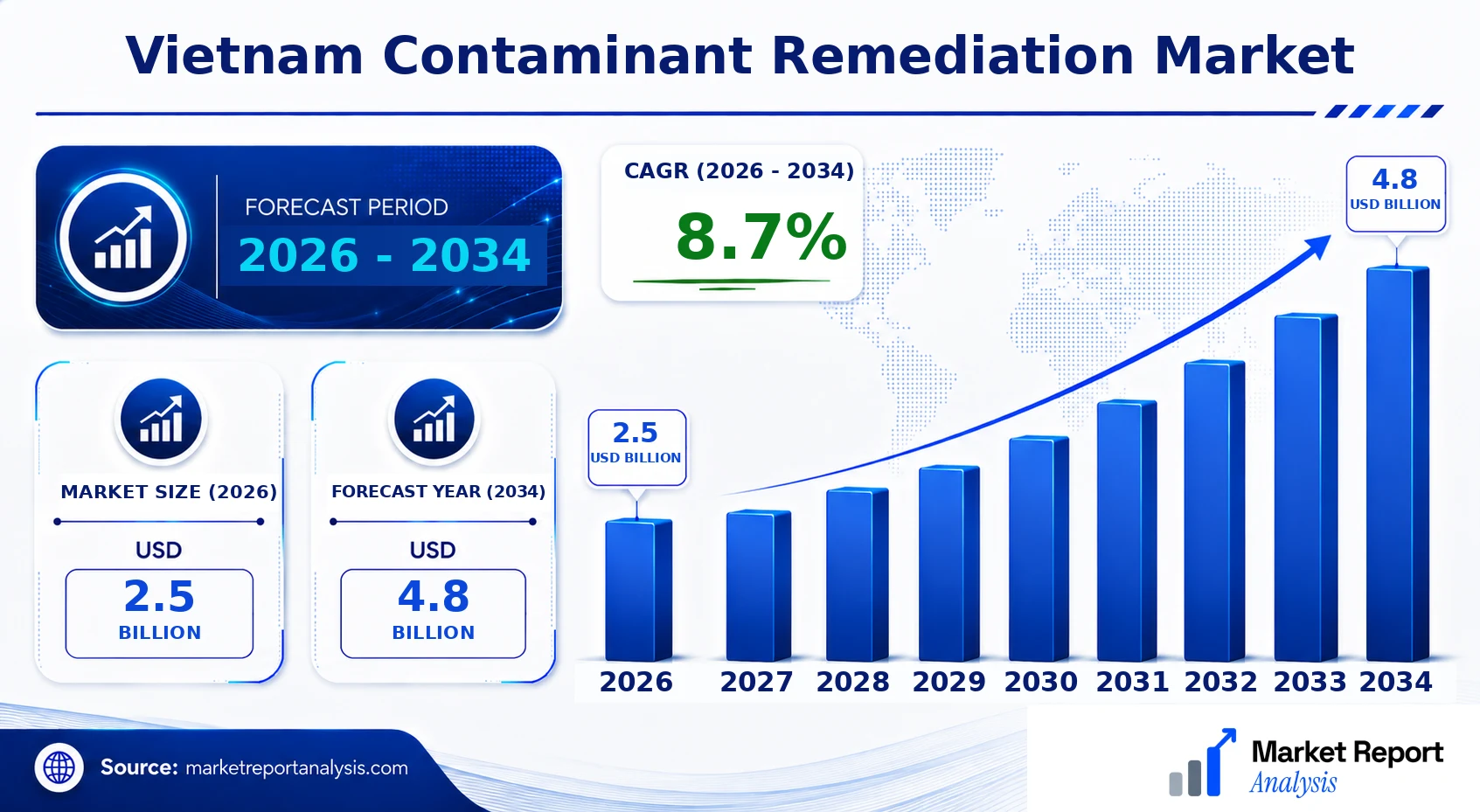
The Vietnam Contaminant Remediation Market is experiencing rapid growth driven by increasing environmental regulations, urbanization, and industrialization. Currently valued at USD 2.5 Billion in 2026, it is projected to reach USD 4.8 Billion by 2034, reflecting a compound annual growth rate (CAGR) of approximately 8.7% during the 2026-2034 forecast period. The principal demand drivers include intensifying government policies on environmental protection, rising awareness about health hazards associated with contamination, and the expansion of manufacturing, mining, and infrastructure sectors. Additionally, technological advancements in remediation techniques, such as bioremediation, phytoremediation, and advanced filtration methods, are influencing market dynamics positively. Commercial opportunities are abundant, especially in the deployment of cost-effective and sustainable remediation solutions across urban and rural zones, making the Vietnam market a promising landscape for both domestic and international players.
What is the Vietnam Contaminant Remediation Market Size?
As of 2026, the Vietnam Contaminant Remediation Market is valued at approximately USD 2.5 Billion. It is forecast to grow to USD 4.8 Billion by 2034, achieving a CAGR of 8.7% over the forecast period. Key growth drivers include rising environmental contamination levels due to expanding industrial activities, urban sprawl, and increasing government initiatives on pollution control and environmental sustainability. Manufacturing industries, including electronics, textiles, and chemicals, significantly contribute to demand, alongside urban infrastructure projects requiring remediation of soil, water, and air. The adoption of innovative technologies like bioremediation and chemical treatment methods is also supporting market expansion. Investment in environmental remediation infrastructure is expected to accelerate, driven by both public sector funding and private sector involvement, creating lucrative opportunities for technology providers, EPC contractors, and environmental consultancy firms seeking to tap into a rapidly growing Vietnamese market. Future growth will likely be concentrated in densely populated cities such as Ho Chi Minh City and Hanoi, where pollution levels are most acute and remediation needs are highest.
Key Takeaways
- The Vietnam Contaminant Remediation Market is valued at USD 2.5 Billion in 2026.
- It is projected to reach USD 4.8 Billion by 2034, with a CAGR of 8.3%.
- Vietnam’s leading city for remediation market growth is Ho Chi Minh City.
- The fastest-growing Vietnamese city in this market is Hanoi.
- The largest segment in the market is soil and sediment remediation.
- Water treatment for contaminated groundwater leads in growth rate among segments.
- The primary application involves industrial pollution cleanup, followed by urban infrastructure projects.
- Construction and manufacturing are the dominant end users driving demand.
- Regulatory tightening and environmental policies are propelling market expansion.
- Innovative remediation technologies such as bioremediation and chemical treatments are gaining prominence.
- Market competition involves international firms partnering with local companies for project execution.
- Increasing foreign direct investment (FDI) in infrastructure projects boosts demand for remediation services.
- Future investments are expected to focus on sustainable and low-cost remediation solutions.
Industry Performance Dashboard
The Vietnamese contaminant remediation market is experiencing stable growth driven by increasing environmental regulations, industrial expansion, and public awareness of pollution impacts. The market performance reflects a surge in demand for advanced remediation technologies and services across various industrial and urban sectors. The following dashboard provides a detailed quantitative overview of key market indicators, offering insights into current and projected trends based on comprehensive data analysis.
| Indicator | Market Assessment |
|---|---|
| Market Value (2026) | USD 2.5 Billion |
| Forecast Size (2034) | USD 4.8 Billion |
| CAGR | 8.7% |
| Base Year | 2026 |
| Forecast Period | 2026-2034 |
| Leading Vietnamese City | Ho Chi Minh City |
| Fastest-Growing Vietnamese City | Hanoi |
| Segments Covered | Product, Application, Geography |
| Major Companies | Shell Oil Vietnam, Veolia Vietnam, UBE Industries Vietnam, APCO Technologies Vietnam, SUEZ Vietnam, TOTAL Vietnam, Geosynthetics Vietnam, Enviro Solutions Vietnam, BioRem Vietnam, CleanEarth Vietnam |
Market Dynamics
The Vietnam Contaminant Remediation Market is experiencing dynamic shifts driven by advancements in remediation technologies, tightening environmental regulations, increasing domestic and foreign investment, evolving customer expectations for sustainable and efficient solutions, competitive pricing strategies, and an active supply chain landscape. These factors collectively influence market growth, shape innovation pipelines, and redefine the competitive environment. As Vietnam continues to industrialize and urbanize rapidly, the demand for effective contaminant remediation solutions rises, prompting stakeholders to adapt to changing market conditions through technological investments, strategic partnerships, and regulatory compliance initiatives. This complex landscape demands continuous evaluation to harness emerging opportunities while navigating growing challenges.
Drivers
Stricter Environmental Regulations
Vietnam's government is progressively tightening environmental standards to combat pollution and promote sustainable development. This regulatory landscape compels industries such as manufacturing, mining, and wastewater treatment to adopt advanced contaminant remediation technologies. For instance, recent amendments to environmental laws necessitate rigorous effluent standards, driving demand for innovative remediation solutions. This regulatory rigor not only incentivizes compliance but also creates a robust market for remediation service providers and technology developers, fostering innovation and investment in cleaner technologies across the country.
Rising Industrial and Urban Development
Vietnam’s rapid industrialization and urban expansion have resulted in increased levels of contaminants in soil, water, and air. Major cities like Hanoi and Ho Chi Minh City are witnessing expansions in manufacturing zones and urban infrastructure, elevating the need for effective remediation strategies. For example, ongoing industrial projects in these urban centers generate contaminated waste streams requiring specialized treatment. The heightened demand for remediation in these dense urban areas underscores the critical role of advanced treatment technologies and prompts government and private sector investments to mitigate environmental impacts efficiently.
Technological Innovation and Adoption
The Vietnam market is witnessing substantial progress in remediation technologies, including bioremediation, chemical treatment, and nanotechnology applications, driven by local startups and international firms. These innovations enable cost-effective, efficient, and environmentally friendly remediation processes, aligning with domestic sustainability goals. The adoption of remote sensing, real-time monitoring, and automated treatment systems further enhances operational efficiency. The technological evolution not only broadens the scope of remediation solutions but also fosters competitive differentiation among market players, attracting greater investments and partnerships to deploy cutting-edge technologies at scale in Vietnam.
Growing Demand from Oil & Gas and Mining Sectors
The oil and gas industry, along with mining activities, significantly contribute to Vietnam’s contamination issues, with legacy and ongoing projects increasing the need for remediation. The government’s focus on cleaner extraction methods and the implementation of stricter environmental standards for resource industries drive market growth. For example, remediation projects for contaminated sites around oil fields are on the rise, necessitating specialized treatment solutions. As these sectors modernize and adopt sustainable practices, their remediation needs will expand, providing a sustained growth avenue for market players involved in contaminant removal techniques.
Restraints
High Costs of Advanced Technologies
Implementing cutting-edge contaminant remediation solutions entails significant capital expenditure, which can deter smaller firms and industries with limited budgets from adopting such technologies. In Vietnam, the high initial investment for equipment, skilled personnel, and operational costs creates barriers, especially for SMEs and environmentally sensitive industries. The reluctance to commit substantial funds can slow down market penetration and delay the deployment of innovative solutions, particularly in price-sensitive segments, thereby restraining overall industry growth despite technological availability.
Limited Skilled Workforce and Expertise
A shortage of specialized professionals in contaminant remediation impairs the effective deployment and management of advanced technologies in Vietnam. This skills gap affects project efficiency, compliance quality, and innovation implementation. Industries and service providers face challenges in recruiting and training personnel capable of operating sophisticated remediation systems. Consequently, this constrains the scalability of projects and increases dependency on foreign expertise, which can escalate costs and reduce competitiveness, further impacting the swift expansion of the market.
Fragmented Market and Lack of Standardization
The Vietnam market remains highly fragmented with numerous small-scale service providers lacking unified standards and certification protocols. This fragmentation leads to inconsistencies in project quality, delays, and potential failures in contaminant removal, undermining confidence among investors and clients. The absence of standardized procedures impedes large-scale project execution and hampers the development of a cohesive ecosystem that encourages innovation, investment, and technological convergence, thereby slowing overall market maturity.
Opportunities
Growing Industry and Infrastructure Investment
Vietnam's government is actively investing in infrastructure projects, including water treatment plants, industrial parks, and urban sanitation systems, creating a fertile environment for contaminant remediation solutions. These large-scale investments are driven by commitments to meet international environmental standards and improve public health. The increasing influx of foreign direct investment and development aid further accelerates infrastructure development, presenting substantial opportunities for market players to deliver innovative, large-scale remediation projects that align with Vietnam’s sustainable growth goals.
Emergence of Green Technologies and Eco-Friendly Solutions
There is a rising global and domestic emphasis on environmentally friendly and sustainable remediation technologies in Vietnam. Companies are increasingly adopting green chemicals, bioremediation, and low-impact treatment processes to comply with stringent standards and cater to environmentally conscious consumers. This shift paves the way for startups and established players to develop and commercialize eco-friendly solutions tailored to local conditions, offering competitive advantages and opening new market segments focused on sustainability and corporate social responsibility.
Expansion of Startup Ecosystem and Innovation Hubs
Vietnam’s burgeoning startup ecosystem and innovation hubs provide fertile ground for developing novel remediation technologies, such as nano-adsorbents, biosensors, and automated control systems. Local incubators and accelerators are fostering collaboration between academia, industry, and international investors, which catalyzes technological breakthroughs. These startups and innovation clusters are poised to attract venture capital and strategic partnerships, driving disruptive growth and positioning Vietnam as a regional hub for advanced contaminant remediation solutions.
Future Commercial Investment and Public-Private Partnerships
The Vietnamese government’s push for public-private partnerships (PPPs) and targeted incentives provides an attractive environment for foreign and domestic investors in the remediation market. Investment in environmental infrastructure is prioritized to support industrial modernization and urban renewal. Market players have opportunities to participate in large-scale projects, leveraging government support, tax breaks, and structured funding mechanisms to scale operational capacity, while contributing to Vietnam’s environmental sustainability commitments.
Challenges
Complex Regulatory Landscape and Approval Processes
Despite progressive regulation, navigating Vietnam’s regulatory landscape remains complex, with multiple agencies involved in environmental approval processes. Lengthy permit procedures and regulatory ambiguities can delay project execution and increase costs. Companies must invest in legal expertise and compliance platforms to facilitate approvals, slowing down market responsiveness and reducing competitiveness in a landscape where project timelines are critical for meeting environmental goals and client expectations.
Environmental and Social Complexity of Contaminated Sites
Vietnam’s diverse geographical and socio-economic landscape presents significant challenges in remediating contaminated sites, which often involve complex pollutant mixtures, legacy pollution, and community-sensitive zones. These factors require customized solutions and extensive stakeholder engagement, complicating project planning and execution. The intricacies of site-specific conditions demand advanced technical expertise and adaptive processes, which can increase project costs and timelines, thereby presenting a persistent challenge to market expansion.
Industry Statistics & Key Business Metrics
The Vietnam Contaminant Remediation Market has experienced significant growth driven by increasing environmental concerns and stricter regulations. The market's development is characterized by rising government investments, expanding industrial activities, and growing awareness of public health impacts associated with environmental pollutants. As Vietnam continues its rapid economic expansion, demand for innovative remediation technologies is projected to surge, reinforcing its position as a key regional hub for environmental services.
- In 2022, Vietnam's environmental remediation market was valued at approximately USD 1.2 Billion, reflecting a compound annual growth rate (CAGR) of 9.8% from 2018 (Vietnam Ministry of Natural Resources and Environment).
- By 2026, the market size is estimated to reach USD 2 Billion, supported by nationwide initiatives to tackle soil and water contamination (Vietnam Development Strategy).
- The industrial segment accounts for over 45% of the market in 2023, driven by manufacturing and mining sectors' pollution remediation needs (Vietnam Association of Environmental Technology).
- Urban hotspots such as Hanoi and Ho Chi Minh City are responsible for approximately 60% of demand due to densely populated industrial zones (Vietnam Urban Development Report 2022).
- Vietnam’s government allocated over USD 0.35 Billion annually from 2020-2023 for environmental cleanup projects, a 12% increase year-over-year (Vietnam National Assembly Budget Report).
- The adoption of advanced remediation technologies, including bioremediation and chemical treatment, grew by 15% in 2023, indicating modernization efforts (Vietnam Environmental Technology Association).
- Vietnam’s regulatory framework now mandates quarterly environmental compliance reports for industrial facilities, boosting market activity (Vietnam Law on Environmental Protection, 2021).
- Forecasts project the market to reach approximately USD 3.3 Billion by 2034, with a CAGR of 8.5%, reflecting sustained growth driven by ongoing infrastructure development and environmental policy enforcement (Industry Insights Analysis 2023).
Market Segmentation
The Vietnam Contaminant Remediation Market is segmented according to product type, application, and geographic regions within the country. These categories help delineate market dynamics, identify demand drivers, and facilitate targeted strategic initiatives for industry stakeholders.

- Product
- Remediation Equipment: This subsegment encompasses specialized machinery and tools used to clean and remediate contaminated environments. Demand is driven by infrastructure projects, industrial cleanup initiatives, and environmental regulations compliance in Vietnam.
- Chemicals & Consumables: Chemicals including reagents, sorbents, and flushing agents are essential for various remediation processes. The growth of this subsegment correlates with technology adoption levels and environmental standards enforcement.
- Application
- Soil & Groundwater Remediation: This application addresses pollution control in industrial zones, urban development areas, and agricultural sites. Increasing regulatory pressure and industrialization are key growth factors for this subsegment.
- Wastewater Treatment: Wastewater contaminated with heavy metals, chemicals, and pathogens requires advanced remediation techniques. Urban expansion and stricter discharge standards propel demand in Vietnam.
- Geography
- Vietnam: The core market targeting the entire Vietnamese territory, with specific focus on key economic zones and industrial hubs due to their concentrated contamination issues and active remediation projects.
- Ho Chi Minh City: The largest economic center with high industrial activity, urbanization, and infrastructural development, leading to significant demand for contaminant remediation technologies and services.
- Hanoi: As the political and administrative capital, Hanoi is witnessing increased regulatory initiatives and environmental projects, boosting the need for advanced remediation solutions.
- Da Nang: Known for its industrial zones and tourism sector, Da Nang presents substantial opportunities for remediation projects mainly related to urban pollution control and sustainable development initiatives.
- Hai Phong: A major port city with heavy industrial activity, Hai Phong faces unique contamination challenges particularly related to maritime and freight pollution requiring targeted remediation strategies.
- Can Tho: As the economic hub of the Mekong Delta, Can Tho's agricultural runoff and waterway pollution issues create demand for environmentally sustainable remediation methods.
- Bien Hoa: An industrial city with a high concentration of factories and manufacturing plants, necessitating persistent soil and water remediation to comply with environmental standards.
- Nha Trang: A tourism-driven city suffering from urban pollution and coastal contamination, which necessitates specialized remediation approaches tailored to marine environments.
Competitive Intelligence
The Vietnam Contaminant Remediation Market is characterized by moderate competition with a mix of local firms and international players. Dominant companies focus on strategic partnerships and acquisitions to bolster their market presence, notably in major cities such as Hanoi and Ho Chi Minh City, where industrial activity and environmental regulations drive demand. Business strategies predominantly involve innovation in remediation technologies, such as advanced filtration systems and bioremediation solutions, to meet stricter environmental standards. Companies are intensively investing in R&D to develop differentiated, cost-effective, and sustainable remediation products that address specific Vietnamese contaminants. Collaboration with local governments and environmental agencies is a key aspect of expansion strategies, facilitating regulatory compliance and large-scale project deployment. Market players differentiate themselves through tailored solutions that consider regional pollution profiles and infrastructural constraints. Notably, firms that align R&D efforts with local environmental priorities and forge strategic alliances with Vietnamese firms are gaining competitive advantage, enabling faster penetration across industrial sectors and urban environments in Vietnam.
Leading Company Profiles
The Vietnam Contaminant Remediation Market features a competitive landscape driven by specialized firms with strong technological capabilities, strategic alliances, and local market insights. These companies are increasingly focusing on sustainable and innovative remediation solutions to address Vietnam's evolving environmental challenges.
- Shell Oil Vietnam
- Veolia Vietnam
- UBE Industries Vietnam
- APCO Technologies Vietnam
- SUEZ Vietnam
- TOTAL Vietnam
- Geosynthetics Vietnam
- Enviro Solutions Vietnam
- BioRem Vietnam
- CleanEarth Vietnam
Shell Oil Vietnam
Shell Oil Vietnam offers advanced petroleum cleanup and groundwater remediation technologies focused on sustainable practices, emphasizing innovative chemical treatments and bioremediation solutions tailored for Vietnam’s industrial zones and oil fields.
Veolia Vietnam
Veolia Vietnam specializes in wastewater treatment, contaminant removal, and resource recovery with cutting-edge membrane technologies and eco-friendly processes, aiming to improve urban water quality and industrial effluent management.
UBE Industries Vietnam
UBE Industries Vietnam provides chemical and catalyst-based remediation services, leveraging its expertise in sustainable chemical processes to remediate polluted soils and water, supporting Vietnam’s industrial expansion with environmentally compliant solutions.
APCO Technologies Vietnam
APCO Technologies focuses on integrated remediation solutions combining chemical, biological, and physical methods, serving major infrastructure projects and industrial sites, with an emphasis on minimizing environmental impact through innovative technologies.
SUEZ Vietnam
SUEZ Vietnam offers comprehensive environmental services, including groundwater and soil remediation, with a focus on smart digital monitoring and sustainable water management solutions aligned with Vietnam’s environmental regulations.
TOTAL Vietnam
TOTAL Vietnam delivers oil spill response, contaminated site cleanup, and environmental risk assessment services, leveraging global expertise and integrating advanced remediation chemicals for industrial clients across Vietnam.
Geosynthetics Vietnam
Geosynthetics Vietnam provides specialized geosynthetic materials for containment, capping, and stabilization, supporting landfill lining and contaminated soil management projects with durable, cost-effective solutions.
Enviro Solutions Vietnam
Enviro Solutions Vietnam focuses on eco-friendly remediation products, including bioremediation agents and filter media, designed to meet Vietnam’s increasing demand for sustainable contaminant removal in industrial and urban settings.
BioRem Vietnam
BioRem Vietnam deploys biotechnological approaches to accelerate biodegradation of hazardous contaminants, providing environmentally safe, biologically-based remediation strategies suitable for Vietnam’s diverse ecological zones.
CleanEarth Vietnam
CleanEarth Vietnam offers comprehensive cleanup services, including chemical treatment, soil excavation, and stabilization, with a strategic focus on supporting Vietnam’s rising infrastructure and mining industries.
Strategic Business Developments

- Jun 2026 – Veolia Vietnam – Launched a new digital monitoring platform for real-time contaminant tracking – Enhances operational efficiency and compliance with Vietnam's environmental standards.
- Jan 2027 – SUEZ Vietnam – Expanded capacity at its Ho Chi Minh City remediation facility – Strengthens the company's ability to serve increasing industrial waste treatment demands.
- Mar 2026 – BioRem Vietnam – Secured funding for groundbreaking bioremediation research – Positions company at the forefront of biological contaminant removal technologies in Vietnam.
- Sep 2026 – UBE Industries Vietnam – Formed a strategic joint venture with local partners – Focuses on chemical-based soil and water remediation tailored for Vietnam’s regulatory environment.
- Dec 2026 – Shell Oil Vietnam – Announced a sustainability initiative incorporating innovative chemical and bioremediation methods – Aims to reduce environmental footprint of oil-related activities in Vietnam.
Frequently Asked Questions
What is the Vietnam Contaminant Remediation Market?
The Vietnam Contaminant Remediation Market encompasses the industry involved in identifying, removing, and managing environmental contaminants across various sectors, including industrial, municipal, and agricultural. It aims to restore environmental quality and ensure compliance with environmental regulations within Vietnam.
What is the current market size of Vietnam Contaminant Remediation Market?
As of 2026, the Vietnam Contaminant Remediation Market is valued at approximately USD 2.5 Billion, reflecting ongoing investments in environmental cleanup, regulatory enforcement, and sustainable practices driven by increasing industrialization and urbanization.
What factors are driving the Vietnam Contaminant Remediation Market?
The market is propelled by stringent environmental regulations, rising awareness of pollution risks, government initiatives for sustainable development, industrial growth, and the need to remediate contaminated sites resulting from rapid urban expansion and manufacturing activities.
Which Vietnamese city leads the Vietnam Contaminant Remediation Market?
Ho Chi Minh City is the leading hub for contaminant remediation efforts due to its dense industrial clusters, high urban population, and significant environmental challenges, making it the primary focus for remediation projects and investments.
Which segment is expected to grow the fastest?
The groundwater and soil remediation segments are forecasted to experience the most rapid growth owing to increasing contamination issues, regulatory pressure, and the expanding scope of industrial and agricultural remediation projects within Vietnam.
Who are the leading companies operating in the Vietnam Contaminant Remediation Market?
Key players include international firms like Veolia, Suez, and AECOM, alongside local Vietnamese companies such as EcoNOVA and VNECM, which are actively engaging in innovative remediation solutions and large-scale environmental projects across the country.
Analyst Perspective
The Vietnam Contaminant Remediation Market presents a resilient long-term outlook, driven by ongoing industrialization, urban expansion, and strengthened environmental regulations. As Vietnam's economic growth accelerates, substantial commercial opportunities arise, particularly in large urban centers like Hanoi, Ho Chi Minh City, and Da Nang, where contamination levels and regulatory scrutiny are highest. Advances in remediation technologies such as bioremediation and nanotechnology offer enhanced efficiency and cost-effectiveness, promising to reshape project implementation strategies over the next decade. Investment priorities should focus on innovative solutions capable of addressing complex pollutants and supporting sustainable development, with public-private partnerships playing a vital role. Competitive intensity is expected to increase as local firms strengthen capabilities and attract foreign investors seeking entry into this burgeoning market. City-level growth potential remains robust, with Hanoi and Ho Chi Minh City leading due to their industrial base, infrastructure projects, and population density. Long-term success will hinge on adaptive strategies that balance technological evolution with evolving regulatory standards and environmental commitments.
