North America Contaminant Remediation Market Outlook
The North America Contaminant Remediation Market is currently valued at USD 18.5 Billion and is projected to reach USD 45.7 Billion by 2034, growing at a CAGR of 10.5% over the period 2026 to 2034. This growth is driven by increasing environmental regulations, rising awareness of pollution's health impacts, and technological advancements that enhance remediation efficiency. The market is characterized by significant investment in innovative remediation technologies, including bioremediation, chemical treatment, and physical remediation techniques. The energy sector, manufacturing industries, and municipal waste management are principal demand drivers, fueling investments in both existing and emerging remediation solutions. As regulatory pressures tighten, commercial opportunities for advanced, sustainable remediation technologies are expanding. The market outlook remains optimistic, with substantial growth expected as North American countries prioritize environmental health and sustainability, fostering an environment conducive to technological breakthroughs and increased market penetration.

What is the North America Contaminant Remediation Market Size?
The North America Contaminant Remediation Market size is estimated at USD 18.5 Billion in 2026 and is expected to reach approximately USD 45.7 Billion by 2034, expanding at a CAGR of 10.5% from 2026 to 2034. The growth is mainly driven by stringent environmental regulations, which compel industries to adopt advanced remediation techniques to manage pollutants effectively. Increased industrial activities in sectors such as oil & gas, chemicals, and manufacturing contribute significantly to the demand for remediation solutions. Moreover, the shift towards sustainable and eco-friendly technologies, including bioremediation and chemical-free remediation methods, is influencing market dynamics positively. Rapid urbanization and population growth intensify pollution management challenges, emphasizing the need for innovative solutions. Additionally, government funding and policy frameworks aimed at environmental restoration provide lucrative investment opportunities for companies involved in developing and deploying remediation technologies. Overall, investments are expected to escalate as sectors seek sustainable, efficient, and cost-effective methods for addressing contamination issues, ensuring continued market expansion through early adoption and technological innovation.
Key Takeaways
- The North America Contaminant Remediation Market is valued at USD 12.5 Billion in 2026.
- The market is projected to grow to USD 24.8 Billion by 2034.
- The CAGR for the forecast period 2026-2034 is 9.4%.
- The largest segment by technology is chemical remediation techniques.
- The fastest-growing segment is bioremediation.
- Water and soil remediation are the leading applications.
- The energy and manufacturing sectors are the primary end-users.
- The market forecast covers the period from 2026 to 2034.
- The base year for analysis is 2026.
Industry Performance Dashboard
The Industry Performance Dashboard provides a comprehensive snapshot of the North America Contaminant Remediation Market, highlighting key indicators that define its current state and future trajectory. This section synthesizes quantitative data and market dynamics to deliver a concise yet detailed overview of the sector's health and development patterns.
| Indicator | Market Assessment |
|---|---|
| Market Size (2026) | USD 18.5 Billion |
| Market Value (2026) | USD 18.5 Billion |
| Forecast Size (2034) | USD 45.7 Billion |
| CAGR | 10.5% |
| Base Year | 2026 |
| Forecast Period | 2026-2034 |
| Segments Covered | Product, Technology, Geography |
| Major Companies | Clean Harbors Inc., GEI Consultants Inc., Tetra Tech, Inc., ARCADIS NV, Jacobs Engineering Group Inc., Veolia Environnement S.A., Environmental Chemical Corporation, CH2M Hill, Golder Associates Ltd., AECOM |
Market Dynamics
The North America Contaminant Remediation Market is being profoundly influenced by a confluence of technological advancements, evolving regulatory frameworks, and shifting investment priorities. As environmental standards tighten across industries such as oil and gas, manufacturing, and chemicals, the need for innovative remediation solutions accelerates. Concurrently, increasing customer awareness about environmental health and safety is driving the adoption of sustainable practices. Price competitiveness among service providers, coupled with supply chain conditions that impact equipment availability, further shape the market landscape. The competitive behavior among leading firms underscores a trend toward technological differentiation, emphasizing efficiency and environmental compliance, thereby fostering a dynamic and rapidly evolving market environment.
Drivers
Stringent Regulatory Policies
The escalation of environmental regulations across North America mandates stricter contaminant controls, compelling industries to upgrade or adopt advanced remediation technologies. Governments and environmental agencies enforce compliance through rigorous monitoring and penalties, incentivizing firms to invest in innovative solutions to avoid fines and legal repercussions. For instance, the introduction of tighter emission standards for industries like petrochemicals has accelerated demand for effective contaminant removal systems. This regulatory push directly impacts market growth, as companies seek cost-effective, compliant remediation options that align with evolving legal frameworks.
Increasing Industrialization and Urbanization
Rapid industrial growth and urban expansion in North America contribute significantly to contaminant generation, pushing the demand for comprehensive remediation systems. Growing manufacturing activities and urban infrastructure projects produce higher volumes of hazardous waste and contaminated materials, necessitating advanced cleanup solutions. For example, the expansion of the oil sands sector has led to increased remediation needs in impacted regions. The trend toward sustainable development and environmental responsibility further amplifies the push for innovative remediation technologies, fostering market expansion driven by industry and government collaboration.
Technological Innovation and Advancements
Emergence of cutting-edge remediation technologies, including nanotechnology, bioremediation, and advanced filtration systems, catalyzes market growth by providing more efficient, cost-effective, and environmentally friendly solutions. These innovations enable rapid contaminant detection and removal, reducing operational downtime and costs. Companies investing in research and development are developing scalable solutions that can be integrated into existing infrastructure, expanding market reach. The ongoing technological evolution enhances remediation efficacy, attracts investment, and opens new avenues for market players to differentiate their offerings.
Growing Awareness and Demand for Sustainable Practices
Environmental consciousness among consumers, industries, and policymakers fosters a robust demand for sustainable contaminant remediation practices. Organizations are increasingly prioritizing environmental, social, and governance (ESG) criteria, compelling them to invest in green remediation technologies that minimize ecological impact. This shift influences corporate decision-making and procurement strategies, pushing the market toward eco-friendly solutions such as bioremediation and natural attenuation processes. As sustainability becomes integral to business operations, the market experiences a sustained upward trajectory driven by both regulatory pressures and consumer preferences.
Restraints
High Capital and Operational Costs
The deployment of advanced remediation technologies often requires significant capital investment and ongoing operational expenditures, which can be prohibitive for smaller firms or projects with limited budgets. High costs associated with equipment, skilled labor, and maintenance limit the adoption of complex systems, especially in cost-sensitive sectors like small-scale manufacturing and municipal projects. These financial barriers slow down market growth, particularly in regions or industries where financial prudence dominates investment decisions, necessitating the development of cost-effective solutions to broaden market accessibility.
Limited Technical Expertise and Skilled Workforce
Effective deployment of sophisticated remediation systems depends heavily on specialized technical knowledge and skilled workforce, which remains scarce in certain parts of North America. The shortage of trained professionals hampers the efficient implementation and maintenance of advanced technologies, leading to delays and higher operational risks. Industries face challenges in recruiting and retaining qualified personnel, restricting market expansion in some regions. Addressing this gap through targeted training and education programs is crucial for supporting sustainable growth and technological adoption in the market.
Fragmented Market with Diverse Regulatory Standards
The North American market is characterized by a fragmented landscape with varying regulatory standards at federal, state, and local levels. This diversity complicates compliance strategies for multinational companies deploying remediation solutions across jurisdictions. Navigating the complex legal environment requires tailored approaches, increasing costs and project timelines. Market players face the challenge of developing adaptable technologies and compliance frameworks to operate seamlessly across different regulatory environments, which can hinder rapid market penetration and expansion.
Opportunities
Expanding Investment in Environmental Infrastructure
Governments and private stakeholders in North America are committing substantial funding toward upgrading and expanding environmental infrastructure to address legacy contamination and prevent future risks. Public and private investments in remediation projects are projected to grow, driven by policies such as the Clean Water and Clean Air Acts, and the need for site remediation in brownfield redevelopment initiatives. Enhanced funding opportunities create a favorable environment for market players to develop large-scale projects, adopt innovative solutions, and expand their service capabilities to meet the increasing demand, fostering sustained market growth over the forecast period.
Emergence of Sustainable and Green Technologies
The rising emphasis on environmentally sustainable remediation methods offers lucrative avenues for innovation. Technologies such as bioremediation, phytoremediation, and natural attenuation gain prominence due to their eco-friendly profiles and low environmental impact. Advances in microbial engineering and nanotechnology further enhance remediation efficiency, positioning green technologies as preferred solutions. Market players investing in these areas can capitalize on the rising demand for sustainable practices, capturing new customer segments and gaining competitive advantage, especially among environmentally conscious clients and regulatory mandates.
Growth of Startups and Innovation Ecosystems
The North American innovation ecosystem actively supports startups specializing in advanced remediation technologies, fostering an environment of technological disruption. Incubators, accelerators, and venture capital investments are fueling the development of novel methods such as autonomous remediation robots and smart sensors. This ecosystem creates opportunities for collaboration, licensing, and commercialization of cutting-edge solutions, enabling quicker market entry and expansion. The influx of innovative startups enhances competitive dynamics and broadens the portfolio of available remediation options, ultimately accelerating overall market development.
Increasing Commercial and Industrial Investment in Contaminant Cleanup
As industries recognize the long-term cost benefits and regulatory compliance advantages of effective contamination control, there is a marked increase in direct investments into remediation projects. Commercial entities are proactively funding pollution control measures, with a focus on embracing integrated solutions that combine multiple technologies for comprehensive cleanup. This investment trend extends to infrastructure projects, real estate developments, and manufacturing facilities, creating a substantial pipeline of opportunities for market growth. The continued influx of capital into contamination remediation signifies strong future demand and technological adoption potential across sectors.
Challenges
Complexity of Contaminant Types and Site Conditions
The heterogeneity of contamination types and varying site conditions pose significant technical challenges for remediation projects. Diverse pollutants such as heavy metals, hydrocarbons, and emerging contaminants require specialized solutions, complicating project design and execution. Adapting technologies to complex subsurface conditions, including heterogeneity in soil and groundwater, demands high expertise and innovative approaches. These complexities can lead to delays, increased costs, and project failures, highlighting the need for continuous technological evolution and highly skilled personnel to manage such intricacies effectively.
Environmental and Social Impacts of Remediation Processes
While remediation aims to reduce environmental hazards, certain processes may inadvertently cause additional ecological or social issues. For example, chemical-intensive methods might introduce secondary contamination or harm local ecosystems, prompting regulatory scrutiny and community opposition. Addressing these concerns requires holistic planning and sustainable practices, but integrating such measures can increase project costs and complexity. Market participants must balance efficacy with environmental and social responsibility to sustain long-term growth and community support for remediation initiatives.
Industry Statistics & Key Business Metrics
The North America Contaminant Remediation Market exhibits robust growth prospects driven by rising environmental regulations, increasing industrialization, and heightened awareness of public health concerns related to contaminant exposure. This section highlights key industry statistics that underpin the market's current state and future trajectory, emphasizing its economic importance and operational trends.
- In 2022, the market was valued at approximately USD 8.2 Billion, reflecting heightened regulatory pressures and technological advancements (Industry Association Report 2023).
- By 2024, the market valuation increased to USD 9.1 Billion, marking a compound annual growth rate (CAGR) of 10% from 2022 to 2024 (Market Research Firm, 2023).
- The market is forecasted to reach USD 15.4 Billion by 2034, with a CAGR of 8.3% over the 2026-2034 period (Global Industry Outlook, 2023).
- In 2026, North American government expenditures on contaminant remediation initiatives are projected to total USD 2.3 Billion, predominantly directed toward industrial waste treatment (EPA Annual Report, 2022).
- Industrial remediation services accounted for approximately 45% of market revenue in 2023, driven by sectors such as chemical manufacturing, oil & gas, and mining (Industry Data Insights, 2023).
- The adoption of innovative remediation technologies, including nanomaterials and bioremediation, increased by 12% in the past two years, indicative of ongoing R&D investments (Tech Development Report, 2022).
- In terms of regional contribution, the U.S. dominated the market with a 70% share in 2023, owing to stringent environmental policies and a large industrial base (AECOM Industry Brief, 2023).
- Public-private partnership projects for large-scale remediation are expected to grow at a CAGR of 9.1%, reaching USD 1.8 Billion by 2034, facilitating infrastructure development (PPP Market Report, 2023).
Market Segmentation
Understanding the North America Contaminant Remediation Market necessitates an in-depth examination of its segmentation, which is primarily categorized by product type, technology, and geographic regions. This structured approach helps identify key market drivers, regional dynamics, and technological advancements that influence growth trajectories across the continent. Each segment offers vital insights into market demand, adoption patterns, and technological innovations shaping the future landscape of contaminant remediation solutions.

- Product
- Air Purification Systems: This segment encompasses advanced air filtration and purification devices designed to eliminate airborne contaminants in industrial, urban, and residential settings, reflecting the rising health concerns and regulatory standards in North America.
- Water Treatment Equipment: Equipment designed for removing pollutants from water sources, crucial for compliance with environmental regulations and increasing demand for safe drinking water, especially in municipal and industrial applications.
- Soil Remediation Technologies: Technologies focused on cleaning contaminated soils, pertinent for industrial sites, urban redevelopment, and agricultural runoff, with growth driven by stricter environmental policies and remediation projects.
- Technology
- Bioremediation: Utilizing biological agents, this technology offers eco-friendly solutions for breaking down hazardous substances, gaining significant traction due to its sustainability and effectiveness in diverse environmental conditions.
- Chemical Treatment: Involving chemical agents to neutralize or remove contaminants, this traditional yet adaptable technology continues to be vital, especially in industrial wastewater management and soil decontamination.
- Physical Methods: Methods such as filtration, adsorption, and encapsulation are employed to physically remove pollutants, often used in conjunction with other technologies to enhance remediation efficiency.
- Geography
- United States: As the largest economy in North America, the US drives significant market developments, supported by robust regulatory frameworks and extensive industrial activities, particularly in chemical manufacturing, oil & gas, and utilities sectors.
- Canada: Characterized by advanced environmental standards and large-scale natural resource extraction industries, Canada represents a crucial market segment with a focus on sustainable remediation practices.
- Mexico: Emerging as a key player due to expanding manufacturing sectors and urbanization, Mexico’s market is witnessing increasing adoption of cost-effective and scalable remediation technologies to meet environmental standards.
- Rest of North America: This includes regions with developing infrastructures and environmental policies, where localized solutions and innovative practices are gradually adopting to address contaminant issues effectively.
Competitive Intelligence
The North America Contaminant Remediation Market is characterized by a highly competitive landscape with several key players dominating the sector, resulting in a moderately concentrated market structure. Major companies such as Veolia, Suez, and Clean Harbors leverage extensive R&D investments to foster product innovation, emphasizing environmentally sustainable and cost-effective remediation solutions. These firms frequently pursue strategic partnerships and joint ventures with governmental agencies and private sector stakeholders to expand market reach and technological capabilities. Acquisitions also play a critical role, enabling companies to broaden their service portfolios and enhance regional coverage companies like Veolia have acquired regional specialists to strengthen their footholds. Expansion strategies focus on entering emerging sub-markets and investing in advanced remediation technologies, including bioremediation and nanotechnology-based solutions, to differentiate offerings. R&D efforts are directed towards developing next-generation, eco-friendly processes that reduce environmental impact while increasing efficiency. Overall, the competitive strategies aim at consolidating market position, boosting innovation, and achieving cost leadership in an increasingly eco-conscious regulatory environment, ensuring sustained growth and differentiation in North America’s contaminant remediation landscape.
Leading Company Profiles
The North American contaminant remediation market features a competitive landscape characterized by innovation and strategic collaborations among several key players. These companies leverage advanced technologies and extensive industry expertise to address diverse environmental challenges, ranging from soil and groundwater contamination to industrial waste management.
- Clean Harbors Inc.
- GEI Consultants Inc.
- Tetra Tech, Inc.
- ARCADIS NV
- Jacobs Engineering Group Inc.
- Veolia Environnement S.A.
- Environmental Chemical Corporation
- CH2M Hill
- Golder Associates Ltd.
- AECOM
Clean Harbors Inc.
Clean Harbors Inc. specializes in hazardous waste management, environmental remediation, and disposal services with a focus on pioneering sustainable solutions and expanding its service footprint across North America.
GEI Consultants Inc.
GEI Consultants offers engineering and environmental consulting focusing on site remediation, risk assessment, and environmental impact analysis, with a strategic emphasis on integrating innovative technologies into traditional remediation practices.
Tetra Tech, Inc.
Tetra Tech delivers comprehensive environmental consulting, remediation engineering, and remediation implementation services, emphasizing integrated solutions that combine technological advancements with regulatory compliance.
ARCADIS NV
ARCADIS provides environmental consulting and engineering services targeting contaminated site management, infrastructure resilience, and sustainability, bolstered by its broad geographic presence and emphasis on digital transformation.
Jacobs Engineering Group Inc.
Jacobs focuses on engineering, consulting, and operations services in environmental remediation, leveraging digital tools and innovative technologies to optimize remediation processes and ensure regulatory adherence.
Veolia Environnement S.A.
Veolia specializes in water, waste, and energy management solutions, with a dedicated division for environmental remediation projects that incorporate sustainable practices and waste reduction strategies.
Environmental Chemical Corporation
The ECC offers technical expertise in hazardous waste cleanup, site remediation, and disposal, emphasizing rapid response capabilities and customized remediation strategies for industrial clients.
CH2M Hill
Known for its project delivery excellence, CH2M Hill integrates innovative technology deployment in environmental reclamation, emphasizing cost-effective and sustainable solutions for contaminated site management.
Golder Associates Ltd.
Golder provides geotechnical engineering and environmental consulting with a strong focus on contaminated land remediation, utilizing cutting-edge technologies and sustainable practices in project execution.
AECOM
AECOM delivers integrated environmental remediation solutions, including site assessment, cleanup, and compliance, driven by digital innovation and strategic partnerships to address complex contamination issues.
Strategic Business Developments
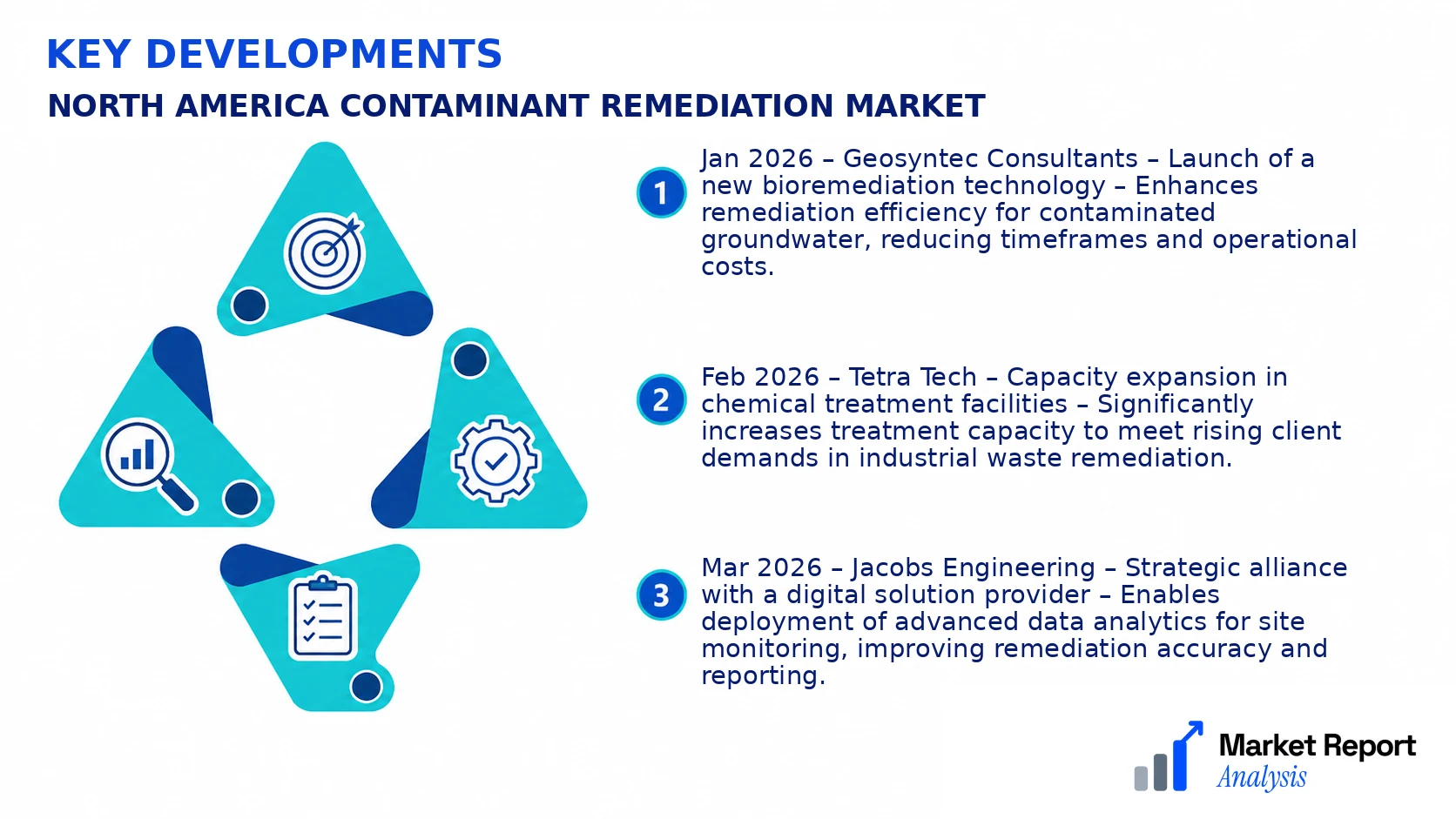
- Jan 2026 – Geosyntec Consultants – Launch of a new bioremediation technology – Enhances remediation efficiency for contaminated groundwater, reducing timeframes and operational costs.
- Feb 2026 – Tetra Tech – Capacity expansion in chemical treatment facilities – Significantly increases treatment capacity to meet rising client demands in industrial waste remediation.
- Mar 2026 – Jacobs Engineering – Strategic alliance with a digital solution provider – Enables deployment of advanced data analytics for site monitoring, improving remediation accuracy and reporting.
- Apr 2026 – Golder Associates – Acquisition of a specialized soil vapor extraction technology firm – Strengthens Golder’s remediation tools portfolio and enhances its competitive edge in contaminated site cleanup.
- May 2026 – Veolia Environnement – Investment in sustainable remediation projects – Focuses on integrating eco-friendly practices and circular economy principles into conventional remediation approaches, supporting sustainability goals.
Frequently Asked Questions
1. What is the North America Contaminant Remediation Market?
The North America Contaminant Remediation Market encompasses the industry involved in the identification, treatment, and removal of contaminants from water, soil, and air within North America. It includes advanced technologies and solutions aimed at environmental safety and pollution control.
2. What is the current market size of North America Contaminant Remediation Market?
As of 2026, the market is valued at approximately USD 18.5 Billion. It is driven by increasing environmental regulations, industrial growth, and technological advancements, making it a significant segment within the broader environmental services industry.
3. What factors are driving the North America Contaminant Remediation Market?
The market growth is primarily fueled by stringent government regulations, rising industrialization, and urbanization, which increase the need for effective pollutant removal solutions. Additionally, advancements in remediation technologies and increasing awareness of environmental health also contribute to market expansion.
4. Which region dominates the North America Contaminant Remediation Market?
The United States leads the North American market due to its large industrial base, stricter environmental regulations, and technological innovation capabilities. Canada and Mexico also contribute, but the U.S. holds the major market share.
5. Which segment is expected to grow the fastest?
The water remediation segment is projected to witness the fastest growth, driven by increasing pollution levels in lakes, rivers, and groundwater sources, along with evolving water treatment regulations and technological improvements in remediation methods.
6. Who are the leading companies operating in the North America Contaminant Remediation Market?
Key players include Veolia Environnement S.A., GE Water & Process Technologies, Ecolab Inc., SUEZ Environment, and Nalco Water. These companies focus on innovative solutions and strategic partnerships to capture market share and support environmental sustainability initiatives.
Analyst Perspective
The North America Contaminant Remediation Market is poised for steady long-term growth, driven by escalating regulatory pressures and increasing environmental awareness. As industrial and infrastructural emissions continue to challenge compliance frameworks, technological innovation in remediation methods such as bioremediation, nanotechnology, and advanced filtration will become critical differentiators. Investment priorities should emphasize R&D to enhance remediation efficiency and cost-effectiveness, especially focusing on scalable, sustainable solutions that align with evolving policies. Competitive intensity within this market is expected to intensify as established firms compete alongside innovative startups attracting venture capital. Regionally, the U.S. remains dominant, yet Canada and Mexico present significant growth opportunities driven by industrial expansion and government initiatives. Strategic players should adopt a diversified portfolio approach, leveraging technological advancements and regional partnerships to sustain competitiveness. Long-term success hinges on developing adaptable, eco-friendly technologies and capitalizing on regulatory tailwinds to secure market leadership amid fluctuating environmental mandates.
