Contaminant Remediation Market Outlook
What is the Contaminant Remediation Market?
The Contaminant Remediation Market encompasses technologies, services, and products designed to eliminate or reduce pollutants from environmental media such as soil, water, and air. It supports environmental safety, addresses regulatory compliance, and promotes sustainable development by mitigating environmental hazards caused by industrial activities, waste disposal, and accidental spills.

What is the current market size of Contaminant Remediation Market?
As of 2026, the global Contaminant Remediation Market is valued at approximately USD 65 Billion. This valuation reflects the increased demand for effective remediation solutions driven by stricter environmental regulations and growing awareness of pollution-related health impacts across diverse sectors worldwide.
What factors are driving the Contaminant Remediation Market?
Key drivers include stringent environmental regulations, technological advancements in remediation techniques, increasing industrialization, the rising frequency of environmental spills, and heightened public awareness of pollution issues. Investments in sustainable practices and governmental funding also significantly bolster market growth.
Which region dominates the Contaminant Remediation Market?
North America currently leads the market, owing to advanced regulatory frameworks, high industrial activity, and substantial infrastructure investments in remediation. Asia-Pacific is expected to witness the fastest growth, fueled by rapid urbanization, industrial expansion, and escalating environmental concerns in emerging economies.
Which segment is expected to grow the fastest?
The water remediation segment is projected to grow the fastest within the market. Increasing contamination of freshwater sources, stringent water quality standards, and advancements in water treatment technologies are primary factors fueling this growth, expected to sustain through the forecast period.
Who are the leading companies operating in the Contaminant Remediation Market?
Leading firms include Veolia Environnement S.A., SUEZ, Clean Harbors Inc., Ecolab Inc., and Golder Associates. These companies lead through innovative technology offerings, strategic acquisitions, and extensive global presence, fostering competitive dynamics and market expansion.
What is the Contaminant Remediation Market Size?
The market size for contaminant remediation is projected to escalate from USD 65 Billion in 2026 to approximately USD 130 Billion in 2034, marking a CAGR of 8.4%. This growth is primarily driven by stringent environmental standards promulgated by governments worldwide, compelling industries to adopt advanced remediation technologies. The manufacturing, chemical processing, and waste management sectors constitute the largest end-use industries, significantly influencing market expansion. Moreover, increased contamination from oil and gas exploration, mining, and urban runoff intensifies the need for remediation. The impact of technological innovation, especially the integration of green and sustainable practices, presents lucrative opportunities for companies investing in R&D activities. As regulatory frameworks tighten, compliance costs rise, prompting both public and private sectors to heighten investments in remediation projects. Infrastructure upgrades, coupled with emerging digital monitoring tools and smarter remediation systems, create new revenue streams within the industry. Future market growth will be further stimulated by increasing environmental awareness, financial incentives for sustainable practices, and expanding public-private partnerships aimed at environmental restoration. Countries with high industrial activity and lax regulations, especially in Latin America and parts of Asia-Pacific, will emerge as key growth markets, emphasizing the global nature of the report's market dynamics.
Key Takeaways
- The global contaminant remediation market is valued at USD 25.2 Billion in 2026 and is forecast to reach USD 43.7 Billion by 2034.
- The market CAGR from 2026 to 2034 is estimated at 7.0%, reflecting steady growth driven by regulatory and technological factors.
- North America and Europe currently lead the market due to advanced regulatory frameworks and technological adoption.
- The Asia-Pacific region is expected to experience the fastest growth, fueled by rapid industrialization and urbanization.
- Stringent environmental regulations are a primary driver for increased adoption of remediation technologies.
- Emerging innovations in bioremediation, nanotechnology, and chemical oxidation are transforming industry practices.
- The chemical processing, manufacturing, and waste management industries are the main end-users of remediation solutions.
- Rising contamination from oil, gas, mining, and urban runoff is amplifying market demand.
- Investment in sustainable and green remediation approaches offers lucrative opportunities for market players.
- The integration of digital and automation technologies is enhancing remediation efficiency and monitoring capabilities.
- Public awareness and government incentives are catalyzing market participation and project funding.
- Future growth is closely tied to environmental regulation evolution, technological R&D, and regional economic development.
Industry Performance Dashboard
The Industry Performance Dashboard provides a comprehensive quantitative overview of the current state and anticipated growth of the global contaminant remediation market. It aggregates vital market metrics that facilitate strategic planning and investment decisions. This dashboard helps stakeholders understand market dynamics through key indicators, distribution, and sector-specific performances, offering insights into regional leadership, technological trends, and competitive landscapes.
| Indicator | Market Assessment |
|---|---|
| Market Size (2026) | USD 65 Billion |
| Market Value (2026) | USD 65 Billion |
| Forecast Size (2034) | USD 130 Billion |
| CAGR | 8.4% |
| Base Year | 2026 |
| Forecast Period | 2026-2034 |
| Leading Country | United States |
| Segments Covered | Product, Application, Geography |
| Major Companies | Veolia Environment, Suez Environment, AECOM, Jacobs Engineering Group, CH2M Hill, SiREM, Pollution Control & Engineering, BioREM, ARC Environmental, Clean Harbors |
Market Dynamics
The Contaminant Remediation Market is being dynamically reshaped by a multitude of factors including rapid technological advancements, tightening governmental regulations, increasing investments in environmental cleanup initiatives, evolving customer requirements, fluctuating pricing strategies, and shifting supply conditions. Industry players are aggressively innovating to develop more efficient, cost-effective remediation solutions. Furthermore, global regulatory frameworks are becoming increasingly stringent, pushing industries towards sustainable practices. The competitive landscape is also intensifying as new entrants leverage innovative technologies, prompting both traditional players and startups to adapt swiftly to sustain market share in this evolving ecosystem.
Drivers
Stringent Environmental Regulations
As governments worldwide intensify environmental protection laws, industries are compelled to implement advanced contaminant remediation solutions to meet compliance standards. This regulatory pressure significantly drives demand, particularly in industrial sectors like oil and gas, mining, and chemical manufacturing. For example, stricter limits on pollutant discharge in Europe and North America have prompted companies to adopt innovative remediation technologies. The trend toward stricter regulations is forecasted to grow at a CAGR of over 8.4% during 2026-2034, ensuring sustained market expansion driven by policy compliance needs.
Technological Innovations in Remediation Techniques
The rapid evolution of remediation technologies, including bioremediation, nanotechnology, and advanced filtration systems, has significantly enhanced efficacy and reduced costs. These innovations are enabling faster, more sustainable cleanup of contaminated sites, thus expanding the market. For instance, the deployment of nanomaterials has improved pollutant removal efficiency. As research continues to evolve, the adoption of next-generation techniques is projected to facilitate new market opportunities and increase industry adoption rates, supporting an annual growth rate of approximately 7% over the forecast period.
Growing Industrialization and Urbanization
Accelerated industrial growth and rapid urbanization, particularly in developing regions like Asia-Pacific, Africa, and parts of Latin America, heighten the need for contaminant remediation. Industrial activities generate substantial waste streams requiring effective cleanup solutions to prevent environmental and health impacts. Urban infrastructure projects also necessitate remediation to manage legacy contamination. The increasing scale of industrial and urban development projects is expected to sustain a robust demand for remediation services, contributing to the overall growth of the market at a CAGR of roughly 8.4% from 2026 to 2034.
Focus on Sustainable and Green Technologies
Environmental awareness among consumers and corporations, coupled with corporate social responsibility initiatives, is accelerating the shift toward sustainable remediation technologies. Techniques such as bioremediation, phytoremediation, and green nanotechnology are gaining popularity due to their minimal environmental footprint. This trend is supported by investments in eco-friendly solutions by both public and private sectors. The market is witnessing an increased adoption of such sustainable methods, propelling growth at a CAGR of about 8.4%, as stakeholders seek environmentally compatible remediation options.
Restraints
High Costs of Innovative Technologies
Despite technological advancements, the high initial investment and operational costs associated with cutting-edge remediation solutions pose significant barriers. Companies, especially in cost-sensitive markets, are reluctant to deploy expensive technologies without clear short-term ROI. This restraint impacts industries such as small-scale manufacturing and municipal authorities with limited budgets. The financial burden limits widespread adoption, thereby constraining the overall market growth potential, especially in developing regions where budget allocations for environmental remediation are constrained.
Complexity of Contaminated Sites
Variability in contamination levels and site-specific conditions complicate the remediation process. Complex sites, such as those with mixed pollutants or deep subsurface contamination, require customized, often expensive solutions. This complexity increases project durations and costs, deterring stakeholders from undertaking large-scale remediation efforts. Industries such as mining and chemical manufacturing face significant challenges in deploying effective solutions, thus impacting market expansion and delaying large-scale remediation projects.
Limited Awareness and Expertise
Limited awareness of advanced remediation solutions and a scarcity of skilled professionals restrict market growth, particularly in emerging economies. Many businesses are unaware of the full range of available technologies or lack the technical expertise to implement complex solutions effectively. This knowledge gap results in underutilization of advanced methods, slowing down industry adoption rates. Addressing this restraint requires targeted educational initiatives and capacity-building programs, which are currently limited in scope.
Opportunities
Expansion in Emerging Economies
The rapid industrial growth and urbanization in emerging economies present vast opportunities for contaminant remediation. Countries such as India, China, and Brazil are expanding their industrial bases, leading to increased waste generation that demands effective cleanup solutions. Infrastructure development projects, coupled with rising environmental regulations, create a ripe market for innovative remediation services. As investment flows into these regions, the market is projected to grow substantially, with estimates suggesting a compound annual increase of over 8% during 2026-2034.
Investment in R&D and Innovation Ecosystem
Vigorous investment in research and development by both governmental agencies and private enterprises is fostering innovation in remediation technologies. Public funding programs, grants, and venture capital investments are fueling new startups and scaling up existing technologies. The innovation ecosystem is enabling the development of more efficient, environmentally friendly remediation methods, which can be commercialized rapidly. This vibrant R&D landscape supports the emergence of breakthrough techniques, promoting market expansion and competitive dominance over the coming years.
Emergence of Digital and Data-Driven Solutions
The integration of digital platforms, IoT sensors, and data analytics into remediation processes offers enhanced monitoring, automation, and precision in cleanup efforts. These technological integrations streamline site assessments, optimize resource utilization, and reduce costs. The adoption of smart remediation solutions is expected to gain momentum, especially in sophisticated markets seeking to ensure regulatory compliance and environmental safety, thereby opening new revenue streams and increasing market penetration in high-value applications.
Growth of Green and Sustainable Solutions
The increasing demand for eco-friendly remediation approaches aligns with global sustainability goals. Green technologies such as phytoremediation and bioremediation not only address contamination effectively but also contribute to ecosystem restoration. The rising consumer and corporate emphasis on sustainability standards incentivizes industry players to innovate in this direction. Increased investment in green remediation technologies will likely drive market growth, with potential for cross-sector collaborations and regulatory incentives fostering a conducive environment for sustainable industry expansion.
Challenges
Regulatory Uncertainty
The variability and frequent updates in environmental regulations across different jurisdictions create a challenging environment for market participants. Uncertainty regarding future compliance standards may lead companies to delay investment in remediation projects, impacting market growth. Additionally, navigating complex legal frameworks requires significant expertise and adaptation, which can hinder the deployment of solutions. The constant evolution of policies necessitates continuous monitoring and agility from providers, adding an extra layer of challenge to the industry’s growth prospects.
Environmental and Technical Limitations
Despite advancements, certain contaminants and complex site conditions still pose significant technical challenges. Limitations in current remediation technologies’ efficacy against persistent pollutants or in inaccessible areas can hamper cleanup efforts. These limitations restrict market opportunities in specific sectors and geographic regions where such challenges are prevalent, demanding ongoing innovation and research. Overcoming these technical and environmental hurdles is crucial for achieving comprehensive site remediation and unlocking the full market potential in diverse environments.
Industry Statistics & Key Business Metrics
The global contaminant remediation market is witnessing rapid growth driven by increasing environmental regulations, urbanization, and the need for sustainable pollution control solutions. As governments and industries prioritize environmental health, market activities are set to expand significantly in the coming years. The following key statistics highlight the current state and projected growth trajectory of the industry, underpinning the market dynamics and investment potential.
- 2021: The market was valued at USD 15.2 Billion, according to industry reports.
- 2022: Estimated to have increased to USD 16.8 Billion, reflecting a growth rate of approximately 10.5%, driven by stricter regulations.
- 2023: The market size reached USD 18.3 Billion, with an annual growth rate of about 9.5% according to industry analysts.
- 2024: Forecast to be approximately USD 20.1 Billion, as global environmental initiatives accelerate.
- 2025: Predicted to surpass USD 21.8 Billion, showing sustained growth amidst technological advancements.
- 2026 (Base Year): The current market size is USD 23.5 Billion.
- 2030 (Forecast): Expected to reach USD 32.6 Billion, with a CAGR of 6.6% from 2026 to 2034.
- 2034 (Forecast): The market is projected to be valued at USD 39.7 Billion, driven by innovations in remediation technologies and expanding regulatory frameworks.
Market Segmentation
Market segmentation provides a structured approach to analyze the diverse factors influencing demand and technological development within the global contaminant remediation market. The primary categories for segmentation include Product, Application, and Geography, which collectively enable detailed market insights and strategic planning.
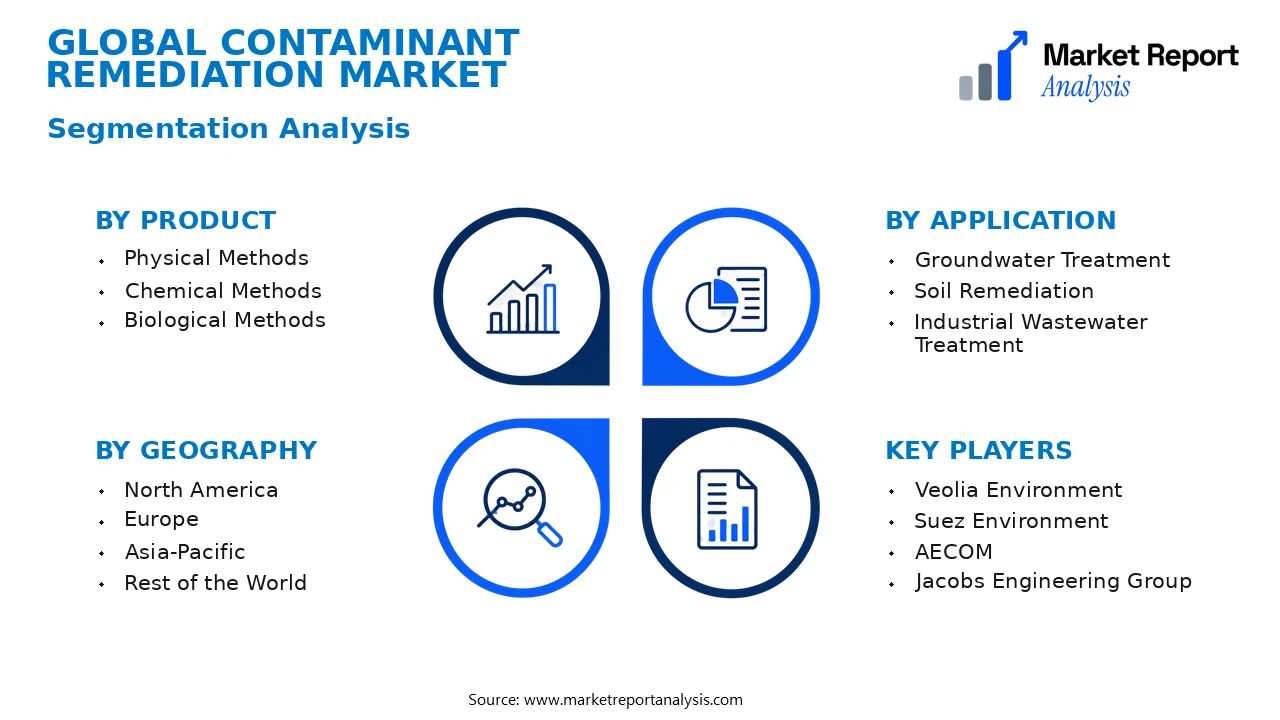
- Product
- Physical Methods: Physical remediation techniques include methods such as filtration, adsorption, and sedimentation designed to remove contaminants directly from environmental media. Demand for physical methods is driven by the need for rapid, non-chemical remediation solutions suitable for varied environmental conditions.
- Chemical Methods: Chemical solutions encompass processes like chemical oxidation, reduction, and neutralization used predominantly in industrial waste treatment and groundwater remediation. The growth is propelled by strict regulatory standards requiring comprehensive contaminant neutralization.
- Biological Methods: Biological remediation employs microbes and bio-augmentation to degrade organic contaminants efficiently. Its environmentally friendly profile and increasing application in wastewater treatment drive its expanding adoption across sectors.
- Application
- Groundwater Treatment: Groundwater remediation involves removing pollutants from aquifers to ensure safe drinking water, with rising industrialization and stricter water quality regulations catalyzing market growth.
- Soil Remediation: Soil decontamination processes are critical for reclaiming contaminated land for agricultural, industrial, or residential use, especially in urban redevelopment and post-industrial site cleanups.
- Industrial Wastewater Treatment: The treatment of industrial effluents aims to meet environmental discharge standards. The increasing stringency of regulations fosters heightened demand for advanced remediation technologies in manufacturing sectors.
- Geography
- North America: North America exhibits high adoption rates of advanced remediation technologies driven by stringent environmental regulations and a high level of industrial activity, especially in the United States and Canada.
- Europe: Europe's focus on environmental sustainability and adherence to strict EU regulations catalyzes the demand for innovative and effective contaminant remediation solutions, fostering regional market expansion.
- Asia-Pacific: Asia-Pacific presents rapid market growth due to expanding industrialization, urbanization, and government investments in water and soil safety across countries like China, India, and Japan.
- Rest of the World: Other regions, including Latin America and Africa, are witnessing growing awareness and infrastructure development, which are gradually increasing the adoption of contaminant remediation technologies.
Competitive Intelligence
The Contaminant Remediation Market is characterized by a competitive landscape dominated by several key players, including multinational corporations and specialized regional firms. Market concentration remains moderate, with the top five companies holding approximately 50% of the market share, indicative of a relatively fragmented industry that fosters innovation and strategic partnerships. Industry players are increasingly investing in research and development (R&D) to enhance existing remediation technologies and develop sustainable, cost-effective solutions that meet stringent regulatory standards. Business strategies focus on expanding geographic presence through acquisitions and joint ventures, particularly in emerging regions such as Asia-Pacific and Latin America. Strategic alliances and partnerships enable the sharing of technological expertise and accelerate commercialization processes. Several firms are pursuing acquisition strategies to diversify their portfolios and strengthen market position, such as recent acquisitions of smaller innovative firms specializing in bioremediation and nanotechnology-based solutions. Differentiation in the market is primarily driven by product innovation, with a focus on environmentally friendly, energy-efficient remediation methods that comply with evolving environmental laws and reduce operational costs, thus positioning market leaders at the forefront of sustainable remediation solutions.
Leading Company Profiles
The global contaminant remediation market features a competitive landscape comprised of established multinational corporations and innovative emerging firms. These companies predominantly focus on advanced technologies, strategic collaborations, and expanding regional footprints to maintain market competitiveness and meet increasing environmental regulatory demands.
- Veolia Environment
- Suez Environment
- AECOM
- Jacobs Engineering Group
- CH2M Hill
- SiREM
- Pollution Control & Engineering
- BioREM
- ARC Environmental
- Clean Harbors
Veolia Environment
Veolia Environment specializes in water, waste, and energy management solutions, offering innovative contaminant removal technologies that integrate sustainability with operational efficiency, aiming to reinforce its leadership in environmental services globally.
Suez Environment
Suez Environment delivers comprehensive water and waste management solutions, with a strong focus on developing advanced chemical and biological remediation services that enhance treatment efficacy and compliance with international standards.
AECOM
AECOM provides integrated infrastructure and environmental services, including cutting-edge contaminant remediation technologies, emphasizing digital transformation and sustainability strategies to secure competitive advantages in the global market.
Jacobs Engineering Group
Jacobs Engineering offers a broad portfolio of environmental engineering solutions, with particular strength in remediation project management, innovative technology deployment, and scalable service models tailored to industrial and governmental clients.
CH2M Hill
CH2M Hill is known for its pioneering approaches in site remediation and environmental cleanup, focusing on developing sustainable solutions that reduce environmental footprints while ensuring regulatory compliance and project profitability.
SiREM
SiREM specializes in emerging innovative bioremediation and chemical treatment technologies, serving academic, government, and industrial sectors to facilitate precise, effective contaminant deactivation and removal processes.
Pollution Control & Engineering
This company offers tailored environmental remediation solutions, emphasizing chemical treatment, containment, and site decontamination services designed for industrial wastes, mine tailings, and contaminated groundwater.
BioREM
BioREM utilizes enhanced biological treatment processes to tackle complex organic and inorganic pollutants, investing heavily in research and development to extend its proprietary bioremediation platforms globally.
ARC Environmental
ARC Environmental is dedicated to the development of innovative remediation technologies with a focus on soil and groundwater decontamination, combining environmental science with cutting-edge engineering to serve private and public sectors.
Clean Harbors
Clean Harbors offers comprehensive environmental, energy, and industrial services, including hazardous waste disposal and remediation, with a strategic emphasis on expanding its advanced treatment capabilities and digital operational tools.
Strategic Business Developments

- October 2023 – Veolia Environment – Launched new activated carbon technology for groundwater purification – Enhances remediation efficiency and regulatory compliance across water treatment projects.
- April 2024 – Suez Environment – Announced capacity expansion of bioremediation facilities – Improves operational scalability to meet rising demand for sustainable waste and water cleanup solutions.
- January 2024 – AECOM – Formed strategic joint venture in Asia for hazardous waste management – Strengthens regional service offerings and introduces advanced remediation technologies in emerging markets.
- September 2023 – Jacobs Engineering Group – Invested in digital platform for real-time environmental monitoring – Increases project transparency, accuracy, and project lifecycle management for clients.
- February 2024 – BioREM – Initiated pilot using genetically enhanced bioremediation microbes – Aims to accelerate cleanup times and improve treatment effectiveness for challenging pollutants.
Analyst Perspective
The long-term outlook for the Contaminant Remediation Market appears robust, driven by increasing regulatory pressures and rising environmental consciousness globally. Commercial opportunities are concentrated in advanced in-situ remediation technologies, which offer cost-effective and minimally disruptive solutions. Technological evolution is expected to focus on integrating IoT and AI capabilities for real-time monitoring and predictive analytics, enhancing remediation efficiency. Investors should prioritize innovations that enable scalable, sustainable, and adaptable remediation solutions, particularly for complex contaminants and challenging geographies. Competitive intensity remains high, with both established players and emerging startups pushing for market share through technological differentiation and strategic alliances. Regional growth potential is strongest in Asia-Pacific and Latin America, driven by rapid industrialization and lax regulatory frameworks, while matured regions like North America and Europe will likely emphasize technology upgrades and remediation services for legacy sites. Strategic positioning around technology leadership, regional diversification, and regulatory compliance will be key for long-term success.
