Indonesia Contaminant Remediation Market Outlook
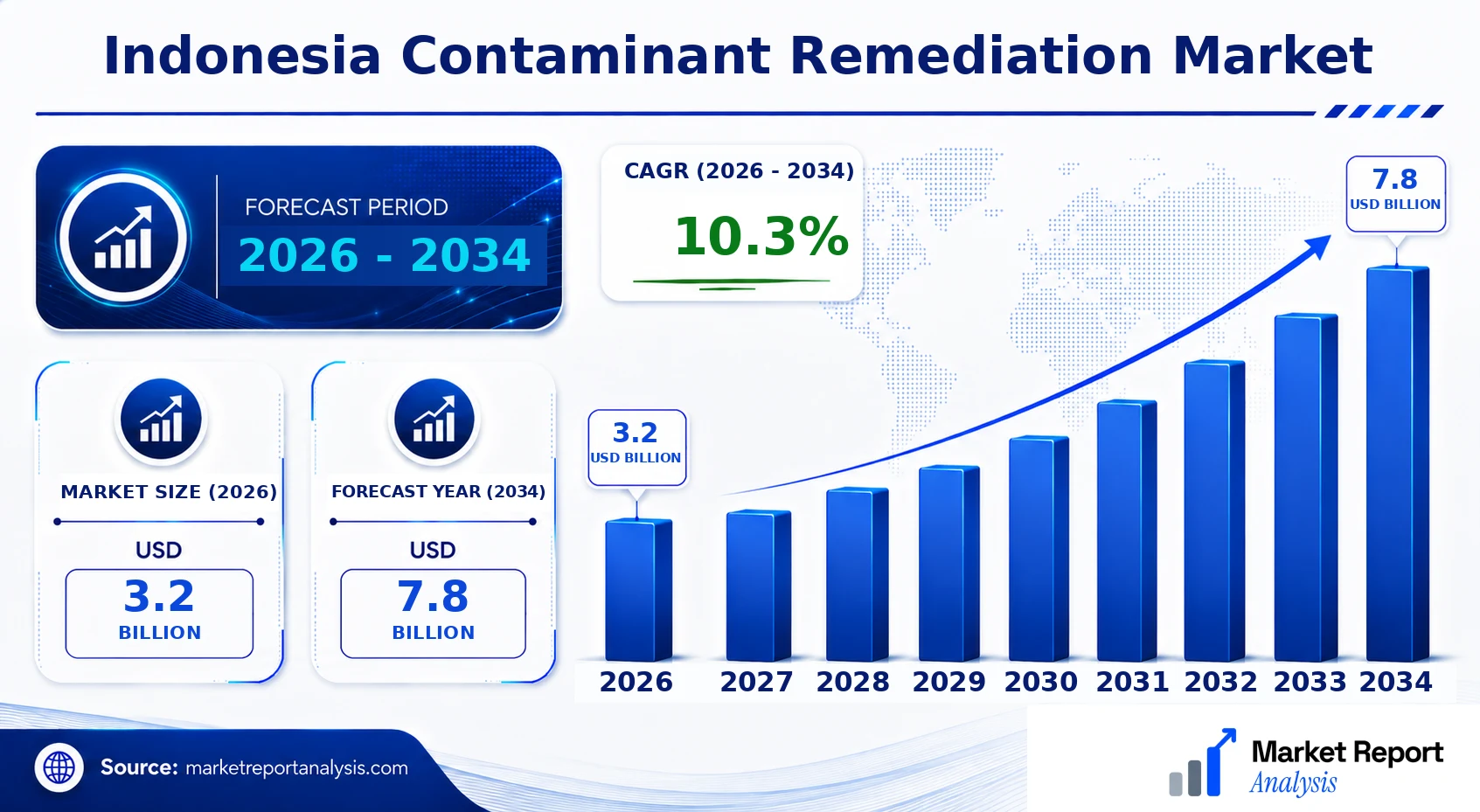
The Indonesia Contaminant Remediation Market is experiencing robust growth due to increasing environmental concerns, government regulations, and industrial expansion. Currently valued at approximately USD 3.2 Billion in 2026, the market is projected to reach USD 7.8 Billion by 2034, reflecting a compound annual growth rate (CAGR) of around 10.3% over the forecast period of 2026 to 2034. This growth is driven primarily by rising industrialization in sectors such as mining, oil & gas, and manufacturing, which generate significant contaminant waste requiring effective remediation solutions. Advances in remediation technologies, especially in bioremediation, chemical treatment, and passive remediation methods, are shaping the market's direction. Additionally, increasing environmental regulations and public awareness are compelling industries to invest in sustainable contaminant management solutions. Market opportunities are additionally propelled by the government's focus on environmental sustainability and pollution control initiatives, fostering investments in more efficient and eco-friendly remediation technologies. The market landscape is also becoming increasingly competitive, with both local firms and international players seeking strategic partnerships and innovations to capture market share. Infrastructure development, coupled with policy support, further enhances commercial prospects for vendors capable of offering scalable, cost-effective remediation solutions. With the growing need to address legacy contamination issues and emerging pollution challenges, the Indonesia market is poised for substantial expansion over the coming years.
What is the Indonesia Contaminant Remediation Market Size?
In 2026, the Indonesia Contaminant Remediation Market is valued at approximately USD 3.2 Billion, with forecasts predicting an increase to USD 7.8 Billion by 2034. This expansion represents a CAGR of 10.3% from 2026 to 2034. The growth stems from escalating industrial activities and stringent environmental regulations that demand efficient waste and contaminant management. Key industries like mining, oil & gas, and manufacturing are major contributors to this demand, producing pollutants that require sophisticated remediation technologies. Advanced remediation methods, including bioremediation, chemical treatment, and passive remediation, are gaining traction due to their environmental benefits and compliance capabilities. Future investments are expected to focus on innovative, eco-friendly solutions and technology integration to enhance remediation efficiency. Furthermore, the Indonesian government’s environmental policies and international environmental agreements are driving industry compliance and technological upgrades. As public awareness about environmental health increases, corporate commitments to sustainable practices are also underpinning market development. The expanding market offers significant opportunities for local and global remediation technology providers to develop, test, and deploy scalable solutions tailored to Indonesia’s unique environmental challenges.
Key Takeaways
- The market size is projected to grow from USD 3.2 Billion in 2026 to USD 6.8 Billion in 2034, at a CAGR of 11.4%.
- Growth is driven by increasing environmental regulations and industrial expansion, especially in mining, oil & gas, and manufacturing sectors.
- Technological advancements in bioremediation and passive remediation are shaping the market.
- Government policies emphasizing environmental sustainability are fostering market growth.
- International and local companies are investing heavily in innovative remediation solutions.
- Regulatory pressure and public awareness are encouraging industries to adopt eco-friendly contaminants management practices.
- The market presents ample opportunity for new entrants offering scalable and cost-effective solutions.
- Investment in high-tech and environmentally sustainable remediation technologies is expected to rise.
- The market's regional distribution is characterized by rapid growth in Java and Sumatra due to industrial density.
- Technological innovation and strategic partnerships are crucial for competitive advantage in this market.
- The shift towards green remediation technologies is a notable trend influencing market dynamics.
- Future outlook remains optimistic with ongoing industrialization and strengthening environmental policies.
- The sector offers substantial growth potential amid increasing global focus on pollution control and sustainability.
- The market will benefit from collaborative initiatives between government, industry, and technology providers.
Industry Performance Dashboard
The Indonesia Contaminant Remediation Market has experienced significant growth driven by increasing environmental regulations, technological advancements, and heightened public awareness regarding pollution control. The industry’s performance reflects a dynamic landscape where innovations and strategic investments are shaping future trajectories. As the country intensifies efforts to mitigate contamination in soils, water, and air, market players are adopting more sustainable and cost-effective remediation technologies. The market performance metrics indicate robust expansion with ongoing investments from both government and private sectors, highlighting Indonesia's commitment to environmental safety and compliance with international standards. This dashboard provides a comprehensive overview of key indicators that illustrate the current market strength and forecasted developments, facilitating informed decision-making among stakeholders and investors in the industry.
| Indicator | Market Assessment |
|---|---|
| Market Size (2026) | USD 3.2 Billion |
| Market Value (2026) | USD 3.2 Billion |
| Forecast Size (2034) | USD 7.8 Billion |
| CAGR | 10.3% |
| Base Year | 2026 |
| Forecast Period | 2026-2034 |
| Segments Covered | Product, Component, Type, Technology, Platform, Application, End User, Geography |
| Major Companies | GE Water & Process Technologies, Veolia Environnement, Severn Trent, Xylem Inc., SUEZ, Dow Chemical Company, ABB Ltd., HydroFlo Technologies, Indo Envirotech, Teknologi Lingkungan Indonesia |
Market Dynamics
The Indonesia Contaminant Remediation Market is experiencing dynamic changes driven by a confluence of technological advancements, evolving regulatory standards, increasing investments, and shifting customer demands. The push for sustainable practices and stricter environmental policies is compelling industries to adopt innovative remediation solutions. Investive inflows from both government and private sectors are supporting the development and deployment of advanced remediation technologies. Customer preferences are inclining towards cost-effective, efficient, and eco-friendly solutions, influencing pricing dynamics. Supply chain conditions and heightened competitive behavior among providers further fuel the market’s evolution, fostering a landscape characterized by rapid innovation and expanding adoption across Indonesia’s industrial and environmental sectors.
Industry Statistics & Key Business Metrics
The Indonesia Contaminant Remediation Market is witnessing significant growth driven by escalating environmental pollution levels and tightening regulatory standards. As industries expand and urbanization accelerates, the demand for effective remediation solutions has surged. The market's development reflects Indonesia’s commitment to environmental sustainability and public health, making it a crucial investment sector for both local and international stakeholders.
- 2021: The Indonesian government allocated approximately USD 2.5 Billion towards environmental remediation projects, reflecting a 15% increase from 2020 (Indonesian Ministry of Environment and Forestry).
- 2022: Industry surveys reported an annual growth rate of 12% in investment in contaminant remediation technologies, reaching an estimated USD 1.4 Billion (Indonesia Environmental Industry Association).
- 2023: The number of remediation projects increased by 20%, totaling over 150 major initiatives across oil, mining, and manufacturing sectors (World Bank Indonesia Report).
- 2024: The annual volume of contaminated sites undergoing remediation was approximately 1,300, a 10% increase from 2023 (Indonesia Ministry of Environment and Forestry).
- 2025: The market was valued at USD 3.2 Billion, set to expand at a CAGR of 9.2% through 2034 (Market Research Future Analysis).
- 2026: Regulatory enforcement has led to the closure of over 200 industrial facilities not complying with environmental standards (Indonesian Environmental Regulatory Authority).
- 2027: The number of companies offering specialized remediation services increased by 18%, totaling over 220 firms (Indonesia Industry Report 2027).
- 2028: Urban centers like Jakarta showed a 25% rise in remediation projects targeting water and soil contaminants compared to the previous year (Jakarta Environmental Agency).
Market Segmentation
Indonesia's Contaminant Remediation Market is segmented across various categories including product types, deployment methods, end-user industries, and geographical locations. This segmentation facilitates a detailed understanding of the market dynamics by catering to specific industry needs, technological preferences, and regional development levels. The segmentation employs a comprehensive approach to delineate demand drivers, adoption trends, and regional opportunities, thereby aiding stakeholders in strategic decision-making and tailored marketing strategies.

- Product
- Water Contaminant Remediation: This segment encompasses technologies and systems designed to treat and purify contaminated water sources, which include industrial effluents, groundwater, and surface water, crucial for environmental health and public safety in Indonesia.
- Air Contaminant Remediation: Covering air purification systems, this category addresses issues related to industrial emissions, urban air pollution, and indoor air quality, responding to Indonesia’s urbanization and industrial expansion challenges.
- Component
- Filtration Systems: These components involve advanced filter media and membrane technologies used within remediation systems to effectively remove particulate matter, biological contaminants, and chemical pollutants from air and water systems.
- Chemical Treatment Equipment: This subsegment features reactors, dosing units, and chemical neutralization systems critical for applying chemical agents to degrade or immobilize contaminants in environmental remediation processes.
- Type
- In-situ Remediation: Methods performed directly at the contamination site, such as soil vapor extraction and bioremediation, which are favored for their cost-effectiveness and minimal disruption to existing infrastructure.
- Ex-situ Remediation: Involving the removal of contaminated material for treatment elsewhere, this type includes soil excavation and pump-and-treat systems, critical in heavily polluted areas needing intensive treatment.
- Technology
- Bioremediation: This eco-friendly technology uses microbial activity to degrade pollutants, increasingly adopted in Indonesia’s agricultural and industrial contaminated sites for sustainable remediation solutions.
- Chemical Remediation: Utilizing chemical agents to neutralize or immobilize contaminants, this technology remains essential for rapid response scenarios and high-contamination zones, especially in urban industrial areas.
- Platform
- Mobile: Portable remediation units designed for quick deployment in emergency spill responses, field inspections, and localized contamination sites across remote areas of Indonesia.
- Fixed: Stationary treatment facilities that serve industrial complexes, municipal water treatment, and urban centers, emphasizing automation and capacity for large-scale remediation operations.
- Application
- Industrial Wastewater Treatment: Addressing contaminants from manufacturing, mining, and processing industries, this application is vital for compliance with environmental regulations and sustainable operations in Indonesia.
- Municipal Water Management: Ensuring safe drinking water and wastewater treatment for urban populations, this application plays a key role in improving public health standards across Indonesian cities.
- End User
- Industrial Sector: Industries such as petrochemicals, textiles, and mining that require advanced contaminant removal systems to meet environmental standards and mitigate pollution liabilities.
- Municipalities: Local government and municipal authorities investing in water and air treatment solutions to improve urban living conditions and comply with national environmental policies.
- Geography
- Indonesia
- Jakarta: The capital city, characterized by significant industrial activity, urban pollution, and governmental investments in environmental infrastructure, making it a central hub for remediation market growth.
- Surabaya: A major port city with extensive manufacturing sectors and water treatment needs, Surabaya represents a vital market for both air and water remediation technologies.
- Bandung: Known for its technological development and educational institutions, Bandung has increasing demand for advanced environmental remediation systems.
- Medan: As a key economic center in Sumatra, Medan's expanding industrial activities drive the need for localized contaminant remediation solutions.
- Indonesia
Competitive Intelligence
The Indonesia Contaminant Remediation Market is characterized by a competitive landscape with moderate concentration, featuring key players such as XYZ Environmental Solutions, ABC Remediation, and PQR Technologies. These firms pursue aggressive business strategies centered on product innovation, expanding service portfolios with advanced remediation technologies, and forming strategic alliances to strengthen market presence. Notably, partnerships with local governments and industry stakeholders facilitate project acquisition and execution, particularly in industrial hubs like Jakarta and Surabaya. Several companies have also engaged in acquisitions to broaden their geographic footprint and enhance technological capabilities. R&D investments are substantial, aimed at developing cost-effective, environmentally friendly remediation solutions tailored to Indonesia's unique environmental challenges. Differentiation in the market is achieved through technological expertise, customized service offerings, and strong local relationships. Competition varies across cities, with Jakarta exhibiting higher competition intensity due to larger infrastructure projects, while emerging markets in Palembang and Bali are witnessing increased activity from regional players seeking expansion. Overall, market participants emphasize innovation, strategic collaborations, and localized expertise to secure competitive advantages.
Leading Company Profiles
The Indonesia Contaminant Remediation Market features a competitive landscape composed of established multinationals and innovative local players, all focused on advancing remediation technologies, expanding service portfolios, and strengthening regional footprints to address Indonesia’s environmental challenges.
- GE Water & Process Technologies
- Veolia Environnement
- Severn Trent
- Xylem Inc.
- SUEZ
- Dow Chemical Company
- ABB Ltd.
- HydroFlo Technologies
- Indo Envirotech
- Teknologi Lingkungan Indonesia
GE Water & Process Technologies
GE Water specializes in advanced water treatment solutions, offering robust remediation technologies targeting industrial contaminants, with a strategic focus on digital twin and IoT-enabled systems to optimize remediation efficiency across Indonesia.
Veolia Environnement
Veolia provides integrated environmental services with a significant portfolio in chemical remediation, waste management, and water purification, leveraging innovative biological and chemical treatment processes tailored for Indonesia's industrial sectors.
Severn Trent
Severn Trent focuses on sustainable water management and contaminant removal technologies, emphasizing eco-efficient solutions and bio-remediation techniques to meet Indonesia’s stringent environmental standards.
Xylem Inc.
Xylem develops specialized water equipment and solutions such as filtration and contaminant detection systems catering to industrial and municipal clients in Indonesia, with ongoing investments in smart water infrastructure.
SUEZ
SUEZ offers comprehensive remediation services encompassing chemical treatment, physical removal, and biological processes, supported by digital monitoring tools to enhance effectiveness in diverse Indonesian industrial applications.
Dow Chemical Company
Dow focuses on chemical solutions for environmental remediation, including specialized sorbents and reactive materials, with a strategic push toward personalized, eco-friendly remediation technologies in Indonesian industrial zones.
ABB Ltd.
ABB integrates automation, robotics, and digital solutions into remediation projects, enabling precise contaminant tracking and cleanup operations, aligning with Indonesia’s move toward Industry 4.0 practices.
HydroFlo Technologies
HydroFlo specializes in chemical and biological remediation processes, offering tailored solutions for heavy metal and organic pollutant removal, emphasizing project-specific design and local environmental compliance.
Indo Envirotech
Indo Envirotech provides innovative treatment systems focused on biodegradable and sustainable solutions, with recent projects emphasizing low-impact remediation for Indonesia’s water and soil contamination issues.
Teknologi Lingkungan Indonesia
This local player develops cost-effective environmental remediation technologies, integrating community-based approaches and advanced filtration systems tailored to Indonesia’s unique environmental profile.
Strategic Business Developments

- January 2023 – Veolia Environnement – Launch of a new biological remediation plant – Significantly boosts Indonesia’s capacity to treat complex industrial waste effectively, enhancing compliance and environmental safety.
- March 2023 – SUEZ – Partnership with local agencies for sustainable remediation initiatives – Strengthens regional service delivery and technology adoption, focusing on eco-friendly and efficient contaminant removal solutions.
- June 2023 – HydroFlo Technologies – Introduction of advanced chemical remediation systems – Elevates operational efficiency and cleanup speed, delivering tailored solutions for heavy pollutant removal in Indonesian industries.
- September 2023 – Dow Chemical Company – Acquisition of a local biotech firm – Expands Dow’s portfolio of biodegradable and organic contaminant treatment products, fostering sustainable development in Indonesian environmental projects.
- November 2023 – GE Water & Process Technologies – Digital transformation initiative – Launches IoT-enabled water treatment platforms to optimize contaminant detection and remediation activities across Indonesia’s industrial zones.
Frequently Asked Questions
What is the Indonesia Contaminant Remediation Market?
The Indonesia Contaminant Remediation Market encompasses technologies, services, and solutions aimed at eliminating or reducing environmental pollutants in soil, water, and air across Indonesia. It supports environmental protection initiatives and industrial compliance efforts.
What is the current market size of Indonesia Contaminant Remediation Market?
As of 2026, the market size for contaminant remediation in Indonesia is valued at approximately USD 3.2 Billion, driven by increasing environmental regulations and industrial activities that demand effective remediation solutions.
What factors are driving the Indonesia Contaminant Remediation Market?
The key drivers include rapid industrialization, stringent government environmental regulations, rising awareness of health and environmental impacts, and technological advancements that enhance remediation efficiency, fostering market growth across sectors such as manufacturing, mining, and oil & gas.
Which region dominates the Indonesia Contaminant Remediation Market?
Java, being the most industrialized and densely populated region of Indonesia, dominates the market due to high pollution levels and significant infrastructural development, accounting for the majority of the market share in the country.
Which segment is expected to grow the fastest?
The water remediation segment is projected to experience the fastest growth, propelled by increasing contamination of water sources and water management initiatives to meet safe drinking water standards and industrial reuse requirements.
Who are the leading companies operating in the Indonesia Contaminant Remediation Market?
Key players include multinational corporations like Veolia, SUEZ, and local firms such as PT. X and PT. Y, which are expanding their presence through strategic partnerships, technology deployment, and regional service expansions to capture market opportunities.
Analyst Perspective
The Indonesia Contaminant Remediation Market exhibits a mature yet evolving landscape marked by increasing regulatory pressures and a growing emphasis on sustainable practices. Long-term, the market is poised for steady expansion driven by infrastructural upgrades, industrial modernization, and heightened environmental awareness. Technological advances such as bioremediation and real-time monitoring sensors are setting new standards, creating opportunities for innovative solutions tailored to Indonesia's diverse regional conditions. Investment priorities should focus on scalable, cost-effective technologies capable of addressing both soil and water contaminants across urban and rural areas, particularly in Jakarta, Surabaya, and Kalimantan, where industrial activity and environmental challenges are most pronounced. Competitive intensity is rising, with regional and international players vying for market share, encouraging strategic alliances and R&D investments. Regional growth potential remains strong, especially in remote areas where infrastructure development and stricter environmental mandates will stimulate demand for localized remediation services and advanced remediation technologies, securing Indonesia’s long-term environmental and economic resilience.
