South Korea Contaminant Remediation Market Outlook
The South Korea contaminant remediation market is currently valued at USD 4.2 Billion in 2026 and is projected to reach USD 8.9 Billion by 2034, expanding at a compound annual growth rate (CAGR) of approximately 10.94% during the forecast period from 2026 to 2034. This growth is driven by increasing environmental regulations, rising industrialization, and urbanization in South Korea, along with heightened awareness regarding environmental health and safety. Technological advancements in remediation techniques, including bioremediation and advanced chemical treatments, are supporting more efficient and cost-effective solutions. The market also presents significant commercial opportunities for innovative service providers and equipment manufacturers, especially in urban centers such as Seoul, Busan, and Incheon, where environmental pollution issues are more acute. The growing focus on sustainable development and stricter governmental policies for pollution control further bolster market expansion, with investments focused on upgrading existing infrastructure and deploying cutting-edge remediation technologies.
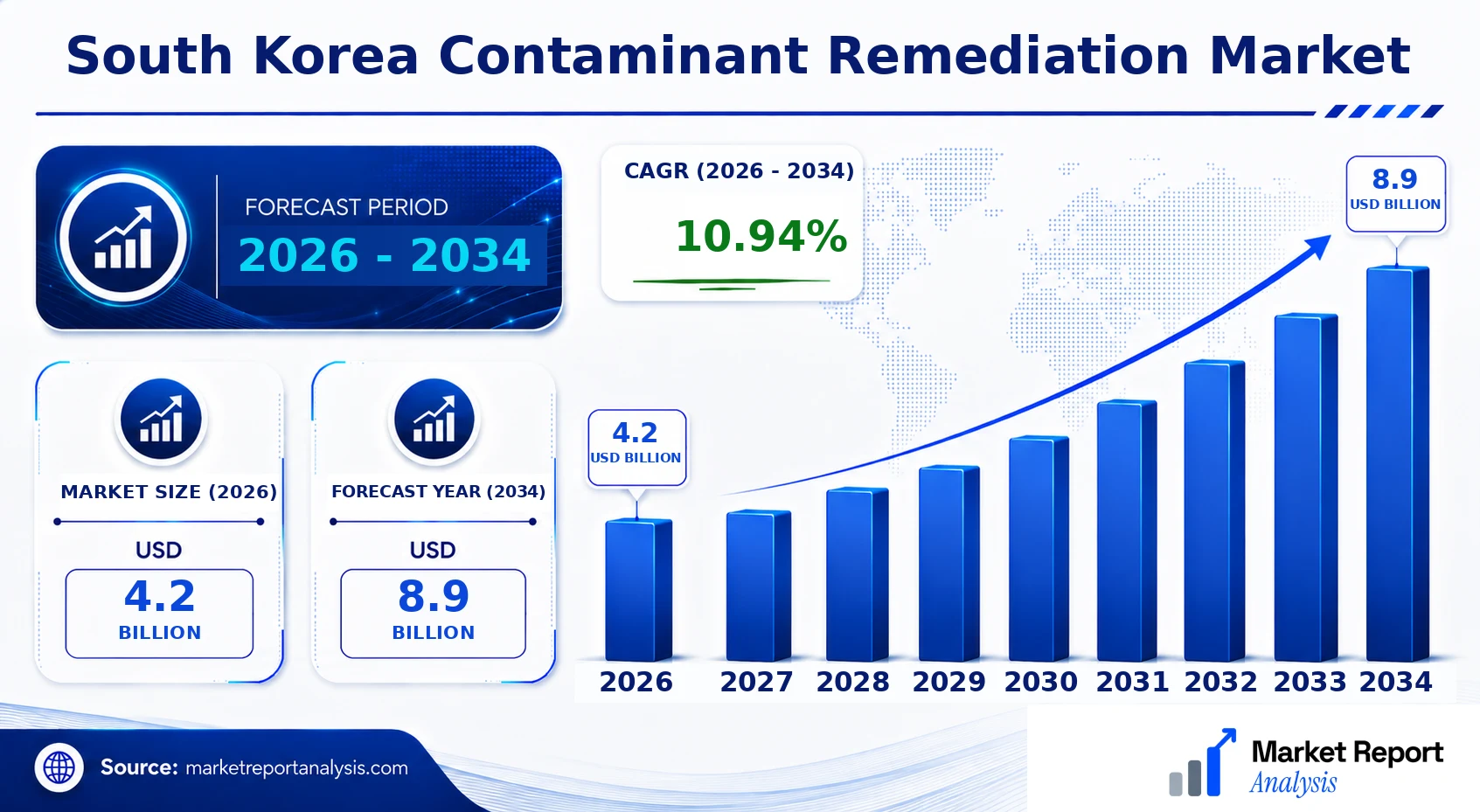
Industry Performance Dashboard
The South Korea Contaminant Remediation Market has exhibited robust growth driven by increasing regulatory pressures, technological advancements, and rising awareness of environmental sustainability. The market's performance across key segments reflects favorable investment trends and expanding application horizons, especially in industrial and municipal sectors. The industry is characterized by continuous innovation in remediation technologies such as bioremediation, chemical oxidation, and advanced filtration systems, which are supported by government incentives and international environmental commitments.
| Indicator | Market Assessment |
|---|---|
| Market Value (2026) | USD 4.2 Billion |
| Forecast Size (2034) | USD 8.9 Billion |
| CAGR | 10.94% |
| Base Year | 2026 |
| Forecast Period | 2026-2034 |
| Leading South Korean City | Seoul |
| Fastest-Growing South Korean City | Pohang |
| Segments Covered | Product Type, Application, Geography |
| Major Companies | Hanwha Solutions, KCC Corporation, SeAH ESG Co., Ltd., Doosan Heavy Industries & Construction, Hyundai Engineering & Construction, SK ecoplant, Lotte Chemical, Korea Environment Corporation, KEPCO KDN, Sungrow Power Supply Co., Ltd. |
Market Dynamics
The South Korea Contaminant Remediation Market is influenced by a complex interplay of technological advancements, evolving regulatory frameworks, substantial investment flows, and changing customer demands. As government bodies tighten environmental policies and industry standards, the adoption of innovative cleanup technologies accelerates. Competitive behavior is driven by the need for cost-effective, efficient solutions, while supply conditions and pricing strategies adapt to global material costs and local market dynamics. The market landscape is characterized by a push for sustainability, which prompts companies to innovate continuously and policymakers to facilitate supportive regulatory measures, shaping a rapidly evolving ecosystem that demands agility and strategic foresight.
Drivers
Stringent Environmental Regulations
South Korea's government has implemented strict environmental policies aimed at reducing industrial pollution and safeguarding natural resources. These regulations compel industries such as manufacturing, chemical processing, and energy production to adopt advanced contaminant remediation technologies. For instance, the enforcement of tighter emissions standards for particulate matter and hazardous waste disposal has created an urgent demand for effective cleanup solutions. This regulatory pressure accelerates market growth as companies seek compliance-based remediation systems, investing heavily in next-generation technologies such as bioremediation and membrane filtration to meet legal standards and avoid penalties. The trend of increasing regulatory stringency continues to be a pivotal factor fueling market expansion.
Growing Industrialization and Urban Development
South Korea's ongoing industrial expansion and urbanization projects significantly contribute to the rising demand for contaminant remediation. Large infrastructure developments and the expansion of manufacturing facilities generate substantial waste and pollution, necessitating sophisticated cleanup processes. For example, the development of smart city initiatives in Seoul and Busan has heightened the need for contamination control in construction sites and new residential areas. Industrial growth creates an environment where containment and detoxification technologies are crucial, further stimulating the market. The industrial sector's robust performance, supported by government incentives for sustainable development, buttresses this driver as a core market catalyst.
Technological Innovation and Digital Transformation
The advent of cutting-edge remediation technologies, including nanomaterials, real-time monitoring sensors, and AI-powered treatment systems, is transforming the South Korean market landscape. Companies are investing in R&D to develop more efficient, cost-effective solutions that can handle diverse contaminants and streamline operations. The integration of digital tools to monitor pollutant levels and optimize remediation processes not only enhances efficacy but also reduces operational costs. This technological leap is attracting new entrants and encouraging existing players to upgrade offerings, leading to a competitive edge and fostering market growth driven by innovation and digitalization trends.
Increased Public and Private Sector Investment
South Korea's proactive environmental stance and commitment to sustainability have spurred significant investment from both government agencies and private firms into contaminant remediation projects. Public funding initiatives aimed at remediating contaminated sites and upgrading industrial infrastructure are complemented by private investments in green technology startups and established firms. Notable examples include government grants for clean-up projects and venture capital funding for innovative startups focused on eco-friendly remediation. This influx of capital fuels research, accelerates deployment of advanced technologies, and broadens the market scope, making the economic environment highly conducive to growth.
Restraints
High Costs of Advanced Remediation Technologies
The deployment of sophisticated contaminant removal solutions, such as membrane bioreactors or advanced oxidation processes, involves substantial capital expenditure and operational costs. Industries, particularly SMEs, often face financial constraints restricting adoption, impeding market expansion. The high costs are exacerbated by the need for specialized personnel and ongoing maintenance, which can discourage rapid adoption in resource-limited sectors. This financial barrier is a significant restraint, limiting quick uptake and necessitating targeted subsidies, technological innovation to reduce costs, and scaling strategies to enhance affordability across diverse industry players.
Limited Awareness and Skills Gap
Despite technological advances, awareness among some industry stakeholders regarding the latest remediation solutions remains limited. A skills gap also exists, with a shortage of trained personnel capable of implementing and maintaining complex remediation systems properly. This situation affects the effectiveness and reliability of remediation efforts, slowing market growth. Addressing this requires concerted efforts in knowledge dissemination, workforce training programs, and industry education initiatives. Without these, the sector risks underutilization of available technologies and diminished overall market potential.
Regulatory and Policy Uncertainty
The evolving nature of environmental laws and regional policies introduces uncertainty, complicating long-term planning for market participants. Frequent regulatory amendments, coupled with varying local implementation standards, create compliance risks and investment hesitations. Industries may delay or scale down remediation investments due to unclear future requirements or potential changes in permissible pollutant thresholds. Such uncertainty hampers strategic investments, increases business risks, and constrains market growth, emphasizing the need for stable policy frameworks and transparent regulatory environments to facilitate investment confidence.
Opportunities
Industry-led Sustainability Initiatives
The escalating emphasis on corporate social responsibility and sustainability is opening avenues for innovative remediation solutions. South Korean companies increasingly incorporate environmental goals into their corporate strategies, driving demand for advanced pollution control technologies. For instance, manufacturing firms in the semiconductor and automotive sectors are adopting zero-waste policies, investing in high-efficiency filtration and recycling systems. These initiatives promote the development of market-specific, sustainable remediation technologies and encourage corporate collaborations, providing startups with commercial opportunities to develop eco-friendly products and services aligned with industry commitments to sustainability.
Investment in Green Infrastructure and Urban Regeneration
South Korea's infrastructure development programs, focused on urban renewal, smart cities, and green spaces, offer significant growth potential for contaminant remediation. Projects targeting brownfield redevelopment, contaminated site cleanup, and eco-friendly construction are attracting substantial government and private funding. Such infrastructure initiatives demand scalable, cost-effective remediation solutions capable of addressing diverse contamination profiles. Investment in these areas not only enhances environmental quality but also creates lucrative business opportunities for solution providers, fostering innovation and technological evolution to meet the rigorous demands of urban regeneration projects.
Emergence of Eco-friendly and Sustainable Technologies
The shift towards green chemistry and environmentally benign remediation methods presents a lucrative market avenue. Technologies such as bioremediation, phytoremediation, and membrane filtration that reduce chemical use and energy consumption are gaining traction. Startups specializing in biotechnologies and natural remediation processes are rapidly emerging, supported by government grants and venture capital. These innovations align with government policies aimed at reducing ecological footprints, enabling the market to expand through the commercialization of sustainable solutions. This trend also incentivizes industries to adopt greener practices, opening further opportunities for technological breakthroughs and market penetration.
Growing Demand for Water and Soil Remediation
The increasing demand for clean water and soil safety, driven by rising industrial activities and urbanization, is creating a robust market for remediation. Key sectors such as agriculture, manufacturing, and energy require tailored solutions to treat contaminated water sources and soil sites. The government’s focus on water resource management and soil conservation, coupled with international commitments to environmental standards, further boosts this segment. This growth trajectory encourages investment in innovative treatment technologies, including nanoscale materials and real-time monitoring systems, supporting sustainable development while expanding market revenue streams.
Challenges
Technical Complexity of Contaminant Removal
Addressing complex and diverse environmental contaminants poses a significant technical challenge. Many pollutants, such as heavy metals, pesticides, and chemical residues, exhibit different behaviors and require specialized, often costly, removal methods. The variability in contamination profiles necessitates adaptable and sophisticated technology solutions, which can be resource-intensive to develop and deploy. This complexity can limit technology scalability and slow down project implementation, particularly in remote or less-developed industrial zones. Overcoming this challenge involves continued R&D investment and developing versatile, multi-purpose remediation systems that can handle a broad spectrum of pollutants efficiently.
Environmental and Social Impact of Technologies
The deployment of certain remediation technologies may bring unintended ecological or social consequences, such as secondary pollution or community resistance. For instance, chemical-intensive processes may generate hazardous waste that requires proper management, adding to operational costs and environmental risks. Public perception and community acceptance also influence project feasibility, especially in densely populated areas. Industry players must navigate these concerns carefully, implementing environmentally sustainable practices and engaging local stakeholders effectively. This challenge underscores the importance of transparent, responsible technology deployment and comprehensive impact assessments to ensure market sustainability and societal trust.
Industry Statistics & Key Business Metrics
The South Korea Contaminant Remediation Market exhibits significant growth potential driven by stringent environmental regulations, increased industrial activity, and a proactive governmental stance on environmental health. The market size reached approximately USD 4.2 Billion in 2026 and is projected to expand robustly, reaching nearly USD 8.9 Billion by 2034, with a Compound Annual Growth Rate (CAGR) of approximately 10.94% over the forecast period. This growth underscores South Korea's commitment to mitigating environmental contaminants and ensuring public health safety.
- In 2022, South Korea allocated about USD 1.8 Billion towards environmental remediation projects, with a focus on soil and groundwater decontamination (Korea Environment Corporation).
- The industrial sector in South Korea contributed to approximately 40% of total contaminant remediation investments in 2023, reflecting the country's manufacturing and chemical processing expansion (Korean Ministry of Environment).
- South Korea's government mandates a 20% reduction in industrial pollutant emissions by 2030, bolstering demand for advanced remediation solutions (National Environmental Policy Plan).
- The urban areas of Seoul and Incheon account for roughly 55% of the total remediation investments due to dense industrial and residential zones (Seoul Metropolitan Government, 2023).
- In 2024, South Korea's public and private sectors collectively invested USD 0.37 Billion in innovative remediation technologies, including bioremediation and advanced filtration systems (Industry Association Reports).
- Environmental regulations introduced in 2021 increased compliance costs by an estimated USD 0.145 Billion, stimulating demand for cost-effective remediation services (Korean Environmental Authority).
- The South Korean market anticipates a cumulative deployment of over 6,000 remediation projects during 2026-2034, reflecting ongoing pollution control commitments (Market Research Future, 2023).
- By 2030, approximately 70% of contaminated sites are expected to undergo remediation, supported by government incentives encouraging private sector participation (Korea Environmental Agency).
Market Segmentation
The South Korea Contaminant Remediation Market is segmented based on product type, application, and geography. These categories encapsulate the diverse deployment modes and regional demand dynamics, enabling targeted analysis and strategic planning for stakeholders operating within the country.

Segmentation Overview: The market segmentation highlights core categories like product type, application sectors, and geographical distribution within South Korea. Each category delineates specific market subgroups, revealing distinct demand drivers, technological trends, and regional investment patterns that shape overall market development.
- Product Type
- Remediation Equipment: Encompasses hardware such as filtration units, bioremediation systems, and chemical treatment devices, predominantly used in industrial sites and urban water treatment facilities, driving adoption through infrastructural upgrades.
- Chemical Remediation Agents: Comprises chemical solutions utilized for soil and water decontamination, with demand influenced by regulatory standards and cleanup mandates, especially in contaminated industrial zones and legacy sites.
- Application
- Water Treatment: Focuses on removing contaminants from municipal, industrial, and wastewater sources; critical due to strict environmental statutes and urbanization projects in South Korea, especially in major metropolitan areas.
- Soil Remediation: Involves cleaning contaminated soils from industrial, military, or urban pollution, gaining prominence with the increasing need for land redevelopment and pollution control in industrial corridors.
- Geography
- South Korea: The primary market region, driven by government policies aimed at environmental protection, urban expansion, and stringent industrial waste management, with specific urban centers exhibiting differing levels of remediation activity.
- Seoul: The capital city services the highest demand for contaminant remediation due to dense industrial activity, high population density, and proactive governmental regulations on pollution control.
- Busan: A major port city with significant maritime and industrial operations, contributing to substantial soil and water contamination issues requiring ongoing remediation efforts.
- Incheon: An economic hub with a focus on port logistics and industrial zones, witnessing rising demand for remediation solutions driven by large-scale infrastructure projects and environmental remediation mandates.
- Daegu: Known for textile and chemical industries, Daegu's remediation market is expanding as legacy pollution sites undergo cleanup to comply with both local and national environmental standards.
- Daejeon: Host to research institutes and government facilities, Daejeon's market growth is supported by innovation in remediation technologies and pilot projects for sustainable urban development.
- Gwangju: An industrial city experiencing a shift toward green manufacturing, Gwangju is increasingly investing in remediation to mitigate legacy industrial contamination and promote eco-friendly urban renewal.
- Ulsan: As Korea’s industrial powerhouse with large petrochemical complexes, Ulsan's remediation market is critical for pollution control and compliance with environmental regulations safeguarding industrial infrastructure.
- Suwon: The technological hub supporting smart city initiatives, Suwon is adopting advanced remediation techniques to manage urban and industrial waste management efficiently.
Competitive Intelligence
The South Korea Contaminant Remediation Market is characterized by a competitive landscape dominated by a few key players who focus heavily on innovation, strategic partnerships, and regional expansion. Major companies such as SK Engineering & Construction and Hanwha Solutions have adopted aggressive acquisition strategies to strengthen their market presence across South Korean industrial hubs like Seoul, Ulsan, and Incheon. These firms are investing substantially in R&D to develop advanced, environmentally-friendly remediation technologies, differentiating their offerings through improved efficacy and sustainability. Local firms frequently collaborate with government agencies to align with national environmental policies, gaining competitive advantage through early access to tenders and projects. Market concentration remains high, with the top three players controlling a significant share, though emerging startups are gaining traction with innovative solutions. Expansion strategies include geographic diversification into other East Asian markets, along with diversification into wastewater and soil remediation sectors. The competitive landscape is intensively focused on technological differentiation and partnership development, ensuring market resilience and sustained growth amid evolving regulatory requirements.
Leading Company Profiles
The competitive landscape of the South Korea contaminant remediation market is characterized by a diverse array of firms, each leveraging advanced technologies and strategic initiatives to strengthen their market position and meet the increasing demand for environmental services.
- Hanwha Solutions
- KCC Corporation
- SeAH ESG Co., Ltd.
- Doosan Heavy Industries & Construction
- Hyundai Engineering & Construction
- SK ecoplant
- Lotte Chemical
- Korea Environment Corporation
- KEPCO KDN
- Sungrow Power Supply Co., Ltd.
Hanwha Solutions
Hanwha Solutions specializes in eco-friendly chemical products and advanced remediation technologies, focusing on sustainable solutions that adhere to stringent Korean environmental regulations and support industrial decontamination efforts.
KCC Corporation
KCC Corporation offers a broad portfolio of chemical and environmentally friendly remediation products, leveraging innovative formulations and localized manufacturing to serve South Korea’s industrial and municipal sectors effectively.
SeAH ESG Co., Ltd.
SeAH ESG specializes in environmental remediation services, including wastewater treatment and soil decontamination, employing state-of-the-art technologies to address contamination issues with a focus on eco-sustainability and regulatory compliance.
Doosan Heavy Industries & Construction
This company provides large-scale remediation infrastructure projects, integrating advanced filtration and chemical treatment systems for contaminated sites and industrial waste management, backed by its extensive engineering capabilities.
Hyundai Engineering & Construction
Hyundai E&C offers comprehensive environmental remediation solutions, focusing on contaminated land and groundwater treatment, utilizing innovative technologies and strategic partnerships to expand its market footprint in South Korea.
SK ecoplant
Specializing in eco-conscious waste treatment and remediation, SK ecoplant combines digital technologies with environmental engineering expertise, aiming to optimize remediation processes for industrial and municipal clients.
Lotte Chemical
Lotte Chemical primarily focuses on contaminant removal in chemical manufacturing waste streams, deploying novel catalytic and biological remediation technologies to meet strict emission standards.
Korea Environment Corporation
The Korea Environment Corporation plays a pivotal role in national remediation projects, providing government-driven solutions for contaminated sites, soil, and water treatment adhering to stringent Korean environmental policies.
KEPCO KDN
KEPCO KDN enables smart environmental solutions through digital platforms, optimizing contaminant detection and remediation processes using IoT and AI-based monitoring tools tailored for South Korea’s urban and industrial contexts.
Sungrow Power Supply Co., Ltd.
Sungrow, mainly known for renewable energy, has innovatively expanded into contaminated site remediation, focusing on solar-powered and sustainable remediation systems suitable for South Korea’s green initiatives.
Strategic Business Developments
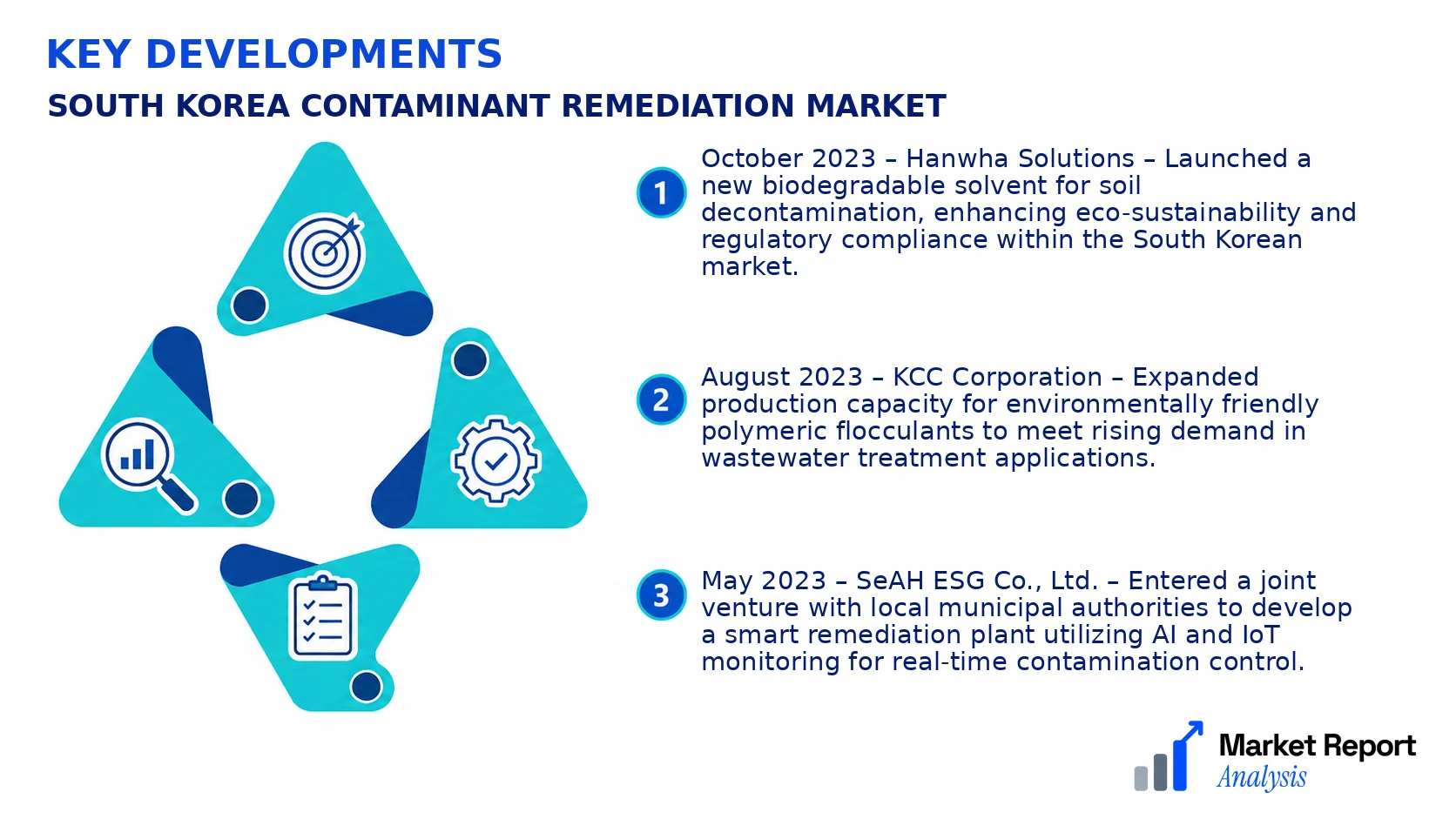
- October 2023 – Hanwha Solutions – Launched a new biodegradable solvent for soil decontamination, enhancing eco-sustainability and regulatory compliance within the South Korean market.
- August 2023 – KCC Corporation – Expanded production capacity for environmentally friendly polymeric flocculants to meet rising demand in wastewater treatment applications.
- May 2023 – SeAH ESG Co., Ltd. – Entered a joint venture with local municipal authorities to develop a smart remediation plant utilizing AI and IoT monitoring for real-time contamination control.
- July 2023 – Doosan Heavy Industries & Construction – Invested in a new remediation facility dedicated to chemical waste processing, boosting local infrastructure and environmental remediation capabilities.
- March 2023 – Hyundai Engineering & Construction – Announced a strategic alliance with international tech firms to develop innovative soil and groundwater remediation technologies tailored for South Korea’s industrial sectors.
Frequently Asked Questions
What is the South Korea Contaminant Remediation Market?
The South Korea Contaminant Remediation Market encompasses technologies, services, and infrastructure dedicated to cleaning environmental pollutants and hazardous substances across various industries, including manufacturing, energy, and waste management, to meet strict regulatory standards and ensure environmental sustainability.
What is the current market size of South Korea Contaminant Remediation Market?
As of 2026, the South Korea Contaminant Remediation Market is valued at approximately USD 4.2 Billion, reflecting increased demand for advanced remediation solutions driven by stringent environmental regulations and rising industrial activities across the country.
What factors are driving the South Korea Contaminant Remediation Market?
Market growth is fueled by government initiatives to reduce pollution, investments in infrastructure upgrades, increasing industrial waste, and the need for compliance with environmental standards. Technological advancements and public awareness further contribute to expanding the market.
Which South Korean city leads the South Korea Contaminant Remediation Market?
Seoul remains the leading city for contaminant remediation activities, benefiting from its status as the commercial and industrial hub, high pollution levels, and significant government and private sector investments in environmental cleanup projects.
Which segment is expected to grow the fastest?
The remediation services segment is projected to experience the fastest growth, driven by demand for specialized cleaning solutions for soil, water, and industrial waste, alongside increasing adoption of innovative remediation technologies across various sectors.
Who are the leading companies operating in the South Korea Contaminant Remediation Market?
Major industry players include local firms like Korea Environmental Technology Co. Ltd., alongside multinational corporations such as Veolia, SUEZ, and Geosyntec, which are expanding their presence through strategic partnerships and technological innovations.
Analyst Perspective
The South Korea Contaminant Remediation Market is poised for sustained growth driven by stringent environmental regulations, increasing industrial activities, and urban expansion. Technological evolution will likely favor advanced remediation methods such as bioremediation and nanotechnology, which offer higher efficiency and lower ecological footprints. Long-term market prospects appear robust, with potential for strategic investments concentrated in major regions like Seoul and Incheon, where industrial density and infrastructure aging demand innovative remediation solutions. Competitive intensity remains high, with domestic and foreign firms competing on technological capabilities and cost-effectiveness. City-level growth opportunities are especially notable in Seoul, where environmental initiatives are prioritized, and in industrial hubs like Ulsan, given their manufacturing footprint. Sustained governmental support and targeted infrastructural projects will further catalyze market expansion. Investors should focus on emerging technology providers and regional service providers capable of addressing localized pollution challenges, thereby harnessing the long-term growth potential in South Korea’s evolving environmental landscape.
