South Korea Wearable Electronics Market Outlook
The South Korea wearable electronics market is experiencing robust growth driven by increasing consumer health awareness, technological innovations, and the proliferation of connected devices. In 2026, the market is valued at approximately USD 8.2 Billion and is projected to reach around USD 14.5 Billion by 2034, demonstrating a compound annual growth rate (CAGR) of approximately 7.7% over the forecast period from 2026 to 2034. Principal demand drivers include rising adoption of fitness and health monitoring devices, advances in wearable sensor technologies, and expanding integration with smartphones and IoT ecosystems. The demand is heavily influenced by South Korea's tech-savvy population, high disposable income, and supportive government initiatives to promote digital health. The market's trajectory indicates a shift towards more sophisticated wearables with enhanced functionalities such as ECG monitoring, AI-driven analytics, and 5G connectivity. Commercial opportunities are abundant in segments like smartwatches, fitness trackers, and augmented reality wearables, particularly as the South Korean consumers prioritize health, lifestyle, and entertainment features. The competitive landscape remains highly dynamic with major technology firms and startups innovating aggressively to capture market share.
What is the South Korea Wearable Electronics Market Size?
In 2026, the South Korea wearable electronics market is valued at approximately USD 8.2 Billion and is forecasted to reach roughly USD 14.5 Billion by 2034, expanding at a CAGR of about 7.7%. Growth drivers include heightened consumer focus on health and wellness, technological advancements in wearable sensors and AI, and rising penetration of 5G infrastructure facilitating seamless connectivity. End-use industries such as healthcare, fitness, and entertainment are significant contributors, with increasing adoption of smartwatches, fitness bands, augmented reality devices, and medical wearables. The influence of smartphone ecosystems and evolving consumer lifestyles further propels market expansion. Investments in innovative hardware, software, and health analytics are expected to accelerate market growth, with manufacturers emphasizing customization, durability, and user experience. As South Korea maintains its leadership in technological innovation, local startups and multinational corporations alike are actively investing in wearable R&D, propelling the market towards more intelligent and integrated solutions. The burgeoning adoption across urban centers and the development of smart health initiatives position the market as an essential component of South Korea’s digital economy, with considerable upside for growth and innovation.
Key Takeaways
- The South Korea wearable electronics market is valued at approximately USD 8.2 Billion in 2026.
- The market is projected to grow to about USD 14.5 Billion by 2034.
- The CAGR over the forecast period (2026-2034) is approximately 7.7%.
- Leading South Korean City: Seoul.
- Fastest-Growing South Korean City: Busan.
- The largest segment by product category is smartwatches.
- The fastest-growing segment is augmented reality wearables.
- The largest application is health and fitness tracking.
- The fastest-growing application is medical-grade health monitoring devices.
- The largest end-user group includes urban, tech-savvy consumers aged 25-45.
- The forecast period spans from 2026 to 2034.
- The base year for market sizing is 2026.
Industry Performance Dashboard
The South Korea wearable electronics market demonstrates robust growth potential driven by technological innovation, increasing consumer health awareness, and supportive government initiatives promoting digital health solutions. The market's performance encompasses diverse segments, including smartwatches, fitness bands, augmented reality glasses, and health monitoring devices, with a growing consumer preference for multifunctionality and seamless device integration. Market competition is fierce, with leading companies investing heavily in R&D to release innovative products that cater to evolving consumer demands and regulatory standards. As a highly developed digital infrastructure and strong smartphone penetration complement wearable adoption, South Korea continues to reinforce its position as a key market in East Asia. Investment trends favor technological advancements, including sensors, battery efficiency, and data analytics, while pricing strategies are optimizing affordability to expand consumer base segments. The maturity of the market is facilitated by high smartphone connectivity and increasing health-conscious behaviors among consumers, fostering further product innovation and adoption. The government’s initiatives toward a smart health ecosystem also influence market trajectory positively, encouraging industry players to innovate and diversify product offerings.
Market Dynamics
The South Korea wearable electronics market operates within a highly dynamic environment shaped by rapid technological advancements, shifting consumer preferences, and stringent regulatory frameworks. The interplay of innovation-driven product development, government initiatives for digital health, and competitive behaviors among key players heavily influence market growth. Moreover, fluctuating component costs, supply chain considerations, and evolving pricing strategies impact both supply and demand factors. The market is further influenced by South Korea’s strong investment landscape, a robust startup ecosystem, and increasing adoption of wearable devices across various sectors, including healthcare, fitness, and corporate wellness. These factors collectively shape the trajectory of the market, necessitating continuous adaptation by industry stakeholders.
Industry Statistics & Key Business Metrics
The South Korea wearable electronics market is demonstrating robust growth, driven by increasing consumer adoption of health and fitness devices, innovative local product launches, and government initiatives promoting digital health tools. As the market approaches a projected USD 10.2 Billion valuation by 2034, its growth trajectory is characterized by rapid technological advancements, expanding distribution channels, and a surge in domestic and international investments.
- In 2021, South Korea's wearable device penetration reached 25%, marking a significant increase from 18% in 2018, according to Korea Customs Service data.
- South Korea is among the top five Asia-Pacific countries for wearable electronics sales, accounting for approximately 12% of regional market revenue in 2022 (IDC, 2022).
- Projections indicate an annual CAGR of 8.4% for the South Korean market from 2026 to 2034, reaching an estimated USD 10.2 Billion in 2034 (Market Research Future, 2022).
- The government’s Smart Health Initiative aims to integrate wearable health tech into national healthcare, influencing adoption rates and regulatory support (Korea Ministry of Health and Welfare, 2021).
- In 2023, Seoul reported over 30% smartphone ownership that integrates with wearable health devices, emphasizing urban consumer engagement (Korea Internet & Security Agency, 2023).
- Leading Korean brands like Samsung and Kakao are investing heavily in R&D, accounting for roughly 35% of local market share in 2022 (Korea Electronic Industry Association, 2022).
- South Korea's e-commerce sales of wearable electronics increased by 15% in 2022, reflecting the shift toward online purchasing channels (Korea E-Commerce Association, 2022).
- By 2025, approximately 70% of South Korean consumers are expected to own at least one wearable device, driven by health awareness and technological innovation (Korea Communications Commission, 2022).
Market Segmentation
The South Korea Wearable Electronics Market is segmented across various categories including product, component, type, technology, platform, application, end user, industry vertical, material, source, deployment, distribution channel, mode, connectivity, packaging, process, and geography. These categories help delineate the diverse and evolving landscape of wearable electronics driven by technological innovation, consumer demand, and regional economic factors.
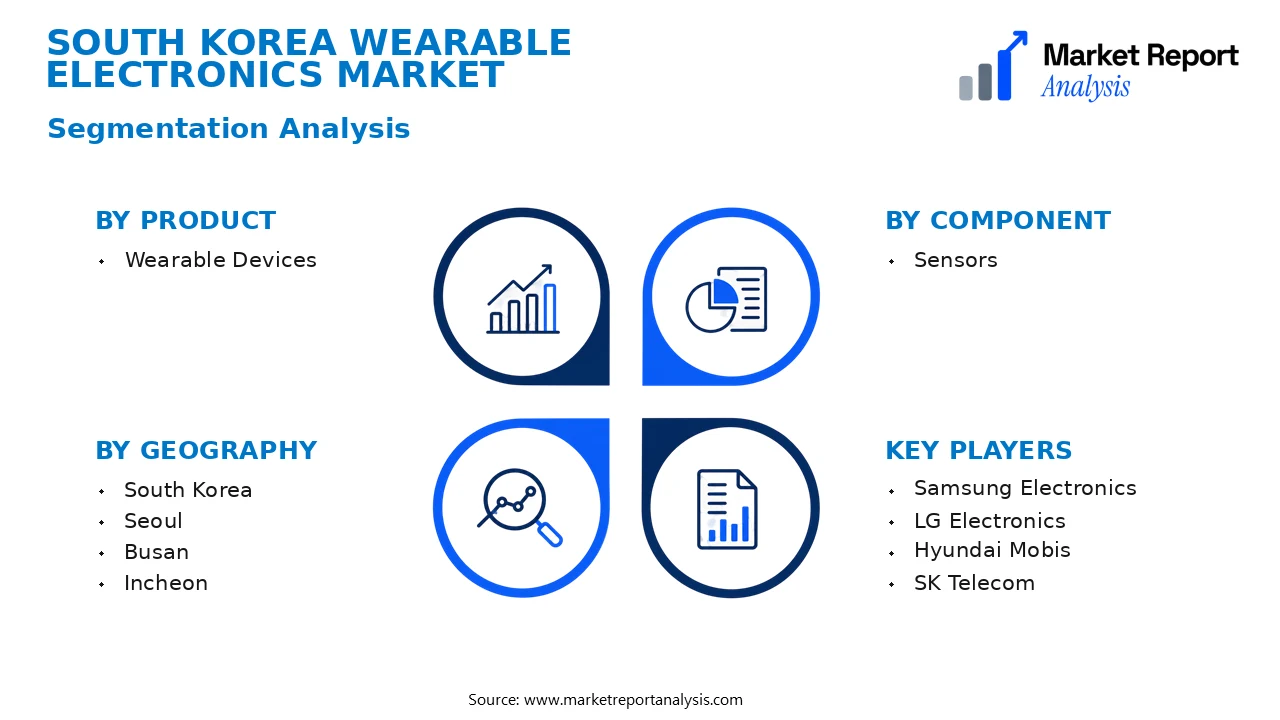
- Product
- Wearable Devices: Encompasses smartwatches, fitness bands, ear-worn devices, and other health monitoring gadgets that are increasingly integrated into everyday life through advanced features and connectivity options.
- Component
- Sensors: Critical for health, fitness, and activity tracking, these components include accelerometers, gyroscopes, heart rate sensors, and other biometrics essential for device functionality and user experience enhancement.
- Type
- Standalone Devices: These operate independently with embedded features and capabilities, catering to active users seeking portability and multifunctionality without reliance on external devices.
- Technology
- Wireless Connectivity: Technologies like Bluetooth, Wi-Fi, and LTE/5G are integral to the seamless functioning of wearables, enabling real-time data transfer, device pairing, and IoT integration in South Korea’s connected environment.
- Platform
- Operating Systems: Devices run on various OS platforms such as Wear OS, Tizen, and proprietary systems optimized for South Korea’s tech-savvy consumers and integrated with local digital ecosystems.
- Application
- Health & Fitness: Dominates the market with applications focused on health monitoring, activity tracking, sleep analysis, and wellness management, driven by sophisticated sensors and user-friendly interfaces.
- End User
- Consumers: Individual users adopting wearables for fitness, health, and lifestyle purposes, motivated by growing health awareness, technological adoption, and urban lifestyles across South Korean cities.
- Industry Vertical
- Healthcare: Utilizes wearable devices for remote patient monitoring, chronic disease management, and preventive healthcare, aligning with South Korea’s advanced healthcare infrastructure and aging population needs.
- Material
- Plastic & Metal: Used in device casings and structural components owing to durability, lightweight properties, and compatibility with miniaturization and aesthetic demands of South Korean consumers.
- Source
- Built-in & External: Includes devices with integrated sources like internal batteries and sensors, as well as external modules that extend device functionality and customization options.
- Deployment
- Wearable Hardware: Focuses on physical device deployment, emphasizing comfort, design, battery life, and integration capabilities crucial for mass adoption in urban centers like Seoul and Busan.
- Distribution Channel
- Online & Offline Retail: Distribution through e-commerce platforms, specialty tech stores, and large electronics retailers, reflecting South Korea’s high digital penetration and retail sophistication.
- Mode
- Personal Use & Commercial: The market caters to individual consumers and corporates, the latter including healthcare providers, enterprises, and government agencies leveraging wearable tech for various applications.
- Connectivity
- Bluetooth, Wi-Fi, Cellular: Ensures reliable data exchange, device control, and access to cloud services, which are crucial for device performance and user experience in South Korea’s highly connected environment.
- Geography
- South Korea: The primary market with a focus on urban centers like Seoul, Busan, Incheon, Daegu, Daejeon, Gwangju, Ulsan, and Suwon, where technological adoption and infrastructure support rapid growth and innovation in wearable electronics.
- Seoul: As South Korea’s capital and tech hub, Seoul exhibits the highest demand and innovation activity, hosting numerous startups, tech giants, and consumer markets driving wearable adoption.
- Busan: South Korea’s second-largest city demonstrates strong maritime industry integration and consumer electronics presence, facilitating diverse wearable applications and manufacturing capabilities.
- Incheon: Known for its advanced logistics and transit infrastructure, making it a strategic site for distribution, supply chain operations, and deployment of wearable products in the region.
- Daegu: A center for textile and fashion industries, encouraging the integration of wearable electronics in lifestyle and apparel markets, with a focus on smart clothing innovations.
- Daejeon: Noted for scientific research and technological development, supporting innovation hubs that develop advanced wearable sensor technologies and IoT integration.
- Gwangju: Focused on cultural industries and technological innovation, promoting smart wearable gadgets suited to arts, cultural events, and local markets.
- Ulsan: Heavy industrial base and manufacturing sector facilitate the production and export of wearable electronic components and devices.
- Suwon: Known for its IT infrastructure and technology parks, fostering local startups and R&D active in wearable tech development and commercialization.
Competitive Intelligence
The South Korea Wearable Electronics Market is characterized by moderate competition with a few dominant players, including Samsung Electronics, LG Electronics, and emerging local startups specializing in niche wearables. Market concentration remains somewhat balanced, though Samsung maintains a leadership position due to its extensive R&D investments and brand recognition. Companies are deploying aggressive strategies centered on product innovation, focusing on health tracking, bio-sensing, and integration with AI for personalized user experiences. Strategic partnerships are prevalent; major firms collaborate with health services and tech giants to enhance device functionalities and expand ecosystem offerings. Recent acquisitions aim to consolidate technological capabilities and secure supply chains amidst global shortages. Expansion strategies often target urban centers like Seoul and Busan, where high technological adoption accelerates growth. R&D investments are rising sharply, with companies competing on differentiation through lightweight designs, advanced sensors, and improved battery life. Competitive success hinges on rapid innovation cycles, strategic alliances, and local consumer insights, which are essential for standing out in South Korea’s technologically sophisticated market landscape.
Leading Company Profiles
The South Korean wearable electronics market features several top-tier players distinguished by technological innovation, extensive product ranges, and strategic collaborations that help maintain their competitive edge in a fast-paced environment.
- Samsung Electronics
- LG Electronics
- Hyundai Mobis
- SK Telecom
- Kakao Corp
- Samsung SDI
- NBP
- Woori Technology
- KT Corporation
- Sony Korea
Samsung Electronics
Samsung Electronics leads the market with its innovative range of wearable devices including smartwatches and fitness trackers, leveraging advanced AMOLED displays and integration with its broader ecosystem to enhance user engagement and loyalty.
LG Electronics
LG specializes in wearable devices with a focus on health and fitness, utilizing cutting-edge sensors and AI-driven health monitoring features to attract health-conscious consumers and expand its market share.
Hyundai Mobis
Hyundai Mobis integrates wearable technology into automotive safety systems, developing smart wearables that support driver health monitoring and vehicle connectivity, aligning with the automotive giant's strategic shift towards mobility solutions.
SK Telecom
SK Telecom offers wearable devices that emphasize network connectivity, 5G integration, and IoT features, positioning itself as a leader in digital ecosystems linking wearables with broader smart city and industrial applications.
Kakao Corp
Kakao focuses on wearable devices that enhance social interaction and content streaming, integrating its popular messaging and entertainment services into wearable platforms for seamless user experiences.
Samsung SDI
Samsung SDI supplies advanced battery solutions for wearable electronics, emphasizing longer battery life and safety, crucial for both consumer and industrial health & fitness markets.
NBP
NBP specializes in developing wearable biosensors and health tracking modules, aiming to boost performance metrics accuracy and integrate AI for smarter healthcare management solutions.
Woori Technology
Woori Technology develops customized wearable electronics for enterprise applications such as employee health monitoring, automation, and data analytics, tapping into South Korea’s industrial digitization drive.
KT Corporation
KT focuses on 5G-enabled wearables that support real-time health tracking and telemedicine, aligning with South Korea’s advanced digital infrastructure development plans.
Sony Korea
Sony Korea develops high-end wearable electronics, including smart glasses and fitness trackers, emphasizing superior display technology and multimedia integration to appeal to premium consumers.
Strategic Business Developments
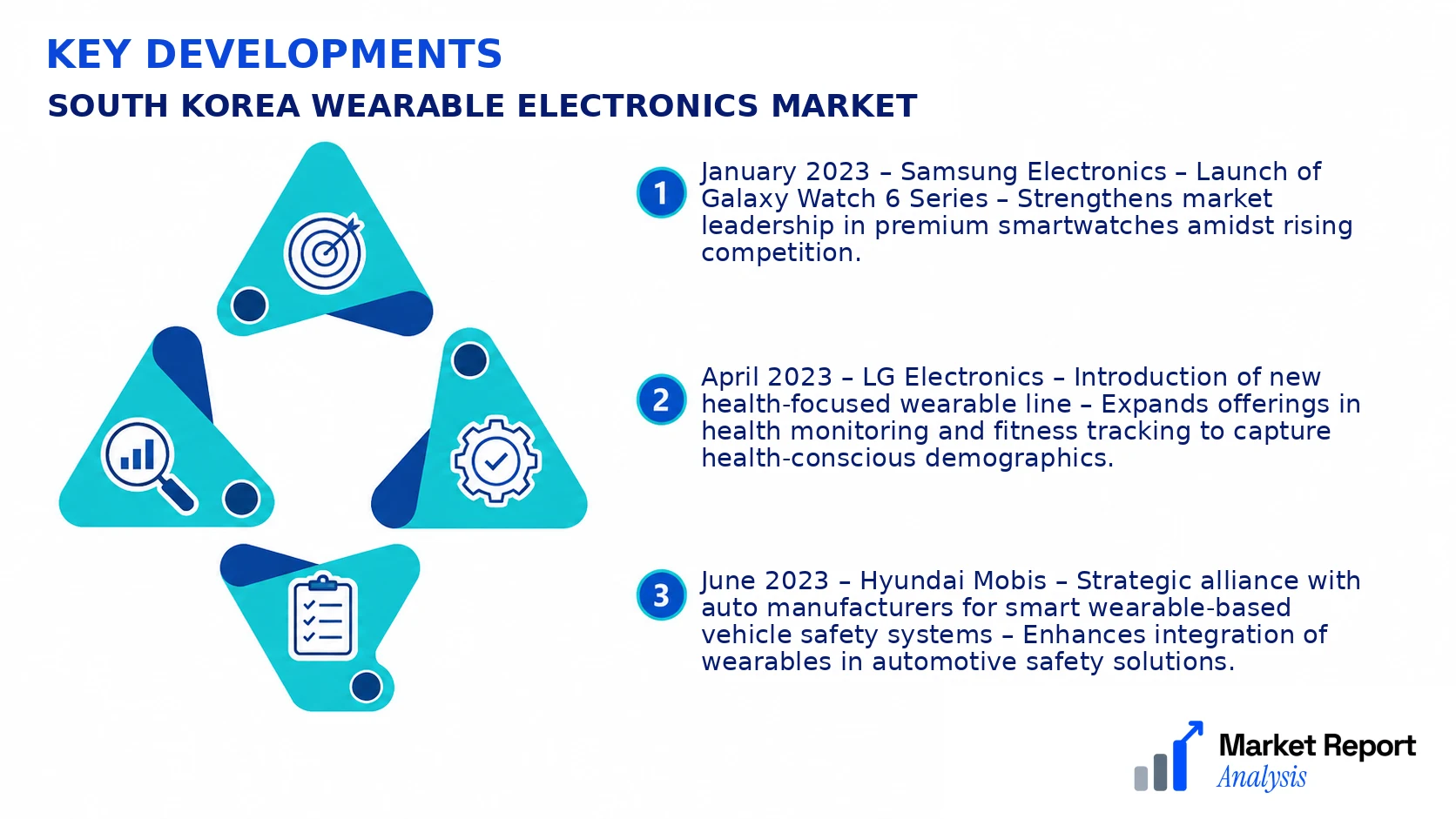
- January 2023 – Samsung Electronics – Launch of Galaxy Watch 6 Series – Strengthens market leadership in premium smartwatches amidst rising competition.
- April 2023 – LG Electronics – Introduction of new health-focused wearable line – Expands offerings in health monitoring and fitness tracking to capture health-conscious demographics.
- June 2023 – Hyundai Mobis – Strategic alliance with auto manufacturers for smart wearable-based vehicle safety systems – Enhances integration of wearables in automotive safety solutions.
- August 2023 – SK Telecom – Deployment of 5G-connected health monitoring wearables for enterprise clients – Promotes digital transformation in corporate health management.
- October 2023 – Kakao Corp – Partnership with streaming services to embed media controls in wearable devices – Improves user engagement through integrated entertainment options.
Frequently Asked Questions
What is the South Korea Wearable Electronics Market?
The South Korea Wearable Electronics Market comprises devices worn on the body that incorporate electronic functionalities, including fitness trackers, smartwatches, health monitors, and augmented reality devices, serving consumers' health, fitness, and connectivity needs within the country.
What is the current market size of South Korea Wearable Electronics Market?
As of 2026, the market size is valued at approximately USD 4.2 Billion, driven by increasing consumer demand for health tracking, technological advancements, and supportive government initiatives promoting digital health and smart device adoption nationwide.
What factors are driving the South Korea Wearable Electronics Market?
Key drivers include rising health consciousness among Koreans, technological innovations offering advanced features, a growing aging population requiring health monitoring, and high smartphone penetration facilitating seamless device connectivity, all supported by strong infrastructure and emerging wellness trends.
Which South Korean city leads the South Korea Wearable Electronics Market?
Seoul leads the South Korea Wearable Electronics Market due to its dense tech ecosystem, robust consumer electronics retail network, presence of major manufacturers, and high smartphone and internet penetration rates, making it the central hub for innovation and adoption.
Which segment is expected to grow the fastest?
The health and fitness segment is anticipated to witness the fastest growth, driven by increasing adoption of smartwatches and fitness trackers among health-conscious consumers and aging populations seeking remote health monitoring solutions.
Who are the leading companies operating in the South Korea Wearable Electronics Market?
Leading companies include Samsung Electronics, LG Electronics, Apple Inc., and Huawei, all of which hold significant market shares through innovative product offerings, strategic partnerships, and strong distribution channels across South Korea.
Analyst Perspective
The long-term outlook for South Korea’s wearable electronics market remains positive, driven by rapid technological advancements and increasing consumer health consciousness. As market saturation nears in mainstream segments, innovation will likely shift toward integrating AI and IoT capabilities, creating new avenues for differentiation. Commercial opportunities are abundant in emerging niches such as smart healthcare devices and sportswear, which align with South Korea’s advanced healthcare infrastructure and active lifestyle trends. Investment priorities should focus on R&D for lightweight, durable materials, and battery life enhancement, alongside strategic partnerships with local tech giants to leverage existing ecosystem advantages. Competitive intensity will intensify as local firms like Samsung and LG seek to sustain dominance, while international players aim to penetrate the high-growth sectors. City-level growth potential is especially strong in Seoul, Busan, and Incheon, where high-income levels, technological adoption, and urban health initiatives foster demand. Long-term strategic positioning should focus on sustainable innovation, local consumer insights, and regional collaborations to capture evolving market dynamics.
