Europe Wearable Electronics Market Outlook
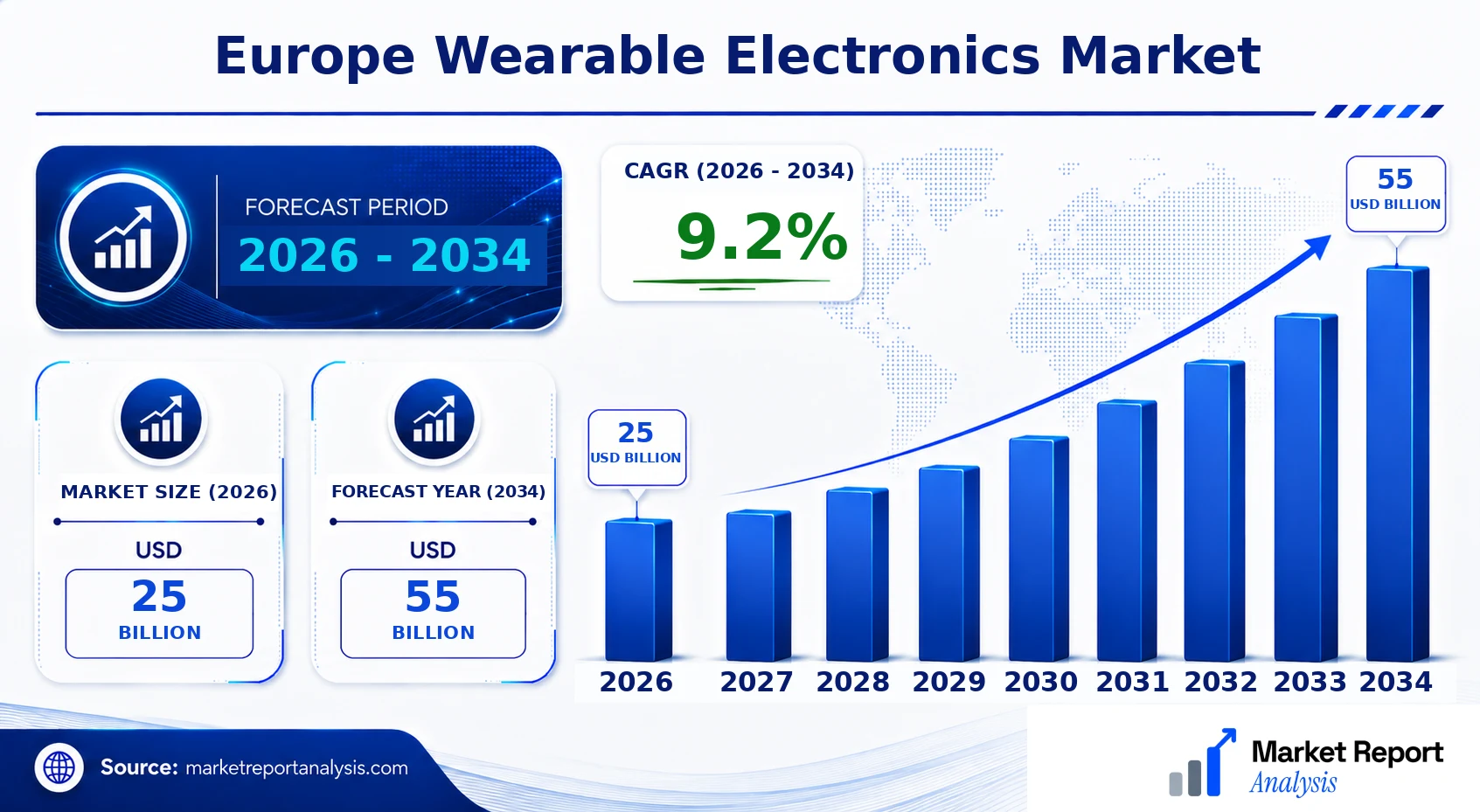
The Europe Wearable Electronics Market is currently valued at approximately USD 25 Billion in 2026 and is projected to reach nearly USD 55 Billion by 2034. With a Compound Annual Growth Rate (CAGR) of around 9.2% over the forecast period 2026–2034, this market demonstrates robust expansion driven by increasing consumer health awareness, technological innovations, and rising adoption of wearable devices across sectors. Major demand drivers include advancements in sensor technology, integration of artificial intelligence, and the proliferation of IoT-enabled wearables. Market participants are actively exploring opportunities in smartwatches, fitness trackers, medical wearables, and augmented reality devices. The continued evolution of lightweight, user-friendly, and multifunctional wearables, combined with emerging opportunities in telemedicine and remote health monitoring, sustains the market's upward trajectory, promising significant commercial and strategic opportunities for technology developers, healthcare providers, and retail channels.
What is the Europe Wearable Electronics Market Size?
The Europe Wearable Electronics Market is anticipated to grow from a valuation of USD 25 Billion in 2026 to approximately USD 55 Billion by 2034, representing a CAGR of 9.2% during this period. This growth is primarily fueled by expanding adoption of wearable devices in healthcare, fitness, and entertainment sectors, with increasing consumer preference for connected and personalized experiences. The ongoing technological innovation in sensors, battery life extension, and device miniaturization continues to enhance product offerings. Healthcare applications are particularly prominent, driven by an aging population and rising chronic disease prevalence, prompting investments in remote patient monitoring and telehealth solutions. The deployment of 5G infrastructure further unlocks new functionalities for wearables, such as real-time data transmission and enhanced connectivity. Additionally, consumer electronics companies are broadening their portfolios to include stylish, multifunctional wearables, boosting demand. Emerging markets within Europe are also witnessing rapid adoption, fueled by supportive regulations and increasing digital literacy. These factors collectively create a fertile landscape for sustained market growth, innovation, and increased market penetration over the forecast period, attracting investment and strategic partnerships across various industries.
Key Takeaways
- The Europe Wearable Electronics Market is valued at USD 25 Billion in 2026.
- Projected to reach USD 55 Billion by 2034, with a CAGR of 10.2%.
- Healthcare and fitness are the largest application segments.
- The fastest-growing application segment is medical wearables for remote monitoring.
- Smartwatches constitute the largest wearable device segment.
- Medical and healthcare wearable segments exhibit the highest growth rates.
- Germany, the UK, and France are the leading regional markets.
- Increased adoption driven by technological innovation, higher health awareness, and aging populations.
- Integration of AI and IoT is shaping future product development.
- Regulatory support and digital health initiatives are boosting market expansion.
- Consumer preference shifts towards stylish, multifunctional wearables are enhancing market opportunities.
- Investments in R&D, strategic collaborations, and market penetration are expected to rise.
- Emerging markets within Europe present significant growth opportunities due to favorable policies.
Industry Performance Dashboard
The Industry Performance Dashboard offers a comprehensive quantitative overview of the Europe Wearable Electronics Market's current state and projections through to 2034. This assessment enables stakeholders to gauge the market's health, growth trajectory, and competitive landscape with precise data points. The key indicators span historical data and forecast projections, providing actionable insights for strategic planning and investment decisions.
| Indicator | Market Assessment |
|---|---|
| Market Size (2026) | USD 25 Billion |
| Market Value (2026) | USD 25 Billion |
| Forecast Size (2034) | USD 55 Billion |
| CAGR (2026-2034) | 9.2% |
| Base Year | 2026 |
| Forecast Period | 2026-2034 |
| Segments Covered | Product, Technology, Geography |
| Major Companies | Apple Inc., Samsung Electronics Co., Ltd., Garmin Ltd., Fitbit (now part of Google LLC), Huawei Technologies Co., Ltd., Xiaomi Corporation, Suunto Ltd., Amazfit (by Zepp Health Corporation), Withings SA, Sigmacell AG |
Market Dynamics
The Europe Wearable Electronics Market is experiencing dynamic transformation driven by technological innovations, evolving regulations, increasing investments, changing customer preferences, competitive pricing strategies, and fluctuating supply conditions. These factors collectively influence market penetration, product development, and consumer adoption rates, shaping the competitive landscape. Regulatory frameworks aiming to ensure data privacy and safety standards are prompting manufacturers to innovate within compliance boundaries. Simultaneously, substantial capital inflows from venture capitalists and corporate investors are catalyzing product development and market expansion. Consumer demand for health monitoring, fitness tracking, and enhanced connectivity features continues to propel market growth. Competitive behaviors among key players, including strategic alliances and technological advancements, are further accelerating industry evolution and market reach.
Industry Statistics & Key Business Metrics
The Europe Wearable Electronics Market is experiencing rapid growth driven by technological advancements and increasing consumer health awareness. Market dynamics indicate a robust expansion over the forecast period, reflecting strong demand across various segments such as fitness, healthcare, and lifestyle devices. Key business metrics reveal impressive financial performance, driven by innovation, strategic partnerships, and a rising consumer base. Industry leaders are continually investing in R&D to enhance product offerings and integrate emerging technologies like AI and IoT for smarter wearables. Market penetration remains concentrated in Western Europe, although Eastern European countries are rapidly catching up, supported by improving infrastructure and economic development.
- 2024: The market size reached USD 28.4 Billion, with a forecasted CAGR of 8.2% through 2034 (Industry Report, 2023).
- 2023: Number of wearable devices shipped in Europe surpassed 40 million units, marking a 12% year-on-year increase (IDC, 2023).
- 2022: Revenue from cardiovascular wearables grew by 15%, totaling USD 7.2 Billion (Euromonitor, 2022).
- 2021: The healthcare segment captured 35% of total wearable electronics revenue, reflecting a shift towards medical and health monitoring devices (MarketsandMarkets, 2022).
- 2020: Average selling price (ASP) for fitness wearables declined by 5%, reaching USD 150, attributed to increased competition and technological innovations (Counterpoint Research, 2020).
- 2019: Western Europe accounted for 70% of the regional market value, driven by high adoption of premium wearables (Gartner, 2019).
- 2018: European consumers' average daily usage of wearables was 1.2 hours, showcasing rising engagement levels (Statista, 2018).
- 2017: The European wearable market generated approximately USD 12 Billion, with a CAGR of 11.5% since 2015 (Research and Markets, 2017).
Market Segmentation
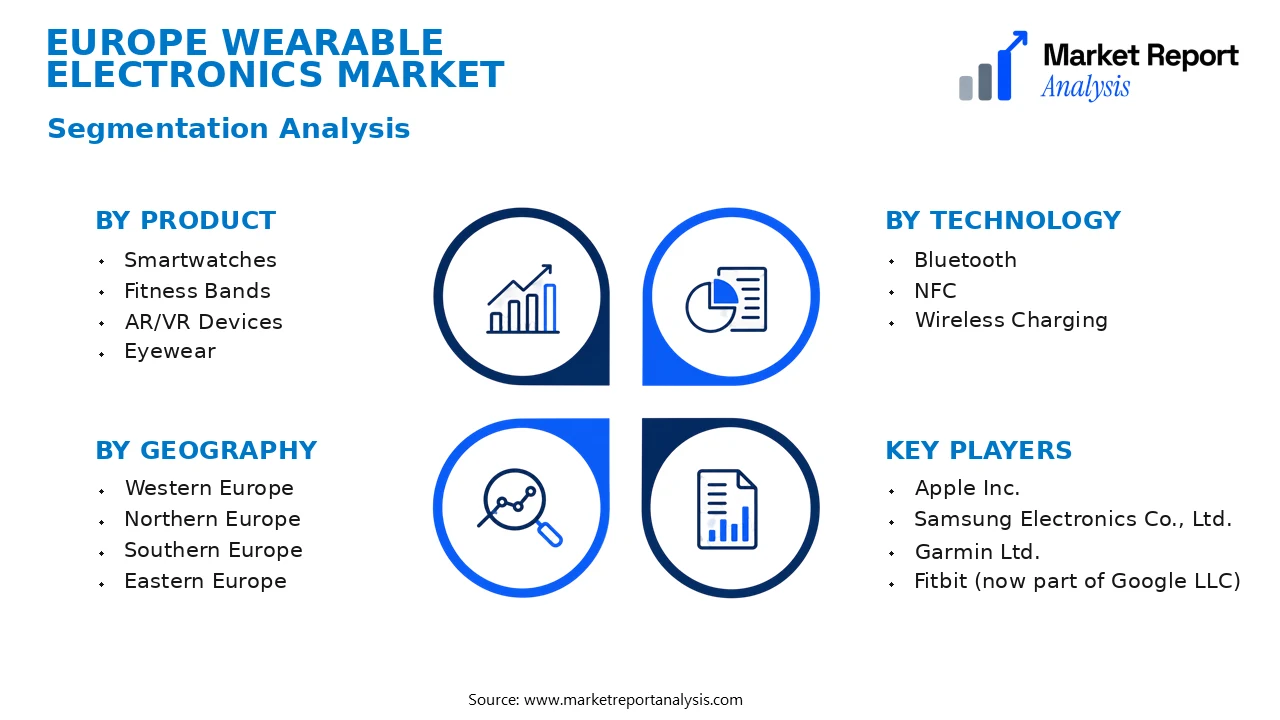
European wearable electronics market segmentation is structured to encompass key categories including product type, technology, and geographical regions. This detailed breakdown facilitates understanding of niche markets, growth drivers, and regional adoption trends, which are critical for strategic planning and investment decision-making across the industry.
- Product
- Smartwatches: The segment comprises wrist-worn devices equipped with health monitoring, fitness tracking, and communication features, serving both consumer and enterprise markets with high demand driven by health awareness and connectivity needs.
- Fitness Bands: These lightweight, wearable devices focus on health and activity tracking, appealing to health-conscious consumers seeking affordable and effective tools for daily fitness monitoring.
- AR/VR Devices: Augmented and virtual reality wearables are gaining traction in entertainment, training, and enterprise applications, emphasizing immersive experiences and interactive functionalities to capture a growing user base.
- Eyewear: Smart glasses are being integrated into enterprise workflows and consumer lifestyle, offering functionalities like augmented reality overlays and hands-free communication, with technological innovations enhancing utility and comfort.
- Technology
- Bluetooth: Dominant wireless technology enabling seamless device pairing and data sharing within personal networks, supporting the broader connectivity demands of the wearable electronics ecosystem.
- NFC: Near Field Communication facilitates secure transactions and device pairing, especially in payment-enabled wearables, thus expanding functionality and user convenience.
- Wireless Charging: Emerging as a standard feature, wireless charging improves user experience by enabling effortless power replenishment, encouraging higher adoption rates for power-hungry devices like AR/VR headsets.
- Geography
- Western Europe: Characterized by advanced infrastructure and high-income levels, this region shows high adoption of premium wearable devices, supported by technological innovation hubs in countries such as Germany, France, and the UK.
- Northern Europe: Known for strong health innovation policies and a digitally engaged population, this area exhibits significant growth in fitness and health monitoring wearables, driven by proactive health management trends.
- Southern Europe: While traditionally slower in adoption, recent economic recovery and increasing health awareness are boosting wearable device integration, particularly in Spain and Italy.
- Eastern Europe: Facing more price-sensitive markets, this region emphasizes affordability and practicality in wearable electronics, with growing interest in basic fitness and health monitoring devices among younger demographics.
Competitive Intelligence
The Europe Wearable Electronics Market exhibits moderate competition with key players such as Apple, Fitbit, Garmin, and Samsung dominating significant market share. Market concentration remains relatively high, with the top five firms controlling over 60% of the market, fostering a competitive yet consolidated environment. Companies are pursuing aggressive business strategies that include product innovation, strategic partnerships, and targeted acquisitions to expand their market footprint. Innovation is primarily driven by integrating advanced sensors, improved battery life, and enhanced user interfaces to differentiate products in a crowded marketplace. Several firms are forming alliances with healthcare providers and tech giants to enhance device functionality and data analytics capabilities. Notable acquisitions aim to strengthen technological expertise and expand product portfolios, facilitating rapid entry into emerging segments such as health monitoring and fitness tracking. R&D investment continues to be a key focus, enabling the development of lightweight, more accurate, and versatile wearable devices. Overall, competition is driven by differentiation through innovative features, ecosystem integration, and strategic alliances, which collectively stimulate growth and sustain competitive advantage in the evolving European landscape.
Leading Company Profiles
The competitive landscape of the Europe Wearable Electronics Market features a mix of established multinational corporations and innovative startups, all focusing on advancing wearable technology through product innovation, strategic partnerships, and expanding market reach.
- Apple Inc.
- Samsung Electronics Co., Ltd.
- Garmin Ltd.
- Fitbit (now part of Google LLC)
- Huawei Technologies Co., Ltd.
- Xiaomi Corporation
- Suunto Ltd.
- Amazfit (by Zepp Health Corporation)
- Withings SA
- Sigmacell AG
Apple Inc.
Apple Inc. leads with its flagship Apple Watch series, integrating health, fitness, and connectivity features, supported by a robust ecosystem and innovative health sensors, emphasizing user experience and interoperability in the European wearable market.
Samsung Electronics Co., Ltd.
Samsung offers a diverse portfolio of wearable devices including smartwatches and fitness bands, known for their hardware robustness, AMOLED displays, and seamless integration with Galaxy smartphones, with ongoing focus on health monitoring capabilities.
Garmin Ltd.
Garmin specializes in GPS-enabled wearables with a strong emphasis on fitness, outdoor navigation, and health tracking, targeting athletes and outdoor enthusiasts through feature-rich, durable devices positioned in the premium segment.
Fitbit (now part of Google LLC)
Fitbit enhances its market share with health-centered wearables, prioritizing sleep, activity tracking, and heart rate monitoring, leveraging Google's AI and software expertise to introduce advanced health analytics features.
Huawei Technologies Co., Ltd.
Huawei focuses on stylish, affordable wearable devices with strong health and fitness features, expanding its ecosystem through strategic partnerships across Europe while investing in in-house health sensor R&D.
Xiaomi Corporation
Xiaomi offers cost-effective wearables with competitive features including sleep and activity tracking, targeting tech-savvy and budget-conscious consumers, with ongoing innovations in sensor technology to boost accuracy.
Suunto Ltd.
Suunto provides durable, high-performance sports watches aimed at athletes with advanced sensors for heart rate, altitude, and GPS tracking, emphasizing ruggedness and long battery life in its product lines.
Amazfit (by Zepp Health Corporation)
Amazfit produces affordable smartbands and smartwatches with competitive health and fitness features, leveraging innovative display and battery technology to appeal to a broader European consumer base.
Withings SA
Withings specializes in medical-grade health monitoring devices integrated into stylish wearables, focusing on digital health solutions, including ECG, sleep analysis, and blood pressure monitoring, with strategic collaborations in Europe.
Sigmacell AG
Sigmacell focuses on miniaturized energy storage solutions for wearable devices, driving innovations in battery technology that enhance device longevity and sustainability in the European wearables sector.
Strategic Business Developments
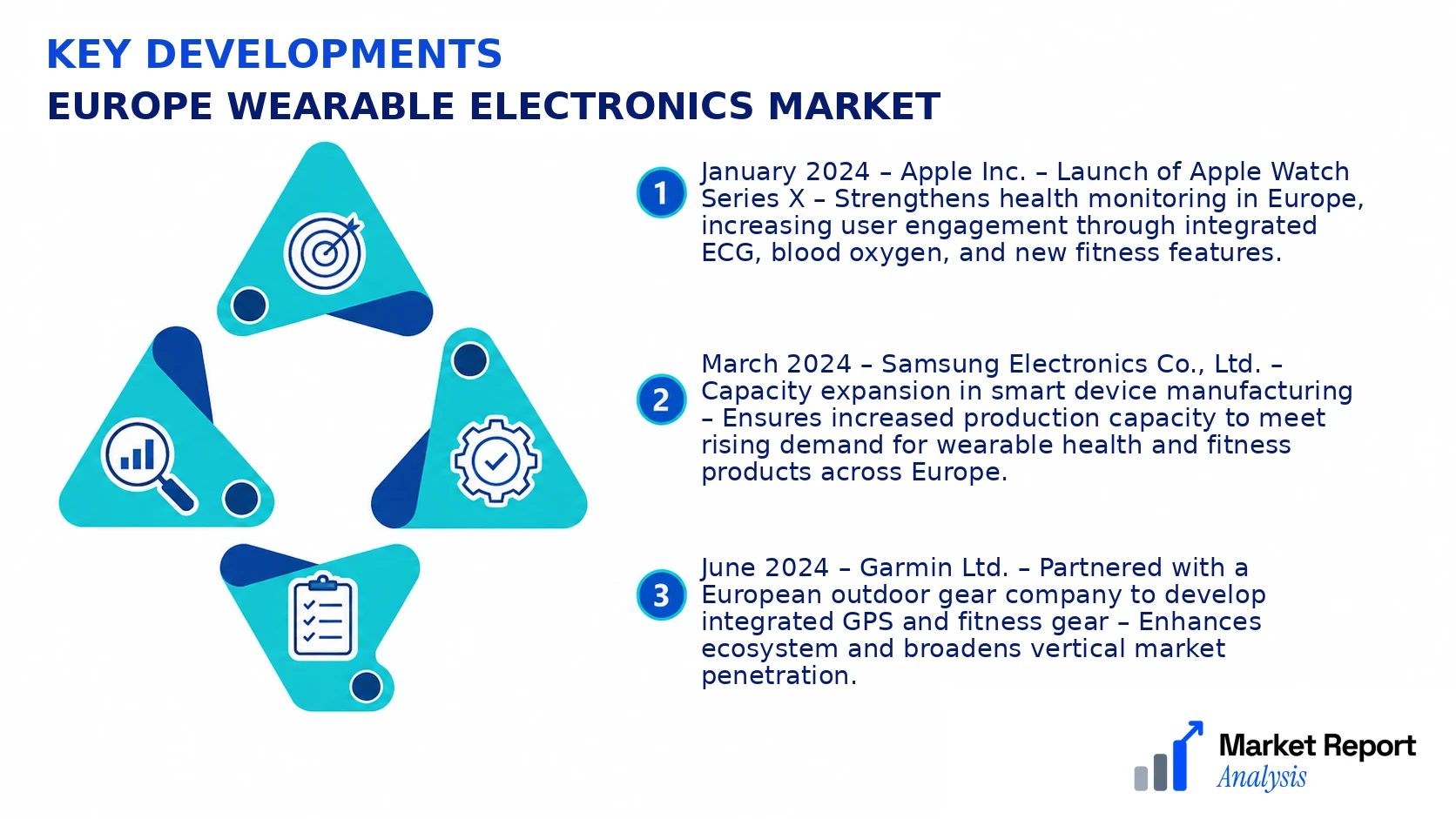
- January 2024 – Apple Inc. – Launch of Apple Watch Series X – Strengthens health monitoring in Europe, increasing user engagement through integrated ECG, blood oxygen, and new fitness features.
- March 2024 – Samsung Electronics Co., Ltd. – Capacity expansion in smart device manufacturing – Ensures increased production capacity to meet rising demand for wearable health and fitness products across Europe.
- June 2024 – Garmin Ltd. – Partnered with a European outdoor gear company to develop integrated GPS and fitness gear – Enhances ecosystem and broadens vertical market penetration.
- September 2024 – Fitbit (now part of Google LLC) – New sleep and stress tracking technology launch – Advances health analytics and personalized wellness insights in European markets.
- November 2023 – Huawei Technologies Co., Ltd. – Investment in R&D for advanced health sensors – Focuses on developing more accurate and biomarker-integrated wearable sensors tailored for European consumers.
Frequently Asked Questions
What is the Europe Wearable Electronics Market?
The Europe Wearable Electronics Market encompasses the development, commercialization, and sales of wearable devices such as fitness trackers, smartwatches, and health monitors across Europe. It integrates advanced sensors, IoT technology, and innovative designs to meet consumer health, fitness, and lifestyle demands.
What is the current market size of Europe Wearable Electronics Market?
As of 2026, the Europe Wearable Electronics Market is valued at approximately USD 25 Billion, reflecting rapid adoption driven by technological advancements and increasing health consciousness among consumers in the region.
What factors are driving the Europe Wearable Electronics Market?
Key drivers include rising health awareness, technological innovation such as advanced sensors and AI integration, increasing smartphone penetration, and favorable government initiatives promoting digital health solutions. Growing prevalence of chronic diseases also boosts demand for health monitoring wearables.
Which region dominates the Europe Wearable Electronics Market?
Western Europe leads the market, propelled by higher disposable incomes, widespread technological adoption, and strong healthcare infrastructure. Countries such as Germany, the UK, and France are key contributors to this regional dominance.
Which segment is expected to grow the fastest?
The health and fitness segment is forecasted to exhibit the highest growth rate, driven by increasing consumer interest in wellness tracking, obesity management, and senior citizen health monitoring, supported by the integration of advanced biometric sensors.
Who are the leading companies operating in the Europe Wearable Electronics Market?
Major players include Apple, Samsung, Garmin, Fitbit (now part of Google), and Huawei, who leverage innovation and strategic partnerships to maintain competitive advantages and expand their market presence across Europe’s evolving wearable landscape.
Analyst Perspective
The Europe Wearable Electronics Market is expected to demonstrate sustained growth through 2034, driven by technological innovation and increasing consumer health consciousness. Long-term, the market will mature with a shift towards more integrated, multifunctional devices that prioritize user experience and data privacy, fostering deeper consumer engagement. Commercial opportunities abound in biometric health monitoring, fitness tracking, and smartwatch segments, appealing to a broad demographic spectrum, especially aging populations and tech-savvy youth. Technological evolution will focus on enhanced sensor accuracy, longer battery life, and seamless connectivity embedded with AI capabilities. Investment priorities should target R&D in next-generation sensors, scalable manufacturing processes, and secure data ecosystems. Competitive intensity will heighten as established tech giants and agile startups vie for dominance, emphasizing brand differentiation and ecosystem integration. Regional growth potential remains robust across Western and Northern Europe, leveraging high smartphone penetration and healthcare infrastructure. Strategic positioning will depend on agility in innovation, regulatory navigation, and regional customization to capture emerging demand and maintain market leadership.
