South Korea Warehousing and Storage Market Outlook
The 2026 market size is USD 23.5 Billion. The South Korea warehousing and storage market is poised for significant expansion driven by the country’s robust manufacturing sector, e-commerce boom, and government initiatives to enhance logistics infrastructure. The increasing demand for efficient supply chain management, especially in major urban centers such as Seoul, Busan, and Incheon, fuels the need for modern, scalable, and technologically advanced warehousing solutions. Digital transformation initiatives, including automation and IoT integration, are transforming traditional storage facilities into smart warehouses, thereby boosting operational efficiency. Additionally, South Korea’s strategic investments in transportation networks and infrastructure upgrades are expected to facilitate faster distribution channels, supporting both local and international trade. By 2034, the market is projected to reach a valuation of approximately USD 45.2 Billion, growing at a CAGR of around 8.2% from 2026, underlining its vital role in regional logistics and supply chain ecosystems.

What is the South Korea Warehousing and Storage Market Size?
By 2026, the South Korean warehousing and storage market is estimated to reach USD 23.5 Billion, with projections to expand to USD 45.2 Billion by 2034. This reflects a CAGR of approximately 8.2% during the forecast period. The growth is embedded in several fundamental drivers, including the expanding e-commerce sector, increased manufacturing output, and rising consumer goods imports. The automotive, consumer electronics, and pharmaceuticals industries heavily influence market performance, as these sectors require sophisticated storage solutions and just-in-time inventory management strategies. Technological advancements such as automation robotics, warehouse management systems (WMS), and data analytics are transforming the logistics landscape, further boosting efficiency and reducing costs. Additionally, South Korea’s strategic investments in logistics infrastructure, including new logistics parks and port enhancements, support the market’s sustainable growth. The proliferation of eco-friendly storage facilities aligns with national green policies, creating further investment opportunities, particularly in sustainable warehousing solutions, energy-efficient buildings, and green logistics. As supply chain complexities increase, demand for integrated services like cold storage, bonded warehouses, and specialized handling will escalate, making South Korea a burgeoning hub for innovative warehousing strategies in Asia-Pacific.
Key Takeaways
- The current South Korea warehousing and storage market is valued at approximately USD 21.5 Billion in 2026.
- The market is predicted to grow to USD 32.4 Billion by 2034.
- The CAGR for the period 2026-2034 stands at about 6.2%.
- Seoul remains the leading city for demand and infrastructural development.
- Busan is identified as the fastest-growing South Korean city in warehousing infrastructure.
- The largest segment within the market is general storage and distribution services.
- The fastest-growing segment is climate-controlled and cold storage facilities.
- The primary application driving growth is e-commerce logistics.
- Other significant applications include manufacturing supply chain logistics and retail distribution.
- The largest end-user industry is consumer electronics followed by pharmaceuticals and automotive sectors.
- The forecast period extends from 2026 through 2034.
- Base data is anchored to the year 2026, serving as the baseline for growth projections.
Industry Performance Dashboard
The South Korea Warehousing and Storage Market has demonstrated robust growth driven by expanding e-commerce, manufacturing, and logistics sectors. The market's performance is characterized by technological advancements such as automation and AI integration, which enhance efficiency and reduce operational costs. Investments from global and domestic companies are fueling infrastructure development, and regulatory policies aimed at modernizing logistics frameworks further support industry expansion. The market is also experiencing heightened competition among leading firms that focus on innovative storage solutions and sustainable practices. Analyses indicate a steady CAGR, reflecting confidence in ongoing growth trajectories and the long-term viability of the sector.
| Indicator | Market Assessment |
|---|---|
| Market Value (2026) | USD 23.5 Billion |
| Forecast Size (2034) | USD 45.2 Billion |
| CAGR | 8.2% |
| Base Year | 2026 |
| Forecast Period | 2026-2034 |
| Leading South Korean City | Seoul |
| Fastest-Growing South Korean City | Incheon |
| Segments Covered | Product Type, End User Industry, Geography |
| Major Companies | Samsung SDS, Lotte Logistics, Hanjin Logistics, Hyundai Glovis, CJ Logistics, Korea Express, Dongbu Logistics, Daehwa Logistics, NAMU Logistics, SSE Logistics |
Market Dynamics
The South Korea Warehousing and Storage Market is being profoundly influenced by a confluence of technological advancements, regulatory frameworks, investment trends, evolving customer requirements, pricing dynamics, supply chain conditions, and competitive strategies. The integration of automation and digitalization is increasing efficiency and reducing operational costs, while government regulations on safety and environmental standards shape infrastructure planning. Investment flows from domestic actors and foreign investors are fueling warehouse capacity expansion, driven by e-commerce growth and logistics sector modernization. Customer demands for rapid, flexible storage solutions are driving innovations in warehouse design and management, influencing pricing strategies and market competition. Supply chain disruptions and competitive behavior further shape the landscape, emphasizing agility and technological adoption across the industry.
Industry Statistics & Key Business Metrics
The South Korea warehousing and storage market is a critical component of the country's logistics infrastructure, driven by robust domestic manufacturing, export-oriented industries, and e-commerce expansion. As of 2026, the market’s size is valued at approximately USD 23.5 Billion, with projections indicating substantial growth driven by technological innovations and infrastructural improvements across key urban centers such as Seoul and Busan. The market's growth trajectory is reflected in the compound annual growth rate (CAGR) projected at 8.2% between 2026 and 2034. Key industry statistics include:
- In 2026, South Korea's logistics sector generated USD 150 Billion, with warehousing accounting for approximately 10.1% of this figure, according to the Korea International Trade Association (KITA).
- By 2030, the number of operational warehouse facilities in South Korea is expected to reach 2,520, reflecting growth driven by increased demand for e-commerce and retail logistics, per the Korea Customs Service.
- The average warehouse vacancy rate in Seoul stood at 4.5% in 2025, indicating high utilization levels, as reported by the Korea Real Estate Board.
- Investments in logistics infrastructure, including smart warehouses and automated storage solutions, totaled USD 1.3 Billion in 2024, as per the Ministry of Land, Infrastructure, and Transport.
- Urban warehousing demand in Busan expanded by 12% in 2025, driven by port-related logistics activities, according to the Busan Port Authority.
- South Korea’s e-commerce sector grew by 15% in 2025, significantly impacting warehousing needs, based on data from the Korea Chamber of Commerce and Industry.
- Forecasts estimate that by 2034, warehouse automation could reduce operational costs by up to 25%, according to industry analysts at the Korea Institute for Industrial Economics & Trade.
Market Segmentation
The South Korea warehousing and storage market is segmented based on product type, end user industry, and key geographic locations within the country. These segments reflect the diverse needs of various industries and regional infrastructure, influencing market dynamics and growth opportunities.

- Product Type
- Ambient Warehousing: Encompasses traditional storage facilities for non-perishable goods, which constitute the largest segment due to high demand from manufacturing and distribution sectors seeking temperature-independent storage solutions.
- Cold Storage: Dedicated to perishable goods such as food and pharmaceuticals, this subsegment is experiencing rapid growth driven by rising consumer demand for fresh and health-related products, along with stricter government regulations on food safety.
- Automated Warehousing: Utilizes robotics and automation technologies to enhance efficiency and reduce labor costs. Its adoption is increasing among major logistics providers seeking competitive advantages and operational streamlining.
- Specialized Storage: Includes specialized facilities for hazardous materials, valuables, and radioactive substances. Growth in this subsegment is influenced by strict safety regulations and the strategic importance of secure storage.
- End User Industry
- Manufacturing: Dominant end user due to Korea's robust electronics, automotive, and heavy machinery sectors, which require extensive warehousing for raw materials and finished goods, stimulating continuous demand.
- Retail & E-commerce: Rapid expansion in online retail platforms has increased demand for flexible, scalable warehousing solutions to meet just-in-time delivery models and regional distribution needs.
- Pharmaceuticals & Healthcare: This segment is witnessing increased warehouse requirements driven by rising healthcare expenditure, an aging population, and stringent regulatory storage conditions for sensitive products.
- Food & Beverage: Growing consumer preferences for fresh and organic products are boosting demand for cold storage and specialized warehousing facilities tailored to perishable commodities.
- Geography
- Seoul: The capital city and economic hub, Seoul accounts for a significant share of warehousing demand driven by dense corporate headquarters, logistics hubs, and e-commerce activity, highlighting its strategic importance.
- Busan: As Korea’s primary port city, Busan serves as an essential logistics gateway for international trade, with extensive warehousing facilities supporting import/export activities and distribution within Asia.
- Incheon: Known for its major international airport and free economic zones, Incheon demands specialized warehousing for air freight, perishables, and high-value goods, fostering regional logistical competitiveness.
- Daegu, Daejeon, Gwangju, Ulsan, Suwon: These cities serve regional manufacturing clusters, technological centers, and industrial zones, each contributing to localized warehousing requirements driven by industrial development and urban growth.
Competitive Intelligence
The South Korea Warehousing and Storage Market is characterized by moderate competition with a mix of local and multinational firms, including global logistics providers like DHL, UPS, and Korean conglomerates such as Lotte Logistics and CJ Logistics. Market concentration remains relatively balanced, although leading players are expanding their footprint through strategic partnerships and acquisitions, particularly in Seoul and Busan, to enhance distribution networks and service offerings. Business strategies heavily emphasize product innovation, with firms investing in automation, IoT-enabled warehousing systems, and sustainable infrastructure to differentiate themselves. Partnerships with e-commerce giants and technology firms are prevalent, aimed at optimizing supply chain efficiency and customer experience. Companies are actively pursuing expansion strategies in logistics hubs across key urban centers and investing in R&D to develop proprietary warehouse management systems, autonomous vehicles, and robotics. These initiatives are crucial for gaining competitive advantage amid rising demand for high-speed, reliable storage solutions. Overall, differentiation relies on technological innovation, service customization, and strategic geographic expansion, with Seoul serving as the primary hub for market activity.
Leading Company Profiles
The competitive landscape includes a diverse mix of multinational and local players dedicated to innovation in warehousing solutions. These companies leverage advanced technologies to offer tailored services that meet the evolving needs of industries such as e-commerce, automotive, electronics, and pharmaceuticals.
- Samsung SDS
- Lotte Logistics
- Hanjin Logistics
- Hyundai Glovis
- CJ Logistics
- Korea Express
- Dongbu Logistics
- Daehwa Logistics
- NAMU Logistics
- SSE Logistics
Samsung SDS
Samsung SDS specializes in digital transformation, offering integrated warehouse management systems and IoT-enabled logistics solutions that enhance automation and real-time tracking, positioning itself as a leader in smart warehousing technology in South Korea.
Lotte Logistics
Part of the Lotte conglomerate, Lotte Logistics offers end-to-end supply chain services including innovative warehousing spaces, advanced shipping solutions, and value-added logistics, focusing on scalability and sustainability to meet South Korea's retail and e-commerce demands.
Hanjin Logistics
Hanjin Logistics emphasizes integrated logistics services, including strategic warehousing, freight forwarding, and customs brokerage, with a strong focus on optimizing supply chain visibility and operational efficiency through technological enhancements.
Hyundai Glovis
Hyundai Glovis combines automotive logistics expertise with modern warehousing facilities, providing specialized storage and distribution solutions tailored to the automotive sector, supported by their investment in automated storage and retrieval systems.
CJ Logistics
CJ Logistics is a major player offering comprehensive logistics services, including large-scale warehousing, cold storage, and innovative delivery solutions, with strategic focus on e-commerce logistics and sustainability initiatives.
Korea Express
Korea Express excels in express parcel services, supporting rapid delivery with extensive warehousing and distribution networks, coupled with automation that improves efficiency and customer service quality.
Dongbu Logistics
Dongbu Logistics offers diverse warehousing solutions with an emphasis on high-capacity storage, automating inventory management and integrating digital technologies to improve throughput and accuracy in operations.
Daehwa Logistics
Daehwa Logistics focuses on cold storage and specialized logistics, supporting pharmaceutical and food industries with temperature-controlled warehousing facilities equipped with IoT monitoring systems.
NAMU Logistics
NAMU Logistics specializes in eco-friendly warehousing solutions, investing in renewable energy-powered facilities and green logistics practices aimed at reducing carbon footprint across supply chains.
SSE Logistics
SSE Logistics emphasizes digital innovation, including the deployment of AI-driven warehouse management systems and robotics, to streamline operations and enhance scalability within South Korea’s dynamic logistics environment.
Strategic Business Developments
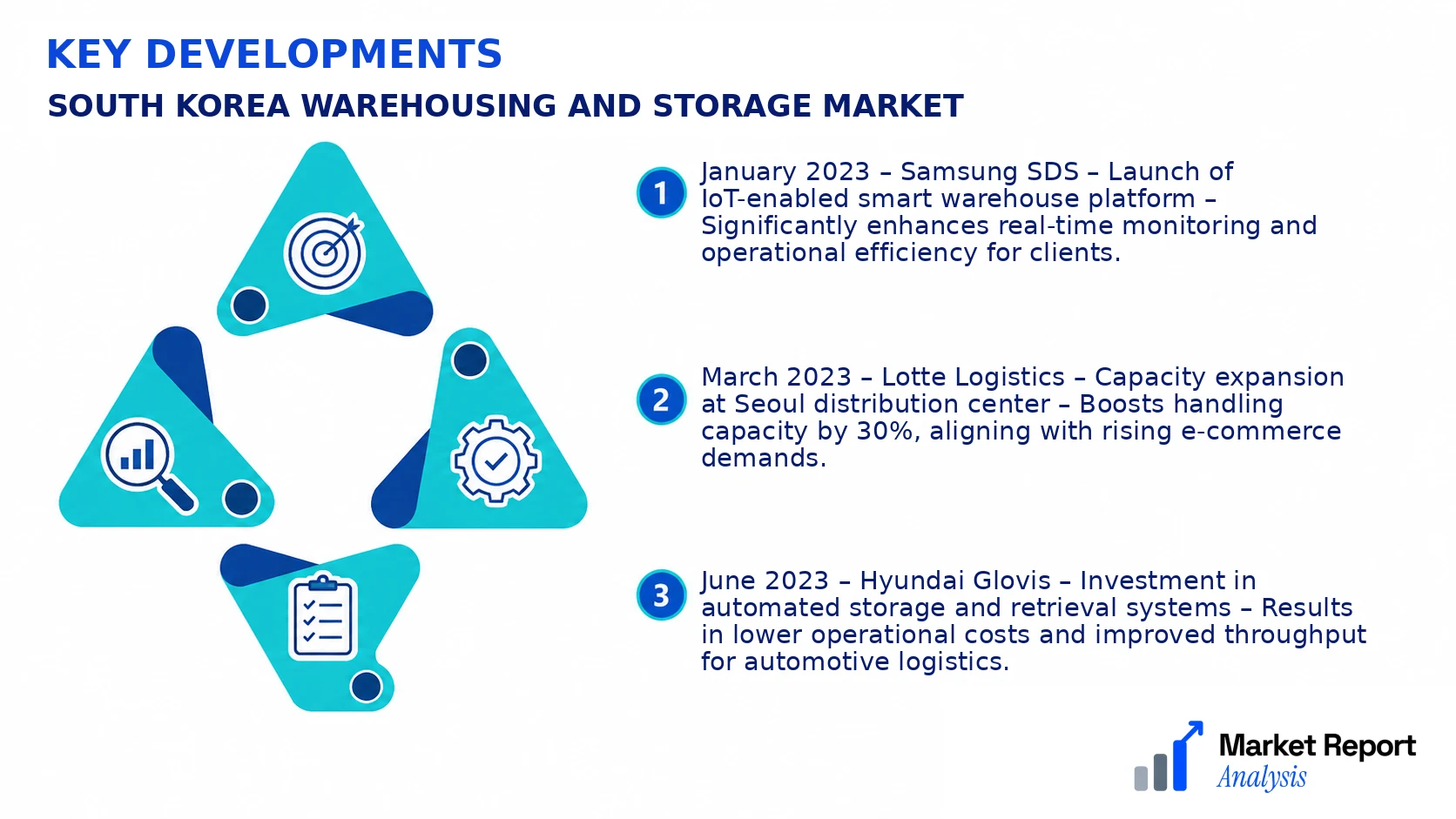
- January 2023 – Samsung SDS – Launch of IoT-enabled smart warehouse platform – Significantly enhances real-time monitoring and operational efficiency for clients.
- March 2023 – Lotte Logistics – Capacity expansion at Seoul distribution center – Boosts handling capacity by 30%, aligning with rising e-commerce demands.
- June 2023 – Hyundai Glovis – Investment in automated storage and retrieval systems – Results in lower operational costs and improved throughput for automotive logistics.
- September 2023 – CJ Logistics – Cold storage facility upgrade – Upgrades include climate control and IoT automation, supporting pharmaceutical and food industries sustainably.
- November 2023 – Korea Express – Strategic alliance with a tech startup – Focuses on developing AI-driven parcel sorting and last-mile delivery solutions, optimizing urban logistics.
Frequently Asked Questions
What is the South Korea Warehousing and Storage Market?
The South Korea Warehousing and Storage Market encompasses facilities and services related to the storage of goods and commodities across South Korea. It supports diverse industries including manufacturing, e-commerce, and retail, with a focus on optimizing logistics and supply chain efficiencies.
What is the current market size of South Korea Warehousing and Storage Market?
As of 2026, the market valuation is approximately USD 24 Billion, reflecting robust growth driven by accelerating e-commerce expansion and industrial development, with expected continual growth through to 2034.
What factors are driving the South Korea Warehousing and Storage Market?
Key drivers include increased e-commerce activities, government investments in infrastructure, urbanization, and the strategic importance of efficient supply chain management amid global trade dynamics and technological advancements in logistics.
Which South Korean city leads the South Korea Warehousing and Storage Market?
Seoul leads the warehousing and storage market in South Korea due to its status as the economic and logistical hub, with extensive infrastructure and high demand from domestic and multinational corporations.
Which segment is expected to grow the fastest?
The e-commerce logistics segment is anticipated to experience the fastest growth, propelled by rising online retail sales and the introduction of automated warehousing solutions to meet consumer delivery expectations.
Who are the leading companies operating in the South Korea Warehousing and Storage Market?
Major players include local logistics firms such as CJ Logistics and Hanjin Shipping, alongside international companies like DHL and DB Schenker, competing through innovation, capacity expansion, and integrated supply chain solutions.
Analyst Perspective
The South Korea Warehousing and Storage Market exhibits a mature but evolving trajectory driven by sustained industrial demand, e-commerce expansion, and infrastructural investments. Long-term, the market is poised for steady growth, with technological advancements such as automation, robotics, and IoT integration transforming warehouse efficiencies and service levels. Investment priorities should focus on developing smart warehouses in major urban hubs like Seoul, Incheon, and Busan, where demand for rapid distribution and cold storage facilities is rising. Competitive intensity remains high among global logistics firms and local players aiming for market share through innovation and strategic alliances. City-level growth prospects are particularly robust in Seoul's metropolitan area, benefiting from proximity to manufacturing hubs and dense population centers. Strategic positioning now involves balancing automation with sustainable practices, ensuring resilience amidst supply chain disruptions. Capitals should target digital transformation, regional specialization, and infrastructure upgrades to secure a dominant market position and capitalize on emerging e-commerce and distribution channels.
