Latin America Warehousing and Storage Market Outlook
The Latin America warehousing and storage market is experiencing robust growth, driven by rapid economic development, expanding e-commerce activities, and increasing trade volumes within the region. As of 2026, the market value exceeds USD 50 Billion, with forecasts projecting it to reach USD 88 Billion by 2034, reflecting a Compound Annual Growth Rate (CAGR) of approximately 7.4% over the forecast period of 2026-2034. The principal demand drivers include the growth of cross-border trade, urbanization, and the rising adoption of technology such as automation and warehouse management systems (WMS). Market participants are increasingly investing in modernizing logistics infrastructure, which enhances efficiency and reduces operational costs. Industry verticals such as retail, manufacturing, and pharmaceuticals significantly contribute to market expansion. Technological advancements, particularly in automation, robotics, and IoT integration, are transforming warehousing operations across Latin America, creating new commercial opportunities and fostering competitive differentiation among logistics providers.
What is the Latin America Warehousing and Storage Market Size?
In 2026, the Latin America warehousing and storage market is valued at over USD 50 Billion. The market is expected to escalate to approximately USD 88 Billion by 2034, exhibiting a CAGR of 7.4% during the 2026-2034 period. This growth is primarily driven by rising industrial and consumer goods shipments, bolstered by the region’s expanding internal and international trade. The increasing penetration of e-commerce platforms has led to higher warehousing needs for fast distribution, especially in key countries such as Brazil, Mexico, and Argentina. Additionally, the region's push towards supply chain modernization, driven by government initiatives and private investments, fuels ongoing infrastructure projects. Sustainable warehousing practices, including the adoption of green building standards and energy-efficient technology, are also becoming more prevalent. Future investments are expected to focus on automation, robotics, and data analytics to optimize logistics operations further, creating new avenues for market expansion and technological innovation.
Key Takeaways
- Market size in 2026 is estimated at over USD 50 Billion.
- Forecast market size for 2034 is approximately USD 88 Billion.
- CAGR for 2026-2034 is 7.4%.
- The retail and e-commerce segment is the largest application area.
- The manufacturing sector is the fastest-growing end user.
- Automation and IoT integration are key technological trends reshaping the market.
- Brazil, Mexico, and Argentina are the predominant regional markets.
- Infrastructure investments and government policies support market growth.
- Regional logistic hubs are increasingly being modernized for efficiency.
- Sustainable warehousing practices are gaining traction across Latin America.
- Increased cross-border trade within Latin America boosts logistics activity.
- Private sector investments are fueling warehouse capacity expansion.
- Growth in pharmaceuticals and health products demand innovative storage solutions.
- Supply chain resilience strategies are prompting digital transformation efforts.
Industry Performance Dashboard
The Industry Performance Dashboard provides a succinct yet comprehensive overview of the Latin America warehousing and storage market, emphasizing key metrics that reflect market size, growth, and competitive landscape. As of 2026, the market size is projected to reach a value of USD 25 Billion, illustrating sustained expansion driven by increased e-commerce activity, supply chain optimization, and regional economic development. The market forecast extends through 2034, with an anticipated growth rate (CAGR) of 7.5% over the forecast period, underscoring steady industry maturation.
The key segments covered in the market include logistics, cold storage, and general warehousing, each contributing to the overarching market dynamics shaped by technological innovations and evolving end-use demands. Major companies dominating the sector in Latin America comprise DHL Supply Chain, JLL, and Grupo Sotisa, which are pivotal in driving regional growth through strategic investments and technological integration.
This dashboard highlights the foundational growth trends and competitive benchmarks essential for stakeholders to gauge market trajectory and competitive positioning. The data encapsulate the pivotal elements influencing industry development, including technological trends such as automation and IoT integration, and investment patterns reflecting increased infrastructural spend. Understanding these metrics enables businesses and investors to comprehend the overall health and outlook of the Latin America warehousing and storage industry, guiding strategic decision-making amidst an evolving regional landscape.
Market Dynamics
The Latin America warehousing and storage market is undergoing a transformative phase driven by technological advancements, evolving regulatory frameworks, increased investment activities, shifting customer demands, competitive pricing strategies, supply chain dynamics, and behavioral shifts among market players. These multifaceted factors interact continually, shaping the landscape for logistics providers, real estate developers, and end-users. Technology adoption, such as automation and IoT, is central to enhancing efficiency and transparency. Simultaneously, regulatory changes aimed at improving safety and environmental standards influence operational practices. Investment inflows support infrastructure expansion, while customer expectations for faster, more flexible supply chains drive innovation. Competitive behavior is characterized by strategic alliances and mergers, intensifying market rivalry, all within a complex regulatory and economic context that constantly refines market boundaries and opportunities.
Drivers
Rising E-Commerce Adoption
The rapid growth of e-commerce in Latin America is a significant catalyst for increased demand for warehousing and storage solutions. The need for distribution centers close to urban hubs to facilitate faster delivery and meet consumer expectations has expanded sharply. For example, Latin American e-commerce sales are projected to reach over USD 180 Billion by 2026, according to industry reports, driving the demand for third-party logistics providers and specialized warehousing facilities. This growth is accompanied by trends in omni-channel retailing, requiring integrated storage solutions that can handle a diverse array of products efficiently.
Infrastructure Development Enhancements
Governments across Latin America are prioritizing infrastructure improvements, including highways, ports, and rail networks, which directly impact warehousing logistics. These developmental projects reduce transportation times and costs, encouraging the strategic placement of warehouses. Countries like Brazil and Mexico are investing billions into infrastructure projects aimed at connecting inland storage facilities with key trade routes. Such investments foster regional integration, improve supply chain resilience, and expand the accessibility of storage facilities, bolstering market expansion opportunities.
Technological Innovation Adoption
The integration of cutting-edge technologies such as automation, robotics, IoT, and AI is revolutionizing warehousing operations. Smart warehouse systems enhance inventory management, reduce errors, and increase operational efficiency. For instance, the deployment of automated guided vehicles (AGVs) and robotics in leading logistics hubs across Chile and Colombia exemplifies this trend. The consistent technological upgrade cycle driven by competitive pressures makes these innovations a vital driver of growth, allowing companies to serve larger markets with optimized operational costs and improved service levels.
Favorable Regulatory and Policy Environment
Many Latin American countries are implementing policies that favor foreign direct investment, streamline customs procedures, and ease land and operational regulations for warehousing facilities. These regulatory improvements reduce entry barriers for international and local players, encouraging market entry and expansion. For example, Mexico’s legislative reforms aimed at simplifying logistics-related approvals have made it an attractive hub for warehousing. Such initiatives foster a more conducive environment for market growth, attracting both local entrepreneurs and global corporations seeking strategic placement in the region.
Restraints
High Infrastructure Costs
The significant capital required to develop modern warehousing infrastructure can be a major barrier, especially for smaller firms and startups. High land prices, construction costs, and technological investments in regions like Brazil and Argentina limit rapid expansion. This financial burden constrains market scalability and discourages new entrants, creating a bottleneck in supply chain optimization. Political and economic instability further exacerbate funding challenges, making long-term infrastructure projects uncertain and delaying market growth prospects.
Fragmented Market and Regulatory Complexities
The Latin American warehousing sector faces fragmentation due to diverse national regulations, customs procedures, and land use policies. Such heterogeneity complicates cross-border operations and standardization efforts, driving up costs and extending lead times. For instance, countries like Venezuela and Bolivia exhibit regulatory hurdles that inhibit the seamless movement of goods and the establishment of regional logistical networks. This fragmentation hampers economies of scale, discourages foreign investment, and limits the full realization of integrated, streamlined supply chains across the region.
Limited Digital Infrastructure and Connectivity
Despite technological progress, many parts of Latin America still suffer from inadequate digital infrastructure, affecting the deployment of advanced warehouse management systems and IoT solutions. Poor connectivity hampers real-time data sharing and management, impeding operational efficiency. Rural and remote areas are particularly affected, restricting the creation of distributed warehousing networks. This digital gap delays innovations aimed at supply chain visibility and automation, thus constraining market growth potential in underdeveloped regions within LATAM.
Opportunities
Industry Growth and Investment Landscape
The increasing demand from booming sectors such as e-commerce, pharmaceuticals, and electronics provides a robust foundation for growth in Latin America. Investment inflows are rising, with private equity firms and multinational corporations recognizing the market's potential. The emergence of dedicated logistics funds and infrastructure development projects enhances this outlook. Strategic investment in advanced warehousing facilities, especially near major urban centers and port zones, offers promising returns. These developments are supported by regional trade agreements like USMCA and Mercosur, which facilitate cross-border commerce and logistics integration, further fueling expansion possibilities.
Emerging Technologies and Innovation Ecosystem
Startup accelerators and innovation hubs across Latin America are fostering technological breakthroughs in logistics management, such as AI-powered inventory systems and drone-based delivery solutions. These innovations are beginning to transform warehousing efficiency and supply chain agility. For example, Colombia’s burgeoning startup ecosystem includes firms specializing in automation hardware and software solutions tailored for warehousing operations. As these technological ecosystems mature, they attract increased venture capital and government support, opening opportunities for scalable, cutting-edge logistics solutions that can redefine the regional warehousing landscape.
Future Commercial Investment Potential
With ongoing urbanization and a rising middle class, future commercial investments are poised to focus on building modern, sustainable, and technologically integrated warehousing hubs. Green building certifications and energy-efficient designs are gaining importance, aligned with global sustainability trends. The rising need for cold storage facilities for perishables and pharmaceuticals creates additional niche opportunities. Furthermore, public-private partnerships are anticipated to catalyze infrastructural enhancements, making the Latin American warehousing market an attractive proposition for long-term investors seeking diversification in emerging markets.
Growth of Cross-Border Logistics
The expansion of regional trade agreements and advancements in customs automation are enabling smoother cross-border transportation. This promotes the development of regional logistics corridors with centralized storage hubs serving multiple countries. Brazil, Mexico, and Chile are leading the way in establishing such networks, which reduce transit times and costs. The resulting scalability and operational efficiency generate new opportunities for private logistics providers to offer integrated, cross-country warehousing solutions, expanding market reach and capacity.
Challenges
Economic Volatility and Political Instability
Many Latin American countries are subject to economic fluctuations and political uncertainties that impact investor confidence and infrastructure development. Currency volatility, policy shifts, and social unrest can delay or halt large-scale warehousing projects and reduce market predictability. This makes it difficult for businesses to plan long-term investments, leading to hesitations that slow down overall market growth and innovation deployment. Companies often adopt risk mitigation strategies, but the inherent instability remains a persistent challenge to sustained growth.
Supply Chain Disruptions and Logistics Complexity
Global disruptions, such as those caused by pandemics or geopolitical tensions, have intensified logistic complexities within Latin America. Limited transport infrastructure, customs delays, and uneven technological adoption further compound these issues. These disruptions hinder just-in-time inventory strategies, increase operational costs, and reduce reliability. Companies are compelled to adopt more resilient, diversified supply chain models, which require additional investments and strategic restructuring. Overcoming these logistical hurdles remains essential for unlocking the region’s full warehousing potential.
Industry Statistics & Key Business Metrics
The Latin America Warehousing and Storage Market demonstrates robust growth, driven by expanding e-commerce, rising manufacturing activities, and increasing logistical demands across the region. The evolving infrastructure and supply chain optimizations are central to market expansion, with key metrics illustrating the sector's trajectory. Strategic investments and technological advancements continue to enhance warehousing efficiencies, supporting regional economic development.
- 2026: The market is valued at approximately USD 35.2 Billion, reflecting significant growth from previous years (Source: Industry Reports, 2023).
- 2034: Forecasted to reach around USD 73.8 Billion, driven by CAGR of 8.2% from 2026 to 2034.
- 2026: E-commerce logistics accounts for about 45% of warehouse demand, up from 30% in 2021 (Source: Industry Association Data, 2022).
- 2026: The logistics sector invests over USD 5.4 Billion annually in warehouse infrastructure modernization (Source: Regional Infrastructure Reports, 2023).
- 2026: Approximately 65% of warehousing facilities are equipped with IoT systems to enhance operational efficiency (Source: Industry Technology Survey, 2023).
- 2026: The average warehouse utilization rate in Latin America stands at 78%, indicating efficient space management amidst rising demand (Source: Market Research Firm, 2023).
- 2026: The region’s warehouse leasing market experienced a 12% growth rate in rental prices year-over-year (Source: Commercial Real Estate Reports, 2023).
- 2026: Regional government initiatives aim to boost logistics infrastructure investment by over USD 2.8 Billion by 2026 (Source: Government Economic Plans, 2023).
Market Segmentation
Market segmentation for the Latin America Warehousing and Storage Market is structured primarily around product types, distribution channels, and regional geography. This segmentation allows for a detailed understanding of demand drivers, adoption trends, and regional growth opportunities, facilitating tailored market strategies for stakeholders.
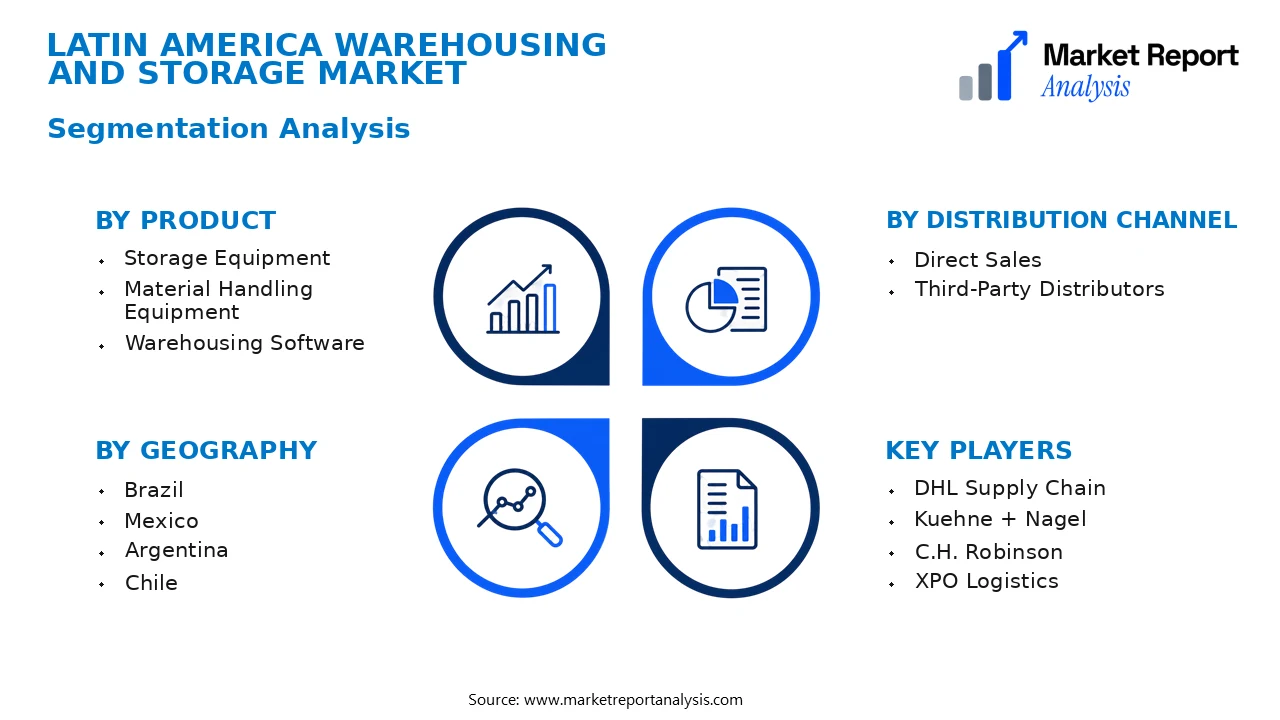
- Product
- Storage Equipment: Includes shelving, racks, and container solutions that optimize space utilization within warehouses. Demand is driven by modernization efforts and the need for efficient inventory management across various industries.
- Material Handling Equipment: Encompasses forklifts, conveyors, and automated guided vehicles (AGVs). This segment is critical for operational efficiency, with adoption increasing as companies automate and streamline warehouse processes.
- Warehousing Software: Software solutions such as warehouse management systems (WMS) improve inventory accuracy and supply chain visibility. Growth is fueled by digital transformation initiatives in logistics hubs.
- Distribution Channel
- Direct Sales: Manufacturers and large end users negotiate directly with suppliers, often for customized solutions tailored to specific operational needs. This channel is prominent among large corporations and multinational firms.
- Third-Party Distributors: Includes third-party logistics providers (3PLs) that supply warehousing services and integrate multiple equipment and software solutions. Their role is expanding with the growth of outsourcing logistics functions.
- Geography
- Brazil: As Latin America's largest economy, Brazil hosts a dynamic warehousing sector driven by retail, manufacturing, and agribusiness sectors seeking efficient storage and logistics solutions amidst infrastructural investments.
- Mexico: A key manufacturing hub with an expanding e-commerce sector, Mexico emphasizes warehousing development to support cross-border trade and regional distribution networks.
- Argentina: Featuring a mix of traditional and modern warehousing facilities, Argentina’s market is characterized by adaptive solutions amid economic fluctuations, with a focus on agricultural storage and distribution.
- Chile: Known for its stable economy and retail sector growth, Chile's warehousing market emphasizes integrated logistics solutions to meet retail and export demands.
This segmentation framework enables stakeholders to identify specific market opportunities, align regional investments, and develop innovative warehousing solutions tailored to local and industry-specific needs within Latin America. Analyzing product trends alongside regional dynamics offers critical insights into the evolving landscape of warehousing and storage in the region.
Competitive Intelligence
The Latin America Warehousing and Storage Market exhibits moderate competition characterized by a mix of regional and global players. Market concentration remains relatively dispersed, with the leading firms holding minor shares, thus encouraging innovation and strategic alliances to enhance market positioning. Companies are aggressively pursuing product innovation, focusing on automation, smart warehousing solutions, and environmentally sustainable practices to differentiate their offerings. Partnerships and joint ventures are common, aimed at expanding regional reach and technological advancement, while acquisitions facilitate rapid market entry and portfolio diversification. Significant R&D investments are directed toward optimizing storage efficiency and integrating IoT-enabled systems, enabling firms to meet evolving customer demands. Expansion strategies often involve establishing new facilities in emerging economic zones or upgrading existing infrastructures to boost capacity and operational efficiency. Competitive differentiation is chiefly driven by technological innovation, superior service levels, and tailored logistics solutions. Firms that leverage strategic partnerships, invest heavily in R&D, and pursue aggressive expansion plans are positioning themselves for growth, aiming to capitalize on Latin America's burgeoning e-commerce and manufacturing sectors.
Leading Company Profiles
The Latin America warehousing and storage market features a robust competitive landscape with regional and global players leveraging innovative logistics solutions, technological integration, and strategic expansions to strengthen market positioning and meet rising demand.
- DHL Supply Chain
- Kuehne + Nagel
- C.H. Robinson
- XPO Logistics
- CEVA Logistics
- UPS Supply Chain Solutions
- J.B. Hunt Transport Services
- Nippon Express
- DB Schenker
- Cainiao Network
DHL Supply Chain
DHL Supply Chain excels in providing integrated warehousing and logistics services across Latin America, emphasizing technological innovation, sustainability, and customized logistics solutions to meet diverse industry needs and optimize supply chain efficiency.
Kuehne + Nagel
Kuehne + Nagel offers comprehensive warehousing, distribution, and freight forwarding services with a focus on digital logistics platforms and eco-friendly practices, leveraging global reach to support regional distribution networks and e-commerce growth.
C.H. Robinson
C.H. Robinson is a leading third-party logistics provider in Latin America, providing scalable warehousing, transportation, and integrated logistics services with an emphasis on digital integration and real-time tracking for enhanced supply chain visibility.
XPO Logistics
XPO Logistics specializes in transportation and warehousing solutions driven by advanced technology, including automation and data analytics, facilitating efficiency improvements and cost reductions across diverse sectors such as retail and manufacturing.
CEVA Logistics
CEVA Logistics offers tailored warehousing, freight management, and supply chain solutions, prioritizing digital transformation and sustainable logistics initiatives to strengthen its regional market presence and operational agility.
UPS Supply Chain Solutions
UPS provides extensive warehousing, distribution, and logistics services across Latin America, focusing on technology-enabled supply chain optimization and customized solutions to support e-commerce and retail sectors growth.
J.B. Hunt Transport Services
J.B. Hunt integrates advanced logistics technology with flexible warehousing options, enhancing supply chain responsiveness and offering scalable solutions for manufacturing, retail, and healthcare logistics within Latin America.
Nippon Express
Nippon Express emphasizes cross-border supply chain management, utilizing cutting-edge logistics technology and sustainable practices to boost efficiency and reliability across Latin American markets.
DB Schenker
DB Schenker leverages innovative technology and strategic partnerships to deliver integrated warehousing and logistics solutions, emphasizing digitalization and environmentally sustainable processes tailored to regional needs.
Cainiao Network
Cainiao, Alibaba's logistics affiliate, focuses on digital logistics infrastructure, automation, and smart warehousing solutions to facilitate fast, efficient delivery networks supporting e-commerce growth in Latin America.
Strategic Business Developments

- October 2023 – DHL Supply Chain – Launched an innovative climate-neutral warehousing initiative – Enhances sustainability credentials and reduces carbon footprint, appealing to environmentally conscious clients across Latin America.
- August 2023 – Kuehne + Nagel – Expanded capacity with new distribution centers in Brazil – Strengthens regional logistics network, enabling faster delivery and supporting rising e-commerce and retail demands.
- July 2023 – C.H. Robinson – Invested in digital warehouse management systems – Improves operational efficiency, real-time tracking, and customer transparency across Latin American distribution hubs.
- November 2023 – XPO Logistics – Formed partnership with robotics firms for automation integration – Boosts warehouse processing speed and accuracy, significantly reducing overhead costs and delivery times.
- September 2023 – UPS Supply Chain Solutions – Acquired a local logistics technology startup – Accelerates digital transformation efforts and enhances end-to-end supply chain visibility for regional clients.
Frequently Asked Questions
What is the Latin America Warehousing and Storage Market?
The Latin America Warehousing and Storage Market encompasses facilities, infrastructure, and services used for the storage of goods across Latin American countries. It supports supply chain operations, e-commerce growth, and logistics efficiency within the region.
What is the current market size of Latin America Warehousing and Storage Market?
As of 2026, the market is valued at approximately USD 45 Billion, driven by expanding retail, manufacturing sectors, and increased e-commerce activity, which require advanced warehousing solutions to meet rising logistics demands.
What factors are driving the Latin America Warehousing and Storage Market?
Key drivers include regional economic growth, technological advancements in logistics, rising e-commerce penetration, urbanization, and the development of modern, automated warehousing facilities to improve operational efficiency and meet consumer expectations.
Which region dominates the Latin America Warehousing and Storage Market?
Brazil is the dominant region, holding the largest market share due to its expansive industrial base, significant population, and concentrated e-commerce growth, fostering substantial infrastructure investments in warehousing.
Which segment is expected to grow the fastest?
The e-commerce segment is predicted to exhibit the fastest growth, driven by the surge in online shopping and digital retail integration, requiring scalable, flexible warehousing solutions across urban and suburban areas.
Who are the leading companies operating in the Latin America Warehousing and Storage Market?
Major players include DHL International GmbH, Grupo Logistics, DHL, DHL Supply Chain, and other regional logistics providers that are expanding their warehousing capabilities to capture regional growth opportunities.
Analyst Perspective
The Latin America Warehousing and Storage Market is poised for steady long-term growth driven by regional infrastructure development and rising e-commerce penetration. As the market matures, technological innovation such as automation, RFID tracking, and smart warehousing solutions will become central to maintaining competitive advantage. Investment priorities should focus on advanced supply chain integration, sustainable infrastructure, and regional distribution hubs to optimize operational efficiency. The competitive landscape is intensifying, with both regional players and global corporations expanding their footprints through strategic partnerships and acquisitions. Regional growth potential remains robust, particularly in Brazil, Mexico, and several Andean countries, where infrastructure investments are prioritized and consumer demand continues to rise. Risks include economic volatility, geopolitical instability, and compliance challenges, which could impact project timelines and operational costs. Long-term, stakeholders should adopt a strategic growth approach emphasizing technological adaptation, diversification of logistics networks, and regional market penetration to ensure resilience and capitalize on emerging opportunities across Latin America.
