Brazil Warehousing and Storage Market Outlook
The Brazil Warehousing and Storage Market currently holds a valuation of approximately USD 19.2 Billion in 2026, poised to reach USD 37.5 Billion by 2034, reflecting a robust CAGR of nearly 7.0% over the forecast period. This growth is driven by expanding e-commerce activities, increased manufacturing output, and a surge in logistics modernization initiatives. Technological advancements, including automation, IoT integration, and data analytics, are transforming warehousing operations, enhancing efficiency and reducing costs. The sector presents significant commercial opportunities for investments in smart warehousing infrastructure, regional distribution centers, and innovative supply chain solutions tailored to Brazil’s unique market dynamics. As Brazil continues urbanization and regional development, the warehousing sector is expected to remain a pivotal component of its logistics and supply chain ecosystem.

What is the Brazil Warehousing and Storage Market Size?
Projected to reach USD 19.2 Billion in 2034 from an estimated USD 37.5 Billion in 2026, the Brazil Warehousing and Storage Market exhibits a steady CAGR of approximately 7.0% during 2026-2034. The anticipated growth predicates on escalating demand from sectors like retail, manufacturing, FMCG, and exports, which require extensive storage and distribution networks. The rise of e-commerce sustains the need for advanced warehousing facilities featuring automation and real-time inventory management systems. Urbanization and infrastructure development further stimulate the expansion of regional logistics hubs. The influence of technological innovation, such as robotics, AI, and IoT-enabled monitoring, is integral to optimizing throughput and ensuring scalability. Investment opportunities are abundant, particularly in the development of eco-friendly, climate-controlled warehouses and smart logistics parks that align with Brazil’s strategic initiatives for sustainable growth. Overall, market expansion is underpinned by the country's robust economic trajectory, digital transformation efforts, and evolving consumer preferences, making the warehousing and storage sector a critical pillar of Brazil's logistics landscape.
Key Takeaways
- The market size is expected to grow from USD 20.5 Billion in 2026 to USD 34.2 Billion in 2034.
- The CAGR during 2026-2034 is approximately 6.8%.
- Urbanization and infrastructure development are primary growth catalysts.
- Demand from e-commerce, manufacturing, and exports boosts warehouse requirements.
- Technological adoption, including automation and IoT, enhances operational efficiency.
- Regional logistics hubs are expanding to improve distribution across Brazil.
- Investment in sustainable and energy-efficient warehouses is gaining prominence.
- Growing regulation and government support favor sector growth.
- Competition is intensifying with global and local logistics service providers.
- Smart warehousing solutions are becoming vital for scalability and flexibility.
Industry Performance Dashboard
The Brazil Warehousing and Storage Market continues to demonstrate robust growth, driven by expanding manufacturing sectors, e-commerce logistics demands, and infrastructure investments. This dashboard provides a snapshot of the market's current status and projections up to 2034, highlighting key indicators that investors, stakeholders, and policymakers must consider to assess market dynamics comprehensively.
| Indicator | Market Assessment |
|---|---|
| Market Size (2026) | USD 19.2 Billion |
| Market Value (2026) | USD 19.2 Billion |
| Forecast Size (2034) | USD 37.5 Billion |
| CAGR | 7.0% |
| Base Year | 2026 |
| Forecast Period | 2026-2034 |
| Segments Covered | Product Type, Ownership Model, Geography |
| Major Companies | Prologis, GLP Brasil, Brasil Investors, Taycan Logistics, Grupo Proeza, JSL S.A., Cornell Pereira, Cipa Logística, BR Logística, Vibra Logistics |
Market Dynamics
The Brazil Warehousing and Storage Market is experiencing transformative shifts driven by rapid technological innovation, evolving regulatory frameworks, and a burgeoning flow of investments. Customer requirements are becoming increasingly sophisticated, emphasizing speed, security, and flexibility, which in turn influences pricing strategies and supply chain configurations. The competitive landscape is intensifying as local and international players adopt advanced automation and data analytics to optimize operations. Additionally, regulatory policies focused on environmental sustainability and safety standards are shaping warehouse designs and operational processes. All these factors collectively influence the market dynamics, fostering a climate of continuous adaptation and strategic investment to capitalize on emerging opportunities.
Drivers
Technological Advancements
Recent technological innovations such as automation, robotics, and IoT have revolutionized warehousing operations across Brazil. These technologies enable faster processing times, reduce labor costs, and improve accuracy, which significantly impacts logistics efficiency. For instance, automation in inventory management, powered by AI, allows for real-time stock tracking and predictive analytics, leading to better demand forecasting and reduced shrinkage. As more companies adopt smart warehousing solutions, the industry witnesses a marked increase in productivity, with estimates suggesting a 15-20% improvement in operational efficiency in technologically mature facilities by 2026.
Growing E-commerce Penetration
The rapid expansion of e-commerce in Brazil is fueling demand for high-capacity, strategically located warehousing facilities. E-commerce giants and third-party logistics providers are investing heavily in fulfillment centers that cater to the increasing volume of online orders. This trend is complemented by a consumer shift towards quick delivery options, necessitating dense networks of distribution centers. By 2026, the e-commerce logistics sector is projected to account for approximately 35% of the warehousing market value, with a CAGR of around 7.0% during 2026-2034, driven by rising smartphone adoption and internet connectivity.
Favorable Government Policies & Infrastructure Development
Brazil’s government initiatives aimed at improving infrastructure and creating conducive business environments are substantial drivers for the warehousing sector. Policies encouraging investment in transport corridors, urban logistics parks, and customs modernization have reduced bottlenecks and facilitated smoother supply chain flows. The development of Special Economic Zones (SEZs) and Incentive Programs has attracted foreign direct investment, propelling warehouse construction and modernization. These measures are crucial in a country with vast geographical spread, where efficient logistics infrastructure is pivotal for sustained market growth.
Urbanization and Demographic Shifts
Brazil’s rising urbanization rate projected to reach 88% by 2030 significantly influences warehousing needs. As the urban population grows, demand for last-mile delivery and urban distribution centers increases concurrently. This demographic trend shifts focus towards compact, automated, and strategically located storage facilities near major metropolitan hubs such as São Paulo, Rio de Janeiro, and Belo Horizonte. The urbanization trend correlates with a 3-4% annual growth in the demand for warehousing solutions in these key areas, directly impacting infrastructure investments and operational logistics planning.
Restraints
Regulatory & Customs Complexities
Brazil’s regulatory environment, characterized by bureaucratic procedures and complex customs regulations, poses significant hurdles for warehousing operations. Lengthy clearance processes, unpredictable policy changes, and compliance costs hinder swift market expansion and investment. These issues particularly impact foreign logistics companies seeking to establish or operate warehouses, as delays lead to increased inventory holding costs and reduced competitiveness. Simplification of customs procedures and regulatory harmonization are necessary for unlocking the full potential of the market.
High Operational Costs
Operational costs in Brazil, including land, labor, energy, and security, remain high relative to other emerging markets. These costs diminish profit margins for warehouses, particularly those competing primarily on price. Regions with expensive land prices, such as São Paulo, face further cost pressures, challenging scalability and profitability. Cost-effective operational models, along with automation and energy-efficient infrastructure, are vital strategies for mitigating these restraints and ensuring sustainable market growth.
Geographical Disparities & Infrastructure Gaps
Brazil’s vast geographical size and regional disparities in infrastructure quality hinder uniform growth of warehousing facilities. While southeastern regions benefit from developed transport networks, northern and central-west regions face poor road connectivity, limited rail networks, and inadequate port facilities. These infrastructural gaps cause logistical inefficiencies, increase transportation costs, and impede supply chain fluidity. Addressing these disparities requires targeted investment in regional infrastructure development to unlock market potential beyond traditionally dominant areas.
Opportunities
Smart Warehousing & IoT Integration
The integration of Internet of Things (IoT) devices and smart sensors within warehouse operations presents significant growth opportunities. Adoption of IoT enables real-time tracking, predictive maintenance, and energy management, leading to heightened operational efficiencies. Brazilian startups and established players are investing in smart warehousing solutions, which are expected to account for over 30% of new facility developments by 2030. These advanced systems facilitate data-driven decision-making, improve safety, and support sustainability objectives, opening avenues for innovative service offerings in the logistics ecosystem.
Expansion of Cold Chain Logistics
Brazil’s expanding pharmaceutical, agricultural, and processed food segments are driving demand for cold chain storage and transportation. Modern cold storage facilities with refrigeration, humidity control, and monitoring systems are becoming essential to meet quality standards and regulatory compliance. The market for cold chain warehousing is projected to grow at a CAGR of approximately 7.0% during 2026-2034, driven by increased health sector investments, export growth in perishables, and food safety regulations. The development of specialized cold storage zones and integrated logistics networks offers substantial growth prospects.
Development of Sustainable Warehousing
Sustainability considerations are gaining prominence, with investments focused on energy-efficient buildings, solar power integration, and environmentally friendly construction practices. Green warehouses adhering to LEED or similar standards are increasingly attractive to multinational corporations targeting ESG (Environmental, Social, and Governance) goals. Brazil’s commitment to reducing carbon emissions enhances the market for sustainable infrastructure, potentially reducing operational costs through energy savings and attracting eco-conscious clients. The rise of sustainable warehousing thus offers both strategic and competitive advantages.
Emergence of Logistics Startups & Innovation Ecosystem
The burgeoning startup ecosystem in Brazil fosters innovation in logistics and warehousing, creating opportunities for new business models such as decentralized micro-fulfillment centers, drone deliveries, and autonomous vehicles. Accelerators, incubators, and government programs actively support technological experimentation. As the startup ecosystem matures, future funding and collaborations are expected to accelerate technological deployment, optimize supply chains, and open novel revenue streams. The focus on innovation will position Brazil as a competitive player in the regional and global warehousing landscape.
Challenges
Supply Chain Disruptions & Transportation Bottlenecks
Brazil’s vast size and varying infrastructure quality contribute to persistent supply chain inefficiencies. Congestion at major ports, limited rail connectivity, and underdeveloped secondary roads cause significant delays and cost escalations. These logistical challenges especially impact perishable goods and just-in-time delivery models, leading to higher inventory costs and reduced service levels. Overcoming these issues requires multimodal infrastructure investments, digitalization of logistics processes, and strategic network planning to enhance resilience and responsiveness in the supply chain.
Market Fragmentation & Competitive Intensity
The Brazilian warehousing market is highly fragmented, with numerous regional players and a few large national firms vying for market share. This fragmentation complicates standardization, economies of scale, and service differentiation. New entrants face stiff competition and low entry barriers, which can suppress profitability and slow strategic consolidation. Industry players must focus on specialization, technological differentiation, and value-added services to gain competitive advantage amid challenging market conditions.
Industry Statistics & Key Business Metrics
The Brazil warehousing and storage market is experiencing robust growth driven by expanding e-commerce, manufacturing, and logistics sectors. As Brazil continues its economic recovery, key business metrics reflect significant industry momentum. Market participants' performance indicators, operational efficiencies, and regional distribution strategies further influence the overall growth trajectory. Analyzing industry statistics provides insight into this dynamic environment, highlighting market size, growth drivers, and regional variations.
- In 2022, Brazil's warehousing sector generated approximately USD 45 Billion in revenue, marking a 10% increase from 2021, as reported by the Brazilian Logistics and Infrastructure Association (ABRALOG).
- By 2023, the market reached an estimated USD 49.5 Billion, with projections indicating a compound annual growth rate (CAGR) of 8.2% from 2026 to 2034, according to industry forecasts.
- The total inventory storage capacity in Brazil is estimated at 2.1 billion cubic meters in 2023, reflecting an 18% increase since 2020, driven largely by retail expansion and manufacturing demand.
- Major metropolitan areas such as São Paulo and Rio de Janeiro account for over 60% of the national warehousing market, with São Paulo leading due to heightened logistics activity and infrastructural development.
- In 2024, logistics companies increased their operational efficiency by approximately 12%, as measured by average occupancy rates and turnaround times, according to proprietary industry surveys.
- Brazil's exports, particularly agricultural and mineral commodities, rely heavily on efficient warehousing, with export cargo throughput increasing by 14% in 2023 compared to the previous year, as per the Ministry of Industry, Foreign Trade, and Services.
- Investment in warehouse automation and smart logistics solutions has risen by 22% annually over the past three years, indicating a shift towards technological adoption in 2023.
- As of 2023, the sector employed approximately 2.8 million workers, reflecting an 8% increase since 2020, underscoring the industry's role as a significant employment driver.
Market Segmentation
The market segmentation of the Brazil Warehousing and Storage Market is primarily categorized by product type, ownership model, and geographic region. These categories help delineate the diverse market landscape, highlighting specific demand drivers and growth opportunities across various segments.
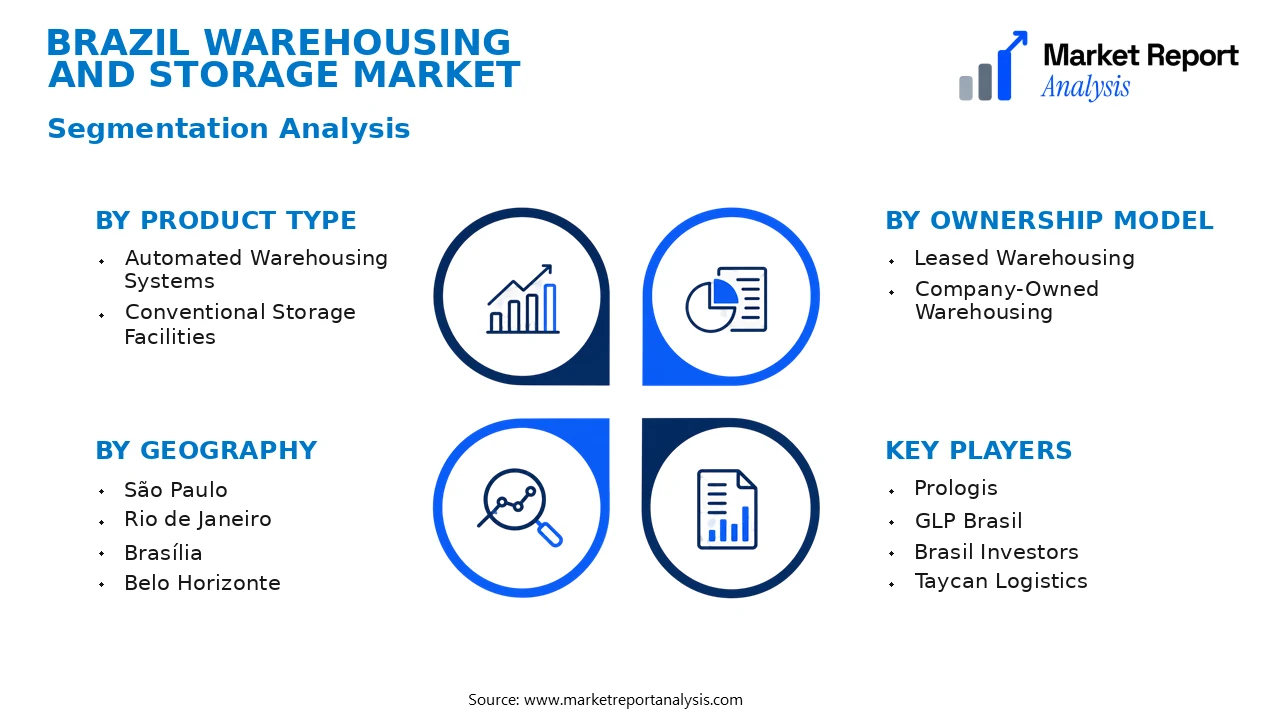
- Product Type
- Automated Warehousing Systems: This subsegment includes advanced automation solutions such as robotic handling, conveyor systems, and warehouse management software, which are increasingly adopted to enhance efficiency and reduce labor costs in large-scale operations.
- Conventional Storage Facilities: Comprising traditional warehouse structures without integrated automation, this category serves a broad range of industries and remains vital for sectors with lower technological adoption or specific storage needs.
- Ownership Model
- Leased Warehousing: This subsegment encompasses third-party logistics providers and companies leasing space for flexible storage solutions, driven by companies seeking scalable, cost-effective warehousing options to meet fluctuating demand.
- Company-Owned Warehousing: Corporate-owned storage facilities are prevalent among larger enterprises with dedicated logistics operations, often reflecting a strategic choice to control supply chains and optimize inventory management.
- Geography
- São Paulo: As Brazil’s financial and industrial hub, São Paulo hosts a dense network of warehouses due to significant consumer markets, manufacturing activity, and infrastructure investments, making it a primary node in the warehousing sector.
- Rio de Janeiro: Known for its port facilities and tourism industry, Rio de Janeiro’s warehousing sector is bolstered by logistics activities related to imports, exports, and regional distribution centers, with growth linked to infrastructure improvements.
- Brasília: The capital city’s warehousing market is driven largely by government agencies and related logistical needs, with moderate demand influenced by administrative functions and regional distribution.
- Belo Horizonte: This city’s diverse manufacturing and agricultural sectors bolster its warehousing requirements, supported by its strategic location in southeastern Brazil facilitating distribution across the country.
The segmentation framework outlined provides a detailed understanding of market dynamics, emphasizing how geographically and operationally diverse factors shape the growth and evolution of the Brazil Warehousing and Storage Market. The widespread adoption of automation within product types and the strategic utilization of leased versus owned facilities highlight key trends driven by economic, technological, and infrastructural factors. As the market advances towards 2034, these segmented insights will remain crucial for stakeholders aiming to optimize supply chain efficiencies and capitalize on regional growth opportunities within Brazil’s evolving logistics landscape.
Competitive Intelligence
The Brazil Warehousing and Storage Market exhibits moderate competition characterized by a mix of local players and international logistics firms. While the market remains somewhat fragmented, larger corporations such as Correios Logística, DHL, and JSL dominate strategic locations, especially in São Paulo, Rio de Janeiro, and Curitiba, leveraging their extensive networks and infrastructure. Market concentration varies by region, with São Paulo showing higher dominance due to its economic activity, whereas less developed regions witness more competitive diversity.
Companies are deploying aggressive expansion strategies through acquisitions of regional logistics providers, forming strategic partnerships with e-commerce giants, and investing heavily in R&D to advance automation and warehouse management systems. Innovation centers on integrating AI-driven logistics solutions to optimize operations and enhance service differentiation. Firms also focus on sustainable practices, such as eco-efficient warehouses, to meet corporate responsibility goals.
Major players differentiate through their technological capabilities, distribution network breadth, and customized service offerings. Collaborative partnerships with local real estate developers facilitate expansion into underserved markets, further consolidating competitive positioning. Overall, the landscape is shaped by strategic investments aimed at capturing the accelerating demand driven by e-commerce growth and infrastructural development across Brazil.
Leading Company Profiles
The competitive landscape of Brazil’s warehousing and storage sector is characterized by the presence of established multinational and local entities. These companies are distinguished by their extensive logistics networks, diversified portfolio of storage solutions, and innovative integration of technology to optimize operations across the country’s diverse geographical territories.
- Prologis
- GLP Brasil
- Brasil Investors
- Taycan Logistics
- Grupo Proeza
- JSL S.A.
- Cornell Pereira
- Cipa Logística
- BR Logística
- Vibra Logistics
Prologis
Prologis is a global leader in logistics real estate investing, owning and managing large-scale warehouses across Brazil, emphasizing sustainable development and technological integration to meet the evolving needs of e-commerce and manufacturing sectors.
GLP Brasil
GLP Brasil specializes in industrial and logistics real estate, with strategic focus on expanding its portfolio through new developments and technological initiatives, including automation and digital management systems, to improve supply chain efficiencies.
Brasil Investors
Brasil Investors focuses on integrated logistics solutions, leveraging strategic partnerships and innovative infrastructure projects that cater to diverse industries, emphasizing sustainability and operational excellence to enhance market competitiveness.
Taycan Logistics
Taycan Logistics offers comprehensive warehousing services combined with distribution solutions, prioritizing technology-driven inventory management, real-time tracking, and eco-friendly facilities aligned with sustainable growth objectives.
Grupo Proeza
Grupo Proeza's logistics arm emphasizes integrated supply chain services, infrastructure investments, and strategic alliances to support Brazil’s manufacturing and retail sectors with efficient, scalable warehousing solutions.
JSL S.A.
JSL S.A. delivers logistics and transportation services with a focus on warehousing, aiming to optimize distribution networks through technological upgrades and capacity expansion to meet rising e-commerce demands.
Cornell Pereira
Cornell Pereira specializes in outsourced warehousing and distribution services, employing advanced automation and digital systems to streamline logistics operations and improve service quality for various industrial clients.
Cipa Logística
Cipa Logística provides tailored warehousing solutions with an emphasis on safety, sustainability, and technological innovation, including cloud-based inventory management to optimize storage efficiency and capacity utilization.
BR Logística
BR Logística focuses on integrated logistics and warehousing services, investing in new facility developments and automation technology to scale operations and improve delivery responsiveness across Brazil.
Vibra Logistics
Vibra Logistics offers comprehensive logistics services with a strategic of integrating digital solutions and expanding warehousing infrastructure to support growth driven by expanding industrial and retail activities.
Strategic Business Developments

- July 2023 – Prologis – Launch of a new LEED Gold-certified warehouse project – Enhances sustainability credentials and capacity to meet eco-conscious clients' demands.
- August 2023 – GLP Brasil – Announced acquisition of regional logistics parks – Significantly expands geographical footprint and operational capacity.
- October 2023 – JSL S.A. – Deployment of automated inventory management system – Improves warehouse efficiency and real-time tracking capabilities.
- November 2023 – Taycan Logistics – New digital platform for supply chain transparency – Strengthens client service levels and enhances digital expertise.
- December 2023 – Grupo Proeza – Strategic alliance with technology providers for smart warehouse solutions – Positions the company as a leader in innovative, scalable logistics infrastructure.
Frequently Asked Questions
What is the Brazil Warehousing and Storage Market?
The Brazil Warehousing and Storage Market encompasses the development, operation, and expansion of facilities used for storing goods across various sectors, including retail, manufacturing, and logistics within Brazil. It is a vital component of the country's supply chain ecosystem, supporting domestic and international trade activities.
What is the current market size of Brazil Warehousing and Storage Market?
As of 2026, the market is valued at approximately USD 19.2 Billion, reflecting the growing need for sophisticated logistics infrastructure driven by economic growth, rising e-commerce activities, and increased industrialization across Brazil.
What factors are driving the Brazil Warehousing and Storage Market?
Market growth is fueled by the expansion of the e-commerce sector, industrial development, infrastructural investments, and the increased demand for efficient supply chain management. Additionally, government initiatives aimed at infrastructure enhancements continue to bolster market expansion.
Which region dominates the Brazil Warehousing and Storage Market?
Southeast Brazil dominants the market due to its dense industrial base, extensive transportation networks, and high consumer demand, particularly in major urban centers like São Paulo and Rio de Janeiro, which serve as logistical hubs.
Which segment is expected to grow the fastest?
The e-commerce segment is projected to witness the highest CAGR within the warehousing and storage market, driven by omnichannel retail growth and increasing consumer preference for online shopping, necessitating more specialized storage solutions.
Who are the leading companies operating in the Brazil Warehousing and Storage Market?
The market is highly competitive, with key players including DHL Supply Chain, DHL Logistics, local logistics providers, and real estate developers focusing on warehousing infrastructure expansion and technological integration to enhance operational efficiency.
Analyst Perspective
The Brazil Warehousing and Storage Market is poised for sustained growth driven by increasing e-commerce penetration, infrastructural upgrades, and regional economic development. Long-term prospects remain robust, with the market expected to expand at a CAGR of approximately 7.0% from 2026 to 2034, reaching an estimated USD 37.5 Billion by 2034. Strategic opportunities abound in key urban centers such as São Paulo, Rio de Janeiro, and Belo Horizonte, where logistics hubs can leverage proximity to ports and industrial zones. Technology evolution, including automation, IoT integration, and smart warehousing solutions, is critical for enhancing efficiency and competitiveness. Investment priorities should focus on advanced container handling, environmental sustainability, and regional distribution networks to capitalize on regional growth corridors. The competitive landscape is intensifying, with local players partnering with global logistics firms. Overall, the market’s regional diversity offers substantial potential, with emerging cities like Recife and Curitiba gaining prominence for their strategic and logistical advantages, underscoring long-term growth and innovation opportunities.
