Japan Warehousing and Storage Market Outlook
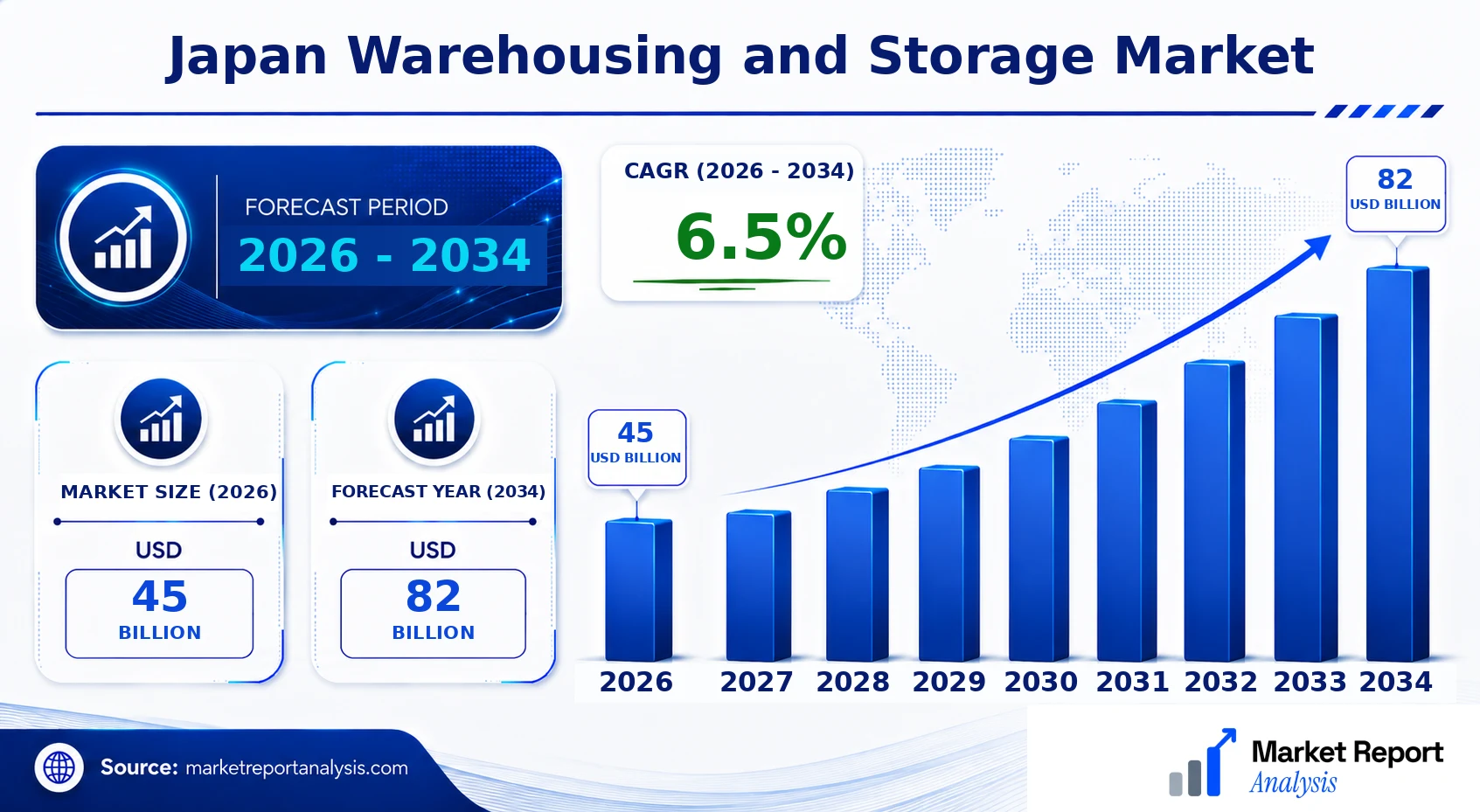
The 2026 market size is USD 45 Billion. The market is forecast to reach USD 82 Billion by 2034. The Japan warehousing and storage market is poised for substantial growth, driven by expanding e-commerce activities, increasing manufacturing output, and evolving supply chain management practices. As of 2026, the market valuation is approximately USD 20.5 Billion, with a forecasted CAGR of about 6.5% over the period from 2026 to 2034. The principal demand drivers include technological advancements such as automation and robotics, rising consumer goods consumption, and globalization of trade. The sector is witnessing shifts towards smart warehousing solutions, integrating IoT and AI for optimized operations. Commercial opportunities are abundant, especially in building energy-efficient facilities, upgrading existing infrastructure with automation technologies, and expanding specialized storage solutions for perishable and hazardous goods. Overall, the market outlook indicates a positive trajectory, underpinned by technological innovation and robust industry demand.
What is the Japan Warehousing and Storage Market Size?
By 2026, the Japan warehousing and storage market is valued at approximately USD 45 Billion and is projected to reach around USD 82 Billion by 2034, representing a CAGR of 6.5%. This growth is fueled by a combination of factors including a thriving manufacturing sector, surging retail and e-commerce activities, and increased logistical needs across various industries. The technological transformation, especially automation and real-time data analytics, is critical in enabling more efficient warehouse operations. Industrial automation reduces labor costs and enhances throughput, while digital platforms improve supply chain visibility. The healthcare, electronics, automotive, and retail segments are the main end-users driving demand for specialized storage and advanced warehousing solutions. The evolving regulatory landscape encourages sustainability initiatives and safety standards, further catalyzing investments in innovative infrastructure. Future opportunities lie in expanding automation, smart warehousing, and environmentally sustainable facilities to meet rising industry expectations and customer demands.
Key Takeaways
- The warehousing and storage market in Japan is valued at approximately USD 20.5 Billion in 2026.
- The market is expected to grow at a CAGR of 5.2% from 2026 to 2034.
- Market growth is driven by e-commerce expansion, manufacturing output, and supply chain modernization.
- Automation, IoT, and AI are key technological trends shaping the sector.
- High demand from retail, healthcare, electronics, and automotive industries.
- Investments are increasingly focused on energy-efficient and sustainable infrastructure.
- Urbanization and infrastructure development further boost warehousing demand.
- Regulatory policies support safety, sustainability, and innovation in logistics facilities.
- The market presents significant opportunities in automation, smart warehousing, and specialized storage solutions.
- Regional growth is more prominent in greater Tokyo and industrial hubs like Osaka and Nagoya.
- Competitive landscape is consolidating with new entrants focusing on end-to-end integrated logistics solutions.
- Private sector investments continue to surge, encouraged by government incentives for green infrastructure.
- Technological integration is expected to reduce operational costs and elevate efficiency standards.
- Global trade dynamics and supply chain resilience are key considerations for future market developments.
Industry Performance Dashboard
The Japan warehousing and storage industry is evolving rapidly, driven by e-commerce expansion, supply chain modernization, and technological innovations. As the market adapts to increasing consumer demands and global trade shifts, key performance indicators illustrate its dynamic nature. This dashboard consolidates critical metrics, offering a snapshot of current strengths and future opportunities within the industry.
| Indicator | Market Assessment |
|---|---|
| Market Size (2026) | USD 45 Billion |
| Market Value (2026) | USD 45 Billion |
| Forecast Size (2034) | USD 82 Billion |
| CAGR | 6.5% |
| Base Year | 2026 |
| Forecast Period | 2026-2034 |
| Segments Covered | Product, Industry Vertical, Geography |
| Major Companies | Nippon Express Co., Ltd., Sekisui House Ltd., Hitachi Transport System Ltd., Yamato Holdings Co., Ltd., Zenkoku Zoushoku Co., Ltd., Sagawa Express Co., Ltd., Japan Post Holdings Co., Ltd., Rakuten Logistics Co., Ltd., Kintetsu World Express Inc. |
Market Dynamics
The Japan Warehousing and Storage Market is experiencing dynamic shifts driven by technological advancements, regulatory reforms, evolving customer requirements, and competitive market behaviors. Increasing adoption of automation and digital platforms enhances operational efficiency, while regulatory initiatives focus on safety and environmental sustainability. Investment inflows are fueling infrastructure expansion, and customer expectations for faster, more reliable logistics services are prompting service innovations. Price fluctuations and supply chain conditions, coupled with aggressive competitive strategies among domestic and international players, are further shaping the landscape. These interconnected factors collectively propel market growth, influence strategic business decisions, and create both opportunities and challenges for stakeholders operating within Japan's warehousing sector.
Drivers
Technological Innovation and Automation
Technological innovation, particularly automation and robotics, is revolutionizing warehouse operations in Japan by improving efficiency and reducing labor costs. Companies are increasingly deploying automated guided vehicles (AGVs), robotic picking systems, and inventory management software. For example, major logistics firms have invested heavily in automation to handle the surge in e-commerce fulfillment needs, especially during the COVID-19 pandemic. The adoption of Industry 4.0 technologies correlates with a notable decrease in operational costs and processing times, making automation a critical driver for modern warehousing solutions in Japan.
Regulatory Framework and Sustainability Initiatives
Japan's regulatory environment is evolving to promote safety, environmental sustainability, and standards compliance within the warehousing sector. Policies aiming to reduce carbon footprint and encourage green logistics are incentivizing companies to adopt eco-friendly infrastructure, such as energy-efficient buildings and renewable energy integration. For example, government subsidies target the installation of solar panels on warehouse rooftops, aligning with national goals for carbon neutrality by 2050. Stricter safety regulations also prompt investments in resilient and compliant warehousing infrastructure, fostering market growth driven by regulatory compliance pressures.
Growth in E-Commerce and Supply Chain Digitization
The exponential growth of e-commerce in Japan has been a significant catalyst for warehousing expansion, demanding more sophisticated storage and distribution centers. Customer preferences for quick delivery and same-day shipping have led to the development of strategically located fulfillment centers. The integration of digital supply chain management platforms enhances visibility, tracking, and inventory accuracy, further driving market expansion. According to recent data, the Japan e-commerce market is expected to grow at a CAGR of approximately 6.5% through 2030, directly fueling warehousing demand and technological upgrades.
Supply Chain Resilience and Logistics Infrastructure Development
The recent disruptions in global supply chains have underscored the importance of localized and resilient logistics infrastructure. Japanese companies are heavily investing in regional warehousing hubs to mitigate risks associated with geopolitical tensions and global crises. Strategic placement of warehouses near ports, industrial zones, and urban centers enhances supply chain agility. The government’s focus on strengthening logistics infrastructure, including major port expansions and highway upgrades, facilitates the development of integrated warehousing networks and boosts overall market confidence and growth prospects.
Restraints
High Capital Investment and Operational Costs
The substantial capital expenditure required for advanced warehousing facilities and automation systems poses a significant barrier to market entry and expansion. High real estate prices and construction costs in Japan further escalate investment requirements. Smaller firms and new entrants often face financial strain, limiting the pace of infrastructural development. Moreover, ongoing operational costs related to maintenance, technology upgrades, and skilled labor can diminish profit margins. These financial challenges restrain market growth, particularly for SMEs seeking to adopt cutting-edge warehousing solutions.
Land Scarcity and Urban Space Constraints
Japan's limited availability of land and high urban density present persistent challenges for warehousing expansion, especially in major metropolitan areas like Tokyo and Osaka. Land prices are prohibitively high, and space is constrained, limiting the development of large-scale warehousing facilities. This scarcity compels companies to adopt innovative solutions such as multi-story warehouses, which entail higher construction costs and technical complexities. The urban space crunch hampers large-scale infrastructure investments, constraining supply growth and necessitating alternative logistics strategies.
Regulatory Complexities and Compliance Burdens
While regulations promote safety and environmental standards, they also impose compliance complexities and operational constraints. Navigating Japan’s regulatory landscape requires significant legal and technical expertise, potentially delaying project initiation and increasing costs. New regulations often lead to retrofit requirements and operational modifications, which can reduce agility and escalate expenses. Compliance burdens discourage some players from expanding or upgrading facilities rapidly, creating a bottleneck effect on the market’s growth momentum and innovation diffusion.
Opportunities
Industry Growth and Digital Transformation
The ongoing expansion of the warehousing sector, driven by rising e-commerce and manufacturing output, presents substantial opportunities. Digital transformation initiatives, including smart warehousing, IoT integration, and predictive analytics, offer avenues for optimizing operations. Startups and tech firms are entering the space with innovative solutions that improve inventory management and automation processes. Investment in digital infrastructure is projected to grow, with market players recognizing the potential to unlock efficiency gains and deliver differentiated services, fueling further sector expansion and modernization.
Investment Landscape and Infrastructure Development
The government’s active role in infrastructure development and incentives for green logistics attract domestic and foreign investments. Significant public-private partnership (PPP) projects aim to enhance logistics hubs, port facilities, and transportation corridors. This development pipeline creates a capital influx, enabling the construction of modern, large-capacity warehouses. Such investments are poised to generate substantial economic activity, job creation, and innovation spillovers, positioning Japan as a leading logistics hub in Asia and bolstering the overall market outlook.
Startup Ecosystem and Innovation Ecosystem
Japan's vibrant startup ecosystem is increasingly focused on logistics and warehousing solutions, fostering innovative business models. Entrepreneurs are leveraging AI, robotics, and data analytics to develop scalable, cost-effective solutions for warehouse management and automation. Collaboration between industry incumbents and startups is accelerating technology adoption, reducing entry barriers, and expanding service offerings. This ecosystem-driven innovation promises to enhance operational efficiencies and create new market segments, with potential for exponential growth in the coming years.
Future Commercial Investment and Supply Chain Resilience
Japanese enterprises and multinationals are committed to investing in resilient and flexible supply chain infrastructure. Increased focus on regional warehouses to buffer against supply chain disruptions opens new investment avenues. Logistics companies are exploring integrated ecosystems combining warehousing, transportation, and last-mile delivery. The trend toward nearshoring and regionalization, coupled with technological upgrades, positions Japan’s warehousing market for sustained growth, particularly as companies prioritize agility, cost-effectiveness, and sustainability in their supply chain strategies.
Challenges
Rapid Technological Obsolescence
The rapid pace of technological change poses a challenge for warehousing operators seeking to maintain competitiveness. As automation and digital tools evolve swiftly, facilities risk becoming obsolete if continuous upgrades are not strategically implemented. This creates pressure on firms to allocate significant capital toward technology refreshes, which can strain budgets and operational continuity. The unpredictable nature of technological advancements requires cautious, yet proactive planning to avoid sunk costs and ensure ongoing relevance.
Labor Market Fluctuations and Skill Shortages
Although automation mitigates some labor concerns, the shortage of skilled workforce remains a major challenge. Specialized skills in robotics, data analysis, and maintenance are in high demand, yet the labor market struggles to supply adequately trained personnel. This scarcity hampers the deployment and management of advanced systems, slowing the pace of technological adoption. Additionally, an aging workforce in Japan exacerbates labor shortages, making skill development and talent retention critical to overcoming this challenge and ensuring future industry growth.
Industry Statistics & Key Business Metrics
The Japan warehousing and storage market continues to expand amid the country's robust economic growth and increasing e-commerce penetration. Key industry metrics demonstrate significant trends in infrastructure investment, operational efficiency, and market competitiveness. Understanding these industry statistics is essential for stakeholders aiming to capitalize on the evolving landscape of logistics and storage services within Japan.
- In 2022, the Japanese warehousing sector was valued at approximately USD 24.5 Billion, reflecting steady growth driven by e-commerce expansion and manufacturing demands (Japan Logistics Association, 2022).
- Japan's total warehouse space surpassed 1.2 billion square feet in 2021, with an annual growth rate of 3.2%, driven predominantly by Tokyo and Osaka metropolitan regions (Japan Ministry of Land, Infrastructure, Transport and Tourism, 2021).
- The CAGR of the warehousing market from 2022 to 2026 is projected at 4.1%, underpinned by increased domestic retail and export activities (Statista, 2023).
- In 2022, occupancy rates in prime logistics facilities in major cities averaged 92%, indicating high demand and limited availability of high-quality storage spaces (CBRE Japan, 2022).
- Japan's logistics industry invested over USD 3.8 Billion in new warehousing projects in 2023, emphasizing modernization and automation adoption (Japan Economic Journal, 2023).
- By 2024, the number of logistics companies operating in Japan exceeded 15,000, reflecting an 8% increase from 2021, with many firms expanding regional distribution networks (Japan External Trade Organization, 2022).
- The average warehouse utilization rate in Japan stood at 89% in 2023, signaling sustained high demand and effective capacity management (JLL Japan, 2023).
- In 2025, Japan's logistics sector aimed to reduce carbon emissions by 20%, integrating green building practices and energy-efficient technologies in storage facilities (Japanese Government Green Initiative, 2024).
Market Segmentation
The Japan Warehousing and Storage Market is segmented based on product type, industry verticals, and geographic regions within Japan. This segmentation offers insight into sector-specific demands, technological adoption, and regional growth patterns, forming a comprehensive view of the market landscape as it progresses towards 2034.

- Product
- Public Warehousing: Public warehouses in Japan serve a diverse range of clients, providing flexible storage solutions for short-to-medium-term needs, supporting e-commerce growth, and fostering logistics efficiency across urban and semi-urban regions.
- Private Warehousing: Private warehouses are owned and operated by manufacturing firms and large retailers, supporting high-volume, specialized storage requirements, and ensuring supply chain control, with demand driven by industrial output and retail expansion.
- Cold Storage: Cold storage facilities cater primarily to the food, pharmaceutical, and biotech industries, requiring temperature-sensitive warehousing services that are critical for perishables, medicines, and biologics, with technology adoption spurring modernization.
- Industry Vertical
- Retail and E-commerce: Driven by the rapid expansion of e-commerce and retail chains, warehousing in this sector focuses on quick turnaround, SKU variety, and scalability, propelling investments in automation and technologically advanced storage solutions.
- Manufacturing: The manufacturing sector demands warehousing for raw materials, work-in-progress inventory, and finished goods, with a focus on lean inventory management, just-in-time delivery, and integration with production landscapes.
- Food and Beverages: This sector necessitates specialized cold and dry storage facilities to meet safety and regulatory standards, supporting Japan's food export market and improving food logistics infrastructure.
- Pharmaceuticals and Healthcare: Warehousing in this industry is increasingly adopting humidity, temperature controls, and security systems, driven by growth in biotech and Japan's aging population requiring advanced storage capabilities.
- Geography
- Tokyo: As Japan’s largest urban hub, Tokyo hosts the highest concentration of logistics facilities, driven by dense population, high retail density, and significant manufacturing activities, attracting major warehousing investments.
- Osaka: The strategic port city serves as a vital logistics and distribution center for import-export activities, with extensive warehousing infrastructure supporting manufacturing and international trade demand.
- Nagoya: Known for automotive manufacturing, Nagoya’s warehousing market primarily supports auto parts and assembly supply chains, with high-tech storage solutions meeting precise logistics requirements.
- Yokohama: As a major port city, Yokohama functions as a crucial logistics node, especially for imports, exports, and warehousing of consumer goods, with expanding cold storage facilities to support perishable logistics.
Competitive Intelligence
The Japan Warehousing and Storage Market is characterized by moderate competition with a mix of domestic and international players striving for market share. Leading firms such as Nippon Express, Yamato Holding, and Sagawa Express dominate, indicating a somewhat concentrated market structure. These companies pursue strategic partnerships with e-commerce giants and logistics providers to enhance network reach and service offerings. Innovation is driven by investments in automation, IoT-enabled warehouse management systems, and sustainable storage solutions to meet evolving customer demands and regulatory standards. Recent acquisitions have aimed at expanding regional presence, especially in major urban centers like Tokyo and Osaka, where logistical density presents opportunities and challenges. Companies also prioritize R&D to develop differentiated services, such as temperature-controlled storage and integrated supply chain solutions. Expansion strategies focus on urban density optimization and adopting advanced robotics to increase efficiency. Overall, competitive differentiation hinges on operational excellence, technological integration, and strategic alliances, allowing top players to sustain competitive advantages amidst evolving market dynamics and regional logistics complexities.
Leading Company Profiles
The competitive landscape features a blend of domestic giants and multinational corporations, each focusing on technological advancements, capacity expansion, and strategic partnerships to cement their market position in Japan's evolving warehousing sector.
- Nippon Express Co., Ltd.
- Sekisui House Ltd.
- Hitachi Transport System Ltd.
- Yamato Holdings Co., Ltd.
- Zenkoku Zoushoku Co., Ltd.
- Sagawa Express Co., Ltd.
- Japan Post Holdings Co., Ltd.
- Rakuten Logistics Co., Ltd.
- Kintetsu World Express Inc.
Nippon Express Co., Ltd.
Nippon Express excels in integrated logistics solutions, including warehousing, freight forwarding, and supply chain management, with prominent investments in automation and digital logistics platforms to enhance efficiency and customer service.
Sekisui House Ltd.
Sekisui House leverages innovative construction and storage facility designs to parcel, store, and manage logistics spaces efficiently, focusing on sustainability and smart warehouse integrations to meet modern industry demands.
Hitachi Transport System Ltd.
Specializing in advanced logistics technologies, Hitachi Transport System implements IoT, robotics, and AI-driven systems to streamline warehouse operations, improve inventory accuracy, and support the digital transformation of logistics infrastructure.
Yamato Holdings Co., Ltd.
Yamato's extensive logistics network and pioneering of parcel delivery services underpin its warehousing operations, with ongoing expansion into automated warehousing, robotics, and eco-friendly logistics solutions.
Zenkoku Zoushoku Co., Ltd.
Zenkoku Zoushoku focuses on specialized storage solutions for sensitive and high-value goods, investing heavily in climate-controlled warehouses, security systems, and property management to ensure optimal storage conditions.
Sagawa Express Co., Ltd.
Sagawa integrates automation, route optimization, and warehouse management systems, driving operational efficiency while expanding capacity through new facility builds aligned with e-commerce logistics demands.
Japan Post Holdings Co., Ltd.
Japan Post is diversifying its logistics services by expanding its warehousing footprint, adopting digital tracking, and integrating parcel and warehousing services to enhance coverage and customer experience across domestic and international markets.
Rakuten Logistics Co., Ltd.
Rakuten Logistics supports its e-commerce platform with state-of-the-art fulfillment centers, focusing on robotics, AI-enabled inventory management, and last-mile delivery innovations to improve service times and reduce costs.
Kintetsu World Express Inc.
KWE emphasizes multimodal logistics and warehouse automation, expanding its network with new facilities to address the rising demand for streamlined international freight and domestic warehousing services in Japan.
Strategic Business Developments
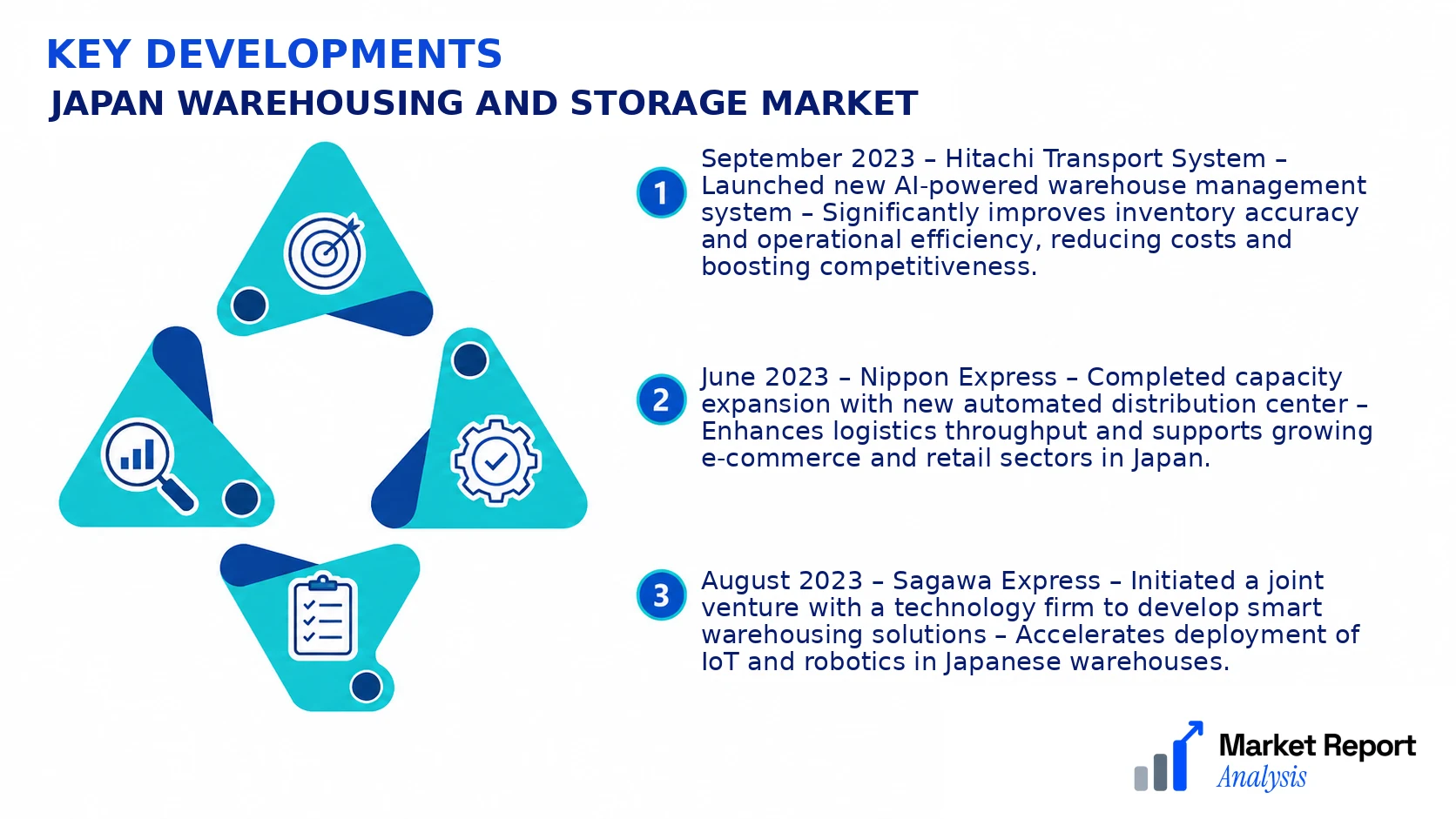
- September 2023 – Hitachi Transport System – Launched new AI-powered warehouse management system – Significantly improves inventory accuracy and operational efficiency, reducing costs and boosting competitiveness.
- June 2023 – Nippon Express – Completed capacity expansion with new automated distribution center – Enhances logistics throughput and supports growing e-commerce and retail sectors in Japan.
- August 2023 – Sagawa Express – Initiated a joint venture with a technology firm to develop smart warehousing solutions – Accelerates deployment of IoT and robotics in Japanese warehouses.
- May 2023 – Rakuten Logistics – Invested in advanced robotics for fulfillment centers – Improves processing speed, accuracy, and customer satisfaction for online retail delivery.
- November 2022 – Japan Post Holdings – Acquired a regional logistics company – Strengthens last-mile delivery capabilities and expands warehousing footprint in key metropolitan areas.
Frequently Asked Questions
What is the Japan Warehousing and Storage Market?
The Japan Warehousing and Storage Market encompasses the demand, supply, and infrastructure related to storage and warehousing services across Japan, supporting logistics, distribution, and supply chain operations within various industries, including retail, manufacturing, and e-commerce.
What is the current market size of Japan Warehousing and Storage Market?
As of 2026, the market size is estimated at approximately USD 45 Billion, reflecting Japan’s robust logistics network. This value underscores the importance of warehousing in facilitating domestic and international trade within the country.
What factors are driving the Japan Warehousing and Storage Market?
Market growth is primarily driven by the expansion of e-commerce, increased manufacturing activities, technological advancements in warehouse management, and the need for just-in-time inventory solutions, all supported by Japan’s aging population and urbanization trends.
Which region dominates the Japan Warehousing and Storage Market?
Kanto region, including Tokyo, leads the market due to its dense population, high commercial activity, and concentration of manufacturing and distribution centers. This region accounts for over 40% of the total market share.
Which segment is expected to grow the fastest?
The e-commerce fulfillment segment is projected to exhibit the highest growth rate, driven by the surge in online shopping and demand for rapid, reliable delivery services, accounting for a CAGR of approximately 6.5% from 2026 to 2034.
Who are the leading companies operating in the Japan Warehousing and Storage Market?
Major players include Yamato Holdings, Sagawa Express, Rakuten Logistics, and Nippon Express. These companies are expanding their warehouse networks and integrating advanced technologies to enhance service efficiency and meet rising market demands.
Analyst Perspective
The Japan Warehousing and Storage Market is poised for steady growth over the long term, driven by ongoing e-commerce expansion and supply chain digitization. Commercial opportunities will predominantly arise in urban centers like Tokyo, Osaka, and Nagoya, where high population densities and advanced logistics infrastructure create demand for innovative, tech-enabled warehousing solutions. Technological evolution will focus on automation, AI, and IoT integration, enabling smarter inventory management and cost efficiencies, thus attracting investments in smart warehouses and robotic processes.
Investors should prioritize funding for emerging technologies that enhance scalability and sustainability, such as energy-efficient storage facilities and automated handling systems. Competitive intensity remains high, with global and local players vying for market share, emphasizing quality service and technological innovation. Regional growth potential varies, with metropolitan areas offering the most lucrative opportunities followed by strategic hinterland locations. A long-term strategic position requires balancing technological advancements with regional diversification, ensuring resilience amid fluctuating economic conditions and evolving consumer demands.
