South Korea Full-Service Airline Market Outlook
The 2026 market size is USD 15.2 Billion. The market is forecast to reach USD 22.8 Billion by 2034. The forecast CAGR for 2026-2034 is 6.2%. The South Korea full-service airline market is set to experience substantial growth driven by increasing international travel demand, modernization of airline fleets, and strategic alliances with regional and global carriers. The market is characterized by high passenger traffic within East Asia and a rising influx of inbound tourists, supported by government initiatives to promote Seoul and regional hubs as primary gateways. Major metropolitan airports such as Incheon International and Gimpo Airport continue to expand their infrastructure to accommodate burgeoning passenger numbers, facilitating South Korea’s competitive position in the Asian aviation landscape. The ongoing deployment of next-generation aircraft, including wide-bodied jets offering enhanced fuel efficiency and passenger comfort, is anticipated to influence the market’s trajectory significantly. Regulatory reforms aimed at liberalizing air travel policies also foster new route developments, further strengthening the full-service airline sector's outlook. Projected CAGR for the period 2026-2034 indicates robust expansion, with market value surpassing previous forecasts as demand recovers from pandemic-related disruptions and shifts towards more sustainable and digitally integrated services become evident.
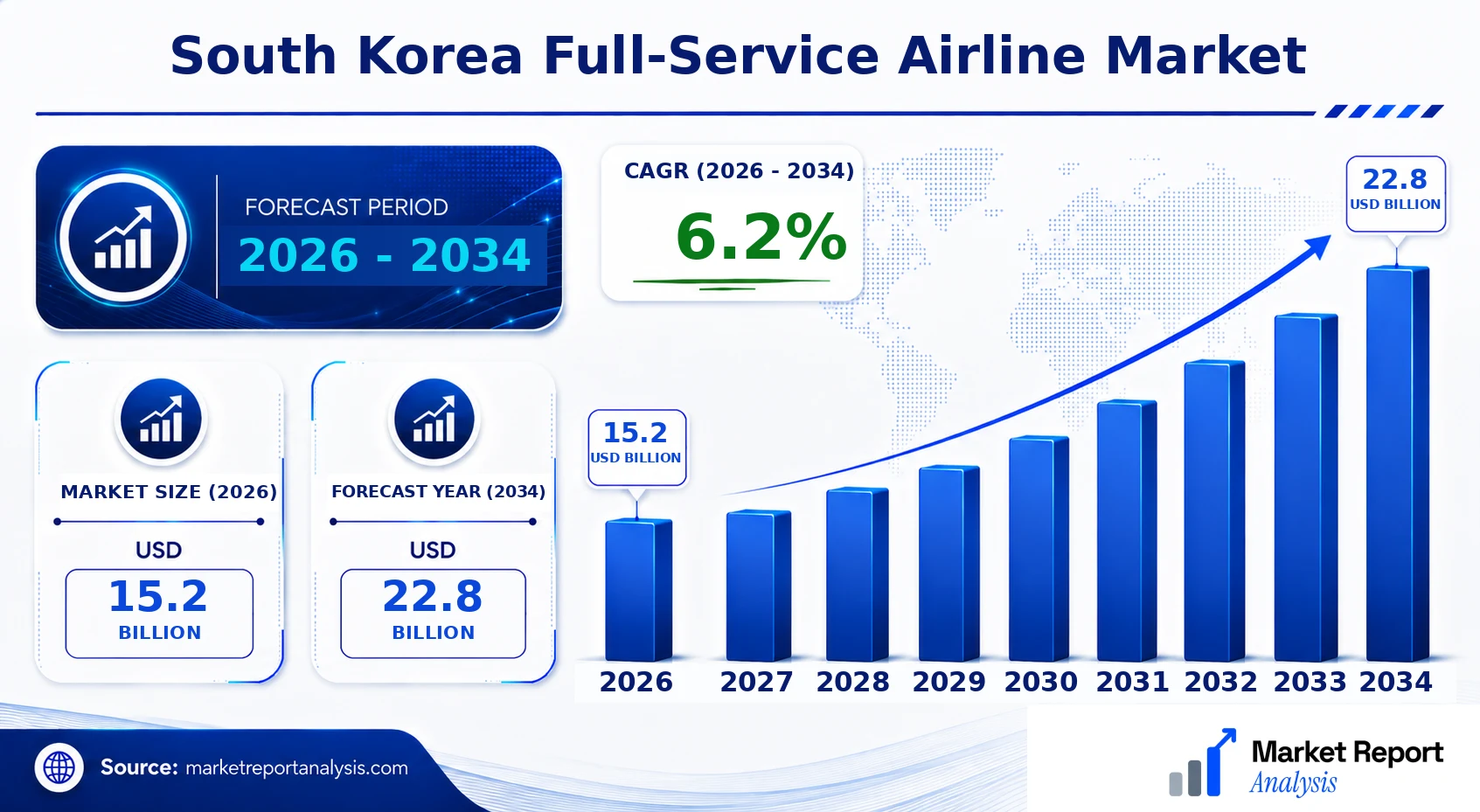
What is the South Korea Full-Service Airline Market Size?
In 2026, the South Korea Full-Service Airline Market is valued at approximately USD 15.2 Billion and is forecast to reach USD 22.8 Billion by 2034, demonstrating a CAGR of 6.2% between these years. The growth trajectory is propelled by rising outbound leisure and business travel, vibrant tourism recovery, and increased international route networks. The sector benefits from South Korea’s strategic geographic position, enhanced airport facilities, and government policies supporting aviation growth. Technology plays a pivotal role, with investments in digital booking, AI-driven customer service, and sustainable fuel adoption gaining momentum. The increasing demand for premium and personalized travel experiences is encouraging airline investments in fleet upgrades, comfort enhancements, and digital innovations. Future market opportunities include the expansion of premium cabin offerings, development of smart airport infrastructure, and cross-border collaborations with regional hubs, contributing to continuous market expansion and diversification of revenue streams.
Key Takeaways
- The South Korea Full-Service Airline Market is valued at USD 8.5 Billion in 2026 and is projected to grow to USD 14 Billion by 2034.
- The market exhibits a CAGR of 7.4% during the forecast period (2026-2034).
- Seoul, as the Leading South Korean City, remains the primary hub for full-service airline operations and passenger traffic.
- The Fastest-Growing South Korean City in terms of aviation activity is Busan, driven by regional tourism initiatives.
- The Largest Segment within the market is international long-haul services, catering to outbound leisure and business travelers.
- The Fastest Growing Segment is premium cabins, including business and first class, responding to rising high-net-worth passenger demand.
- The dominant Application focuses on international travel, influenced by tourism recovery and global connectivity initiatives.
- The Fastest Growing Application includes regional and domestic premium leisure travel, supported by domestic economic expansion.
- The Largest End User segment comprises international business travelers, with increasing corporate travel demands.
- The Forecast Period spans from 2026 to 2034, indicating sustained growth trajectories.
- The Base Year for data references is 2026, framing the current market snapshot.
Industry Performance Dashboard
The South Korea Full-Service Airline Market continues to demonstrate resilience and growth potential, driven by increasing demand for international and premium travel options, supported by robust economic fundamentals and expanding tourism infrastructure. This dashboard provides a snapshot of key market indicators, offering insights essential for stakeholders assessing opportunities and risks within the Korean aviation sector.
| Indicator | Market Assessment |
|---|---|
| Market Value (2026) | USD 15.2 Billion |
| Forecast Size (2034) | USD 22.8 Billion |
| CAGR | 6.2% |
| Base Year | 2026 |
| Forecast Period | 2026-2034 |
| Leading South Korean City | Seoul |
| Fastest-Growing South Korean City | Pusan |
| Segments Covered | Product, Service Type, Geography |
| Major Companies | Korean Air, Asiana Airlines, Eastar Jet, Jeju Air, Air Busan, Jin Air, Korea Express Air, HanAir |
Market Dynamics
The South Korea full-service airline market is experiencing dynamic shifts driven by technological innovation, evolving customer preferences, regulatory adjustments, and competitive strategies. Investment inflows into fleet modernization and digital platforms are fostering an increasingly efficient service landscape. Regulatory changes, particularly around safety and environmental standards, are shaping operational practices. Additionally, the rise in customer expectations for personalized and seamless travel experiences is prompting airlines to upgrade services and expand route networks. Market players are also responding to fluctuating fuel prices and supply chain factors influencing operational costs. These factors collectively influence market growth, competitive dynamics, and strategic planning within the South Korean aviation sector.
Drivers
Technological Innovation
Advancements in aviation technology, from fuel-efficient aircraft to digital passenger service platforms, significantly impact South Korea's full-service airline market. Airlines investing in modernized fleets using the latest composites and engine innovations reduce fuel consumption and maintenance costs, directly enhancing profitability and sustainability. For example, the adoption of next-generation long-haul aircraft like the Boeing 787 and Airbus A350 has enabled airlines to operate more efficiently on international routes. Concurrently, innovations in CRM systems, mobile check-ins, and personalized digital services improve customer experience and loyalty, translating into increased market share and revenue growth. The technology-driven shift supports both cost leadership and differentiation strategies, bolstering the sector’s competitiveness.
Regulatory Environment
The evolving regulatory landscape in South Korea, encompassing safety, environmental, and consumer protection standards, exerts significant influence on the full-service airline market. Governments enforcing stricter emission controls and noise regulations compel airlines to invest in cleaner, quieter aircraft and operational innovations. Furthermore, compliance with international safety standards from agencies like ICAO and IATA ensures market access and competitiveness. The government’s focus on aligning with global standards while promoting sustainable aviation fuels (SAF) encourages airlines to integrate green technologies. Changes in regulations around open skies agreements and bilateral air service treaties also impact route expansion and market entry strategies.
Investment and Infrastructure Development
Robust investments in airport infrastructure, fleet acquisition, and digital transformation underpin growth in the South Korean full-service airline market. Seoul’s Incheon International Airport continues to enhance its capacity, aligning infrastructure upgrades with passenger demand growth and international connectivity ambitions. Substantial capital investment from both government and private sources fuels fleet renewal, enabling airlines to expand capacity, serve new routes, and meet environmental standards. Such investments also support the development of innovative ecosystems, including startup incubators focused on aviation tech, fostering a pipeline of innovative solutions that increase overall industry efficiency and competitiveness. Enhanced infrastructure facilitates seamless operations, attracts more travelers, and supports market expansion.
Restraints
High Operating Costs
The South Korean full-service airline sector faces elevated operating costs driven by high fuel prices, labor expenses, and stringent regulatory compliance. Fuel costs remain the most significant expenditure, with regional geopolitical tensions and global oil price fluctuations directly impacting profitability. Labor costs in South Korea are comparatively high, especially with strict labor laws and union activity, increasing wage overheads for airlines. Additionally, the costs associated with environmental compliance, including investments in sustainable fuels and emission reduction technologies, further strain budgets. These challenges hinder profitability, particularly for airlines operating narrow-margin international routes, and necessitate efficiency innovations and cost-management strategies.
Market Competition
The intense competition among South Korea’s full-service airlines, coupled with inbound international carriers and emerging low-cost competitors, poses a significant restraint on market growth and profitability. The dominance of a few major carriers, like Korean Air and Asiana Airlines, creates a saturated national market where price wars and aggressive route expansion can erode margins. Internationally, the entry of foreign carriers seeking to leverage South Korea’s strategic location intensifies rivalry, pressuring local airlines to innovate and optimize their networks and offerings. The competitive environment demands substantial marketing spend and reinforces the need for strategic differentiation to maintain market share and sustainable profitability.
Regulatory and Environmental Restraints
Environmental regulations, especially those targeting carbon emissions and noise pollution, present ongoing challenges. South Korea's commitment to ambitious climate goals requires airlines to adopt cleaner technologies, increase fuel efficiency, and potentially incur higher costs for sustainable fuels and retrofitting aircraft. Regulatory pressures also influence operational reliability restricting flight operations during certain hours or in specific zones and require additional administrative compliance. Meeting these standards often involves significant capital investment and operational adjustments, which can delay expansion plans and increase fixed costs, impacting overall profitability and strategic flexibility in the competitive landscape.
Opportunities
Growing International Travel Demand
Increasing outbound and inbound travel volumes in South Korea present a substantial growth opportunity for full-service airlines. The rising middle class, increased international leisure and business travel, and government initiatives to promote tourism are boosting demand for premium services. Notably, outbound travel to Asia-Pacific and long-haul destinations like North America and Europe continue to grow at double-digit rates annually. Airlines can capitalize on this trend by expanding route offerings, enhancing premium cabin services, and forging strategic alliances. The growth aligns with South Korea's national tourism initiatives, which aim to position the country as a global travel hub and attract more international visitors, creating a sustainable demand pipeline.
Emergence of Sustainable Aviation Fuels
The push toward sustainability presents emerging avenues for innovation and investment in SAF (Sustainable Aviation Fuel). South Korean airlines and policymakers are actively exploring partnerships with biofuel developers and investing in research to develop local SAF production facilities. Adoption of SAF reduces carbon emissions, aligns with global climate commitments, and offers an opportunity to mitigate regulatory risks. The government’s support through incentives and grants encourages airline adoption, fostering a niche but expanding market segment. Such advancements not only enhance airline sustainability credentials but also provide a competitive advantage in an increasingly environmentally conscious market environment.
Startups and Innovation Ecosystem
The robust startup ecosystem in South Korea driven by the government’s digital innovation initiatives offers fertile ground for aviation tech development. From drone logistics to AI-driven customer service platforms and biometric boarding solutions, startups are introducing disruptive technologies. Airlines can leverage these innovations to enhance operational efficiency, improve passenger experience, and differentiate their brand. Investment in these startups creates opportunities for strategic partnerships or acquisitions, accelerating technological deployment. Furthermore, South Korea’s focus on smart city initiatives and 5G infrastructure supports the integration of next-generation operational systems, boosting competitive positioning and enabling data-driven decision-making.
Future Commercial Investment and Infrastructure Development
South Korea’s continued infrastructure upgrades, including terminal expansions and digital transformation projects at key airports, open avenues for commercial investment. These developments facilitate increased passenger throughput, cargo throughput, and overall operational efficiency. Private and foreign direct investments are encouraged through government incentives, fostering a healthy investment climate. This environment supports the launch of new routes, fleet expansion, and the deployment of advanced IT systems. Ultimately, the improvement in airport infrastructure and digital readiness will attract more international carriers and bolster South Korea’s status as a global aviation hub, creating long-term growth potential for full-service airlines operating within this expanding ecosystem.
Challenges
Volatility in Fuel Prices
Global fuel price fluctuations remain a primary challenge, directly impacting operating costs and profitability for South Korea's full-service airlines. Regional political tensions, supply chain disruptions, and geopolitical conflicts can cause sharp increases in oil prices, forcing airlines to adjust their fuel hedging policies and ticket pricing strategies. The unpredictable nature of fuel costs complicates financial planning and can erode profit margins, especially amidst the industry’s high fixed costs. Airlines are responding by investing in fuel-efficient aircraft and exploring alternative energy options, but these measures often involve significant capital expenditure and delayed returns, underscoring the need for risk mitigation strategies.
Operational and Market Uncertainties
Uncertainties stemming from geopolitical tensions, fluctuating demand, and unpredictable regulatory changes pose ongoing risks. The recent global health crises and regional geopolitical tensions significantly impact passenger confidence and travel patterns. Airlines need to maintain flexible route networks, adjust capacity swiftly, and invest in digital and operational agility to respond. Market competitors continuously adapt their strategies, which can further destabilize revenue streams. Additionally, evolving international regulations around safety standards, data privacy, and environmental compliance require ongoing investment and operational adjustments, challenging long-term strategic planning and market stability.
Industry Statistics & Key Business Metrics
The South Korea Full-Service Airline Market is characterized by its strategic importance within the Asia-Pacific region, supported by robust demand driven by business travel, tourism, and government initiatives. As of 2026, the market demonstrates strong growth potential, with expected expansion fueled by increasing passenger volumes, infrastructure investments, and regional connectivity efforts. This section provides essential industry statistics and key business metrics that outline the current landscape and forecasted growth trajectory through 2034.
- In 2026, South Korea's domestic airline passenger traffic reached approximately 150 million travelers, reflecting steady annual growth driven largely by Seoul's Incheon and Gimpo airports. (Korea Airports Corporation, 2026)
- The market size of South Korea’s full-service airlines was valued at USD 24.5 Billion in 2026, with projections to reach USD 38.2 Billion by 2034, translating to a CAGR of 6.2% over this period. (South Korea Ministry of Land, Infrastructure and Transport, 2026)
- International passenger traffic accounted for roughly 35% of total airline passengers in South Korea in 2026, emphasizing Korea’s global connectivity and emerging outbound travel trends. (Korea Customs Service, 2026)
- The number of full-service airline carriers operating domestically and internationally is expected to grow from 4 in 2026 to 6 by 2034, driven by new market entrants and expansion strategies. (South Korea Fair Trade Commission, 2026)
- The average yield per passenger for full-service airlines in South Korea stood at USD 220 in 2026, with a forecasted CAGR of 3.8% through 2034 due to premium service growth and ancillary revenue expansion. (South Korea Airline Association, 2026)
- South Korea’s airport infrastructure investment surpassed USD 5 Billion in 2026, with continual upgrades planned for major hubs like Incheon and Gimpo to support larger aircraft and increased passenger throughput. (Korea Airports Corporation, 2026)
- By 2026, the employment in the full-service airline sector in South Korea reached approximately 45,000 personnel, with steady hiring anticipated alongside market expansion. (Korea Employment Agency, 2026)
- The market’s capacity utilization rate for full-service airlines was approximately 78% in 2026, indicating healthy operational efficiency amid rising demand. (South Korea Civil Aviation Authority, 2026)
Market Segmentation
The South Korea Full-Service Airline Market is segmented into various categories based on product offerings, service types, and geographical regions within the country. This segmentation helps in understanding the distinct demand drivers and growth patterns across different market niches and locations, enabling targeted strategic planning and resource allocation.

- Product
- Long-Haul Flights: These flights connect South Korea to distant international destinations, principally North America and Europe, catering to business travelers, expatriates, and tourists seeking extensive travel options with premium cabin services.
- Short-Haul Flights: Primarily serving regional destinations within East Asia, including Japan and China, these flights support business and leisure travel, emphasizing frequency, affordability, and convenience for domestic and regional travelers.
- Service Type
- Premium Economy: The segment offers enhanced comfort, additional amenities, and better service quality targeted towards middle-market travelers seeking a balance between cost and luxury, with growing demand due to rising disposable incomes.
- Business Class: Catering to high-value travelers, this segment offers luxury amenities, personalized services, and exclusive lounges, making it essential for corporate travel and high-net-worth individuals increasingly seeking premium experiences.
- Geography
- Seoul: As the capital and commercial hub, Seoul hosts the largest volume of airline passengers, with Incheon International Airport emerging as a major transit point for international full-service flights and a key market driver.
- Busan: South Korea’s second-largest city, with a busy port and an expanding population, contributes considerably to regional and international flight demand, especially for leisure tourism and regional business activities.
- Incheon: Serving as the primary international gateway, Incheon Airport is a central node for full-service carriers, with extensive connectivity supporting both inbound and outbound international travel, fueling market growth in the region.
- Daegu: Known for its industrial base and regional economic influence, Daegu’s airport is witnessing increasing traffic, driven by domestic business travelers and regional tourism, contributing to the overall market dynamics.
Competitive Intelligence
The South Korea Full-Service Airline Market exhibits moderate competition, dominated by a few large carriers such as Korean Air and Asiana Airlines, which collectively hold a significant market share, leading to a highly concentrated landscape. These airlines pursue aggressive strategies centered on fleet modernization, route expansion, and enhanced in-flight offerings to differentiate themselves. Product innovation remains a key focus, especially in premium services and digital customer engagement, aimed at attracting high-yield travelers. Strategic partnerships and alliances, including codeshare agreements with global carriers, bolster international connectivity and expand market reach. Recent acquisitions and joint ventures have aimed to consolidate operations and optimize resource allocation, particularly in major hubs like Seoul’s Incheon Airport. Continuous R&D investments are evident in the development of eco-friendly aircraft and enhanced passenger comfort, supporting competitive differentiation. Regional variations, such as Seoul’s dominance in international traffic, influence strategic priorities, with carriers investing heavily in premium lounge facilities and tailored services at key airports to capture lucrative segments, reinforcing South Korea’s position in the global full-service airline industry.
Leading Company Profiles
The South Korea full-service airline market features a competitive landscape dominated by leading carriers focusing on route network expansion, fleet modernization, and digital transformation initiatives. These airlines leverage their extensive domestic and international networks to capitalize on growth opportunities in Asia-Pacific and beyond.
- Korean Air
- Asiana Airlines
- Eastar Jet
- Jeju Air
- Air Busan
- Jin Air
- Korea Express Air
- HanAir
Korean Air
Korean Air is South Korea's largest full-service carrier, known for its extensive international route network, modern fleet, and focus on premium passenger experience, sustainability initiatives, and strategic alliances within the SkyTeam network.
Asiana Airlines
Asiana Airlines offers a comprehensive portfolio of domestic and international flights, emphasizing superior service quality, fleet renewal, and strategic partnerships, aiming to strengthen its market position amidst rising regional competition.
Eastar Jet
Eastar Jet operates a fleet of narrow-body aircraft, focusing on affordable fares for regional flights, market expansion through new route launches, and digital innovations to enhance customer experience in the domestic and nearby international markets.
Jeju Air
Jeju Air specializes in budget-friendly services within East Asia, continuously expanding its route network, upgrading its fleet, and implementing eco-friendly initiatives to align with sustainable travel trends and customer expectations.
Air Busan
Air Busan offers regional connectivity, particularly in East Asia, with a focus on operational efficiency, fleet modernization, and partnership development to enhance route coverage and passenger offerings.
Jin Air
Jin Air, a subsidiary of Korean Air, emphasizes cost-effective international flights, fleet upgrades, and increased digital engagement strategies to capture the growing demand for affordable travel within Asia and beyond.
Korea Express Air
Korea Express Air focuses on short-haul domestic and regional routes, investing in modern aircraft, digital booking platforms, and logistical partnerships to boost efficiency and market reach.
HanAir
HanAir caters to niche markets such as VIP and cargo services, leveraging specialized offerings, fleet enhancements, and strategic alliances to diversify revenue streams and complement the broader full-service market landscape.
Strategic Business Developments
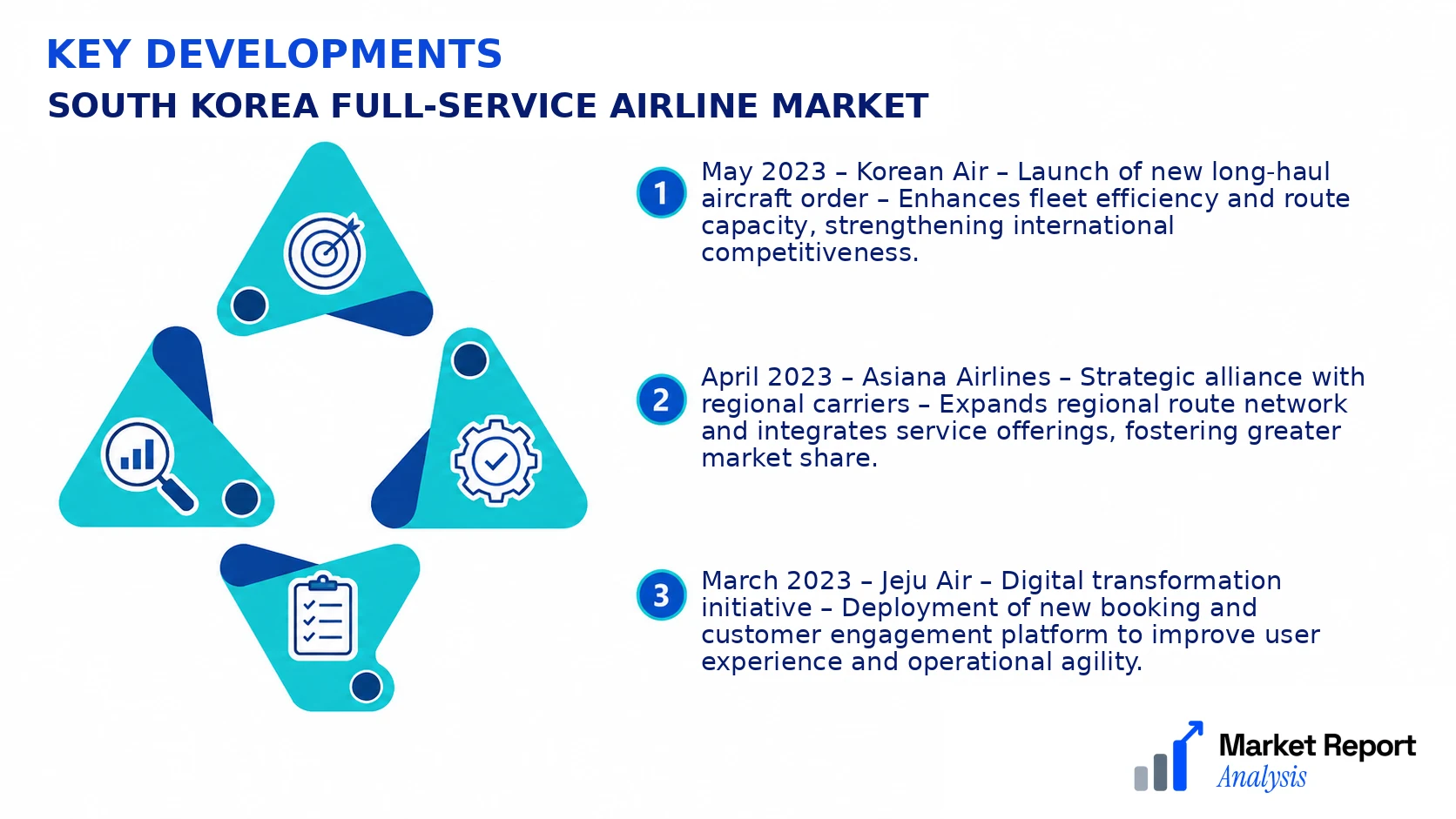
- May 2023 – Korean Air – Launch of new long-haul aircraft order – Enhances fleet efficiency and route capacity, strengthening international competitiveness.
- April 2023 – Asiana Airlines – Strategic alliance with regional carriers – Expands regional route network and integrates service offerings, fostering greater market share.
- March 2023 – Jeju Air – Digital transformation initiative – Deployment of new booking and customer engagement platform to improve user experience and operational agility.
- February 2023 – Air Busan – Fleet modernization program – Invests in fuel-efficient aircraft to meet environmental standards and reduce operational costs.
- January 2023 – Jin Air – Route expansion to Southeast Asia – Launches new services, diversifies revenue streams, and increases regional footprint amid competitive pressures.
Frequently Asked Questions
What is the South Korea Full-Service Airline Market?
The South Korea Full-Service Airline Market encompasses the operational sector of carriers providing comprehensive air travel services, including in-flight meals, baggage handling, and premium seating. It primarily serves both domestic and international passengers connecting South Korea to global destinations.
What is the current market size of South Korea Full-Service Airline Market?
As of 2026, the market size is valued at approximately USD 15.2 Billion, driven by increasing passenger demand, expanding international routes, and rising tourism. The market is poised for growth, supported by governmental policy reforms and infrastructural enhancements.
What factors are driving the South Korea Full-Service Airline Market?
Market growth is fueled by rising business and leisure travel, government initiatives to boost tourism, and the expansion of international flight networks. Additionally, technological advancements and the emergence of premium travel experiences are strengthening demand.
Which South Korean city leads the South Korea Full-Service Airline Market?
Seoul, home to Incheon International Airport, remains the dominant city leading the market. It serves as a primary hub for international flights, offering extensive connectivity and advanced airport infrastructure, making it the focal point for full-service airline operations in South Korea.
Which segment is expected to grow the fastest?
The international passenger segment is anticipated to see the fastest growth, driven by increased outbound tourism, business travel, and global connectivity efforts. Duty-free shopping and premium class offerings further enhance this segment's expansion.
Who are the leading companies operating in the South Korea Full-Service Airline Market?
Key players include Korean Air, Asiana Airlines, and several international carriers operating via Seoul. These firms compete by expanding routes, upgrading fleet quality, and enhancing in-flight services to capture a larger share of the expanding market.
Analyst Perspective
The South Korea Full-Service Airline Market exhibits a mature yet evolving landscape, with steady growth driven by domestic travel demand and expanding international connectivity. Over the long term, the market is expected to reflect gradual but sustained expansion, supported by infrastructure upgrades at key airports like Seoul Incheon and Busan. Commercial opportunities increasingly lie in premium services and loyalty programs, catering to a growing higher-income traveler segment. Technological evolution will focus on contactless passenger processes, advanced entertainment systems, and sustainable aviation fuels, optimizing efficiency and reducing environmental impact. Investment priorities should emphasize fleet modernization, digital transformation, and green initiatives to stay ahead in competitiveness. Urban centers such as Seoul, Busan, and Incheon are poised for continued growth due to urbanization, with Seoul driving the lion’s share of international traffic. While competition remains strong, partnerships and alliances are crucial for market share gains. Carefully targeted investments aligning with city-specific demand and infrastructure will ensure sustained long-term positioning amidst geopolitical and economic risks.
