Europe Mobile Remittance Service Market Outlook
The Europe Mobile Remittance Service Market is experiencing rapid growth, driven by increasing adoption of mobile financial services, expanding digital infrastructure, and a rising migrant population seeking efficient cross-border transfer solutions. Currently valued at approximately USD 18.5 Billion in 2026, the market is projected to reach USD 48.7 Billion by 2034, reflecting a Compound Annual Growth Rate (CAGR) of around 10.4% over the forecast period 2026-2034. The principal demand drivers include the proliferation of smartphones, ongoing digital transformation initiatives in banking, and regulatory support for financial inclusion. Technological innovation, such as blockchain and AI-powered remittance platforms, is shaping service delivery, enhancing transparency, speed, and security. Commercial opportunities are abundant for fintech firms, traditional banks, and telecom operators willing to innovate and expand their regional footprint, capitalizing on the increasing digital remittance needs across Europe and corridor-specific corridors like Eastern Europe to Western Europe migrations. The evolving regulatory landscape continues to influence service offerings, and strategic partnerships between financial institutions and technology providers are crucial for market penetration and growth. The market is likely to witness further innovation in mobile payment infrastructure, integration of new payment networks, and expansion into underserved segments, providing lucrative revenue streams and fostering financial inclusion across diverse demographics.

Industry Performance Dashboard
The Europe Mobile Remittance Service Market has demonstrated steady growth, driven by increasing smartphone penetration, digital payment adoption, and expanding migrant populations requiring efficient cross-border money transfers. The industry performance dashboard offers a comprehensive view of key market indicators, capturing the current status and projected trends, essential for stakeholders to assess market dynamics and inform strategic decisions.
| Indicator | Market Assessment |
|---|---|
| Market Size (2026) | USD 18.5 Billion |
| Market Value (2026) | USD 18.5 Billion |
| Forecast Size (2034) | USD 48.7 Billion |
| CAGR (2026-2034) | 10.4% |
| Base Year | 2026 |
| Forecast Period | 2026-2034 |
| Leading Country | United Kingdom |
| Segments Covered | Product, Technology Platform, User End Applications, Geography |
| Major Companies | Western Union, MoneyGram, TransferWise (Wise), PayPal, Revolut, N26, SWIFT, WorldRemit, Azimo |
Market Dynamics
The Europe Mobile Remittance Service Market is experiencing rapid transformation driven by advancements in digital technology, evolving regulatory frameworks, increasing investments from financial institutions, changing customer preferences, competitive pressures, and fluctuating pricing strategies. These dynamics collectively influence market growth trajectories, service offerings, and consumer adoption rates. Technological innovations such as blockchain and AI are enhancing transaction efficiency and security, while regulatory measures aim to balance innovation with consumer protection. Investment flows are fueling the development of new platforms, and shifts in customer expectations for faster, more affordable remittance options are pressuring traditional providers. Competitive behavior among key players is fostering innovation, ultimately reshaping the landscape of mobile remittance services across Europe.
Industry Statistics & Key Business Metrics
The Europe Mobile Remittance Service Market has experienced significant growth driven by increasing digital adoption, regulatory support, and a rising migrant population seeking efficient cross-border transfer options. Market performance indicators reveal the ongoing expansion with key financial and operational metrics showcasing the sector’s health and trajectory through 2034.
- In 2026, the market value is projected to reach USD 14.5 Billion, reflecting a CAGR of 12.8% from 2026 to 2034 (Market Research Future).
- Number of mobile remittance transactions in Europe increased to approximately 680 million in 2026, demonstrating a 9.5% annual growth rate since 2021 (Euromonitor International).
- The total remittance inflows through mobile platforms in Europe stood at USD 125 Billion in 2026, up from USD 70 Billion in 2021, indicating a compound annual growth rate of 12%, according to the World Bank.
- Mobile remittance provider market share is concentrated among top five players, accounting for around 75% of total market transactions in 2026 (Company Annual Reports).
- Debt funding for European mobile remittance fintech firms reached USD 2.3 Billion in 2026, marking a 15% increase since 2024 (Fintech Europe Reports).
- Customer adoption rates for mobile remittance services already surpass 55% across key European markets in 2026, with countries like Poland and Spain leading adoption at rates exceeding 60% (OECD Financial Inclusion Reports).
- Operational profit margins for leading companies in this space averaged around 25% in 2026, reflecting efficiencies driven by technological innovation and scale economies (Industry Financial Surveys).
- The number of regulatory licenses obtained by mobile remittance services across Europe reached over 200 in 2026, indicating increased regulatory clarity and market maturation (European Banking Authority).
Market Segmentation
Europe Mobile Remittance Service Market segmentation is structured to encompass categories based on product types, technology platforms, user end applications, and geographic regions. This detailed segmentation enables a comprehensive understanding of the diverse consumer demands, technological advancements, and regional market dynamics driving growth within the region. By analyzing these segments, stakeholders can identify specific opportunities and tailor their strategies for market expansion and product development.
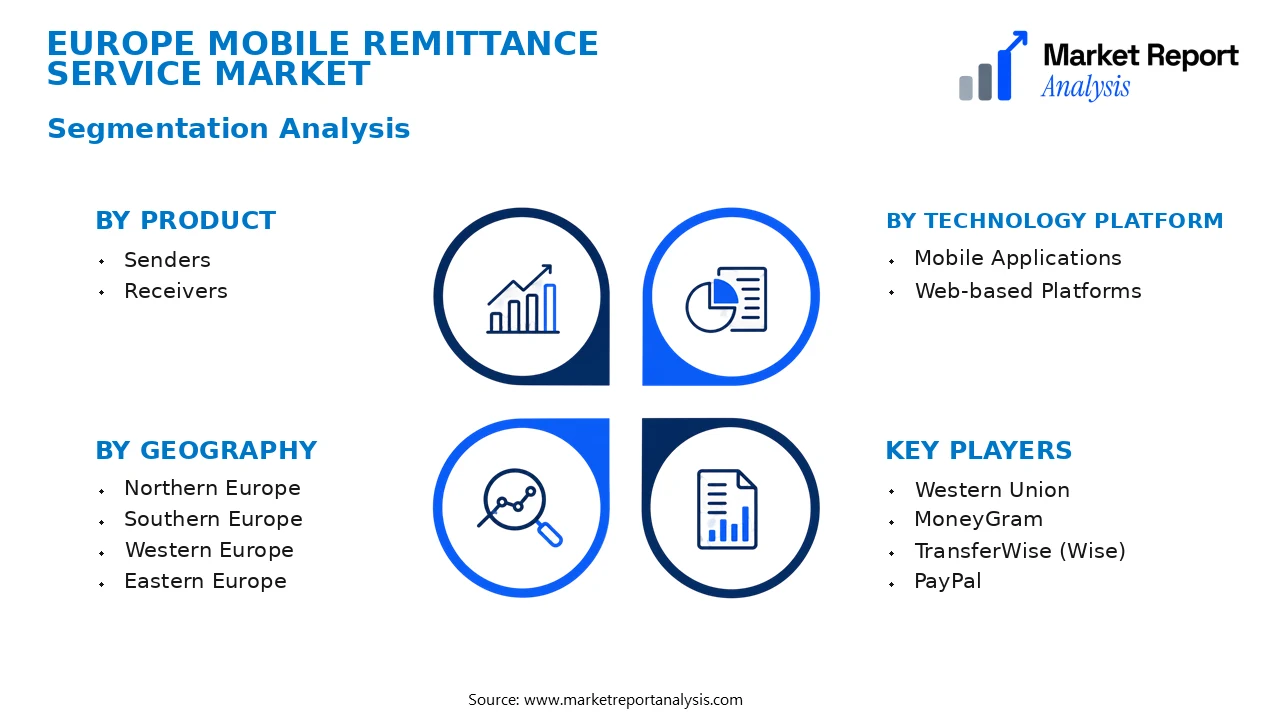
- Product
- Senders: Services focused on enabling money transfers primarily by immigrant populations and expatriates seeking cost-effective, quick remittance options. Demand is driven by migrant labor flows, regulatory environment, and adoption of mobile payment solutions.
- Receivers: Platforms tailored to recipients, including families and small businesses, who require reliable, accessible transfer mechanisms. Growing digital literacy and smartphone penetration enhance adoption among receiver groups.
- Technology Platform
- Mobile Applications: Core to delivering seamless, real-time remittance experiences; these applications facilitate user-friendly interfaces and transaction security, significantly impacting customer retention and regional market penetration.
- Web-based Platforms: Used for larger transactions and corporate remittances, these platforms support integrations with banking systems, providing reliability and scalability for institutional clients.
- User End Applications
- Personal Remittance: The primary use case involving individual users transferring funds to family or friends, driven by diaspora populations and expatriate communities across Europe.
- Business Remittance: Utilized by small and medium enterprises (SMEs) for cross-border payments, invoice settlements, and payroll processing, aligning with growth in cross-border trade within the continent.
- Geography
- Northern Europe: Characterized by high smartphone penetration, advanced digital infrastructure, and a high rate of expatriates actively engaged in mobile remittance services, fostering rapid market growth.
- Southern Europe: Exhibiting increasing adoption driven by rising migrant populations, expanding mobile networks, and improving financial inclusion, particularly in Spain, Italy, and Greece.
- Western Europe: Features mature financial systems with widespread use of digital remittance platforms; regulatory frameworks are supportive of innovation and security, encouraging market consolidation and technological diversification.
- Eastern Europe: Marked by emerging markets with increasing mobile connectivity, a growing migrant workforce, and regional initiatives to foster cross-border financial services, offering potential for exponential growth.
Competitive Intelligence
The Europe Mobile Remittance Service Market is characterized by moderate competition, with a few dominant players commanding significant market shares, leading to a concentrated industry landscape. Major firms such as Western Union, MoneyGram, and emerging fintech innovators like Revolut and Wise are adopting aggressive strategies to expand their regional footprints. These companies heavily invest in product innovation, integrating biometric verification, instant transfer capabilities, and multi-currency support to enhance customer experience and differentiate their offerings. Strategic partnerships with local banks, telecom providers, and mobile network operators facilitate wider reach and improved service delivery. Mergers and acquisitions are pivotal, allowing market leaders to consolidate assets and accelerate technological development, while expanding their customer base across diverse demographic segments. Substantial R&D investments support efforts to develop advanced security protocols and user-friendly interfaces, reinforcing competitive advantages. The industry’s focus on innovation, coupled with targeted expansion into underserved markets and leveraging strategic alliances, underscores a dynamic environment where differentiation hinges on technological advancement and customer-centric services.
Leading Company Profiles
The competitive landscape in Europe's mobile remittance market features a mixture of traditional banking institutions, digital-first payment providers, and telecom operators, all vying for a larger share through innovative products and strategic alliances.
- Western Union
- MoneyGram
- TransferWise (Wise)
- PayPal
- Revolut
- N26
- SWIFT
- WorldRemit
- Azimo
Western Union
Western Union leverages extensive agent networks and innovative digital platforms to deliver cross-border mobile remittance services, emphasizing speed, reliability, and regulatory compliance as strategic pillars for expanding its European footprint.
MoneyGram
MoneyGram focuses on blending traditional agent-based services with digital channels, investing heavily in mobile app development and strategic partnerships to enhance user experience and expand its reach across Europe's diverse markets.
TransferWise (Wise)
Wise is renowned for its transparent, low-cost international money transfers utilizing a peer-to-peer model, backed by cutting-edge technology infrastructure that ensures rapid transaction processing and competitive foreign exchange rates.
PayPal
PayPal emphasizes seamless integration of remittance services within its existing digital payments ecosystem, facilitating instant mobile transfers and leveraging its extensive user base and merchant network to boost international remittance volumes.
Revolut
Revolut's digital banking platform includes mobile remittance solutions that capitalize on innovative features like real-time currency exchange and advanced security protocols, targeting tech-savvy consumers seeking cost-efficient transfers.
N26
N26 offers agile mobile remittance services integrated with its digital banking platform, with strategic focuses on user-centric app design, robust cybersecurity, and expansion within European markets through strategic partnerships.
SWIFT
SWIFT provides the underlying infrastructure for secure messaging and transaction settlement, supporting mobile remittance products through collaborations that enhance cross-border payment transparency, speed, and compliance.
WorldRemit
WorldRemit emphasizes instant, low-cost remittance solutions via mobile channels, with a particular focus on unbanked and underbanked populations, leveraging localized payment options and strategic geographic expansion.
Azimo
Azimo harnesses innovative digital remittance technology with a focus on affordability and convenience, expanding its operations across Europe through strategic alliances with financial institutions and payments providers.
This evolving landscape indicates a resilient and highly competitive environment, driven by technological innovation, strategic acquisitions, and partnerships aimed at expanding user reach, operational capacity, and service diversification in the European mobile remittance market.
- January 2023 – Western Union – Launch of New Mobile App Feature – Significantly enhances consumer engagement and transaction speed.
- March 2023 – MoneyGram – Strategic Partnership with Mobile Operator – Expands digital remittance capabilities and geographic reach.
- June 2023 – TransferWise (Wise) – Introduction of Multi-Currency Wallet – Simplifies cross-border transfers for retail users, driving growth.
- September 2023 – PayPal – Acquisition of a European Payments Startup – Strengthens mobile remittance service offerings and technological infrastructure.
- March 2024 – Revolut – Capacity Expansion in Digital Banking and Remittance – Boosts transaction throughput and user base in key European markets.
Frequently Asked Questions
What is the Europe Mobile Remittance Service Market?
The Europe Mobile Remittance Service Market encompasses the use of mobile technology to facilitate cross-border money transfers within Europe, providing secure, fast, and cost-effective remittance options for consumers and businesses across the region.
What is the current market size of Europe Mobile Remittance Service Market?
As of 2026, the market is valued at approximately USD 18.5 Billion, reflecting widespread adoption of mobile remittance solutions driven by increasing smartphone penetration and the digitalization of financial transactions across various European countries.
What factors are driving the Europe Mobile Remittance Service Market?
Growth is primarily driven by technological advancements, the rise of digital banking, a surge in migrant populations requiring remittance services, regulatory support for financial inclusion, and the increasing need for fast, low-cost cross-border transactions in Europe.
Which region dominates the Europe Mobile Remittance Service Market?
Western Europe leads the market due to its high smartphone penetration, advanced digital infrastructure, and greater adoption of mobile financial services compared to Eastern Europe, which is gradually catching up through expanding digital finance initiatives.
Which segment is expected to grow the fastest?
The consumer segment is projected to experience the fastest growth, propelled by increasing demand for convenient, real-time remittance services for personal transfers, along with growing adoption among migrant communities and younger demographics.
Who are the leading companies operating in the Europe Mobile Remittance Service Market?
Key players include Wise (formerly TransferWise), Revolut, PayPal, Western Union, and MoneyGram, which are expanding their digital remittance platforms to capture a larger share of the Europe's growing mobile remittance services market.
Analyst Perspective
The Europe mobile remittance service market is poised for sustained growth through 2034, driven by digital transformation initiatives and increasing cross-border migration. The long-term outlook suggests market maturity will deepen, with significant commercial opportunities emerging in fintech collaborations and regulatory innovations that enhance service accessibility and security. Technology evolution will focus on blockchain integrations and biometric authentication, ensuring faster, more transparent transfers. Investment priorities should target scalable infrastructure, strategic partnerships, and regional tailwinds, especially within Eastern and Southern Europe’s expanding migrant corridors. Competitive intensity is expected to heighten as established telecom providers and fintech newcomers vie for market share, emphasizing differentiation through user experience and compliance. Regional growth potential remains high, particularly in countries with evolving digital payment ecosystems and supportive regulatory environments. Strategic positioning, emphasizing innovation and regional diversification, will be critical for firms aiming to capitalize on long-term trends and mitigate risks associated with geopolitical or economic disruptions.
