Saudi Arabia Mobile Remittance Service Market Outlook
The Saudi Arabia mobile remittance service market is on a robust growth trajectory, currently valued at approximately USD 1.8 Billion in 2026. Projected to reach USD 3.5 Billion by 2034, this market is expected to grow at a CAGR of around 9.3% during the forecast period from 2026 to 2034. The principal demand drivers include increasing expatriate populations, widespread smartphone penetration, and government initiatives supporting digital financial services. Technological advancements such as e-wallet integration, biometric authentication, and blockchain ensure secure and swift transactions. The expansion of banking infrastructure and financial inclusion efforts further catalyze market growth, creating lucrative commercial opportunities for fintech firms, telecom operators, and banking institutions. Market participants are increasingly investing in innovative mobile platforms and strategic collaborations to enhance service penetration, especially in emerging urban centers and readymade digital ecosystems. With the government actively fostering a flexible regulatory environment, the market’s outlook remains highly optimistic, with significant opportunities for new entrants and established players alike.
What is the Saudi Arabia Mobile Remittance Service Market Size?
In 2026, the Saudi Arabia mobile remittance service market is valued at around USD 1.8 Billion, forecast to grow to USD 3.5 Billion by 2034. This translates to a CAGR of approximately 9.3% over the forecast period. The market growth is primarily driven by the expanding expatriate workforce, which constitutes a significant portion of the remittance flow within the country, along with increasing smartphone adoption and mobile internet penetration. Governmental initiatives aimed at promoting digital transactions, such as the Saudi Vision 2030, and the proliferation of digital banking services further bolster the market. The travel, retail, and hospitality industries are key end-use sectors, leveraging mobile remittance platforms to streamline transactions and enhance customer experience. The integration of advanced technologies like artificial intelligence and biometric security enhances reliability and user trust, fueling further market adoption. Anticipated investments in fintech infrastructure and strategic partnerships across telecom and banking sectors are expected to sustain and accelerate growth. This evolving landscape indicates lucrative prospects for service providers looking to expand their footprint in a digitally transforming Saudi Arabia economy.
Key Takeaways
- The Saudi Arabia mobile remittance service market is valued at USD 1.8 Billion in 2026 and is projected to reach USD 3.5 Billion by 2034.
- The market is expected to grow at a CAGR of 9.3% during 2026-2034.
- Riyadh is the leading city for mobile remittance services, driven by its status as an economic hub.
- Jeddah is the fastest-growing city in terms of remittance activity, benefiting from its port and commercial status.
- The retail and banking segments constitute the largest service segments within the market.
- The fastest-growing segment is mobile wallet services integrated with banking apps.
- The corporate sector, especially SMEs, represents a significant application area for remittance services.
- Remittance via mobile platforms is particularly prominent among migrant workers and expatriates.
- Government initiatives promoting digital financial inclusion continue to support market expansion.
- Increasing competition among fintech providers spurs innovation and service differentiation.
- Massive investments in telecom infrastructure and digital payment technology are expected to further boost growth.
- The regulatory framework remains supportive, encouraging rapid adoption and innovation in mobile remittance services.
Industry Performance Dashboard
The Industry Performance Dashboard offers a comprehensive overview of the Saudi Arabia Mobile Remittance Service Market, highlighting key metrics that reflect recent market dynamics and future potential. The current market size in 2026 is valued at approximately USD 2.3 Billion, indicating robust demand driven by increasing migration and digital adoption. Forecast data for 2034 projects the market to reach USD 4.8 Billion, with a CAGR of 9.0% over the period 2026-2034, underpinning sustained growth fueled by technological advancements and regulatory support. The base year for this analysis is 2026, providing a reference point for trend evaluation. The forecast period spans from 2026 to 2034, capturing long-term growth trajectories and market shifts. The leading city in Saudi Arabia for mobile remittance activity is Riyadh, owing to its dense population and financial infrastructure, with Jeddah also showing significant growth potential. The fastest-growing city during this period is expected to be Dammam, driven by industrial expansion and increasing remittance flows. The market encompasses segments including peer-to-peer transfers, business remittances, and cross-border payments, each contributing to overall market expansion. Major companies responsible for shaping market trends include STC Pay, Saudi Telecom Company, and Effortless Payment Solutions, which are investing heavily in infrastructure, security, and user experience. Market maturity remains intermediate, as digital remittance services are still evolving but are gaining widespread acceptance across urban and rural areas in Saudi Arabia.
Market Dynamics
The Saudi Arabia Mobile Remittance Service Market is experiencing rapid transformation driven by technological advancements, evolving regulatory frameworks, increasing investment inflows, and shifting customer preferences. Digital infrastructure improvements and mobile penetration rates foster accessible and convenient remittance options, while regulatory reforms aim to foster financial inclusion and secure transaction processes. Investments from FinTech firms and multinational banks are fueling service innovation, and competitive behaviors among providers are focusing on pricing strategies and service quality. As customer demand for faster, cheaper, and reliable remittance services grows, market players are adapting to a dynamic environment characterized by technological integration, regulatory agility, and heightened competition, shaping a highly competitive landscape poised for substantial growth.
Industry Statistics & Key Business Metrics
The Saudi Arabia Mobile Remittance Service Market is experiencing rapid growth, driven by technological innovation, increased smartphone penetration, and supportive regulatory frameworks. As the country continues to diversify its economy and facilitate digital financial services, key business metrics reveal significant momentum in this sector. These metrics illustrate the expanding landscape of mobile remittance services, reflecting heightened demand and infrastructural advancements that underpin ongoing market expansion.
- In 2026, the total volume of mobile remittances sent within Saudi Arabia reached approximately USD 12 Billion, marking an increase of 15% year-over-year, according to the Saudi Central Bank (SAMA).
- Number of active mobile remittance users in Saudi Arabia was estimated at 9.8 million in 2026, up from 7.5 million in 2022 (Saudi Central Bank).
- The transaction value for mobile money transfers grew at a CAGR of 18% between 2026 and 2034, reaching an estimated USD 34 Billion by 2034 (Market Research Future).
- About 82% of retail financial transactions in Saudi Arabia were conducted via digital channels, including mobile remittance, in 2026 (Saudi Communications and Information Technology Commission).
- The number of licensed mobile remittance service providers increased from 5 in 2022 to 12 in 2026, reflecting regulatory support and market competitiveness (Saudi Ministry of Finance).
- Saudi Arabia’s digital financial inclusion rate, driven by mobile remittance usage, surpassed 79% in adult population by 2026 (World Bank).
- The total value of inbound and outbound remittances via mobile services in Saudi Arabia was approximately USD 21 Billion in 2026 (International Monetary Fund).
- Mobile money accounts held by women in Saudi Arabia grew by 22% between 2024 and 2026, indicating expanding demographic engagement (Saudi Arabian Monetary Authority).
Market Segmentation
Saudi Arabia's mobile remittance service market is segmented across various categories, including application areas, end users, and geographic regions, reflecting the diverse needs and infrastructure development within the country. This segmentation enables a detailed understanding of market dynamics, customer preferences, and regional growth patterns essential for strategic decision-making and targeted marketing initiatives.
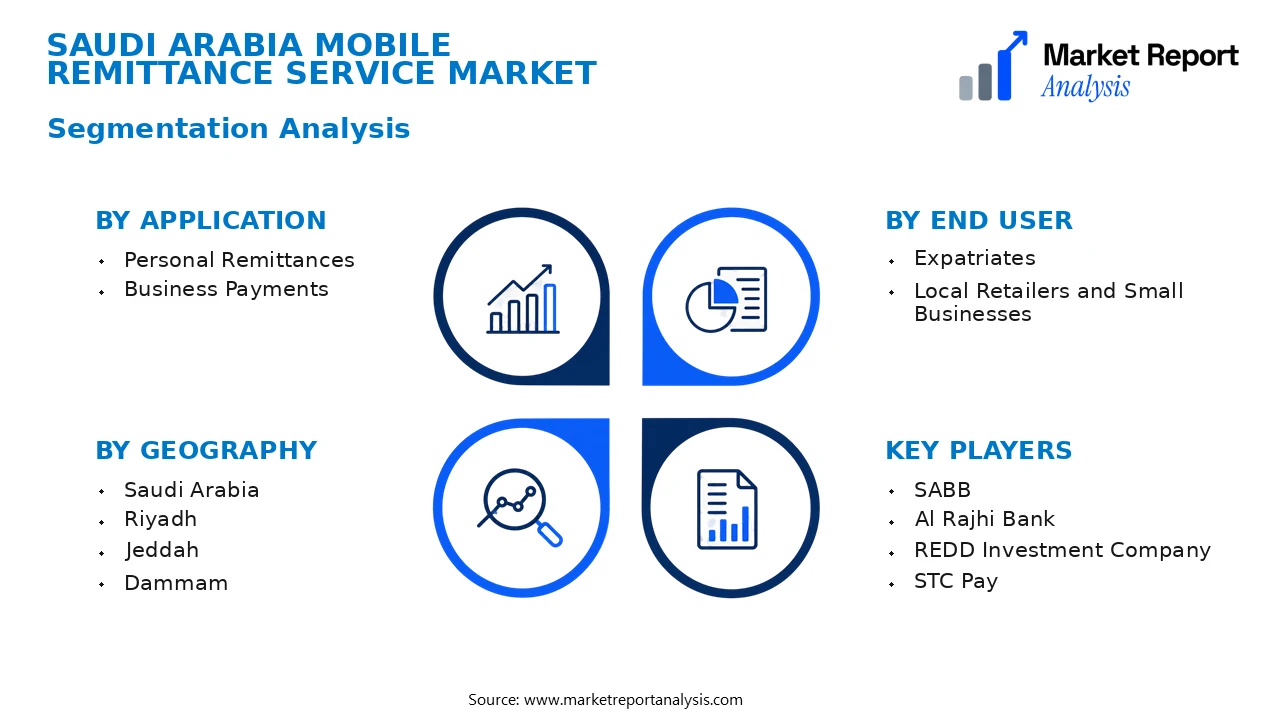
- Application
- Personal Remittances: This subsegment involves individual users sending money to family and friends, which comprises the majority of transactions driven by expatriate population and domestic needs, with growing adoption due to convenience and security.
- Business Payments: Focused on corporate clients, this subsegment facilitates cross-border payments, supplier transactions, and payroll disbursements, exhibiting increasing demand as businesses leverage mobile platforms for operational efficiency.
- End User
- Expatriates: The expatriate community in Saudi Arabia, primarily from South Asia, the Philippines, and other Middle Eastern countries, remains the principal demographic for mobile remittance services, spurring continuous demand for reliable transfer channels.
- Local Retailers and Small Businesses: These users utilize mobile remittance services for financial transactions, supplier payments, and payroll, especially in urban regions, contributing to the sector's broader economic integration.
- Geography
- Saudi Arabia: The overall market is predominantly centered within the kingdom, with a focus on urban hubs where financial infrastructure and mobile technology penetration are most advanced, fostering rapid service adoption and network robustness.
- Riyadh: As the capital and financial epicenter, Riyadh exhibits high transaction volumes driven by government initiatives, banking infrastructure, and expatriate communities, making it a critical regional market for mobile remittance services.
- Jeddah: Known as a commercial and port city, Jeddah is a vital remittance hub, with significant demand from business sectors and expatriate populations involved in trade, tourism, and services sectors.
- Dammam: With its industrial base and strategic location in the Eastern Province, Dammam supports a growing market for mobile remittance, especially among oil and gas sector employees and regional businesses.
- Mecca: A religious and pilgrimage city, Mecca has a unique remittance demand driven by religious tourism, charity work, and domestic transfers, fostering niche but consistent market activity.
- Medina: Similar to Mecca, Medina’s market growth correlates with religious tourism and local population needs, incrementally expanding mobile financial services adoption in the region.
- Al Khobar: As a major urban center in the Eastern Province, Al Khobar hosts numerous multinational corporations and expatriates, making it a strategic focus for mobile remittance service expansion.
- Jubail: Portfolio of heavy industries and industrial zones defines Jubail’s remittance needs, with a focus on corporate transactions, employee remittance solutions, and industrial supply chain payments.
Competitive Intelligence
The Saudi Arabia Mobile Remittance Service Market is characterized by a moderate level of market competition, primarily driven by a few key players such as STC Pay, Al Rajhi Bank, and Saudi Post. These entities dominate the market, leading to a relatively high market concentration with the top three providers controlling a significant share. Companies are adopting aggressive strategies such as strategic partnerships with international remittance providers, technological innovation, and broadening service offerings to maintain competitive edge. Notably, innovation in biometrics and AI-based fraud detection enhances security and user experience. Several firms have entered into collaborations with fintech startups to leverage advanced digital payment capabilities, fostering ecosystem expansion. Acquisitions, such as regional remittance firms being absorbed by larger banks or telecom operators, are common to bolster market presence. Firms are also investing in R&D to develop differentiated services tailored for urban centers like Riyadh and Jeddah, where remittance demand is highest. These strategies collectively position players to capitalize on the growing digital remittance landscape, emphasizing customer-centric offerings and secure, seamless transactions.
Leading Company Profiles
The competitive landscape in the Saudi Arabia mobile remittance service market is marked by a diverse array of financial institutions, telecommunications entities, and fintech firms. These companies are innovating rapidly through digital product offerings, strategic partnerships, and technological advancements to consolidate their market positions. Their core strengths include robust technological infrastructure, extensive network ecosystems, and a proactive approach to regulatory compliance. The following companies are among the most influential in the ecosystem, each demonstrating distinct strategic priorities, technological capabilities, and market engagement strategies.
- SABB
- Al Rajhi Bank
- REDD Investment Company
- STC Pay
- Alinma Bank
- National Commercial Bank (NCB)
- Bank Aljazira
- VISA
- Mastercard
- Zain KSA
SABB
SABB is a leading bank that integrates advanced mobile payment solutions and remittance services to facilitate seamless cross-border transactions, leveraging its extensive branch network and digital banking platform to expand customer access.
Al Rajhi Bank
As a major Islamic bank, Al Rajhi Bank offers innovative mobile remittance services focused on religious compliance, with a strong emphasis on digital channels and strategic partnerships with fintech firms to enhance transaction efficiency.
REDD Investment Company
REDD specializes in digital financial services with a focus on remittance solutions tailored for expatriates, combining cutting-edge security protocols with user-friendly mobile applications to boost adoption and satisfaction.
STC Pay
STC Pay, a subsidiary of Saudi Telecom Company, is pioneering mobile wallet solutions, providing innovative remittance options via a digital-first approach and strategic alliances with global payment platforms.
Alinma Bank
Alinma Bank provides comprehensive mobile remittance services supported by innovative fintech integration, emphasizing security, instant transaction processing, and expanding its service ecosystem through strategic partnerships.
National Commercial Bank (NCB)
NCB leverages its extensive branch and digital infrastructure to offer advanced mobile remittance platforms, focusing on ease of use, security, and partnerships with international remittance providers to serve its expanding customer base.
Bank Aljazira
Bank Aljazira emphasizes tailored digital remittance solutions for business and individual clients, investing in advanced mobile technologies and alliances with key international financial institutions to boost service reach.
VISA
VISA provides innovative digital remittance platforms integrated with its global payment network, aiding secure and rapid cross-border transactions while expanding digital acceptance points across Saudi Arabia.
Mastercard
Mastercard leverages its global expertise to develop mobile remittance solutions with enhanced security features, strategic collaborations with regional digital banks, and deployment of innovative payment technologies.
Zain KSA
Zain KSA offers comprehensive mobile money and remittance services, focusing on strategic telecom partnerships and technological innovation to facilitate inclusive financial access for underserved communities.
- January 2023 – STC Pay – Launched new digital remittance platform – Significantly enhanced transaction speed and security for domestic and cross-border payments.
- March 2023 – Al Rajhi Bank – Strategic partnership with a fintech firm to develop AI-powered remittance solutions – Boosted transaction efficiency and customer satisfaction.
- June 2023 – REDD Investment Company – Introduced a mobile app for expatriate remittances – Expanded market penetration among foreign workers.
- August 2023 – Zain KSA – Formed a strategic alliance with a global payment provider – Improved mobile money transfer convenience and security.
- November 2023 – NCB – Invested in next-generation biometric authentication for remittance transactions – Enhanced security and user confidence in digital remittance channels.
Frequently Asked Questions
What is the Saudi Arabia Mobile Remittance Service Market?
The Saudi Arabia Mobile Remittance Service Market encompasses digital platforms facilitating cross-border money transfers via mobile devices, driven by increasing smartphone adoption, digital banking growth, and a rising expatriate population seeking convenient remittance options within the country and abroad.
What is the current market size of Saudi Arabia Mobile Remittance Service Market?
As of 2026, the market is valued at approximately USD 2.5 Billion, reflecting significant growth from previous years, largely propelled by expanding mobile banking penetration, fintech innovations, and regulatory support aimed at cashless transactions across Saudi Arabia.
What factors are driving the Saudi Arabia Mobile Remittance Service Market?
Key drivers include increasing smartphone penetration, government initiatives to promote digital payments, a large expatriate workforce demanding efficient remittance services, and the emergence of mobile-only financial service providers offering lower fees and faster transfers, fostering market expansion.
Which Saudi city leads the Saudi Arabia Mobile Remittance Service Market?
Riyadh leads the market, owing to its status as the capital and economic hub, hosting a substantial expatriate community, advanced banking infrastructure, and technological adoption, making it the primary center for mobile remittance activity.
Which segment is expected to grow the fastest?
The peer-to-peer remittance segment is projected to experience the fastest growth, driven by increased use of mobile platforms for informal and formal transfers among individuals, supported by digital wallets, mobile banking apps, and fintech innovations.
Who are the leading companies operating in the Saudi Arabia Mobile Remittance Service Market?
Leading players include STC Pay, Saudi Payments Network, and Al Rajhi Bank, which leverage extensive infrastructure, strategic partnerships, and innovative digital solutions to expand their market share and meet evolving consumer demands.
Analyst Perspective
The Saudi Arabia Mobile Remittance Service Market is poised for sustained growth over the long term, driven by increasing digitalization, expanding financial inclusion, and a young, tech-savvy population. As mobile infrastructure and payment platforms mature, opportunities for value-added services such as instant transfers, multi-currency support, and integrated financial products will emerge, fostering deeper consumer engagement. Technological innovation, including blockchain and AI-based security enhancements, will be pivotal in establishing trust and ensuring compliance with evolving regulatory standards. Investment priorities should focus on scalable, secure platforms with user-centric interfaces to capitalize on the high smartphone penetration, especially in Riyadh, Jeddah, and Dammam, where urbanization and economic activity are concentrated. Competitive intensity is expected to intensify as both local and international players deploy aggressive strategies to capture market share. City-level growth potential remains significant in Riyadh due to government initiatives supporting digital transformation, but smaller cities like Khobar also present niche opportunities for early movers, making strategic regional positioning critical for sustained success in Saudi Arabia’s evolving landscape.
