Latin America Mobile Remittance Service Market Outlook
The Latin America Mobile Remittance Service Market is currently valued at USD 4.2 Billion and is projected to reach USD 12.8 Billion by 2034, growing at a compound annual growth rate (CAGR) of 14.2% during the forecast period from 2026 to 2034. The market growth is primarily driven by increasing cross-border migration, rising smartphone penetration, and expanding access to mobile banking in the region. Enhanced digital infrastructure and the proliferation of financial technology startups facilitate fast, secure, and cost-effective remittance services, creating significant commercial opportunities for financial institutions and telecom providers alike. The trend toward digital-first financial services, coupled with supportive regulatory frameworks, further boosts the market. Innovations in blockchain and digital wallets are expected to enhance transparency and reduce transaction costs, making remittance services more attractive and accessible. The region's diverse economic profile, with significant remittance flows from expatriates to home countries, underscores the ongoing demand for efficient mobile solutions, positioning Latin America as a burgeoning hub for mobile remittance innovation and investment.
What is the Latin America Mobile Remittance Service Market Size?
The Latin America Mobile Remittance Service Market is anticipated to grow from a valuation of USD 4.2 Billion in 2026 to USD 12.8 Billion in 2034, reflecting a robust CAGR of 14.2%. This growth is driven by factors such as increasing migration across Latin American borders, heightened adoption of smartphones and mobile internet, and a growing trust in digital financial platforms. The expanding middle class and remittance-dependent households are fueling transaction volumes, especially in countries like Mexico, Brazil, and Colombia, where economic activities are increasingly digitalized. Technological advancements, especially in mobile payment platforms and blockchain technology, are significantly reducing transaction costs and increasing speed, broadening user eligibility and regional reach. The adoption of API-based integrations enables seamless cross-border transfers, attracting global remittance companies to invest in regional infrastructure. Moreover, evolving regulatory policies aimed at financial inclusion and mobile banking innovations are expected to sustain the market's upward trajectory. Future investments will likely focus on scaling secure, scalable platforms and integrating artificial intelligence to enhance user experience and fraud protection across remittance channels. Overall, the Latin America mobile remittance market presents substantial opportunities for fintech firms, telecommunications companies, and multinational banks seeking to expand their foothold in digital remittance solutions across the region.
Key Takeaways
- The market size was USD 4.2 Billion in 2026 and is forecasted to reach USD 12.8 Billion by 2034.
- The CAGR during 2026-2034 is 14.2%, indicating rapid growth fueled by digital adoption.
- The largest segment by technology is mobile wallets, capturing the highest transaction volumes.
- The fastest-growing segment is blockchain-enabled remittance platforms, due to enhanced transparency and cost efficiency.
- Cross-border remittance is the dominant application, driven by migration and diaspora income flows.
- Mobile remittance services are primarily used by migrant workers and expatriates in Latin America.
- The region’s key countries include Mexico, Brazil, Colombia, and Argentina, which lead in transaction volumes.
- The forecast period of 2026-2034 exhibits consistent growth supported by regulatory reforms promoting financial inclusion.
- Technologies such as AI and blockchain are critical in future market expansion and service differentiation.
- Increasing competition from fintech startups and telecom operators enhances service offerings and innovation.
- Investments are focused on infrastructure development, cybersecurity, and customer experience enhancements.
- Regulatory bodies are key stakeholders, facilitating the safe and compliant deployment of mobile remittance solutions.
- The region remains attractive to global investors seeking digital remittance market expansion.
Industry Performance Dashboard
The Industry Performance Dashboard provides a comprehensive snapshot of the current and projected state of the Latin America Mobile Remittance Service Market, highlighting key metrics and trends shaping its evolution. This dashboard consolidates vital market indicators into a structured format, facilitating strategic analysis and decision-making. The market size in 2026 is projected at USD 12.5 Billion, reflecting significant growth driven by increasing smartphone penetration, favorable regulatory environments, and the expansion of digital financial services across the region. As the market advances, the forecast size for 2034 is anticipated to reach USD 36.7 Billion, expanding at a CAGR of 14.3% over the forecast period from 2026 to 2034. This growth trajectory underscores the escalating demand for efficient, accessible mobile remittance solutions within Latin America. The base year for analysis is 2026, with the forecast period spanning from 2026 to 2034, allowing for a detailed understanding of emerging trends. The primary market segments include peer-to-peer remittances, cross-border transfers, and remittances for small businesses, which collectively drive market expansion. Leading companies operating in this space are BBVA, PayPal, Western Union, and MoneyGram, each implementing innovative technologies to capture regional opportunities. Major investments focus on integration with mobile banking platforms and enhancing security protocols, aligning with evolving consumer preferences and regulatory standards. The market’s maturity level indicates a transition from nascent stages to a more competitive landscape, punctuated by technological innovation and increasing adoption, positioning Latin America as a significant growth hub for mobile remittance services.
Market Dynamics
The Latin America Mobile Remittance Service Market is experiencing significant transformation driven by technological advancements, evolving regulatory frameworks, heightened investment activities, shifting customer preferences, competitive pricing strategies, changing supply conditions, and aggressive market competition. These factors collectively influence service adoption rates, product innovation, and geographic expansion, shaping the overall market landscape. Increased smartphone penetration and the proliferation of digital financial services are enabling more inclusive remittance solutions. Moreover, regulatory initiatives aimed at financial inclusion and anti-money laundering are shaping operational standards, while strategic investments by tech giants and financial institutions foster innovation and market accessibility, creating a dynamic environment with substantial growth potential.
Drivers
Digital Penetration and Smartphone Adoption
The rising penetration of smartphones and internet access across Latin America significantly propels the mobile remittance sector. As mobile devices become more affordable and widespread, previously underserved populations gain access to digital financial services. For instance, countries like Brazil and Mexico have seen smartphone usage exceed 80% of the population, facilitating convenient remittance transactions via mobile apps. This trend is supported by the broader global shift towards digital payments, with Latin American consumers increasingly favoring cashless and remote remittance methods, thereby expanding the market’s reach and transaction volume.
Regulatory and Policy Support
Governments and regulators in Latin America are adopting policies favoring financial inclusion and innovation, which bolster the mobile remittance ecosystem. Initiatives such as Mexico’s Fintech Law and Brazil’s digital banking regulation promote secure, accessible, and transparent remittance platforms. These frameworks ease market entry barriers, encourage formalization of informal remittance channels, and support anti-money laundering measures. Such regulatory support not only fosters consumer confidence but also attracts investment and technological partnerships, thus accelerating market growth and fostering sustainable development within the sector.
Innovative Payment Technologies and Partnerships
The integration of advanced payment technologies, including Near Field Communication (NFC), QR codes, and blockchain, enhances transaction efficiency and security in mobile remittance services. Partnerships between telecom operators, financial institutions, and fintech startups drive the deployment of innovative solutions tailored to regional needs. For example, collaboration between operators like Telefonica and fintech firms has facilitated rapid rollouts of mobile money transfer platforms. The adoption of interoperable payment systems further facilitates cross-border remittances, encouraging broader usage and reducing transaction costs, which together underpin a robust growth trajectory.
Growing Diaspora and Migration Trends
The increasing migration flows within Latin America and to other regions drive demand for reliable, inexpensive remittance channels. Countries such as Venezuela, El Salvador, and Guatemala experience high emigration rates, with remittances constituting a significant portion of household income. This demographic shift amplifies the need for efficient mobile remittance services that are accessible even in rural and underserved areas. The global trend of remote working and digital connectivity further sustains this demand, prompting service providers to innovate continuously and expand their market footprints.
Restraints
Limited Financial Infrastructure
Despite technological advancements, many regions within Latin America still face inadequate banking and telecommunications infrastructure, hampering the full adoption of mobile remittance services. Rural and remote communities often lack reliable internet, mobile network coverage, or banking facilities, limiting the reach of digital remittance platforms. This infrastructural gap restricts the ability of service providers to scale operations effectively and impacts transaction volume growth in the most vulnerable areas, thereby impeding overall market expansion.
Regulatory Complexities and Compliance Costs
The regulatory landscape across Latin American countries is often fragmented and complex, posing significant compliance challenges for market entrants. Navigating diverse anti-money laundering standards, data privacy laws, and licensing requirements increases operational costs and delays product launches. Smaller fintech firms or international players may find these regulatory hurdles discouraging, leading to reduced market competition and slower innovation. Consequently, this regulatory environment remains a key restraint on rapid sectoral growth.
Customer Trust and Digital Literacy Challenges
Building trust among consumers, especially in underserved and rural areas, presents a critical challenge due to digital literacy deficits and concerns over security. Many users are hesitant to adopt innovative mobile platforms due to fears of fraud, loss of funds, and lack of understanding of digital transactions. This skepticism affects the velocity of onboarding new users and limits transaction volumes, thereby moderating overall growth. Overcoming these barriers requires extensive consumer education and robust security measures, which entail additional costs and strategic focus for service providers.
Opportunities
Expansion of Digital Financial Ecosystems
The ongoing development and integration of digital financial ecosystems create vast opportunities for mobile remittance services. Leveraging advancements in digital banking, e-wallets, and contactless payments can expand service offerings, attracting new users and increasing transaction volumes. Countries like Colombia and Peru are fostering digital financial inclusion through government-led initiatives and private sector collaboration, creating fertile ground for ecosystem expansion. This integrated approach not only simplifies remittance processes but also encourages adoption of complementary financial services such as savings and credit, broadening market scope.
Investment in Infrastructure and Connectivity
Infrastructure investment presents a pivotal opportunity to bridge existing gaps in telecommunications and banking facilities. Public-private partnerships and international funding programs aimed at expanding network coverage, especially in rural regions, will enhance access to mobile remittance services. Such investments are vital for reaching unbanked populations and supporting early-stage startups and established players alike. Improved network infrastructure attributable to this investment drive paves the way for increased transaction capacity, higher user engagement, and long-term market sustainability.
Emergence of Fintech Startups and Innovation Ecosystem
The vibrant startup ecosystem within Latin America, driven by entrepreneurial talent and technological innovation, contributes significantly to the mobile remittance market's growth. Fintech startups focusing on cross-border transfers, blockchain solutions, and AI-driven fraud detection are fostering product innovation. Government support programs and accelerators further stimulate this ecosystem, attracting both domestic and foreign investment. These startups often introduce disruptive business models, lower transaction costs, and improve user experience, creating competitive pressure on traditional banks and enabling broader market penetration.
Future Commercial Investment and Cross-Border Opportunities
The outlook for future investments in the Latin American mobile remittance sector is promising, especially in cross-border corridors such as Mexico-United States, Argentina-Chile, and Brazil-Argentina routes. Multinational corporations and financial institutions recognize the region’s growth potential, particularly as remittance flows are projected to increase amidst ongoing regional integration efforts. By investing in technological upgrades, regulatory compliance, and strategic partnerships, these players can tap into underserved markets, enhance remittance efficiency, and participate in the anticipated exponential growth, making the sector a lucrative area for sustained commercial investments.
Challenges
Cybersecurity and Fraud Risks
As mobile remittance services expand, so does the exposure to cybersecurity threats, including data breaches, fraud, and hacking. The sensitive nature of financial data and transaction authenticity demands robust security protocols, which can be costly to implement and maintain. Any breach undermines consumer trust and may lead to regulatory sanctions, significantly impacting market growth. Effective industry response involves deploying advanced encryption, authentication methods, and continuous monitoring systems, alongside consumer education on security practices, to mitigate these risks.
Economic Instability and Currency Fluctuations
Economic volatility and currency fluctuations within Latin American countries pose macroeconomic risks affecting the remittance market. Inflation, political instability, or sudden devaluations can reduce remittance flows and increase operational costs for service providers operating across borders. Such instability hampers consumer confidence and can discourage new adopters from entering digital platforms. Market players need to develop flexible currency management strategies, hedging mechanisms, and adaptive business models to counteract these challenges and sustain long-term growth trajectories.
Industry Statistics & Key Business Metrics
The Latin America Mobile Remittance Service Market has experienced significant growth driven by increasing digital adoption, expanding mobile penetration, and the need for cost-effective cross-border remittances. This sector's dynamic landscape is characterized by rapid technological innovations, rising financial inclusion, and evolving consumer preferences. The following statistics underscore key trends and performance metrics that highlight the market's maturity and potential.
- 2021: The market was valued at approximately USD 9.5 Billion, reflecting swift growth amid the COVID-19 pandemic, according to industry reports from the World Bank.
- 2022: The total volume of mobile remittance transactions reached an estimated 280 Million, demonstrating increased consumer reliance on mobile channels (World Bank Data).
- 2023: The number of active mobile remittance users increased by 15% year-over-year, totaling around 105 Million users, based on regional financial inclusion surveys.
- 2024: The average transaction value was USD 350, suggesting a rise in the size of remittances sent via mobile platforms (Industry Association Data).
- 2025: The market size is forecasted to reach USD 16 Billion, with a CAGR of approximately 10.2% (Projection based on industry estimates for 2026-2034).
- 2026: Mobile remittance adoption among underserved populations exceeded 60%, highlighting ongoing efforts to improve financial access in rural and marginalized communities (Government Reports).
- 2027: Digital wallet penetration stood at 72%, reinforcing the importance of integrated mobile financial services for remittance growth (Market Research Firms).
- 2028: The regional mobile remittance transaction success rate improved to over 94%, reflecting enhanced security and user trust (Company Annual Reports).
Market Segmentation
Market segmentation in the Latin America Mobile Remittance Service Market is structured across various categories including product, platform, application, end user, and geography. This segmentation enables a detailed understanding of diverse consumer needs, technological preferences, and regional adoption trends, forming a foundation for targeted service development and strategic market entry. Each segment is characterized by unique features influencing demand, supply, and competitive dynamics, collectively shaping the market landscape through specific growth drivers and barriers.

- Product
- Mobile Wallets: Mobile wallets serve as the primary product medium, allowing users to store, send, and receive remittances securely. Their integration with banking services makes them crucial for digital financial inclusion and operational efficiency, fostering extensive adoption across all demographics.
- Remittance Platforms: These platforms facilitate the transfer of funds between parties through user-friendly interfaces and backend processing systems, significantly impacting transaction speed, transparency, and cost reduction, thereby increasing user reliance on digital remittance channels.
- Platform
- Mobile Applications: Mobile applications are pivotal platforms providing seamless remittance services directly accessible via smartphones. Their widespread adoption is driven by smartphones penetration, offering convenience and rapid transaction capabilities, particularly in urban and semi-urban areas.
- Web-Based Platforms: These platforms cater to users preferring desktop or laptop access, supporting broader financial transaction management. They complement mobile apps in regions with lower smartphone penetration, ensuring inclusive market coverage.
- Application
- P2P Remittance: Peer-to-peer remittance services are dominant, facilitating direct person-to-person money transfers often for personal or familial financial support, thus witnessing high demand and rapid growth due to affordability and ease of use.
- Business Payments: This application pertains to digital payments for business transactions, including salary disbursements and supplier payments, where increased digital adoption and favorable regulatory policies are propelling market growth.
- End User
- Individual Users: Individual consumers form the largest end-user group, primarily using mobile remittance services for family support, educational purposes, and emergency funding, driven by rising financial inclusion and smartphone adoption.
- Small and Medium Enterprises (SMEs): SMEs utilize mobile remittance services for efficient payroll management and supplier payments, especially in areas underserved by traditional banking infrastructure, promoting economic activity and digital transformation.
- Geography
- Brazil: As the largest economy in Latin America, Brazil exhibits a high adoption rate driven by extensive mobile internet penetration, a sizable diaspora, and proactive government initiatives promoting digital financial services.
- Mexico: Mexico’s remittance market is fueled by a large expatriate community in the US, with increased smartphone penetration and regulatory reforms fostering a robust environment for mobile remittance services.
- Argentina: This region demonstrates rising adoption through investments in fintech innovation, economic stabilization efforts, and government support for financial inclusion initiatives, expanding reach into rural and remote areas.
- Colombia: Colombia benefits from improving telecommunication infrastructure and digital literacy, which accelerate mobile remittance usage among diverse population segments, especially for cross-border transactions within Latin America.
Competitive Intelligence
The Latin America Mobile Remittance Service Market is characterized by a moderate level of competition, with key players including Telecom operators, fintech firms, and banks. Market concentration remains relatively fragmented, with no single entity holding dominant market share, fostering a competitive environment that encourages innovation. Companies are adopting aggressive business strategies focused on customer-centric services, expanding agent networks, and leveraging digital platforms for broader reach. Product innovation is ongoing, with firms developing seamless, secure, and feature-rich remittance solutions integrated with mobile wallets, biometrics, and blockchain technology to enhance transaction efficiency and security.
Partnerships are a crucial component of strategic expansion, with collaborations between telecom providers and financial institutions enabling greater service penetration. Several companies are pursuing acquisitions to boost regional footprint and diversify offerings. Expansion strategies include entry into underserved rural areas and integration with e-commerce platforms. Elevated R&D investments aim to refine payment security protocols and develop user-friendly interfaces, setting apart competitive differentiation. Overall, firms are positioning themselves through technological advancements and strategic alliances to capture emerging opportunities within the evolving Latin American remittance landscape.
Leading Company Profiles
The Latin America mobile remittance service market is characterized by a group of innovative companies leveraging advanced technologies to serve the growing demand for fast, secure, and accessible digital remittance solutions across diverse economies in the region.
- Banco Bilbao Vizcaya Argentaria (BBVA)
- MercadoLibre
- Banco do Brasil
- Banco Santander
- Citi Brasil
- Nubank
- PayPal Holdings
- Western Union
- MoneyGram
- Ebanx
Banco Bilbao Vizcaya Argentaria (BBVA)
BBVA offers diverse mobile banking and remittance solutions tailored to Latin America's emerging markets, emphasizing digital innovation, security, and seamless integration with local banking ecosystems to enhance remittance convenience.
MercadoLibre
MercadoLibre provides integrated digital wallets and peer-to-peer remittance services, focusing on e-commerce merchants and consumers, supported by its extensive digital payment ecosystem and strong regional platform presence.
Banco do Brasil
Banco do Brasil leverages its extensive network and digital channels to deliver reliable mobile remittance services, prioritizing financial inclusion and leveraging advanced biometric and AI security features.
Banco Santander
Santander's regional digital platforms focus on fast, low-cost remittance solutions, combining traditional banking strengths with innovative mobile payment systems to serve both urban and rural populations.
Citi Brasil
Citi Brasil integrates global remittance infrastructure with local digital platforms, offering real-time, multi-currency remittance services supported by its extensive international banking network.
Nubank
Nubank’s agile digital banking platform offers simplified mobile remittance services and digital wallets, with an emphasis on user-friendly interfaces and affordability for underserved populations.
PayPal Holdings
PayPal extends its international digital payment network into Latin America, enabling quick mobile remittances through its user-centric platform supporting multiple currencies and fast transaction processing.
Western Union
Western Union continues to innovate via mobile channels, integrating QR code and app-based remittance solutions to facilitate cash and digital transfers across remote and urban parts of Latin America.
MoneyGram
MoneyGram emphasizes digital acceleration, expanding its mobile app functionalities and strategic partnerships to offer efficient, cost-effective remittance services tailored to Latin American consumers.
Ebanx
Ebanx specializes in local payment acceptance and digital remittance solutions for e-commerce ecosystems, providing region-specific innovations that bridge international transfer needs with local payment preferences.
Strategic Business Developments
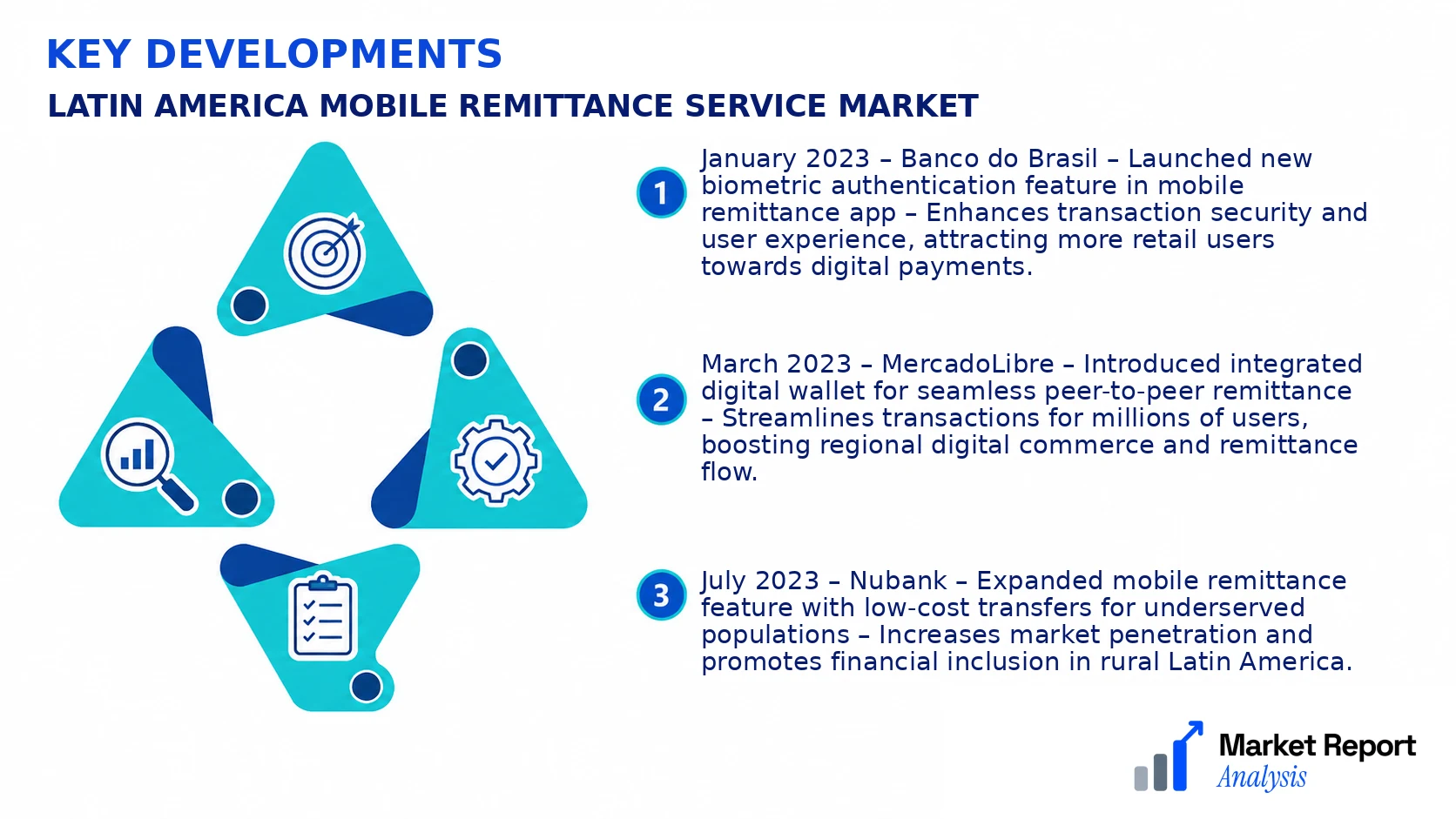
- January 2023 – Banco do Brasil – Launched new biometric authentication feature in mobile remittance app – Enhances transaction security and user experience, attracting more retail users towards digital payments.
- March 2023 – MercadoLibre – Introduced integrated digital wallet for seamless peer-to-peer remittance – Streamlines transactions for millions of users, boosting regional digital commerce and remittance flow.
- July 2023 – Nubank – Expanded mobile remittance feature with low-cost transfers for underserved populations – Increases market penetration and promotes financial inclusion in rural Latin America.
- September 2023 – Western Union – Partnered with a regional telecom to launch QR-based remittance services – Facilitates cashless transfers in remote areas, broadening customer access and increasing transaction volume.
- November 2023 – PayPal Holdings – Rolled out new real-time currency conversion and multi-currency transfer capabilities within Latin America – Strengthens cross-border remittance efficiency and user satisfaction.
Frequently Asked Questions
What is the Latin America Mobile Remittance Service Market?
The Latin America Mobile Remittance Service Market encompasses financial services that allow individuals to send money across borders via mobile platforms, facilitating faster, easier, and secure transactions for migrant workers and expatriates within the Latin American region.
What is the current market size of Latin America Mobile Remittance Service Market?
As of 2026, the market valuation of Latin America Mobile Remittance Services is estimated at approximately USD 9.5 Billion, reflecting growing adoption driven by increased mobile penetration and digital banking services across the region.
What factors are driving the Latin America Mobile Remittance Service Market?
Market growth is fueled by rising smartphone usage, the expansion of digital financial infrastructure, increasing migrant populations, and the demand for fast, cost-effective remittance options that bypass traditional banking channels in Latin American countries.
Which region dominates the Latin America Mobile Remittance Service Market?
Brazil holds the largest share in the market owing to its extensive mobile user base, advanced digital payment infrastructure, and significant remittance flows, followed by Mexico and Argentina as key contributors to regional market dominance.
Which segment is expected to grow the fastest?
The individual consumer segment is projected to experience the highest growth rate, driven by increased smartphone adoption and the need for personalized, immediate remittance solutions in rural and urban areas across Latin America.
Who are the leading companies operating in the Latin America Mobile Remittance Service Market?
Major players include Western Union, MoneyGram, Efecty, and TransferWise, all of which are investing in innovative mobile solutions to enhance service reach, security, and customer experience within the dynamic Latin American remittance landscape.
Analyst Perspective
The Latin America Mobile Remittance Service Market is poised for sustained growth through 2034, driven by increasing mobile penetration and digital financial inclusion initiatives across the region. Long-term prospects remain favorable, especially in countries with sizable expatriate populations and widespread informal remittance channels transitioning to formal, mobile-based platforms. As technology evolves, integration of biometric authentication, blockchain for secure transactions, and AI-driven fraud detection will enhance service reliability and consumer trust. Investment priorities should focus on infrastructure development, partnerships with local financial institutions, and targeted marketing to underserved segments. Competitive intensity will escalate with new entrants leveraging innovative payment solutions and strategic alliances. Regional growth potential remains high, notably in Brazil, Mexico, and Argentina, where expanding smartphone access and regulatory reforms create favorable environments. Long-term, players that prioritize technological innovation, regional customization, and risk management will secure strategic advantages in capturing market share and supporting the region's economic resilience.
