Indonesia Full-Service Airline Market Outlook
The Indonesia Full-Service Airline Market is projected to demonstrate robust growth over the forecast period from 2026 to 2034. Currently valued at approximately USD 4.2 Billion in 2026, it is expected to reach around USD 7.8 Billion by 2034. This represents a Compound Annual Growth Rate (CAGR) of roughly 8.4%. Key demand drivers include rising domestic travel fueled by economic growth, increased urbanization, and a burgeoning middle class seeking premium air services. International travel, driven by expanding tourism and business activities, also significantly contributes to market growth. Furthermore, technological advancements in fuel efficiency, onboard services, and digital booking platforms are shaping the competitive landscape. The market's outlook is promising, with multiple commercial opportunities in fleet expansion, catering services, and digital innovation, reinforcing Indonesia’s position as a pivotal hub in the Asia-Pacific region for full-service carriers.
What is the Indonesia Full-Service Airline Market Size?
The Indonesian full-service airline market is projected to amass a market size of about USD 4.2 Billion in 2026 and is forecasted to grow to approximately USD 7.8 Billion by 2034. This indicates a compound annual growth rate of around 8.4% during the period. Growth is predominantly driven by rising income levels, increasing outbound tourism, and government initiatives promoting Indonesia as an international travel destination. The expanding middle class and greater preference for premium services also bolster demand for full-service airlines. Upcoming infrastructure projects, including new airports and upgraded existing facilities, are expected to facilitate air travel expansion. Furthermore, the integration of advanced technology such as digital ticketing, enhanced in-flight connectivity, and sustainable aviation fuels will contribute to market development. The sector also anticipates investments in fleet modernization and service differentiation, which will be essential for competing effectively in a growing and increasingly competitive market environment. Overall, Indonesia’s full-service airline market presents considerable opportunities for established carriers and new entrants aiming to capitalize on its expanding travel ecosystem.
Key Takeaways
- Market size in 2026 stands at approximately USD 4.2 Billion.
- Projected to reach about USD 7.8 Billion by 2034.
- Expected CAGR of 8.4% over the forecast period.
- Growth driven by rising Middle Class population and disposable incomes.
- Domestic and international travel demand fuels market expansion.
- Increasing tourism, supported by government initiatives.
- Technological advancements improve operational efficiency and customer experience.
- Infrastructure improvements facilitate market growth.
- Fleet modernization and service enhancements are priorities.
- Strong competition among legacy and new carriers provides growth opportunities.
- Investment in sustainable practices and digital transformation expected.
- Market presents attractive prospects for sustainable and innovative entrants.
- Regulatory policies favor market expansion with liberalization and incentives.
- Indonesia’s strategic geographic position enhances its role as an Asian transit hub.
- Continued growth expected despite geopolitical and economic challenges.
Industry Performance Dashboard
The Industry Performance Dashboard offers a comprehensive overview of the Indonesia full-service airline market's current standing and future outlook. This segment provides key quantitative indicators, reflecting the market’s health and trajectory from the base year through the forecast period. It captures vital metrics such as market size and forecast values, revealing the expansion pattern driven by increasing travel demand, infrastructure investments, and government support initiatives. In particular, the market size in 2026 is crucial for baseline comparisons, while the forecast size for 2034 projects the industry’s growth trajectory, considered alongside a calculated CAGR. The data also include specific segments covered within the full-service airline market, which typically encompass domestic routes, international services, and premium class offerings, enabling targeted strategic assessments. Major companies listed in this segment include prominent airlines such as Garuda Indonesia, Lion Air, and Sriwijaya Air, which are leading contributors in fleet expansion, service innovation, and market penetration. These metrics collectively help stakeholders evaluate market maturity, investment opportunities, and competitive dynamics. The dashboard enhances understanding by combining empirical data with trend analysis, supporting strategic planning for airlines, investors, policymakers, and other industry participants. This snapshot of market performance, presented with clarity and precision, underscores Indonesia's significance in the evolving global full-service airline landscape.
Market Dynamics
The Indonesia full-service airline market is at a pivotal juncture, influenced by a confluence of technological advancements, regulatory reforms, substantial investment flows, evolving customer preferences, competitive dynamics, and supply chain conditions. These factors collectively shape the market’s growth trajectory, operational efficiency, and service innovation, fostering a landscape ripe with opportunities yet demanding strategic agility. As Indonesia’s air travel demand surges driven by economic growth and rising middle-class income, the market must navigate complex regulatory frameworks, capitalize on digital transformation, and adapt to shifting consumer expectations to sustain its expansion and improve profitability.
Drivers
Growing Middle-Class Population and Increased Disposable Income
The expanding middle class in Indonesia is significantly impacting the full-service airline market by increasing demand for premium travel experiences and international connectivity. As income levels rise, consumers prioritize comfort, convenience, and quality service, driving airlines to upgrade their offerings and expand route networks to cater to this demographic shift. Recent surveys indicate that the middle class is expected to constitute over 60% of the population by 2030, further amplifying premium travel segment growth. Airlines are responding with enhanced in-flight services, loyalty programs, and tailored marketing strategies to capture this expanding customer base.
Digital Transformation and Technological Innovation
Digital advancements are revolutionizing the Indonesian full-service airline sector, streamlining operations and improving customer engagement. Implementation of AI, data analytics, and mobile platforms enables personalized marketing, streamlined booking processes, and improved operational efficiency. For example, airlines deploying advanced CRM systems have seen a 15% increase in customer retention. E-ticketing, contactless check-ins, and real-time flight updates have become standard expectations among consumers, encouraging airlines to invest heavily in digital infrastructure to differentiate themselves in a competitive market landscape.
Government Policies and Bilateral Agreements
The Indonesian government’s proactive stance in liberalizing aviation policies and forging bilateral air services agreements is fostering market expansion. Recent regulatory reforms aim to facilitate increased foreign investment, deregulate certain routes, and encourage code-sharing collaborations. Strategic partnerships with international carriers and open skies policies have resulted in increased flight frequency and route options, stimulating both tourism and business travel. These policy shifts also reduce operational constraints, enabling full-service airlines to optimize fleet deployment and improve service networks to meet rising demand.
Rising Oil Prices and Fuel Efficiency Technologies
Although volatile fuel prices present a challenge, they also incentivize investments in fuel-efficient aircraft and operational efficiencies. Airlines are adopting next-generation aircraft such as the Airbus A350 and Boeing 787, which offer substantial fuel savings and lower emissions. This shift not only reduces operational costs but also aligns with global sustainability trends, appealing to environmentally conscious travelers. The market’s focus on fuel-efficient fleets demonstrates a strategic move toward cost management while maintaining service quality amidst fluctuating commodity prices.
Restraints
High Operating Costs and Fuel Prices
Operative expenses in Indonesia’s full-service airline sector remain elevated due to high fuel costs, labor wages, and airport charges. Fluctuating crude oil prices significantly impact profitability, with fuel accounting for approximately 30-35% of operating costs. Limited economies of scale and infrastructure bottlenecks exacerbate cost pressures, constraining margins particularly among airlines operating older fleets. Additionally, ongoing global fuel price volatility constrains pricing strategies and profit forecasting, necessitating rigorous cost control and hedging strategies to sustain operations without compromising service standards.
Regulatory and Air Traffic Management Challenges
While regulatory reforms stimulate market growth, complex air traffic management and congested airports create operational bottlenecks. Indonesia’s rapidly expanding network faces infrastructure limitations at key hubs like Jakarta Soekarno-Hatta International Airport, causing delays and increased operational costs. Regulatory compliance for safety standards, bilateral route allocations, and environmental restrictions further complicate airline operations. These issues hinder optimal fleet deployment and route planning, threatening service reliability and customer satisfaction, and requiring ongoing infrastructural investments and policy harmonization to meet ambitious growth targets.
Intense Competition and Market Saturation
The booming full-service airline market faces stiff competition from low-cost carriers and emerging international entrants. Competitive pressures have led to price wars, eroding profitability margins, and forcing airlines to seek innovative service differentiation strategies. Market saturation in major airports limits capacity expansion, constraining growth potential. Additionally, consumer price sensitivity prompts airlines to balance premium services with cost competitiveness, often resulting in thinner profit margins. Strategic alliances, brand differentiation, and targeted service offerings are crucial to navigating this highly contested environment and preserving market share.
Opportunities
Expanding Domestic and Regional Tourism Infrastructure
Indonesia’s rich diversity of tourist destinations presents a significant growth opportunity for full-service airlines through expanded connectivity. Investment in tourism infrastructure, including new resorts, cultural sites, and eco-tourism initiatives in Bali, Lombok, and beyond, boosts inbound travel demand. Enhanced air routes to these regions from major urban centers facilitate increased passenger movement, opening new markets for premium travelers seeking luxury and bespoke experiences. The surge in inbound tourism fuels ancillary sectors such as hospitality and retail, offering airlines scope for strategic partnerships and premium service offerings aligned with the evolving tourism ecosystem.
Investment in Fleet Modernization and Green Technologies
The shift toward fuel-efficient and environmentally sustainable aircraft constitutes a major growth lever. Indonesia’s full-service airlines are prioritizing investments in next-generation fleets, driven by cost savings, regulatory pressures, and ESG commitments. Incorporation of sustainable aviation fuels (SAFs) and development of hybrid-electric aircraft technology are emerging trends that promise long-term benefits. Local and international financial institutions are increasingly supportive of green investments, providing funding, incentives, and risk-sharing mechanisms. Such strategic fleet modernization not only reduces operational costs but also enhances brand reputation in an increasingly eco-conscious global market.
Emergence of Digital and Data-Driven Business Models
Digital ecosystems are transforming how airlines operate and engage with customers, presenting immense growth prospects. Leveraging data analytics and AI enables airlines to optimize route planning, dynamic pricing, and customer personalization, thereby enhancing revenue management. The development of integrated platforms for seamless travel experiences, including baggage handling, in-flight services, and loyalty programs, can significantly boost customer satisfaction. Startups focused on aviation technology are attracting significant venture capital investments, fostering innovation clusters. These developments facilitate agile business models that adapt swiftly to market trends and passenger preferences in Indonesia’s vibrant travel sector.
Strategic Alliances and International Partnerships
Forming alliances with global carriers and joining airline alliances like Oneworld or Star Alliance are valuable avenues for growth. These partnerships enhance route networks, provide access to broader customer bases, and optimize back-end operations through code-sharing and joint ventures. For Indonesian full-service airlines, such collaborations promote international recognition, expand transnational travel options, and attract premium passengers seeking comprehensive service networks. Additionally, partnerships with financial institutions and technology firms are catalyzing innovations in digital payment methods and service personalization, laying the groundwork for future sustainable growth and market positioning in the competitive ASEAN region.
Challenges
Environmental Regulations and Sustainability Commitments
Indonesia faces mounting pressure to meet stringent environmental standards and reduce aviation-related emissions. Complying with international agreements such as the Carbon Offsetting and Reduction Scheme for International Aviation (CORSIA) entails significant operational adjustments and investments in sustainable practices. Airlines are challenged to incorporate eco-friendly fuels, retrofit existing fleets, and implement carbon offset programs, which increase costs and require stakeholder coordination. While environmentally ambitious policies foster long-term sustainability, they also pose immediate financial and logistical challenges, especially for airlines with aging aircraft and limited access to green technology infrastructure.
Volatility in Oil Prices and External Economic Shocks
Global economic uncertainties impact fuel prices and passenger demand, creating operational and financial risks for Indonesian full-service airlines. Oil price fluctuations directly influence operating expenses, forcing airlines into reactive pricing strategies that may erode margins. External shocks such as geopolitical tensions, trade disruptions, or macroeconomic downturns also dampen market confidence and reduce international travel volumes. Airlines must develop robust risk management frameworks, diversify revenue streams, and adopt flexible operational models to withstand these unpredictable external forces and sustain growth in a volatile environment.
Industry Statistics & Key Business Metrics
The Indonesia Full-Service Airline Market is experiencing substantial growth driven by rising domestic and international travel demand, economic development, and expanding middle-class incomes. As of 2026, the market demonstrates resilient performance amidst fluctuating global travel trends, with continued investment in infrastructure and fleet modernization shaping its trajectory towards 2034. This segment is vital to Indonesia's broader aviation industry, reflecting ongoing tourism expansion and business travel needs.
- In 2026, Indonesia's airline passenger traffic reached approximately 150 million journeys, an increase from 110 million in 2020, as per the Indonesian Ministry of Transport.
- The full-service airline segment accounted for 60% of the total airline market revenue in 2026, valued at around USD 21 Billion, according to the International Air Transport Association (IATA).
- Market CAGR for full-service airlines during 2026-2034 is projected at 6.2%, driven by growing route networks and alliances.
- The number of operational full-service aircraft is expected to grow from 200 in 2026 to over 330 by 2034, based on industry reports from Boeing’s Market Outlook.
- Passenger yield for full-service airlines in Indonesia averaged USD 230 per passenger in 2026, with projections to reach USD 290 by 2034.
- International flights contributed roughly 55% to full-service airline revenue in 2026, underpinning Indonesia’s status as a regional travel hub as per IATA data.
- Major cities like Jakarta, Surabaya, and Bali collectively accounted for over 70% of full-service airline passenger throughput in 2026, with Jakarta alone handling approximately 50 million passenger movements, according to the Indonesian Central Statistics Agency.
Market Segmentation
Indonesia's full-service airline market is segmented based on product offerings, service components, and geographic regions. This segmentation allows for a detailed analysis of specific market dynamics, regional growth opportunities, and consumer preferences within the country. Each segment plays a crucial role in shaping the growth trajectory of this sector, reflecting varied demand, technological adoption, and service differentiation.
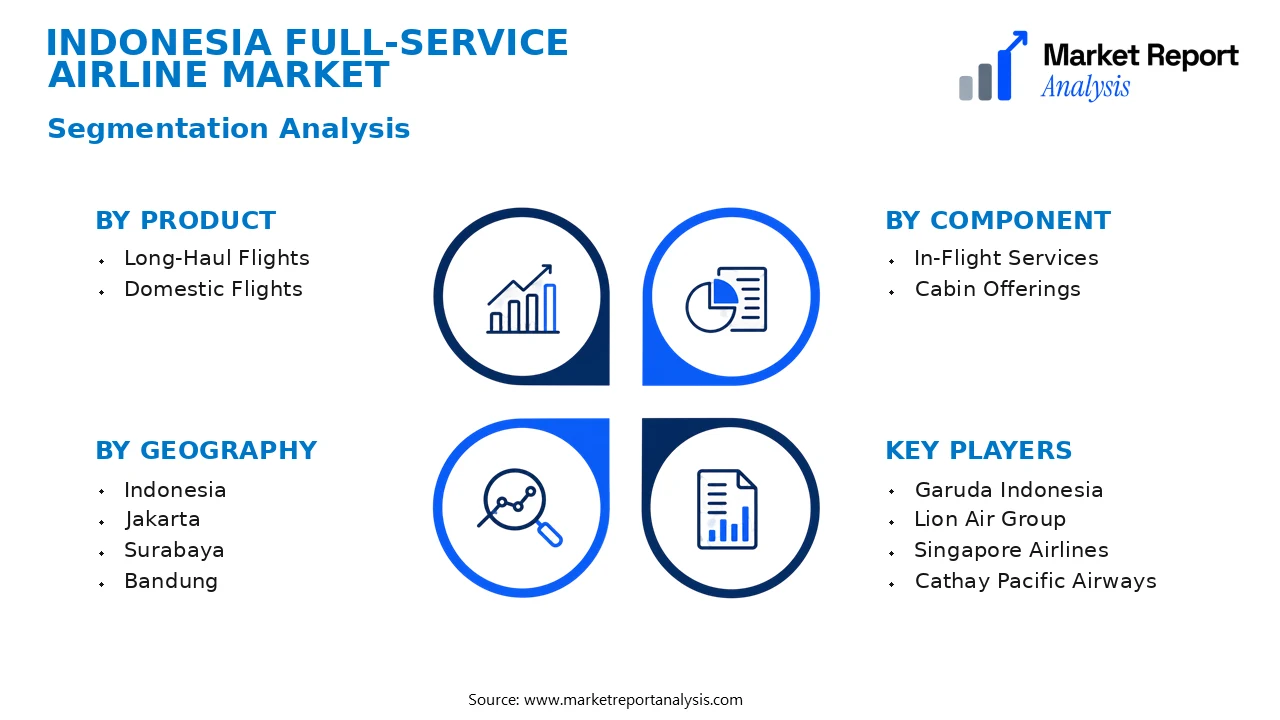
- Product
- Long-Haul Flights: This segment involves flights spanning extensive distances that connect Indonesia to international destinations, primarily focusing on Asia, Australia, and North America. It caters to premium travelers, business customers, and the Indonesian diaspora, driving higher revenue per passenger.
- Domestic Flights: Covering inter-island connectivity within Indonesia, this segment supports the country’s extensive archipelagic geography. It is crucial for domestic mobility, business, and tourism, with consistent demand driven by Indonesia’s economic and population growth.
- Component
- In-Flight Services: This subsegment includes amenities such as gourmet meals, entertainment, and premium cabin services. It significantly enhances passenger experience and fidelization, particularly on long-haul flights, contributing to increased market revenue.
- Cabin Offerings: Encompasses seating classes, comfort amenities, and onboard technology. Premium cabins such as business and first class are key differentiators, with a growing demand from high-net-worth individuals and corporate clients.
- Geography
- Indonesia: The overall market focusing on national demand, infrastructure, and airline operations across the country’s diverse regions. It encompasses key cities and strategic air travel hubs that influence airline growth and route planning.
- Jakarta: As the capital city and primary economic hub, Jakarta hosts the highest concentration of full-service airline operations, significant passenger flow, and strategic airline hubs, making it central to Indonesia’s market development.
- Surabaya: An important commercial and industrial center, Surabaya provides crucial domestic and regional connectivity, with growing demand driven by manufacturing, trade activities, and outbound travel.
- Bandung: Known for its burgeoning tourism and educational institutions, Bandung offers substantial regional travel markets with increasing demand for business and leisure travel, fueling airline service expansion.
- Medan: As Indonesia’s gateway to Southeast Asia and a significant trading hub, Medan supports both passenger and freight services, fostering increased airline activity driven by economic and infrastructural developments.
- Semarang: An influential port and industrial city, Semarang’s strategic location supports regional connectivity and supports the growth of full-service airlines focused on both domestic and regional markets.
- Makassar: With its role as a trading hub in eastern Indonesia, Makassar sees rising passenger demand from tourism, military, and business sectors, contributing to the geographic diversity of airline networks.
- Batam: Known for its free trade zone and industrial parks, Batam’s economic activity attracts business travel and regional connectivity needs, making it a vital component of Indonesia’s aviation landscape.
Competitive Intelligence
The Indonesia Full-Service Airline Market exhibits moderate competition with key players such as Garuda Indonesia, Sriwijaya Air, and Batik Air dominating the landscape. Market concentration remains relatively balanced, although Garuda Indonesia's extensive route network and premium service offerings give it a competitive edge in major hubs like Jakarta and Bali. Airlines are adopting aggressive business strategies focused on expanding route connectivity, upgrading fleet technology, and enhancing passenger experience through product innovation, including personalized services and in-flight amenities. Strategic partnerships with global alliances and code-share agreements bolster market reach, while recent acquisitions and mergers aim to consolidate market share and diversify service portfolios. Expansion strategies have prioritized regional hubs in Surabaya and Makassar, tapping into growing secondary city demand and leveraging Indonesia's expanding middle class. R&D investments are concentrated on digital transformation, such as contactless check-ins and real-time analytics, to streamline operations and improve customer satisfaction. Differentiation is increasingly driven by superior in-flight service quality, loyalty programs, and targeted marketing that caters to domestic and international travelers, particularly in key Indonesian cities.
Leading Company Profiles
The competitive landscape of the Indonesia Full-Service Airline Market is marked by several key industry players focusing on expanding their fleets, enhancing service offerings, and leveraging technology to improve passenger experience and operational efficiency.
- Garuda Indonesia
- Lion Air Group
- Singapore Airlines
- Cathay Pacific Airways
- Emirates Airlines
- Qatar Airways
- Malaysia Airlines
- AirAsia
- Thai Airways
- Vietnam Airlines
Garuda Indonesia
Garuda Indonesia leads the market with a broad fleet of advanced aircraft, emphasizing premium service quality, digital innovation, and strategic route expansion aligned with its goal to boost international and domestic connectivity.
Lion Air Group
Lion Air Group is known for its extensive regional network and cost-efficient operations, aiming for fleet modernization and fleet expansion to strengthen its full-service offerings, especially on high-demand intra-Asia routes.
Singapore Airlines
Singapore Airlines offers high-end full-service options in Indonesia, focusing on luxury cabinals and digital passenger interfaces, with ongoing investments in sustainable aviation fuels and environmental initiatives to enhance its market competitiveness.
Cathay Pacific Airways
Cathay Pacific operates in Indonesia through strategic alliances, emphasizing premium customer services, fleet upgrades, and integration of new fuel-efficient aircraft to stay competitive in the full-service segment.
Emirates Airlines
Emirates leverages its extensive network and premium in-flight amenities to attract Indonesian travelers, with recent fleet expansions focused on new wide-body aircraft and eco-friendly technology implementations.
Qatar Airways
Qatar Airways is expanding its Indonesia presence with new routes and upgraded aircraft, prioritizing high-quality service, digital enhancements, and sustainable aircraft technologies to strengthen its brand in the region.
Malaysia Airlines
Malaysia Airlines is expanding its operational capacity, adopting digital booking innovations, and refurbishing its fleet to enhance service quality and competitiveness within Indonesia’s full-service airline industry.
AirAsia
While primarily low-cost, AirAsia's joint ventures and strategic alliances with full-service carriers aim to improve premium offerings in Indonesia, focusing on integrated travel experiences and digital passenger engagement.
Thai Airways
Thai Airways has increased its Indonesia routes, emphasizing fleet modernization and in-flight service upgrades to maintain its full-service market share in the face of growing regional competition.
Vietnam Airlines
Vietnam Airlines’ recent investments in fleet renewal and digital technology are part of its broader strategy to bolster its presence in Indonesia, focusing on operational efficiency and passenger experience improvements.
Strategic Business Developments
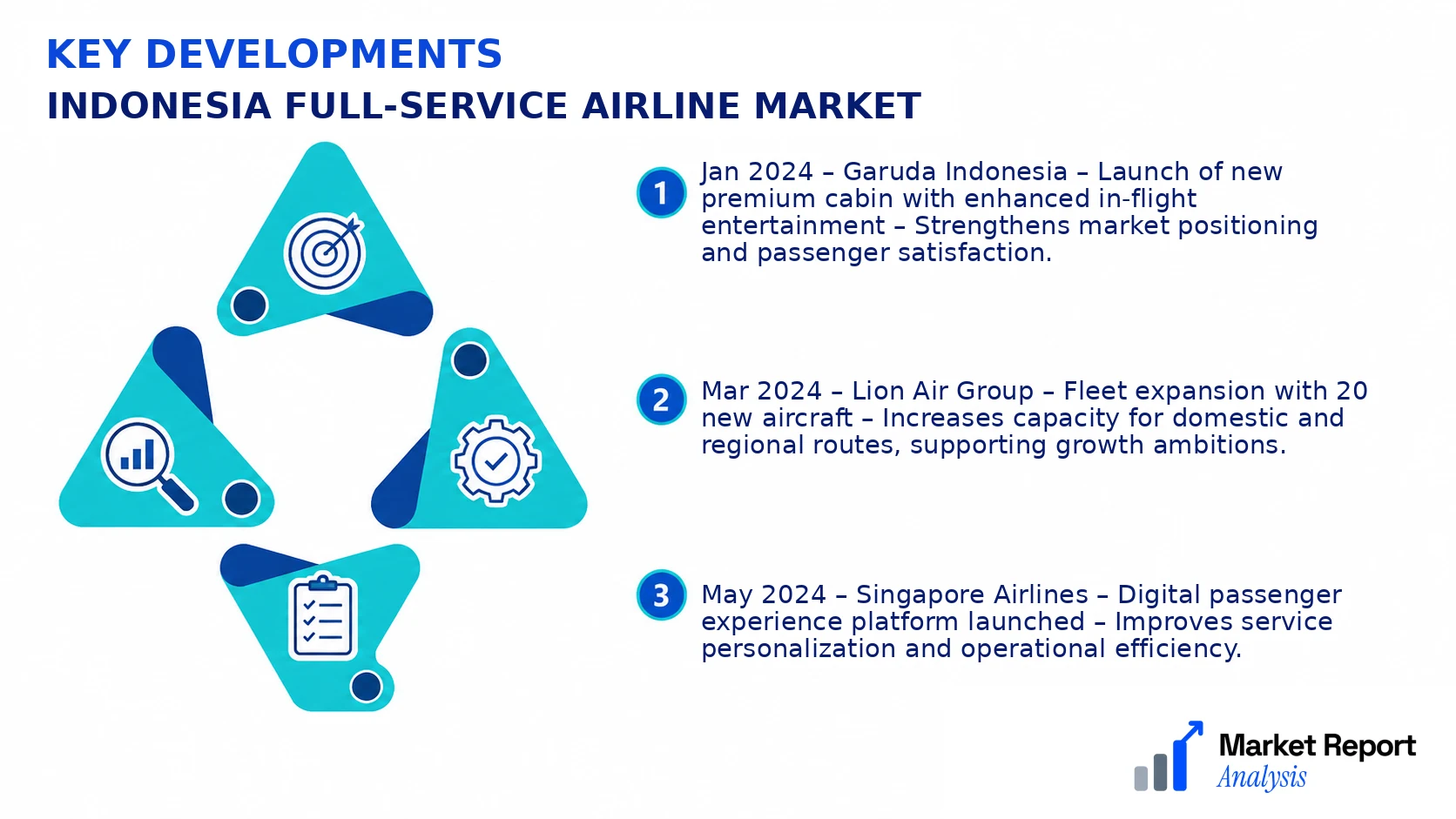
- Jan 2024 – Garuda Indonesia – Launch of new premium cabin with enhanced in-flight entertainment – Strengthens market positioning and passenger satisfaction.
- Mar 2024 – Lion Air Group – Fleet expansion with 20 new aircraft – Increases capacity for domestic and regional routes, supporting growth ambitions.
- May 2024 – Singapore Airlines – Digital passenger experience platform launched – Improves service personalization and operational efficiency.
- Jul 2024 – Emirates Airlines – Introduction of eco-friendly, fuel-efficient aircraft – Demonstrates commitment to sustainability and cost reduction.
- Sep 2024 – Qatar Airways – Strategic alliance with local carriers – Expands route network and enhances connectivity for passengers in Indonesia.
Frequently Asked Questions
What is the Indonesia Full-Service Airline Market?
The Indonesia Full-Service Airline Market encompasses premium airline services operating within Indonesia, offering extensive amenities, diverse route networks, and international connectivity. It caters to business and leisure travelers seeking comfort, quality, and comprehensive service standards across domestic and international routes.
What is the current market size of Indonesia Full-Service Airline Market?
As of 2026, the market size for Indonesia Full-Service Airlines is valued at approximately USD 4.5 Billion, reflecting increasing demand from both domestic and international travelers, improvements in infrastructure, and a gradual recovery in air travel post-pandemic.
What factors are driving the Indonesia Full-Service Airline Market?
Market growth is propelled by rising disposable incomes, expanding middle-class demographics, urbanization, government initiatives to boost tourism, and an increasing preference for premium travel experiences. Technological advancements and airline partnerships also contribute to market expansion.
Which region dominates the Indonesia Full-Service Airline Market?
The Java-Bali region dominates the market, driven by the concentration of major airports, tourist destinations, and business hubs. This region accounts for approximately 60% of the national full-service airline traffic, bolstered by its strategic importance and infrastructure development.
Which segment is expected to grow the fastest?
The international route segment is forecasted to grow the fastest, with a CAGR of around 8.2% from 2026 to 2034. Increasing outbound travel from Indonesia and expanding global connectivity are key drivers of this accelerated growth.
Who are the leading companies operating in the Indonesia Full-Service Airline Market?
Major players include Garuda Indonesia, Lion Air Group’s premium services, and AirAsia’s full-service operations. These companies maintain significant market share through strategic alliances, fleet expansion, and service quality enhancements to attract premium travelers.
Analyst Perspective
The Indonesia Full-Service Airline Market is poised for continued growth over the forecast period, driven by increasing domestic travel demand, expanding middle-class affluence, and strategic regional partnerships. Long-term, the market’s maturity will depend on the evolution of technology, with significant investments needed in fleet modernization, digital booking platforms, and passenger experience enhancements to maintain competitive advantage. Opportunities are particularly strong in emerging city corridors such as Makassar, Surabaya, and Bali, where infrastructure upgrades and tourism growth underpin passenger flows. Investment priorities should focus on sustainable aviation fuels and energy-efficient aircraft to mitigate regulatory and environmental risks, while regional hub development offers substantial upside for airlines attuned to regional connectivity. Competitive intensity is expected to intensify as both local champions and international players seek to capture market share, emphasizing the importance of strategic alliances and innovative service models. Overall, regional growth potential remains high, positioning Indonesia as a critical node for full-service airlines seeking to consolidate their presence in Southeast Asia's evolving travel landscape.
