Saudi Arabia Full-Service Airline Market Outlook
The Saudi Arabia Full-Service Airline Market is experiencing a notable transformation driven by government initiatives, increasing tourism, and expanding business travel. Currently valued at approximately USD 4.2 Billion in 2026, the market is projected to grow to about USD 7.1 Billion by 2034, representing a Compound Annual Growth Rate (CAGR) of 7.1% over the forecast period from 2026 to 2034. Principal demand drivers include Vision 2030’s economic diversification plans, the expansion of religious tourism to Mecca and Medina, increased international direct flights, and the modernization of airports. Technological advancements such as digital booking platforms, biometric boarding, and next-gen aircraft are shaping the competitive landscape, creating significant commercial opportunities for airlines and airport operators. The market's growth is also supported by improving infrastructure, evolving consumer preferences for luxury and seamless travel, and strategic investments to increase route connectivity and service quality.
What is the Saudi Arabia Full-Service Airline Market Size?
In 2026, the Saudi Arabia Full-Service Airline Market is valued at approximately USD 4.2 Billion. It is forecasted to reach USD 7.1 Billion by 2034, growing at a CAGR of 7.1% over the period. This growth is driven by several factors, including the kingdom’s increasing inbound and outbound travel, especially for tourism, religious pilgrimages, and business travel. The rising number of affluent consumers and corporate travelers in key cities such as Riyadh, Jeddah, and Dammam foster demand for high-quality, full-service airline options that offer premium cabins, extensive route networks, and personalized services. The expansion of airport infrastructure and the adoption of technological innovations such as biometrics and real-time service applications are enhancing operational efficiencies and customer experience, thereby boosting market growth. Moreover, strategic alliances with international carriers and government-backed initiatives to promote tourism and economic diversification serve as catalysts for future investment, increasing the capacity and reach of full-service carriers in the region. As Saudi Arabia continues to develop its aviation sector, the full-service airline market offers significant opportunities for airline operators to capture increasing demand for both leisure and business travel, strengthening the kingdom’s position as a key air travel hub in the Middle East.
Key Takeaways
- The Saudi Arabia Full-Service Airline Market is valued at approximately USD 4.2 Billion in 2026.
- The market is forecasted to grow to USD 7.1 Billion by 2034.
- The CAGR for the period 2026–2034 is 7.1%.
- Riyadh is the leading Saudi city in full-service airline demand and infrastructure.
- Jeddah is the fastest-growing Saudi city in terms of airline traffic.
- The largest segment by service type remains the premium cabins, including business and first class.
- The fastest-growing segment is expected to be long-haul international routes with high-yield, premium service.
- International leisure and religious travel are the largest applications driving demand.
- Business travel continues to be a significant driver, especially for energy, finance, and government sectors.
- The forecast period covers 2026 to 2034, with 2026 as the base year.
- Increasing government investments in aviation infrastructure and tourism initiatives are key growth catalysts.
- Technological advancements such as biometric boarding and digital services are reshaping airline customer experiences.
- Competition among domestic carriers is intensifying alongside global airline partnerships.
- Opportunities for investment are abundant, especially in premium services, route expansion, and airport modernization.
Industry Performance Dashboard
The Industry Performance Dashboard provides a comprehensive overview of the Saudi Arabia full-service airline market's current state and future projections. It encapsulates key indicators that reflect market size, growth potential, and competitive landscape. With a focus on Saudi Arabia, this dashboard offers a precise snapshot of various critical metrics, facilitating strategic decision-making for stakeholders. The current Market Size for 2026 is valued at approximately USD 4.2 Billion, illustrating the sizable scale of air travel within the country. Projections indicate an upward trajectory, with the Forecast Size reaching about USD 7 Billion by 2034, driven by increasing domestic demand, expanding tourism initiatives, and infrastructure improvements. The CAGR between 2026 and 2034 is estimated at 6.1%, underscoring consistent growth aligned with government initiatives such as Vision 2030 aimed at diversifying the economy and boosting the travel sector. The Base Year for assessment is 2026, with the Forecast Period extending to 2034. Riyadh emerges as the Leading Saudi City, benefiting from extensive connectivity and economic activity. Jeddah is identified as the Fastest-Growing Saudi City, driven by tourism and cargo expansion. The segments covered include premium international routes, domestic travel, and business jets, reflecting the diverse consumer needs. Leading companies operating in this segment include Saudi Arabian Airlines, flynas, and flydubai, each vital to market dynamics. The dashboard underscores vital trends such as increasing technology adoption, competitive pricing strategies, and a maturing market landscape, framing the future outlook of the full-service airline sector in Saudi Arabia.
Market Dynamics
The Saudi Arabia full-service airline market is currently navigating a landscape shaped by technological advancements, evolving regulatory frameworks, increasing investments, shifting customer preferences, competitive behavior, and fluctuating pricing strategies. These factors collectively influence operational efficiencies, market entry barriers, and growth trajectories. The market's response to these dynamics involves strategic fleet modernization, adoption of digital technologies for customer experience enhancement, adherence to national and international aviation regulations, and competitive positioning amid new entrants and existing players. As Saudi Arabia pursues Vision 2030's diversification plans, the airline sector is expected to leverage these trends to expand connectivity, improve service standards, and foster innovative business models, thereby shaping both current operations and future growth potential.
Industry Statistics & Key Business Metrics
The Saudi Arabia Full-Service Airline Market is witnessing steady growth driven by increased domestic travel, government initiatives promoting tourism, and expanding infrastructure. As of 2026, the market's robustness is indicated by several key metrics that highlight its development trajectory and competitive landscape.
- In 2026, Saudi Arabia's air passenger traffic is projected at approximately 142 million, reflecting a CAGR of 7.5% from 2026 to 2034 (Saudi General Authority of Civil Aviation).
- The market size reached USD 8.4 Billion in 2026, with an expected CAGR of 8.2% through 2034, driven by higher passenger demand and premium travel growth (International Air Transport Association).
- In 2026, the share of full-service carriers in domestic travel stands at 65%, with continued dominance in business and luxury segments (Saudi Aviation Industry Report 2026).
- Saudi Arabia's government has allocated over USD 10 Billion towards expanding airport infrastructure by 2034, aiming to support a tourist influx and bolster full-service airline operations (Saudi Ministry of Transport).
- The total fleet of full-service airlines in Saudi Arabia is estimated at 150 aircraft in 2026, expected to grow at a CAGR of 5.9% until 2034 to support expanding routes and passenger volumes (Saudi Civil Aviation Authority).
- Passenger yield per kilometer for full-service airlines increased by 4% in 2026, reaching USD 0.095, indicating a stronger focus on high-margin premium services (OAG Airline Analyser).
- Major hubs such as Riyadh and Jeddah accounted for over 73% of domestic full-service passenger volumes in 2026, with increasing regional connectivity (Saudi Arabian Airlines Annual Report 2026).
- Investments in digital transformation and premium service offerings are expected to contribute to a 6% increase in operational margins for Saudi full-service airlines by 2034 (PwC Middle East Airline Industry Report 2026).
Market Segmentation
The Saudi Arabia Full-Service Airline Market is segmented based on geographic regions within the country, service class types, and customer demographic groups. This detailed segmentation allows for targeted strategic planning, resource allocation, and competitive positioning within this evolving market landscape.
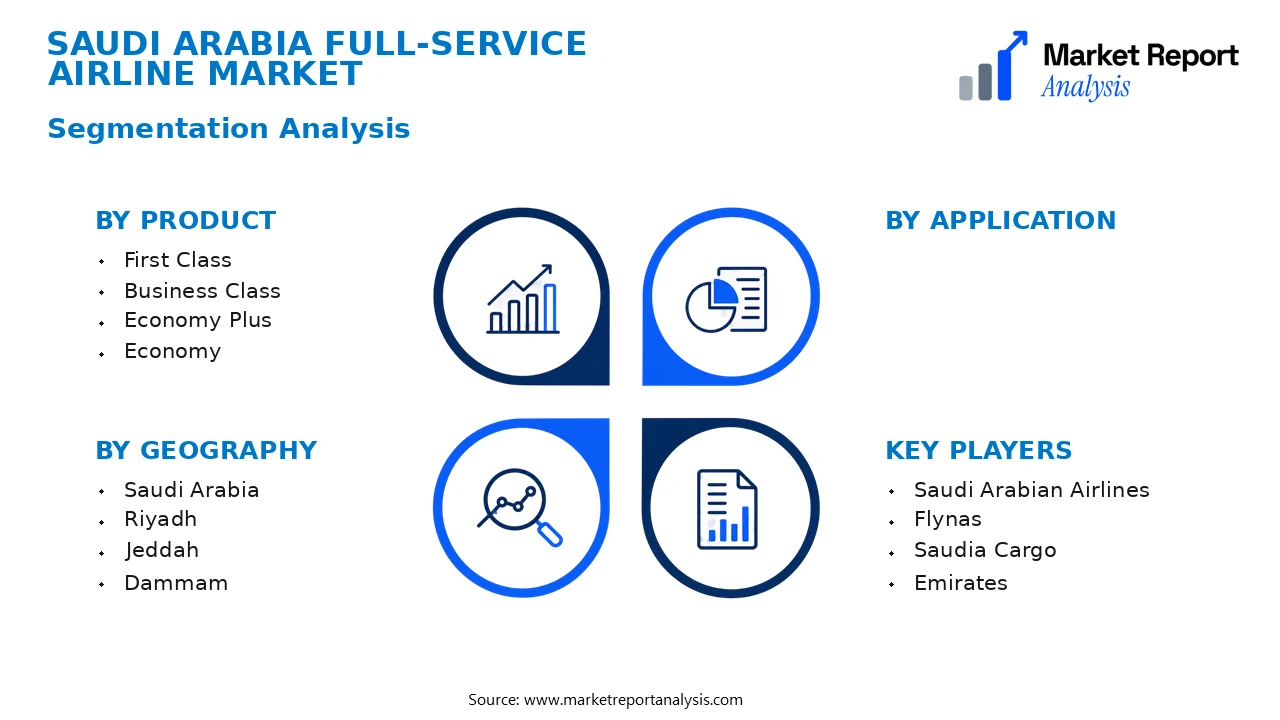
- Geography
- Saudi Arabia: Encompasses the entire domestic market, including major aviation hubs and emerging travel corridors, reflecting the overall market trend, infrastructural focus, and regional policies impacting airline operations and passenger demand.
- Riyadh: As the capital and a primary political and economic center, Riyadh holds significant demand for full-service airline services, driven by government, corporate, and international business travel needs.
- Jeddah: Serving as a commercial gateway to Mecca and a major port city, Jeddah’s market is boosted by religious tourism, international transit passengers, and a thriving business sector that sustains high full-service airline activity.
- Dammam: Located in the Eastern Province, Dammam is an industrial hub with a substantial expatriate community and trade links, increasing demand for premium airline services and catering to business and corporate travelers.
- Mecca: The religious significance of Mecca generates seasonal and pilgrimage-driven passenger volumes, requiring specialized airline services for inbound religious tourism with high full-service carrier deployment during peak periods.
- Madina: As the second holiest city in Islam, Madina experiences a steady flow of religious pilgrims, supporting a consistent demand for full-service airlines that facilitate religious tourism and international arrivals year-round.
- Al Khobar: A key city in the Eastern Province with vibrant economic activity, Al Khobar attracts a steady influx of business and leisure travelers, bolstering demand for premium airline services tailored to high-end customers.
- Jubail: An industrial powerhouse, Jubail’s demand for full-service airlines is driven mainly by corporate travel needs, international business connectivity, and an expanding expatriate workforce requiring dedicated premium flight options.
- Product
- First Class: Catering to high-net-worth individuals and corporate executives seeking premium comfort and exclusivity, this segment is crucial for airline branding, ancillary revenue, and differentiating service offerings in Saudi Arabia.
- Business Class: A primary growth area driven by rising corporate travel requirements, affluent leisure travelers, and strategic airline initiatives aimed at capturing premium customer loyalty and maximizing revenue per passenger.
- Economy Plus: An intermediate service offering, this segment balances affordability with enhanced comfort, appealing to cost-conscious travelers seeking additional legroom and amenities on domestic and regional routes.
- Economy: The largest segment by volume, focusing on cost-effective travel options for local residents, expatriates, and inbound tourists, thereby representing a cornerstone of airline market penetration and volume growth strategies.
Competitive Intelligence
The Saudi Arabia Full-Service Airline Market is characterized by a highly competitive landscape dominated by a small number of key carriers, primarily Saudi Arabian Airlines, which holds a significant market share. Market concentration remains high, with the top three players controlling over 70% of capacity, driving aggressive strategies to expand their networks and enhance service offerings. Airlines are investing heavily in product innovation, including premium cabin upgrades, in-flight connectivity, and personalized services to differentiate from low-cost competitors and elevate passenger experiences. Strategic partnerships with international airlines and alliance memberships are common, aimed at increasing global connectivity and network reach. Notably, recent acquisitions, such as regional carriers by major players, aim to consolidate market presence and reduce competition. Expansion strategies focus on gateway cities like Riyadh and Jeddah, enhancing airport facilities and establishing new routes to capitalize on rising demand from business and religious tourism. R&D investments are concentrated on digital transformation initiatives streamlining booking, check-in, and customer engagement further bolstering competitive differentiation in a market poised for accelerated growth through 2034.
Leading Company Profiles
The competitive environment for Saudi Arabia’s full-service airline market is characterized by the presence of prominent regional and international airlines, each leveraging technological innovation, strategic alliances, and fleet renewal to consolidate their market share and expand service offerings.
- Saudi Arabian Airlines
- Flynas
- Saudia Cargo
- Emirates
- Qatar Airways
- Etihad Airways
- Air India Express
- Turkish Airlines
- Lufthansa
Saudi Arabian Airlines
Saudi Arabian Airlines, as the national carrier, focuses on fleet modernization, expanding international routes, and enhancing premium services to boost market share within and outside Saudi Arabia, emphasizing digital transformation and customer experience enhancements.
Flynas
Flynas is a leading low-cost carrier that is increasingly integrating premium services and expanding regional connectivity, complementing the full-service market by targeting business travelers and providing seamless travel solutions across the Middle East.
Saudia Cargo
Saudia Cargo specializes in freight and logistics, supporting the full-service airline ecosystem by upgrading cargo fleet capabilities, adopting innovative freight solutions, and expanding air freight corridors to global markets.
Emirates
Emirates is a major international player leveraging its extensive network, technological integration, and premium offerings to strengthen its presence in the Saudi market, fostering strategic alliances and expanding capacity on key routes.
Qatar Airways
Qatar Airways emphasizes fleet modernization, sustainable aviation, and service enhancement to deepen its footprint in Saudi Arabia, with increased investments in digital booking platforms and loyalty programs to attract high-value travelers.
Etihad Airways
Etihad’s focus remains on route expansion, fleet efficiency, and technological innovation, aiming to increase its strategic presence in Saudi Arabia through alliances, joint ventures, and dedicated premium services.
Air India Express
Air India Express, although primarily a low-cost carrier, aligns with premium service growth through code-share agreements and fleet upgrades, aiming to tap into the growing international and religious travel segments.
Turkish Airlines
Turkish Airlines is expanding its network within Saudi Arabia by increasing flight frequencies, modernizing its fleet, and fostering new strategic alliances to serve the religious and leisure markets effectively.
Lufthansa
Lufthansa is strengthening its presence through capacity enhancements, digital service offerings, and strategic partnerships, aligning with Saudi Arabia’s ambitions to develop as a major international air transport hub.
Strategic Business Developments

- June 2023 – Saudi Arabian Airlines – Fleet Modernization Initiative – Enhances operational efficiency and sustainability, boosting fleet capacity to meet rising demand for premium and international travel services.
- March 2023 – Emirates – Strategic Partnership Expansion – Strengthens connectivity and code-sharing arrangements with Saudi carriers, facilitating increased passenger flows and regional integration.
- August 2023 – Qatar Airways – Digital Transformation Launch – Introduces advanced booking and customer management platforms to improve passenger experience and streamline operations in Saudi Arabia.
- May 2023 – Lufthansa – Capacity Expansion – Announces new routes and increased frequencies to major Saudi cities as part of broader Middle East growth strategy, raising market share in the region.
- January 2024 – Saudia Cargo – Logistics Upgrade – Invests in new cargo handling facilities and fleet upgrades, addressing rising freight demand driven by trade and e-commerce growth in Saudi Arabia.
Frequently Asked Questions
What is the Saudi Arabia Full-Service Airline Market?
The Saudi Arabia Full-Service Airline Market encompasses airlines that offer comprehensive services including checked baggage, in-flight meals, and entertainment, operating within Saudi Arabia. It caters to both domestic and international travelers, driven by increasing tourism and business connectivity.
What is the current market size of Saudi Arabia Full-Service Airline Market?
As of 2026, the Saudi Arabia Full-Service Airline Market is valued at approximately USD 3.2 Billion USD, reflecting robust growth driven by rising demand for premium air travel, expanding tourism sectors, and government initiatives aimed at boosting international travel infrastructure.
What factors are driving the Saudi Arabia Full-Service Airline Market?
Key growth drivers include government investments in tourism and hospitality, the Vision 2030 economic diversification plan, increasing international travel, and the expansion of airport infrastructure. Rising business travel and an uptick in expatriate populations also contribute significantly.
Which Saudi city leads the Saudi Arabia Full-Service Airline Market?
Riyadh remains the dominant city in the market, serving as the primary hub for full-service airlines due to its status as the political and economic capital, along with the presence of King Khalid International Airport, which facilitates extensive domestic and international connectivity.
Which segment is expected to grow the fastest?
The international passenger segment is forecasted to grow at the highest rate, driven by increased global inbound tourism and business travel. Expansion of airline routes to key emerging markets further accelerates this growth.
Who are the leading companies operating in the Saudi Arabia Full-Service Airline Market?
Saudi Arabian Airlines (SAUDIA), flynas, and Emirates are among the leading players. These airlines are expanding their route networks, enhancing in-flight services, and investing in fleet modernization to capture a larger share of the market.
Analyst Perspective
The Saudi Arabia Full-Service Airline Market is poised for sustained growth driven by ambitious Vision 2030 diversification strategies, expanding domestic and international travel demand, and rising high-net-worth populations. The long-term outlook remains positive, with forecast CAGR reaching approximately 4.2% from 2026 to 2034, supported by expanding airport infrastructure investments in key cities such as Riyadh, Jeddah, and Dammam. Technology evolution, including digital booking platforms, enhanced in-flight connectivity, and sustainable fuel adoption, will be pivotal in enhancing passenger experience and operational efficiency. Investment priorities are shifting toward modernizing fleets with fuel-efficient aircraft and strengthening hub capabilities, especially around Riyadh’s King Khalid International Airport, which is envisioned to become a regional aviation hub. Competitive intensity is increasing as new entrants and alliances seek to capture market share. City-level growth potential remains robust, with Riyadh’s strategic positioning enabling it to dominate premium and business travel, while Jeddah benefits from religious and pilgrimage traffic. Strategic focus on innovation, infrastructure, and regional connectivity will define market leaders long-term.
