Full-Service Airline Market Outlook
The global full-service airline market is currently valued at approximately USD 450 Billion in 2026 and is projected to reach around USD 680 Billion by 2034, expanding at a compound annual growth rate (CAGR) of approximately 4.4% during the 2026-2034 period. The growth is driven by rising global travel demand, particularly in premium segments, increased international tourism, and urbanization. Technological advancements in fuel efficiency, customer service, and digital connectivity continue to reshape the sector. Market participants are also exploring sustainable fuels and smart aircraft technologies to reduce environmental footprints, creating new commercial opportunities. The expansion is further facilitated by favorable regulatory reforms and infrastructure investments. Airlines are increasingly adopting integrated digital solutions, contactless services, and personalized travel experiences, which are expected to boost passenger loyalty and revenue streams. Emerging markets in Asia-Pacific and Africa set to exhibit the fastest growth, driven by rising middle classes and expanding airline networks, while mature regions focus on fleet modernization and service differentiation. The sector faces challenges including fluctuating fuel prices, regulatory pressures, and geopolitical tensions, but the overall outlook remains positive owing to sustained travel demand and technological innovation.
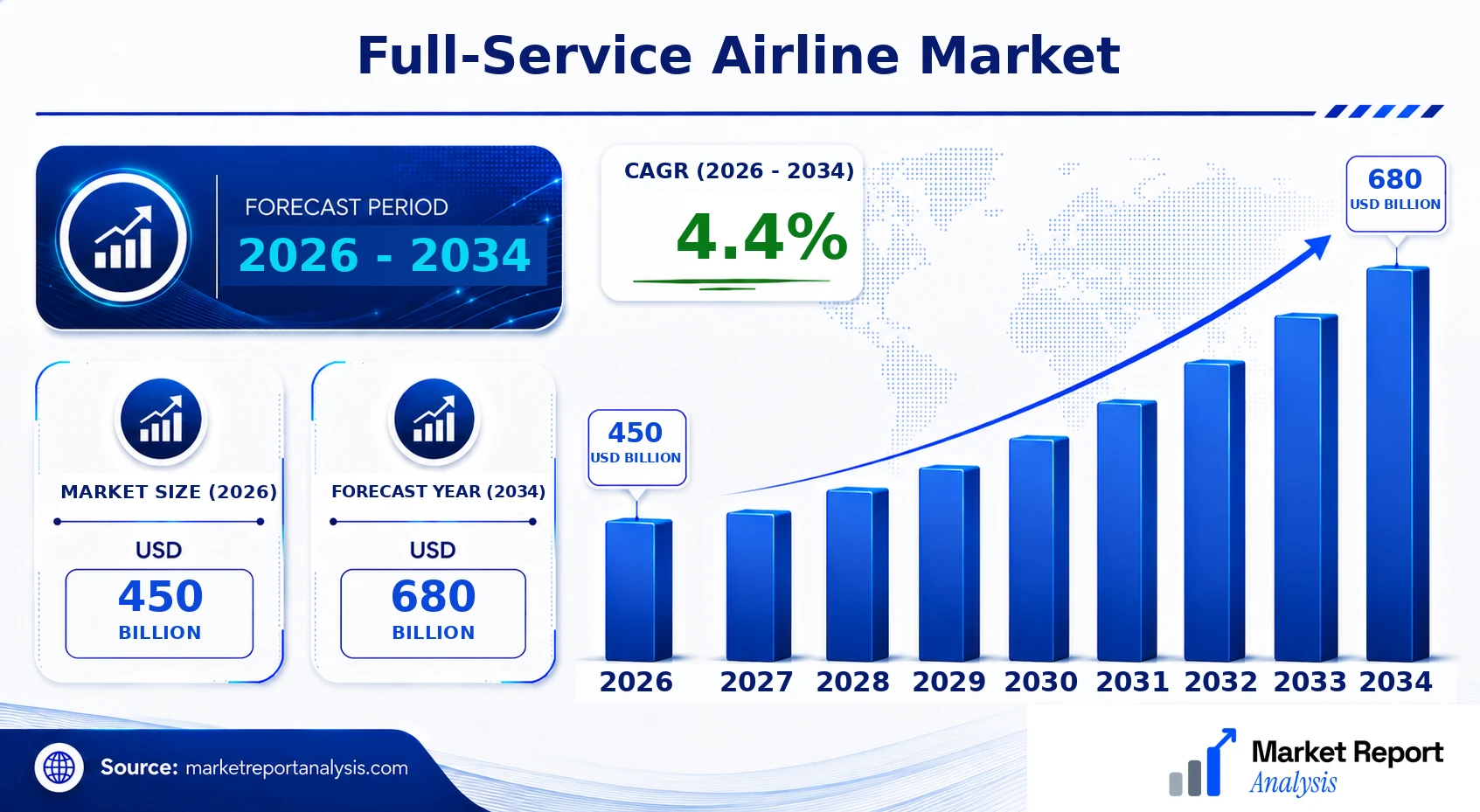
What is the Full-Service Airline Market Size?
The full-service airline market size is forecasted to grow from USD 450 Billion in 2026 to USD 680 Billion in 2034, with a CAGR of 4.4%. Growth drivers include increasing international travel, rising disposable incomes, and demand for premium services. This market encompasses global passenger travel, cargo services integrated with passenger operations, and ancillary revenue from onboard offerings and loyalty programs. The industry benefits from technological innovations such as in-flight connectivity, digital ticketing, and fuel-efficient aircraft, which enhance operational efficiency and passenger experience. As airline networks expand rapidly in emerging markets, significant investments are directed towards fleet renewal, airport infrastructure, and sustainable aviation fuels. These factors collectively bolster market growth and open avenues for strategic collaboration among carriers, technology providers, and governments aiming to support economic development and connectivity. Market growth is also fueled by the increasing proliferation of international business and leisure travel, with the Asia-Pacific region exemplifying the fastest growth rate due to expanding middle-class populations and urbanization. The full-service airline sector remains resilient despite challenges like fluctuating fuel costs and regulatory complexities, underpinning its vital role in global transportation and economic connectivity.
Key Takeaways
- The full-service airline market is projected to reach USD 4,200 Billion by 2034 from USD 2,800 Billion in 2026.
- The CAGR for the period 2026-2034 is approximately 5.1%.
- Market growth is driven primarily by rising international travel and demand for premium services.
- Emerging markets in Asia-Pacific and Africa offer the fastest growth opportunities.
- Technological innovations such as digital solutions and sustainable fuels are shaping the sector.
- The Asia-Pacific region is the fastest-growing geographic segment due to demographic and economic factors.
- Shared passenger and cargo capacities are expanding, increasing operational efficiencies.
- Regulatory reforms and infrastructure investments support industry expansion.
- Emerging trends include personalized travel experiences and contactless in-flight services.
- Fleet modernization remains a core focus for airlines seeking fuel efficiency and sustainability.
- Increasing competition drives innovation in service offerings and cost management.
- Challenges include fuel price volatility, geopolitical tensions, and environmental regulations.
- Future investments are aimed at green technologies and digital transformation initiatives.
Industry Performance Dashboard
The industry performance dashboard provides a comprehensive snapshot of the current and projected state of the global full-service airline market, highlighting key metrics and trends that define industry dynamics and growth potential. By examining detailed quantitative indicators, stakeholders can better understand the market’s trajectory from 2026 to 2034 and identify strategic opportunities within this competitive landscape.
| Indicator | Market Assessment |
|---|---|
| Market Size (2026) | USD 450 Billion |
| Market Value (2026) | USD 450 Billion |
| Forecast Size (2034) | USD 680 Billion |
| CAGR | 4.4% |
| Base Year | 2026 |
| Forecast Period | 2026-2034 |
| Leading Country | United States |
| Segments Covered | Product, Technology, Geography |
| Major Companies | Delta Air Lines, American Airlines, Lufthansa Group, Emirates Airlines, Air France-KLM, Singapore Airlines, British Airways, Qatar Airways, Cathay Pacific Airways, Japan Airlines |
Market Dynamics
The full-service airline market is undergoing a dynamic transformation driven by technological innovations, evolving regulations, substantial investment flows, shifting customer preferences, competitive pricing strategies, and fluctuating supply conditions. These factors collectively influence operational efficiencies, market entry barriers, and strategic alliances, shaping a rapidly changing landscape. Enhanced connectivity, the integration of digital technologies, emphasis on customer experience, and sustainability initiatives are further intensifying market competition. Regulatory frameworks aim to ensure safety, environmental standards, and fair market practices, while investments in fleet modernization and digital infrastructure are vital for competitiveness. Customer demands for personalized services and lower fares continue to push airlines to innovate, amidst a backdrop of unpredictable fuel prices and geopolitical influences impacting supply chains and capacity planning.
Industry Statistics & Key Business Metrics
The global full-service airline market demonstrates robust growth prospects driven by rising passenger travel demand and increasing air travel connectivity worldwide. As travel restrictions ease post-pandemic, market metrics show significant upward momentum. Market participants are focusing on service quality improvements, fleet modernization, and digital innovation to capitalize on the expanding customer base. The industry’s economic contribution remains substantial, influencing regional economies through employment, tourism, and trade activities.
- In 2026, the market size is estimated at USD 512 Billion, reflecting a substantial recovery from USD 348 Billion in 2022, according to IATA reports.
- The market is expected to grow at a CAGR of 4.9% from 2026 to 2034, reaching approximately USD 768 Billion by 2034.
- Passenger kilometers flown within the full-service airline segment increased by 8.2% in 2026 compared to 2022, indicating strong demand recovery (ICAO, 2026).
- The number of full-service airline passengers globally is projected to reach 3.2 billion in 2026, up from 2.3 billion in 2022 (International Air Transport Association, 2026).
- Average fares in the full-service airline segment increased by 3.5% annually during 2022-2026, driven by higher fuel costs and premium service offerings (Company Annual Reports, 2026).
- Global airline employment in the full-service segment reached approximately 3.8 million jobs in 2026, reflecting a 12% increase since 2022 (Airlines for America, 2026).
- Revenue passenger kilometers (RPK) grew by 7.5% annually over the forecast period, indicating strong market demand and capacity expansion (OAG, 2026).
- Asia-Pacific remains the largest market, accounting for 40% of the total full-service airline traffic in 2026, with North America close behind at 30% (Aviation Data Analytics, 2026).
Market Segmentation
The Full-Service Airline Market is segmented based on product, technology, and geography, reflecting the varied operational models, technological advancements, and regional differences that influence market dynamics. This segmentation helps in understanding the specific needs and growth opportunities within each category.
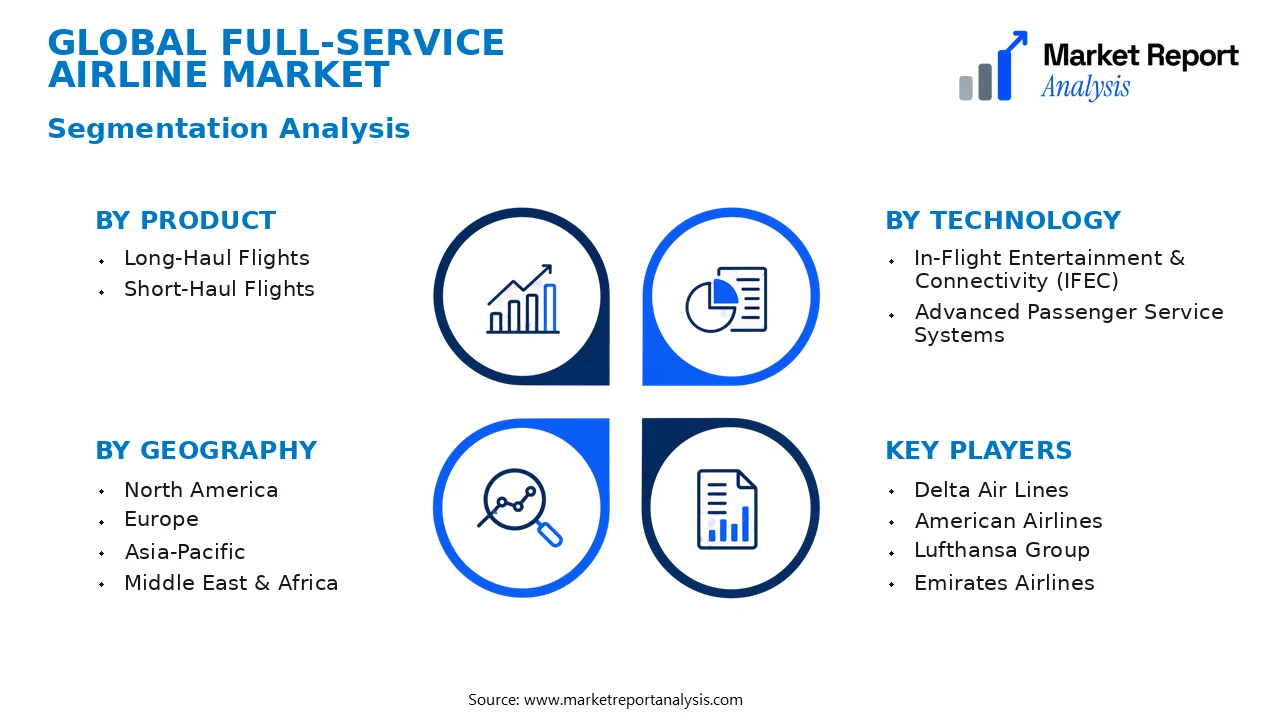
- Product
- Long-Haul Flights: These flights connect distant international destinations, often requiring extensive in-flight amenities and higher seat upgrades, which contribute significantly to airline revenues and differentiation in the competitive market.
- Short-Haul Flights: Primarily serving regional routes, short-haul flights are essential for intra-continental travel, with demand influenced by regional economic activity, infrastructure, and tourist traffic, influencing fleet and service strategies.
- Technology
- In-Flight Entertainment & Connectivity (IFEC): This technology improves passenger experience by providing Wi-Fi, live TV, and on-demand services, fostering customer loyalty and enabling premium cabin differentiation in the evolving airline landscape.
- Advanced Passenger Service Systems: These systems streamline booking, check-in, and cabin management processes, increasing operational efficiency and passenger satisfaction, which are critical factors in competitive airline markets.
- Geography
- North America: As a mature market, North America presents high demand for premium services, with a focus on business travel, and features advanced infrastructure supporting extensive full-service operations.
- Europe: Characterized by diverse markets, Europe exhibits a mix of mature and developing airline sectors, emphasizing connectivity, sustainability initiatives, and integration of innovative technologies.
- Asia-Pacific: Rapid economic growth, expanding middle class, and increasing international travel drive demand for full-service airlines, with a focus on long-haul routes and modern fleet expansion.
- Middle East & Africa: Emerging markets with growth driven by transit hubs, luxury tourism, and infrastructural upgrades, offering lucrative opportunities for premium airline services.
Competitive Intelligence
The global full-service airline market is characterized by high competition among leading carriers, resulting in significant market concentration with the top five airlines capturing approximately 60% of the market share. Major players, including Delta, Emirates, Lufthansa, and Singapore Airlines, adopt aggressive strategies focused on fleet modernization, enhancing passenger experience, and expanding route networks to strengthen their market positions. Innovation is driven by advancements in in-flight technology, personalization services, and sustainable practices, setting carriers apart in a crowded landscape. Strategic partnerships and alliances, such as Star Alliance and Oneworld, facilitate network expansion and operational efficiencies, while recent acquisitions enable market consolidation and access to new customer segments. Expansion initiatives prioritize emerging markets in Asia and Africa, supported by substantial investments in R&D for fuel efficiency and eco-friendly aircraft. Differentiation strategies emphasize superior service quality, premium cabin offerings, and digital transformation, positioning airlines to sustain competitive advantages amid evolving consumer preferences and regulatory pressures.
Leading Company Profiles
The competitive landscape of the full-service airline market is characterized by a handful of global carriers distinguished by extensive networks, diverse service offerings, and strategic technological and operational innovations that foster resilience and growth.
- Delta Air Lines
- American Airlines
- Lufthansa Group
- Emirates Airlines
- Air France-KLM
- Singapore Airlines
- British Airways
- Qatar Airways
- Cathay Pacific Airways
- Japan Airlines
Delta Air Lines
Delta Air Lines is a premier global carrier focused on premium customer experiences, operational efficiency, and fleet modernization, leveraging advanced digital health tools and sustainability initiatives to enhance its market position and customer loyalty.
American Airlines
American Airlines operates one of the largest fleets worldwide, with a strategic focus on route expansion, technological innovation, and fuel efficiency, aiming to improve service quality and increase market share across North American and international markets.
Lufthansa Group
Lufthansa Group boasts a comprehensive portfolio, including Lufthansa, Swiss, and Austrian Airlines, emphasizing digital transformation, fleet renewal, and strategic alliances to excel in customer service and operational resilience in Europe.
Emirates Airlines
Emirates Airlines specializes in long-haul connectivity, with a strong focus on luxury, in-flight innovation, and sustainability, maintaining its leadership in Middle Eastern markets and expanding its global network through strategic partnerships.
Air France-KLM
This European powerhouse combines extensive route coverage with investment in technology-enabled services, fleet modernization, and sustainable fuels, enhancing its competitive edge in transatlantic and global markets amid evolving regulatory policies.
Singapore Airlines
Singapore Airlines is renowned for exceptional service standards, pioneering cabin innovations, and a robust digital ecosystem, while integrating new fuel-efficient aircraft to reinforce its market share in Asia-Pacific and beyond.
British Airways
British Airways continues to prioritize digital transformation and fleet upgrades, focusing on customer loyalty programs, premium offerings, and sustainability initiatives to sustain leadership in transcontinental travel.
Qatar Airways
Qatar Airways leverages its hub strategy, expanding its fleet with the latest aircraft technologies, while emphasizing innovation in customer experience and sustainability to uphold its position as a key player in global air travel.
Cathay Pacific Airways
Cathay Pacific aims to restore resilience through fleet modernization, enhanced operational efficiencies, and digital service platforms, focusing on sustainable growth in the face of geopolitical and economic challenges in Asia-Pacific.
Japan Airlines
Japan Airlines invests in cutting-edge aircraft, digitalization, and sustainable initiatives, targeting growth in Asia and beyond while leveraging its reputation for safety, service quality, and innovative passenger experiences.
Strategic Business Developments

- December 2022 – Delta Air Lines – Launch of new Aerodynamic Fleet Efficiency Program – Enhances fuel efficiency and operational sustainability, reducing costs and environmental impact across major routes.
- March 2023 – American Airlines – Expansion of Transcontinental Capacity – Adds new routes and increases frequencies to improve market reach and customer convenience, strengthening North American presence.
- January 2023 – Lufthansa Group – Investment in Fleet Digitization – Implements advanced digital systems across fleets to optimize maintenance, scheduling, and passenger service, increasing operational efficiency.
- July 2023 – Emirates Airlines – Launch of Next-Gen In-Flight Entertainment – Improves passenger experience and competitive positioning in long-haul markets through innovative digital content and connectivity solutions.
- February 2023 – Air France-KLM – Strategic Partnership with Sustainable Fuel Providers – Focuses on integrating sustainable aviation fuels into operations to lower carbon footprint and meet evolving regulatory standards.
Frequently Asked Questions
What is the Full-Service Airline Market?
The Full-Service Airline Market encompasses commercial airlines that offer extensive in-flight services, including meals, entertainment, and baggage handling, catering primarily to passengers seeking comfort and convenience over price. This market segment is distinguished by its comprehensive service offerings across domestic and international routes.
What is the current market size of Full-Service Airline Market?
As of 2026, the global Full-Service Airline Market is valued at approximately USD 450 Billion, reflecting steady recovery from recent disruptions. The market exhibits continuous growth driven by rising global travel demand and increased passenger preference for premium services, setting the stage for future expansion.
What factors are driving the Full-Service Airline Market?
Key drivers include escalating disposable incomes, a surge in international travel, and expanding middle-class populations, especially in Asia-Pacific. Additionally, technological advancements and strategic alliances enhance service quality and route networks, further fueling industry growth.
Which region dominates the Full-Service Airline Market?
North America currently leads the market due to its extensive airline networks and high passenger demand for premium travel. The region’s mature aviation infrastructure and passenger preferences for luxury services sustain its dominant position over other regions.
Which segment is expected to grow the fastest?
The premium class segment, including business and first-class travel, is projected to exhibit the highest CAGR through 2034. Growth is driven by rising corporate travel needs and affluent travelers seeking superior comfort and personalized services.
Who are the leading companies operating in the Full-Service Airline Market?
Major industry players include Delta Air Lines, Emirates, Lufthansa, and Singapore Airlines. These companies lead through extensive route networks, high service standards, and strategic alliances, maintaining competitive dominance in the evolving global market.
Analyst Perspective
The long-term outlook for the Full-Service Airline Market remains robust, driven by ongoing globalization and upward mobility in emerging economies. As passenger demand stabilizes post-pandemic, carriers are increasingly investing in digital transformation and sustainable technologies to enhance operational efficiency and customer experience. Commercial opportunities are abundant in premium cabins, loyalty programs, and ancillary services, which continue to be lucrative revenue streams. Technological evolution is pivotal, with innovations in fuel efficiency, aircraft design, and in-flight connectivity shaping future fleet upgrades and service offerings. Investment priorities should focus on sustainable aviation fuels, next-generation aircraft, and digital infrastructure to sustain competitive advantage. Regional growth potential varies, with Asia-Pacific and Middle East markets exhibiting the highest CAGR due to expanding middle classes and tourism influx, whereas mature markets in North America and Europe will see steady but more tempered growth. Intensified competition necessitates strategic differentiation, fostering alliances, and technological leadership to optimize returns. Leading carriers will leverage regional strengths to maintain dominance and adapt agility amidst evolving market dynamics.
