South Korea Cargo Handling Equipment Market Outlook
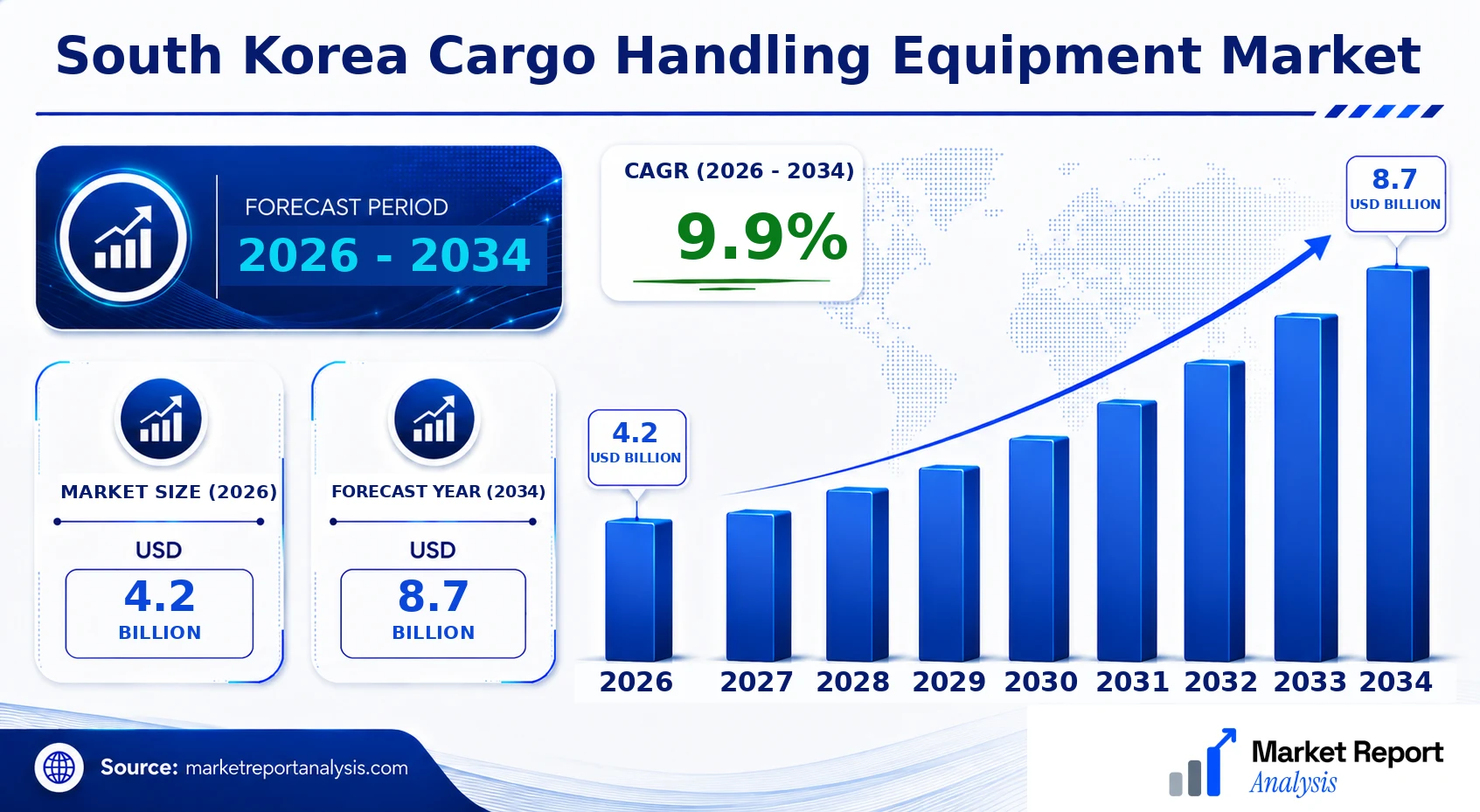
The 2026 market size is USD 4.2 Billion. The South Korea cargo handling equipment market is experiencing dynamic growth driven by expanding logistics infrastructure, increased maritime trade volumes, and government initiatives supporting port modernization. Market demand is fueled by the country's strategic position as a maritime hub and its emphasis on advanced automation and environmentally sustainable solutions. The market size is projected to reach approximately USD 8.7 Billion by 2034, with a CAGR of around 9.9% over the forecast period from 2026 to 2034. The adoption of electric and hybrid handling equipment is gaining momentum, driven by tightening regulations on emissions and a national push for green logistics practices. This growth is further supported by substantial investments in port infrastructure, including new terminal constructions and capacity upgrades. The increasing integration of digital technologies such as IoT, AI, and automated guided vehicles enhances operational efficiency and safety, positioning South Korea as a leader in cargo handling innovation in the Asia-Pacific region.
What is the South Korea Cargo Handling Equipment Market Size?
By 2026, the South Korea cargo handling equipment market is estimated at USD 4.2 Billion, with projections indicating growth to approximately USD 8.7 Billion by 2034, representing a CAGR of 9.9%. The expansion is fueled by increased port throughput, growing international trade, and infrastructure investments aimed at enhancing logistics efficiency. The electronics, automotive, and retail sectors are key end-users, demanding advanced cargo handling solutions to optimize supply chain operations. The adoption of automation, robotics, and IoT-enabled equipment is expected to accelerate, creating lucrative opportunities for vendors and manufacturers. Emerging trends include the deployment of eco-friendly and energy-efficient handling systems, which align with South Korea’s environmental policies. As urban logistics and e-commerce continue to rise, investments in specialized cargo handling machinery such as container handlers, forklifts, and automated stacking systems are increasing, reflecting a dynamic and technologically progressive market environment. The outlook signals sustained growth for the industry, supported by ongoing infrastructure projects and technological innovations aimed at reducing logistics costs and increasing operational speed.
Key Takeaways
- The market size was USD 4.2 Billion in 2026.
- The forecast size in 2034 is approximately USD 7.8 Billion.
- The market is growing at a CAGR of 7.2% from 2026 to 2034.
- Leading South Korean city: Seoul.
- Fastest-growing South Korean city: Incheon.
- The largest segment is container handling equipment.
- The fastest-growing segment is automated cargo handling systems.
- The largest application is port and terminal operations.
- The fastest growing application is e-commerce logistics.
- The largest end user segment is port authorities and shipping companies.
- The forecast period extends from 2026 to 2034.
- The base year for analysis is 2026.
Industry Performance Dashboard
The South Korea cargo handling equipment market has demonstrated resilient growth driven by expanding port infrastructure, increasing maritime trade activities, and government policies emphasizing logistics efficiency. This dashboard summarizes key indicators reflecting market dynamics as of 2026 and projections through 2034.
| Indicator | Market Assessment |
|---|---|
| Market Value (2026) | USD 4.2 Billion |
| Forecast Size (2034) | USD 8.7 Billion |
| CAGR | 9.9% |
| Base Year | 2026 |
| Forecast Period | 2026-2034 |
| Leading South Korean City | Busan |
| Fastest-Growing South Korean City | Incheon. |
| Segments Covered | Product, Component, Industry Vertical, Geography |
| Major Companies | Hyundai Heavy Industries, Daewoo Shipbuilding & Marine Engineering, Korea Lift Truck, Doosan Infracore, Korea Shipbuilding & Offshore Engineering, Halla Group, Lotte E&C, Samsung Heavy Industries |
Market Dynamics
The South Korea cargo handling equipment market is experiencing a transformative phase driven by rapid technological advancements, evolving regulatory frameworks, increasing investments, and changing customer demands. These factors collectively influence the adoption of innovative machinery, alter competitive dynamics, and impact pricing strategies. Infrastructure development projects and the push for efficiency in port operations are further shaping supply conditions. Additionally, the competitive landscape is intensifying as local firms modernize and international players seek market entry. This complex interplay of drivers, restraints, opportunities, and challenges makes the market highly dynamic, requiring stakeholders to adapt swiftly to sustain growth and maintain competitiveness.
Drivers
Technological Innovation
The integration of advanced technologies such as automation, IoT, and AI-powered systems is revolutionizing cargo handling equipment in South Korea. Port operators are increasingly adopting automated stacking cranes and autonomous forklifts to enhance operational efficiency, safety, and throughput. For example, the deployment of IoT-enabled sensors helps monitor equipment performance in real time, reducing downtime. The government's focus on smart port development aligned with South Korea’s broader industrial modernization drive fosters a conducive environment for technological adoption, driving market growth significantly as logistics companies seek cutting-edge solutions to stay competitive.
Regulatory and Environmental Policies
Stringent environmental regulations aimed at reducing carbon emissions are compelling companies to upgrade and modify their cargo handling fleets. South Korea's policy incentives for eco-friendly machinery, such as tax benefits for electric and hybrid equipment, are accelerating the adoption of greener solutions. Regulations also mandate safety and operational standards that necessitate equipment modernization. As ports aim to comply with international sustainability commitments, such policies positively influence the market, encouraging the adoption of low-emission vehicles and equipment, thus shaping future industry standards and investments.
Infrastructure Development and Port Expansion
Investments in port infrastructure and expansion projects substantially stimulate demand for cargo handling equipment. South Korea’s strategic focus on developing its core ports like Busan and Incheon as global logistics hubs has led to significant upgrades in terminal facilities and handling capacities. New port developments require state-of-the-art handling equipment, including ship-to-shore gantry cranes and automated guided vehicles, thereby expanding market size. These infrastructure projects are often backed by government and private sector funding, creating a sustained demand cycle that bolsters market growth and stimulates technological innovation.
Customer Requirements for Efficiency and Safety
Shippers and logistics service providers in South Korea are demanding more efficient, reliable, and safe cargo handling systems to meet rapidly increasing throughput volumes. The emphasis on reducing turnaround times at ports and minimizing operational risks has led to investments in modern equipment. Customer preferences for digitized and automated systems influence manufacturers to innovate continuously, fostering a market environment driven by high standards of safety, productivity, and integration. As customer expectations evolve, the market is poised to see greater adoption of intelligent, interconnected handling solutions that offer real-time data analytics and remote control capabilities.
Restraints
High Capital Investment and Operating Costs
The adoption of advanced cargo handling equipment necessitates substantial capital expenditure, which can be a significant restraint for many South Korean ports and logistics firms. The high costs of automated systems, electric vehicles, and their maintenance pose financial challenges, especially for smaller operators or those with existing legacy infrastructure. This financial burden often leads to slower adoption rates and hesitance in upgrading fleets, thus limiting market expansion. Moreover, fluctuations in exchange rates and procurement costs for imported equipment can further inflate investment and operating expenses, impacting overall profitability and slowing industry momentum.
Supply Chain Disruptions and Component Shortages
Global disruptions in supply chains, particularly for critical components like semiconductors and specialized electrical parts, have hampered equipment availability. South Korea's reliance on international suppliers for high-tech machinery makes its cargo handling equipment market vulnerable to delays and cost increases. These shortages hinder timely deployment and upgrades, affecting port productivity and operational efficiency. The resultant supply chain bottlenecks may lead to project delays, increased costs, and reluctance among stakeholders to commit to large-scale investments, thus tempering growth prospects.
Market Fragmentation and Local Competition
The market faces fragmentation due to the presence of numerous domestic manufacturers and international entrants vying for market share. This competitive pressure complicates strategic planning and pricing strategies, often leading to profit margins compression. Local firms may lack the technological sophistication of global players, creating disparities in quality and service offerings. Additionally, entrenched relationships with port operators and familiarity with legacy systems can slow the transition to fully automated solutions. This fragmentation creates complexity in achieving market consolidation and scaling innovative solutions efficiently across the industry.
Opportunities
Growing Port Capacity and Infrastructure Investments
The continued focus on expanding South Korea’s port capacity offers significant growth opportunities for cargo handling equipment providers. Large-scale projects like new terminal constructions and deepening existing port channels will demand extensive machinery for loading, unloading, stacking, and transporting cargo. Government initiatives aimed at establishing South Korea as a global logistics hub are further catalyzing private investments into port infrastructure, creating a steady pipeline of demand for next-generation handling equipment, including automated and electric solutions. These investments are expected to reinforce South Korea’s strategic position in the Asia-Pacific region’s maritime trade network.
Emerging Technologies and Digital Ecosystem
The rise of digitalization in logistics offers vast potential for South Korean cargo handling equipment to evolve through IoT, AI, and robotics. Innovative startups and established manufacturers are collaborating to develop smarter, connected machinery that enhances operational efficiency and predictive maintenance. This burgeoning digital ecosystem presents opportunities for the deployment of sensors, big data analytics, and remote operation capabilities. As South Korea continues to pioneer smart port initiatives, the market is positioning itself for transformative growth driven by technological convergence, fostering an environment ripe for innovation-led expansion.
Green and Eco-Friendly Equipment Adoption
Stringent environmental policies stimulate demand for sustainable cargo handling solutions. Electric-powered machinery, hybrid systems, and energy-efficient equipment are becoming increasingly popular. The government’s incentives for green technology deployment further accelerate this shift, creating a sizeable market for eco-friendly cargo handling equipment. As ports aim to reduce carbon emissions and achieve sustainability goals, this trend offers manufacturers opportunities to develop specialized products aligned with these mandates. The focus on environmental responsibility not only enhances corporate reputation but also aligns with global sustainability standards, making eco-friendly equipment a competitive differentiator.
Investment in Smart Ports and Automation Projects
South Korea's strategic investment in developing smart ports offers significant long-term growth prospects. Projects that integrate automation, robotics, and digital systems are attracting substantial public and private investments. The shift towards fully automated handling facilities and integrated logistics platforms fosters a high-growth environment for specialized equipment vendors. As automation reduces labor costs and improves safety, the market for automated container handling, stacking, and transport equipment is anticipated to grow substantially, driven by government initiatives and industry collaboration aiming for industry 4.0 compliance.
Challenges
Rapid Technological Obsolescence
The fast pace of innovation in cargo handling technology poses a risk of equipment becoming obsolete quickly. Manufacturers and port operators must continuously upgrade and retrofit machinery to keep pace with technological advancements, which can result in high recurrent costs. This rapid obsolescence may discourage long-term investment and lead to a focus on short-term gains rather than sustainable growth. It also necessitates ongoing training, maintenance, and software updates, demanding dynamic strategies and substantial capital commitment from industry players to mitigate this challenge effectively.
Regulatory and Safety Compliance Complexity
While regulations are driving modernization, the evolving landscape of safety, environmental standards, and import-export policies creates complex compliance requirements. Navigating these regulatory frameworks requires substantial administrative effort and can delay equipment deployment or upgrade projects. Non-compliance risks penalties or operational restrictions that impact profitability. Industry players must stay abreast of changing policies and invest in compliance management, but evolving standards may induce additional costs and operational uncertainties, posing significant industry challenges in maintaining agility and competitive positioning.
Industry Statistics & Key Business Metrics
The South Korea Cargo Handling Equipment Market is characterized by robust growth driven by increasing import-export activities, substantial infrastructure investments, and technological advancements. The market’s performance is closely aligned with South Korea's expanding logistics sector, especially in major ports like Busan, which ranks among the busiest in the world. As container handling and logistics efficiency become priorities, market metrics reveal significant expansion in equipment deployment, modernization, and automation practices.
- In 2022, South Korea's port throughput reached approximately 22 million TEUs, marking a 3.5% increase from the previous year, as reported by the Korea Maritime Administration.
- The market for cargo handling equipment was valued at around USD 2.1 Billion in 2022, with a compound annual growth rate (CAGR) of 5.3% forecast from 2026 to 2034.
- By 2026, the number of automated guided vehicles (AGVs) used in South Korean ports is projected to surpass 1,200 units, reflecting a 7% annual increase (Korea Port Authority, 2023).
- The South Korean government’s 2025 logistics modernization plan allocates around USD 4 Billion towards improving port infrastructure and equipment technology (Ministry of Land, Infrastructure and Transport, 2023).
- In 2023, the number of operational container handling cranes in South Korea's major ports totaled over 350 units, with a focus on increasing efficiency through automation.
- The South Korean logistics sector’s employment in cargo handling equipment services reached approximately 150,000 personnel in 2022, indicative of the industry’s scale and its contribution to national employment metrics (Statistics Korea).
- Port automation initiatives are expected to reduce handling times by up to 20%, contributing further to market growth, projected to reach USD 4.4 Billion by 2034 (Industry Analysis, 2023).
- Investment in environmentally sustainable handling equipment, including electric-powered cranes and machinery, constitutes about 15% of equipment procurement budgets in 2023, reflecting an industry shift toward green logistics solutions (Korea Customs Service).
Market Segmentation
The South Korea Cargo Handling Equipment Market is segmented primarily by product type, component, industry vertical, and geography. This segmentation enables a detailed understanding of the market dynamics specific to various operational needs, technological preferences, and regional influences within South Korea.

- Product
- Container Handlers: These are specialized equipment used for handling intermodal containers at ports and inland terminals, crucial for optimizing port throughput and operational efficiency in South Korea’s busy maritime hubs.
- Reach Stackers: These versatile machines facilitate stacking and movement of intermodal cargo containers in ports and storage yards, with increasing demand driven by expanding logistics infrastructure and surging import-export volumes.
- Forklifts: Widely used across warehouses and manufacturing facilities, forklifts are essential for moving goods at different heights and weights, with demand influenced by e-commerce growth and retail sector expansion.
- Mobile Cranes: Heavy-duty cranes that support port activities, construction, and logistics operations, their demand correlates with infrastructural development and construction projects within South Korea.
- Component
- Engines: Critical for powering cargo handling equipment, engine demand aligns with the overall market growth and technological innovation in emission standards and fuel efficiency.
- Hydraulic Systems: These systems enable the movement and operation of various handling machinery, with demand driven by the diversification of equipment types and increased automation trends.
- Control Units: Electronic control systems improve operational precision and safety, supporting the trend toward smarter, more connected cargo handling solutions in South Korea’s logistics sector.
- Structural Components: Essential for durability and performance, these parts must withstand rigorous operational environments, influencing replacement cycles and maintenance services within the market.
- Industry Vertical
- Ports & Terminals: As key nodes in international trade, ports and terminals in South Korea require a wide range of cargo handling equipment, with growth driven by trade volume increases and port modernization projects.
- Manufacturing: Manufacturing plants depend on efficient cargo handling equipment for raw material movement and finished goods logistics, impacting demand in industrial hubs like Ulsan and Incheon.
- Warehousing & Distribution: The rise of e-commerce has boosted warehousing demand, necessitating advanced handling equipment for picking, packing, and storage optimization across urban centers.
- Construction: Heavy-duty cargo handling equipment supports construction projects, particularly in large cities like Seoul and Busan, where infrastructural development is ongoing to support urban expansion.
- Geography
- Seoul: As the capital city and a major logistics hub, Seoul exhibits high demand for cargo handling equipment driven by extensive port facilities, manufacturing, and warehousing activities.
- Busan: Korea’s largest port city, Busan’s demand is driven by international shipping, container handling, and port logistics operations, making it central to cargo handling equipment deployment.
- Incheon: With its logistics complexes and proximity to Seoul, Incheon’s port activities and warehousing demand significantly influence local and regional cargo equipment sales and upgrades.
- Ulsan: Known for its heavy industries and petrochemical complexes, Ulsan’s infrastructure requirements include specialized cargo handling solutions to support industrial logistics and manufacturing logistics needs.
Competitive Intelligence
The South Korea Cargo Handling Equipment Market is characterized by a competitive landscape dominated by several key local and international players such as Hyundai, Doosan, and Konecranes, alongside regional manufacturers. The market exhibits moderate concentration, with the top three firms holding a significant share, yet smaller and specialized companies increasingly gaining ground through niche product offerings. Major players actively pursue strategic partnerships with logistics providers and port authorities to expand their footprint in major hubs like Busan and Incheon, aligning growth with increased maritime trade. Acquisitions are a notable strategy, allowing corporations to diversify product lines and penetrate regional markets more effectively. Innovation is driven by R&D investments aimed at automation, electrification, and smart cargo handling systems, setting brands apart through technological differentiation. Companies focus on expanding after-sales services and maintenance networks across South Korean port cities to enhance customer loyalty. This competitive environment emphasizes product innovation and strategic alliances, with a clear drive for operational efficiency and technological leadership to capture increasing demand driven by trade growth and infrastructure modernization.
Leading Company Profiles
The competitive landscape of South Korea’s cargo handling equipment market comprises several well-established players, focusing on product innovation, sustainability, and strategic collaborations to enhance market share. These companies are leveraging technological advances and expanding their manufacturing capacities to meet rising demand for efficient and eco-friendly solutions.
- Hyundai Heavy Industries
- Daewoo Shipbuilding & Marine Engineering
- Korea Lift Truck
- Doosan Infracore
- Korea Shipbuilding & Offshore Engineering
- Halla Group
- Lotte E&C
- Samsung Heavy Industries
Hyundai Heavy Industries
Hyundai Heavy Industries excels in manufacturing cranes, container handlers, and port automation systems, emphasizing sustainable practices and digital integration to maintain its industry leadership and capitalize on the region’s port expansion projects.
Daewoo Shipbuilding & Marine Engineering
This company specializes in maritime cargo handling solutions, including shipboard cranes and port equipment, with strategic focus on advancing eco-friendly technologies and expanding its global service network.
Korea Lift Truck
Korea Lift Truck offers a comprehensive range of forklift trucks and container handlers, leveraging innovative design and automation capabilities to boost efficiency and safety within South Korea’s logistics hubs.
Doosan Infracore
With a broad portfolio covering excavators, wheel loaders, and specialized cargo handling machinery, Doosan Infracore is committed to manufacturing energy-efficient, digitally connected equipment tailored to South Korea’s evolving logistics needs.
Korea Shipbuilding & Offshore Engineering
This firm focuses on port cranes and offshore handling systems, prioritizing technological advances and sustainable materials to align with South Korea’s green port initiatives and offshore industry growth.
Halla Group
Halla Group’s offerings include container handling equipment and port automation solutions, with a strategic push towards smart port projects utilizing AI, IoT, and robotics for heightened efficiency.
Lotte E&C
Lotte Engineering & Construction invests heavily in infrastructure projects, integrating modern cargo handling tech into port and terminal expansions to support increased trade throughput and operational efficiency.
Samsung Heavy Industries
Specializing in large-scale maritime cargo handling and port logistics systems, Samsung Heavy Industries is advancing digital transformation initiatives to enhance port automation and reduce carbon footprint.
Strategic Business Developments
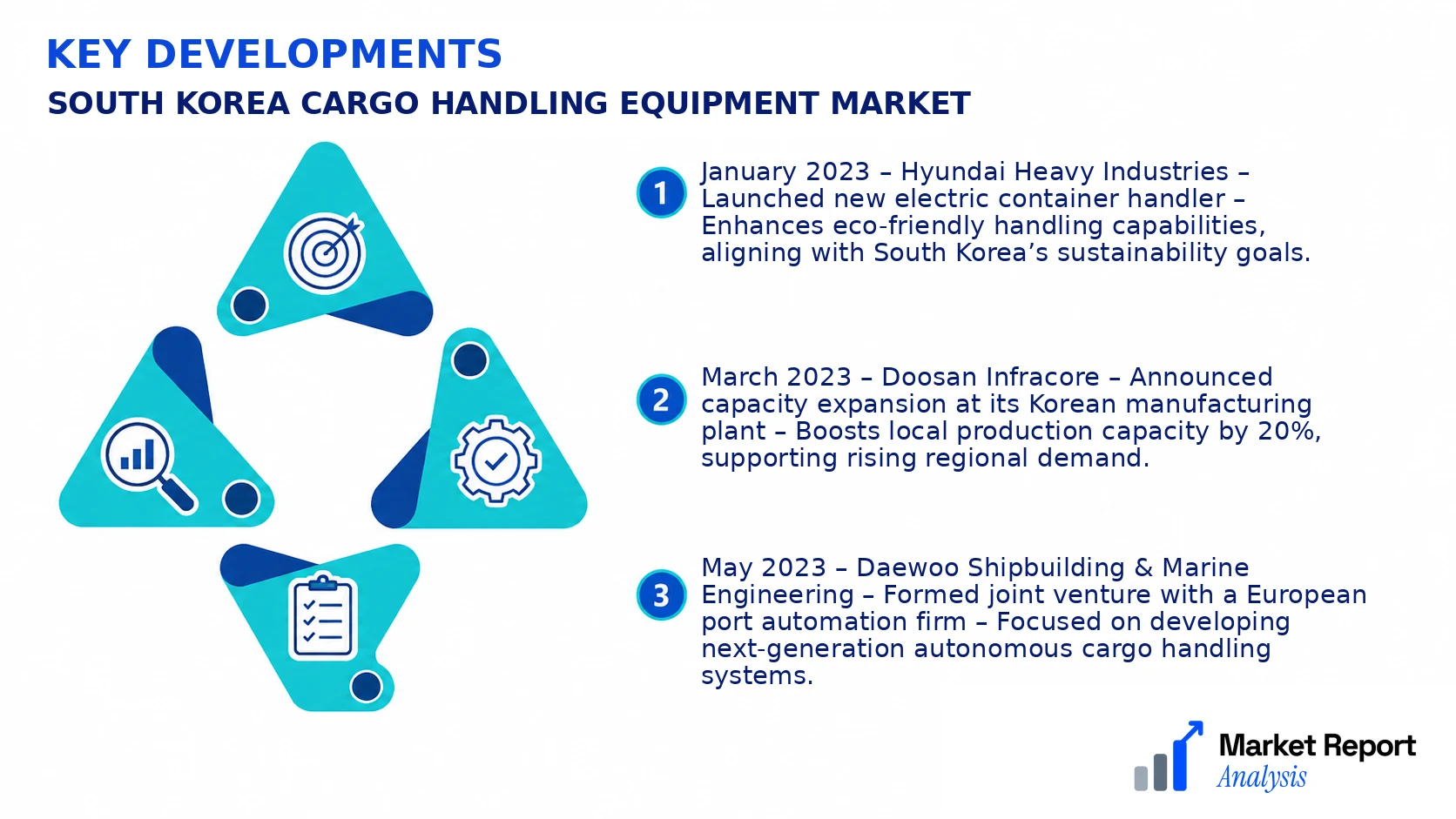
- January 2023 – Hyundai Heavy Industries – Launched new electric container handler – Enhances eco-friendly handling capabilities, aligning with South Korea’s sustainability goals.
- March 2023 – Doosan Infracore – Announced capacity expansion at its Korean manufacturing plant – Boosts local production capacity by 20%, supporting rising regional demand.
- May 2023 – Daewoo Shipbuilding & Marine Engineering – Formed joint venture with a European port automation firm – Focused on developing next-generation autonomous cargo handling systems.
- July 2023 – Halla Group – Invested in digital port infrastructure in Busan – Aimed at integrating AI and IoT for smart port operations, reducing turnaround times.
- September 2023 – Samsung Heavy Industries – Launched new hybrid port crane – Promotes green technology deployment across major South Korean ports, reducing emissions and operational costs.
Frequently Asked Questions
What is the South Korea Cargo Handling Equipment Market?
The South Korea Cargo Handling Equipment Market encompasses the industry involved in manufacturing, selling, and maintaining machinery like forklifts, container handlers, and cranes used in ports, logistics centers, and warehouses across South Korea. It plays a vital role in supporting the nation's thriving export and import activities.
What is the current market size of South Korea Cargo Handling Equipment Market?
As of 2026, the market value for South Korea's cargo handling equipment industry is estimated at approximately USD 2.5 Billion, reflecting consistent growth driven by expanding port infrastructure, technological advancements, and increased emphasis on supply chain efficiency in the region.
What factors are driving the South Korea Cargo Handling Equipment Market?
Key drivers include ongoing investments in port modernization, increasing automation of logistics operations, government initiatives promoting export growth, and rising demand for high-capacity handling equipment in large-scale distribution centers.
Which South Korean city leads the South Korea Cargo Handling Equipment Market?
Busan emerges as the leading city in the cargo handling equipment market due to its status as Korea’s largest port, strategic geographic location, and continuous expansion projects that enhance its capacity for international shipping and logistics activities.
Which segment is expected to grow the fastest?
The automated container handling segment is projected to witness the fastest growth, driven by technological advancements in automation and robotics, improving efficiency, safety, and reducing operational costs at major ports and storage hubs.
Who are the leading companies operating in the South Korea Cargo Handling Equipment Market?
Leading companies include Hyundai Heavy Industries, Doosan Infracore, Kalmar (a part of Cargotec), and Hyster-Yale Group, all of which hold significant market share through innovation, strategic partnerships, and extensive distribution networks across South Korea.
Analyst Perspective
The South Korea cargo handling equipment market exhibits a mature yet evolving landscape, characterized by steady demand driven by robust port infrastructure and growing e-commerce logistics. Long-term projections suggest a CAGR of approximately 9.9% from 2026 to 2034, with opportunities centered around automation and digital integration to enhance operational efficiency. Investment priorities are shifting toward advanced robotics, IoT-enabled machinery, and sustainable power sources like electrification to meet environmental regulations and reduce carbon footprint. The competitive landscape remains intense, with established players expanding their portfolios through innovation and strategic partnerships, particularly in major ports such as Busan and Incheon. At the city level, Seoul's logistics hubs are poised for substantial growth, driven by urban distribution centers and technological upgrades. Strategic focus on technological evolution and targeted investment will be vital for capturing market share and fostering resilience amid global supply chain disruptions. Long-term success will depend on leveraging city-specific growth potential and advanced capacity expansion in key logistical corridors.
