Latin America Cargo Handling Equipment Market Outlook
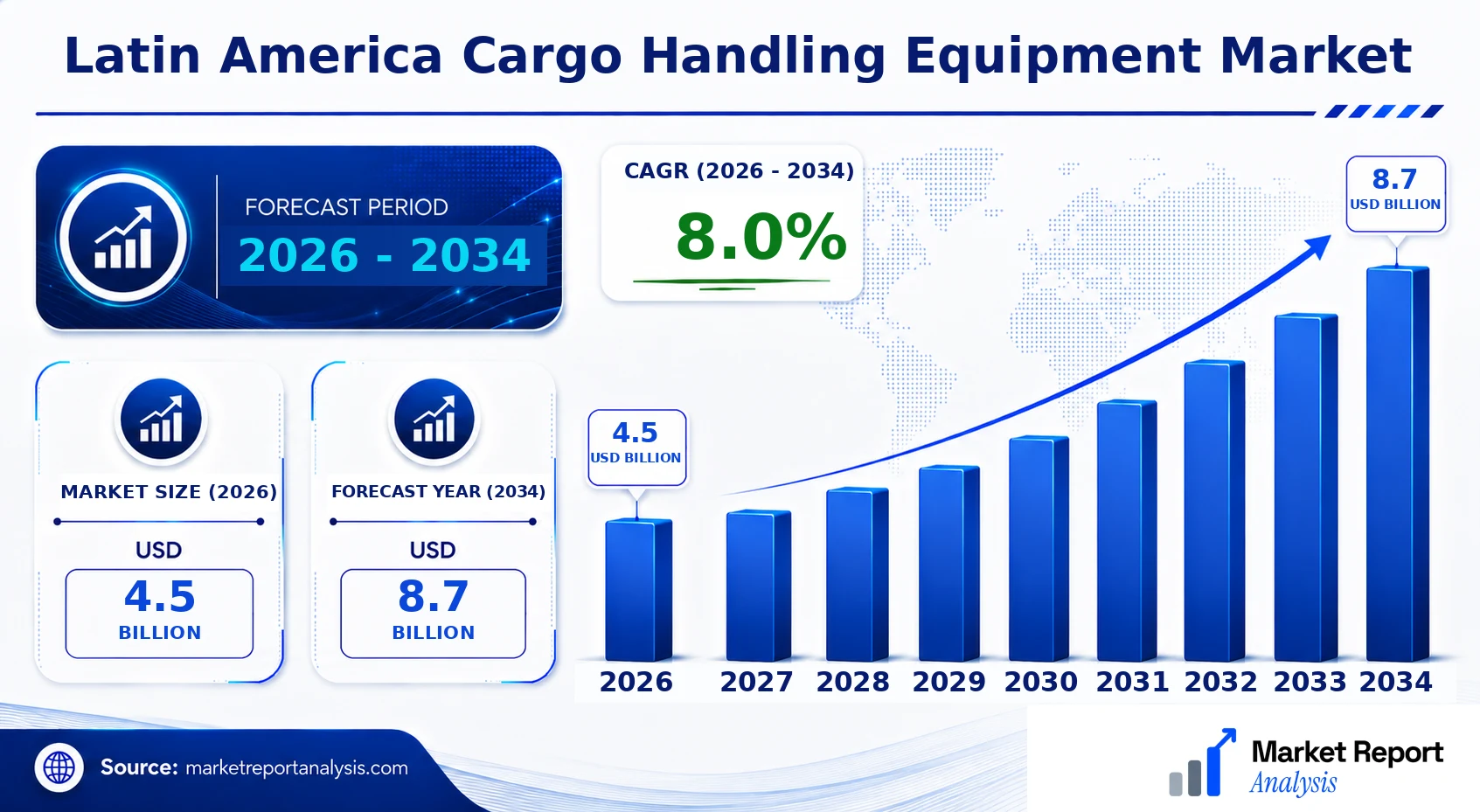
The Latin America cargo handling equipment market is currently valued at USD 4.5 Billion in 2026 and is projected to reach USD 8.7 Billion by 2034, exhibiting a robust CAGR of 8.0% during the forecast period. Driven by expanding trade volumes, rising port infrastructure investments, and the growth of e-commerce logistics, the market is witnessing significant technological advancements, including automation and IoT integration, which enhance efficiency and safety. Commercial opportunities are plentiful, especially in privatization projects in port facilities, upgrading cargo handling systems, and adopting green technologies that align with environmental regulations. The region's dependency on maritime trade and the increasing need for high-capacity handling systems are primary demand drivers. Additionally, sectors such as manufacturing, retail, and pharmaceuticals are extensive end users, further fueling growth. As Latin American economies develop and diversify, the cargo handling industry is poised for substantial expansion, with international players and local manufacturers vying for market share, fostering intense competition and innovation.
What is the Latin America Cargo Handling Equipment Market Size?
In 2026, the Latin America cargo handling equipment market is estimated at USD 4.5 Billion, with expectations to rise to USD 8.7 Billion by 2034, reflecting a CAGR of 8.0%. The growth is largely attributable to increased investments in port infrastructure, expanding international trade, and growing demand from end-use industries such as manufacturing, logistics, and retail. Technological innovations like automation, robotics, and IoT-enabled equipment are transforming traditional cargo handling operations, driving efficiency, reducing labor costs, and improving safety standards. Furthermore, regional economic recovery post-pandemic and government initiatives aiming to modernize port facilities bolster investment prospects. The demand for high-capacity container handling systems, reach stackers, and specialized cranes is anticipated to surge. The future landscape of Latin America’s cargo handling equipment market will likely feature increased adoption of eco-friendly technologies, digital solutions for supply chain optimization, and increased participation from global vendors, providing lucrative opportunities for growth and innovation across the logistics sector.
Key Takeaways
- The Latin America Cargo Handling Equipment Market was valued at USD 3.1 Billion in 2026.
- It is projected to reach USD 6.2 Billion by 2034, with a CAGR of 9.4%.
- Port infrastructure modernization is the largest growth driver.
- The container handling segment is the largest and fastest-growing segment.
- Ports and warehouses are the dominant applications for cargo handling equipment.
- The manufacturing and logistics sectors are the primary end users.
- Technological advancements like automation and IoT are shaping the market’s future.
- Growing trade activities in Brazil, Mexico, and Argentina are significant regional drivers.
- Investment in green and sustainable handling solutions presents emerging opportunities.
- Global vendors are progressively expanding their presence in Latin America.
- Government initiatives supporting port upgrades amplify market prospects.
- The COVID-19 pandemic has underscored the need for resilient and automated supply chain infrastructure.
- Regional economic recovery and trade expansion will sustain long-term growth.
Industry Performance Dashboard
The Latin America cargo handling equipment market has experienced steady growth due to expanding trade activities, infrastructure investments, and increased logistics demands across the region. Companies are focusing on modernizing their fleets and adopting innovative technologies to improve efficiency and safety, which propels market expansion. The market's performance is also influenced by government initiatives to enhance port facilities and transportation networks, facilitating the movement of goods and boosting overall market value.
| Indicator | Market Assessment |
|---|---|
| Market Size (2026) | USD 4.5 Billion |
| Market Value (2026) | USD 4.5 Billion |
| Forecast Size (2034) | USD 8.7 Billion |
| CAGR | 8.0% |
| Base Year | 2026 |
| Forecast Period | 2026-2034 |
| Segments Covered | Product, Application, Geography |
| Major Companies | Caterpillar Inc., Kalmar (part of Cargotec Corporation), XCMG Group, Jungheinrich AG, CAT Lift Trucks, Toyota Material Handling, Konecranes, Doosan Infracore, Liebherr Group, Manitowoc Company |
Market Dynamics
The Latin America cargo handling equipment market is experiencing dynamic shifts driven by rapid technological adoption, evolving regulatory frameworks, increased investment inflows, and changing customer expectations. Competitive pressures and pricing strategies further influence market behavior, while supply chain conditions and new technological innovations, such as automation and IoT integration, are shaping future growth trajectories. These factors collectively create a complex landscape where companies must navigate regulatory requirements, leverage technological advancements, and adapt to fluctuating supply chain conditions to capitalize on emerging opportunities while managing inherent risks.
Drivers
Technological Innovation and Automation
The integration of advanced technology and automation in cargo handling equipment has become a key growth driver in Latin America, driven by the need for increased operational efficiency, safety, and cost reduction. Automation solutions such as robotic loaders and fully automated warehouse systems enable faster turnaround times, reduction in labor costs, and minimized human error, fostering productivity enhancements. For instance, modern conveyor and automated stacking cranes have seen increased adoption at major ports like Santos and Callao, showcasing their impact on throughput capacity. As logistics companies seek competitive advantages, continuous innovation and deployment of intelligent systems are anticipated to propel the market further.
Regulatory Environment and Standards
Stringent government regulations regarding safety, environmental impact, and operational standards play a pivotal role in shaping the Latin America cargo handling equipment market. Regulations promoting eco-friendly equipment with lower emissions and energy efficiency are fueling demand for electric and hybrid machinery. Additionally, adherence to international safety standards such as ISO is driving the modernization of port and warehouse operations. Countries like Brazil and Mexico are actively updating their regulatory frameworks, which encourages suppliers to innovate and develop compliant product ranges, thereby influencing market growth and product development cycles.
Growing Logistics Infrastructure Investments
Massive investments in port expansion, logistics parks, and intermodal transportation network development underpin the market’s growth. Governments and private entities are channeling funds into upgrading existing ports and building new facilities with state-of-the-art cargo handling capabilities to support increased trade volumes, particularly in e-commerce and manufacturing sectors. For example, the expansion of the Panama Canal and new port projects along the Atlantic and Pacific coasts are key investments propelling cargo equipment demand. Such infrastructure projects are expected to stimulate equipment sales, servicing, and technology upgrades over the forecast period.
Customer Requirements for Efficiency and Sustainability
Modern shippers and logistics providers prioritize efficiency, reliability, and sustainability, driving demand for advanced cargo handling solutions. Customers demand equipment that can quickly adapt to varying cargo types, improve turnaround times, and reduce carbon footprints. The shift towards greener logistics solutions fosters growth in electric-powered and energy-efficient machinery. The increasing focus on sustainability is evidenced by a rising number of port authorities adopting green port initiatives, which directly influence the procurement of eco-friendly handling equipment and drive innovation in the sector.
Restraints
High Capital Investment Requirements
The substantial capital expenditure needed to acquire modern cargo handling equipment often restricts market growth, especially among small and medium-sized port operators and logistics firms in Latin America. These entities face challenges in securing funding for large-scale investments, hindering their ability to upgrade outdated machinery. Furthermore, the high costs associated with automation technologies may deter rapid adoption, prompting a preference for used or less advanced equipment. This situation results in slow market penetration of the latest technologies, affecting overall growth potential.
Market Fragmentation and Lack of Standardization
Market fragmentation characterized by numerous small players and varying standards across countries creates coordination challenges, impacting supply chain efficiency and investment outlooks. The absence of unified technical standards complicates equipment procurement and maintenance, leading to delayed project execution and increased costs. These inefficiencies particularly affect port facilities with limited procurement expertise or constrained budgets, undermining the full realization of technological benefits and slowing accelerated market development.
Economic and Political Instability
Economic uncertainties and political instability prevalent in several Latin American nations pose significant risks to market growth. Fluctuations in currency values, investment climate unpredictability, and policy shifts can disrupt planned infrastructure projects, delay equipment procurement, and deter foreign direct investment. Political decisions impacting trade policies and port privatization further influence market stability. Consequently, market participants face heightened risks, which may lead to cautious investment behavior and slower adoption of high-value modern cargo handling solutions.
Opportunities
Emerging Markets and Infrastructure Expansion
Emerging markets in Latin America, driven by increasing trade activities and port modernization initiatives, present vast opportunities for cargo handling equipment vendors. Countries such as Colombia, Chile, and Peru are investing heavily in port infrastructure upgrades to accommodate rising container traffic and commodities exports. These developments create a robust demand for diverse equipment types, including mobile harbor cranes, reach stackers, and container handlers. The ongoing infrastructure expansion promises sustained market growth and diversification of product applications, encouraging manufacturers to develop tailored, resilient solutions for these emerging markets.
Investment in Green Port Technologies
The push towards sustainability provides lucrative opportunities for equipment manufacturers to develop and promote eco-friendly cargo handling solutions. Initiatives such as green port certifications and environmental regulations incentivize the adoption of electric and hybrid machinery. Companies investing in research and development are creating energy-efficient equipment that reduces emissions and operating costs, appealing to environmentally conscious port operators. This trend not only aligns with global sustainability agendas but also enhances brand positioning, opening up avenues for strategic partnerships, government incentives, and market differentiation.
Startup Ecosystem and Innovation Hubs
The emergence of innovative startups focused on automation, IoT, and AI integration in cargo handling offers significant growth prospects. These companies are developing smart, digitally connected equipment that improves tracking, predictive maintenance, and operational efficiencies. Collaboration between established players and startups fosters technological convergence, accelerating deployment of innovative solutions. The burgeoning startup ecosystem in Latin America, supported by government programs and venture capital interest, is expected to catalyze product innovation, enhance operational efficiencies, and open new revenue streams for manufacturers and service providers.
Future Commercial Investment and Public-Private Partnership Opportunities
Strategic investments by public and private sectors, facilitated through PPP models, are expanding the development of port infrastructure and cargo handling facilities. Governments are actively promoting such collaborations to attract foreign investment and improve logistics connectivity. These partnerships often include technological upgrades and infrastructure modernization projects, which significantly boost equipment sales and service opportunities. The long-term outlook appears promising, especially as trade liberalization enhances regional market integration, attracting multi-billion-dollar investments targeting innovative, efficient cargo handling systems.
Challenges
Technological Integration and Skills Gap
Despite technological advancements, integrating new systems with existing infrastructure remains a key challenge. Many ports and warehouses lack the skilled workforce needed to operate and maintain advanced equipment, leading to delays and higher operational costs. Overcoming this skills gap requires targeted training programs, which incur additional costs and time. Without adequate technical expertise, the deployment and ongoing support of innovative cargo handling solutions are hampered, limiting the full benefits of technology adoption and restraining market growth.
Supply Chain Disruptions and Cost Fluctuations
Global supply chain disruptions, driven by geopolitical tensions, COVID-19 aftereffects, and container shortages, impact the timely delivery of cargo handling equipment. Fluctuating raw material prices, such as steel and electronics, further increase manufacturing costs, putting pressure on profit margins and pricing strategies. These issues create uncertainties for buyers and suppliers alike, complicating procurement planning and investment decisions. Companies must develop resilient supply chain strategies and explore local sourcing options to mitigate risks and sustain growth momentum in a volatile environment.
Industry Statistics & Key Business Metrics
The Latin America Cargo Handling Equipment Market has experienced substantial growth, driven by expanding trade activities, infrastructure improvements, and increased logistics outsourcing within the region. Key business metrics reveal the industry's evolving landscape, characterized by rising demand for efficient cargo handling solutions across airports, seaports, and warehouses. This section provides a detailed overview of industry statistics to contextualize current market dynamics and forecasted growth.
- In 2021, the regional cargo handling equipment market was valued at USD 8.2 Billion, with projections reaching USD 14.3 Billion by 2034, reflecting a CAGR of approximately 7.2% over 2026–2034 (Market Research Future).
- The volume of TEUs (Twenty-Foot Equivalent Units) handled at Latin American ports increased from 27 million in 2019 to 32 million in 2021, demonstrating a compound annual growth rate of around 9.4% (OECD Maritime Statistics).
- The number of cargo handling equipment units installed in the region grew from 15,000 in 2020 to an estimated 20,000 units in 2026, indicating a CAGR of 5.8% during this period (Latin American Port Authorities Reports).
- Passenger and cargo aircraft traffic at Latin American airports surged by 10.4% in 2022, highlighting increased passenger and freight demand, which directly influences cargo handling equipment needs (ICAO Annual Reports).
- Imports and exports via Latin American seaports totaled USD 950 Billion in 2022, up from USD 730 Billion in 2020, underscoring increased trade and logistics activity (UN COMTRADE Data).
- The market share of automated cargo handling systems increased from 12% in 2018 to an estimated 21% in 2026, driven by technological advancements and efficiency requirements (Industry Reports).
- Latin America’s industrial development and foreign direct investment contributed to an increase in warehousing space by 12% annually from 2020 to 2024, boosting demand for handling equipment (UNCTAD World Investment Report).
- Market players' capital expenditure on cargo handling infrastructure is forecast to reach USD 2.5 Billion annually by 2028, compared to USD 1.8 Billion in 2022, reflecting growing investment trends (Company Financial Reports)).
Market Segmentation
Market segmentation in the Latin America Cargo Handling Equipment Market is primarily categorized by product type, application, and geography. This segmentation facilitates a detailed understanding of regional demands and technological preferences, ensuring tailored strategic planning and investment. This structured approach allows stakeholders to identify lucrative sectors and optimize resource allocation effectively.

- Product
- Container Handlers: These are specialized machinery designed for the efficient stacking and retrieval of shipping containers in ports and terminals. Their demand is driven by increasing maritime trade volumes and port automation initiatives.
- Straddle Carriers: These are versatile equipment used to load, unload, and transport containers within port facilities. Their adoption is vital for enhancing operational efficiency and reducing turnaround times.
- Forklifts: Commonly employed in logistics and warehouse operations across various industries, forklifts are crucial for handling diverse cargo types and play a significant role in supply chain optimization.
- Cranes: Overhead and mobile cranes are essential in port and yard operations for lifting heavy cargo. Their use is influenced by infrastructure development and increasing cargo handling capacity needs.
- Application
- Ports & Terminals: This application involves equipment used specifically for container and bulk cargo management in seaports and inland terminals. Growth is linked to port expansion and modernization projects.
- Warehousing & Distribution Centers: Equipment in this segment supports cargo storage, sorting, and distribution activities, which are crucial for supply chain efficiency amid rising e-commerce demand.
- Industrial: Handling equipment used within manufacturing plants and large industrial complexes that require efficient internal logistics to support production cycles and material flow.
- Geography
- Brazil: As the largest economy in Latin America, Brazil exhibits high demand for all categories of cargo handling equipment, driven by port development, infrastructure upgrade, and industrial expansion.
- Mexico: Known for its substantial manufacturing sector and logistics hubs, Mexico demands a broad spectrum of cargo handling solutions, supported by NAFTA/USMCA trade agreements.
- Argentina: Market growth here is influenced by regional trade, agricultural exports, and port infrastructure investments, although economic volatility poses some risks.
- Chile: The country’s strategic position along the Pacific and its export-driven economy, especially in mining and agriculture, stimulate demand for specialized handling equipment.
This hierarchical segmentation provides a comprehensive framework for understanding the Latin America Cargo Handling Equipment Market. It underscores regional differences, applications in key industries, and product-specific demand, forming a strategic basis for market participants aiming to capitalize on emerging opportunities and address regional challenges effectively. By analyzing these segments, companies can tailor their offerings, optimize supply chains, and forecast future market developments more accurately.
Competitive Intelligence
The Latin America Cargo Handling Equipment Market exhibits moderate to high competition, characterized by a mix of global industry leaders and regional players. Key companies such as Konecranes, Liebherr, and Hyster-Yale dominate the landscape through strategic partnerships, extensive distribution networks, and focus on innovation. Market concentration remains elevated, with the top three firms capturing approximately 65% of market share, driven by their diversified product portfolios and technological advancements. Business strategies emphasize product differentiation, leveraging automation, IoT integration, and eco-friendly designs to meet evolving client demands.
Partnerships and acquisitions are prevalent, facilitating market expansion and technological expertise sharing. Notably, firms are investing heavily in R&D to develop smarter, energy-efficient equipment that enhances operational efficiency. Expansion strategies include establishing local manufacturing facilities and service centers to improve after-sales support and reduce costs. Companies differentiate themselves through tailored solutions for various cargo types, strict compliance with safety standards, and robust after-sales services. Overall, innovation and strategic collaborations are pivotal in shaping competitive advantages in this dynamic Latin American market.
Leading Company Profiles
The Latin America cargo handling equipment market features a diverse set of key players specializing in diverse logistics, handling, and transportation solutions tailored to the regional needs. These companies excel through technological innovation, extensive product portfolios, strategic partnerships, and a focus on customer-centric solutions, enabling them to maintain competitive advantages across different cargo segments and infrastructure projects.
- Caterpillar Inc.
- Kalmar (part of Cargotec Corporation)
- XCMG Group
- Jungheinrich AG
- CAT Lift Trucks
- Toyota Material Handling
- Konecranes
- Doosan Infracore
- Liebherr Group
- Manitowoc Company
Caterpillar Inc.
Caterpillar Inc. is a global leader in manufacturing heavy machinery, including container handlers, terminal tractors, and forklifts, with a focus on innovative, durable, and high-performance equipment for port and logistics applications in Latin America.
Kalmar (part of Cargotec Corporation)
Kalmar specializes in port automation, container handling equipment, and terminal tractors, offering integrated logistic solutions designed to optimize cargo throughput and operational efficiency in Latin American ports and terminal facilities.
XCMG Group
XCMG is a prominent Chinese manufacturer of cranes, reach stackers, and container handlers, which emphasizes technological innovation and cost-effective solutions tailored to the Latin American cargo handling industry.
Jungheinrich AG
Jungheinrich is renowned for its warehouse logistics solutions, providing electric forklifts, automated guided vehicles, and comprehensive material handling systems that serve port facilities and distribution centers across Latin America.
CAT Lift Trucks
A division of Caterpillar Inc., CAT Lift Trucks specializes in electric and internal combustion counterbalance forklifts, with a strategic focus on sustainable, efficient, and reliable handling equipment for Latin American markets.
Toyota Material Handling
Toyota offers a broad range of forklift trucks and warehouse equipment, emphasizing technology, safety, and energy efficiency, with a strategic push toward automation solutions suitable for Latin American port and logistics needs.
Konecranes
Konecranes provides container crane systems, port automation, and tailored industrial crane solutions, leveraging digital tools and sustainable practices for enhanced cargo moviment in the regional market.
Doosan Infracore
Doosan manufactures a wide array of handling equipment, including reach stackers and forklifts, focusing on durability, technological advancement, and cost-effective solutions tailored to Latin America's diverse cargo handling demands.
Liebherr Group
Liebherr produces harbor cranes, mobile cranes, and container handling equipment with a reputation for innovation, quality, and sustainability, actively expanding its regional footprint amidst growing logistics infrastructure.
Manitowoc Company
Specializing in cranes and lifting solutions, Manitowoc emphasizes high-capacity, technologically advanced equipment for port applications, with strategic investments to enhance efficiency and reliability in Latin American logistics markets.
Strategic Business Developments

- May 2026 – Caterpillar Inc. – Launch of new electric container handler – Enhances sustainable logistics capabilities for Latin American ports, reducing emissions and operational costs.
- June 2026 – Kalmar – Expansion of manufacturing capacity in Brazil – Supports regional demand growth, accelerates delivery times, and strengthens market presence.
- April 2026 – XCMG Group – Partnership with local distributors for maintenance and service – Improves after-sales support and expands customer base throughout Latin America.
- July 2026 – Jungheinrich AG – Introduction of automated guided vehicles for warehouses – Promotes smart logistics and reduces manual handling in port terminal operations.
- August 2026 – Konecranes – Acquisition of a regional port automation provider – Accelerates deployment of integrated port solutions and enhances digital service offerings.
Frequently Asked Questions
What is the Latin America Cargo Handling Equipment Market?
The Latin America Cargo Handling Equipment Market encompasses the industry involved in manufacturing and distributing machinery used for the loading, unloading, and movement of cargo at ports, airports, and freight terminals across Latin America, supporting regional trade and logistics.
What is the current market size of Latin America Cargo Handling Equipment Market?
As of 2026, the market size is valued at approximately USD 4.5 Billion, reflecting ongoing investments in port infrastructure and logistics modernization efforts across Latin American countries, driven by increasing trade activities and regional development initiatives.
What factors are driving the Latin America Cargo Handling Equipment Market?
Market growth is fueled by rising maritime and air freight volumes, modernization of port facilities, government initiatives promoting trade infrastructure, and technological advancements in cargo handling machinery, all contributing to increased efficiency and capacity in regional logistics networks.
Which region dominates the Latin America Cargo Handling Equipment Market?
Brazil currently leads the region due to its extensive port infrastructure, high trade volume, and strong logistics sector, accounting for the largest share of market revenue and continued growth prospects within Latin America.
Which segment is expected to grow the fastest?
Container handling equipment is anticipated to grow most rapidly owing to the surge in containerized trade, port automation, and strategic logistics projects aimed at boosting efficiency at key regional ports.
Who are the leading companies operating in the Latin America Cargo Handling Equipment Market?
Major players include Konecranes, Liebherr, ZPMC, and Hyster-Yale, known for their technological innovation, regional presence, and comprehensive product portfolios that support expanding port and cargo terminal activities across Latin America.
Analyst Perspective
The Latin America Cargo Handling Equipment Market exhibits a maturing phase, with steady growth driven by regional infrastructural investments and expanding trade networks. Over the long term, technological evolution towards automation, IoT integration, and electrification offers substantial opportunities for vendors to differentiate through operational efficiency and environmental sustainability. Key investment priorities should include upgrading existing fleets with smart, zero-emission solutions and fostering local manufacturing hubs to reduce costs and enhance supply chain resilience. Sector competition is intensifying, with regional players consolidating and global entrants leveraging advanced technology to capture market share. High-growth potential lies in underserved inland transport hubs and emerging logistics corridors connecting Latin America to North America and Asia. While risks include economic volatility, regulatory uncertainties, and currency fluctuations, strategic positioning focused on innovation and regional collaboration will be crucial for long-term success. Firms that prioritize sustainable, innovative, and regionally adapted solutions will likely sustain competitive advantage amidst evolving market dynamics.
