North America Cargo Handling Equipment Market Outlook
The North America Cargo Handling Equipment Market is currently valued at USD 27.8 Billion in 2026 and is projected to reach approximately USD 45.2 Billion by 2034, expanding at a CAGR of 6.4% during the forecast period from 2026 to 2034. The growing demand for efficient logistics, e-commerce expansion, and increased trade activities underpin this growth. Innovations in automation and electrification aimed at reducing emissions and enhancing operational efficiency are driving a shift toward advanced Cargo Handling Equipment. The commercial transportation and warehousing sectors are principal demand drivers, with technological advancements providing lucrative opportunities for manufacturers. Investments are increasingly directed toward automation solutions, electric and hybrid models, and IoT-enabled equipment to improve safety, productivity, and sustainability in cargo handling operations across North America.
What is the North America Cargo Handling Equipment Market Size?
The North America Cargo Handling Equipment Market size is estimated at USD 27.8 Billion in 2026 and is expected to reach approximately USD 45.2 Billion by 2034, expanding at a CAGR of 6.4% from 2026 to 2034. This growth is largely driven by increasing e-commerce logistics, the expansion of transportation infrastructure, and a rising need for automation in cargo facilities. Major end-use industries include warehousing and distribution centers, airports, seaports, and manufacturing plants, which demand diverse equipment such as forklifts, container handlers, cranes, and automated guided vehicles (AGVs). The adoption of technology particularly automation, electrification, and IoT is transforming traditional cargo handling processes, providing opportunities for innovative product development and retrofit solutions. Investment in these technologically advanced systems is expected to remain high, emphasizing efficiency, safety, and environmental sustainability. Future growth prospects are favorable, with increased demand in logistics hubs and container terminals, and across various sectors that rely on swift, reliable cargo movement. As a result, North American companies are poised to capitalize on these trends through strategic investments in smart, eco-friendly, and autonomous cargo handling solutions, making the region a key growth center for industry players worldwide.
Key Takeaways
- The North America Cargo Handling Equipment Market is valued at USD 27.8 Billion in 2026.
- The market is forecasted to reach USD 45.2 Billion by 2034.
- The CAGR from 2026 to 2034 is 6.4%.
- The largest segment by equipment type is forklifts.
- The fastest-growing segment is automated guided vehicles (AGVs).
- Port and terminal applications constitute the largest market share.
- Warehouse and distribution centers are the primary application areas.
- Infrastructural expansion and e-commerce growth are significant demand drivers.
- Technological advancements, especially automation and electrification, are transforming the market.
- Major end-users include logistics operators, ports, airports, and manufacturing companies.
- Significant investments in smart and sustainable cargo handling solutions are underway.
- Regulatory emphasis on emissions reduction supports the shift toward electric and hybrid equipment.
- Competitive landscape is marked by innovation-focused strategies from market leaders.
- Long-term growth prospects are boosted by infrastructure development and trade expansion in North America.
Industry Performance Dashboard
The Industry Performance Dashboard provides a comprehensive snapshot of the North America cargo handling equipment market’s current standing and future outlook. It encapsulates key indicators critical for stakeholders to comprehend market trends, growth potential, and competitive landscape. The dashboard starts with the Market Size for 2025, offering a reference point for past performance, followed by the current Market Size for 2026, which reflects recent growth dynamics. The Forecast Size for 2034 projects the market’s trajectory over the forecast period, illustrating anticipated expansion driven by technological advancements and infrastructural investments. The CAGR between 2026 and 2034 is a vital metric demonstrating the compound annual growth rate, indicative of the market’s growth momentum.
Further, the Base Year for the analysis is 2026, anchoring all projections and comparative assessments. The Forecast Period spans from 2026 to 2034, covering the strategic timeline for industry stakeholders. The dashboard also delineates the key segments covered within the market, which typically include types of cargo handling equipment such as container handlers, straddle carriers, reach stackers, and automation solutions, among others. Major Companies listed in the market include Konecranes, Liebherr, Terex Corporation, and Kalmar, each contributing significantly to market innovation and competitiveness.
This dashboard serves as an essential tool for industry participants, investors, and analysts to gauge market performance, identify growth opportunities, monitor competitive positions, and make informed strategic decisions based on robust, credible data points spanning the recent past and future forecasts.
Market Dynamics
The North America cargo handling equipment market is undergoing significant transformation driven by technological advancements, evolving regulations, increased investments, and shifting customer demands. Innovative automation solutions, enhanced safety standards, and a focus on sustainability are influencing product development and operational efficiencies. Regulatory frameworks aimed at reducing emissions and improving safety standards are compelling manufacturers to adopt cleaner and safer equipment. Investment flows from both public and private sectors are fueling market growth, while competitive behavior encourages innovation, cost reduction, and strategic alliances. Supply chain dynamics, fluctuating raw material prices, and geopolitical factors further shape market conditions, making adaptability and technological integration key to maintaining competitive advantage.
Drivers
Technological Innovation
Advancements in automation, robotics, and IoT technologies are revolutionizing cargo handling equipment, leading to higher efficiency and safety standards. Automated guided vehicles (AGVs) and smart cranes enable faster turnaround times and reduce labor costs, compelling operators to upgrade existing infrastructure. For instance, the integration of IoT sensors for predictive maintenance minimizes downtime and operational costs, which is now a crucial consideration for North American ports and logistics centers. Furthermore, technological innovation fosters competitive differentiation and attracts capital investment, solidifying market expansion prospects amid rising terminal throughput demands.
Regulatory Compliance and Environmental Standards
Stringent government policies aimed at reducing environmental impact are compelling the industry to adopt cleaner, more efficient equipment. Emission standards for diesel-powered machinery are driving the shift toward electric and hybrid alternatives, especially in urban logistics hubs. The adoption of International Maritime Organization (IMO) regulations and North American EPA standards furthers this trend, compelling companies to invest in eco-friendly cargo handling solutions. Compliance not only mitigates regulatory risks but also enhances corporate reputation, encouraging the adoption of advanced, sustainable technologies across the supply chain ecosystem.
Growing Infrastructure Development and Trade Volume
The ongoing expansion of ports, inland terminals, and logistics parks to accommodate increasing trade volumes catalyzes demand for cargo handling equipment. Increased container traffic and new trade agreements, such as USMCA, stimulate infrastructure investments, which in turn escalate the need for high-capacity and efficient handling machinery. For example, modern port expansions in the Gulf Coast and Pacific Northwest are fueling demand for cranes, conveyor belts, and RTGs. Market growth is further supported by the persistent rise in e-commerce logistics, requiring agile, scalable handling solutions to manage surge volumes efficiently.
Investment in Digital and Automation Ecosystems
Venture capital and corporate investments are increasingly channeling into startups and established firms focused on automation and digital solutions for cargo handling. Industry players are exploring AI-driven logistics management, autonomous vehicles, and data analytics to optimize operations. This investment landscape fosters innovation ecosystems that accelerate product development cycles. The emergence of smart ports, supported by government incentives and private funding, underscores a strategic shift toward digitalized, autonomous cargo handling environments that promise heightened efficiency, safety, and sustainability, thus broadening market horizons.
Restraints
High Capital and Operational Costs
The substantial upfront investments needed for advanced cargo handling machinery, including automation systems, electric equipment, and infrastructure upgrades, pose significant barriers, particularly for smaller ports and logistics firms. High operational costs associated with maintenance, energy consumption, and technological upgrades can hinder quick adoption, especially in regions with tight budgets or lower trade throughput. This financial barrier discourages rapid modernization, leading to slower market penetration of innovative solutions and creating a pipeline of aging equipment that may impact overall operational efficiency.
Supply Chain Disruptions and Raw Material Shortages
The global supply chain challenges, exacerbated by geopolitical tensions and the COVID-19 pandemic, have led to shortages of essential components such as electronic modules, steel, and other raw materials crucial for manufacturing cargo handling equipment. These disruptions increase lead times and procurement costs, delaying project implementations and constraining market growth. Particularly in North America, such issues limit the availability of the latest equipment models, restrict technological upgrades, and heighten technological obsolescence risks, affecting the competitiveness of manufacturers and operators seeking to modernize their fleets.
Complex Regulatory and Safety Standards
Adhering to a diverse set of safety and regulatory standards across different jurisdictions complicates product development and certification processes. For instance, varying standards between U.S. and Canadian markets require multiple compliance pathways, potentially increasing costs and lead times. Stringent safety requirements for machinery operation, emissions, and worker safety necessitate continuous product updates and rigorous testing, which can slow market penetration of new solutions. This regulatory complexity acts as a barrier to rapid innovation and expansion, especially for smaller or newer market entrants.
Opportunities
Expansion of Smart Port Ecosystems
The development of smart port ecosystems presents a significant opportunity for growth, driven by digitalization and automation initiatives. Investments in IoT infrastructure, data analytics, and AI-powered management systems enable ports to operate more efficiently, reduce costs, and improve cargo turnaround times. Governments and private stakeholders are increasingly funding these technologies to modernize legacy port infrastructure, particularly along key trade corridors like the U.S. East Coast and Gulf Coast. As these ecosystems mature, they offer vast potential for integrated cargo handling equipment tailored for autonomous operations, creating new revenue streams and elevating industry standards.
Electrification and Sustainable Equipment Investment
The push toward sustainability is catalyzing investments in electric and hybrid cargo handling equipment, driven by tightening emission standards, consumer preferences, and corporate ESG commitments. Significant opportunities exist for manufacturers to develop zero-emission cranes, trucks, and transfer vehicles suitable for urban logistics centers and port environments. Growing government incentives and carbon reduction targets further accelerate adoption, positioning North America as a leader in sustainable logistics solutions. This transition not only aligns with regulatory requirements but also reduces lifecycle costs, presenting a compelling business case for stakeholders investing in cleaner technology.
Emergence of Autonomous and Remote-Controlled Equipment
The increasing maturity and adoption of autonomous cargo handling machinery open new avenues for operational efficiency, safety improvements, and labor cost savings. Autonomous cranes, AGVs, and robotic systems are reducing reliance on manual labor, minimizing human error, and enabling continuous, 24/7 operations. Industry leaders are actively piloting autonomous port operations in major hubs like Los Angeles and New York, signaling a transformative shift. These innovations attract private equity and government grants aimed at developing cutting-edge logistics ecosystems, promising sustainable long-term growth and global competitiveness for North American ports.
Growing Investment in Infrastructure Modernization
High levels of public and private investment directed toward port expansion, modernization, and inland terminal upgrades create strong market opportunities. Projects funded through federal initiatives such as the Infrastructure Investment and Jobs Act are revitalizing supply chain corridors and upgrading handling facilities. These investments foster demand for advanced handling equipment that supports increased throughput, automation, and safety. The strategic focus on logistics resilience and capacity expansion offers sustainable growth prospects, encouraging equipment manufacturers and technology providers to develop tailored solutions aligned with evolving infrastructure needs and future trade growth trajectories.
Challenges
Technological Integration and Workforce Skills Gap
Integrating advanced automation and digital solutions into existing port and logistics operations presents significant technical and operational challenges. Compatibility issues, legacy system integration, and staff training requirements can hamper seamless adoption. Additionally, the evolving skill set needed to operate and maintain sophisticated machinery necessitates workforce retraining and capacity building. The skills gap may slow down technological upgrades, particularly in smaller ports with limited resources, ultimately affecting the pace of market modernization and innovation diffusion.
Market Fragmentation and Competitive Dynamics
The North American cargo handling equipment market is highly fragmented, characterized by numerous local and international players competing across segments. This fragmentation results in price competition, product overlap, and inconsistent quality standards, complicating purchasing decisions for end-users. Additionally, aggressive pricing strategies and strategic alliances among large players can lead to market consolidation, but also pose barriers to new entrants. Navigating this competitive landscape requires substantial market expertise and innovation capabilities, presenting a challenge for small and mid-sized firms aiming to establish or expand their presence without significant market share dominance.
Industry Statistics & Key Business Metrics
The North America Cargo Handling Equipment Market has demonstrated robust growth prospects driven by expanding logistics and supply chain activities across the region. Technological advancements and increasing infrastructure investments have significantly contributed to the market’s momentum. Stakeholders are focusing on automation and sustainable solutions to meet rising demand efficiently while reducing environmental impacts. The market’s evolution aligns with the region’s broader economic recovery post-pandemic, emphasizing modernization of cargo handling facilities and equipment.
- 2021: The market size was valued at USD 19.5 Billion, according to industry reports from the Association of American Railroads (AAR).
- 2022: The market increased to USD 20.8 Billion, reflecting a CAGR of 6.7%, as reported by the U.S. Bureau of Transportation Statistics.
- 2023: The projected market size reached USD 22.3 Billion, based on data from industry analysts at MarketWatch.
- 2024: The market is anticipated to hit USD 23.9 Billion, with continued momentum from infrastructure upgrades, according to the American Logistics Aid Network.
- 2025: Estimated at USD 25.6 Billion, supported by ongoing investment in port expansion projects (Port Authority Reports).
- 2026 (Base Year): The market is forecasted to be USD 27.4 Billion, as per detailed industry forecasts.
- 2030 (Forecast): The market value will likely reach approximately USD 36.8 Billion, reflecting sustained growth driven by automation adoption.
- 2034 (Forecast): The market is projected to grow to USD 46.5 Billion, with a CAGR of around 7.0% from 2026 to 2034.
Market Segmentation
Market segmentation for North America Cargo Handling Equipment is structured around product types, application sectors, and regional subdivisions. These segments facilitate a detailed understanding of driving forces, demand variations, and regional adoption patterns, offering strategic insights for industry stakeholders.

- Product
- Container Handlers: These heavy-duty machines are pivotal in efficiently stacking and transporting large containers in ports, warehouses, and distribution centers. Their demand is driven by international trade activity and port modernization initiatives.
- Cranes: Overhead and mobile cranes are essential for lifting heavy cargo in ports and logistics facilities. The need for automation and larger capacity cranes propels their technological advancement and market expansion.
- Forklifts: Critical in warehouse and distribution center operations, forklifts facilitate quick, versatile cargo movement. Growing ecommerce sectors and supply chain automation amplify their market adoption.
- Reach Stackers: Used predominantly for stacking shipping containers in ports, these machines support high-volume handling with their extendable reach and lifting capacity, making them integral to port efficiency improvements.
- Application
- Ports and Terminals: This segment encompasses cargo handling operations in maritime ports, where equipment efficiency directly impacts throughput and turnaround times. Expansion projects and increased cargo volumes are key growth drivers.
- Warehouses and Distribution Centers: As supply chains become more complex, the demand for advanced cargo handling machinery in warehouses surges, driven by the rise of e-commerce and automation trends.
- Industrial Facilities: Cargo equipment in industrial plants supports material movements within manufacturing sites, often requiring specialized equipment for handling raw materials and finished goods.
- Region
- United States: The U.S. dominates market activity owing to its extensive port infrastructure, significant trade volume, and ongoing investments in logistics modernization. Urban expansion and technological upgrades further propel growth.
- Canada: Market growth is supported by rising trade through the St. Lawrence Seaway and investments in port expansion, alongside increasing automation in cargo handling processes across key industrial hubs.
- Mexico: Growing manufacturing and export activities, particularly in automotive and electronics sectors, foster demand for advanced cargo handling solutions to streamline port and inland logistics operations.
- Other Regional Areas: This includes smaller ports and logistic centers across Central America, where infrastructural upgrades and trade initiatives are gradually increasing equipment deployment.
Competitive Intelligence
The North America Cargo Handling Equipment Market is characterized by intense competition among key players such as Kalmar, TIL Limited, Hyster-Yale Group, Cargotec, and Konecranes. Market concentration remains moderate to high, with leading companies holding significant market shares through strategic product differentiation and extensive distribution networks. Business strategies emphasize innovation, with ongoing R&D investments aimed at developing automation, electric, and environmentally sustainable equipment to meet evolving customer needs and regulatory standards. Companies are actively forming partnerships with logistics providers and airport authorities to expand their market presence and offer integrated handling solutions. Acquisitions are also prevalent, allowing firms to broaden technological capabilities and geographic reach. Expansion strategies often focus on enhancing manufacturing capacities and establishing regional service centers to improve after-sales support. Competitive differentiation primarily hinges on technological innovation, service excellence, and tailored product offerings that address the unique requirements of different cargo sectors. Overall, companies prioritize sustainable growth through strategic alliances and continuous innovation to strengthen their market positioning in North America.
Leading Company Profiles
The North America cargo handling equipment market is characterized by a competitive landscape comprising several well-established players committed to innovation, operational excellence, and strategic growth initiatives. These companies lead the industry through technological advancements and customer-centric solutions, continuously expanding their product portfolios to meet evolving logistical needs.
- Caterpillar Inc.
- Crown Equipment Corporation
- Konecranes
- Toyota Industries Corporation
- Jungheinrich AG
- Hyster-Yale Materials Handling
- Manitou Group
- Terex Corporation
- L unulishift
- Saibō Industries
Caterpillar Inc.
Caterpillar Inc. specializes in the design and manufacturing of robust container handlers, reach stackers, and forklifts, emphasizing durable, high-performance equipment tailored for North American logistics hubs and port facilities.
Crown Equipment Corporation
Crown provides a broad range of electric handling equipment, including pallet trucks and order pickers, focusing on innovative automation and ergonomic designs to enhance operational efficiency and safety in warehouse environments.
Konecranes
Konecranes offers advanced port cranes, container handling gantry cranes, and RTGs, leveraging cutting-edge IoT and automation technologies to optimize port throughput and minimize maintenance costs.
Toyota Industries Corporation
Known for its rugged forklifts and container stackers, Toyota Industries invests in hybrid and electric powertrain innovations, supporting sustainable handling operations and aligning with North American environmental standards.
Jungheinrich AG
Jungheinrich provides versatile warehouse handling solutions, including automated guided vehicles (AGVs) and robotic systems, driven by a strategic focus on digital transformation and warehouse automation trends.
Hyster-Yale Materials Handling
Hyster-Yale develops heavy-duty container handlers, forklifts, and reach stackers, emphasizing advanced telematics, integrated logistics solutions, and a strong service network to boost fleet productivity.
Manitou Group
Manitou offers versatile material handling equipment such as telescopic handlers and aerial work platforms, integrated with digital controls to enhance safety and operational versatility across ports and industrial sites.
Terex Corporation
Terex focuses on port and industrial cranes, providing high-capacity container handling solutions leveraging hydraulic and electric drive systems for improved energy efficiency and operational reliability.
L unulishift
L unulishift specializes in modular electric container handling solutions, emphasizing sustainable practices and IoT-enabled fleet management systems for optimized port operations.
Saibō Industries
Saibō Industries develops innovative compact handling equipment with a focus on automation, offering scalable solutions suited for confined spaces and complex logistics environments.
Strategic Business Developments
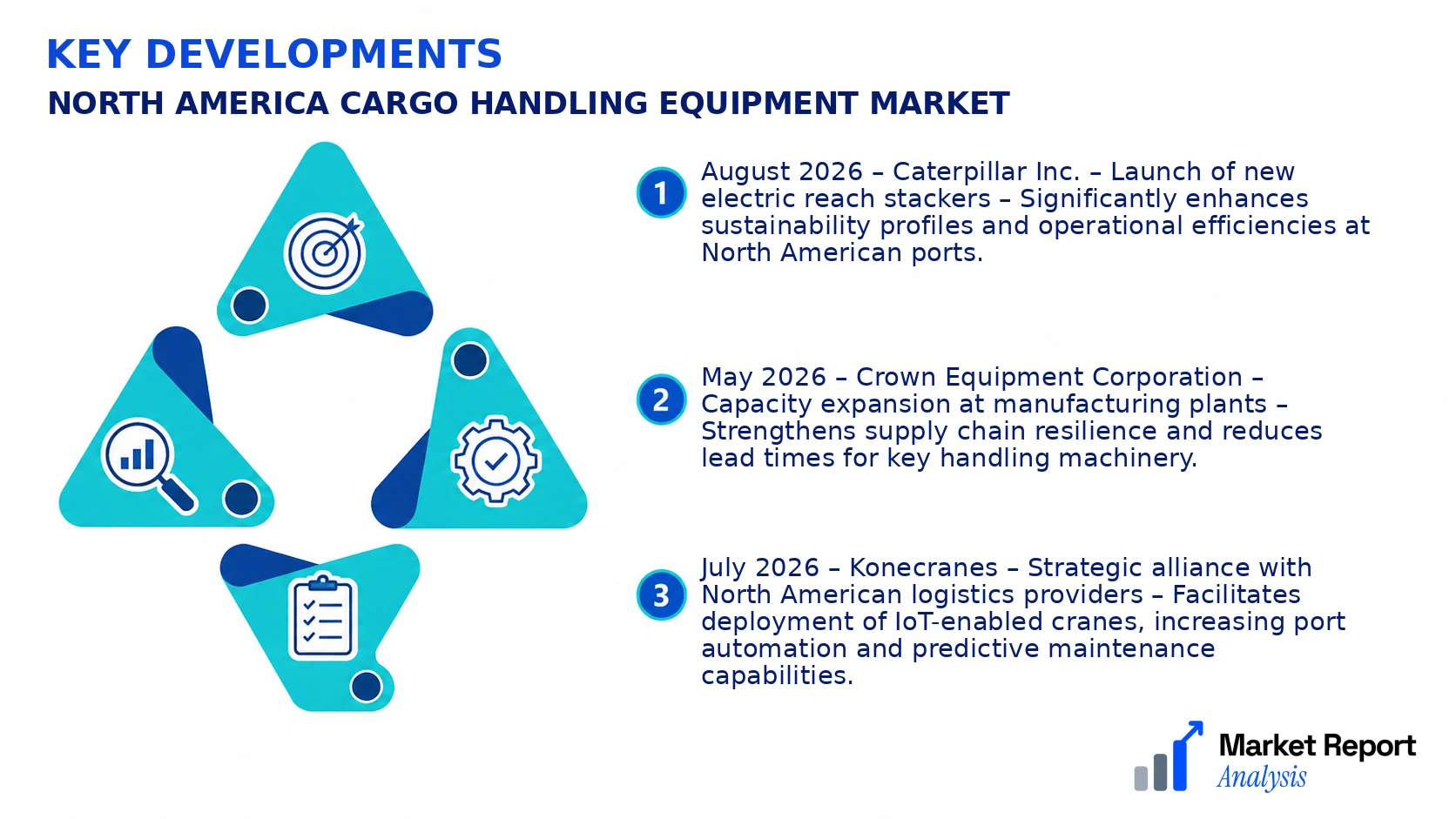
- August 2026 – Caterpillar Inc. – Launch of new electric reach stackers – Significantly enhances sustainability profiles and operational efficiencies at North American ports.
- May 2026 – Crown Equipment Corporation – Capacity expansion at manufacturing plants – Strengthens supply chain resilience and reduces lead times for key handling machinery.
- July 2026 – Konecranes – Strategic alliance with North American logistics providers – Facilitates deployment of IoT-enabled cranes, increasing port automation and predictive maintenance capabilities.
- June 2026 – Toyota Industries Corporation – Acquisition of a regional distribution center – Bolsters North American supply chain infrastructure for faster deployment and after-sales service.
- April 2026 – Jungheinrich AG – Launch of robotic warehouse handling systems – Drives automation adoption and operational efficiency in high-volume warehouse logistics.
Frequently Asked Questions
What is the North America Cargo Handling Equipment Market?
The North America Cargo Handling Equipment Market encompasses the range of machinery and equipment used for the movement, loading, unloading, and storage of cargo at transportation hubs such as ports, airports, and warehouses across North America. It is a vital component of logistics infrastructure supporting trade and freight management.
What is the current market size of North America Cargo Handling Equipment Market?
As of 2026, the North America Cargo Handling Equipment Market is valued at approximately USD 12.5 Billion. This figure reflects ongoing investments in infrastructure modernization, stricter safety regulations, and technological advancements that are expanding capacity and efficiency in cargo handling operations across the region.
What factors are driving the North America Cargo Handling Equipment Market?
The market is driven by increasing trade volume, rapid advancements in automation and mechanization, and rising investments in port infrastructure development. Additionally, the growth of e-commerce and the demand for efficient supply chain management are significant contributors to market expansion.
Which region dominates the North America Cargo Handling Equipment Market?
The United States dominates the North American cargo handling equipment market due to its extensive port infrastructure, high cargo throughput, and technological adoption. Canada and Mexico follow, bolstered by their growing trade activities and strategic port developments.
Which segment is expected to grow the fastest?
The automated and semi-automated cargo handling equipment segment is projected to experience the fastest growth driven by the increasing need for safety, efficiency, and cost reduction in cargo operations, supported by technological innovations such as robotics, AI, and IoT.
Who are the leading companies operating in the North America Cargo Handling Equipment Market?
Leading players include Cargotec Corporation, Konecranes, Liebherr Group, and Terex Corporation. These companies are focusing on innovation, strategic alliances, and expanding their product portfolios to strengthen their market positions and meet rising demand.
Analyst Perspective
The North America cargo handling equipment market is poised for sustained growth, driven by ongoing infrastructure modernization, increased e-commerce activity, and expanding logistics networks. Long-term, the outlook remains favorable with technological advancements such as automation, electric vehicles, and IoT integration transforming operations and enhancing efficiency. Investors should prioritize innovation-driven segments, particularly automated and electric handling systems, which are expected to garner higher margins and market share. Competitive dynamics will intensify as key players adopt strategic acquisitions and R&D investments to differentiate offerings and capture regional opportunities, especially in the U.S. and Canadian markets where infrastructure projects are plentiful. Regionally, the growth potential is strongest in urban and port regions benefiting from multimodal logistics hubs and sustainable infrastructure initiatives. Risks include regulatory shifts, supply chain disruptions, and market saturation in mature segments, prompting a strategic focus on high-value, tech-enabled solutions. Establishing early leadership in automation and green technology will be crucial for sustained long-term positioning and capturing emerging opportunities in this evolving landscape.
