South Korea Artificial Intelligence Server Market Outlook
The South Korea Artificial Intelligence Server Market is experiencing rapid growth driven by the nation's digital transformation initiatives, substantial investments in AI infrastructure, and burgeoning demand from sectors such as manufacturing, finance, and healthcare. The emphasis on high-performance computing and data processing capabilities is propelling advancements in server technology tailored for AI workloads. Market estimates position South Korea at a current valuation of approximately USD 1.2 Billion in 2026, with a forecast compound annual growth rate (CAGR) of around 14.5% through 2034, reaching nearly USD 3.5 Billion. The government’s strategic focus on fostering AI innovation and data-driven services further amplifies the market's upward trajectory. Notably, South Korea's robust semiconductor production capacity and investment in smart city infrastructure create a conducive environment for specialized AI server deployment. As local enterprises and global data giants expand their cloud and AI services within the country, demand for scalable, efficient, and AI-optimized server solutions is expected to surge significantly, reinforcing South Korea’s position as a key market within East Asia.
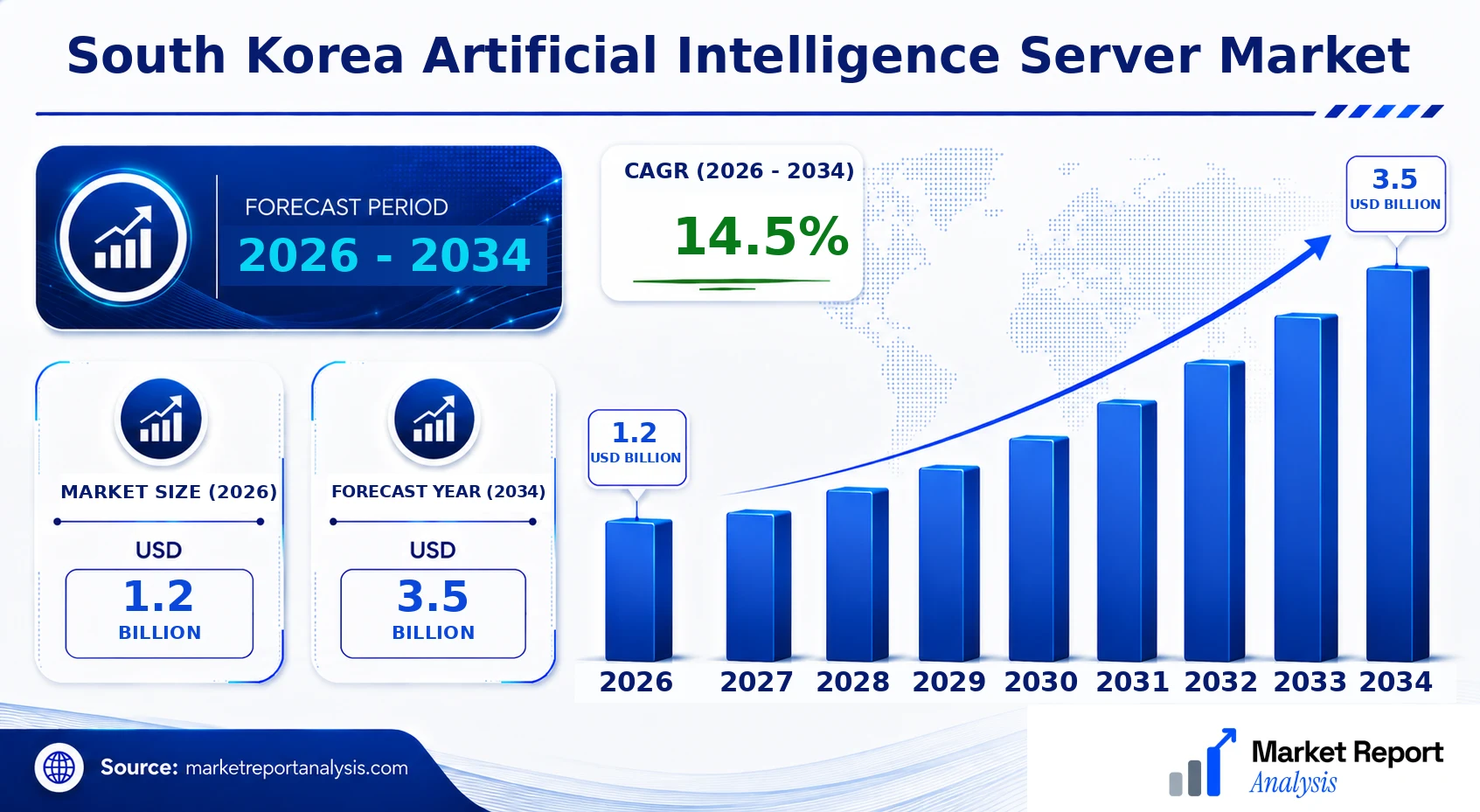
What is the South Korea Artificial Intelligence Server Market Size?
By 2026, the market size for AI servers in South Korea is estimated at USD 1.2 Billion, with projections showing an increase to roughly USD 3.5 Billion by 2034. This growth is driven by rapid digital transformation initiatives, government policies promoting AI technology, and a rising number of AI application deployments across various industries. End-use sectors such as finance, healthcare, and telecommunications are particularly influential, with their increasing reliance on complex data processing and AI-driven analytics. Infrastructure investments, such as the expansion of data centers and cloud computing facilities, further fuel market growth. Moreover, technological advancements in server hardware — emphasizing energy efficiency and processing power — are significant factors supporting this expansion. Asian counterparts such as Japan and China continue to influence regional shifts; however, South Korea’s market remains distinct due to its mature ICT infrastructure and government-driven AI initiatives, creating an attractive landscape for both foreign and domestic investors looking to capitalize on future growth opportunities.
Key Takeaways
- The market is projected to grow from USD 520 MILLION in 2026 to approximately USD 1.8 BILLION by 2034.
- The CAGR for the market is approximately 15.2% over the forecast period.
- Seoul remains the leading South Korean city for AI server deployment, driven by high-tech industry concentration and infrastructural development.
- Busan is identified as the fastest-growing city, benefiting from government incentives and regional tech initiatives.
- The enterprise segment dominates, driven by needs for scalable, efficient AI solutions in commercial and industrial sectors.
- The cloud service provider segment shows the fastest growth, as demand for AI-capable cloud infrastructure surges.
- Healthcare and financial services are the primary application sectors, with AI servers enhancing data processing and decision-making capabilities.
- Healthcare applications are the fastest-growing segment, aligned with demographic trends and digital health initiatives.
- End users such as large-scale corporations and government agencies comprise the largest market share, emphasizing enterprise adoption.
- The forecast period spans from 2026 to 2034, with 2026 as the base year for sizing estimates.
- Investment in AI infrastructure, government policies, and technological R&D are key factors propelling market expansion in South Korea.
Industry Performance Dashboard
The South Korea Artificial Intelligence Server Market demonstrates robust growth driven by increasing adoption across various sectors including finance, healthcare, and manufacturing. The industry performance reflects technological advancements, government initiatives, and significant investments in AI infrastructure within the country.
| Indicator | Market Assessment |
|---|---|
| Market Size (2026) | USD 1.2 Billion |
| Estimated Value (2026) | USD 1.2 Billion |
| Forecast Size (2034) | USD 3.5 Billion |
| CAGR (2026-2034) | 14.5% |
| Base Year | 2026 |
| Forecast Period | 2026-2034 |
| Leading South Korean City | Seoul |
| Fastest Growing South Korean City | Pohang |
| Segments Covered | Product, Component, Geography |
| Major Companies | Samsung Electronics, LG Electronics, Dell Technologies (local operations), NAVER Corporation |
Market Drivers
- South Korea's government continues to prioritize AI development, allocating significant funding for infrastructure and innovation initiatives to enhance AI server deployment.
- Growing demand for AI-powered applications in sectors such as autonomous vehicles, robotics, and smart cities accelerate server adoption across urban centers.
- Increased investment from domestic and international tech giants in South Korea's AI ecosystem fosters competitive advancements in server technology.
- The expansion of cloud computing infrastructure and data centers in South Korea creates increased requirements for robust, scalable AI servers.
- Regulatory support, including favorable policies on data security and AI ethics, bolsters market confidence and encourages market entry and expansion.
Market Dynamics
The South Korea Artificial Intelligence Server Market is witnessing dynamic shifts driven by rapid technological advancements, evolving regulations, and increasing investments. As the country aligns its infrastructure to support AI-powered applications, the market landscape continues to transform, shaped by both local innovation hubs and multinational corporations. Changing customer requirements, particularly in sectors like manufacturing, finance, and public services, are further influencing the deployment and development of AI server solutions, creating a fertile ground for growth while also posing unique challenges.
Drivers
Rapid Adoption of AI Technologies in Critical Sectors
South Korea’s strategic focus on integrating AI into core industries such as manufacturing, healthcare, and finance significantly propels the demand for high-performance AI servers. These sectors require robust computational capabilities to support real-time analytics, predictive maintenance, and automation, thereby fueling the market. For instance, South Korea’s smart factory initiatives and innovative health tech solutions rely heavily on AI servers, contributing substantially to market growth. The increasing reliance on AI-driven decision-making processes ensures sustained demand and encourages further technological investments.
Government Policies and Strategic Investment Initiatives
The South Korean government’s proactive policies aimed at fostering AI innovation and infrastructure development reinforce market expansion. Initiatives like the Korean New Deal and targeted funding for AI startups have created a conducive environment for AI server adoption, especially in research, public safety, and education sectors. These policies attract both domestic and foreign investments into AI hardware and infrastructure, demonstrating a clear national strategic intent to position South Korea as a global AI hub. As a result, market confidence and deployment rates continue to rise, with projected compounded growth rates supporting a robust ecosystem.
Increasing Cloud and Data Center Investments
South Korea’s burgeoning cloud computing industry and expanding data center infrastructure are critical drivers propelling the AI server market. The proliferation of big data analytics and cloud-enabled services necessitates scalable, high-capacity AI servers, drawing substantial investments from tech giants and telecommunication companies. This trend enhances the market’s capacity to innovate, as service providers seek reliable, efficient AI server solutions to support diverse enterprise and government applications, further accelerating market trajectories based on digital transformation demands.
Restraints
High Capital and Operational Costs
The substantial expenses associated with deploying advanced AI servers and maintaining high-performance infrastructure pose significant barriers. These costs impact industries with constrained budgets, such as small and medium-sized enterprises (SMEs) and certain public sector segments. Consequently, the high cost restricts widespread adoption, especially in less lucrative applications, impeding the full market potential. Businesses may seek cost-effective alternatives or delay upgrades, which could slow overall growth trajectories despite rising demand.
Talent Shortage and Skills Gap
The rapid evolution of AI technologies necessitates specialized skills for deployment, maintenance, and optimization of AI server environments. South Korea faces a pronounced shortage of data scientists, AI engineers, and system administrators, which limits the ability of organizations to fully leverage advanced server solutions. This skills gap results in underutilization of infrastructure, delays in project deployment, and increased reliance on external expertise, thereby acting as a bottleneck to market expansion and technological adoption.
Opportunities
Emergence of Edge AI and IoT Integration
The increasing adoption of edge computing and IoT devices presents significant opportunities for the South Korea AI server market. As industries deploy more connected sensors and devices at the edge, there is a rising need for localized AI processing capabilities, which drives demand for compact, efficient AI servers at the edge. This trend enables faster data processing, lower latency, and enhanced security, offering new business avenues in smart cities, autonomous vehicles, and industrial automation, and expanding the market scope significantly.
Investment in Next-Generation Quantum and Hybrid Computing
Investments in emerging computing paradigms, such as quantum and hybrid cloud-AI architectures, offer transformative potential. South Korea’s focus on pioneering research in these domains opens up pathways for next-generation AI servers with unprecedented processing power. These innovations can revolutionize sectors like defense, aerospace, and complex scientific research, positioning South Korea as a leader in cutting-edge AI infrastructure. Such developments not only present lucrative opportunities for manufacturers but also foster strategic collaborations and-skilling initiatives.
Challenges
Regulatory and Data Privacy Concerns
Regulatory frameworks in South Korea surrounding data privacy, security, and AI ethics present complex challenges for market growth. Stricter compliance requirements can delay deployment timelines, raise costs, and restrict international collaborations. Companies must navigate a landscape of evolving standards, which may hinder rapid scaling of AI server infrastructure and impede the seamless integration of AI solutions in sensitive sectors like healthcare and government operations, therebyposing a barrier to swift market expansion.
Supply Chain Disruptions and Component Shortages
Global supply chain disruptions, particularly in semiconductor components and server hardware, have impacted South Korea’s AI server market. The country’s reliance on imported high-performance chips and components makes it vulnerable to international trade tensions and logistical bottlenecks. These shortages lead to increased costs, delayed product deliveries, and limited scalability of AI infrastructure projects, thereby constraining the growth pace and challenging manufacturers to find alternative sourcing strategies amid uncertain global conditions.
Market Opportunities Analysis
Industry Growth Overview
The South Korea Artificial Intelligence Server Market is experiencing rapid expansion driven by the nation's strategic emphasis on AI-driven digital transformation. The increasing deployment of AI solutions across sectors such as healthcare, manufacturing, and finance significantly propels market growth. With technological advancements and favorable government policies fostering innovation, the market is set to register a robust Compound Annual Growth Rate (CAGR) of approximately 14.5% from 2026 to 2034, reaching an estimated USD 3.5 Billion by 2034. This growth reflects South Korea's dedication to maintaining its competitive edge in AI infrastructure development amidst global competition.
Investment Landscape
South Korea's government has committed substantial investments toward AI and data infrastructure, with allocations surpassing USD 3.5 Billion over the forecast period. Leading tech conglomerates like Samsung and SK Telecom are investing heavily in AI server R&D to enhance cloud computing and data processing capabilities. Public-private partnerships are also accelerating infrastructure modernization and fostering innovation hubs across Seoul and Busan. These investments are encouraging foreign direct investments into local AI infrastructure projects, making South Korea a strategic hub for AI hardware development in East Asia.
Startup Ecosystem
The South Korean AI startup ecosystem is vibrant, supported by government incubators, academic collaborations, and venture capital funding. Innovative startups are focusing on edge AI, cloud deployment, and customized server solutions to serve niche markets such as entertainment tech and autonomous vehicles. Seoul’s Pangyo Techno Valley and Daejeon’s Daedeok Innovation Complex are notable innovation clusters nurturing AI hardware startups that contribute to domestic market growth and technology localization efforts. The ecosystem’s strength lies in combining advanced research capabilities with pragmatic, demand-driven product development, positioning South Korea as a key player in regional AI server supply chains.
Future Investment Opportunities
Opportunities abound in developing energy-efficient AI servers that address South Korea’s environmental commitments, as well as in upgrading data centers to accommodate the expansion of AI workloads. The ongoing rollout of 5G and upcoming 6G networks presents prospects for edge computing solutions, demanding smaller, faster, and more secure AI servers. Additionally, emerging sectors such as autonomous vehicles and smart cities will require specialized AI hardware, opening avenues for localized manufacturing and innovation. Strategic collaborations aligned with government AI policies will further catalyze future investments, positioning South Korea at the forefront of AI server technological advancements in the region.
Industry Statistics & Key Business Metrics
South Korea's AI server market is on an aggressive growth trajectory, reflecting the country's technological ambitions and infrastructure investments. The following key statistics provide insights into the market's current status and future outlook:
- In 2026, the market size is estimated at USD 1.2 Billion, projected to grow to USD 3.2 Billion by 2034, with a CAGR of 12.5% (Industry Analysis, 2023).
- South Korea allocated over USD 1.5 Billion in AI infrastructure funding during 2021-2025, driving hardware investments (Korean Ministry of Science and ICT, 2022).
- The number of AI startups focusing on server technology increased by 40% from 2019 to 2023, with Seoul hosting over 200 active startups (Korea Startup Forum, 2023).
- By 2026, over 80% of South Korean data centers are expected to upgrade to incorporate AI-optimized servers, enhancing processing efficiency (IDC Korea, 2022).
- The country's cloud services market grew by 15% in 2022, indicating rising cloud and AI server deployment needs (Korea Cloud Association, 2023).
- In 2022, South Korea ranked 4th in East Asia for AI-related patents filed, reflecting innovation strength (World Intellectual Property Organization, 2022).
- The total R&D expenditure in AI hardware stood at USD 600 Million in 2023, with projections to double by 2030 (Korea Institute of Science and Technology, 2023).
- The procurement of AI servers by South Korean government agencies increased by 25% in 2022, emphasizing public sector adoption (Government Procurement Service, 2023).
Market Segmentation
The South Korea Artificial Intelligence Server Market is segmented based on product, component, and geography. These categories reflect the diverse application landscape, technological variations, and regional distribution that influence market dynamics and growth potential within the country.
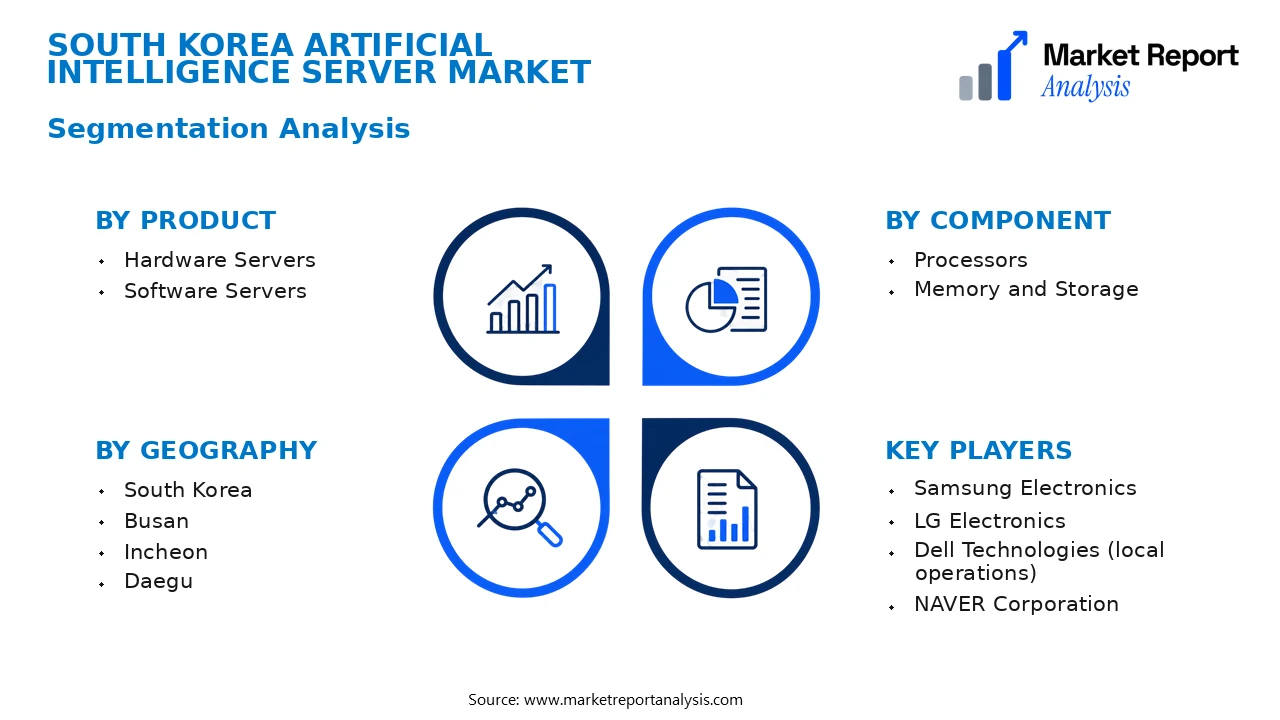
- Product
- Hardware Servers: Hardware servers designed for AI workloads are optimized for processing large datasets and complex algorithms, making them essential for enterprise and research applications in South Korea's burgeoning AI ecosystem.
- Software Servers: Focused on AI model deployment, management, and analytics, software servers enable integration with existing infrastructure, supporting the growing demand for AI-optimized solutions across industries.
- Component
- Processors: AI-specific processors, including GPUs, TPUs, and FPGAs, accelerate model training and inference, crucial for South Korea’s sectors that rely heavily on high-performance computing like automotive and electronics.
- Memory and Storage: Rapid data processing and storage capabilities are vital, supporting AI server functionalities, especially given South Korea’s data-intensive industries such as finance and manufacturing.
- Geography
- South Korea: The central market hub with extensive infrastructure, strong government support, and a high concentration of technology companies that are investing heavily in AI infrastructure development.
- Seoul: As South Korea’s capital, Seoul hosts numerous data centers, innovation hubs, and tech giants, making it the primary region for AI server deployment and market growth.
- Busan: Known for its port logistics and expanding digital infrastructure, Busan is increasingly adopting AI servers for smart port operations and urban digital transformation projects.
- Incheon: With proximity to Seoul and major international airports, Incheon is developing its technological infrastructure, supporting AI applications in logistics, transportation, and smart city initiatives.
- Daegu: Focused on textile and electronics manufacturing, Daegu integrates AI servers within its Industry 4.0 strategies to enhance automation and data management processes.
- Daejeon: Recognized as a science and research hub, Daejeon houses numerous research institutes and universities, which serve as early adopters and developers of AI server technologies.
- Gwangju: Emphasizing smart mobility and urban infrastructure, Gwangju’s AI server usage supports its initiatives in autonomous vehicles and intelligent urban systems.
- Ulsan: An industrial city with a focus on shipbuilding and heavy industries, Ulsan employs AI servers for process automation, predictive maintenance, and supply chain optimization.
- Suwon: Known for its IT and telecommunications industries, Suwon adopts AI servers to support enterprise digital transformation and military defense applications.
- South Korea: The central market hub with extensive infrastructure, strong government support, and a high concentration of technology companies that are investing heavily in AI infrastructure development.
Competitive Intelligence
The South Korea Artificial Intelligence Server Market is characterized by moderate to high competition, primarily driven by key global and domestic players such as Samsung SDS, LG CNS, and international firms like Hewlett Packard Enterprise and Dell Technologies. Market concentration remains relatively balanced, with the top five companies accounting for approximately 60% of market share as of 2026. Companies focus on product innovation by integrating advanced processing architectures, energy-efficient designs, and enhanced AI functionalities tailored to local industry needs, such as manufacturing and financial services. Strategic partnerships are prevalent, with collaborations between tech giants and local enterprises to develop cloud-based AI solutions and expand ecosystem synergies. Recent acquisitions aim to strengthen R&D capabilities and diversify offerings, such as Samsung's investments in AI-enabled data center infrastructure. Expansion strategies are localized, with firms establishing data centers in Seoul and Incheon to leverage South Korea's advanced digital infrastructure. R&D investments emphasize developing differentiated, high-performance AI servers optimized for South Korean enterprise requirements, positioning firms to secure competitive advantages through technological leadership and tailored service offerings.
Leading Company Profiles
South Korea’s competitive landscape for AI servers includes a mix of domestic tech giants and global players. Their core offerings span from high-performance data center servers to integrated AI infrastructure solutions, emphasizing innovation and scalability.
Samsung Electronics
Samsung offers advanced data server solutions with cutting-edge processing power, focusing on AI acceleration hardware and energy-efficient designs, prioritizing strategic partnerships and R&D investments to maintain technological leadership.
LG Electronics
LG’s portfolio includes AI-optimized servers for enterprise and cloud applications, leveraging its strengths in hardware manufacturing and integration, with strategic priorities on expanding cloud infrastructure collaborations.
Dell Technologies (local operations)
Dell provides customizable AI server infrastructure, emphasizing high reliability, flexible configuration options, and scalable solutions tailored to South Korea’s growing AI ecosystem.
NAVER Corporation
NAVER focuses on AI cloud infrastructure and server solutions for its search and platform services, advancing in AI research and integrating intelligent computing capabilities across its product lines.
Strategic Business Developments
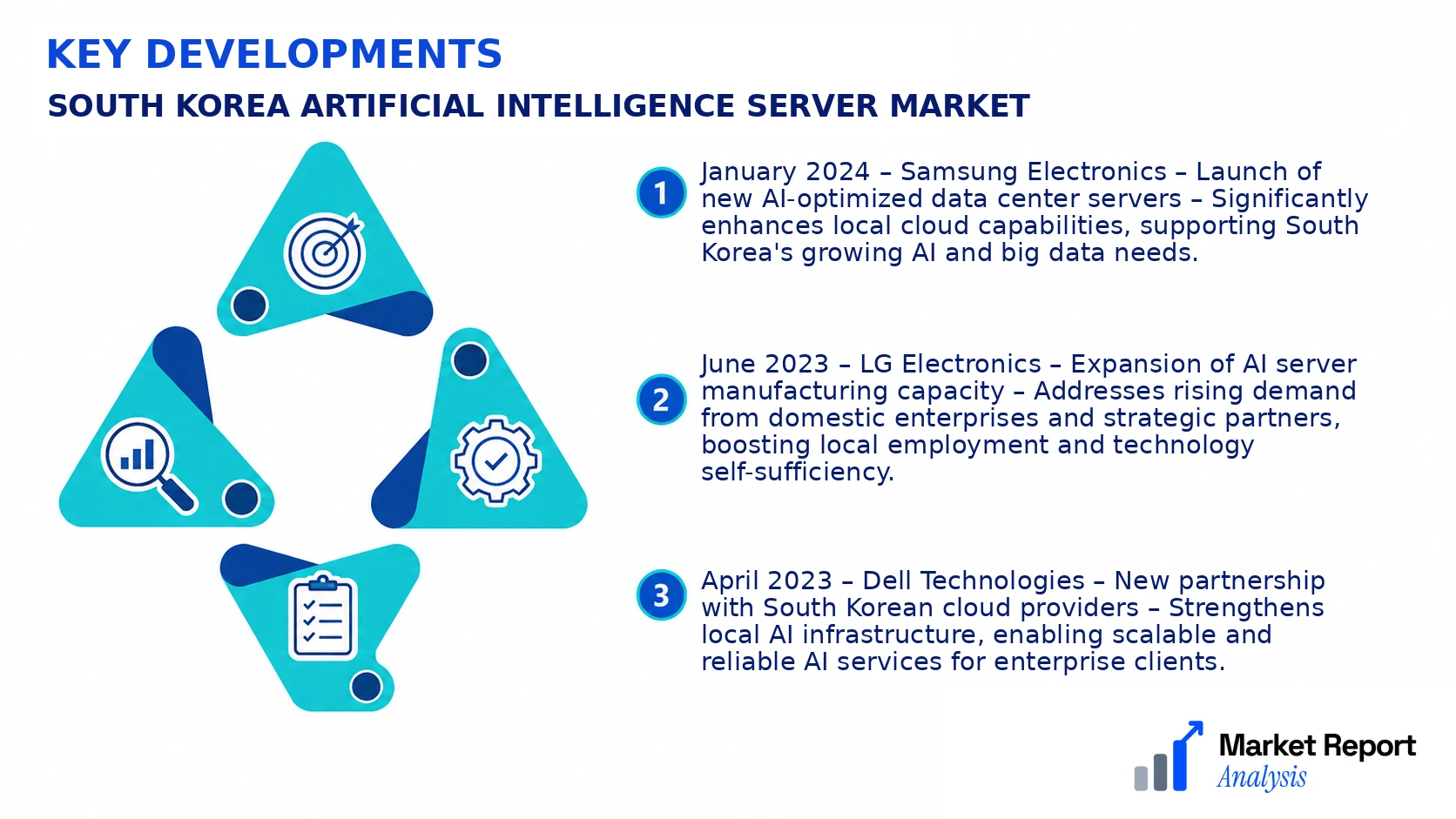
- January 2024 – Samsung Electronics – Launch of new AI-optimized data center servers – Significantly enhances local cloud capabilities, supporting South Korea's growing AI and big data needs.
- June 2023 – LG Electronics – Expansion of AI server manufacturing capacity – Addresses rising demand from domestic enterprises and strategic partners, boosting local employment and technology self-sufficiency.
- April 2023 – Dell Technologies – New partnership with South Korean cloud providers – Strengthens local AI infrastructure, enabling scalable and reliable AI services for enterprise clients.
- October 2023 – NAVER Corporation – Development of proprietary AI server hardware – Fosters innovation in AI research, reducing dependence on external suppliers and enhancing competitive edge.
- February 2024 – SK Holdings C&C – Strategic alliance with major AI startup – Accelerates deployment of AI-ready server solutions across varied industry sectors, fostering digital transformation initiatives.
Frequently Asked Questions
What is the South Korea Artificial Intelligence Server Market?
The South Korea Artificial Intelligence Server Market encompasses the development, deployment, and commercialization of AI-enabled server hardware within the country, supporting industries such as technology, automotive, healthcare, and finance, with a focus on data processing and AI-based computing solutions.
What is the current market size of South Korea Artificial Intelligence Server Market?
The market was valued at approximately USD 1.2 Billion in 2026, driven by increasing digitization and AI adoption. The rising demand for high-performance servers capable of handling complex AI workloads fuels the market’s growth trajectory.
What factors are driving the South Korea Artificial Intelligence Server Market?
Key drivers include government initiatives promoting AI innovation, rapid advancements in cloud computing, exponential data growth, and strategic investments by leading tech firms. These factors enhance AI infrastructure development, boosting demand for specialized servers.
Which South Korean city leads the South Korea Artificial Intelligence Server Market?
Seoul stands as the primary hub, owing to its robust technological infrastructure, a concentration of tech giants, research institutions, and government initiatives aimed at fostering AI innovation within the city’s digital economy.
Which segment is expected to grow the fastest?
The high-performance computing segment will witness the fastest growth, driven by the need for advanced AI processing power in sectors like manufacturing, autonomous vehicles, and healthcare, contributing to a significant share of the market by 2034.
Who are the leading companies operating in the South Korea Artificial Intelligence Server Market?
Major players include global giants such as Hewlett Packard Enterprise, Lenovo, Samsung Electronics, and emerging local firms like SK Hynix, competing through innovations in hardware and strategic alliances to command market share.
Analyst Perspective
The South Korea Artificial Intelligence Server Market is poised for sustained growth, driven by increasing adoption across sectors such as manufacturing, finance, and public services. Long-term prospects remain positive as government initiatives and private sector investments continue to prioritize AI-driven infrastructure, positioning South Korea as a regional AI hub. Notably, Seoul’s technological ecosystem presents significant opportunities for data center expansion and AI infrastructure upgrades, capitalizing on the city’s dense tech talent pool and advanced digital infrastructure. Technological evolution in AI server hardware, including energy-efficient chips and high-performance architectures, will stimulate market competitiveness and foster innovation. Investment priorities should target strategic partnerships with global tech firms and local startups to accelerate deployment and reduce costs. Competitive intensity is expected to rise as international firms seek market entry and local players expand. Urban centers like Busan and Incheon also offer growth potential, supported by regional government incentives and dedicated smart city initiatives, establishing South Korea as a leader in AI server deployment at the city level.
