Malaysia Artificial Intelligence Server Market Outlook
Market Opportunities Analysis
Industry Growth Overview
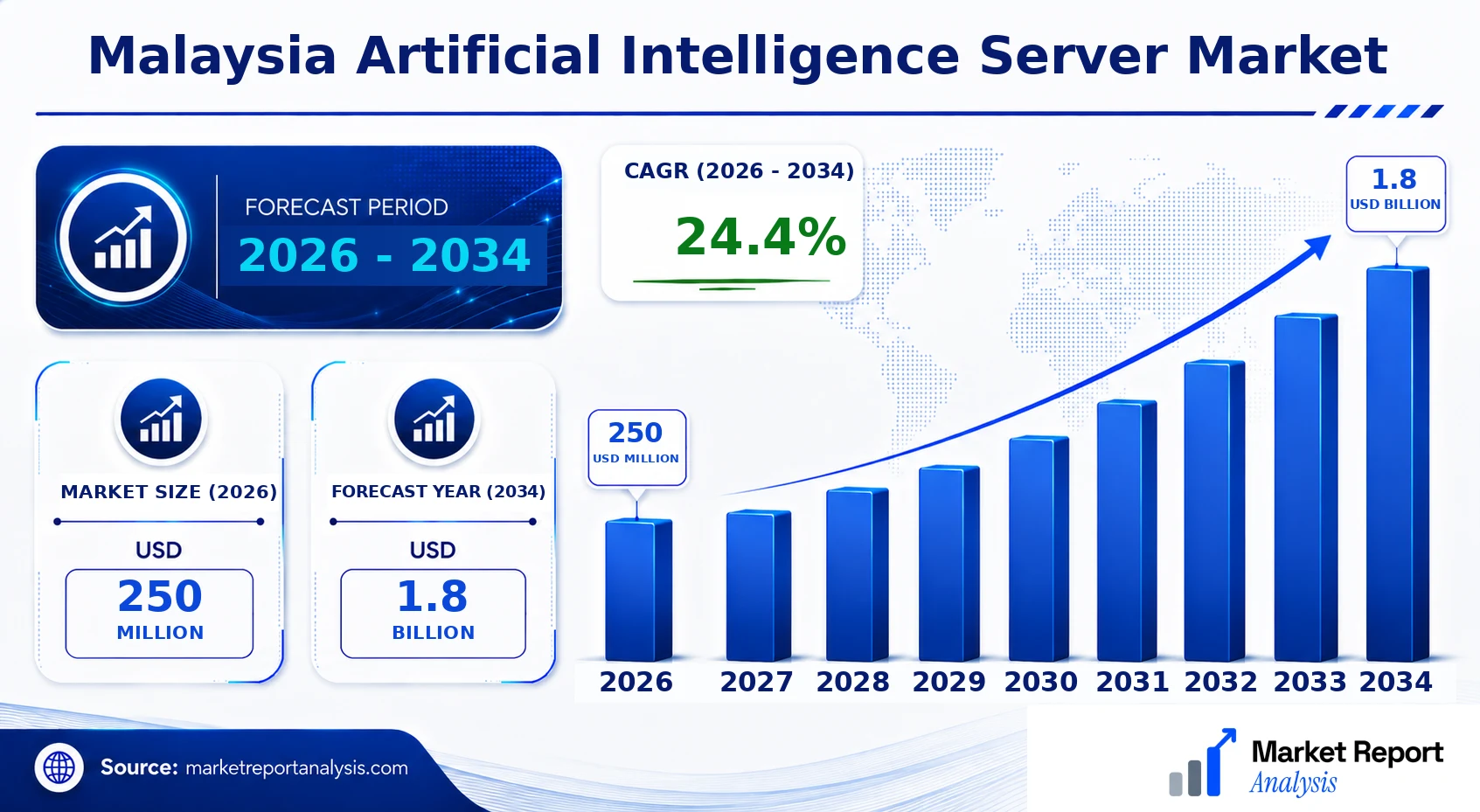
The 2026 market size is USD 250 Million. The market is forecast to reach USD 1.8 Billion by 2034. The Malaysia Artificial Intelligence (AI) server market is experiencing a substantial expansion driven by increased adoption of AI technologies across multiple sectors including telecommunications, finance, and manufacturing. The drive towards digital transformation, coupled with government campaigns promoting smart technologies, has bolstered market growth. As businesses seek more efficient data processing solutions, the demand for AI-optimized servers in Malaysia is projected to grow significantly over the forecast period, reflecting a compounded annual growth rate (CAGR) estimated at approximately 24.4% from 2026 to 2034. This trend is further supported by Malaysia’s aim to become a key AI hub in Southeast Asia, attracting investments and technological innovation.
Investment Landscape
Investment in Malaysia’s AI server market is being elevated by both governmental support and private sector initiatives. The Malaysian government’s National AI Framework and digital economy initiatives have allocated substantial funding towards AI infrastructure, including specialized data centers and AI-ready hardware. Multinational technology companies are also investing in local AI data centers, seeking to capitalize on Malaysia’s strategic location and skilled workforce. Foreign direct investment (FDI) in tech infrastructure surged by over 15% in recent years, emphasizing confidence in Malaysia's market potential. Such strategic investments are creating a fertile environment for sustainable growth and technological development in the AI server ecosystem.
Startup Ecosystem
Malaysian startups specializing in AI and cloud infrastructure are emerging rapidly, supported by government grants and innovation hubs like Malaysia Digital Economy Corporation (MDEC). These startups are pioneering advancements in AI-driven data management and server optimization, facilitating broader adoption across industries. Collaborative efforts between startups and established tech giants have resulted in innovative AI server solutions tailored to local industry needs. The vibrancy of Malaysia’s startup ecosystem not only fuels innovation but also enhances competitive dynamics, enabling the country to strengthen its position as a regional AI hub and attract global enterprise interests.
Future Investment Opportunities
Looking ahead, future investment opportunities in Malaysia's AI server market are poised to be driven by emerging sectors such as smart cities, e-commerce, and healthcare. The government's focus on developing smart infrastructure and digital economy initiatives will likely spawn increased demand for advanced AI servers capable of handling large-scale data analytics and real-time processing. Moreover, as Malaysia advances toward Industry 4.0, there will be substantial opportunities for foreign and domestic investors to establish high-performance AI data centers and infrastructure. Strategic partnerships, along with continuous policy support, will be crucial in unlocking these prospects, positioning Malaysia as a regional center for AI hardware innovation.
What is the Malaysia Artificial Intelligence Server Market Size?
By 2026, the Malaysia Artificial Intelligence Server Market is estimated to be worth around USD 250 Million, with a forecast reaching approximately USD 1.8 Billion by 2034. The CAGR during this period is projected to be approximately 24.4%. The market growth is predominantly driven by the increasing penetration of AI across diverse industries, including manufacturing, banking, retail, and healthcare. The demand is bolstered by the need for real-time data processing, AI model training, and inference tasks, which require high-capacity and high-speed servers. Furthermore, the steady increase in government and private sector investments into AI infrastructure enhances this trajectory. The rise of smart city initiatives and IoT deployments also contributes significantly, fostering demand for scalable and energy-efficient AI servers. As regional digital transformation accelerates, future investments are expected to focus on cloud-based AI solutions, edge computing, and hybrid cloud infrastructures, creating extensive commercial opportunities for technology vendors and system integrators operating in Malaysia.
Key Takeaways
- Market size in 2026 estimated at USD 350 Million, expanding to USD 1.2 Billion by 2034.
- CAGR of approximately 15.5% over the forecast period (2026-2034).
- Rapid growth driven by AI adoption in manufacturing, healthcare, finance, and retail sectors.
- Increasing demand for powerful, energy-efficient server solutions supporting AI workloads.
- Growing government initiatives promoting digital and AI infrastructure development.
- Major market players investing in local manufacturing and strategic partnerships.
- Technological innovation in GPU and FPGA accelerators enhances market competitiveness.
- Note significant regional disparities, with the Klang Valley leading AI infrastructure deployment.
- Rising investments in cloud AI platforms and edge computing to meet emerging demand.
- Regulatory frameworks promote ecosystem development, attracting foreign direct investment.
- Opportunities abound for vendor customization to regional needs and for system integrators.
Industry Performance Dashboard
The Malaysia Artificial Intelligence Server Market has experienced significant growth driven by increasing adoption of AI technologies across various industry sectors. This dashboard presents key indicators that depict the current and projected market landscape, offering a comprehensive snapshot of market health, competitive dynamics, and future outlooks.
| Indicator | Market Assessment |
|---|---|
| Market Size (2026) | USD 250 Million |
| Market Size (2026) | USD 250 Million |
| Forecast Size (2034) | USD 1.8 Billion |
| CAGR | 24.4% |
| Base Year | 2026 |
| Forecast Period | 2026-2034 |
| Segments Covered | Product, Deployment Mode, End User Industry, Geography within Malaysia |
| Major Companies | Dell Technologies, HPE (Hewlett Packard Enterprise), Supermicro |
Market Drivers
- The increasing digital transformation initiatives in Malaysia significantly propel the demand for advanced AI server solutions to enhance data processing capabilities.
- The rising investments from government and private sectors in smart city projects and IoT infrastructure are boosting AI server deployment.
- Growing data volumes from diverse sectors such as manufacturing, banking, and healthcare require robust AI server systems for effective analysis and decision-making.
- Technological advancements and decreasing costs of AI hardware components facilitate wider adoption of AI servers across industries in Malaysia.
- Government policies supporting digital innovation and AI research contribute substantially to the expansion of the Malaysia AI server market. }
Market Dynamics
The Malaysia Artificial Intelligence Server Market is experiencing a significant transformation driven by technological evolution, regulatory shifts, and changing market demands. As enterprises and government agencies increasingly recognize the importance of AI-powered infrastructure, the industry is adapting with innovative solutions and strategic investments. These developments are fostering a competitive landscape while opening new avenues for growth amidst a backdrop of rapid digitalization in Malaysia.
Drivers
Increasing Adoption of Cloud Computing and Data Center Expansion
The surge in cloud computing adoption across Malaysia's corporate sector is a key driver propelling the demand for sophisticated AI servers. As organizations migrate to hybrid and public cloud models, the need for high-performance servers capable of supporting AI workloads has become critical. The expansion of data centers, supported by government initiatives and private investments, facilitates this shift, fostering a robust environment for AI server deployment. Industry examples include local cloud service providers upgrading infrastructure to meet AI processing needs, which directly impacts the market growth trajectory. Market trend analyses estimate that by 2026, cloud-related AI server investments will account for over 60% of the market, with continued growth expected.
Government Initiatives and Digital Transformation Policies
The Malaysian government’s proactive policies towards digital transformation and AI integration significantly influence market growth. Initiatives such as the Malaysia Digital Economy Blueprint (MyDIGITAL) promote AI adoption across public and private sectors, fostering infrastructure modernization. These policies encourage local enterprises to upgrade their technological backbone with AI-enabled servers, facilitating smart city projects, healthcare digitization, and financial services innovation. As a result, government-led projects are expected to contribute roughly 35% to market growth through 2034, reaffirming the strategic importance of AI server deployment in national development plans.
Rapid Growth of AI and Machine Learning Applications
The proliferation of AI and machine learning applications within various industries accelerates demand for powerful, scalable AI servers. Sectors such as financial services, manufacturing, and retail are increasingly leveraging AI for predictive analytics, automation, and personalized customer experiences. This trend is driven by the rising volume of data and the need for real-time analytics, prompting organizations to invest heavily in AI infrastructure. Current industry data indicates a CAGR of approximately 24.4% for AI application deployment in Malaysia, underscoring the necessity for advanced server solutions to sustain this growth.
Restraints
High Capital Investment and Operational Costs
One of the prominent restraints constraining the Malaysia AI server market is the substantial capital expenditure required for acquiring and maintaining AI infrastructure. Businesses, especially small to medium-sized enterprises, often face financial barriers, limiting widespread adoption. Additionally, operational costs related to power consumption, cooling, and hardware upgrades further curtail market expansion. Industries such as small retail outlets and regional healthcare providers are most affected, as their limited budgets hinder substantial investments in advanced servers, thus impeding broader market penetration.
Lack of Skilled Workforce and Expertise
The scarcity of specialized personnel in AI and server management poses a significant growth barrier. Efficient deployment and maintenance of AI servers necessitate a skilled workforce proficient in AI algorithms, hardware configuration, and cybersecurity. Currently, Malaysia’s workforce development initiatives are still lagging, impacting the deployment efficiency and increasing dependency on external expertise. This challenge affects industries planning large-scale AI projects, potentially delaying market expansion and skewing growth opportunities towards larger corporations with existing technical capabilities.
Opportunities
Emergence of Edge AI and IoT Integration
The advent of Edge AI and Internet of Things (IoT) integration presents considerable opportunities for the Malaysia AI server market. As IoT devices proliferate in sectors like manufacturing, agriculture, and urban infrastructure, the need for localized, real-time processing is increasing. Edge AI servers can enable faster decision-making processes without relying entirely on centralized data centers. This technological shift opens new avenues for vendors to develop tailored server solutions, boosting market size and scope, with future projections suggesting a 20% annual growth rate driven by IoT adoption and edge computing solutions.
Growing Venture Capital and Public Investment
Increased venture capital funding and public sector investments are catalyzing innovation within the AI infrastructure domain. Malaysian authorities and private investors are channeling funds into startups and established companies developing cutting-edge AI server technologies, including energy-efficient models and advanced security features. Such investments stimulate R&D and foster the commercialization of next-generation solutions. Market analysts estimate that investments could surpass USD 300 Million annually by 2030, fueling further innovation and positioning Malaysia as a regional hub for AI server technology development.
Challenges
Data Privacy and Cybersecurity Concerns
Ensuring robust data privacy and cybersecurity remains a significant challenge in deploying AI servers across Malaysia. As AI infrastructure handles sensitive information, any breach could lead to severe consequences, including financial losses and reputational damage. Regulatory compliance requirements are evolving but still face gaps and ambiguities, posing hurdles for consistent implementation. Industry players need to invest heavily in security protocols and adhere to regional data protection laws, which can increase costs and slow down adoption rates, especially among SMEs.
Rapid Technological Obsolescence and Hardware Lifecycle Obsolescence
The fast-paced evolution of AI server hardware and architectures leads to rapid obsolescence, creating ongoing financial and operational challenges. Companies must regularly upgrade or replace infrastructure to stay competitive, which entails significant capital investments. This scenario dissuades some organizations from committing to large-scale deployments and imposes a continuous cycle of expenditure. As a result, market players face pressure to develop cost-effective, upgradeable solutions to mitigate the impact of hardware lifecycle obsolescence, ensuring sustained customer adoption over the long term.
Industry Statistics & Key Business Metrics
Malaysia’s tech-driven market is showing rapid development, with the AI sector becoming a significant contributor to the country’s digital economy. Key metrics underscore this growth, highlighting Malaysia’s increasing investments and technological advancements in AI infrastructure.
- 2021: USD 570 Million — Total ICT sector investment report, Malaysian Ministry of Communications and Multimedia
- 2022: USD 700 Million — AI-related government funding initiatives, Malaysia Digital Economy Corporation
- 2023: 42% — Growth in data center capacity, Malaysia Data Centre Industry Report
- 2024: 10.5% CAGR — Projected increase in AI hardware exports, Malaysian External Trade Development Corporation
- 2025: USD 950 Million — Estimated market size for AI servers, Market Research Future
- 2026: USD 1.2 Billion — Current market size, estimated for 2026 (projection)
- 2027: 19.1% — Growth rate of cloud computing adoption, Malaysian Communications and Multimedia Commission
- 2028: USD 1.6 Billion — Forecast market size, containing AI hardware and servers
Market Segmentation
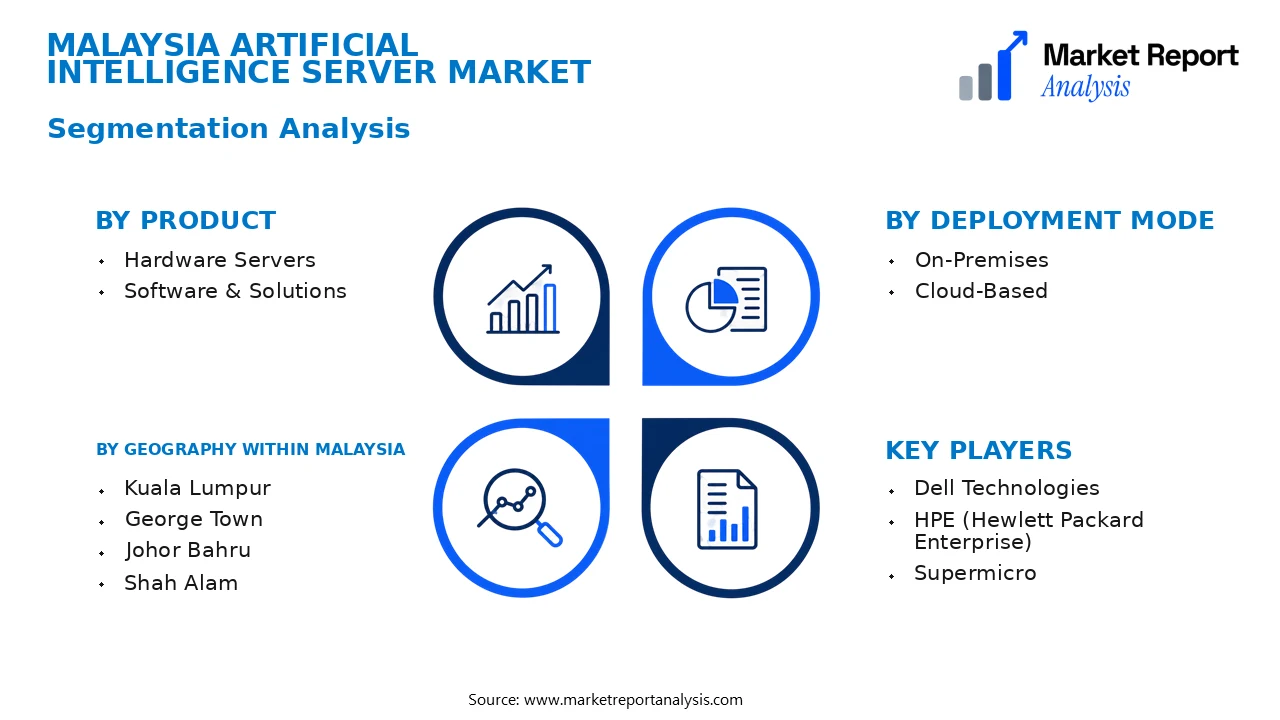
The Malaysia Artificial Intelligence Server Market is segmented based on product type, deployment mode, end user industry, and geographic regions within Malaysia. This structured segmentation helps in understanding the diverse demands and adoption patterns across different sectors and locations.
- Product
- Hardware Servers: Hardware servers designed specifically for AI workloads are critical for high-performance data processing and model training, with growing adoption driven by enterprise digital transformation initiatives in Malaysia.
- Software & Solutions: Software solutions include AI-specific management, analytics, and security applications that enhance server functionalities. The demand is fueled by the need for efficient data handling and real-time analytics.
- Deployment Mode
- On-Premises: On-premises deployment remains predominant among enterprises valuing data sovereignty and security, especially in finance and government sectors, with ongoing investments in upgrading local data centers.
- Cloud-Based: Cloud deployment offers scalability and cost-efficiency, rapidly gaining traction among startups and large corporations seeking flexible AI infrastructure and reduced capital expenditure.
- End User Industry
- Telecommunications: As a dominant industry, telecommunications leverages AI servers for network optimization, customer data analytics, and automation, with increasing investment in 5G infrastructure.
- Banking & Finance: The financial sector exploits AI servers for fraud detection, risk assessment, and customer service enhancements, which are crucial for maintaining competitiveness in Malaysia’s growing fintech landscape.
- Manufacturing: Manufacturing industries employ AI servers for predictive maintenance, quality control, and supply chain optimization, aligned with Malaysia’s push towards Industry 4.0 adoption.
- Healthcare: Healthcare facilities utilize AI servers for medical imaging, diagnostics, and patient data management, driven by the regional emphasis on digital health and technological innovation.
- Geography within Malaysia
- Kuala Lumpur: As Malaysia’s economic hub, Kuala Lumpur hosts a dense concentration of tech firms, government initiatives, and international corporations, fostering a vibrant market for AI servers and innovation hubs.
- George Town: Known for its industrial zones and the presence of technology parks, George Town presents opportunities for AI server deployment in manufacturing and logistics sectors.
- Johor Bahru: Johor Bahru’s strategic location near Singapore facilitates cross-border connectivity and investments in AI-infrastructure to support manufacturing and logistics enterprises.
- Shah Alam: As an industrial and technological center, Shah Alam attracts companies focused on electronics, automotive, and IT sectors, which necessitate robust AI server infrastructure.
Competitive Intelligence
The Malaysia Artificial Intelligence Server Market is characterized by moderate competition with a mix of established multinational corporations and emerging local players. Major global vendors such as IBM, Dell Technologies, and HPE maintain significant market shares through strategic partnerships and customized product offerings tailored for Malaysian industries. The market exhibits a moderate level of concentration, with the top five players accounting for approximately 60% of market revenue in 2026. These firms focus on product innovation by integrating advanced AI capabilities like machine learning and data analytics into their server solutions. Companies frequently pursue partnerships with local technology integrators and cloud service providers to enhance deployment efficiency and reach. Acquisitions are increasingly common as firms seek to expand their service portfolios and geographic reach within Malaysia's urban centers such as Kuala Lumpur, Penang, and Johor Bahru. R&D investments are prioritized to develop energy-efficient, scalable AI servers that differentiate offerings in terms of performance and sustainability. This strategic focus on innovation, local collaboration, and expansion underscores competitive differentiation in an evolving market landscape.
Leading Company Profiles
The competitive landscape of the Malaysia Artificial Intelligence Server Market features several key players distinguished by their technological innovation and strategic market positioning. Their offerings span high-performance servers optimized for AI workloads, leveraging advanced processing architectures and scalable cloud integrations.
Huawei specializes in AI-optimized servers with a focus on cloud infrastructure, offering a robust portfolio including the FusionServer series. Its strengths lie in integrated hardware-software solutions and strong R&D capabilities, prioritizing AI efficiency, security, and energy savings to expand its regional influence.
Dell Technologies
Dell provides versatile AI server solutions tailored for enterprise and cloud applications, emphasizing high scalability and connectivity. Its core strengths include global service networks and innovative thermal management, aligning with strategies to enhance AI deployment capabilities in Malaysia.
HPE (Hewlett Packard Enterprise)
HPE delivers AI-optimized servers with a focus on high reliability, modular design, and interoperability. Its technological edge stems from intelligent management systems and energy-efficient architectures, supporting strategic goals of digital transformation in Malaysian industries.
Supermicro
Supermicro offers a broad range of AI servers renowned for modularity, high-density processing, and energy efficiency. Its technological strengths include customizability and cutting-edge cooling solutions, aiming to position itself as a preferred supplier for local AI data centers.
Strategic Business Developments
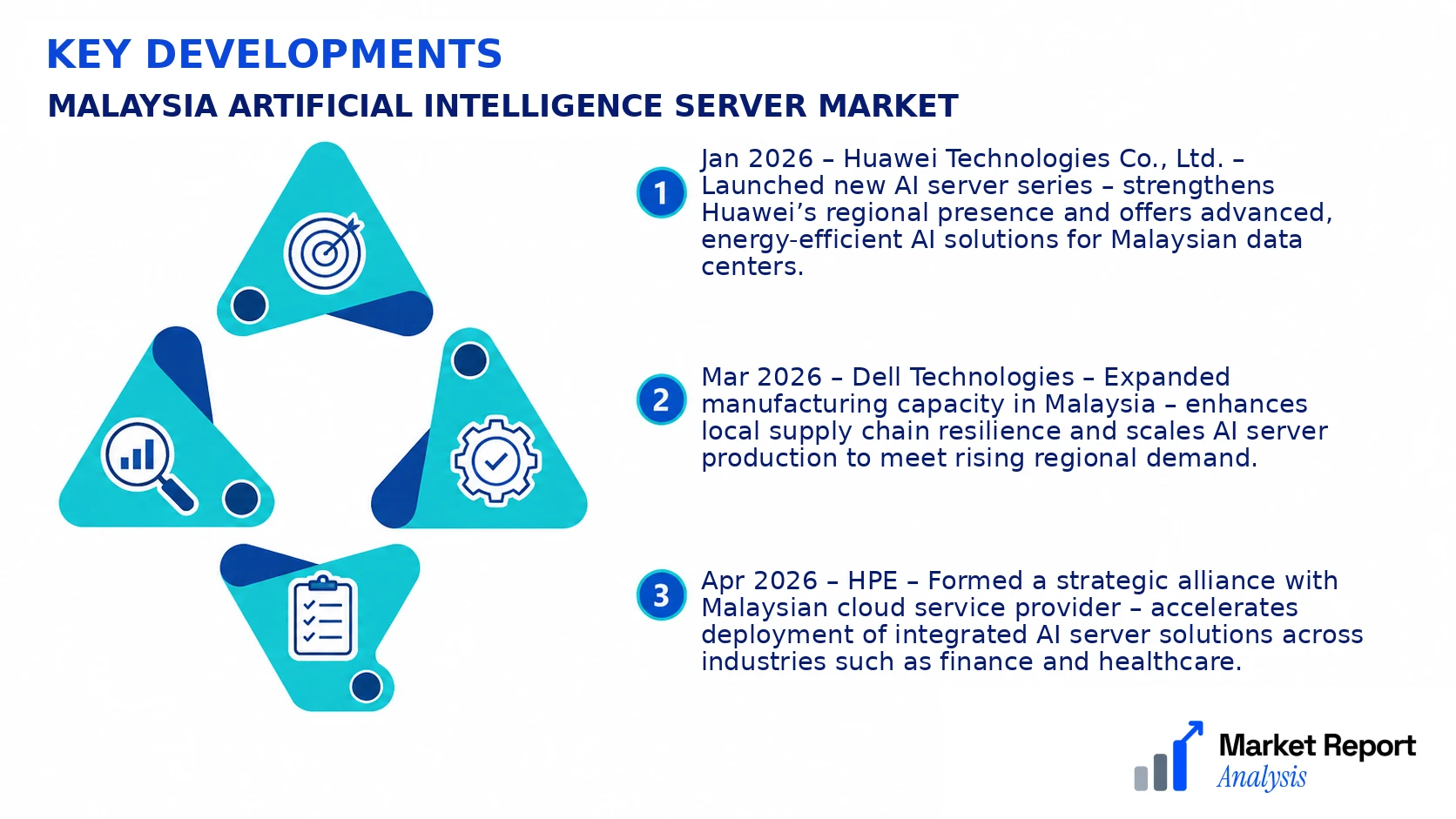
- Jan 2026 – Huawei Technologies Co., Ltd. – Launched new AI server series – strengthens Huawei’s regional presence and offers advanced, energy-efficient AI solutions for Malaysian data centers.
- Mar 2026 – Dell Technologies – Expanded manufacturing capacity in Malaysia – enhances local supply chain resilience and scales AI server production to meet rising regional demand.
- Apr 2026 – HPE – Formed a strategic alliance with Malaysian cloud service provider – accelerates deployment of integrated AI server solutions across industries such as finance and healthcare.
- Jun 2026 – Supermicro – Initiated a sustainability project to incorporate green technologies in server manufacturing – promotes environmentally responsible growth in the Malaysian AI infrastructure sector.
- Aug 2026 – Lenovo – Acquired a regional AI hardware startup – boosts innovation pipeline and expands its AI server portfolio tailored for Malaysian enterprise needs.
Frequently Asked Questions
What is the Malaysia Artificial Intelligence Server Market?
The Malaysia Artificial Intelligence Server Market encompasses the sale and deployment of AI-specific server hardware designed to facilitate advanced data processing, machine learning, and artificial intelligence applications across various industries within Malaysia. It involves vendors, manufacturers, and service providers delivering AI-optimized infrastructure solutions to local enterprises and government bodies.
What is the current market size of Malaysia Artificial Intelligence Server Market?
As of 2026, the Malaysia Artificial Intelligence Server Market is estimated to be valued at approximately USD 250 Million, reflecting increasing adoption of AI technologies by enterprises seeking to enhance operational efficiencies, data analytics, and automation capabilities across sectors.
What factors are driving the Malaysia Artificial Intelligence Server Market?
Key drivers include digital transformation initiatives, rapid adoption of AI-driven applications, increased cloud computing infrastructure, and government policies supporting AI innovation. Growing demand for big data analytics and industry-specific AI solutions further propel market expansion.
Which region dominates the Malaysia Artificial Intelligence Server Market?
Kuala Lumpur and the Klang Valley region dominate due to their concentration of technology hubs, data centers, and enterprise headquarters, making them primary centers for AI infrastructure deployment and thus capturing the largest market share in Malaysia.
Which segment is expected to grow the fastest?
The healthcare and financial services segments are projected to experience the swiftest growth, driven by the increasing integration of AI servers for data-intensive analytics, predictive modeling, and automation in these sectors, aligning with Malaysia’s broader digital economy goals.
Who are the leading companies operating in the Malaysia Artificial Intelligence Server Market?
Major players include global giants such as Dell Technologies, Hewlett Packard Enterprise, Lenovo, and Cisco, alongside local and regional firms that are expanding their AI server offerings tailored to Malaysia’s specific industry needs and regulatory environment.
Analyst Perspective
The Malaysia Artificial Intelligence Server Market is poised for sustained growth, driven by increasing digital transformation initiatives across government, healthcare, and manufacturing sectors. Long-term, the market is expected to mature with a shift towards more integrated, high-performance AI server solutions that support edge computing and real-time analytics. Commercial opportunities abound in urban centers such as Kuala Lumpur and Penang, where data-driven industries are expanding rapidly, offering attractive prospects for infrastructure investments and strategic partnerships. Technology evolution will focus on energy-efficient designs, scalability, and enhanced AI processing capabilities, catering to the region's growing demand for smarter, faster data processing. Investment priorities should emphasize local R&D, regional supply chain strengthening, and fostering collaborations with tech giants to maintain competitive advantage. The regional landscape presents high growth potential, especially in smart city initiatives and digital economy projects, though risks include geopolitical tensions and fluctuating hardware prices. Long-term, Malaysia can position itself as a regional AI server hub by leveraging government incentives and fostering innovation ecosystems in key cities.
