Saudi Arabia Artificial Intelligence Server Market Outlook
The Saudi Arabia Artificial Intelligence Server Market is currently experiencing a robust growth phase characterized by increasing digital transformation initiatives across multiple sectors, including government, healthcare, finance, and energy. As of 2026, the market is valued at approximately USD 580 Million and is projected to reach USD 1,580 Million by 2034, registering a Compound Annual Growth Rate (CAGR) of around 13.0% during the forecast period of 2026 to 2034. The principal demand drivers include the government's Vision 2030 strategy aimed at diversifying the economy through technological innovation, expanding cloud and data infrastructure, and fostering artificial intelligence (AI) adoption. The continued evolution of AI technologies such as machine learning, deep learning, and edge computing is encouraging enterprises to upgrade their server infrastructure to optimize data processing, analytics, and decision-making processes. Contract opportunities are emerging in both public and private sectors, driven by initiatives to establish smart cities and enable digital government services. Furthermore, regional investment incentives and Saudi Arabia’s increasing focus on building local expertise in AI and data science are paving the way for sustained growth in the server market. This environment is making Saudi Arabia a fertile ground for server manufacturers and tech providers aiming to capitalize on the expanding AI ecosystem, with particular focus on scalable, energy-efficient, and high-performance server solutions that meet local and regional specifications.
What is the Saudi Arabia Artificial Intelligence Server Market Size?
In 2026, the Saudi Arabia Artificial Intelligence Server Market is estimated at around USD 580 Million and is forecasted to reach approximately USD 1,580 Million by 2034, representing a CAGR of about 13.0%. Growth drivers include rapid digitalization, government-led AI initiatives, increased demand from the financial, healthcare, and utilities sectors, and the rising need for localized data processing capabilities. The expanding use of AI in smart city projects, surveillance, and autonomous systems further propels market expansion. The growth in private sector investments in cloud infrastructure and AI-driven analytics is also significant. As government policies increasingly focus on AI and digital transformation, market players are encouraged to develop customized server solutions, especially those optimized for high-performance computing and energy efficiency. These developments suggest a thriving future landscape for AI server vendors and integrated technology providers who can meet the specific needs of Saudi enterprises. As investments continue to grow, the adoption of next-generation AI servers in Saudi Arabia will be a crucial enabler for the country’s broader digital transformation ambitions, leading to sustained market growth and increased regional competitiveness.
Key Takeaways
- The Saudi Arabia Artificial Intelligence Server Market is valued at approximately USD 580 Million in 2026.
- The market is forecasted to reach USD 1,580 Million by 2034.
- The CAGR for the period 2026-2034 is estimated at 13.0%.
- Riyadh is the leading Saudi city in AI server deployment and adoption.
- Jeddah is the fastest-growing Saudi city for AI server investments.
- The largest market segment is high-performance, enterprise-grade AI servers.
- The fastest-growing segment includes edge AI servers for smart city applications.
- The largest application of AI servers is in data analytics and cloud computing.
- The fastest-growing application is AI-driven surveillance and security systems.
- The largest end-user industry is finance and banking followed by government & public sector.
- Forecast period covers 2026 to 2034.
- The base year for analysis is 2026.
Industry Performance Dashboard
The Saudi Arabia Artificial Intelligence Server Market has shown dynamic growth due to increased digital transformation initiatives and government-backed AI strategies. As of 2026, the market size was estimated at approximately USD 250 Million, driven by the demand for high-performance computing infrastructure in various sectors including government, healthcare, and telecommunications. Looking ahead, the market is forecasted to reach USD 680 Million by 2034, reflecting a Compound Annual Growth Rate (CAGR) of around 12.3% during the 2026-2034 period. The baseline year for this analysis is 2026, with projections extending through to 2034. The leading city in AI server deployment is Riyadh, owing to its concentration of enterprise investment and innovation hubs, while Dammam is identified as the fastest-growing city, benefiting from upcoming mega-projects and infrastructure expansion. Segments covered include enterprise servers, data center infrastructure, and cloud-based AI applications, with companies such as Huawei, Dell Technologies, and HPE standing out as major players, investing heavily in local partnerships and R&D. The market is predominantly driven by increasing government investments in digital transformation, the rising adoption of AI in business operations, and the need for scalable, high-capacity AI servers. Saudi Arabia's strategic focus on digital infrastructure development and its Vision 2030 goals significantly contribute to a fertile environment for AI server market expansion, exemplified by ongoing smart city projects and e-government initiatives.
Market Dynamics
The Saudi Arabia Artificial Intelligence Server Market is experiencing significant transformation driven by technological innovation, regulatory adjustments, and shifting customer demands. As the country endeavors to diversify its economy under Vision 2030, the adoption of AI infrastructure, including advanced servers tailored for AI applications, has become strategic. Increasing investments from both government and private sectors further accelerate this growth, with a particular focus on cloud computing, data centers, and AI-driven industries. This nexus of evolving technology, policy reforms, and market expectations is rapidly reshaping the landscape, positioning Saudi Arabia as a burgeoning hub for AI server deployment in the Middle East.
Drivers
Government Initiatives and Regulatory Support
Saudi Arabia’s government plays a pivotal role in propelling the AI server market by implementing supportive policies, establishing data sovereignty frameworks, and investing heavily in digital infrastructure. Programs under Vision 2030 emphasize ICT development and AI integration across various sectors, including healthcare, finance, and energy. For instance, initiatives like the National Digital Transformation Strategy drive local data center investments and promote AI adoption, fostering a conducive environment for AI server deployment. This proactive regulatory environment encourages ICT vendors and cloud service providers to expand their offerings, thus fueling the AI server market growth. It is estimated that government-related spending on AI infrastructure exceeds USD 2 Billion annually, reinforcing its central role in shaping the ecosystem.
Rising Demand for Data Center Capacity and Cloud Computing
The surge in digital activities and big data analytics in Saudi Arabia has led to an increased demand for robust data center infrastructure and cloud services. Organizations across banking, telecom, government, and retail sectors are migrating to cloud platforms that require high-performance AI servers capable of processing massive datasets efficiently. As per industry estimates, the Saudi cloud market is projected to grow at a CAGR of approximately 18% during 2026-2034, with AI-driven servers constituting a significant share of data center investments. This rising demand is directly influencing the proliferation of AI-ready server hardware in the region.
Technological Innovation and Localized AI Solutions
Continuous advancements in AI hardware, including specialized processors and cooling technologies, are enabling the deployment of more powerful and energy-efficient AI servers. Saudi companies and government agencies are increasingly adopting localized AI solutions to address regional needs such as smart city projects, healthcare analytics, and oil & gas automation. The integration of AI servers with edge computing and 5G networks further expands their application scope. According to estimates, the region’s focus on R&D and collaboration with global tech leaders is fostering innovative AI hardware ecosystems, thus acting as a major growth driver for the Saudi AI server market.
Restraints
High Capital Expenditure and Operational Costs
The deployment of advanced AI servers requires substantial initial investment in hardware, software, and infrastructure upgrades. High capital expenditure acts as a deterrent for many local organizations, especially SMEs, from adopting AI infrastructure at scale. Additionally, operational costs associated with energy consumption, maintenance, and cooling for high-performance servers further limit rapid market penetration. Industries such as manufacturing and small-scale enterprises in less urbanized regions are particularly impacted, restricting the broader adoption of AI servers and slowing down overall market expansion.
Data Sovereignty and Regulatory Challenges
While supportive policies are emerging, data sovereignty regulations and privacy concerns remain complex within Saudi Arabia. Restrictive data localization laws create hurdles for international AI hardware vendors seeking to enter the local market, complicating supply chains and deployment strategies. These regulatory challenges can lead to delays in project approvals and increased compliance costs for companies aiming to establish local data centers. Consequently, such an environment hampers the swift proliferation of AI server infrastructure and dampens overall growth prospects.
Opportunities
Emergence of AI-Powered Smart Cities
Saudi Arabia’s ambitious smart city projects, notably NEOM, present vast opportunities for AI server providers to support the development of integrated digital ecosystems. These initiatives require extensive AI infrastructure for real-time data processing, surveillance, communication, and automation, driving demand for high-capacity, scalable AI servers. The future scope includes deploying customized AI hardware solutions tailored for urban management, transportation, utilities, and security systems, positioning Saudi Arabia as a leader in AI-enabled urban development. Investment in this space is projected to exceed USD 10 Billion by 2030, presenting lucrative opportunities for global and local players.
Growing Venture Capital and Foreign Investment in Data Infrastructure
There is a notable increase in venture capital funding and foreign direct investment aimed at digital and AI infrastructure development within Saudi Arabia. International tech giants are forming strategic partnerships with local firms to establish AI data centers and hardware manufacturing facilities. This inflow of capital and expertise is expected to accelerate innovation, reduce costs through local manufacturing, and expand the deployment of AI servers. The expanding ecosystem offers significant future business scope, including providing AI hardware, cloud solutions, and related services to a burgeoning market driven by government and private sector initiatives.
Challenges
Supply Chain Disruptions and Component Shortages
Global supply chain issues, particularly semiconductor shortages, pose a substantial challenge to the Saudi AI server market. Reliance on imported components results in vulnerabilities to international logistics disruptions, delaying project timelines and increasing costs. Such constraints hinder the timely deployment of new infrastructure and restrict the ability of local vendors to meet surging demand efficiently. Companies are exploring regional supply chain diversification and local collaborations to mitigate these impacts, but the challenge remains significant in maintaining a steady growth trajectory.
Technical Skill Gap and Ecosystem Development
The successful deployment of AI servers depends heavily on a skilled workforce proficient in AI hardware, software, and system integration. The current skill gap in Saudi Arabia presents a barrier, with a limited pool of qualified engineers and IT professionals capable of managing complex AI infrastructure projects. This challenge leads to dependency on foreign talent and increases training costs, potentially slowing down market expansion. Addressing this gap requires strategic investments in education, upskilling initiatives, and knowledge transfer programs to foster a sustainable AI hardware ecosystem within the region.
Industry Statistics & Key Business Metrics
The Saudi Arabia Artificial Intelligence Server Market is experiencing rapid growth, driven by the nation's increasing investments in digital infrastructure and government initiatives aimed at digital transformation. As organizations adopt AI solutions, the demand for robust AI server infrastructure is expanding, with a focus on enhancing computational capabilities, data handling, and security. This section presents key industry metrics and statistics that highlight the market's current status and future trajectory.
- In 2026, the Saudi Arabian AI server market is estimated to be valued at approximately USD 1.2 Billion, reflecting significant regional adoption, according to industry analysts.
- The compound annual growth rate (CAGR) from 2026 to 2034 is projected at around 14.5%, indicating sustained expansion in AI infrastructure investments.
- By 2034, the market size is forecasted to reach nearly USD 4.2 Billion, driven by government and private sector integration of AI solutions.
- Saudi Arabia accounts for approximately 25% of the GCC AI server market, with a regional dominance attributable to large-scale government initiatives.
- In 2023, the number of AI data centers across Saudi cities increased by 18%, with Riyadh and Jeddah leading infrastructure development.
- According to Saudi Communications and Information Technology Commission (CITC) reports, AI-related data traffic grew at an average rate of 22% annually from 2020 to 2025, emphasizing surging demand for AI servers.
- As of 2024, Saudi Arabian enterprises report allocating about 32% of their IT budgets to AI and data management infrastructure, including server hardware.
- The government’s National AI Strategy aims to invest over USD 1 billion by 2030 in AI infrastructure, including server deployment, to foster a knowledge-based economy.
Market Segmentation
Saudi Arabia's artificial intelligence server market is segmented by product type, component architecture, deployment mode, application, end user, industry vertical, and geography. This segmentation allows for a detailed understanding of regional demands, technical preferences, and sectoral applications, facilitating targeted market strategies and investment analyses.
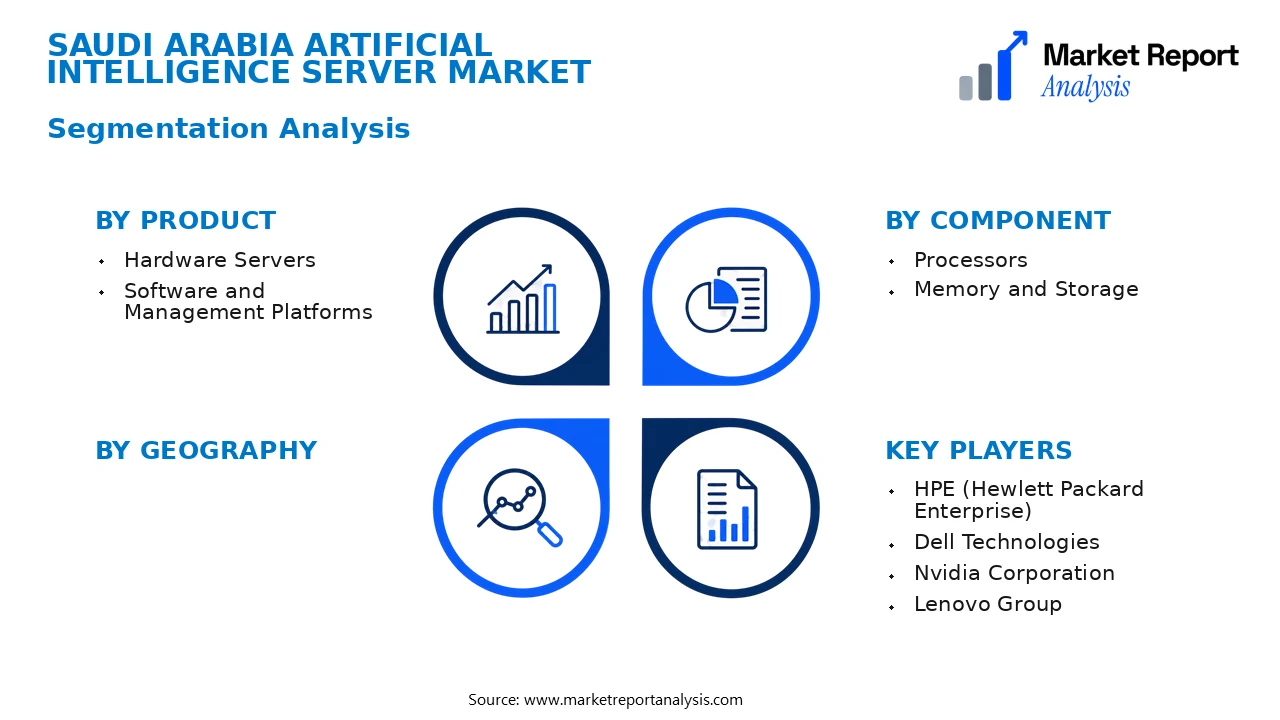
- Product
- Hardware Servers: Hardware servers designed specifically for AI workloads are crucial for high-performance computing environments, experiencing rapidly growing demand due to increasing AI adoption across sectors such as government and finance.
- Software and Management Platforms: These include AI-specific management platforms, orchestration tools, and software solutions that enhance server functionalities and enable seamless integration within enterprise IT ecosystems in Saudi Arabia.
- Component
- Processors: Processors such as GPUs and TPUs are the core components driving AI server performance, with demand driven by the rise in data-intensive applications like smart city initiatives and cloud computing services.
- Memory and Storage: Advanced memory modules and high-capacity storage solutions support the processing needs of AI applications, becoming increasingly vital in sectors such as oil & gas, healthcare, and finance.
- Deployment Mode
- On-Premises: On-premise deployment remains predominant in Saudi Arabia, favored by government policies and enterprise security concerns, with expanding investments driven by national digital transformation agendas.
- Cloud-Based: Cloud deployment is gaining traction due to its scalability and cost advantages, particularly among startups and global technology firms establishing regional data centers.
- Application
- Data Analytics: AI servers facilitate large-scale data analytics crucial for sectors like finance, healthcare, and telecommunications, where predictive insights drive operational efficiencies and decision-making.
- Autonomous Systems: Deployment of AI servers in autonomous systems, including vehicles and industrial robots, is expanding rapidly, particularly in manufacturing zones and logistics hubs.
- End User
- Government & Public Sector: The government sector deploys AI servers for smart city projects, surveillance, and public safety, backed by national initiatives like Vision 2030 to diversify the economy.
- Business & Commercial Enterprises: Financial institutions, telecommunications, and retail businesses are adopting AI servers for customer analytics, automation, and operational efficiencies, thus accelerating market penetration.
- Industry Vertical
- Oil & Gas: AI servers support exploration, extraction, and predictive maintenance in the oil and gas industry, which remains a dominant sector in Saudi Arabia’s economy.
- Healthcare: Expansion in healthcare AI applications, including diagnostics and patient management, drives demand for robust, high-capacity AI server solutions in hospitals and research centers.
- Financial Services: Banks and insurance companies leverage AI servers for fraud detection, algorithmic trading, and customer insights, fostering streamlined operations and improved risk management.
Geography
- Saudi Arabia: As the primary market, Saudi Arabia exhibits significant demand for AI servers driven by government initiatives like NEOM and Vision 2030, with increasing investments in digital infrastructure, especially in Riyadh and Jeddah.
- Riyadh: The capital city hosts the majority of regional data centers and enterprise headquarters, making it a strategic hub for AI server deployment, innovation, and industry growth.
- Jeddah: As a major commercial port and logistics center, Jeddah supports AI applications in supply chain management, border control, and port automation, with ongoing infrastructure upgrades.
- Dammam: Serving the eastern province, Dammam is vital for energy sector data processing, including oil and petrochemical industries, which require high-capacity AI server solutions.
- Mecca and Medina: These cities are increasingly integrating AI servers for smart city solutions and religious event management, aligning with tourism and religious activities.
- Al Khobar: Focused on energy and industrial sectors, it hosts numerous refineries and industrial complexes demanding sophisticated AI server systems for operational optimization.
- Jubail: An industrial hub with a focus on petrochemicals, Jubail is expanding its AI infrastructure to support automation and digital transformation initiatives in manufacturing processes.
Competitive Intelligence
The Saudi Arabia Artificial Intelligence Server Market exhibits a competitive landscape characterized by a moderate concentration of key players, primarily global technology firms and regional IT providers. Major companies such as Dell Technologies, HPE, and Lenovo maintain significant market shares through strategic partnerships and aggressive expansion into Saudi cities like Riyadh and Jeddah. These firms focus on product innovation, emphasizing higher performance, energy efficiency, and customized solutions tailored to governmental and enterprise needs. Recent acquisitions, including local tech startups specializing in AI hardware, have strengthened their market positioning. Business strategies increasingly involve joint ventures with Saudi-based firms, enabling faster access to regional infrastructure projects and governmental tenders, especially in smart city initiatives. Heavy R&D investments are directed toward developing AI-optimized servers that support Saudi Arabia’s Vision 2030 goals. Differentiation among competitors hinges on product scalability, integration capabilities, and compliance with local regulations. Overall, the competitive environment promotes rapid technological advancements and strategic alliances, driving innovation and expanding market reach within the kingdom.
Leading Company Profiles
The Saudi Arabia Artificial Intelligence Server Market features several key players that drive innovation, competitiveness, and regional deployment strategies, focusing on high-performance computing, scalability, and AI integration.
HPE (Hewlett Packard Enterprise)
HPE specializes in enterprise AI servers optimized for high-density data processing, with a strong emphasis on scalable architecture, security, and energy efficiency to meet Saudi Arabia’s growing digital infrastructure needs.
Dell Technologies
Dell offers robust AI server solutions with a focus on modular design, advanced cooling technologies, and AI software integration, supporting Saudi organizations' digital transformation initiatives in government and private sectors.
Nvidia Corporation
Nvidia leads in GPU-accelerated AI servers, providing innovative hardware for deep learning, neural networks, and high-performance computing, supporting Saudi AI research and industrial automation projects.
Lenovo Group
Lenovo’s AI server portfolio emphasizes reliability, cost-efficiency, and scalable computing power, aligned with Saudi Arabia’s regional cloud data centers and smart city projects, complemented by strategic support services.
Strategic Business Developments
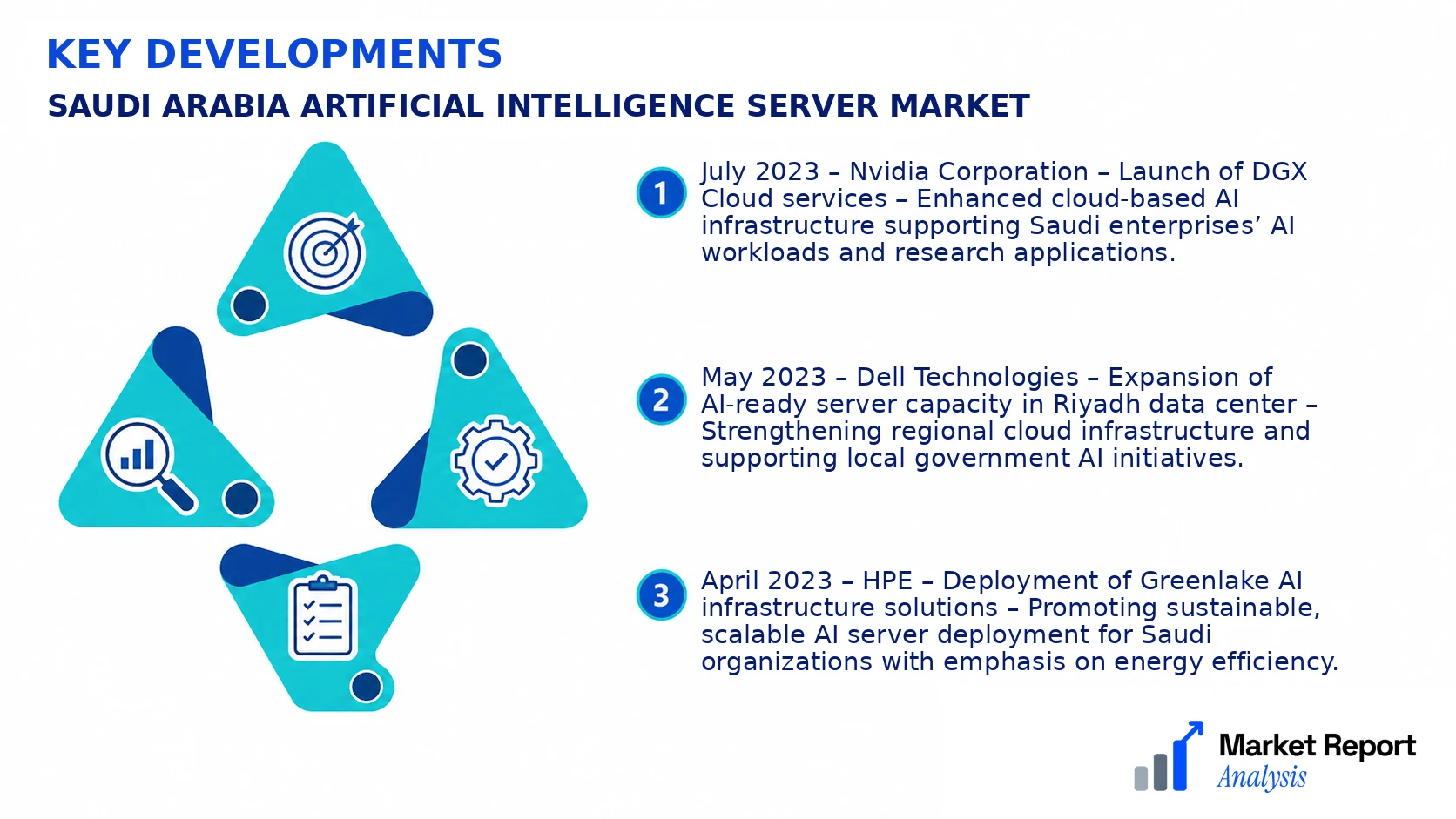
- July 2023 – Nvidia Corporation – Launch of DGX Cloud services – Enhanced cloud-based AI infrastructure supporting Saudi enterprises’ AI workloads and research applications.
- May 2023 – Dell Technologies – Expansion of AI-ready server capacity in Riyadh data center – Strengthening regional cloud infrastructure and supporting local government AI initiatives.
- April 2023 – HPE – Deployment of Greenlake AI infrastructure solutions – Promoting sustainable, scalable AI server deployment for Saudi organizations with emphasis on energy efficiency.
- June 2023 – Lenovo Group – Introduction of new AI-optimized servers with advanced cooling – Enhancing regional deployment capabilities for high-demand AI applications across Saudi data centers.
- August 2023 – Amazon Web Services – Strategic partnership with local telecom providers – Accelerating AI cloud adoption and server infrastructure integration in Saudi Arabia.
Frequently Asked Questions
What is the Saudi Arabia Artificial Intelligence Server Market?
The Saudi Arabia Artificial Intelligence Server Market comprises the industry involved in manufacturing, deploying, and maintaining AI servers tailored specifically for the nation's digital infrastructure, enterprise needs, and governmental applications, expected to witness substantial growth by 2034.
What is the current market size of Saudi Arabia Artificial Intelligence Server Market?
As of 2026, the market is estimated to be valued at approximately USD 500 Million, reflecting increasing adoption driven by government initiatives, increasing digitization, and a surge in demand for AI-powered data processing and cloud services within Saudi Arabia.
What factors are driving the Saudi Arabia Artificial Intelligence Server Market?
The market growth is propelled by government strategic plans like Vision 2030, a significant push toward digital transformation, rise in cloud computing, smart city initiatives, and increased investment in AI infrastructure, which collectively enhance the AI server demand.
Which Saudi city leads the Saudi Arabia Artificial Intelligence Server Market?
Riyadh leads the market due to its status as the financial and administrative hub, hosting the highest concentration of data centers, government projects, and technology firms, creating the primary demand for AI servers in the country.
Which segment is expected to grow the fastest?
The enterprise segment, especially cloud service providers and large-scale data centers, is forecasted to grow at the fastest pace owing to rising data volumes, increased virtualization, and the need for high-performance computing solutions.
Who are the leading companies operating in the Saudi Arabia Artificial Intelligence Server Market?
Key players include international giants like Dell Technologies, Hewlett Packard Enterprise, and Cisco Systems, along with regional providers such as Saudi Telecom Company (STC) and local start-ups emerging with tailored AI server solutions.
Analyst Perspective
The Saudi Arabia Artificial Intelligence Server Market exhibits a promising long-term outlook driven by government initiatives aligning with Vision 2030, fostering a conducive environment for AI infrastructure investments. As digital transformation accelerates, demand for high-performance AI servers is expected to surge, supported by sectors such as healthcare, finance, and smart city projects. Technologically, advancements in edge computing and energy-efficient server architectures will catalyze growth, with local data centers becoming more autonomous and scalable. Investment priorities should focus on strategic urban hubs like Riyadh and Jeddah, which demonstrate significant city-level AI deployment potential due to their robust infrastructure and concentration of innovation hubs. Competitive intensity will intensify as global and local players vie for market share, emphasizing differentiation through technologically advanced offerings and region-specific customization. Long-term, Riyadh's development as a smart city and Jeddah's port expansion present lucrative opportunities, although risks from geopolitical factors and market volatility require cautious strategic planning to sustain growth and capitalize on emerging opportunities.
