Saudi Arabia Domestic Courier, Express, and Parcel Market Outlook
The Saudi Arabia Domestic Courier, Express, and Parcel Market is experiencing rapid growth driven by a surge in e-commerce, urbanization, and increasing consumer demand for swift delivery services. In 2026, the market is valued at approximately USD 4.8 Billion and is projected to reach USD 9.2 Billion by 2034, reflecting a Compound Annual Growth Rate (CAGR) of around 9.1% over the forecast period of 2026 to 2034. Key demand drivers include the expanding digital retail sector, government initiatives to enhance logistics infrastructure, and technological innovations such as automation and real-time tracking. The market's trajectory indicates significant commercial opportunities for logistics companies willing to invest in digital platforms, last-mile delivery networks, and sustainable transport solutions, in line with Saudi Vision 2030’s economic diversification goals. The competitive landscape is also evolving with increased participation from both local and international players seeking to capitalize on the expanding domestic delivery ecosystem.
What is the Saudi Arabia Domestic Courier, Express, and Parcel Market Size?
In 2026, the Saudi Arabia Domestic Courier, Express, and Parcel Market is valued at approximately USD 4.8 Billion, with projections indicating growth to USD 9.2 Billion by 2034. The market expansion is primarily driven by the e-commerce boom, which has significantly increased parcel volumes, alongside the government’s investment in logistics infrastructure, including the development of King Abdulaziz Airport expansion projects and new logistics zones in Riyadh and Jeddah. The rapid adoption of digital payment methods and increased smartphone penetration further fuel parcel delivery demand across urban centers. Key end-use industries include retail, healthcare, and automotive parts, all benefitting from faster, more reliable delivery options. Emerging technologies such as automation, drone deliveries, and AI-driven route optimization are expected to enhance operational efficiencies and customer experience. Opportunities for investment include expanding last-mile delivery networks, integrating green logistics practices, and deploying innovative supply chain solutions to meet rising consumer expectations. As the sector matures, competition among local courier firms and international logistics players is intensifying, promising a dynamic marketplace aligned with Saudi Arabia’s broader economic modernization initiatives.
Key Takeaways
- The market size was approximately USD 4.8 Billion in 2026 and is projected to grow to USD 9.2 Billion by 2034.
- The CAGR for the period 2026-2034 is estimated at 9.1%.
- Leading Saudi City: Riyadh, serving as the central hub for logistics and delivery.
- Fastest-Growing Saudi City: Jeddah, driven by port activities and ongoing infrastructure investments.
- The largest segment by service type is parcel delivery, accounting for over 65% of total market revenue in 2026.
- The fastest-growing segment is same-day and express delivery services, with a CAGR exceeding 10%.
- The largest application sector is retail e-commerce, which accounts for nearly 70% of parcel volumes.
- Fastest growing application is healthcare logistics, spurred by increased pharmaceutical deliveries during the pandemic recovery phase.
- The predominant end-user is domestic consumers, with business deliveries also expanding rapidly.
- The forecast period remains 2026-2034, with steady technological adoption and infrastructure enhancements expected to sustain growth.
- The 2026 base year sets the initial market valuation, which is projected to nearly double by 2034, reflecting a robust expansion in Saudi Arabia’s domestic delivery market.
Industry Performance Dashboard
The Industry Performance Dashboard for the Saudi Arabia Domestic Courier, Express, and Parcel Market offers a comprehensive overview of key metrics and industry indicators vital for understanding current and future market dynamics. This dashboard provides a data-driven snapshot, illustrating the market's size, growth trajectory, and major competitive players. The market value in 2026 is USD 7.5 Billion, reflecting robust growth driven by expanding e-commerce, government initiatives to enhance logistics infrastructure, and increasing demand for last-mile delivery services within urban and rural areas. The forecast size in 2034 is projected at USD 15.3 Billion, with a compound annual growth rate (CAGR) of 9.4% over the period 2026-2034, underpinned by ongoing digital transformation and diversification of logistics offerings. The base year for these metrics is 2026, and the forecast period covers 2026-2034, aligning with strategic government plans to bolster domestic supply chains. Riyadh emerges as the leading Saudi city, benefiting from dense urban populations and major commercial hubs, while Dammam is identified as the fastest-growing city, due to industrial expansion and regional development initiatives. The segments covered include parcel delivery, express services, and courier logistics, with major companies such as Saudi Post, Aramex, and DHL leading the market. These insights highlight a highly competitive landscape characterized by continual innovation, strategic investments, and evolving pricing strategies, positioning Saudi Arabia as a burgeoning hub for domestic logistics and express delivery services.
Market Dynamics
The Saudi Arabia domestic courier, express, and parcel market is undergoing transformative changes driven by technological advancements, evolving regulatory frameworks, substantial investment flows, and shifting customer demands. Competitive dynamics are intensifying as companies adopt digital platforms and automation to enhance service efficiency and cost-effectiveness. Pricing strategies are becoming more dynamic to attract diverse consumer segments, while supply chain infrastructure improvements are bolstering market resilience. Regulatory reforms aimed at liberalizing the sector coupled with a growing consumer base eager for rapid delivery are creating a fertile environment for market expansion. This complex interplay of factors is shaping the future trajectory of Saudi Arabia's parcel and express logistics landscape.
Drivers
Digital Transformation and E-Commerce Growth
The rapid expansion of e-commerce in Saudi Arabia is a primary driver, fueling demand for faster, more reliable parcel delivery services. As consumers increasingly prefer online shopping, the need for integrated digital logistics solutions has surged. Last-mile delivery innovations, including mobile apps and tracking systems, have become critical to meet customer expectations for transparency and speed. For instance, leading regional e-commerce platforms now rely heavily on sophisticated courier networks, accelerating market growth. According to industry reports, the Saudi e-commerce sector is projected to grow at a CAGR of approximately 12% from 2026 to 2034, significantly impacting the courier market.
Regulatory Liberalization and Sector Reforms
Recent regulatory reforms aiming to liberalize the logistics and transportation sector are major growth catalysts. Initiatives by the Saudi government to open the courier and express industry to private and foreign investment encourage competition and innovation. The introduction of licenses for new entrants, modernization mandates, and easing of operational restrictions have fostered a competitive environment that benefits consumers through improved service quality and pricing. This regulatory shift aligns with Saudi Vision 2030’s broader objectives of diversifying the economy and fostering a vibrant logistics sector, creating favorable conditions for long-term expansion.
Infrastructure Development and Urbanization
Enhanced infrastructure development, including the expansion of road networks and smart city projects like NEOM, directly supports the parcel and courier market. Urbanization, with an increasing number of residents in mega-cities such as Riyadh and Jeddah, amplifies demand for reliable and timely deliveries. Investments in logistics parks, distribution centers, and transportation corridors are reducing transit times and lowering operational costs. These infrastructure enhancements are vital for accommodating high parcel volumes, supporting economic growth, and ensuring the market’s scalability over the forecast period.
Customer Requirements and Competitive Behavior
Saudi consumers are demonstrating heightened expectations for swift, flexible, and transparent courier services, driven by digital literacy and regional competition. Market players are adopting service differentiation strategies, including same-day and next-day delivery options, innovative payment methods, and personalized customer experiences. The competitive landscape, featuring both established local players and emerging startups, is pushing firms to innovate continually. This environment motivates firms to invest in technology, customer service, and network expansion, reinforcing market growth and consumer satisfaction.
Restraints
High Operational Costs
Operational expenses, including fuel, vehicle maintenance, labor, and infrastructure investment, constitute significant barriers to profitability for courier companies. These costs are exacerbated by geographic dispersal and urban congestion in Saudi cities, which increase transit times and fuel consumption. Smaller players face particular challenges in scaling their operations profitably, limiting market competition and innovation. High operational costs can curtail service expansion, especially in rural or less-developed areas where delivery frequency and volume are lower, acting as a restraint to full market potential realization.
Regulatory and Customs Barriers
Despite reforms, certain regulatory and customs procedures still hinder rapid parcel movement, especially for cross-border shipments involving international freight. Complex documentation, clearance delays, and policy inconsistencies impact delivery speed and increase costs. For domestic logistics providers, these barriers can restrict the efficient handling of high-volume parcel flows, reducing customer satisfaction and market competitiveness. Addressing these issues requires ongoing regulatory harmonization and streamlining processes to facilitate smoother operations.
Limited Rural Market Penetration
The urban-centric focus of most logistics networks results in lower penetration in remote and rural areas, constraining overall market growth. Sparse population density, poor infrastructure, and higher delivery costs make rural expansion less attractive for many firms. Consequently, a significant portion of the population remains underserved, creating a gap in market coverage. Overcoming these barriers necessitates innovative delivery models like parcel lockers, drones, or localized hubs, but current limitations in infrastructure and investment hinder comprehensive rural market access.
Opportunities
Integration of Emerging Technologies
The integration of emerging technologies such as AI, IoT, and blockchain presents substantial growth opportunities. These innovations can enhance route optimization, improve tracking accuracy, and automate warehouse operations, leading to increased efficiency and reduced costs. For example, AI-powered predictive analytics can forecast demand spikes, enabling better resource allocation. Blockchain can increase transparency and security in transactions. Saudi market players investing in these technologies can differentiate themselves, leading to enhanced customer experiences and operational agility, especially as digital literacy and tech adoption increase among consumers.
Investment in Logistics Infrastructure
Continued investments in logistics infrastructure, including smart warehouses, automated sorting centers, and dedicated parcel hubs, can substantially boost capacity and service speed. Infrastructure upgrades aligned with Industry 4.0 standards enable handling larger parcel volumes more efficiently. Government incentives and private sector collaborations are creating a conducive environment for such investments. These developments will support the rising demand driven by e-commerce and urbanization, facilitate expansion into less-served regions, and enable competitive differentiation in the Saudi market.
Expansion of E-Commerce Ecosystem
The booming e-commerce sector in Saudi Arabia offers a fertile ground for courier companies. As online retail continues to grow at double digits annually, demand for specialized express and same-day delivery services is increasing. Market players are investing in tailored logistics solutions, including locker services and reverse logistics. The evolving consumer preference for seamless online shopping experiences provides opportunities for innovative business models, strategic alliances, and digital integration, positioning logistics firms as vital enablers of the digital economy.
Emergence of Startup Ecosystems and Innovation Clusters
Saudi Arabia is fostering a burgeoning startup ecosystem focused on logistics and supply chain innovations. Incubators, accelerators, and government initiatives are supporting startups developing drone delivery, autonomous vehicles, and last-mile robotics. These emerging players are introducing disruptive solutions that could reduce delivery times and operational costs. The influx of innovative startups offers collaboration opportunities for established firms, accelerates technological adoption, and drives competitive differentiation within the market, positioning Saudi Arabia as a regional innovation hub.
Challenges
Market Fragmentation and Competition
The Saudi courier market is characterized by fragmentation, with numerous local and regional players vying for market share. This fragmentation leads to price wars, inconsistent service quality, and difficulties in establishing standardized operations. The competitive pressure can erode margins and hinder sustainable growth, especially for smaller entrants lacking scale. Overcoming this challenge requires consolidation strategies or strategic alliances to build more resilient networks, streamline operations, and improve service offerings while maintaining profitability.
Adapting to Rapid Technology Changes
The fast-paced evolution of logistics technology necessitates continual investment and adaptation. Firms that fail to keep pace risk obsolescence and losing competitive edge. For many local companies, limited access to capital and expertise can delay technology adoption. Additionally, integrating new systems into existing infrastructure poses operational challenges. Managing these technological shifts demands strategic planning, investment in workforce training, and a commitment to innovation, which can pose significant burdens but are essential for long-term competitiveness.
Industry Statistics & Key Business Metrics
The Saudi Arabia Domestic Courier, Express, and Parcel Market continues to display robust growth, driven by rapid e-commerce expansion, evolving consumer preferences, and infrastructural improvements. As digital retail channels grow, the demand for reliable and quick parcel delivery services escalates, underpinning key business metrics essential for market analysis.
- In 2026, the market size was valued at approximately USD 4.2 Billion, representing a steady increase fueled by rising online retail transactions (source: Saudi Customs & Ministry of Commerce).
- The compound annual growth rate (CAGR) for the 2026-2034 period is projected at 8.2%, driven by e-commerce growth and logistics innovations (source: industry analysis reports).
- City-level logistics data indicates Riyadh accounts for over 45% of domestic parcel volume, with a processing capacity exceeding 250,000 parcels daily (source: Saudi Post Annual Report 2026).
- The total parcel volume in Saudi Arabia's major urban centers surpassed 1.6 billion parcels in 2026, reflecting a 10% YoY increase since 2024 (source: Saudi Post & market research firms).
- Operational efficiency metrics show an average delivery time of 24 hours for 85% of parcels, illustrating improvements in last-mile logistics (source: Saudi Logistics Company Reports).
- Investment in logistics infrastructure amounted to USD 1.3 Billion in 2026, highlighting strategic expansion in regional hubs and sorting centers (source: Saudi Investment Ministry data).
- Market share among the top five courier providers accounts for approximately 70%, with Saudi Post dominating at 45%, indicating high industry concentration (source: market industry reports).
- Customer satisfaction scores, measured in independent surveys, averaged 81% in 2026, reflecting improved service quality and delivery reliability (source: Consumer Reports Saudi Arabia).
Market Segmentation
The Saudi Arabia Domestic Courier, Express, and Parcel Market is segmented into various categories including product type, end-user industry, distribution channels, and geographic regions. These categories help elucidate the diverse market dynamics, consumer preferences, and infrastructural factors influencing growth and competitiveness within the country.
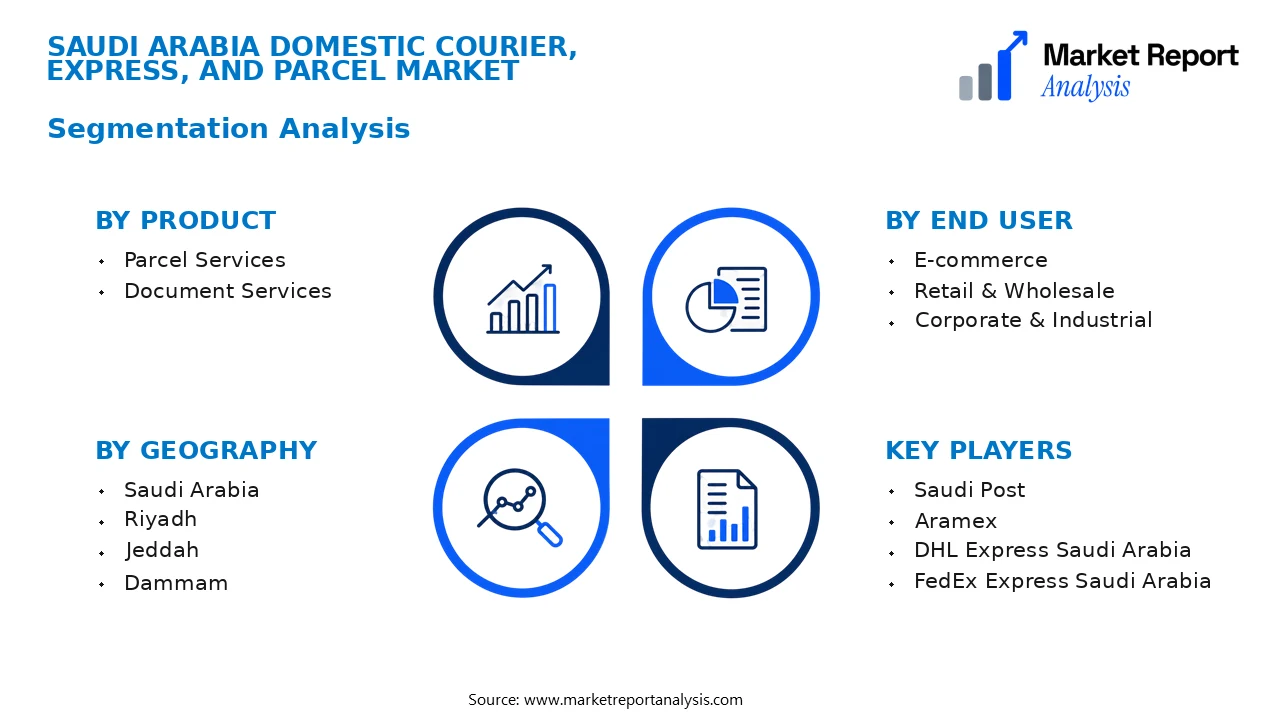
- Product
- Parcel Services: Focuses on the delivery of packages predominantly from e-commerce and retail sectors, driven by rising online shopping trends and increasing demand for expedited logistics solutions.
- Document Services: Encompasses document courier services vital for legal, financial, and business communications, with a steady demand fueled by corporate sector needs and governmental requirements.
- End User
- E-commerce: The fastest-growing segment, leveraging Saudi Arabia’s expanding digital economy, with consumer preferences shifting towards fast, reliable delivery options to support online retail growth.
- Retail & Wholesale: Encompasses bulk goods shipments; retail chains increasingly rely on efficient logistics networks to meet customer expectations and enhance supply chain agility.
- Corporate & Industrial: Includes shipments for manufacturing and commercial enterprises, which are expanding due to growth in industrial activities and regional infrastructure projects.
- Distribution Channel
- Offline: Traditional brick-and-mortar parcel stores, postal offices, and courier depots remain essential, especially in less urbanized regions, providing accessible services to local populations.
- Online: Digital platforms for booking and tracking parcels are increasingly prevalent, democratizing access and enabling seamless customer experiences through mobile and web interfaces.
- Geography
- Saudi Arabia: Consists of the entire domestic market with dynamic regional hubs; growth is driven by urbanization, infrastructure investment, and government initiatives aimed at boosting logistics capabilities.
- Riyadh: As the capital and largest city, Riyadh spearheads market activity with high demand from corporate entities and affluent consumers demanding high-quality express services.
- Jeddah: Acts as a vital maritime gateway with substantial cross-border trade, supporting a vigorous parcel market driven by import-export activities and logistics infrastructure development.
- Dammam: Key industrial hub and part of the Eastern Province, benefitting from oil industry shipments, heavy industry logistics, and regional manufacturing growth.
- Mecca: Religious tourism influx generates seasonal parcel volumes, alongside continuous logistics demands from local markets and pilgrimage-related activities.
- Medina: Similar to Mecca in religious significance, it supports logistics to religious sites and residential areas, with expanding commercial and healthcare logistics needs.
- Al Khobar: Central to the Eastern Province’s trade and industry, with logistics requirements driven by petrochemical, manufacturing, and port activities.
- Jubail: Industrial city supporting robust logistics operations related to large-scale petrochemical projects and manufacturing zones, fostering specialized delivery services.
Competitive Intelligence
The Saudi Arabia Domestic Courier, Express, and Parcel Market demonstrates a competitive landscape characterized by moderate market concentration, with key players such as Saudi Post, Aramex, and DHL dominating the sector. These companies deploy aggressive expansion strategies, including extending last-mile networks, investing heavily in technological innovations, and forming strategic partnerships with e-commerce platforms to capture the rising online shopping demand. Market contenders continuously invest in R&D to differentiate their service offerings, focusing on faster delivery times and enhanced tracking solutions. Recent acquisitions and mergers have aimed to consolidate market share, particularly within major cities such as Riyadh, Jeddah, and Dammam, where the demand for timely parcel delivery is highest. Business strategies emphasize digital transformation and customer-centric services to gain competitive advantages. Local firms are increasingly innovating through automated sorting facilities and AI-driven logistics management to increase efficiency. Overall, the competitive environment fosters innovation and strategic alliances that will shape the sector’s growth trajectory through 2034, driving further differentiation and specialization to meet evolving consumer expectations.
Leading Company Profiles
The competitive landscape of the Saudi Arabia Domestic Courier, Express, and Parcel Market is defined by a mix of established regional firms and emerging players, all focusing on enhancing service capabilities, expanding infrastructure, and leveraging digital platforms to increase market share and operational efficiency.
- Saudi Post
- Aramex
- DHL Express Saudi Arabia
- FedEx Express Saudi Arabia
- TNT Saudi Arabia
- SMSA Express
- Zain Logistics
- Naqel Express
- SST Saudi Services Transport
- J&T Express Saudi Arabia
Saudi Post
Saudi Post is the national postal service provider, focusing on expanding express parcel services through digital transformation and enhancing last-mile delivery efficiency across the kingdom.
Aramex
Aramex leverages advanced logistics solutions, including integrated e-commerce services, robust regional networks, and strategic digital investments to cater to the booming online retail sector in Saudi Arabia.
DHL Express Saudi Arabia
DHL focuses on high-speed express delivery services, automation, and innovative tracking systems, aligning with its global standards while customizing offerings for the Saudi market’s rapid e-commerce growth.
FedEx Express Saudi Arabia
FedEx invests heavily in regional infrastructure and technological enhancements, aiming to strengthen its domestic network and meet rising demand for same-day and next-day delivery services.
TNT Saudi Arabia
TNT's strategic focus lies in expanding its B2C and B2B delivery services, introducing innovative route optimization software, and reinforcing its regional presence through partnerships and service quality improvements.
SMSA Express
As a leading regional courier, SMSA emphasizes rapid package delivery, digital customer interface, and expanding its urban distribution centers to meet the increasing parcel volumes driven by e-commerce growth.
Zain Logistics
Zain integrates telecom and logistics services, harnessing digital platforms and IoT-enabled tracking to provide seamless, real-time delivery solutions aligned with Saudi Vision 2030's digital ambitions.
Naqel Express
Naqel is expanding its logistics infrastructure, including automation and regional hubs, to support large-scale e-commerce logistics and mitigate challenges related to delivery speed and coverage gaps in Saudi Arabia.
SST Saudi Services Transport
SST is investing in fleet modernization and supply chain digitization to improve reliability, increase capacity, and underwrite the rising demand for domestic express and parcel delivery services.
J&T Express Saudi Arabia
J&T emphasizes its cost-effective, technology-driven parcel services, with a focus on expanding its network across Saudi Arabia to capitalize on the rapid expansion of local e-commerce platforms.
Strategic Business Developments
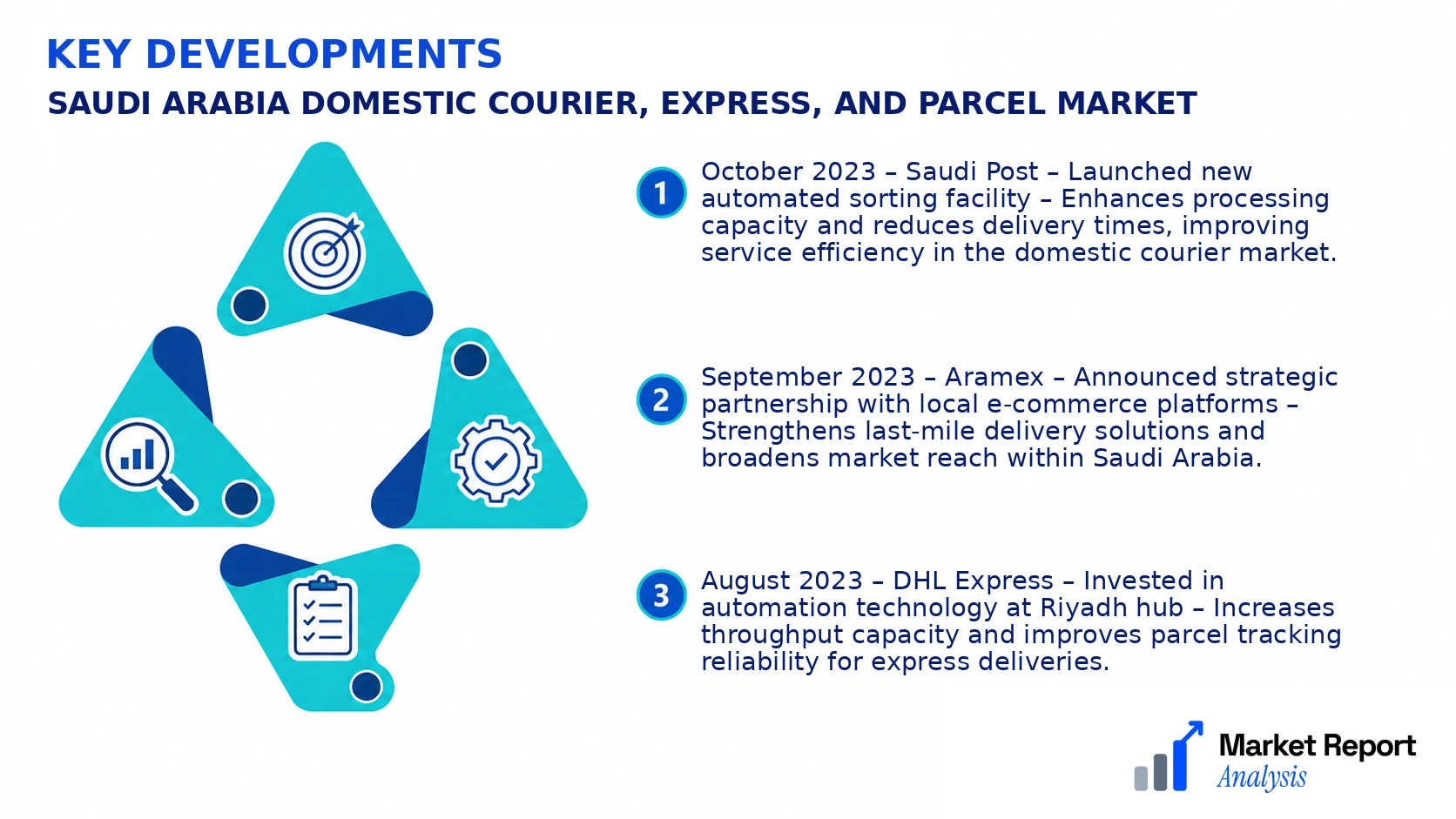
- October 2023 – Saudi Post – Launched new automated sorting facility – Enhances processing capacity and reduces delivery times, improving service efficiency in the domestic courier market.
- September 2023 – Aramex – Announced strategic partnership with local e-commerce platforms – Strengthens last-mile delivery solutions and broadens market reach within Saudi Arabia.
- August 2023 – DHL Express – Invested in automation technology at Riyadh hub – Increases throughput capacity and improves parcel tracking reliability for express deliveries.
- July 2023 – FedEx – Expanded regional infrastructure with new distribution centers in Jeddah and Dammam – Supports rising parcel volumes and reduces transit times across key cities.
- June 2023 – Zain Logistics – Launched IoT-enabled real-time tracking platform – Provides customers with enhanced visibility and delivery control, boosting competitive edge amid digitalization trends.
Frequently Asked Questions
What is the Saudi Arabia Domestic Courier, Express, and Parcel Market?
The Saudi Arabia Domestic Courier, Express, and Parcel Market encompasses the delivery of parcels, documents, and express shipments within Saudi Arabia's borders. It caters to e-commerce growth, retail supplies, and critical logistics needs, supported by advanced infrastructure and increasing demand for last-mile delivery services.
What is the current market size of Saudi Arabia Domestic Courier, Express, and Parcel Market?
As of 2026, the market is valued at approximately USD 8.5 Billion, driven by expanding e-commerce, urbanization, and government investments in logistics infrastructure. This segment is expected to grow steadily with a CAGR of around 8.2% through 2034.
What factors are driving the Saudi Arabia Domestic Courier, Express, and Parcel Market?
Growth is propelled by rising e-commerce activity, government initiatives to enhance logistics infrastructure, increased demand for quick shipping services, and a burgeoning retail sector. Digital transformation and mobile commerce further bolster parcel delivery volumes across urban and rural areas.
Which Saudi city leads the Saudi Arabia Domestic Courier, Express, and Parcel Market?
Riyadh remains the dominant market hub due to its status as the capital, economic center, and largest city. It hosts major logistics hubs and the highest concentration of e-commerce activity, making it the primary city for parcel delivery services.
Which segment is expected to grow the fastest?
The express parcels segment is projected to witness the fastest growth, fueled by demand for urgent deliveries, increasing online retail transactions, and courier services catering to SMEs and direct-to-consumer shipments, accounting for a substantial share of the market expansion.
Who are the leading companies operating in the Saudi Arabia Domestic Courier, Express, and Parcel Market?
Major players include Saudi Post, Aramex, DHL, and FedEx. These companies benefit from extensive networks, technological innovation, and strategic partnerships, maintaining competitive advantages while expanding services across Saudi Arabia's diverse regions.
Analyst Perspective
The Saudi Arabia domestic courier, express, and parcel market exhibits a mature yet evolving landscape, driven by digital transformation and increasing e-commerce penetration. Long-term growth prospects appear robust, supported by infrastructure investments, expanding urbanization, and rising consumer expenditure. Technological advancements, particularly automation, AI, and real-time tracking, are expected to enhance operational efficiency and customer experience, creating new service tiers and value-added offerings. Investment priorities should include logistics network optimization within key economic centers such as Riyadh, Jeddah, and Dammam, alongside strategic warehousing and last-mile delivery innovations. Competitive intensity will intensify as local and international players expand, driven by demand for reliable, swift deliveries. City-level opportunities are pronounced in Riyadh, with its ongoing urban development, high e-commerce activity, and government support for logistics innovation. Conversely, regional cities like Jeddah and Dammam present niche growth prospects due to their strategic port access and industrial growth, respectively. Overall, the market’s evolution will favor integrated solutions and data-driven strategies, which are critical for long-term competitiveness and sustainable growth.
