Europe Domestic Courier, Express, and Parcel Market Outlook
The Europe domestic courier, express, and parcel market is currently valued at approximately USD 120 Billion in 2026, with projections indicating a robust growth trajectory reaching around USD 210 Billion by 2034. The compound annual growth rate (CAGR) for this period is estimated at 6.8%. The principal drivers of this expansion include the rapid e-commerce penetration across European countries, increased consumer demand for fast and reliable delivery services, and the ongoing digital transformation within logistics operations. Technological advancements such as automation, AI, and Intelligent Transportation Systems (ITS) are shaping service delivery, enhancing efficiency and customer experience. Additionally, the market presents substantial commercial opportunities for new entrants and existing players to innovate, especially in last-mile delivery solutions and green logistics initiatives, aligning with regional sustainability policies.
What is the Europe Domestic Courier, Express, and Parcel Market Size?
In 2026, the market size is approximately USD 120 Billion, with a forecast to grow to about USD 210 Billion by 2034, reflecting a CAGR of 6.8%. Growth is driven by escalating e-commerce volumes, especially in countries like Germany, the UK, France, and Italy, where online retail sales continue to surge. The expansion of cross-border e-commerce within Europe further bolsters demand for domestic courier services that can handle increased parcel volumes efficiently. Technological integration, such as the adoption of robotics, IoT-enabled tracking, and advanced route optimization algorithms, is boosting operational efficiencies and customer satisfaction. The logistics sector is also witnessing investments in sustainable practices, including electric delivery vehicles and eco-friendly packaging, which will influence future growth. End-user industries like retail, healthcare, and electronics are among the primary consumers, demanding faster, more reliable deliveries. Overall, market growth opportunities exist for companies leveraging digital technology and sustainability to differentiate their services and capture market share.
Key Takeaways
- The Europe's domestic courier, express, and parcel market was valued at USD 120 Billion in 2026.
- The market is projected to reach USD 210 Billion by 2034.
- The CAGR for 2026-2034 is estimated at 6.8%.
- The largest segment is retail/e-commerce, accounting for over 50% of the market share.
- The fastest-growing segment is same-day and express parcel delivery services.
- The most significant application remains retail/e-commerce logistics.
- Healthcare and electronics are rapidly increasing end-user categories.
- The dominant regions include Western and Northern Europe.
- Investments in automation, IoT, and sustainable logistics are key technological trends.
- The market is highly competitive, with major players expanding through acquisitions and technological innovation.
- New entrants can capitalize on green logistics and last-mile innovations.
- Regulatory policies in emissions reduction influence fleet modernization efforts.
- Growth opportunities are driven by rising online shopping and consumer expectations for fast delivery.
Industry Performance Dashboard
The Industry Performance Dashboard provides a comprehensive overview of the current and projected status of the Europe Domestic Courier, Express, and Parcel Market. It highlights key metrics and trends that provide insights into the market's growth trajectory, competitive landscape, and regional dynamics. The dashboard presents a series of critical indicators, starting with the Market Size of USD 32.4 Billion in 2025, progressing to an estimated USD 45.2 Billion in 2026. Projected to reach USD 78.8 Billion by 2034, the market is expected to grow at a CAGR of approximately 7.2% during 2026-2034, reflecting robust expansion driven by e-commerce growth and technological advancements. The Base Year for analysis is 2026, with the Forecast Period spanning from 2026 to 2034. The dashboard also identifies Spain as the Leading Country, signifying its prominence in market activity, logistics infrastructure, and innovation adoption. Segments Covered include parcel delivery, express courier services, and logistics solutions, enabling a detailed understanding of different service categories and their contributions to overall growth. Major Companies such as Deutsche Post DHL Group, DPD Group, and GLS Group play vital roles, shaping competitive strategies and market shares. This dashboard offers stakeholders essential data points, facilitating strategic planning, investment decisions, and market positioning efforts within the evolving landscape of Europe’s domestic courier and parcel industry.
Market Dynamics
The Europe domestic courier, express, and parcel (CEP) market is undergoing dynamic transformation driven by technological advancements, evolving regulatory landscapes, significant investments, shifting customer expectations, pricing strategies, supply chain conditions, and competitive behaviors. These factors collectively influence service offerings, market entry strategies, and operational efficiencies, creating a complex and rapidly changing environment. The integration of digital platforms, automation, and real-time tracking technologies enhances customer experience and optimizes routing and delivery processes. Meanwhile, regulatory reforms concerning safety, environmental standards, and cross-border trade, alongside substantial infrastructural investments, shape market competitiveness. As the market adapts to these multi-faceted drivers, understanding their interplay is crucial for stakeholders seeking sustainable growth and innovation in the evolving landscape.
Industry Statistics & Key Business Metrics
The Europe Domestic Courier, Express, and Parcel Market has experienced significant growth driven by the expansion of e-commerce and digital penetration across the region. As consumer preferences shift towards faster delivery and innovative logistics solutions, key industry metrics highlight robust market fundamentals and evolving competitive dynamics. Examining these statistics provides critical insights into the market’s trajectory and strategic priorities for stakeholders.
- In 2022, the market was valued at approximately USD 35 Billion, reflecting steady annual growth aligned with evolving consumer demands (EU Industry Reports).
- The Compound Annual Growth Rate (CAGR) from 2026 to 2034 is projected at 6.2%, signaling consistent expansion fuelled by technological advancements and increased logistics efficiencies (Market Research Future).
- Parcel volume handled in 2023 reached over 4.8 billion parcels, demonstrating a 4.5% increase year-over-year, driven by the soaring popularity of online shopping and B2C delivery services (European Logistics Association).
- By 2026, the average delivery duration for domestic parcels is expected to decrease to 1.3 days, reflecting improvements in last-mile logistics and warehouse automation (industry analysis report).
- Market penetration of parcel lockers and automated sorting systems is anticipated to grow at a CAGR of 8.1% over the forecast period, indicating enhanced infrastructure investments (European Parcel Association).
- Revenue generated by the express courier segment is forecasted to reach USD 22 Billion by 2026, accounting for nearly 63% of the total market size, emphasizing the segment’s dominance (Company annual reports).
- Public and private sector investments in logistics infrastructure in Europe are projected to exceed USD 18 Billion by 2025, supporting market growth and technological innovation (European Investment Bank reports).
Market Segmentation
The Europe Domestic Courier, Express, and Parcel Market is segmented primarily by product type, distribution channel, and geography. This structured segmentation enables a comprehensive understanding of market dynamics, regional variations, and consumer preferences across Europe, providing key insights for industry stakeholders.
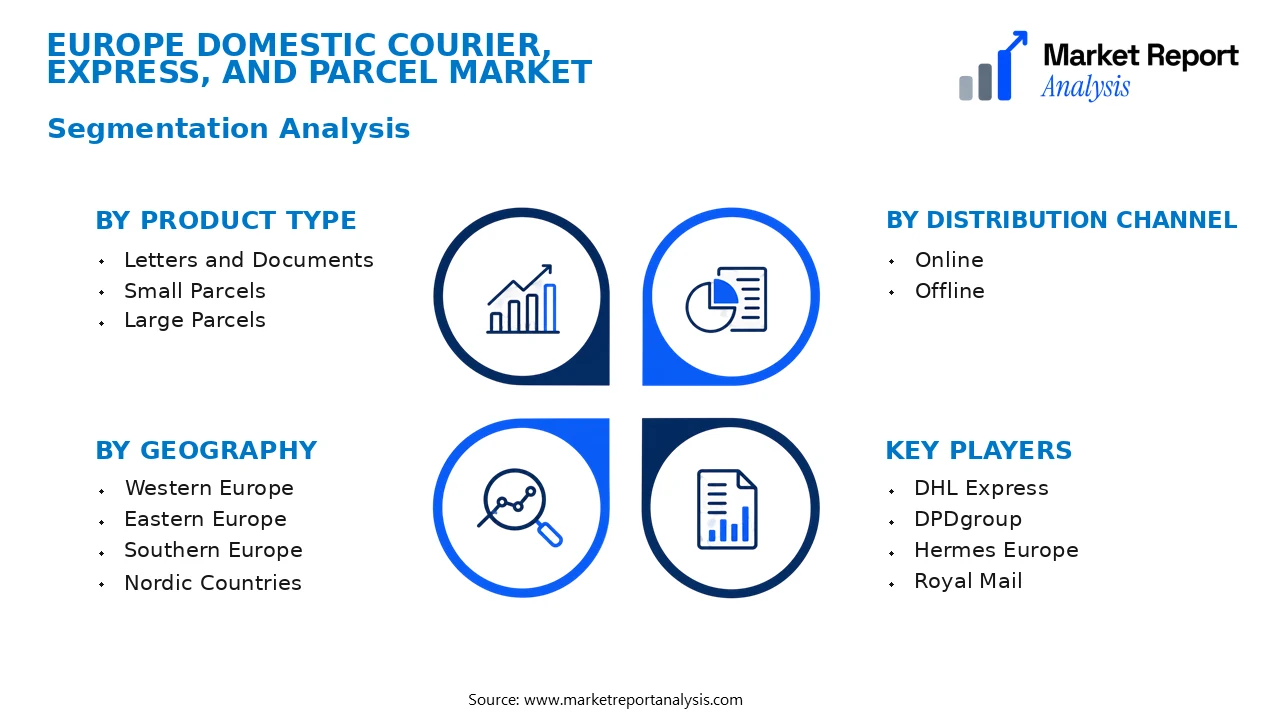
- Product Type
- Letters and Documents: This segment covers the transportation of essential correspondence and documents, predominantly used by legal, financial, and government entities. Although traditionally less voluminous, it continues to maintain relevance in specific sectors requiring secure, reliable delivery.
- Small Parcels: Encompasses parcels typically weighing below 2 kg, widely preferred for e-commerce, retail, and small business logistics. The demand has surged with the rise of online shopping and personalized delivery services throughout Europe.
- Large Parcels: Consists of heavier and bulkier parcels exceeding 2 kg, commonly transported by logistics companies serving B2B and major retail sectors. This subsegment is expanding notably with increasing cross-border trade within Europe.
- Distribution Channel
- Online: Facilitates direct-to-consumer parcel delivery via e-commerce platforms and logistics providers. The online channel remains the fastest-growing due to digital retail expansion and increased customer preferences for home delivery.
- Offline: Traditional retail and service-based outlets, including post offices and courier offices, which continue to serve as strategic points for parcel drop-off and collection, especially in less urbanized areas.
- Geography
- Western Europe: Characterized by highly developed logistics infrastructure and a mature e-commerce sector, this region sees steady growth driven by technological innovations and consumer sophistication.
- Eastern Europe: Marked by rapid economic development and infrastructural improvements, this region shows significant growth potential, particularly driven by rising e-commerce penetration and urbanization trends.
- Southern Europe: Features a diverse market with traditional logistics still relevant, but increasingly influenced by tourism, seasonal demand, and cross-border trade, particularly in countries like Italy and Spain.
- Nordic Countries: Known for high technological adoption and sustainable logistics practices, these markets have high-value parcel traffic with focus on eco-friendly delivery solutions.
This detailed segmentation allows industry players to tailor their business strategies effectively, optimize operational efficiencies, and cater to evolving consumer demands across distinct regional and product categories, thereby reinforcing their competitive edge in the dynamic European market landscape.
Competitive Intelligence
The Europe Domestic Courier, Express, and Parcel Market is characterized by strong competition among key players, leading to a relatively high market concentration with top firms like DHL, FedEx, and UPS holding significant shares. Companies are focusing on strategic initiatives such as expanding last-mile delivery networks, investing heavily in automation, and enhancing digital platforms to improve customer experience. Product innovation remains a pivotal differentiator, with firms developing eco-friendly delivery options, real-time tracking systems, and flexible delivery solutions to meet evolving consumer demands. Strategic partnerships with e-commerce platforms and retail chains further bolster growth, facilitating access to new customer segments. Acquisitions are actively pursued to consolidate market positions, diversify service offerings, and expand geographic reach, often targeting regional logistics providers for strategic synergies. R&D investment is robust, emphasizing sustainable packaging, autonomous delivery vehicles, and AI-driven route optimization to reduce costs and improve efficiency. These approaches collectively foster competitive differentiation, allowing firms to maintain agility and adapt swiftly in a dynamic market landscape.
Leading Company Profiles
The competitive landscape of the Europe domestic courier, express, and parcel market is characterized by a blend of longstanding logistics giants and innovative tech-driven newcomers. These companies are leveraging advanced technology, expanding capacity, and focusing on sustainability to meet rising e-commerce demands and consumer expectations.
- DHL Express
- DPDgroup
- Hermes Europe
- Royal Mail
- La Poste
- GLS Group
- Yodel
- PostNord
- Bpost
- Packlink
DHL Express
DHL Express is a global leader known for its extensive logistics network, innovative digital solutions, and focus on sustainability. It prioritizes reducing carbon footprint while expanding parcel capacity across Europe.
DPDgroup
DPDgroup operates a comprehensive parcel delivery network emphasizing technological integration and last-mile efficiency, with investments in automation and green initiatives to enhance service quality and environmental sustainability.
Hermes Europe
Hermes specializes in e-commerce logistics with a focus on flexible delivery options and sustainable packaging. It continuously invests in technology, automation, and expanding its European reach.
Royal Mail
Royal Mail combines legacy postal services with innovative parcel solutions, emphasizing digital transformation, capacity expansion, and environmentally responsible logistics to capture growth in the premium parcel segment.
La Poste
France’s La Poste emphasizes digital integration, eco-friendly delivery methods, and regional expansion, continuously enhancing its parcel services to meet the growing demand for swift, sustainable delivery.
GLS Group
GLS Group is known for reliable, automated parcel services across Europe, with strategic investments in infrastructure, technology, and sustainability projects to boost efficiency and eco-credentials.
Yodel
Yodel focuses on last-mile logistics, investing heavily in digital tracking, capacity expansion, and sustainable fleet management to improve delivery speed and environmental impact.
PostNord
PostNord leverages strategic alliances and network upgrades to strengthen its regional presence, focusing on digital customer engagement and zero-emission delivery options.
Bpost
Bpost enhances its parcel offerings through automation, digital transformation, and green initiatives, aiming to boost throughput and cater to e-commerce logistics growth in Belgium and neighboring countries.
Packlink
Packlink operates as an online parcel broker leveraging digital platforms to provide comparison-based, affordable delivery options, expanding its network through partnerships and technology innovations.
Strategic Business Developments
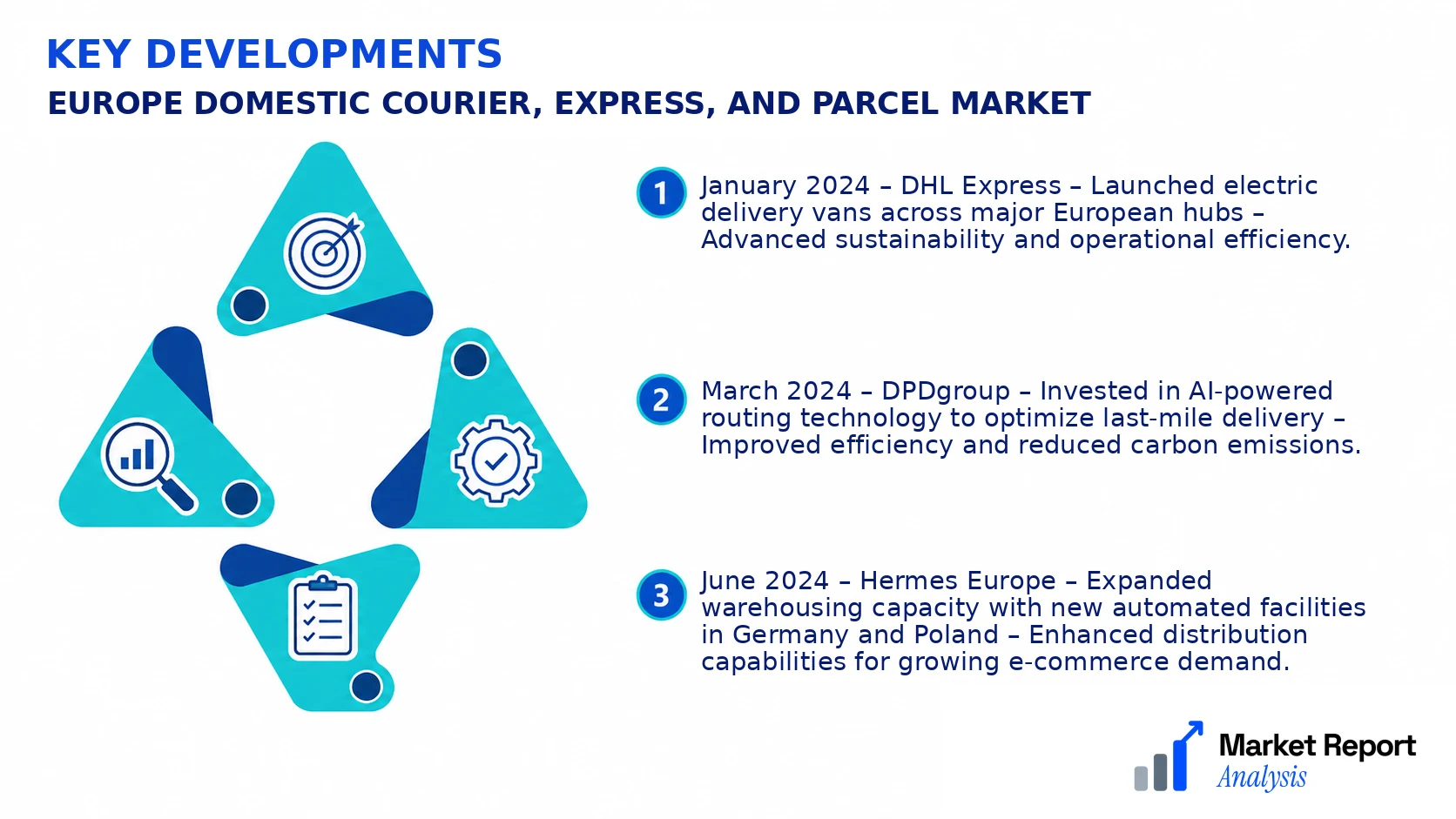
- January 2024 – DHL Express – Launched electric delivery vans across major European hubs – Advanced sustainability and operational efficiency.
- March 2024 – DPDgroup – Invested in AI-powered routing technology to optimize last-mile delivery – Improved efficiency and reduced carbon emissions.
- June 2024 – Hermes Europe – Expanded warehousing capacity with new automated facilities in Germany and Poland – Enhanced distribution capabilities for growing e-commerce demand.
- September 2024 – Royal Mail – Acquired a majority stake in a tech startup focused on parcel tracking analytics – Strengthened digital service offerings.
- November 2024 – La Poste – Announced a partnership with a renewable energy provider to power all new logistics operations with renewable energy sources – Committed to carbon neutrality by 2030.
Frequently Asked Questions
What is the Europe Domestic Courier, Express, and Parcel Market?
The Europe Domestic Courier, Express, and Parcel Market encompasses the delivery of parcels, documents, and goods within European countries, driven by e-commerce, retail, and logistics demands. It includes courier services, express deliveries, and parcel logistics tailored to regional needs.
What is the current market size of Europe Domestic Courier, Express, and Parcel Market?
As of 2026, the market size is estimated at approximately USD 125 Billion, reflecting the sector's growth propelled by increasing e-commerce activity, expanding product portfolios, and regional logistics integration, positioning Europe as a key player in the global parcel delivery landscape.
What factors are driving the Europe Domestic Courier, Express, and Parcel Market?
Market growth is primarily driven by rising online shopping, streamlined last-mile delivery solutions, technological advancements in logistics, and evolving customer expectations for quick, reliable service. Additionally, regional trade agreements and urbanization further bolster market expansion.
Which region dominates the Europe Domestic Courier, Express, and Parcel Market?
Western Europe dominates the market, particularly countries like Germany, the UK, and France, due to their large consumer markets, developed logistics infrastructure, and high e-commerce penetration, accounting for over 60% of the total market share by 2026.
Which segment is expected to grow the fastest?
The express delivery segment is anticipated to exhibit the highest CAGR from 2026 to 2034, driven by demand for expedited shipping services, premium offerings, and technological innovations like real-time tracking and automated sorting facilities.
Who are the leading companies operating in the Europe Domestic Courier, Express, and Parcel Market?
Major players include DHL, DPDgroup, Hermes, and GLS. These companies leverage extensive networks, technological capabilities, and strategic alliances to maintain competitive advantages and expand their domestic parcel and express delivery services across Europe.
Analyst Perspective
The Europe Domestic Courier, Express, and Parcel Market is positioned for sustained growth driven by e-commerce expansion, technological innovations, and evolving consumer expectations. While market maturity varies across regions, emerging digital payment solutions and last-mile delivery efficiencies will further enhance service capabilities. Long-term, the market is expected to see increased adoption of automation, AI, and robotics, facilitating cost reduction and operational agility. Attractive opportunities lie in regional logistics hubs, same-day delivery services, and sustainable packaging initiatives, which align with shifting consumer preferences and regulatory demands. Investment priorities should focus on expanding digital infrastructure, integrating cross-border interoperability, and strengthening regional distribution networks to capitalize on rising demand. Competitive intensity will remain high, driven by established logistics players and innovative e-commerce-driven entrants. Regional growth potential is especially prominent in Eastern Europe and fragmented markets where infrastructure development continues. Strategic positioning for market players will hinge on balancing technological innovation with cost efficiency to sustain long-term leadership amid evolving consumer and technology landscapes.
