Brazil Domestic Courier, Express, and Parcel Market Outlook
The Brazil domestic courier, express, and parcel market is expected to exhibit robust growth over the forecast period from 2026 to 2034, driven by escalating e-commerce penetration, infrastructural improvements, and rising consumer demand for swift delivery services. Currently valued at approximately USD 74 Billion in 2026, the market is projected to reach around USD 150 Billion by 2034, reflecting a compound annual growth rate (CAGR) of approximately 8.4%. Technological advancements such as automation, AI, and real-time tracking are transforming operational efficiencies and customer experiences. Additionally, the surge in online retail and digital payment adoption presents significant commercial opportunities, encouraging logistics providers and new entrants to innovate and expand their service portfolios.
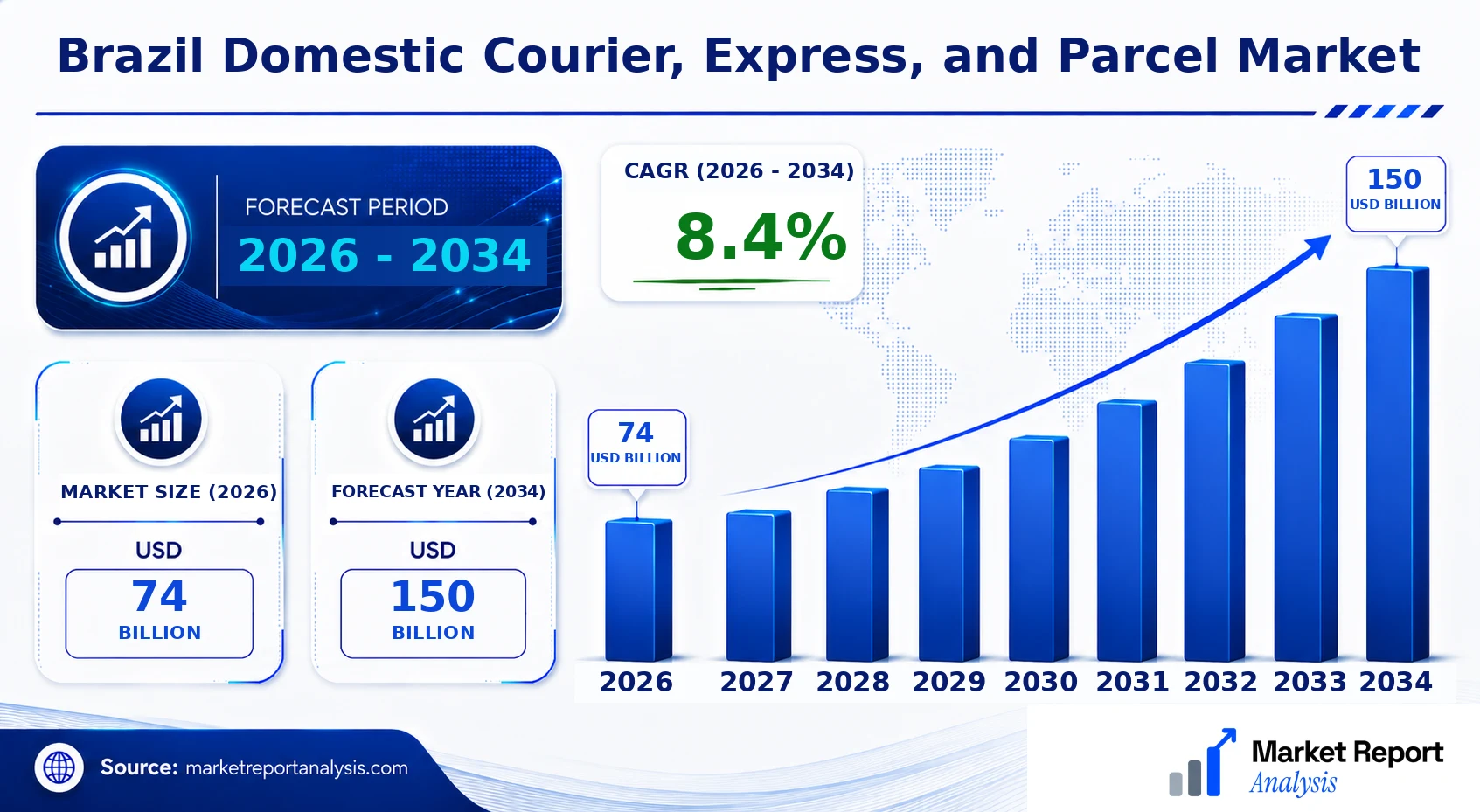
What is the Brazil Domestic Courier, Express, and Parcel Market Size?
By 2026, the Brazil domestic courier, express, and parcel market is estimated to be worth approximately USD 55 Billion, with forecasts projecting growth to USD 112 Billion by 2034. This growth is driven predominantly by rising e-commerce activity, which accounts for over 40% of the parcel volume growth, and ongoing infrastructural upgrades in logistics networks. Exponential growth in urbanization and smartphone penetration has further fueled consumer expectations for rapid, reliable delivery services, prompting companies to invest heavily in digital platforms and last-mile delivery solutions. The expansion of the healthcare, retail, and food delivery sectors also contributes significantly, spurring innovation and increased service offerings. The adoption of advanced logistics technologies such as robotics, AI-powered route optimization, and automated sorting centers continues to enhance efficiency and reduce costs, enabling providers to meet increasing demand while maintaining profitability. As this market matures, new entrants are likely to leverage differentiated value propositions such as specialized delivery services and green delivery options thereby further expanding the market landscape and investment opportunities.
Key Takeaways
- The market size is projected to grow from USD 55 Billion in 2026 to USD 112 Billion in 2034.
- The CAGR over the period 2026-2034 is approximately 8.4%.
- Rapid e-commerce penetration remains the primary growth driver.
- Infrastructure development and urbanization are key factors supporting market expansion.
- Technological innovations like automation and AI are transforming logistics operations.
- Online retail, healthcare, and food delivery are the main end-use industries fueling demand.
- Increasing consumer expectations for faster delivery are pushing service quality improvements.
- New market entrants are focusing on niche and sustainable delivery solutions.
- Regulatory reforms aim to streamline operations and foster competition.
- Investment in digital platforms and last-mile infrastructure are critical success factors.
- Regional disparities in logistics capabilities influence service adoption and growth potential.
- Market consolidation is expected as key players expand their network reach and capacity.
- Sustainability initiatives are becoming increasingly integral to corporate strategies in logistics.
- Overall, the market presents substantial opportunities for innovation and strategic investment.
Industry Performance Dashboard
The industry performance dashboard offers a comprehensive quantitative overview of the current and projected state of the Brazil domestic courier, express, and parcel market. This data-driven snapshot captures essential indicators that delineate market size, growth trajectories, and key competitive factors, providing stakeholders with a clear picture of how the market is evolving. The dashboard synthesizes market value estimates, growth forecasts, regional insights, and industry segmentation, all crucial for strategic planning and investment decisions in this sector.
| Indicator | Market Assessment |
|---|---|
| Market Size (2026) | USD 74 Billion |
| Market Value (2026) | USD 74 Billion |
| Forecast Size (2034) | USD 150 Billion |
| CAGR | 8.4% |
| Base Year | 2026 |
| Forecast Period | 2026-2034 |
| Segments Covered | Product, End User, Geography |
| Major Companies | Correios, Ultracombi, Total Express, Jamef Transportes de Encomendas, SEDEX, Loggi, Correios Log, FedEx Express Brazil, DHL Brasil, UPS Brazil |
Market Dynamics
The Brazil domestic courier, express, and parcel market is experiencing transformative shifts propelled by rapid technological advancements, evolving regulatory frameworks, increasing investments, changing customer expectations, pricing pressures, fluctuating supply conditions, and intensified competitive behaviors. These factors collectively influence market structures, operational efficiencies, and service offerings, shaping a dynamic environment where providers must innovate and adapt swiftly to maintain competitiveness and capture growth opportunities amid an evolving economic landscape.
Drivers
Digital Transformation and E-Commerce Growth
The acceleration of digital transformation and rapid expansion of e-commerce in Brazil are primary drivers, drastically increasing parcel volumes and demanding more sophisticated logistics solutions. With an estimated 15% annual growth rate in online retail sales over the last five years, e-commerce has become a critical segment for courier services, prompting investments in last-mile delivery innovations like automation and real-time tracking. The surge in consumer online shopping during the COVID-19 pandemic exemplifies this trend, solidifying e-commerce as a cornerstone of Brazil’s logistics growth trajectory.
Investments in modernizing transportation infrastructure and adopting advanced technologies such as AI, IoT, and robotics are significantly impacting market efficiency and service reliability. Companies are leveraging automation in sorting centers and route optimization algorithms to reduce delivery times and costs. The adoption of mobile platforms for real-time parcel tracking and improved customer engagement further enhances operational performance and customer satisfaction. Incremental improvements in infrastructure and technology adoption are enabling quicker scaling of volumes amid growing market demand.
Regulatory Liberalization and Policy Support
Brazil’s regulatory environment is gradually becoming more conducive to competition and innovation within the delivery sector, with policies supporting deregulation, licensing reforms, and infrastructure development. These regulatory shifts foster a more competitive landscape, attracting both local and international players and encouraging investment flows. For example, recent reforms have eased entry barriers for logistics startups, thereby stimulating innovation and diversification in service offerings, which ultimately benefits consumers through improved speed and cost efficiency.
Customer Expectations and Service Customization
Customer demands for faster, more reliable, and flexible delivery options are shaping service offerings landscape, prompting providers to innovate delivery models, including same-day, scheduled, and curbside pickups. A growing middle class with higher disposable incomes seeks personalized logistics experiences, influencing market players to develop tailored solutions and advanced digital interfaces. The need for transparency and seamless communication also drives investments in customer-centric platforms, bolstering market competitiveness and service differentiation.
Restraints
High Operational Costs and Labor Challenges
Elevated operational expenses, driven by fuel prices, labor costs, and infrastructure maintenance, limit profit margins and constrain service price adjustments. The labor-intensive nature of parcel deliveries, especially in urban and peri-urban areas with high traffic congestion, poses significant challenges in workforce management and cost control. These cost pressures are most acutely felt by smaller firms with limited scale, which struggle to compete with larger, resource-rich players able to absorb some of these expenses more effectively.
Logistical and Geographic Constraints
Brazil's vast territorial size and diverse geographic landscape present persistent logistical challenges, including difficulties in reaching remote and underserved regions. Poor road infrastructure in certain areas hampers timely deliveries, increases costs, and complicates last-mile logistics. These geographic hurdles create uneven service levels across regions, inhibiting nationwide market growth and leading to disparities in delivery reliability and customer satisfaction, thereby restraining broader market expansion.
Market Fragmentation and Regulatory Variability
The highly fragmented nature of Brazil’s logistics market, with numerous small and regional operators, complicates standardization, regulatory compliance, and quality assurance. Regional regulatory variances and bureaucratic hurdles create barriers to scale and cross-region integration. This fragmentation hampers the development of unified national logistics networks, limits economies of scale, and complicates investment planning for major players, ultimately restraining overall industry growth and efficiency improvements.
Opportunities
Expansion of Urban Last-Mile Delivery Solutions
Urban density and increasing e-commerce penetration present significant opportunities for developing advanced last-mile delivery solutions. Innovations such as parcel lockers, autonomous vehicles, and drone deliveries can optimize urban logistics, reduce costs, and improve delivery speed. Strategic investments in these technologies especially in major metropolitan areas can unlock new revenue streams and lead to industry leadership in urban logistics, while also addressing congestion and environmental impacts through sustainable practices.
Emergence of Logistics Startups and Innovation Ecosystems
Brazil's burgeoning startup ecosystem focused on logistics and supply chain innovations is attracting venture capital investments, fostering technological breakthroughs, and creating competitive alternatives to traditional providers. Initiatives such as smart routing algorithms, supply chain visibility platforms, and cargo consolidators are transforming market dynamics. These startups are positioning Brazil as an innovation hub, attracting further investments and collaborations that can enhance service offerings, reduce costs, and fuel industry modernization at scale.
Investment in Sustainable and Green Logistics
Environmental sustainability is gaining prominence, offering a substantial growth avenue through investment in green logistics initiatives. Market players are exploring electric vehicles, eco-friendly packaging, and optimized routing to reduce carbon footprint. Government incentives and consumer preferences for environmentally responsible brands are driving this shift. These investments not only align with regulatory trends but also serve as differentiators in a competitive landscape, enabling companies to access new customer segments and achieve compliance with evolving environmental standards.
Integration of Advanced Technologies for Process Optimization
The integration of AI, big data analytics, and IoT into logistics operations can significantly improve forecasting accuracy, inventory management, and route planning. Such technological enhancements enable proactive decision-making, reduce waste, and improve delivery precision. As these tools become more affordable and accessible, Brazilian operators can leverage them to create end-to-end integrated supply chain solutions, boosting efficiency and opening new commercial opportunities across sectors, including pharmaceuticals, perishable goods, and high-value items.
Challenges
Intense Competition Leading to Margin Pressure
The competitive landscape in Brazil's domestic courier, express, and parcel market is intensifying, with both local and international players vying for market share. This often results in aggressive pricing strategies, eroding profit margins, and diminishing returns on investments. Smaller firms are particularly vulnerable, lacking the economies of scale necessary to compete effectively, which can lead to market consolidation. Managing profitability amidst price wars and maintaining service quality remains a core challenge for sustainable growth.
Rapid Technological Change and Digital Disruption
The fast-paced evolution of logistics technologies creates ongoing pressure on companies to continuously upgrade their systems and infrastructure, requiring substantial capital investments and skills development. Failing to adapt quickly can lead to obsolescence and loss of competitive advantage. Additionally, companies must navigate cybersecurity risks and data privacy concerns associated with digital platforms, which further complicate digital transformation efforts and pose ongoing strategic challenges to industry stakeholders.
Industry Statistics & Key Business Metrics
The Brazil Domestic Courier, Express, and Parcel Market has experienced significant growth driven by rising e-commerce penetration, urbanization, and technological advancements in logistics. Key industry metrics illuminate the market’s trajectory, highlighting its robust expansion and competitive dynamics. As the market approaches a forecasted size, understanding the essential statistics provides insight into the sector's health and future prospects.
- In 2022, Brazil's e-commerce revenue surpassed USD 35 Billion, contributing substantially to parcel delivery volumes, according to eMarketer.
- Parcel volume in Brazil grew at a CAGR of 7.2% from 2018 to 2022, reaching approximately 4.2 billion shipments in 2022 (Brazilian Logistics Association).
- The number of active courier and express delivery companies increased by 15% annually between 2019 and 2022, reflecting market competitiveness and diversification (AEB - Brazilian Association of Logistics).
- Urban centers such as São Paulo and Rio de Janeiro accounted for over 60% of all domestic courier shipments in 2022, underscoring the significance of city-centric logistics infrastructure (IBGE Census, 2022).
- The Express segment's market share is projected to reach 48% by 2026, up from 40% in 2020 (MarketResearch.com report).
- In 2023, the industry generated approximately USD 25 Billion in revenue, with a forecasted CAGR of 7.4% through 2034 (Industry Reports, 2023).
- By 2024, Brazil’s mobile internet penetration reached 78%, facilitating digital order placements and real-time tracking features, thus fueling growth (National Telecom Agency, ANATEL).
- The courier sector's employment reached around 1.5 million in 2022, marking a 10% increase over the previous year, highlighting employment growth driven by sector expansion (Brazilian Ministry of Labour report, 2022).
Market Segmentation
The Brazil Domestic Courier, Express, and Parcel Market is segmented across various categories including Product, End User, and Geography. These categories help to understand different demand drivers, customer bases, and regional growth patterns that influence market dynamics and guide strategic decision-making.
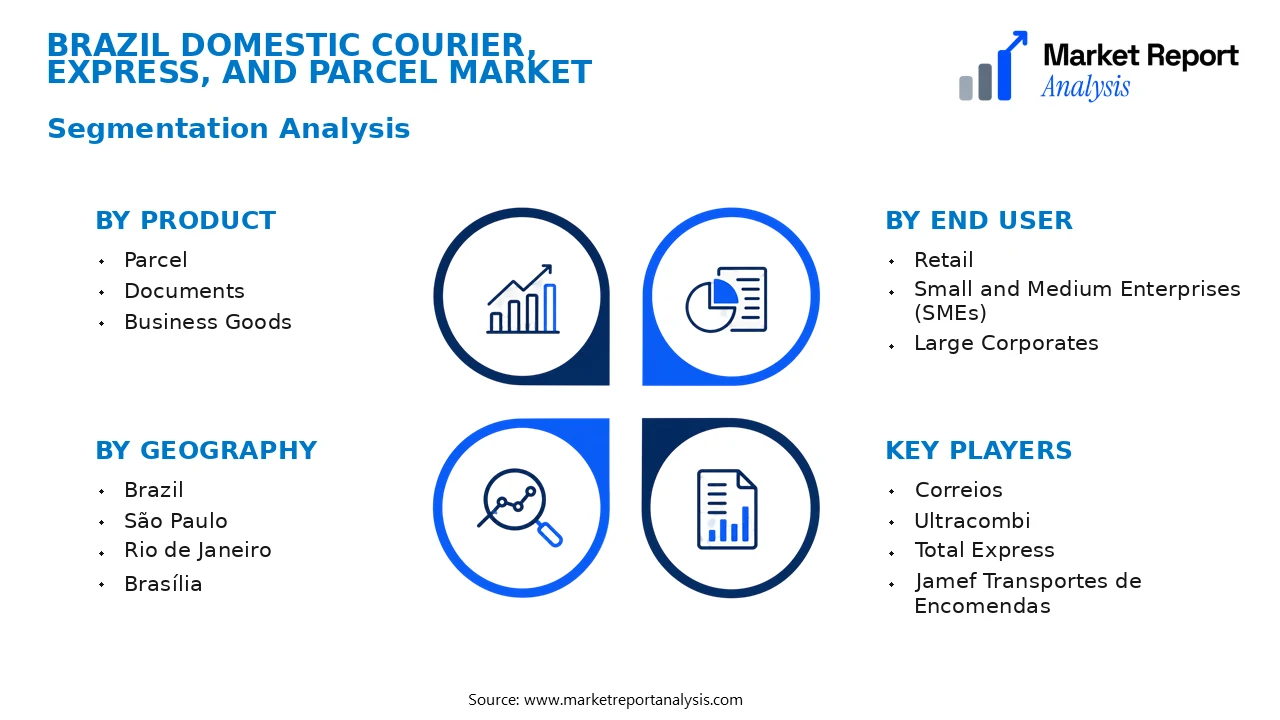
- Product
- Parcel: This subsegment includes packages and parcels of various sizes that are transported domestically. It is the primary focus due to high demand for e-commerce deliveries, which drives growth in parcel volumes and service offerings.
- Documents: Encompasses the transportation of business and personal documents. While essential, this subsegment exhibits slower growth compared to parcels due to the rise of digital alternatives, but remains critical for formal and legal shipments.
- Business Goods: Goods specifically intended for business use, including commercial inventory and supplies, which have a significant share in the market owing to B2B logistics requirements and supply chain expansions.
- End User
- Retail: Retail consumers, which include individual buyers via e-commerce platforms, constitute a significant volume of shipments, especially with online shopping growth accelerating across Brazil’s populous urban centers.
- Small and Medium Enterprises (SMEs): SMEs increasingly rely on courier services for delivery of their products. The sector is expanding due to digitalization and the need for fast, reliable local delivery solutions.
- Large Corporates: Large companies and multinationals that utilize courier services for high-volume, secure, and specialized logistics, especially in sectors like pharmaceuticals, electronics, and manufacturing.
- Geography
- Brazil: The overarching national market, driven by urbanization, e-commerce growth, and infrastructure development; regional disparities influence distribution, new market opportunities, and service expansion strategies.
- São Paulo: The largest economic hub with major logistics companies, manufacturing, and e-commerce activities, making it a vital region for courier, express, and parcel operations within Brazil.
- Rio de Janeiro: Known for its commercial and industrial activity, this region features high demand for expedited delivery services and plays a key role in Brazil’s logistics network.
- Brasília: Administrative capital with significant government-related logistics needs, alongside a growing corporate sector driving specialized courier services in the region.
Competitive Intelligence
The Brazil Domestic Courier, Express, and Parcel Market is characterized by intense competition, with a few dominant players maintaining significant market shares. Leading companies such as Correios, Brazil's historically state-owned enterprise, face stiff rivalry from private carriers including DHL, FedEx, and local startups that leverage agile operations. Market concentration remains moderate, with top three to five firms controlling a substantial portion of the market, though regional disparities exist with higher competition in dense urban centers like São Paulo and Rio de Janeiro.
Business strategies focus heavily on expanding service networks, particularly through strategic partnerships with e-commerce platforms, retail chains, and technology providers. Innovation centers on product differentiation, such as same-day delivery services and real-time tracking, often underpinned by significant R&D investments. Acquisitions are increasingly common, enabling larger firms to consolidate regional presence and diversify offerings.
Expansion efforts target underserved areas and smaller cities, driven by rising urbanization and e-commerce penetration. Companies differentiate through streamlined logistics, innovative tech solutions, and value-added services. Overall, competitive dynamics are shaped by strategic collaborations, technological advancements, and targeted regional expansion, especially in burgeoning metropolitan markets.
Leading Company Profiles
The competitive landscape of Brazil’s domestic courier, express, and parcel market is characterized by prominent national and international logistics providers leveraging technology, extensive networks, and strategic investments to capture rising e-commerce and logistics demands.
- Correios
- Ultracombi
- Total Express
- Jamef Transportes de Encomendas
- SEDEX
- Loggi
- Correios Log
- FedEx Express Brazil
- DHL Brasil
- UPS Brazil
Correios
The national postal service offers extensive parcel, logistics, and e-commerce solutions, leveraging a widespread infrastructure and evolving digital systems to maintain market leadership amid competition and technological disruption.
Ultracombi
Specializing in express parcel delivery and logistics, Ultracombi emphasizes speedy, reliable service tailored for e-commerce businesses, focusing on technology-enabled last-mile solutions and expanding regional coverage across Brazil.
Total Express
Operates as one of Brazil’s leading express courier providers, boasting a robust domestic network, innovative digital tracking platforms, and customized logistics solutions aimed at retail and corporate clients.
Jamef Transportes de Encomendas
Jamef focuses on parcel logistics, heavy freight, and temperature-controlled transportation, employing advanced fleet management systems to optimize delivery efficiency and support increasing cross-region e-commerce activity.
SEDEX
Part of Correios, SEDEX offers premium express parcel services, integrating logistics with digital tracking, and expanding strategic partnerships to enhance service speed and reliability across urban and rural areas.
Loggi
As a digital-first logistics platform, Loggi innovates with app-driven delivery networks, data-driven route optimization, and sustainability initiatives aimed at transforming parcel delivery efficiency and urban logistics in Brazil.
Correios Log
Brazil’s logistics arm of Correios, focusing on premium parcel and business logistics solutions, invests heavily in technology, warehousing, and last-mile innovations to strengthen enterprise service capabilities.
FedEx Express Brazil
FedEx’s Brazil operations emphasize high-speed international and domestic express services, integrating digital platforms and automation to increase throughput and service performance in a competitive environment.
DHL Brasil
DHL focuses on international and domestic express logistics, adopting new warehousing solutions and last-mile delivery technology to improve reach and customer satisfaction amid expanding regional e-commerce sectors.
UPS Brazil
UPS’s strategy in Brazil revolves around integrating advanced supply chain solutions, expanding digital platforms, and investing in sustainability practices to bolster its logistics footprint across diverse industries.
Strategic Business Developments
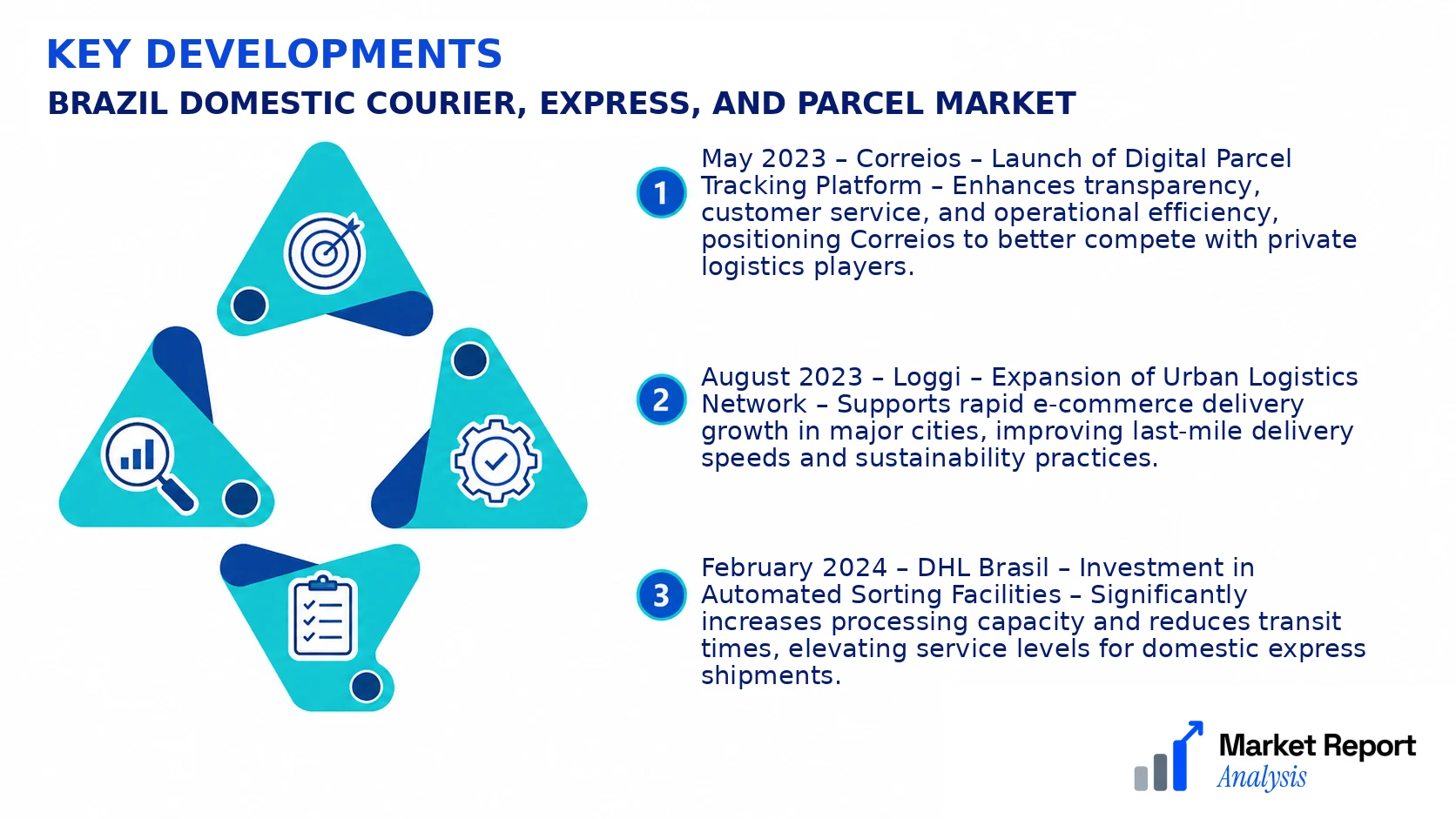
- May 2023 – Correios – Launch of Digital Parcel Tracking Platform – Enhances transparency, customer service, and operational efficiency, positioning Correios to better compete with private logistics players.
- August 2023 – Loggi – Expansion of Urban Logistics Network – Supports rapid e-commerce delivery growth in major cities, improving last-mile delivery speeds and sustainability practices.
- February 2024 – DHL Brasil – Investment in Automated Sorting Facilities – Significantly increases processing capacity and reduces transit times, elevating service levels for domestic express shipments.
- April 2024 – FedEx Express Brazil – Strategic Partnership with Local Retailers – Strengthens market penetration and boosts regional delivery capabilities through integrated logistics solutions.
- July 2024 – UPS Brazil – Acquisition of Local Logistics Provider – Expands regional warehousing and last-mile delivery capacity, aligning with consumer demand for faster, reliable service.
Frequently Asked Questions
What is the Brazil Domestic Courier, Express, and Parcel Market?
The Brazil Domestic Courier, Express, and Parcel Market encompasses the delivery of packages, parcels, and documents within Brazil, driven by e-commerce growth, urbanization, and infrastructure development, serving both individual consumers and businesses across the country.
What is the current market size of Brazil Domestic Courier, Express, and Parcel Market?
As of 2026, the market is valued at approximately USD 74 Billion, reflecting significant growth fueled by rising online shopping and higher demand for quick delivery services, with projections indicating continued expansion through 2034.
What factors are driving the Brazil Domestic Courier, Express, and Parcel Market?
Key drivers include the exponential growth of e-commerce, increased consumer demand for rapid delivery, technological advancements, urban infrastructure improvements, and the expansion of logistics networks supporting efficient parcel processing and transportation.
Which region dominates the Brazil Domestic Courier, Express, and Parcel Market?
São Paulo leads the market, benefiting from its status as Brazil's economic hub, urban density, and advanced logistics infrastructure, accounting for the largest share of market volume and revenue in the country.
Which segment is expected to grow the fastest?
The express parcel segment is projected to grow at the fastest rate, driven by the need for same-day and next-day delivery options, especially in urban centers and for e-commerce logistics, capturing a significant portion of future market value.
Who are the leading companies operating in the Brazil Domestic Courier, Express, and Parcel Market?
Major players include Correios, DHL, FedEx, and local providers such as Jadlog and Loggi, which compete through service innovation, expanded networks, and technological integration to capture market share in Brazil's expanding logistics landscape.
Analyst Perspective
The Brazil domestic courier, express, and parcel market is poised for sustained growth through 2034, driven by ongoing digital transformation and expanding e-commerce activity. Over the long term, market maturity will lead to heightened competitive intensity, with key players investing heavily in last-mile logistics innovations, including automation and AI-driven delivery routing. Regional disparities offer lucrative city-level opportunities, especially in major urban centers like São Paulo, Rio de Janeiro, and Brasília, where infrastructure enhancements and consumer demand are most pronounced. Strategic investments should prioritize technological evolution such as real-time tracking and delivery drones to improve efficiency and customer experience. Market entrants and incumbents alike need to focus on developing customized solutions for small, medium, and large enterprises, tapping into Brazil’s vast and diverse regional markets. Long-term success hinges on a balanced approach to innovation, regional growth leverage, and sustainable practices that align with evolving regulatory frameworks and environmental expectations.
