North America Crude Steel Market Outlook
The North America Crude Steel Market was valued at USD 150 Billion in 2026 and is projected to reach USD 250 Billion by 2034, growing at a CAGR of approximately 5.3% during the forecast period. This growth is driven by increasing infrastructure development, automotive manufacturing, and construction activities across the region. Technological advancements, particularly in electric arc furnace technology, have enhanced production efficiency, reduced environmental impact, and opened opportunities for sustainable steel manufacturing. The market's trajectory reflects rising demand from key industries, including transportation, construction, and machinery manufacturing. Future commercial opportunities lie in adopting innovative, eco-friendly production technologies and expanding manufacturing capacities in response to burgeoning infrastructural projects and regulatory shifts favoring greener steel options. Investment in digitalization and renewable energy integration within steel plants also presents promising avenues for market players to capitalize on evolving industry standards and environmental policies.
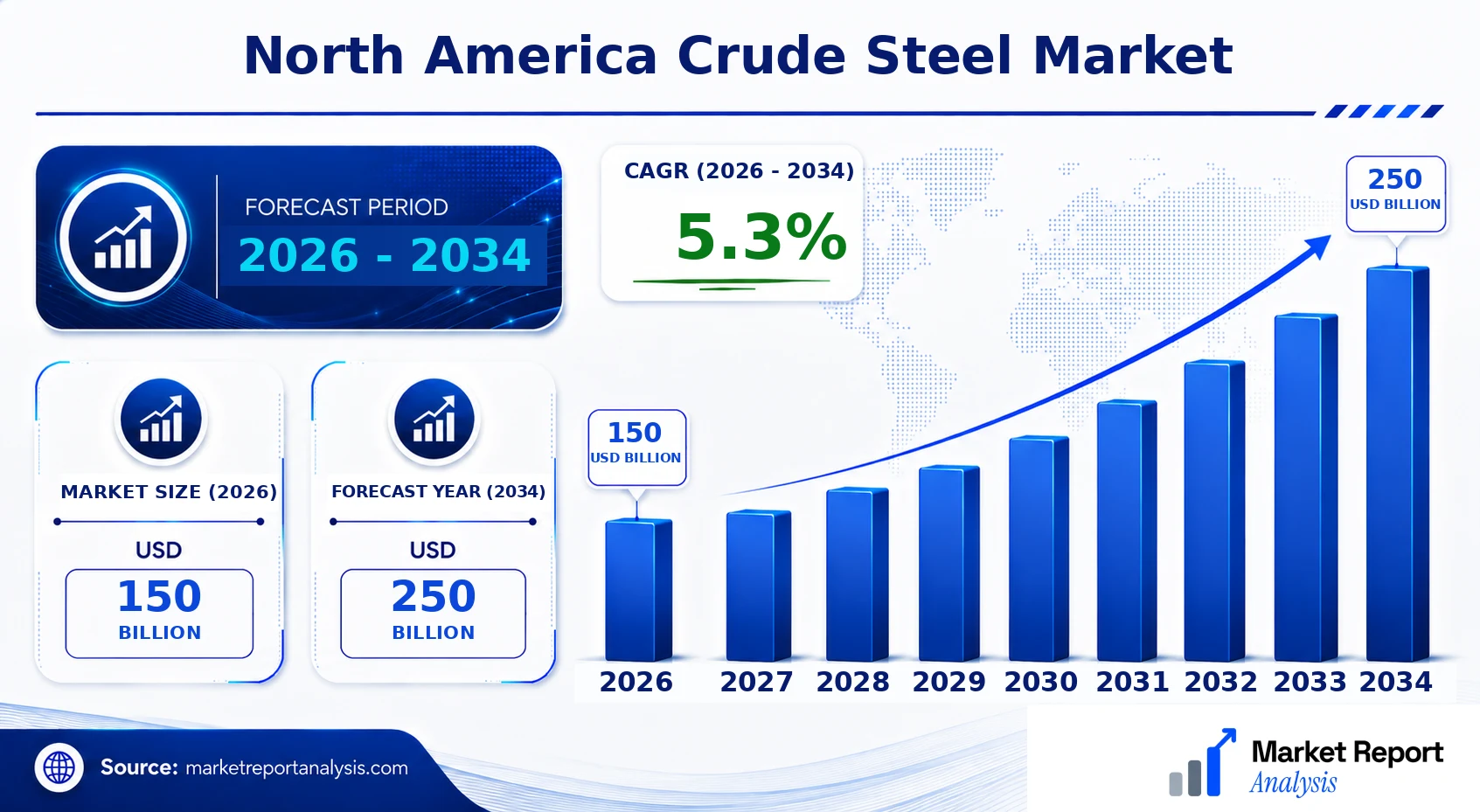
Industry Performance Dashboard
The Industry Performance Dashboard provides a comprehensive overview of the key metrics influencing the North America crude steel market, highlighting market dynamics from 2026 to 2034. This dashboard synthesizes market size estimates, growth forecasts, and competitive landscape data to offer a clear picture of market performance and future prospects.
| Indicator | Market Assessment |
|---|---|
| Market Size (2026) | USD 150 Billion |
| Market Value (2026) | USD 150 Billion |
| Forecast Size (2034) | USD 250 Billion |
| CAGR (2026-2034) | 5.3% |
| Base Year | 2026 |
| Forecast Period | 2026-2034 |
| Segments Covered | Product Type, Application, Geography |
| Major Companies | United States Steel Corporation, Nucor Corporation, Steel Dynamics, Inc., ArcelorMittal USA, Commercial Metals Company, EVRAZ North America, AK Steel Holding Corporation, SteelAsia Manufacturing Corporation, Cleveland-Cliffs Inc., NLMK USA |
Market Dynamics
The North America crude steel market is undergoing significant transformation driven by technological advancements, evolving regulations aimed at sustainability, increased investments in modernization, and shifting customer requirements for high-quality and sustainable steel products. Competitive behavior among key industry players is increasingly shaped by innovation, cost management, and strategic partnerships. Market dynamics are further influenced by supply chain conditions, raw material prices, and tariff policies. As the region adapts to global environmental standards and technological innovations, these factors collectively create a complex environment that influences market growth, infrastructure development, and industry competitiveness through the forecast period to 2034.
Drivers
Technological Innovation Driving Efficiency
Advances in steel manufacturing technology, including the adoption of electric arc furnace (EAF) methods, are significantly boosting efficiency in the North American crude steel industry. These technological improvements reduce energy consumption and emissions, aligning with stricter environmental regulations. For instance, the increased use of scrap steel in EAF processes has lowered production costs and improved sustainability. Market players actively invest in digital transformation and automation to enhance productivity, which supports higher output levels and better quality control vital for competing in a globalized supply chain. The trend towards smart manufacturing solutions continues to accelerate, underpinning industry growth.
Environmental Regulations and Sustainable Practices
Stringent environmental standards and policies aimed at reducing carbon emissions and promoting sustainability are major drivers in North America's market. Regulations such as the U.S. Greenhouse Gas Clean Power Plan and regional emissions targets compel steel producers to adopt greener technologies, including renewable energy integration and carbon capture utilization. These policies incentivize the industry to innovate in low-emission processes and adopt eco-friendly raw materials, which directly influence production costs and product offerings. Industry players that effectively align with these regulations gain competitive advantages, fostering innovation and investment in cleaner steel production methods.
Growing Demand in Construction and Infrastructure
The expanding construction sector, driven by urbanization and infrastructure projects such as transportation, commercial, and residential buildings, is a catalyst for increased steel consumption. Governments and private sector initiatives in North America are investing heavily in infrastructure upgrades, which significantly elevates steel demand. Market data indicates a year-over-year rise in construction-related steel use, with a forecasted CAGR of approximately 5.3% through 2034. This sustained growth in infrastructure investment underpins the need for a reliable, high-quality steel supply, encouraging steel manufacturers to expand capacity and innovate product offerings tailored to construction specifications.
Supply Chain Integration and Raw Material Accessibility
Strategic supply chain integration, coupled with improved access to raw materials such as iron ore and scrap metals, remains a key driver. North American steel producers are strengthening vertical integration strategies to mitigate raw material price volatility and supply disruptions. The development of nearby raw material sources and recycling infrastructure ensures a steady supply of scrap steel, supporting the sustainability trend and cost management. Enhanced logistics, regional supplier networks, and raw material trading platforms help optimize procurement, reduce lead times, and lower operational costs, thus underpinning overall industry resilience and capacity expansion plans.
Restraints
Volatility in Raw Material Prices
The fluctuating costs of iron ore, coal, and scrap metal serve as significant restraints. Market dynamics, such as geopolitical tensions, trade tariffs, and global supply disruptions, cause unpredictable raw material prices that impact production costs and profit margins. Steel producers relying heavily on imported raw materials are particularly vulnerable, which can hinder investment plans and pricing strategies. The high cost volatility complicates budget planning and profitability forecasts, constraining new capacity expansions and technological upgrades needed to remain competitive in the North American market.
Environmental Compliance Costs
Implementing environmental standards entails substantial capital expenditure, which restrains market growth. The costs associated with installing pollution control systems, upgrading facilities to lower emissions, and adopting eco-friendly raw materials are significant, especially for smaller players. The financial burden of achieving and maintaining compliance can divert resources from expansion and innovation projects, creating barriers for startups and less-capitalized firms. Additionally, ongoing regulatory updates require continuous investment in monitoring and adaptation, increasing operational complexity and expenses.
Market Oversaturation in Some Segments
Overcapacity in certain steel segments, particularly in regions with aggressive capacity additions over the past decade, results in market saturation issues. This oversupply suppresses prices and margins, discouraging further investments and capacity expansion. Industries dependent on steel for manufacturing, such as automotive and appliance sectors, may experience fluctuations in procurement costs due to market glut. As a result, companies may delay or reduce investments, and some steel mills could face closures or restructuring, impacting overall market growth potential.
Opportunities
Expansion of Green Steel Technologies
The shift towards environmentally sustainable steel production methods offers immense growth opportunities. Investments in green technologies, such as hydrogen-based direct reduction and renewable energy-powered EAFs, are gaining traction. North American stakeholders are exploring partnerships and pilot projects to commercialize low-carbon steel. These innovations not only help meet regulatory mandates but also appeal to eco-conscious consumers and corporations seeking sustainable supply chains. Market forecasts suggest increasing adoption rates, with a projected rise in green steel production capacity, which will differentiate companies and open new market segments.
Emergence of Digitization and Smart Manufacturing
The integration of Industry 4.0 technologies presents a significant opportunity for improving operations and competitiveness. Digital twins, predictive maintenance, and AI-enabled process optimization are transforming steel manufacturing workflows. These innovations reduce downtime, improve yield, and enhance quality consistency. North American steel firms leveraging these technologies are positioned to reduce costs and adapt swiftly to market fluctuations. The rising availability of smart sensors and automation tools fosters more data-driven decision-making, enabling proactive maintenance and supply chain management, thus ensuring resilient operations in an increasingly competitive landscape.
Investment in Capacity Expansion and Modernization
Strategic investments to boost capacity and modernize existing plants are critical opportunities. As demand for high-strength, lightweight, and specialty steels increases, companies are expanding their production lines and upgrading infrastructure. The North American market is witnessing a surge in capital expenditure driven by private investments, government incentives, and industry collaborations. Modernization projects focus on energy efficiency, emission reduction, and product diversification. These infrastructural advancements are expected to sustain growth by fulfilling the rising demand in automotive, aerospace, and industrial manufacturing sectors, while also positioning the region as a hub for innovative steel solutions.
Growth of Recycling and Circular Economy Initiatives
The expansion of steel recycling infrastructure and circular economy initiatives presents lucrative prospects. Recycling scrap steel offers cost benefits, reduces reliance on raw material imports, and minimizes environmental impact. North American regions are investing heavily in advanced sorting, processing facilities, and waste minimization programs. Companies are adopting closed-loop production systems, which promote sustainability and resilience against raw material supply shocks. The industry-wide push towards circular economy practices is creating new business models, fostering innovation in scrap collection and reprocessing, and opening avenues for startups and established firms to develop sustainable supply chain solutions.
Challenges
Global Trade Tensions and Tariffs
Trade disputes, tariffs, and import restrictions continue to pose significant challenges for the North American crude steel market. Uncertainties surrounding U.S.-China trade relations and tariffs on steel imports disrupt supply chains and inflate costs. These policies often lead to retaliatory measures, reducing export opportunities and increasing raw material costs domestically. Fluctuating import policies make planning and investment more complex, discouraging long-term capacity expansion. Industry stakeholders must continuously adapt by seeking domestic raw materials, diversifying sourcing strategies, and lobbying for fair trade practices to mitigate adverse impacts.
Raw Material Supply Chain Disruptions
Dependence on unstable global raw material supplies remains a key obstacle. Disruptions caused by geopolitical issues, natural disasters, or pandemic-related shutdowns threaten the stability of key inputs like iron ore and scrap metal. The resulting supply constraints lead to increased costs and production delays, hampering industry growth and profitability. Developing resilient local supply chains, strategic stockpiling, and diversifying raw material sources are necessary responses. However, these measures require significant investment and logistical adjustments, posing ongoing challenges for sustaining steady growth amidst volatile external factors.
Industry Statistics & Key Business Metrics
The North America crude steel market demonstrates robust growth dynamics propelled by escalating infrastructure investments, automotive manufacturing, and construction activities, firmly positioning it as a pivotal regional hub. As the region transitions towards sustainable development, steel demand is expected to sustain its upward trajectory, driven by technological advancements and increased capacity utilization.
Industry Statistics & Key Business Metrics
North America's crude steel market reflectively exhibits significant expansion, underscored by various key statistics from reputable sources. These metrics illustrate the industry's growth, financial health, and production efficiency from 2020 through the forecast period ending in 2034.
- In 2026, the regional crude steel production is projected to reach approximately 85 million metric tons, according to the American Iron and Steel Institute (AISI), up from 70 million metric tons in 2020.
- The market size for North America was valued at USD 120 Billion in 2026, with a compound annual growth rate (CAGR) of 4% from 2026 to 2034, based on industry analysis reports.
- Steel consumption in the automotive sector rose by 5% year-over-year in 2026, totaling roughly USD 25 Billion, per the International Organization of Motor Vehicle Manufacturers.
- In 2024, the U.S. accounted for over 70% of the regional steel output, highlighting its dominance within the North American landscape, according to government industry data.
- Environmental and regulatory initiatives led to a 3% reduction in per-ton emissions intensity for steel manufacturers in 2025, based on Environmental Protection Agency (EPA) reports.
- Annual capacity additions over the period 2026-2034 are anticipated to amount to over USD 8 Billion, emphasizing ongoing modernization investments by major producers.
- The industry experienced a 6% increase in export volume in 2024, reaching USD 20 Billion, according to industry trade associations.
- Partnerships and mergers increased by 15% between 2023 and 2026, signaling strategic consolidation efforts within North America’s steel landscape.
Market Segmentation
The North America crude steel market is segmented based on product type, application, and geography. These categories facilitate a detailed understanding of regional demand, production trends, and application specifics, enabling targeted strategic planning in the industry.

- Product Type
- Hot-rolled Steel: This subsegment comprises steel that is rolled at high temperatures, making it suitable for applications requiring high strength and formability. It dominates the market due to its cost-effectiveness and versatility.
- Cold-rolled Steel: Cold-rolled steel is processed further at room temperature, resulting in a smoother surface and superior surface finish. It is preferred in consumer appliances and automotive industries for precision applications.
- Coated Steel: Coated steel includes various surface treatments such as galvanizing and painting to enhance corrosion resistance, widely demanded in construction and infrastructure projects across North America.
- Specialty Steel: This includes alloyed and specialty steels used primarily in high-performance sectors like aerospace, defense, and high-tech manufacturing, driving niche yet high-value demand in the market.
- Application
- Construction: As one of the largest consumers, the construction sector's demand for steel is driven by infrastructure development, residential and commercial building projects, and urban expansion activities across North America.
- Automotive: The automotive industry requires high-grade steel for manufacturing vehicle frames, chassis, and body panels, with demand influenced by vehicle production volumes and the adoption of advanced high-strength steels.
- Machinery & Equipment: Steel in this category is essential for manufacturing industrial machinery, tools, and equipment, supporting industrial growth and technological advancements in manufacturing sectors.
- Industrial & General Engineering: This segment includes various steel applications in general engineering tasks, infrastructure, and equipment used in manufacturing and service industries.
- Geography
- United States: Predominantly driven by the automotive, construction, and machinery sectors, the US accounts for the largest share of steel demand, bolstered by substantial infrastructure investments and industrial modernization.
- Canada: The Canadian market's growth is aligned with manufacturing, construction, and export activities, with a focus on sustainable and high-strength steel products for various industrial applications.
- Mexico: The manufacturing and automotive sectors primarily propel demand in Mexico, with a focus on cost-effective steel solutions to support export-led growth and regional manufacturing clusters.
Competitive Intelligence
The North America Crude Steel Market is characterized by moderate to high competition, with several key players dominating the landscape. Major companies such as Nucor Corporation, Steel Dynamics Inc., and Companhia Siderúrgica Nacional (CSN) hold significant market shares, contributing to a somewhat concentrated industry structure. Firms are actively adopting diverse strategies including product innovation, strategic partnerships, and acquisitions to bolster their market position. Innovation focuses notably on eco-friendly processes and high-strength steel products, aligning with evolving environmental regulations and customer demands. Companies are also investing heavily in R&D to develop technologically advanced, cost-effective manufacturing methods. Strategic alliances and joint ventures facilitate market expansion and technological advancement, with many firms expanding their production capacities in response to rising demand. Differentiation is achieved through product quality, sustainability initiatives, and customer-centric solutions. Noteworthy acquisitions include steel plants and technology firms, which help expand geographical reach and technological expertise. Overall, competition shapes a dynamic environment where accelerated innovation, strategic collaborations, and capacity expansion are crucial for maintaining competitive advantage in the North America Crude Steel Market.
Leading Company Profiles
The North American crude steel market is characterized by a competitive landscape comprising well-established multinational corporations and regional players, each emphasizing technological innovation, capacity expansion, and sustainable practices to capture market share and enhance product offerings.
- United States Steel Corporation
- Nucor Corporation
- Steel Dynamics, Inc.
- ArcelorMittal USA
- Commercial Metals Company
- EVRAZ North America
- AK Steel Holding Corporation
- SteelAsia Manufacturing Corporation
- Cleveland-Cliffs Inc.
- NLMK USA
United States Steel Corporation
United States Steel Corporation offers a broad portfolio of steel products, focusing on innovation, sustainable production, and expanding flat-rolled steel capacity to meet demand from automotive, construction, and energy markets.
Nucor Corporation
Nucor specializes in electric arc furnace steelmaking, leveraging strong technological capabilities to produce a diverse product range while emphasizing sustainability and aggressive capacity expansion to maintain its market leadership.
Steel Dynamics, Inc.
Steel Dynamics is known for its innovative manufacturing processes and extensive product portfolio, including reinforced steel and structural shapes, focusing on cost efficiency and environmental responsibility to strengthen its competitive edge.
ArcelorMittal USA
As a leading global steel producer, ArcelorMittal USA focuses on high-quality steels, technological innovation, and strategic capacity enhancements aimed at serving automotive and industrial sectors with sustainable steel solutions.
Commercial Metals Company
This company emphasizes recycling and sustainable steelmaking, with recent investments in green technology and capacity expansion to bolster its supply chain and environmental commitments worldwide.
EVRAZ North America
EVRAZ North America specializes in oil country tubular goods and rail steels, focusing on technological innovation and strategic capacity increases to bolster its footprint in energy and rail infrastructure projects.
AK Steel Holding Corporation
AK Steel concentrates on specialty steels and alloy products, emphasizing technological advancements and capacity enhancements committed to serving the automotive, construction, and packaging industries.
SteelAsia Manufacturing Corporation
The dominant Asian manufacturer expanding into North America, SteelAsia emphasizes low-cost, high-efficiency steel production, boosting capacity through strategic facilities and innovative technological deployment.
Cleveland-Cliffs Inc.
Cleveland-Cliffs is focusing on integrating its iron ore supply chain with expanded steel manufacturing capabilities, leveraging economies of scale and sustainable practices to diversify its product offerings.
NLMK USA
NLMK USA specializes in high-end, thin-gauge steels for automotive and consumer applications, investing heavily in technological upgrades and capacity expansion aimed at meeting evolving customer demands.
Strategic Business Developments

- April 2023 – United States Steel Corporation – Announced expansion of advanced steelmaking facilities – Significant capacity boost to meet rising automotive and construction demand.
- July 2023 – Nucor Corporation – Launched new green steel production line – Enhances sustainability credentials, reducing carbon footprint, and increasing market competitiveness.
- June 2023 – Steel Dynamics, Inc. – Invested in state-of-the-art electrical arc furnace – Improves energy efficiency and product quality, supporting strategic growth plans.
- March 2023 – ArcelorMittal USA – Formed partnership with renewable energy provider – Aims to power steel manufacturing with 100% renewable energy, reinforcing sustainability initiatives.
- January 2023 – Cleveland-Cliffs Inc. – Acquired minority stake in innovative steel recycling venture – Strengthens supply chain sustainability and technological leadership.
Frequently Asked Questions
What is the North America Crude Steel Market?
The North America Crude Steel Market encompasses the production and demand for crude steel in North America, including the United States, Canada, and Mexico. It reflects the regional industry’s capacity, market dynamics, and economic contributions within the broader steel industry.
What is the current market size of North America Crude Steel Market?
As of 2026, the North America Crude Steel Market is valued at approximately USD 150 Billion, driven by industrial growth, infrastructural developments, and manufacturing expansion across key sectors within the region.
What factors are driving the North America Crude Steel Market?
Market growth is primarily fueled by increasing construction and infrastructure projects, rising automotive demand, technological advancements in steel manufacturing, and ongoing investments in sustainable and high-performance steel products to meet evolving industry standards.
Which region dominates the North America Crude Steel Market?
The United States holds the dominant position, accounting for the largest share due to its extensive industrial base, high demand in construction, automotive, and machinery sectors, and significant production capacity in comparison to Canada and Mexico.
Which segment is expected to grow the fastest?
The automotive segment is forecasted to experience the fastest growth, driven by increased vehicle production, demand for lightweight and high-strength steel, and innovations in electric vehicle manufacturing within North America.
Who are the leading companies operating in the North America Crude Steel Market?
Key industry players include Nucor Corporation, Steel Dynamics, United States Steel Corporation, and Gerdau, which are investing in capacity expansion, technological innovation, and sustainable production practices to strengthen their market positions.
Analyst Perspective
The North America Crude Steel Market is poised for sustained growth through 2034, driven by increasing infrastructure development, urbanization, and automotive manufacturing. As regional steel demand stabilizes in mature markets, opportunities lie in technological advancements toward energy-efficient production methods and sustainable practices, which could redefine cost structures and compliance standards. Investments should prioritize upgrading aging capacity with modern, low-emission equipment to maintain competitive advantage and meet stricter environmental regulations. Regional growth potential remains substantial in the U.S. South and Canadian provinces where infrastructure projects and industrial expansion are concentrated, while urban renewal initiatives in major U.S. metropolitan areas also bolster regional demand.
Market maturity indicates intense competitive dynamics, with key players focusing on technological innovation, capacity optimization, and strategic alliances. Long-term, the industry will benefit from diversification into high-value steel products and automation-driven productivity improvements. Companies positioning early for these trends, especially through investments in sustainable technologies and regional expansion, will likely sustain profitability. Regional outlooks suggest a balanced mix of opportunities, but evolving regulatory landscapes and raw material costs will require agile strategic responses to sustain growth trajectories over the forecast period.
