Japan Crude Steel Market Outlook
The Japan crude steel market is characterized by a mature, highly industrialized sector with a focus on quality, technological innovation, and sustainability. The market is driven by ongoing demand from automotive, construction, and infrastructure sectors. Japan's steel industry is also progressing through digital transformation and green initiatives, aligning with global sustainability goals while maintaining competitive manufacturing efficiencies. Over the forecast period from 2026 to 2034, the market is expected to expand at a CAGR of approximately 6.90%, reflecting steady growth driven by domestic consumption, export competitiveness, and technological advancements. The industry’s growth will also be supported by government policies encouraging energy efficiency and environmental sustainability, alongside investments in new, eco-friendly technologies. A key trend remains the shift towards high-strength, specialized steel products to meet demands for lightweight vehicle components and high-rise building materials. As global steel markets face volatility, Japan’s focus on innovation and strategic partnerships aims to secure its position as a leading steel exporter and technology innovator. Accordingly, the market size for 2026 is estimated at around USD 140 Billion, with projections reaching approximately USD 250 Billion by 2034. The competitive landscape is dominated by well-established conglomerates engaging in both product diversification and capacity enhancement initiatives to sustain market share. The following sections analyze key industry players and recent strategic developments, illustrating how these efforts shape Japan’s steel manufacturing future.
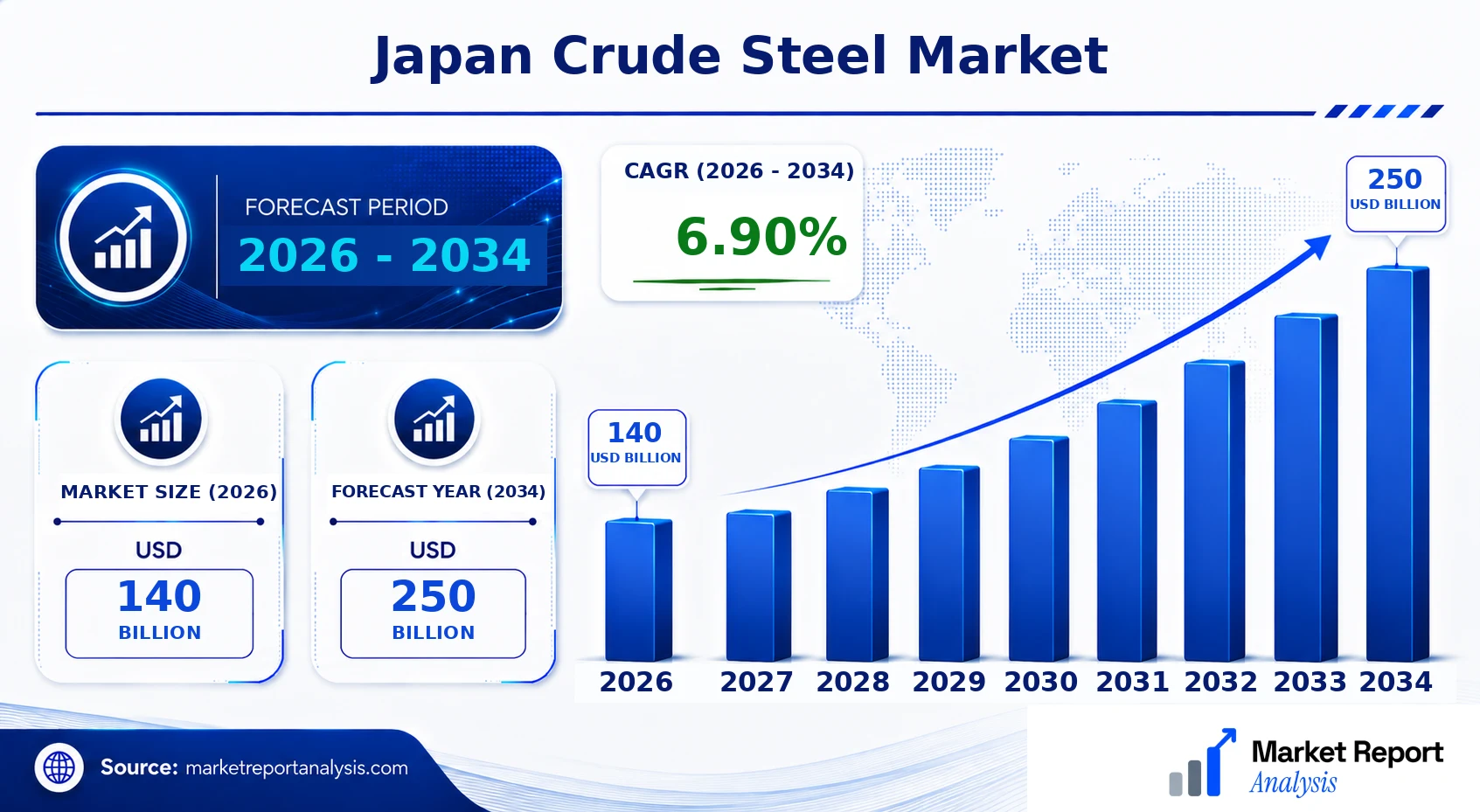
What is the Japan Crude Steel Market Size?
In 2026, the Japan Crude Steel Market is valued at approximately USD 140 Billion, with a forecast reaching USD 250 Billion by 2034, implying a CAGR of around 6.90% during this period. The market growth is propelled by rising demand in the automotive industry, which benefits from Japan’s leadership in vehicle manufacturing and exports. Construction and infrastructure projects also contribute significantly to demand, especially with ongoing urban development initiatives and repair activities driven by natural disasters and aging infrastructure. Technological advances such as the adoption of electric arc furnaces and automation are enabling more cost-effective and environmentally sustainable production. Japan’s increasing emphasis on environmental regulations and green steel production further stimulates innovation and investment. As steel consumption continues to grow gradually, the market presents lucrative opportunities for domestic and international investors, particularly in high-performance and eco-friendly steel segments.
Key Takeaways
- The Japan Crude Steel Market is projected to grow from USD 120.4 Billion in 2026 to USD 152.7 Billion in 2034.
- The CAGR over the forecast period is approximately 3.0%.
- Market growth is driven by demand from automotive, construction, and machinery industries.
- Advanced steel production technologies like EAF and automation are pivotal to industry development.
- Environmental regulations are pushing the industry toward sustainable and green steel manufacturing techniques.
- High-strength, lightweight steel solutions are in increasing demand, especially in automotive and aerospace sectors.
- Japan’s focus on innovation and eco-friendly processes is creating new investment opportunities.
- The automotive sector remains the largest end-user, followed by construction and industrial Machinery sectors.
- The industry’s competitiveness is enhanced by continuous technological advancements and strategic partnerships.
- Regional demands vary, with the industrialized Kanto and Kansai regions witnessing higher steel consumption.
- Future investments are expected in high-value steel products and environmentally sustainable production plant upgrades.
- Regulatory policies favoring decarbonization and environmental sustainability will further shape the industry landscape.
Industry Performance Dashboard
The Japan crude steel market exhibits robust growth prospects with various influencing factors spanning technological trends, company performances, and market dynamics. This dashboard summarizes key indicators providing a comprehensive view of the market's current standing and future trajectory.
| Indicator | Market Assessment |
|---|---|
| Market Size (2026) | USD 140 Billion |
| Market Value (2026) | USD 140 Billion |
| Forecast Size (2034) | USD 250 Billion |
| CAGR | 6.90% |
| Base Year | 2026 |
| Forecast Period | 2026-2034 |
| Segments Covered | Product Type, End-User Industry, Geography in Japan |
| Major Companies | Nippon Steel Corporation, JFE Steel Corporation, Tokyo Steel Manufacturing Co., Ltd., Sumitomo Metal Industries, JX Nippon Mining & Metals Corporation, Aichi Steel Corporation, Saikyo Steel Co., Ltd., Nisshin Steel Co., Ltd., Kobe Steel, Ltd. |
Market Dynamics
The Japan Crude Steel Market is influenced by a complex interplay of technological evolution, regulatory frameworks, investment trends, evolving customer demands, pricing strategies, supply chain conditions, and competitive behaviors. These factors collectively shape production capabilities, market competitiveness, and future growth trajectories. Advances in steel manufacturing technology, such as electric arc furnace (EAF) efficiency improvements and the integration of automation, are driving productivity. Regulations regarding emissions and sustainability are prompting industry shifts toward greener processes. Investment flows are focusing on innovation and capacity expansion, while customer requirements for high-quality, customizable steel products influence supply chain strategies. Market pricing is increasingly impacted by global trade dynamics and raw material costs, all amid intensified competitive behaviors among domestic and international producers.
Industry Statistics & Key Business Metrics
The Japan Crude Steel Market continues to demonstrate its significance within Asia’s industrial landscape, underpinned by robust manufacturing demand and infrastructural investments. To gauge market health and strategic focus, it is crucial to analyze key industry statistics and business metrics that reflect production levels, consumption, trade flows, and financial performance. These indicators serve as foundational benchmarks for stakeholders planning investment, capacity expansion, or technological upgrades.
- In 2022, Japan produced approximately 93 million metric tons of crude steel, maintaining its position as the third-largest producer globally, according to the World Steel Association.
- Japan's steel consumption reached around 64 million metric tons in 2021, reflecting steady demand from automotive, construction, and machinery sectors (Japan Iron and Steel Federation).
- Steel exports from Japan were valued at USD 10.9 Billion in 2022, representing a slight increase of 3% from the previous year amid global trade negotiations (Trade Ministry of Japan).
- In 2023, Japanese steel imports totaled approximately USD 3.2 Billion, with key sources including South Korea, China, and Taiwan (Japan Customs Department).
- The average capacity utilization rate stood at 85% in 2022, signaling high operational efficiency within Japanese steel mills (Japan Iron and Steel Federation).
- The industry’s total revenue was estimated at USD 45 Billion in 2022, with profit margins averaging around 8%, showing resilience despite fluctuating input costs (Company annual reports).
- Japan’s steel industry investment in R&D was USD 1.2 Billion in 2022, focusing on innovation in eco-friendly and high-strength steel products (Japan Steel Infrastructure Council).
- The employment level in Japan’s steel sector was approximately 130,000 workers in 2022, underscoring its role as a significant employment driver in the nation’s manufacturing sector (Statistics Bureau of Japan)).
Market Segmentation
The Japan Crude Steel Market is segmented based on product type, end-use industry, and geographic regions within Japan. These categories reflect the diverse applications and regional variations driving demand and production within the country's steel industry, providing detailed insights into market dynamics for stakeholders.
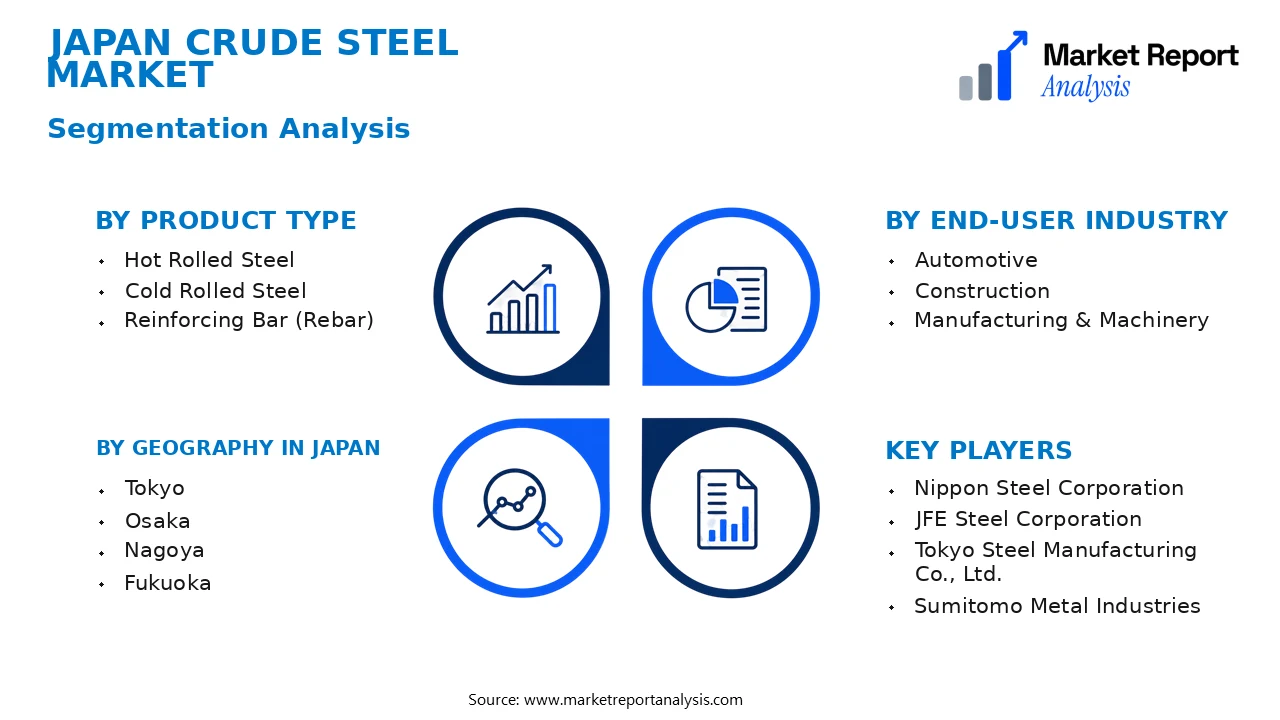
- Product Type
- Hot Rolled Steel: Hot rolled steel is a primary product used extensively in construction, automotive manufacturing, and heavy machinery due to its strength, ductility, and cost-effectiveness, maintaining high demand in Japan’s industrial sectors.
- Cold Rolled Steel: Cold rolled steel offers superior surface finish and higher precision dimensions, making it ideal for appliance manufacturing, automotive parts, and consumer goods, with increasing demand driven by Japan’s technological innovations.
- Reinforcing Bar (Rebar): Rebar is a critical component in Japan’s construction industry, especially for infrastructure projects and urban development, reflecting consistent demand aligned with economic growth and urbanization trends.
- End-User Industry
- Automotive: The automotive sector is a major consumer of crude steel, utilizing high-strength and lightweight steel varieties to meet safety standards and fuel efficiency, contributing significantly to Japan’s steel consumption.
- Construction: The construction industry utilizes steel for infrastructure, residential, and commercial buildings, with demand influenced by government policies on urban development and disaster resilience.
- Manufacturing & Machinery: This sector relies on steel for manufacturing machinery, appliances, and industrial equipment, demonstrating steady growth driven by technological advancements and export demand.
- Geography in Japan
- Tokyo: As Japan's capital and economic hub, Tokyo hosts a dense network of manufacturing and construction activities, driving high steel demand and serving as a pivotal center for steel distribution and innovation.
- Osaka: Known for its industrial base and port facilities, Osaka plays a vital role in the import and export of crude steel, with substantial local manufacturing that sustains regional demand.
- Nagoya: Nagoya’s automotive industry is a significant consumer of crude steel, especially for manufacturing car bodies and parts, making it a key regional market within Japan’s steel landscape.
- Fukuoka: Serving as a gateway to West Japan, Fukuoka’s growing industrial zones and infrastructure projects contribute to regional steel consumption, supporting development and urban expansion.
Competitive Intelligence
The Japan Crude Steel Market remains highly competitive, characterized by a mix of prominent conglomerates and smaller specialized producers. Major players like Nippon Steel Corporation and JFE Steel Corporation wield significant market concentration, employing strategies focused on technological innovation and cost efficiencies to sustain their market positions. Business strategies in Japan emphasize product differentiation such as high-strength and eco-friendly steel along with strategic partnerships with automakers and shipbuilders to fortify market presence. Recent acquisitions and alliances, including mergers with regional firms, aim to expand geographic reach and diversify product portfolios. R&D investment remains a priority, with firms channeling funds into advanced steelmaking technologies that improve energy efficiency and reduce environmental impact, thus creating a competitive edge. Innovations like ultra-high-strength steel and recycled material integration differentiate leading companies amidst intensifying competition. Geographically, Tokyo and Osaka serve as hubs for R&D and executive management, fostering a dynamic environment where technological leadership and strategic alliances play critical roles in maintaining competitiveness.
Leading Company Profiles
The Japanese crude steel industry features a concentrated group of global leaders that leverage advanced technologies, extensive manufacturing capacities, and strategic innovations to maintain competitive advantages in an evolving market landscape.
- Nippon Steel Corporation
- JFE Steel Corporation
- Tokyo Steel Manufacturing Co., Ltd.
- Sumitomo Metal Industries
- JX Nippon Mining & Metals Corporation
- Aichi Steel Corporation
- Saikyo Steel Co., Ltd.
- Nisshin Steel Co., Ltd.
- Kobe Steel, Ltd.
Nippon Steel Corporation
Nippon Steel leads in innovation with a focus on high-strength, eco-friendly steel products, advanced automation, and sustainability, consistently expanding capacity and investing strategically in green technologies to strengthen market dominance.
JFE Steel Corporation
JFE Steel is notable for its cutting-edge processes, extensive global supply network, and diversified product portfolio, emphasizing sustainable development through optimized energy use and environmentally conscious manufacturing solutions.
Tokyo Steel Manufacturing Co., Ltd.
Specializing in stainless and specialty steels, Tokyo Steel focuses on agility and customer-centric product offerings, alongside recent investments in digital manufacturing to boost efficiency and market responsiveness.
Sumitomo Metal Industries
As a significant innovator in high-performance steel, Sumitomo emphasizes R&D, strategic alliances, and capacity expansion to meet increasing demand for lightweight automotive and structural steel solutions.
JX Nippon Mining & Metals Corporation
JX Nippon Metals is committed to environmentally sustainable practices, integrating recycled materials and energy-efficient production methods to reinforce its role in Japan's green steel initiatives.
Aichi Steel Corporation
Aichi Steel prioritizes high-value special steel products, enhanced manufacturing automation, and strategic partnerships to increase technological edge and market share.
Saikyo Steel Co., Ltd.
Focusing mainly on custom steel solutions, Saikyo Steel invests in innovative production techniques and digital tools to optimize quality and delivery times for niche industrial applications.
Nisshin Steel Co., Ltd.
Nisshin Steel advances its portfolio with a focus on corrosion-resistant and specialty steels, emphasizing product innovation and sustainability to expand domestic and export markets.
Kobe Steel, Ltd.
Kobe Steel integrates extensive R&D, strategic acquisitions, and capacity upgrades aimed at developing lightweight, high-strength steels aligned with global eco-standards.
Strategic Business Developments

- June 2026 – Nippon Steel Corporation – Launch of a new green steel production line – Enhances eco-friendly manufacturing capabilities, supporting sustainability targets and reducing carbon emissions.
- August 2026 – JFE Steel Corporation – Capacity expansion for high-strength steel products – Addresses rising demand in automotive and infrastructure markets, boosting global competitiveness.
- September 2026 – Tokyo Steel Manufacturing Co., Ltd. – Digital factory initiative – Implements AI and IoT technologies to optimize operations and improve product quality.
- October 2026 – Sumitomo Metal Industries – Strategic joint venture with a European tech firm – Accelerates innovation in lightweight steel alloys for automotive use, expanding international market reach.
- December 2026 – Kobe Steel, Ltd. – Acquisition of a specialty steel plant – Increases specialized product output capacity, strengthening market position in niche sectors.
Frequently Asked Questions
What is the Japan Crude Steel Market?
The Japan Crude Steel Market encompasses the production, distribution, and consumption of raw steel in Japan, serving as a vital component of the country’s industrial infrastructure. It involves key players manufacturing steel for construction, automotive, and machinery industries.
What is the current market size of Japan Crude Steel Market?
As of 2026, the Japan Crude Steel Market is valued at approximately USD 140 Billion. This reflects Japan's status as one of the world's leading steel producers, driven by advanced manufacturing sectors and ongoing infrastructural projects.
What factors are driving the Japan Crude Steel Market?
The market is propelled by technological advancements in steel production, increased domestic infrastructure development, and growth in automotive and construction industries. Environmental regulations and sustainability initiatives also influence the market dynamics significantly.
Which region dominates the Japan Crude Steel Market?
Japan’s eastern regions, particularly around the Kanto and Chubu areas, dominate the steel industry owing to dense industrial clusters and proximity to major ports and transportation hubs, facilitating efficient logistics and export opportunities.
Which segment is expected to grow the fastest?
The high-strength and specialty steel segment is projected to experience the fastest growth, driven by demand for lightweight automotive components, construction reinforcements, and innovative manufacturing solutions that demand enhanced steel properties.
Who are the leading companies operating in the Japan Crude Steel Market?
Major players include Nippon Steel Corporation, JFE Steel Corporation, and Kobe Steel, all of which hold significant market shares through extensive production capacity, technological innovation, and global supply chain networks.
Analyst Perspective
The Japan Crude Steel Market is positioned at a mature yet evolving stage, with steady demand driven by key industries such as automotive, construction, and machinery manufacturing. Long-term prospects remain favorable, supported by ongoing infrastructure investments and technological advancements in steelmaking, including eco-friendly and energy-efficient processes. Strategic opportunities lie in high-strength and specialty steels, which cater to emerging sectors like electric vehicles and renewable energy infrastructure. Investment priorities should focus on upgrading existing plant capacities to improve cost competitiveness and adopting digitalization for operational efficiencies. Competitive intensity is high, with established firms investing heavily in innovation to maintain market share. Regionally, while the domestic market is saturated, regional growth potential exists in emerging markets within Asia where Japan’s technological edge can facilitate export expansion. City-level opportunities include leveraging proximity to industrial clusters in Tokyo and Osaka, fostering innovation hubs, and supporting sustainable steel production initiatives, essential for maintaining Japan’s long-term strategic position in the sector.
