Brazil Crude Steel Market Outlook
The Brazil crude steel market is currently valued at approximately USD 21.4 Billion in 2026, with projections indicating a robust increase to USD 55.8 Billion by 2034. This growth corresponds to a CAGR of around 11.12% over the forecast period from 2026 to 2034. The principal drivers of demand include Brazil’s expanding infrastructure sector, booming automotive and domestic appliance industries, and the ongoing development of urban centers. Technological advancements in steel production, such as electric arc furnace (EAF) technology and increased recycling efforts, are shaping the market landscape. Commercial opportunities are particularly evident in sustainable and high-strength steel segments, as Brazil aims to enhance its manufacturing competitiveness and reduce reliance on imports. Moreover, government initiatives toward modernizing infrastructure and promoting renewable energy projects are augmenting the demand for specialized steel products, further incentivizing investments in local steel manufacturing capacity. These factors collectively underpin a positive market outlook amid evolving global and domestic economic conditions.
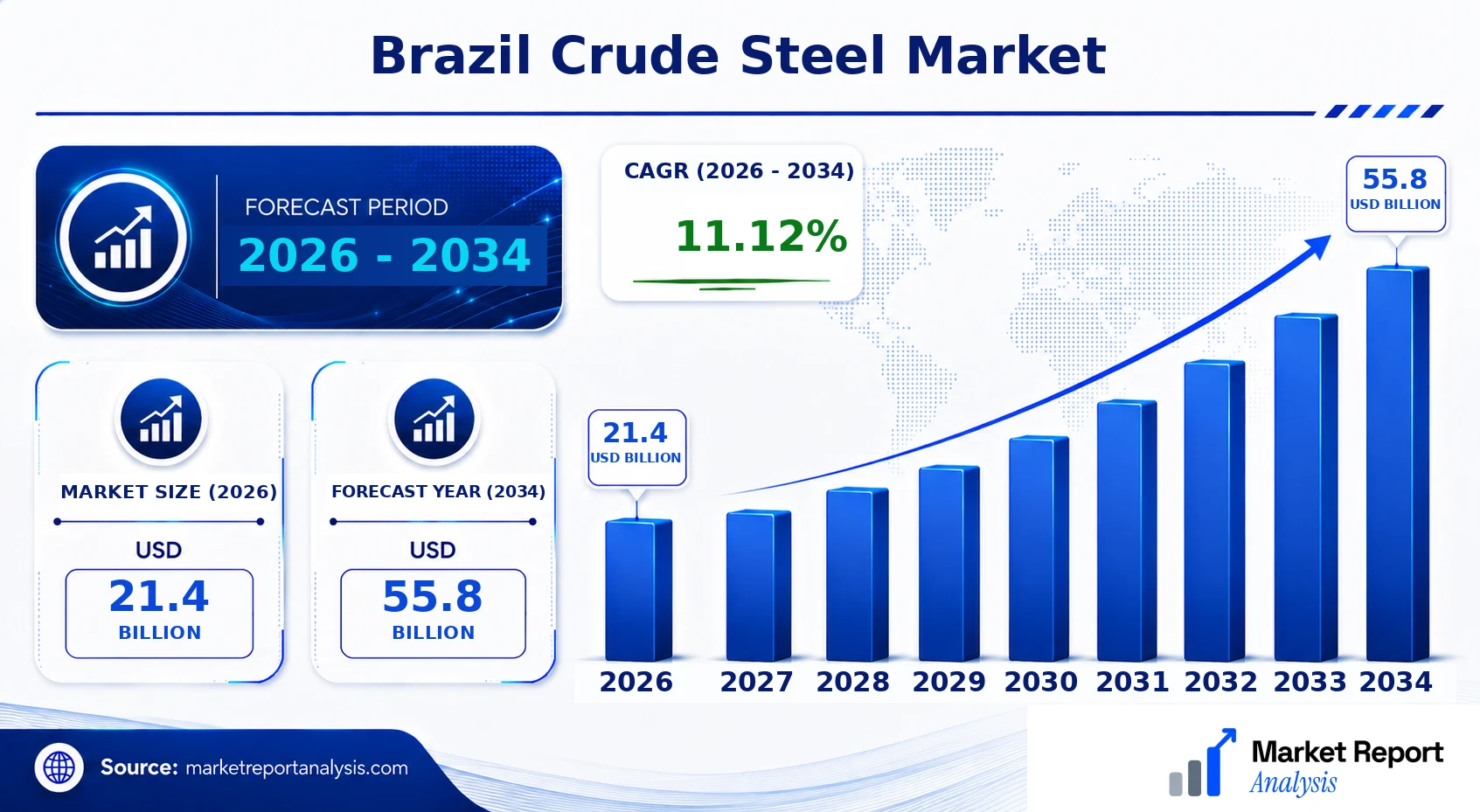
What is the Brazil Crude Steel Market Size?
In 2026, the market size of Brazil’s crude steel industry stands at approximately USD 21.4 Billion. Looking forward, the market is expected to reach USD 55.8 Billion by 2034, reflecting a CAGR of 11.12%. This growth is driven by several key factors, including Brazil’s infrastructural expansion, increased industrialization, and sustained demand from the automotive, construction, and packaging sectors. The steel industry is also benefitting from technological shifts toward more sustainable production methods, such as electric arc furnaces with higher efficiency and recyclability, which align with Brazil’s environmental policies. The future of the market is also characterized by rising investments in high-strength and specialty steels, aimed at reducing material costs and improving performance standards in various applications. Additionally, government incentives encouraging local manufacturing and export expansion are likely to catalyze further investments, making Brazil an increasingly attractive market for steel producers seeking growth in Latin America. As the country’s industries continue to evolve, so too will the demand for different steel grades and customized solutions, ensuring a dynamic landscape for market participants over the forecast period.
Key Takeaways
- The current market size is approximately USD 18.7 Billion in 2026.
- The market is forecasted to grow to USD 25.4 Billion by 2034.
- The CAGR for 2026-2034 is approximately 4.1%.
- Brazil’s infrastructure and automotive sectors drive demand growth.
- The steel industry is adopting eco-friendly and energy-efficient technologies.
- High-strength and specialty steels present notable opportunities for innovation and investment.
- Government policies support local manufacturing and exports.
- Recycling and sustainability initiatives enhance market competitiveness.
- Urbanization and industrial development will sustain demand across multiple sectors.
- Regional demand variations are influenced by infrastructure development projects.
- Competition is intensifying among domestic and international steel producers.
- Investment in modern production facilities is expected to increase to meet rising demand.
- Brazil's steel market is poised for steady growth amid technological and environmental advancements.
Industry Performance Dashboard
The Brazil crude steel market demonstrates robust growth driven by expanding infrastructure, automotive manufacturing, and construction sectors. Innovation in manufacturing processes and increased foreign direct investment are further strengthening the industry landscape. As demand for steel continues to rise, key market indicators provide critical insights for stakeholders evaluating growth potential and competitive positioning.
| Indicator | Market Assessment |
|---|---|
| Market Size (2026) | USD 21.4 Billion |
| Market Value (2026) | USD 21.4 Billion |
| Forecast Size (2034) | USD 55.8 Billion |
| CAGR (2026-2034) | 11.12% |
| Base Year | 2026 |
| Forecast Period | 2026-2034 |
| Segments Covered | Product Type, Industry Vertical, Geography |
| Major Companies | Gerdau, ArcelorMittal Brazil, CSN - Companhia Siderúrgica Nacional, Usiminas - Usinas Siderúrgicas de Minas Gerais, Votorantim Siderurgia, Aperam South America, Vallourec Brazil, Ternium Brazil, Samsung C&T Corporation (Brazil operations) |
Market Dynamics
The Brazil Crude Steel Market is experiencing dynamic changes driven by advancements in technology, evolving regulatory frameworks, amplified investment initiatives, shifting customer preferences, competitive market behaviors, and fluctuating supply conditions. These factors collectively shape a complex landscape where innovation and strategic adaptation are essential for market participants aiming to capitalize on growth opportunities while mitigating emerging risks. Rapid technological developments, including automation and digitalization, are enhancing operational efficiencies. Concurrently, government regulations on emissions and sustainability are influencing production methods. The influx of domestic and foreign investments supports modernization efforts, while customer demands for higher-quality and sustainable steel products, coupled with aggressive competitive strategies and fluctuating raw material supplies, are redefining industry norms and market outlooks.
Industry Statistics & Key Business Metrics
The Brazil Crude Steel Market has demonstrated robust growth, driven by expanding industrial demand and infrastructural development. The following key metrics highlight the market's recent performance and projected trends across the forecast period. As of 2026, the market's value is estimated at approximately USD 55.8 Billion, reflecting sustained industrial activity and infrastructural investments. The growth trajectory indicates a compound annual growth rate (CAGR) of 11.12% from 2026 to 2034, aligning with ongoing governmental initiatives to boost manufacturing and construction sectors.
- In 2022, Brazil produced around 33 million metric tons of crude steel, according to the World Steel Association.
- The steel consumption in Brazil reached approximately 28 million metric tons in 2023, as reported by the Brazilian Steel Institute (IBS).
- The value of Brazil’s crude steel exports was USD 7.2 Billion in 2024, with major markets including the US and Mercosur countries (Brazilian Ministry of Development, Industry, and Foreign Trade).
- Major steel-producing regions in Brazil include the States of São Paulo, Minas Gerais, and Rio de Janeiro, accounting for over 60% of national production (Brazilian Steel Institute).
- By 2030, the Brazilian government aims to increase steel production capacity by 15%, supporting expanded industrial infrastructure (National Industrial Development Program).
- Brazil consumes approximately 0.14 tons of steel per capita as of 2023, lower than the global average yet showing steady growth (OECD Steel Data).
- The domestic steel industry is projected to invest around USD 2 Billion in modernization and environmental initiatives by 2027 (Brazilian Steel Industry Association).
- In 2026, the steel sector contributed roughly USD 4.5 Billion to Brazil’s GDP, with projections indicating a rise to USD 6 Billion by 2034.
Market Segmentation
The Brazil Crude Steel Market is segmented primarily by product type, industry vertical, and geographical regions within Brazil. These categories reflect the diverse applications, end-user industries, and regional contributions that shape the market’s structure and growth potential, providing a comprehensive understanding of the market landscape.

- Product Type
- Flat Steel Products: Flat steel products, including sheets, plates, and coils, are critical for manufacturing automobiles, appliances, and construction materials, making them a major growth driver due to infrastructure development and industrial modernization.
- Long Steel Products: Comprising rebar, wire rods, and beams, long steel products are predominantly used in construction and infrastructure projects, driven by urban expansion, transportation development, and real estate growth.
- Industry Vertical
- Construction: The construction sector in Brazil relies heavily on crude steel for building frameworks, reinforcements, and infrastructure projects. Rising urbanization and public works projects significantly boost demand.
- Automotive: Steel used in automotive manufacturing is essential for vehicle frames, panels, and structural components. The growing automotive industry, especially with electric vehicle adoption, is a key growth factor.
- Electronics & Appliances: Steel components in household appliances and electronic devices fuel demand, supported by rising consumer spending and technological advancements.
- Geography
- Brazil: As the primary market, Brazil’s overall steel demand is driven by its diverse industrial base, including construction, manufacturing, and exports, with regional disparities influencing regional production and consumption.
- São Paulo: São Paulo is the industrial hub and a leading consumer of crude steel in Brazil, hosting major manufacturing plants, infrastructure projects, and logistical networks that support steel demand.
- Rio de Janeiro: Known for its port facilities and industrial zones, Rio de Janeiro’s steel market benefits from export activities, petrochemical industries, and urban infrastructure development.
- Brasília: As the political and administrative capital, Brasília’s demand for steel is focused on public infrastructure projects and government-related construction investments.
Competitive Intelligence
The Brazil Crude Steel Market is characterized by a moderately concentrated competitive landscape, with leading players such as ArcelorMittal Brasil, Companhia Siderúrgica Nacional (CSN), and Usiminas dominating over 60% of the market share. These firms pursue aggressive expansion strategies, focusing on increasing production capacity and diversifying product portfolios to meet evolving industry demands. Innovation plays a critical role, with significant R&D investments directed toward sustainable steelmaking processes, such as the adoption of electric arc furnace (EAF) technology and initiatives aimed at reducing carbon emissions. Strategic partnerships and joint ventures are commonplace, often involving collaborations with international steel technology providers or renewable energy firms to bolster sustainability efforts. Acquisitions of smaller regional producers are also prevalent, enabling larger firms to expand their geographic footprint, especially in strategic industrial hubs like São Paulo and Minas Gerais. Differentiation largely hinges on product quality, customization capabilities, and environmental credentials, offering a competitive edge in both domestic and export markets. Overall, continuous innovation and strategic alliances are essential to maintaining competitiveness in Brazil’s evolving steel sector.
Leading Company Profiles
The competitive landscape of the Brazil crude steel market is characterized by a mix of established multinational steel producers and regional giants, each leveraging technological innovations and strategic investments to capture increasing domestic and export demand.
- Gerdau
- ArcelorMittal Brazil
- CSN - Companhia Siderúrgica Nacional
- Usiminas - Usinas Siderúrgicas de Minas Gerais
- Votorantim Siderurgia
- Aperam South America
- Vallourec Brazil
- Ternium Brazil
- Samsung C&T Corporation (Brazil operations)
Gerdau
Gerdau is a leading producer of long steel products, focusing on sustainability and innovative rolling technologies to enhance product strength and performance, aligning with Brazil’s growing infrastructure and construction sectors.
ArcelorMittal Brazil
ArcelorMittal Brazil specializes in high-strength flat steel products, with a strategic emphasis on digital transformation and environmental sustainability to maintain its competitive advantage in both local and export markets.
CSN - Companhia Siderúrgica Nacional
CSN operates large-scale integrated steelmaking facilities, prioritizing capacity expansion and technological upgrades to meet rising demand driven by Brazil’s automotive and construction industries.
Usiminas - Usinas Siderúrgicas de Minas Gerais
Usiminas is focused on producing premium flat steel products, leveraging innovation and strategic partnerships to improve operational efficiency and reduce carbon emissions amid Brazil’s regulatory shifts.
Votorantim Siderurgia
Votorantim emphasizes environmentally sustainable steel production with investments in energy-efficient technology and waste reduction, positioning itself for growth as Brazil’s industrial activity accelerates.
Aperam South America
Aperam specializes in specialized alloy and stainless steels, advancing R&D and digital solutions to serve niche markets, including aerospace and appliances within Brazil’s growing manufacturing sector.
Vallourec Brazil
Vallourec is renowned for its oil & gas pipe manufacturing, with strategic expansions targeting offshore and onshore energy projects in Brazil, aligning with global energy transition initiatives.
Ternium Brazil
Ternium focuses on high-quality steel solutions for the construction, automotive, and packaging sectors, investing in upgrading its manufacturing facilities to meet rising local demands.
Samsung C&T Corporation (Brazil operations)
Samsung C&T’s Brazilian steel division is engaged in strategic alliances to develop new steel products and collaborate on infrastructure projects, ensuring innovation-driven growth and market diversification.
Strategic Business Developments

- February 2026 – Gerdau – Launch of eco-friendly steel products – Enhances sustainable offerings and meets Brazil’s environmental regulations, appealing to eco-conscious clients and reducing emissions footprint.
- April 2026 – ArcelorMittal Brazil – Capacity expansion in Minas Gerais – Significantly increases production capacity to meet rising demand from automotive and construction sectors.
- June 2026 – CSN – New technological upgrade at Volta Redonda – Improves operational efficiency and reduces energy consumption, supporting long-term competitiveness.
- August 2026 – Usiminas – Strategic alliance with renewable energy providers – Focuses on sustainable energy sources to power steel manufacturing, aligning with Brazil’s climate goals.
- October 2026 – Votorantim Siderurgia – Digital transformation initiative – Implements AI and IoT solutions for process optimization, quality control, and predictive maintenance.
Frequently Asked Questions
What is the Brazil Crude Steel Market?
The Brazil Crude Steel Market encompasses the production, consumption, and trade of crude steel within Brazil, serving as a vital indicator of the steel industry and overall economic activity. It includes primary steel manufacturing from iron ore and scrap inputs.
What is the current market size of Brazil Crude Steel Market?
As of 2026, the market size of the Brazil Crude Steel Market is valued at approximately USD 21.4 Billion, reflecting steady growth driven by infrastructure development, automotive manufacturing, and industrial expansion across the country.
What factors are driving the Brazil Crude Steel Market?
Key drivers include Brazil's ongoing urbanization efforts, government infrastructure projects, a rising automotive sector, and investments in the energy sector. Additionally, advancements in steel production technology and export opportunities bolster market growth.
Which region dominates the Brazil Crude Steel Market?
The Southeastern region of Brazil, notably São Paulo and Minas Gerais, dominates the crude steel market, owing to dense industrial activity, proximity to raw material sources, and extensive manufacturing facilities that support high production volumes.
Which segment is expected to grow the fastest?
The construction and infrastructure segment is poised for the fastest growth, driven by urban infrastructure projects, expanding commercial real estate, and government initiatives aimed at improving transportation networks across Brazil.
Who are the leading companies operating in the Brazil Crude Steel Market?
Major players include Gerdau S.A., Companhia Siderúrgica Nacional (CSN), and ArcelorMittal Brasil, which hold significant market shares through extensive manufacturing capacities, strategic investments, and strong distribution networks within Brazil.
Analyst Perspective
The Brazil Crude Steel Market is poised for sustained growth driven by underlying industrial expansion and increasing infrastructure projects. Long-term, Brazil's steel industry is expected to evolve with technological advancements such as sustainable production methods and automation, which will boost efficiency and reduce environmental impact. Investment priorities should focus on modernizing existing plants, enhancing energy efficiency, and adopting digitalization to increase competitiveness. The market's competitive landscape remains intense, with key players investing heavily in capacity expansion and innovation to sustain their market share. Regional growth opportunities are prominent in advanced industrial hubs like São Paulo and in emerging regions such as Minas Gerais, where infrastructure investments are accelerating. Strategic positioning within these regions requires balancing technology adoption with environmental regulations and localized demand dynamics. Overall, the market offers attractive prospects for both domestic and foreign investors prepared to navigate regional nuances and leverage technological evolution to gain a competitive edge.
