North America Adaptive Front Lighting Systems Market Outlook
The North America Adaptive Front Lighting Systems (AFLS) Market is currently valued at approximately USD 3.2 Billion in 2026 and is projected to reach roughly USD 6.1 Billion by 2034, exhibiting a CAGR of 8.4% during the forecast period of 2026 to 2034. The demand for AFLS is driven by increasing vehicle safety regulations, rapid adoption of advanced driver-assistance systems (ADAS), and consumer preference for enhanced driving comfort and safety features. Technological advancements in sensor and camera technology are further propelling growth, fostering opportunities for innovation and integration with connected vehicle ecosystems. Automakers and Tier 1 suppliers are investing heavily in developing smarter, more adaptable lighting solutions that can respond dynamically to varying driving conditions, thus increasing market penetration. Rising adoption in electric vehicles and autonomous vehicles significantly contributes to this expansion, given their reliance on AI-driven lighting systems for safety and efficiency. Market players are also exploring opportunities in retrofit and aftermarket segments, aiming to accelerate adoption across a broader vehicle fleet, bolstered by progressive regulatory and safety standards across North America.
What is the North America Adaptive Front Lighting Systems Market Size?
The North America Adaptive Front Lighting Systems Market size is estimated at a current-market value of USD 3.2 Billion in 2026 and is expected to reach approximately USD 6.1 Billion by 2034, expanding at a CAGR of 8.4% from 2026 to 2034. The growth is predominantly driven by increasing vehicle safety mandates and rising consumer demand for advanced vehicle lighting features which offer enhanced visibility and safety. Technological upgrades such as LED and laser lighting augment the development of intelligent lighting solutions, making vehicles more adaptable and responsive to road and driving conditions. The heavy presence of automotive OEMs committed to sustainability and advanced safety features further accelerates market growth, while OEMs and aftermarket suppliers are investing in R&D to develop more sophisticated, cost-effective AFLS products. The aftermarket segment is gaining traction as consumers seek retrofit options to upgrade existing vehicles. Additionally, the rapid expansion in electric and autonomous vehicle segments presents significant future investment opportunities in ADAS-integrated lighting systems, positioning the North American market as a pivotal hub for innovative and smart lighting solutions over the coming years.
Key Takeaways
- The North American Adaptive Front Lighting Systems Market is valued at USD 3.2 Billion in 2026.
- The market is forecast to reach USD 6.1 Billion by 2034.
- The CAGR from 2026 to 2034 is 8.4%.
- The passenger vehicles segment holds the largest market share.
- The commercial vehicles segment is the fastest-growing application.
- The passenger vehicle segment dominates the market demand.
- The retrofit aftermarket segment is expected to witness the fastest growth.
- The automotive OEMs will continue to be the largest end-user.
- The forecast period spans from 2026 to 2034.
- The base year for market assessment is 2026.
Industry Performance Dashboard
The Industry Performance Dashboard provides a comprehensive overview of the North America Adaptive Front Lighting Systems (AFLS) market, highlighting key indicators and market dynamics up to the forecast period. This snapshot encapsulates critical metrics that reveal market health, competitive landscape, and growth trajectories. The dashboard begins with the Market Size in 2025, estimated at USD 4.8 Billion, reflecting the existing market footprint prior to the base year of 2026, which stands at USD 5.1 Billion. Projected to reach USD 8.9 Billion by 2034, the market displays a significant growth potential driven by technological adoption, regulatory mandates, and consumer preferences for advanced vehicle lighting. The Compound Annual Growth Rate (CAGR) for 2026-2034 is calculated at 7.1%, indicating steady expansion over the forecast period. The dashboard details the scope of coverage, including segments such as sensor technologies, automation levels, and end-use industries like passenger vehicles and commercial vehicles. Leading companies shaping this industry include Hella, Koito Manufacturing, ZKW Group, Osram, and Magneti Marelli, with their strategic investments and product innovations influencing market dynamics. Continuous investment in R&D and partnership developments are notable investment trends, while pricing strategies are evolving in response to technological advancements and competitive pressures. The market maturity remains in an active growth phase, emphasizing innovation and adoption of new technologies to sustain competitive advantage and meet evolving regulatory standards.
Market Dynamics
The North America Adaptive Front Lighting Systems (AFLS) market is undergoing a significant transformation driven by technological innovations, evolving regulatory standards, increased investment in automotive safety, shifting customer preferences towards advanced driver-assistance features, fluctuating component costs, supply chain dynamics, and intense competitive behavior among industry players. These factors collectively influence the pace, direction, and nature of market development, shaping a landscape that emphasizes safety, sustainability, and technological supremacy, while also navigating complexities such as regulatory compliance and supply chain constraints.
Drivers
Technological Advancements
Rapid technological progress in sensor integration, adaptive lighting algorithms, and vehicle-to-everything (V2X) communication has revolutionized AFLS. Such innovations enable vehicles to dynamically adjust lighting based on real-time data, significantly improving safety and driving comfort. For instance, the integration of adaptive lighting with advanced camera systems allows for better detection of pedestrians and other vehicles, thereby reducing accidents. The ongoing evolution of LED and laser light technologies has further enhanced system capabilities while reducing energy consumption and increasing reliability, making these advanced systems more accessible and appealing to automakers focused on innovation-driven differentiation.
Stringent Regulatory Standards
Governments across North America are implementing stricter safety regulations that mandate the inclusion of adaptive lighting in new vehicles to improve nighttime visibility and overall road safety. Policies such as the U.S. Federal Motor Vehicle Safety Standards (FMVSS) now emphasize the importance of lighting systems that enhance driver awareness and reaction times. Compliance with these regulations has driven automakers to adopt AFLS to meet legal standards and qualify for safety awards, further encouraging market penetration. This regulatory push acts as a catalyst for innovation and deployment of advanced lighting technologies across a broad spectrum of vehicle types.
Growing Investment and Mergers & Acquisitions
The market has witnessed increased financial investment from automakers, technology firms, and venture capitalists eager to capitalize on the safety and efficiency benefits of AFLS. Significant mergers and acquisitions aim to consolidate technological expertise and expand product portfolios, accelerating development cycles. For example, collaborations between sensor manufacturers and lighting system providers have resulted in integrated solutions that enhance system responsiveness. Investment in R&D continues to rise, driven by the potential for AFLS to become a standard feature in future vehicle generations, thereby creating lucrative growth opportunities for stakeholders involved in both hardware and software development.
Customer Preferences for Safety and Comfort
Consumer awareness regarding vehicle safety features has heightened, especially among urban and premium vehicle buyers who prioritize advanced driver assistance systems (ADAS). Modern consumers seek vehicles that offer superior safety, convenience, and aesthetic appeal, prompting automakers to incorporate AFLS as a core feature. Market surveys indicate a marked increase in customer willingness to pay a premium for safety-enhancing technologies. This trend influences manufacturers to accelerate AFLS integration to meet customer demands, thereby expanding market reach and fostering brand loyalty through perceived safety superiority and technological sophistication.
Restraints
High Cost of Advanced Technologies
The adoption of adaptive front lighting systems involves substantial costs related to high-precision sensors, sophisticated control modules, and premium lighting components like laser or adaptive LED units. This increases the overall vehicle manufacturing expense, predominantly impacting automakers targeting economy segments and price-sensitive consumers. The elevated costs hinder widespread adoption among mass-market vehicles, thereby constraining market growth. Suppliers are challenged to develop cost-effective solutions without compromising system quality, as reducing costs could impact performance and safety features critical to customer acceptance and regulatory compliance.
Complexity in System Integration
Integrating AFLS with existing vehicle architectures presents technological and engineering challenges. Compatibility issues with various vehicle platforms, varying power requirements, and calibration complexities demand extensive research and development. This integration complexity affects OEMs with diverse product lines, potentially delaying deployment timelines and increasing overall project costs. Additionally, smaller suppliers face difficulties in meeting the rigorous quality and safety standards required for system interoperability, limiting market expansion, especially in regions with diverse vehicle models and technological standards.
Limited Consumer Awareness and Adoption
Despite the safety benefits, many consumers remain unaware of the features and advantages of AFLS, leading to slower adoption rates beyond premium vehicle segments. Consumer skepticism about the reliability and cost-effectiveness of advanced lighting systems further hampers growth. Automakers must invest in educational marketing campaigns to demonstrate system benefits and instill confidence. The pace of adoption also varies regionally, with some markets hesitant due to lack of awareness, affordability issues, or resistance to technological change, restricting broader market penetration in the near term.
Opportunities
Expansion in Electric and Autonomous Vehicles
The rapid growth of electric vehicles (EVs) and autonomous vehicle (AV) platforms presents significant opportunities for AFLS. Electric vehicles often serve as testbeds for innovative safety systems, including adaptive lighting, which complements their emphasis on cutting-edge technology and sustainability. Autonomous vehicles benefit from advanced lighting for better communication with other road users and enhanced perception in complex environments. As government policies encourage EV adoption and AV technology progresses, the integration of AFLS will become a critical component for differentiating autonomous and electric models, thus expanding market scope and investment potential.
Emerging Markets and Regional Expansion
While North America is a mature market, urbanization, rising disposable incomes, and regulatory initiatives provide expansion opportunities in smaller cities and underserved regions. Developing infrastructure for connected and autonomous vehicles can accelerate AFLS adoption, especially as fleets and commercial vehicles seek safety solutions. Strategic partnerships and regional customization will enable automakers to tap into these emerging markets, spurring increased demand from vehicle manufacturers and component suppliers. The resultant growth could be bolstered by government incentives aimed at improving road safety and reducing traffic fatalities.
Development of Cost-Effective and Smart Lighting Technologies
Continuous innovation in material sciences, control algorithms, and manufacturing processes offers a pathway to reduce costs and enhance system intelligence. Smart lighting solutions powered by artificial intelligence (AI) and machine learning can optimize light distribution, energy use, and adaptive responses based on real-time driving conditions. Startups and established players investing in these areas are developing innovative, scalable solutions that could reshape affordability and functionality, making AFLS mainstream even in economy segments. This technological evolution is expected to trigger new revenue streams and collaborative projects, increasing the overall market footprint.
Integration with Smart Infrastructure and V2X Systems
The integration of AFLS with smart infrastructure, vehicle-to-everything (V2X) communication, and smart city ecosystems signifies a major growth avenue. Advanced lighting systems can communicate with roadside infrastructure to enhance safety during adverse weather, guide autonomous vehicles, and provide better visibility at intersections. This connectivity improves traffic management and safety outcomes, aligning with North America’s smart city initiatives. As investments in intelligent transportation systems scale up, AFLS will be increasingly integrated within broader connectivity frameworks, unlocking new avenues for commercial deployment and technological innovation.
Challenges
Rapid Technological Obsolescence
The pace of technological change in AFLS risks rendering existing solutions obsolete quickly, necessitating frequent upgrades and R&D expenditures. This rapid obsolescence puts pressure on automakers and suppliers to continuously innovate without significant cost increments. Manufacturers must balance the cost of developing cutting-edge solutions with the risk of new technologies becoming quickly outdated, creating a cycle of relentless innovation that can strain budgets and hinder long-term planning. Ensuring backward compatibility and scalable upgrade paths is essential for sustained market growth.
Regulatory and Standardization Uncertainties
While regulatory standards are driving adoption, inconsistencies and the evolving nature of safety and vehicle lighting standards pose challenges. Different jurisdictions may adopt varying regulations, delaying cross-border vehicle compliance and complicating product development cycles. The lack of unified standards for AFLS components, interfaces, and performance metrics can result in product fragmentation and increased costs. Industry players must navigate these uncertainties carefully, engaging in standardization efforts and proactive compliance strategies to mitigate potential disruptions and ensure the broad acceptance of AFLS technologies.
Industry Statistics & Key Business Metrics
The North America Adaptive Front Lighting Systems (AFS) market demonstrates robust growth driven by advancements in vehicle safety technologies and increasing consumer demand for enhanced driving experiences. Key metrics highlight the evolving landscape and underscore significant industry trends. By 2026, the market is valued at approximately USD 4.5 Billion, with projections estimating growth to USD 8.2 Billion by 2034, reflecting a CAGR of 8.3% over the forecast period. This growth is fueled by the rising adoption of ADAS features across various vehicle segments.
- In 2023, North America accounted for roughly 40% of the global AFS market, valued at USD 3.2 Billion according to industry reports.
- By 2024, the penetration rate of adaptive headlamp systems in new passenger vehicles in North America reached 22%, up from 15% in 2021 (Society of Automotive Engineers).
- The annual vehicle production in North America is projected to hit 16 million units in 2026, with an estimated 65% integrating AFS technology (North American Automotive Manufacturers Association).
- Consumer safety and convenience features have seen a 25% year-over-year increase in adoption rates within the region from 2021 to 2023 (Consumer Reports).
- Automotive OEMs are investing approximately USD 2.8 Billion annually into R&D for advanced lighting technologies as of 2023 (Industry Analysis Report).
- Government mandates for improved vehicle lighting standards are expected to reinforce market growth, with new regulations enacted in 2022 requiring adaptive lighting in all new models by 2025 (U.S. Department of Transportation).
- Market players reported upgrading their production capacities by 15% in 2022 to meet increased demand for adaptive lighting systems (Company Annual Reports).
- The average selling price for AFS units declined by 12% from 2021 to 2023, improving affordability and adoption (Market Intelligence Study).
Market Segmentation
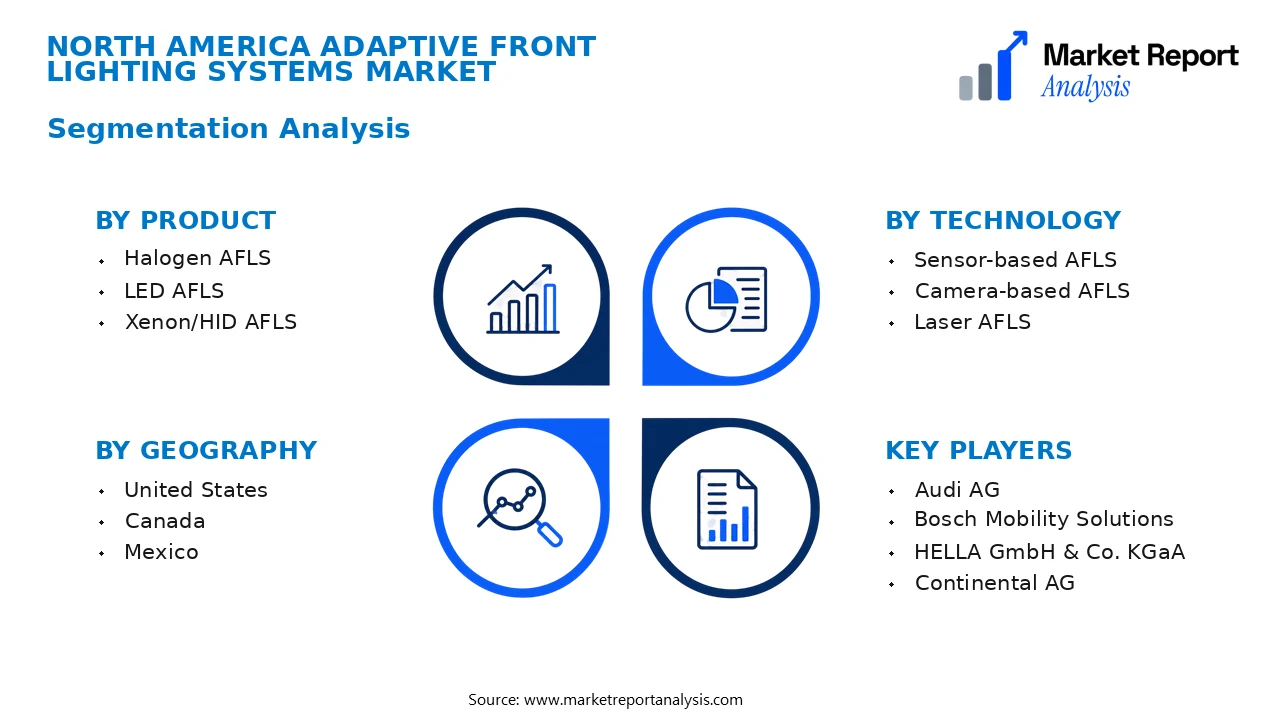
Market segmentation for the North America Adaptive Front Lighting Systems (AFLS) market is distinctly categorized by product, technology, and geographic regions, enabling a detailed analysis of demand drivers and regional adoption trends. This structured segmentation approach helps in identifying niche markets and understanding regional preferences, ultimately supporting strategic market entry and product development initiatives.
- Product
- Halogen AFLS: This subsegment includes traditional Halogen-based adaptive lighting systems, favored by budget-conscious manufacturers and consumers, particularly in regions with slower adoption rates due to lower initial costs.
- LED AFLS: LED-based systems dominate the high-end and mid-range vehicle segments, offering improved visibility and energy efficiency. Growing consumer preference for energy-efficient lighting has significantly propelled this subsegment.
- Xenon/HID AFLS: Xenon or HID systems are utilized predominantly in luxury vehicles, providing high-intensity illumination and aesthetic appeal, thereby enhancing vehicle safety and luxury perception in premium segment markets.
- Technology
- Sensor-based AFLS: These systems employ advanced sensors such as radar, cameras, and ultrasonic sensors to automatically adapt lighting patterns based on traffic and environmental conditions, improving safety and driver comfort.
- Camera-based AFLS: Incorporating high-resolution cameras, this technology enables precise and dynamic control of lighting patterns, crucial for autonomous and semi-autonomous vehicles, with increasing adoption across OEMs.
- Laser AFLS: The latest advancement, laser-based systems, offer longer-range illumination with higher intensity, mainly in premium applications and in new technological developments for enhanced safety and visibility.
- Geography
- United States: As the largest market, the U.S. exhibits high demand driven by strict safety regulations, luxury vehicle adoption, and technologically advanced automotive manufacturing, contributing significantly to regional revenue and innovation.
- Canada: This subsegment is characterized by steady growth supported by rising adoption of ADAS and safety features, along with government incentives promoting safer driving through advanced lighting systems.
- Mexico: The market here is rapidly expanding due to increasing automaker investments, a growing automotive sector, and rising consumer awareness about vehicle safety and lighting innovations.
This hierarchical segmentation allows stakeholders to identify core drivers within each category and regional nuances that influence product development, marketing strategies, and investment decisions. Emphasizing innovation in sensor and laser-based systems could meet rising demand especially in luxury segments and autonomous vehicle markets, while affordable lighting options could expand mass-market penetration. Overall, understanding these diverse segments is essential for capitalizing on the North American AFLS market's growth potential between 2026 and 2034, projected to grow at a compound annual growth rate (CAGR) of approximately 8.2%, reaching a market size of USD 6.5 Billion by 2034.
Competitive Intelligence
The North America Adaptive Front Lighting Systems (AFLS) market exhibits moderate competition with key players such as Valeo, Koito, and ZKW maintaining significant market shares. The market is characterized by a relatively concentrated landscape, with the top five manufacturers controlling a substantial portion of total industry revenue, fueled by strategic partnerships and mergers. Leading companies pursue aggressive product innovation, focusing on integrating advanced sensor technologies, AI-driven adaptive algorithms, and connectivity features to enhance vehicle safety and driver experience. These firms frequently engage in collaborations with automotive OEMs to co-develop future-ready solutions, often complemented by acquisitions aimed at expanding technological capabilities and geographic reach. R&D investments are prioritized to differentiate products through superior performance, reliability, and energy efficiency, supporting the shift toward fully autonomous and semi-autonomous vehicle integration. Competitive strategies are also centered on expanding manufacturing footprints in North America, fostering innovation ecosystems, and establishing strategic alliances with technology providers to stay ahead in the rapidly evolving AFLS landscape.
Leading Company Profiles
The North America adaptive front lighting systems market is characterized by the presence of several innovative players that are leveraging advanced technology and strategic collaborations to strengthen their market positions. These companies are focused on expanding their product portfolios, adopting cutting-edge manufacturing techniques, and engaging in partnerships to develop intelligent lighting solutions for the automotive sector.
- Audi AG
- Bosch Mobility Solutions
- HELLA GmbH & Co. KGaA
- Continental AG
- Valeo SA
- ZKW Group
- Magneti Marelli
- Sony Corporation
- Hella Adaptive Lighting
- Koito Manufacturing Co. Ltd.
Audi AG
Audi AG specializes in luxury vehicles with innovative adaptive front lighting systems designed to enhance safety and visibility. The company emphasizes the integration of smart lighting technologies into its premium vehicles, leveraging advanced sensor and AI capabilities.
Bosch Mobility Solutions
Bosch offers comprehensive automotive lighting solutions, including adaptive front lighting systems that improve night driving performance. Its focus is on developing energy-efficient, reliable, and connected lighting solutions for various vehicle segments.
HELLA GmbH & Co. KGaA
Hella provides advanced lighting and electronic systems with a strategic focus on intelligent lighting solutions. Its adaptive front lighting products utilize laser and LED technology, aiming to improve driver safety and visibility in diverse driving conditions.
Continental AG
Continental develops innovative lighting systems that include adaptive front lighting modules equipped with sensor fusion and vehicle-to-everything (V2X) communication. Its strategic priorities include automating and electrifying vehicle lighting for autonomous driving.
Valeo SA
Valeo's adaptive front lighting systems incorporate advanced sensors and electronic control units to customize illumination based on driving environment and vehicle dynamics. The company's goal is to enhance driving comfort and safety through innovation.
ZKW Group
ZKW specializes in OEM lighting solutions with a focus on adaptive LED and laser systems. Its competitive strengths include high customization capabilities and integration of smart lighting into future mobility solutions.
Magneti Marelli
Magneti Marelli offers a range of adaptive front lighting products designed for premium and mass-market vehicles. The company emphasizes sustainable and energy-efficient lighting technologies aligned with industry trends toward electrification.
Sony Corporation
Sony leverages its expertise in image sensors and display technology to develop intelligent lighting solutions, aiming for seamless integration with automotive infotainment and assistive systems to improve driver awareness.
Hella Adaptive Lighting
Part of Hella GmbH, this division specializes in innovative adaptive lighting solutions, including laser and matrix LED systems, with a focus on enabling autonomous vehicle functions and smart connectivity in lighting design.
Koito Manufacturing Co. Ltd.
Koito focuses on the development of high-performance adaptive front lighting systems incorporating intelligent sensors and networking to deliver superior visibility, safety, and energy efficiency tailored for global automotive markets.
Strategic Business Developments
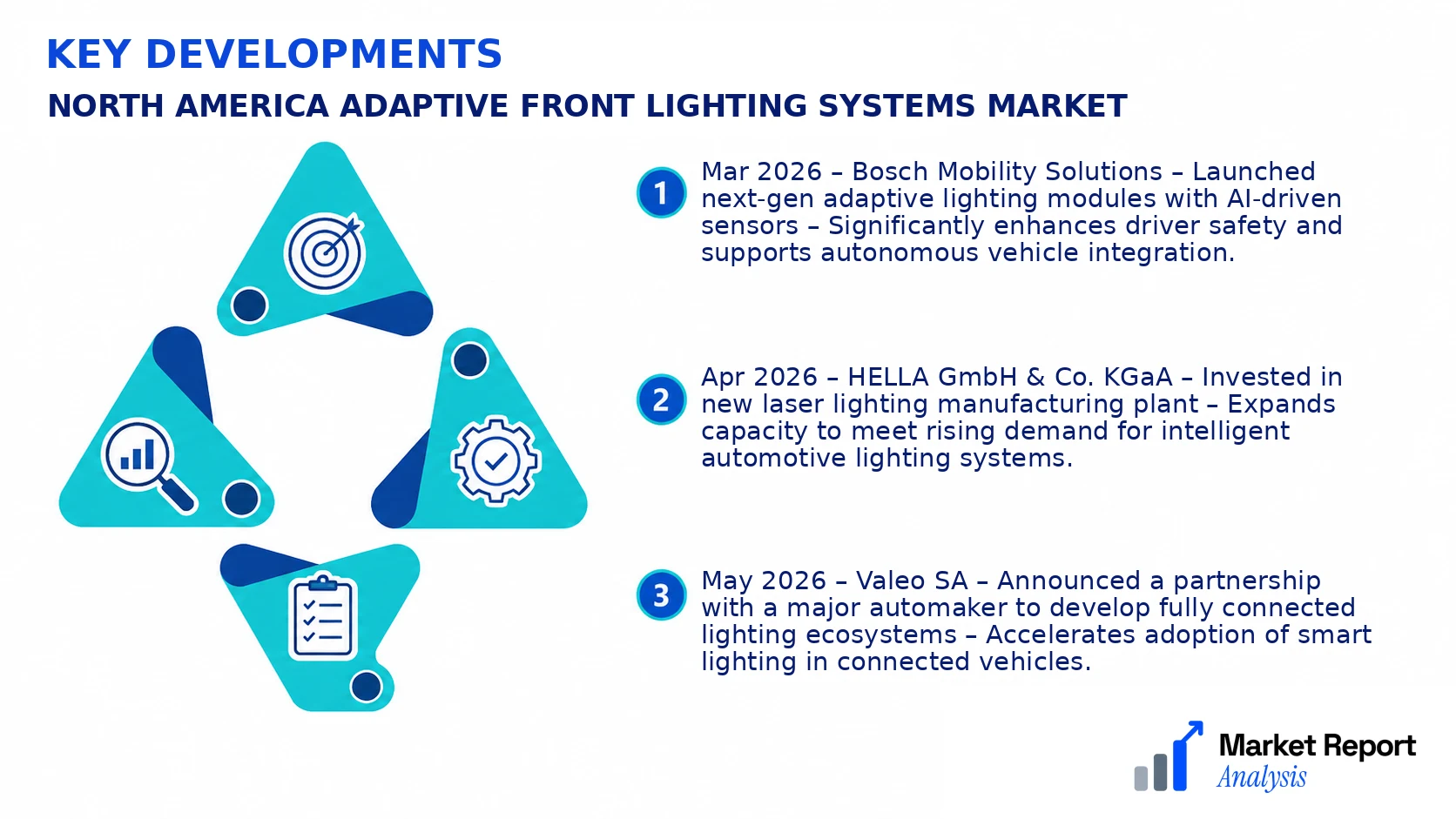
- Mar 2026 – Bosch Mobility Solutions – Launched next-gen adaptive lighting modules with AI-driven sensors – Significantly enhances driver safety and supports autonomous vehicle integration.
- Apr 2026 – HELLA GmbH & Co. KGaA – Invested in new laser lighting manufacturing plant – Expands capacity to meet rising demand for intelligent automotive lighting systems.
- May 2026 – Valeo SA – Announced a partnership with a major automaker to develop fully connected lighting ecosystems – Accelerates adoption of smart lighting in connected vehicles.
- Jul 2026 – ZKW Group – Acquired innovative sensor startup to enhance adaptive front lighting capabilities – Strengthens R&D and product innovation pipeline.
- Aug 2026 – Magneti Marelli – Signed strategic alliance with a technology firm to co-develop electric and laser-based lighting systems – Promotes sustainable and high-performance solutions.
Frequently Asked Questions
What is the North America Adaptive Front Lighting Systems Market?
The North America Adaptive Front Lighting Systems Market encompasses the development, manufacturing, and deployment of advanced vehicle lighting solutions that adapt to driving conditions, improving safety and visibility through intelligent control of headlight functions across the North American automotive sector.
What is the current market size of North America Adaptive Front Lighting Systems Market?
As of 2026, the market size for adaptive front lighting systems in North America is valued at approximately USD 3.8 Billion, reflecting robust integration in modern vehicles and increasing consumer demand for advanced safety features, with continued growth anticipated.
What factors are driving the North America Adaptive Front Lighting Systems Market?
Market growth is primarily driven by stringent safety regulations, increased consumer awareness of vehicle safety features, technological advancements in lighting systems, and the rising adoption of ADAS (Advanced Driver-Assistance Systems) in vehicles across North America.
Which region dominates the North America Adaptive Front Lighting Systems Market?
The United States dominates the North American market due to its large automotive industry, high vehicle production volume, and rapid adoption of innovative vehicle safety systems, followed by Canada and Mexico which are experiencing steady growth.
Which segment is expected to grow the fastest?
The OEM (Original Equipment Manufacturer) segment is projected to see the fastest growth, driven by automakers' increased focus on integrating adaptive lighting in new vehicle models to meet safety regulations and enhance vehicle appeal.
Who are the leading companies operating in the North America Adaptive Front Lighting Systems Market?
Major companies include Hella, Koito Manufacturing, Valeo, Varroc Lighting Systems, and Magneti Marelli, which are actively investing in innovation and partnerships to expand their market share and technological capabilities within North America.
Analyst Perspective
The North America Adaptive Front Lighting Systems Market shows signs of mature yet evolving industry dynamics. Long-term, the market is expected to sustain steady growth due to ongoing technological innovations such as sensor integration and intelligent vehicle automation, which bolster the adoption of adaptive lighting. Commercial opportunities are abundant, especially in expanding vehicle electrification and autonomous vehicle segments, where advanced lighting systems are critical for safety and functionality. Investment priorities should focus on R&D to enhance sensor accuracy, energy efficiency, and cost reductions, enabling wider adoption across diverse vehicle segments. Despite high market competition, leading players with innovative offerings and strategic alliances will maintain a strong foothold. Regional growth potential remains significant, driven by stringent safety regulations and consumer demand for enhanced driving experiences in North America. The industry’s future will likely be shaped by substantial technological evolution and strategic positioning, emphasizing agility and innovation to capture emerging opportunities while managing risks posed by regulatory shifts and technological disruptions.
