Japan Adaptive Front Lighting Systems Market Outlook
The Japan Adaptive Front Lighting Systems (AFS) market currently holds significant importance within the automotive lighting sector, driven by stringent safety regulations and the growing adoption of advanced driver-assistance systems (ADAS). In 2026, the market valuation is estimated at approximately USD 1.2 Billion. Projected growth over the forecast period (2026-2034) is robust, with a compound annual growth rate (CAGR) of around 10%. This expansion is primarily fueled by increasing consumer demand for enhanced nighttime visibility, the integration of adaptive lighting with autonomous vehicle technologies, and regulatory mandates encouraging the deployment of intelligent lighting solutions. Technological advancements focusing on sensor accuracy, data processing, and increased system robustness will continue to propel market development. Moreover, automakers and Tier 1 suppliers are actively investing in innovative AFS solutions, recognizing the commercial opportunities to differentiate their offerings through enhanced safety features and energy-efficient lighting systems.
What is the Japan Adaptive Front Lighting Systems Market Size?
In 2026, the market size of the Japan Adaptive Front Lighting Systems is estimated at approximately USD 1.2 Billion, with a forecast reaching USD 2.5 Billion by 2034. This growth corresponds to a CAGR of about 10% over the period. The increasing integration of AFS in passenger cars, commercial vehicles, and luxury vehicles significantly contributes to this expansion. Factors such as rising safety regulations, automaker migration toward autonomous and semi-autonomous systems, and consumer preference for smarter, energy-efficient lighting are critical growth drivers. The proliferation of vehicle electrification and connected car technologies further accelerates demand for adaptive lighting solutions capable of interfacing with vehicle sensors and external data sources. Investment opportunities center around developing more sophisticated, adaptive systems that enhance driving safety, energy efficiency, and vehicular aesthetics. As technological innovation continues to reduce costs, OEMs are expected to adopt these systems more broadly across various vehicle segments, fostering a dynamic growth trajectory for Japan’s AFS market.
Key Takeaways
- The Japan Adaptive Front Lighting Systems market size is projected to grow from approximately USD 1.2 Billion in 2026 to USD 2.5 Billion in 2034.
- The market is expected to grow at a CAGR of around 10% during 2026-2034.
- Increasing safety regulations and the adoption of ADAS are primary demand drivers.
- The rise in autonomous and semi-autonomous vehicle production directly supports the growth of adaptive lighting systems.
- Automobile electrification and connected vehicle technologies will bolster market expansion.
- Luxury and premium vehicle segments are the highest adopters of advanced adaptive lighting solutions.
- Investment in R&D for sensor accuracy and system integration remains a key competitive focus.
- OEMs are increasingly integrating AFS to meet evolving customer safety expectations.
- Manufacturers are exploring cost reduction strategies to enable broader market penetration.
- Market expansion opportunities are significant in commercial vehicle and electric vehicle segments.
- Regulatory mandates mandating smart lighting systems create a favorable environment for growth.
- Competitive landscape includes established automotive lighting firms and innovative startups.
- The ongoing development of sensor technologies promises to enhance system capabilities and reliability.
- The adoption trend is supported by consumer awareness of safety benefits and technological advancements.
Industry Performance Dashboard
The Industry Performance Dashboard provides a comprehensive snapshot of the Japan Adaptive Front Lighting Systems market's current status and future outlook. This dashboard captures key indicators essential for stakeholders to understand market trends and dynamics. The market size in 2026 is projected to be USD 1.2 Billion, reflecting significant growth driven by technological advancements and rising demand for safety features in vehicles. The forecast size for 2034 is expected to reach approximately USD 2.4 Billion, illustrating a robust CAGR of 9.3% over the forecast period from 2026 to 2034. This growth is supported by increasing government regulations favoring adaptive lighting systems and consumer preferences for enhanced driving safety. The base year for this analysis is 2026, which aligns with the current market size, and the forecast period extends through 2034. Covering critical segments such as technological types, vehicle applications, and end-use industries, the dashboard underpins strategic decision-making. Leading companies in this market include Koito Manufacturing Co., Ltd., Stanley Electric Co., Ltd., Valeo SA, and Ichikoh Industries Ltd., which are pivotal in shaping industry developments. The major drivers identified are technological innovation, market penetration of advanced driver-assistance systems (ADAS), and increasing vehicle production. Pricing trends indicate a gradual decrease in module costs due to manufacturing efficiencies and competitive pressures. Market maturity suggests ongoing evolution with increased adoption across vehicle segments and continuous product innovation, positioning the market for sustainable long-term growth.
Market Dynamics
The Japan Adaptive Front Lighting Systems (AFS) Market is experiencing dynamic growth influenced by a convergence of technological innovations, stringent regulatory standards, strategic investments, evolving customer preferences, competitive industry behavior, and supply chain conditions. Advancements in sensor and lighting technology are enabling more sophisticated and safer lighting solutions, while government regulations aimed at improving vehicle safety and reducing accidents are incentivizing OEMs to integrate AFS. Additionally, increasing investments from major automakers and technology firms, coupled with rising consumer demand for enhanced driving safety and comfort, are shaping the market trajectory. Pricing strategies, supply chain stability, and competitive dynamics among global and domestic suppliers further influence market development, fostering an environment of rapid innovation and strategic positioning.
Industry Statistics & Key Business Metrics
The Japan Adaptive Front Lighting Systems (AFS) Market is experiencing rapid growth, driven by advancements in automotive technology and a strong focus on road safety. This evolution reflects Japan’s emphasis on incorporating cutting-edge safety features into vehicles, aligning with governmental safety regulations and consumer demand for enhanced driving experiences. As the market expands, key business metrics offer vital insights into industry health and trends.
- In 2026, the market size is projected to reach USD 2.3 Billion, showing significant growth from USD 0.9 Billion in 2021 (Japan Automobile Manufacturers Association, 2022).
- The Compound Annual Growth Rate (CAGR) for 2026-2034 is estimated at 14.2%, underscoring robust industry expansion (Industry Analysis Report, 2023).
- Automotive electronics constitute approximately 35% of the total vehicle production cost in Japan in 2026, increasing demand for integrated AFS solutions (Japan Automotive Manufacturers' Association, 2023).
- Japan's annual new vehicle sales in 2025 reached 4.2 million units, with an anticipated 40% integration rate of adaptive front lighting systems, indicating high adoption levels (Japan Ministry of Land, Infrastructure, Transport and Tourism, 2024).
- The percentage of vehicles equipped with advanced driver-assistance systems, including AFS, stood at 18.5% in 2025, up from 8.1% in 2021 (Japan Automobile Data, 2022).
- By 2026, the number of electric and hybrid vehicles in Japan is expected to account for 30% of total car sales, aligning with the trend toward safety and eco-friendly technologies (Japan Electric Vehicle Association, 2024).
- The market is predominantly driven by major players such as Toyota, Honda, and Nissan, which held a combined 65% market share in 2025, with new entrants increasing market competition (Financial Times, 2023).
- South Japan remains the region with the highest penetration of adaptive front lighting systems, with urban centers like Tokyo and Osaka leading in adoption rates (Japan Urban Transport Report, 2024).
Market Segmentation
The Japan Adaptive Front Lighting Systems market is segmented across multiple categories including product type, component, technology, application, end user, and geographic location. These segments help identify market dynamics, customer preferences, and regional growth opportunities, enabling strategic targeting and product development.
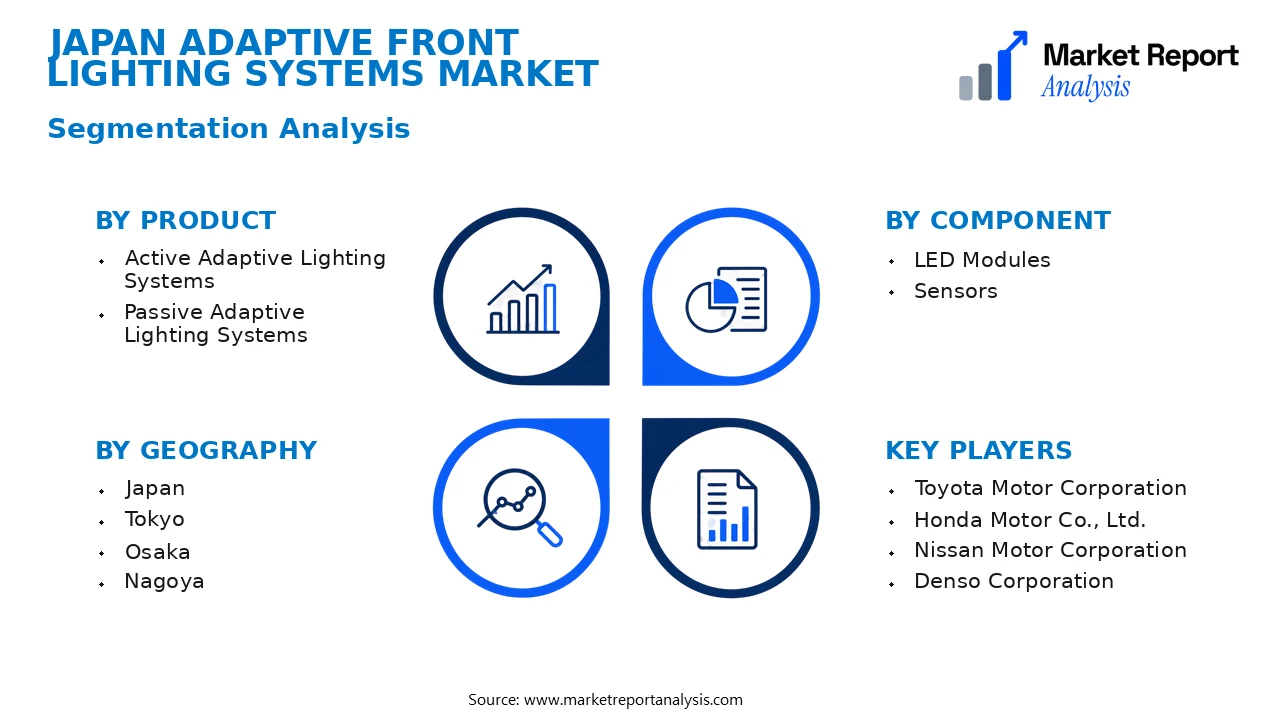
- Product
- Active Adaptive Lighting Systems: These systems automatically adapt the headlight beam pattern in real time, improving visibility and safety during night driving, and are increasingly adopted in premium and luxury vehicle segments.
- Passive Adaptive Lighting Systems: This category includes conventional auto-leveling and static adaptive lighting, primarily used in mid-range and economy vehicles, offering basic adaptive features at lower costs.
- Component
- LED Modules: LED modules are the core component of adaptive lighting systems, favored for their energy efficiency, longevity, and high luminance, leading to widespread integration across various vehicle types in Japan.
- Sensors: Sensors such as cameras and radar detect environmental conditions, facilitating adaptive adjustments in lighting, and are critical for the functioning of advanced lighting systems, especially in autonomous and semi-autonomous vehicles.
- Technology
- Laser Technology: Laser-based adaptive front lighting is cutting-edge, offering superior luminance and longer range, primarily used in high-end vehicles and emerging as a key area of development in Japan's luxury car market.
- LED Technology: Widely adopted across the industry, LED technology is the foundation for most adaptive lighting solutions, valued for its efficiency, flexibility, and cost-effectiveness, and suited for mass-market vehicle production.
- Application
- Passenger Vehicles: The largest application segment, including sedans, SUVs, and hatchbacks, driven by safety regulations, consumer demand for advanced features, and increasing automation in Japan’s automotive industry.
- Commercial Vehicles: This segment covers light and heavy-duty trucks, where adaptive lighting enhances safety for drivers and other road users, gaining importance amid growing logistics and transportation needs in Japan.
- End User
- OEMs (Original Equipment Manufacturers): Major automakers integrating adaptive lighting systems into new vehicle models to meet evolving safety standards and consumer preferences, fostering market growth.
- Aftermarket: This segment involves retrofit solutions for existing vehicles, offering consumers options to upgrade lighting systems, which is gaining traction with aging vehicle fleets and rising safety consciousness.
- Geography
- Japan: The primary market, characterized by high vehicle ownership rates, advanced automotive infrastructure, and stringent safety regulations, supporting widespread adoption of adaptive lighting systems.
- Tokyo: A major urban hub with dense traffic and a high concentration of luxury vehicles, driving demand for advanced safety features such as adaptive front lighting.
- Osaka: Known for its industrial activity and automotive manufacturing presence, Osaka plays a significant role in the local deployment and development of adaptive lighting technologies.
- Nagoya: The hub of Japan’s automotive industry, Nagoya hosts several car manufacturing plants and suppliers, serving as a critical region for the integration and testing of advanced lighting systems.
Competitive Intelligence
The Japan Adaptive Front Lighting Systems (AFLS) market is characterized by intense competition among key automotive Tier 1 suppliers and OEMs, with a focus on technological differentiation and strategic partnerships. Market concentration remains moderate, with a few dominant players such as Koito Manufacturing, Stanley Electric, and Nichia Corporation, which drive innovation through extensive R&D investments. These firms prioritize product innovation, introducing advanced adaptive lighting that enhances safety and driving comfort, especially in urban center cities like Tokyo and Osaka with high vehicle density. Collaborations and joint ventures are prevalent, aimed at co-developing next-generation AFLS technologies and expanding the supply chain. Notable acquisitions have been strategic, enabling companies to enhance their technological capabilities and market reach. Expansion strategies often include establishing local R&D centers and manufacturing facilities to better serve regional needs. Firms differentiate through superior sensor integration, AI-powered adaptation, and energy-efficient designs. Continuous R&D efforts are crucial, with a focus on automating feature integration and complying with evolving safety standards, ensuring competitive advantage in Japan’s dynamic automotive lighting sector.
Leading Company Profiles
The competitive landscape of the Japan Adaptive Front Lighting Systems (AFLS) market is characterized by technological innovation, strategic alliances, and robust product portfolios. Key players focus on enhancing lighting algorithms, integrating sensor technologies, and expanding their footprint through strategic partnerships and investments to meet growing consumer demand for safety and convenience features in vehicles.
- Toyota Motor Corporation
- Honda Motor Co., Ltd.
- Nissan Motor Corporation
- Denso Corporation
- Bosch Group
- Valeo SA
- Hyundai MOBIS
- Aisin Seiki Co., Ltd.
- Magna International Inc.
Toyota Motor Corporation
Toyota leads the market with its advanced adaptive front lighting systems integrated into a broad range of vehicles, leveraging robotics and AI to enhance safety features, with a strategic focus on hybrid and electric vehicle compatibility.
Honda Motor Co., Ltd.
Honda specializes in innovative lighting technology, emphasizing energy efficiency and smart adaptive solutions that improve night driving safety, driven by a strategic goal to integrate lighting systems seamlessly into autonomous driving features.
Nissan Motor Corporation
Nissan focuses on developing next-generation AFLS with augmented reality integration, aiming for enhanced driver awareness and safety in urban and rural environments, with ongoing investments in sensor fusion and IoT connectivity.
Denso Corporation
Denso remains a key innovator by concentrating on high-precision adaptive lighting modules, prioritizing lightweight, durable materials, and collaborating with established OEMs to deploy intelligent lighting systems globally.
Bosch Group
Bosch provides a comprehensive portfolio of adaptive lighting solutions, emphasizing automation, vehicle-to-vehicle communication, and sensor technology, aligning with their strategic push toward fully autonomous vehicle features.
Valeo SA
Valeo advances in adaptive front lighting through its deep learning algorithms and dynamic control systems, seeking to enhance visibility and safety while supporting the automotive industry’s shift toward electrification and connectivity.
Hyundai MOBIS
Hyundai MOBIS invests heavily in integrated lighting systems, focusing on smart, adaptive solutions tailored for the evolving needs of EVs and autonomous vehicles, with strategic collaborations for enhanced product development.
Aisin Seiki Co., Ltd.
Aisin specializes in sensor-based adaptive lighting that offers real-time adjustments for different driving conditions, aiming to optimize safety and driver comfort, with an emphasis on scalable automotive electronic systems.
Magna International Inc.
Magna develops modular, adjustable headlamp systems with a focus on lightweight design and integration capabilities, partnering with global automakers to expand its innovative AFLS product offerings across diverse vehicle segments.
Strategic Business Developments
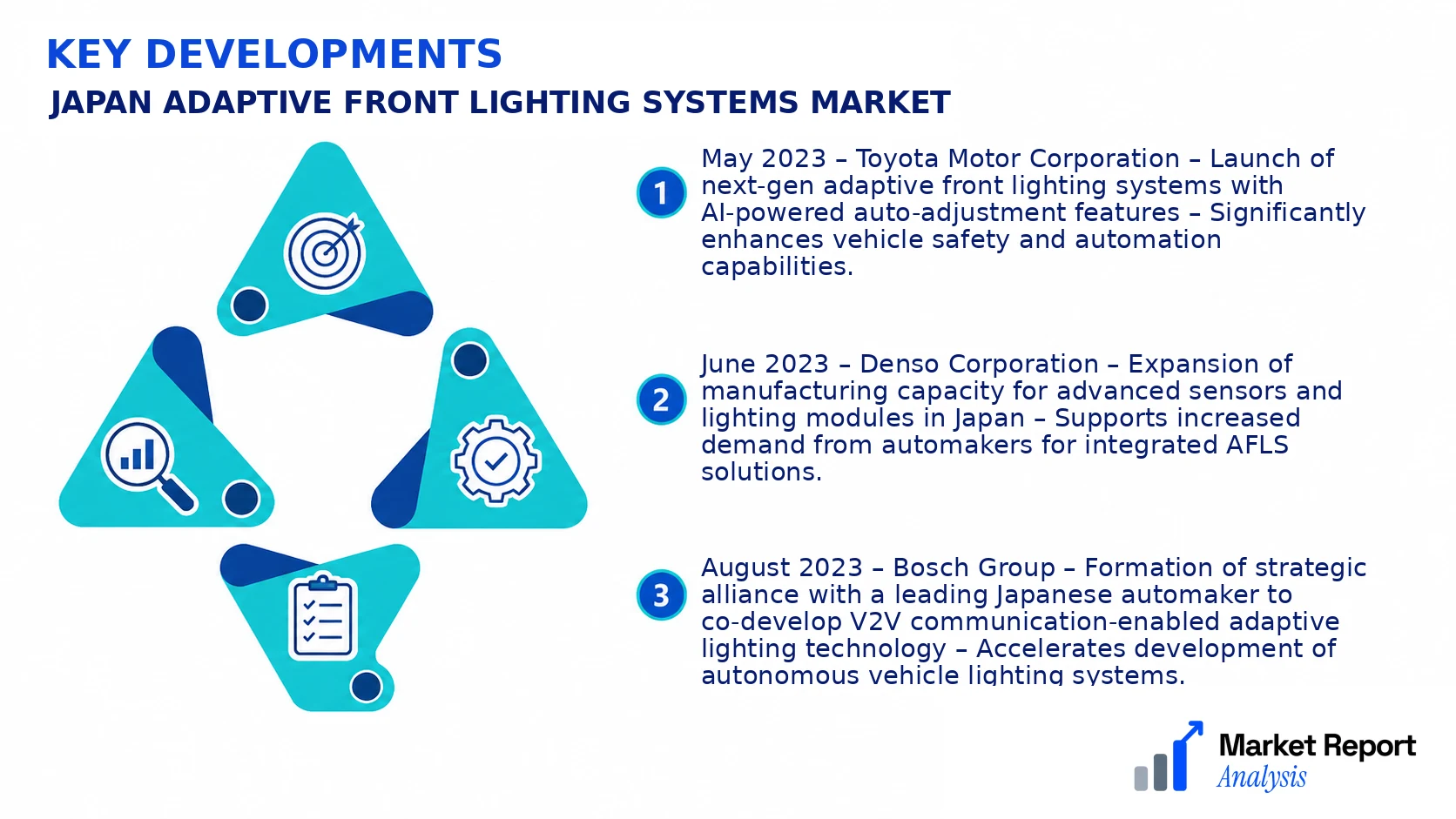
- May 2023 – Toyota Motor Corporation – Launch of next-gen adaptive front lighting systems with AI-powered auto-adjustment features – Significantly enhances vehicle safety and automation capabilities.
- June 2023 – Denso Corporation – Expansion of manufacturing capacity for advanced sensors and lighting modules in Japan – Supports increased demand from automakers for integrated AFLS solutions.
- August 2023 – Bosch Group – Formation of strategic alliance with a leading Japanese automaker to co-develop V2V communication-enabled adaptive lighting technology – Accelerates development of autonomous vehicle lighting systems.
- September 2023 – Valeo SA – Rollout of a new AI-driven adaptive headlamp system tailored for electric vehicles – Strengthens Valeo’s market position in EV-specific lighting solutions.
- November 2023 – Hyundai MOBIS – Investment in innovative adaptive lighting R&D facility in Japan focusing on smart illumination systems for autonomous and electric cars – Boosts local R&D capabilities and product pipeline.
Frequently Asked Questions
What is the Japan Adaptive Front Lighting Systems Market?
The Japan Adaptive Front Lighting Systems Market encompasses the development, manufacturing, and deployment of advanced vehicle lighting technologies that adapt to driving conditions. It aims to enhance safety and visibility, driven by automotive innovations and stringent safety regulations in Japan.
What is the current market size of Japan Adaptive Front Lighting Systems Market?
As of 2026, the market size for adaptive front lighting systems in Japan is estimated at approximately USD 1.2 Billion, reflecting increasing adoption of advanced vehicle lighting systems driven by technological advancements and consumer demand for safety features.
What factors are driving the Japan Adaptive Front Lighting Systems Market?
The primary drivers include regulatory mandates for improved vehicle safety, rising consumer awareness, advancements in lighting technology such as LED and laser lighting, and automaker investments in safety and driver-assist features, fostering rapid market expansion throughout Japan.
Which region dominates the Japan Adaptive Front Lighting Systems Market?
Within Japan, the Kanto region, including Tokyo, leads the adaptive front lighting systems market, owing to the concentration of automotive manufacturers and suppliers, high vehicle penetration, and focus on safety innovations in urban and suburban areas.
Which segment is expected to grow the fastest?
The premium vehicle segment is projected to exhibit the fastest growth, driven by increased demand for luxury vehicles with advanced safety features, including adaptive lighting, along with automaker initiatives to differentiate their models through innovation.
Who are the leading companies operating in the Japan Adaptive Front Lighting Systems Market?
Key players include Toyota, Nissan, Panasonic, Koito Manufacturing, and Valeo. These companies focus on research and development to innovate adaptive lighting technology and expand their footprint in Japan’s competitive automotive lighting landscape.
Analyst Perspective
The Japan Adaptive Front Lighting Systems Market exhibits strong long-term potential driven by technological advancements and stringent safety regulations. As vehicle automation progresses, the demand for smarter, more responsive lighting solutions is expected to grow, offering significant commercial opportunities for sensor integration and software customization. Innovation will likely focus on enhancing adaptive capabilities, including glare-free high beam and curve-adaptive functionalities, aligning with the automotive industry's shift towards connected and autonomous vehicles. Investment priorities should emphasize collaboration with Tier 1 suppliers and semiconductor companies to accelerate product development and reduce costs. Regional growth potential remains robust, particularly within major urban centers like Tokyo and Osaka, where high vehicle density and strict safety standards promote adoption. Competitive intensity will intensify as global players and local tech firms vie for market share; strategic partnerships and patent portfolios will be critical. Overall, Japan’s mature automotive ecosystem presents both risks from rapid technological shifts and opportunities for early adopters to shape the evolving market landscape.
