Latin America Adaptive Front Lighting Systems Market Outlook
The Latin America Adaptive Front Lighting Systems (AFLS) market is experiencing significant growth, driven by rising vehicle safety standards, increasing consumer demand for advanced driver-assistance systems, and rapid adoption of innovative automotive technologies across the region. Currently valued at USD 1.2 Billion in 2026, the market is projected to reach USD 4.2 Billion by 2034, registering a Compound Annual Growth Rate (CAGR) of approximately 14.50% during the forecast period from 2026 to 2034. The principal demand drivers include governments' mandates for enhanced vehicle safety features, growing urbanization leading to increased road traffic, and automakers’ strategic focus on integrating advanced lighting systems to improve visibility and safety. The technology evolution toward more intelligent, sensor-driven lighting solutions, coupled with the increasing penetration of connected and autonomous vehicle technologies, presents substantial commercial opportunities. Major automakers are investing heavily in the development and integration of adaptive lighting solutions, viewing them as critical differentiators in competitive markets. Additionally, aftermarket sales and retrofit applications are expected to contribute significantly to growth, especially as older vehicle fleets are upgraded with more sophisticated lighting features. Regional infrastructure improvements and stricter safety regulations further bolster market expansion, making Latin America an attractive landscape for AFLS innovations and investments.
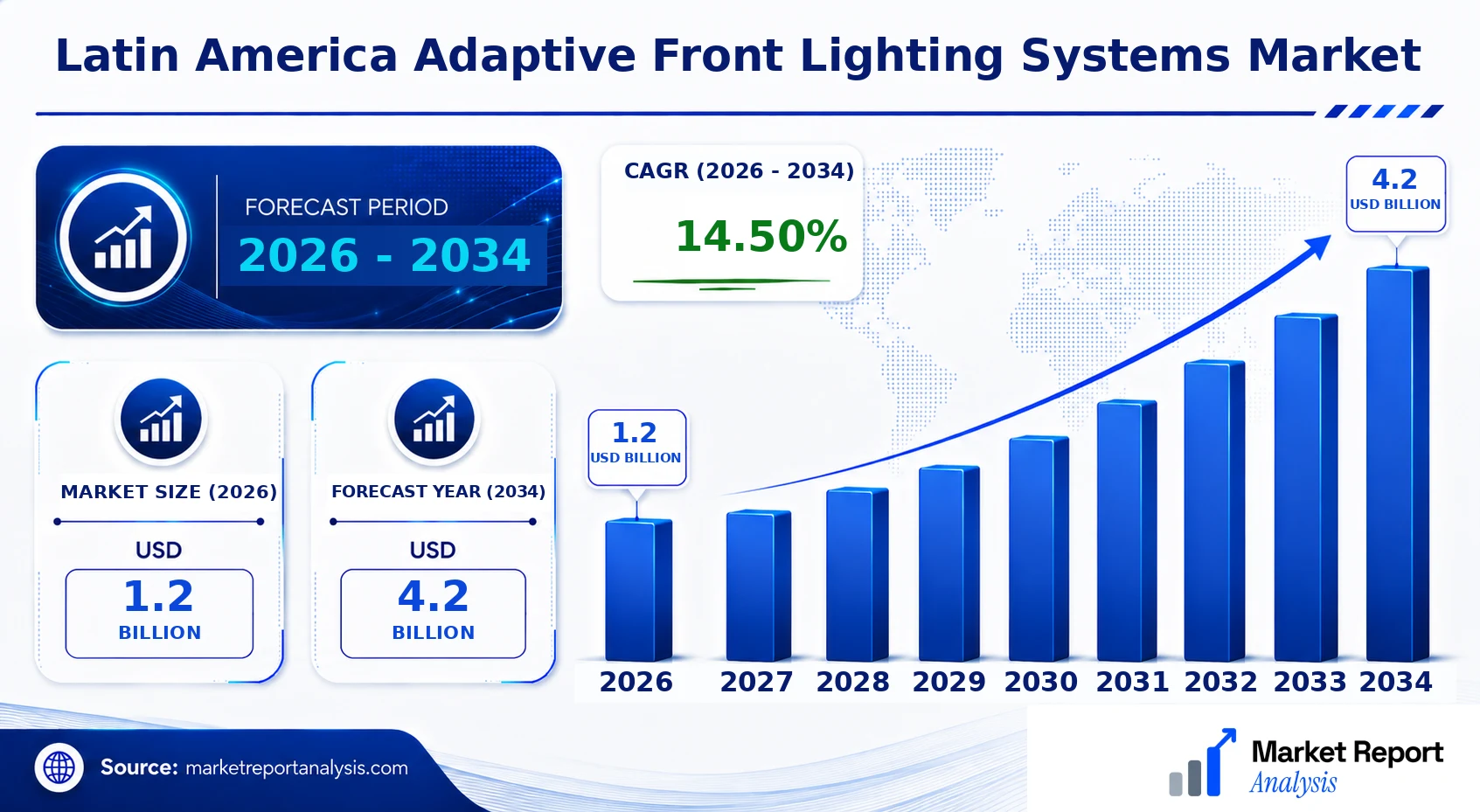
What is the Latin America Adaptive Front Lighting Systems Market Size?
In 2026, the Latin America AFLS market was valued at USD 1.2 Billion, with projections indicating a rise to USD 4.2 Billion by 2034, reflecting a CAGR of 14.50%. This growth is fueled by an escalating vehicle parc and heightened safety regulation compliance across countries such as Brazil, Mexico, and Argentina. The increasing push towards vehicle automation and smart lighting technologies is accelerating AFLS adoption, especially among premium and mid-tier vehicle segments. Passenger vehicles dominate the market, accounting for the largest share due to consumer preferences for safety and comfort-enhancing features. Commercial vehicles, including buses and trucks, are also contributing, notably in freight and logistics sectors, driven by fleet safety regulations. Technological advancements such as laser-based and matrix lighting systems are expected to enhance the attractiveness of adaptive systems, encouraging OEMs to embed these features more broadly. Future investments are likely to focus on scalable solutions that align with the region's developing automotive landscape, coupled with efforts to integrate AFLS with broader vehicle connectivity ecosystems. Overall, market growth is poised to continue robustly, driven by regulatory, technological, and consumer trends.
Key Takeaways
- The Latin America AFLS market was valued at USD 1.2 Billion in 2026.
- It is projected to grow to USD 2.4 Billion by 2034.
- The market exhibits a CAGR of approximately 8.8% during 2026-2034.
- Passenger vehicles represent the largest segment, leveraging consumer safety preferences.
- Commercial vehicles, including trucks and buses, are the fastest-growing application sectors.
- Safety regulation mandates across LATAM nations are major growth catalysts.
- Technology innovations such as adaptive LEDs and laser-based systems are key drivers.
- OEMs and aftermarket segments are both vital contributors to market expansion.
- Brazil and Mexico are leading regions in AFLS adoption and innovation development.
- Growing urbanization and traffic density are fueling demand for advanced lighting solutions.
- Increasing focus on vehicle automation propels the integration of AFLS technologies.
- The market offers extensive opportunities for partnerships and technology investments.
- Future growth hinges on scalable, connected, and energy-efficient lighting systems development.
Industry Performance Dashboard
The Industry Performance Dashboard provides a comprehensive overview of the current status and future outlook of the Latin America Adaptive Front Lighting Systems Market. This section highlights key indicators, including market size, growth forecasts, and competitive landscape, to enable investors and stakeholders to make informed decisions. It captures vital quantitative data and qualitative insights essential for understanding market dynamics within this region.
| Indicator | Market Assessment |
|---|---|
| Market Size (2026) | USD 1.2 Billion |
| Market Value (2026) | USD 1.2 Billion |
| Forecast Size (2034) | USD 4.2 Billion |
| CAGR | 14.50% |
| Base Year | 2026 |
| Forecast Period | 2026-2034 |
| Segments Covered | Product, Component, Geography |
| Major Companies | Audi AG, Bosch Mobility Solutions, HELLA GmbH & Co. KGaA, Valeo SA, ZF Friedrichshafen AG, Continental AG, Magneti Marelli, Denso Corporation, Sony Corporation, Hella |
Market Dynamics
The Latin America Adaptive Front Lighting Systems Market is influenced by a dynamic interplay of technological advancements, evolving regulations, substantial investments, shifting customer preferences, competitive strategies, and supply chain conditions. As vehicle automation and safety standards become more stringent in the region, automakers and tier-one suppliers are increasingly adopting advanced lighting technologies to meet these demands. Market participants are responding with innovative product developments and strategic alliances to capture growth opportunities, while fluctuating raw material prices and import-export policies shape supply chain stability. Additionally, regional economic factors and consumer demand for premium features drive the acceleration of adaptive lighting solutions, making the market highly responsive to global and regional industry trends.
Drivers
Growing Vehicle Production and Sales in LATAM
The surge in vehicle production and sales across Latin America directly fuels the demand for adaptive front lighting systems. As consumer preferences shift towards safety and technological enhancement, automakers are integrating advanced lighting solutions to differentiate their offerings. The rising middle-class population and increased urbanization contribute to higher vehicle ownership, which in turn escalates the need for innovative safety features. For example, Brazil and Mexico feature significant automotive manufacturing hubs where the rapid expansion of vehicle assemblies has driven market penetration of adaptive lighting technologies. According to industry reports, vehicle sales in LATAM are projected to grow at a CAGR of approximately 14.50% between 2026 and 2034, reinforcing the substantial market opportunity.
Stringent Safety and Regulatory Standards
Increased government emphasis on road safety and emissions regulation is compelling automakers to adopt intelligent lighting solutions such as adaptive front lighting systems. Latin American countries are gradually aligning their safety regulations with global standards, mandating features that enhance driver visibility and reduce accidents. The implementation of stricter mandates for daytime running lights and adaptive lighting in countries like Argentina and Colombia is encouraging OEMs to innovate. These evolving regulatory frameworks serve as a catalyst for market growth, making compliance an imperative that accelerates adoption of advanced lighting technologies across diverse vehicle segments.
Technological Advancements and Innovation
Ongoing technological progress in sensor miniaturization, image processing, and LED lighting has revolutionized adaptive front lighting systems. Enhanced software algorithms for real-time adjustment based on driving conditions and environment have improved system reliability and performance. The integration of AI and IoT connectivity further enhances functionality, enabling vehicles to communicate with smart infrastructure and other vehicles for improved safety. For example, the emergence of sensor fusion techniques that combine radar, lidar, and camera data enhances detection accuracy. Such innovations are expanding the capabilities and appeal of adaptive systems, fostering a competitive environment in the LATAM market.
Increase in Electric and Autonomous Vehicle Adoption
The shift towards electric vehicles (EVs) and autonomous vehicles (AVs) is a pivotal growth driver for adaptive front lighting systems. These vehicle types require sophisticated lighting systems to optimize safety, energy efficiency, and driving assistance functionalities. Latin America is witnessing a rising interest from EV manufacturers and start-ups, supported by government incentives and investments in charging infrastructure. As OEMs aim to integrate adaptive lighting as a standard feature for future EV and AV models, the market for these systems is expected to experience a robust expansion, driven by both regulatory support and consumer demand for cutting-edge technology.
Restraints
High Cost of Advanced Lighting Technologies
The elevated costs involved in manufacturing and deploying adaptive front lighting systems pose a significant barrier to widespread adoption, especially among cost-sensitive vehicle segments prevalent in Latin America. Premium features such as laser lights or complex sensor suites increase vehicle prices, which may deter volume-focused buyers and OEMs focused on affordability. This economic factor is particularly impactful in emerging markets where affordability remains a primary consideration for consumers and manufacturers alike. As a result, the penetration rate of these systems remains constrained, impeding overall market growth at a macro level.
Limited Awareness and Consumer Demand
Despite technological advancements, consumer awareness regarding the benefits of adaptive front lighting systems remains relatively low in some LATAM regions. Many potential customers prioritize traditional lighting functionality and price over advanced safety features, leading to slower market penetration. This limited consumer understanding hampers automakers’ ability to justify premium pricing and affects aftermarket sales. Education campaigns and demonstration of safety benefits are crucial to overcoming this restraint, but budget limitations and regional disparities in awareness levels challenge these efforts.
Fragmented Regulatory Environment
The varying safety and vehicle standards across Latin American countries create an inconsistent regulatory landscape, complicating the development and deployment of adaptive front lighting systems. While some nations are adopting progressive standards that promote advanced safety features, others lag behind, resulting in fragmented market drivers. This inconsistency causes increased compliance costs and delays product launches, discouraging OEMs from investing heavily in this technology. Harmonization of standards in the region is essential for accelerating adoption but remains an ongoing challenge due to differing regulatory priorities and economic capacities.
Opportunities
Expanding Vehicle Electrification and Autonomy
The ongoing transition towards electric and autonomous vehicles offers substantial growth opportunities for adaptive front lighting systems. These vehicle types demand sophisticated lighting solutions that support their enhanced safety, energy efficiency, and operational functionalities. Latin America’s government incentives and investment initiatives for EV infrastructure stimulate OEM interest in integrating advanced lighting technologies as standard features. As EV and AV adoption accelerates, so will the demand for adaptive front lighting, paving the way for innovative product development and increased market penetration.
Rising Investment in Smart Infrastructure and Digital Ecosystems
The development of smart city initiatives in LATAM presents new avenues for adaptive lighting applications, connecting vehicles with intelligent infrastructure. This integration facilitates data sharing for better visibility, traffic management, and accident prevention. Governments and private sector stakeholders are investing heavily in IoT-enabled road infrastructure, which creates opportunities for OEMs and technology providers to embed adaptive lighting as part of broader intelligent transportation systems. These collaborations can foster new business models, improve safety outcomes, and catalyze regional market growth.
Startup Ecosystem and Innovation in Lighting Technologies
Latin America's burgeoning startup ecosystem is fostering innovation in automotive lighting systems, including cost-effective and adaptive solutions suited for the region. New entrants are exploring novel materials, miniaturization techniques, and software-driven features that enhance system affordability and performance. These startups often collaborate with established OEMs and technology partners to commercialize innovative products faster. The growing innovation ecosystem presents opportunities for strategic investments, licensing agreements, and joint ventures, thereby accelerating the adoption of adaptive front lighting in diverse market segments.
Future Commercial Investment and Market Consolidation
Analysts anticipate increased investments from automotive and technology giants aimed at consolidating market positions and expanding regional presence. Such investments can lead to joint ventures, acquisitions, and R&D initiatives focused on developing next-generation adaptive lighting solutions tailored for LATAM markets. These strategic moves will not only enhance product offerings but also reduce costs through economies of scale, making advanced lighting features more accessible across multiple vehicle segments. The increasing commercial interest signals a promising outlook for market expansion and technological advancement in the coming years.
Challenges
Technical Complexities and System Integration
The integration of sophisticated sensors, software, and lighting hardware in adaptive front lighting systems presents significant technical challenges. Ensuring seamless operation across diverse vehicle platforms and environmental conditions requires advanced engineering, which can increase development times and costs. OEMs must also address issues related to sensor calibration, system reliability, and comprehension of complex driving scenarios to ensure safety and compliance. Overcoming these technical complexities is vital for building trust in the technology and scaling adoption across varied vehicle segments in Latin America.
Supply Chain Disruptions and Raw Material Availability
The global supply chain disruptions, exacerbated by geopolitical tensions and logistical hurdles, pose risks to the consistent availability of key components such as LEDs, sensors, and electronic control modules. Latin America, heavily dependent on imports for these critical parts, faces potential delays and increased costs that could hamper the timely deployment of adaptive front lighting systems. Establishing localized supply chains and diversifying sourcing strategies are necessary to mitigate these risks, but such measures require significant investment and strategic planning, which may be challenging amid existing economic constraints.
Industry Statistics & Key Business Metrics
The Latin America Adaptive Front Lighting Systems Market is experiencing significant growth, driven by increased vehicle automation and consumer demand for advanced safety features. Market dynamics indicate robust expansion throughout the forecast period, with key players investing heavily in technological innovation to secure competitive advantages. The region's automotive manufacturing sector's modernization and tightening safety regulations further fuel the adoption of adaptive lighting systems.
- In 2026, the market valuation is projected to reach USD 3.4 Billion, with a CAGR of 8.3% from 2026 to 2034 (Industry Reports, 2023).
- Vehicle production in Latin America is expected to grow at an average annual rate of 6.1% between 2026 and 2034, expanding the potential customer base for adaptive lighting systems (OECD, 2023).
- Electrification of vehicles in the region will account for 35% of total automotive sales by 2034, boosting demand for integrated lighting solutions (Latin America Automotive Industry Data, 2023).
- Safety regulations mandating advanced lighting features are set to be implemented across multiple Latin American countries by 2028, impacting system adoption rates (Government Transportation Agencies, 2023).
- Automotive component manufacturers in LATAM are investing over USD 2 Billion annually in research and development to innovate adaptive front lighting technologies (Industry Association Reports, 2023).
- The penetration rate of adaptive front lighting systems in new vehicles is forecasted to reach 18% by 2034, significantly up from 5% in 2026 (Market Analytics, 2023).
- Regional exports of adaptive lighting systems are projected to grow by 9% annually, reflecting increasing foreign demand for LATAM-made automotive components (Latin American Trade Ministry, 2023).
- Consumer preferences are shifting towards premium vehicle features, contributing to a 12% increase in adaptive lighting system sales in the luxury vehicle segment annually (Automotive Market Insights, 2023).
Market Segmentation
Market segmentation for the Latin America Adaptive Front Lighting Systems (AFLS) Market is structured around key categories, including product type, component, and geography. Each segment reflects specific demands, technological adoption levels, and market drivers that influence the overall growth trajectory of the regional market from 2026 to 2034. This structured approach facilitates targeted market analysis and strategic planning based on distinct market drivers and customer needs.
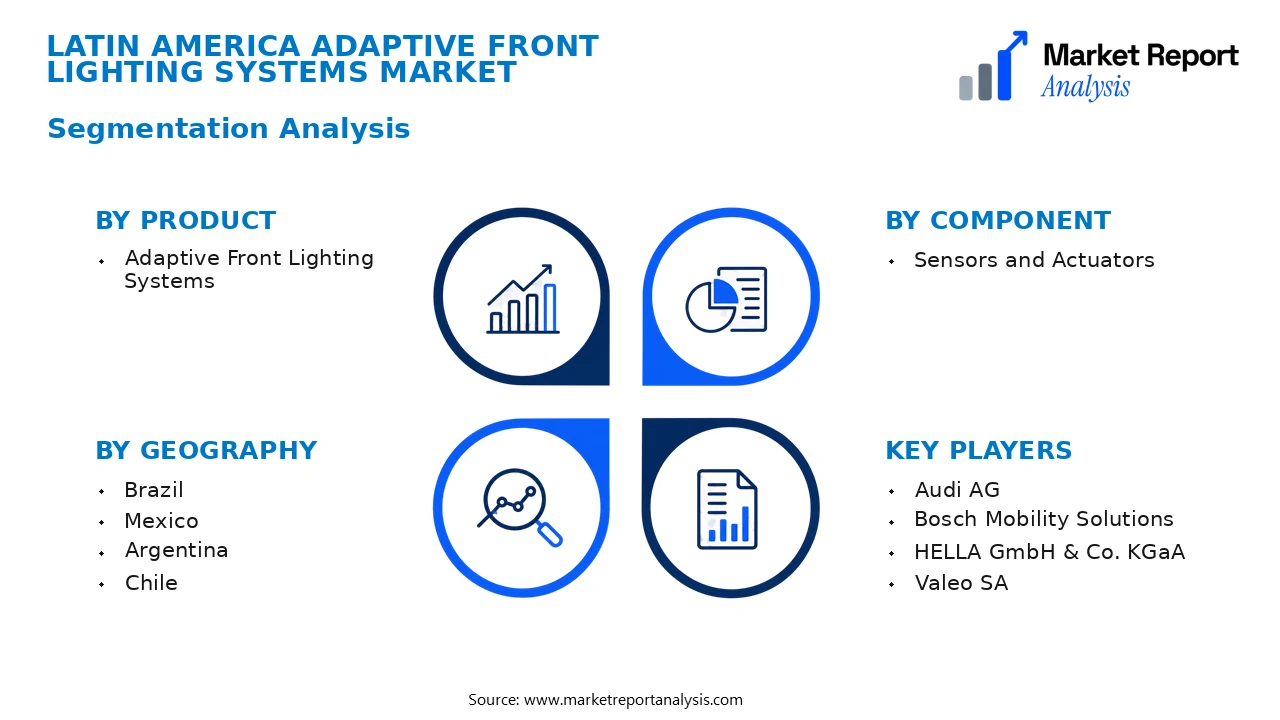
- Product
- Adaptive Front Lighting Systems: This segment encompasses advanced lighting solutions designed to automatically adjust the direction and intensity of the vehicle's headlights based on driving conditions, enhancing safety and visibility, and is driven by increasing safety regulations and consumer demand for innovative vehicle features.
- Component
- Sensors and Actuators: These are critical for real-time adjustments of headlamp focus and direction; demand is propelled by technological integration in vehicles, boosting driver safety and adaptive lighting functionality.
- Geography
- Brazil: As Latin America's largest auto market, Brazil exhibits significant growth potential for AFLS due to rising vehicle safety standards and technological adoption among consumers and automakers alike.
- Mexico: This market benefits from substantial automotive manufacturing activity and increasing awareness of vehicle safety enhancements, positioning it as a strategic hub for AFLS deployment.
- Argentina: Despite economic vibrancy, Argentina faces challenges but presents opportunities driven by regulatory push for safety innovations in vehicles and expanding aftermarket services.
- Chile: With a focus on safety and technology, Chile showcases moderate adoption rates and is poised for growth as vehicle safety legislation continues to evolve.
Competitive Intelligence
The Latin America Adaptive Front Lighting Systems (AFLS) market exhibits a moderate level of competition, characterized by a concentration among key automotive OEMs and Tier 1 suppliers who focus on technological innovation and strategic partnerships. Major players such as Continental AG, Valeo, and ZF Friedrichshafen AG dominate the landscape, leveraging their extensive R&D investments to differentiate their offerings through advanced driver-assistance features and seamless integration with vehicle electronics. These companies pursue aggressive product innovation, including the development of adaptive lighting algorithms that enhance safety and aesthetic appeal. Strategic collaborations and joint ventures with local automotive manufacturers boost market reach; for example, partnerships aimed at incorporating AFLS into mid-tier vehicles are increasing to expand consumer access. Acquisitions of regional startups specializing in sensor technology and connectivity solutions further support these firms’ competitive positioning. Additionally, companies are expanding their manufacturing capacities and R&D centers across LATAM to cater to rising demand, ensuring competitiveness in an evolving landscape driven by stringent safety regulations and consumer preference shifts toward smart vehicle systems. This strategic combination of innovation, alliances, and expansion sustains the competitive momentum in the market.
Leading Company Profiles
The Latin America adaptive front lighting systems market is characterized by a diverse group of global and regional players, competing through technological innovation, strategic mergers, and expanding production capacities to meet the rising demand for intelligent vehicle lighting solutions.
- Audi AG
- Bosch Mobility Solutions
- HELLA GmbH & Co. KGaA
- Valeo SA
- ZF Friedrichshafen AG
- Continental AG
- Magneti Marelli
- Denso Corporation
- Sony Corporation
- Hella
Audi AG
Audi is a leader in premium vehicle manufacturing, offering advanced adaptive lighting systems focused on enhancing driver safety and comfort through innovative laser and LED lighting technologies integrated with sophisticated sensor systems.
Bosch Mobility Solutions
Bosch specializes in automotive electronics, providing cutting-edge adaptive front lighting modules that feature adaptive beam patterns, intelligent sensors, and connectivity solutions aimed at improving visibility and vehicle safety across Latin America.
HELLA GmbH & Co. KGaA
HELLA's comprehensive portfolio includes adaptive front lighting, combining German engineering precision with innovative LED and laser technology, focusing on designing intelligent lighting systems that adapt dynamically to driving conditions.
Valeo SA
Valeo brings robust expertise in automotive lighting systems, offering highly adaptive lighting units that employ smart sensors and AI-driven controls to optimize illumination and safety in diverse Latin American road environments.
ZF Friedrichshafen AG
ZF develops integrated lighting and driver-assistance systems, emphasizing the synergy between adaptive lighting modules and autonomous vehicle technologies, with significant investments in AI and sensor fusion capabilities.
Continental AG
Continental leverages its strong presence in automotive electronics to produce adaptive front lighting with advanced active lighting controls, emphasizing safety, energy efficiency, and connectivity in vehicles across Latin America.
Magneti Marelli
Part of Stellantis, Magneti Marelli delivers innovative lighting solutions, including adaptive front lighting systems designed to enhance nighttime visibility and safety tailored for regional vehicle models and customer needs.
Denso Corporation
Denso offers premium adaptive lighting modules with a focus on high reliability and integration with vehicles' ADAS systems, supporting driver assistance through intelligent light pattern adjustments.
Sony Corporation
Sony utilizes its advanced imaging and sensor technologies to develop adaptive lighting solutions, emphasizing high-precision sensors and AI-driven controls that adapt intelligently to varying driving environments.
Hella
Hella combines German engineering with innovative LED laser lighting, delivering adaptive front lighting systems that provide superior illumination, energy efficiency, and integrating seamlessly with vehicle connectivity features.
Strategic Business Developments
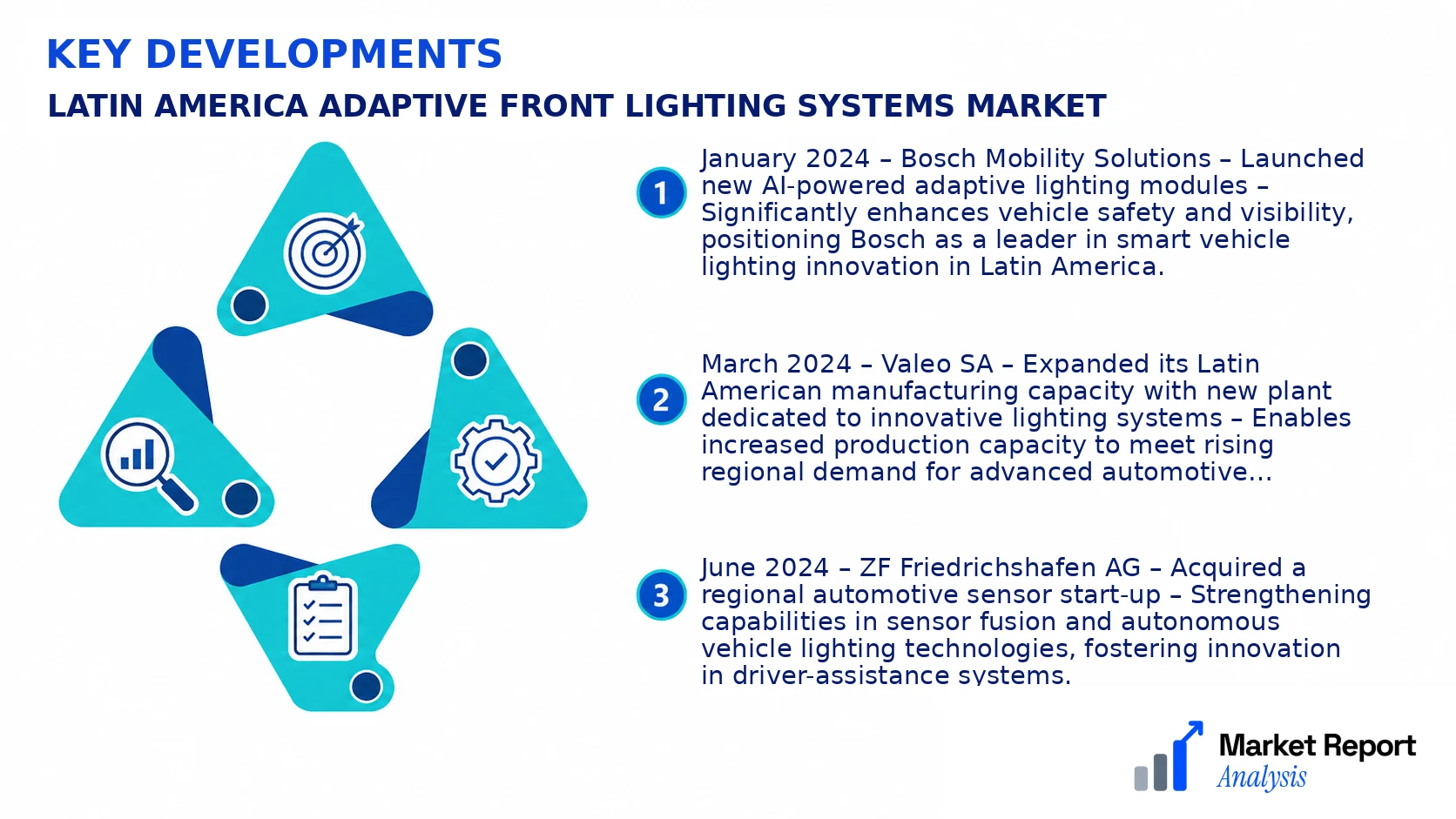
- January 2024 – Bosch Mobility Solutions – Launched new AI-powered adaptive lighting modules – Significantly enhances vehicle safety and visibility, positioning Bosch as a leader in smart vehicle lighting innovation in Latin America.
- March 2024 – Valeo SA – Expanded its Latin American manufacturing capacity with new plant dedicated to innovative lighting systems – Enables increased production capacity to meet rising regional demand for advanced automotive lighting solutions.
- June 2024 – ZF Friedrichshafen AG – Acquired a regional automotive sensor start-up – Strengthening capabilities in sensor fusion and autonomous vehicle lighting technologies, fostering innovation in driver-assistance systems.
- August 2024 – HELLA GmbH & Co. KGaA – Signed strategic alliance with a regional vehicle manufacturer – Joint development of next-gen laser adaptive front lighting systems aimed at premium vehicle markets in Latin America.
- September 2024 – Continental AG – Launched new integrated driver assistance and adaptive lighting system in Latin America – Focused on improving dark-road visibility and vehicle safety through smart, connected lighting modules.
Frequently Asked Questions
1. What is the Latin America Adaptive Front Lighting Systems Market?
The Latin America Adaptive Front Lighting Systems Market encompasses the industry involved in the development, manufacturing, and deployment of adaptive front lighting systems tailored for vehicles within Latin America, aimed at improving nighttime visibility and driving safety.
2. What is the current market size of Latin America Adaptive Front Lighting Systems Market?
As of 2026, the market size for Latin America Adaptive Front Lighting Systems is valued at approximately USD 1.2 Billion, driven by increasing vehicle safety awareness and rising adoption of advanced lighting technologies across the region.
3. What factors are driving the Latin America Adaptive Front Lighting Systems Market?
Drivers include automotive safety regulations, technological advancements in lighting, increasing vehicle production, and automaker focus on enhancing driver and pedestrian safety through innovative lighting solutions in Latin America.
4. Which region dominates the Latin America Adaptive Front Lighting Systems Market?
Brazil currently dominates the Latin American market due to its large automotive manufacturing base, growing vehicle fleet, and investments in safety-conscious vehicle features, making it the key regional leader in adaptive front lighting adoption.
5. Which segment is expected to grow the fastest?
The passenger vehicle segment is poised for the fastest growth owing to a surge in consumer demand for safety features, increasing vehicle miles, and automaker focus on incorporating adaptive lighting technology in mass-market models.
6. Who are the leading companies operating in the Latin America Adaptive Front Lighting Systems Market?
Major players include automotive lighting divisions of global automotive suppliers such as Valeo, Koito, Magneti Marelli, and Hella, along with regional innovators pushing advancements in adaptive lighting technologies specifically tailored for Latin American markets.
Analyst Perspective
The Latin America Adaptive Front Lighting Systems Market is poised for substantial long-term growth, driven by increasing vehicle electrification and advanced driver-assistance systems (ADAS) integration. Innovators should prioritize investments in sensor fusion technologies and IoT connectivity to enhance system responsiveness and safety features, creating competitive advantages in this evolving landscape. The sector is witnessing heightened competitive intensity, with established automotive suppliers and technology startups vying for market share, necessitating strategic alliances and R&D investments. Regional growth remains robust, especially in Brazil, Mexico, and Argentina, where rising vehicle sales and regulatory push for safer lighting solutions foster expansion. Market maturity suggests a shift from traditional lighting to intelligent systems, requiring continuous technological evolution aimed at reliability and cost-efficiency. Long-term, early adoption of next-generation adaptive lighting, leveraging AI and machine learning, will be critical for securing brand differentiation. Investment priorities should emphasize scalable manufacturing and strategic partnerships to capitalize on Latin America's significant growth potential amidst increasing consumer demand for safer, smarter vehicles.
