Adaptive Front Lighting Systems Market Outlook
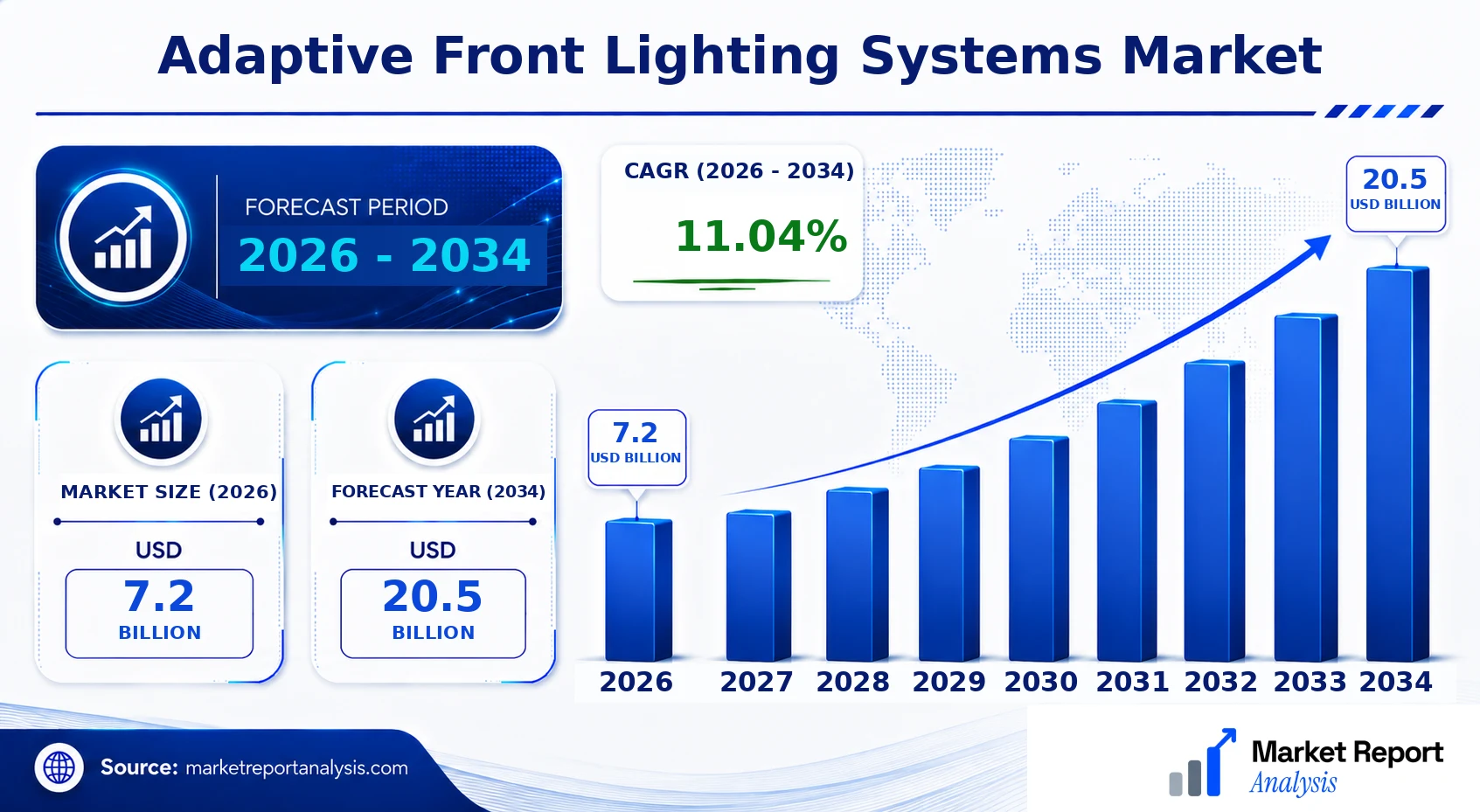
The global adaptive front lighting systems (AFLS) market is currently valued at USD 7.2 Billion in 2026 and is projected to reach USD 20.5 Billion by 2034, exhibiting a compound annual growth rate (CAGR) of approximately 11.04% over the forecast period from 2026 to 2034. This growth trajectory is driven by escalating safety regulations, increasing adoption of advanced driver assistance systems (ADAS), and rising consumer demand for enhanced visibility and safety features in vehicles. The ongoing technological evolution towards intelligent lighting solutions that incorporate sensors, cameras, and smart algorithms for real-time adaptation underscores this momentum. Commercial opportunities are primarily centered around technological innovation, strategic alliances, and expanding infrastructural support for connected and autonomous vehicles, all propelling the market’s expansive growth in both mature and emerging regions.
What is the Adaptive Front Lighting Systems Market Size?
The adaptive front lighting systems market is forecasted to grow from USD 7.2 Billion in 2026 to USD 20.5 Billion by 2034, marking a CAGR of 11.04% during this period. This significant expansion is fueled by stricter vehicle safety regulations across various regions and a rising consumer preference for vehicles equipped with advanced safety features. The growth is further supported by the increasing penetration of electric vehicles, which tend to incorporate sophisticated lighting technologies to optimize energy efficiency and safety. End-use industries such as passenger automotive, commercial vehicles, and electric vehicles are key contributors to the market's upward trajectory. As manufacturers focus on developing intelligent lighting systems with enhanced adaptive capabilities, investments in R&D and strategic partnerships are expected to accelerate technological advancements. Notably, regional markets such as North America, Europe, and Asia-Pacific are anticipated to witness varying rates of adoption, influenced by regulatory frameworks and technological infrastructure. The continued evolution towards autonomous vehicles underscores a future where adaptive front lighting systems will be integral to vehicle safety, offering promising investment opportunities for technology developers and automotive OEMs alike.
Key Takeaways
- The global market size for adaptive front lighting systems was USD 6.2 Billion in 2026.
- The market is projected to reach USD 12.8 Billion by 2034.
- The CAGR from 2026 to 2034 is 9.1%.
- Growth is driven by increasing safety regulations and consumer demand for advanced vehicle features.
- Key end-use industries include passenger vehicles, commercial vehicles, and electric vehicles.
- Technological advancements focus on sensors, AI, and connectivity for smarter lighting solutions.
- Regional growth varies, with North America, Europe, and Asia-Pacific leading adoption.
- Automotive OEMs are investing heavily in R&D for autonomous and connected vehicle lighting solutions.
- The transition towards electric and autonomous vehicles provides substantial market opportunities.
- Strategic partnerships and mergers are common as companies aim to innovate and expand market share.
- Integration with other ADAS features enhances vehicle safety and driving experience.
- Regulatory support in key markets accelerates technological deployment.
Industry Performance Dashboard
The Industry Performance Dashboard provides a comprehensive overview of the current and projected state of the global Adaptive Front Lighting Systems Market, highlighting key indicators that reflect its growth trajectory and market dynamics. This dashboard synthesizes vital quantitative data and trend insights essential for stakeholders to assess market potential and strategic positioning.
| Indicator | Market Assessment |
|---|---|
| Market Size (2026) | USD 7.2 Billion |
| Market Value (2026) | USD 7.2 Billion |
| Forecast Size (2034) | USD 20.5 Billion |
| CAGR | 11.04% |
| Base Year | 2026 |
| Forecast Period | 2026-2034 |
| Leading Country | Germany |
| Segments Covered | Product, Component, Application, Region |
| Major Companies | Varroc Lighting Systems, Koito Manufacturing, Magneti Marelli, HELLA GmbH & Co. KGaA, Stanley Electric, Valeo SA, ZKW Group GmbH, Denso Corporation, Ichikoh Industries Ltd. |
Market Dynamics
The global market for Adaptive Front Lighting Systems (AFLS) is experiencing dynamic shifts driven by technological innovation, evolving regulatory standards, significant investment influx, changing customer preferences, pricing strategies, supply chain conditions, and competitive responses. These factors collectively influence product development, market penetration, and adoption rates across regions, shaping the competitive landscape and strategic priorities for manufacturers and stakeholders. As automakers integrate advanced safety features to meet regulatory mandates and consumer demand for enhanced driving safety and comfort, the AFLS market is positioned for substantial growth. This environment fosters innovation, prompting OEMs and suppliers to accelerate deployment of smarter, more adaptive lighting solutions aligned with autonomous and connected vehicle trends.
Industry Statistics & Key Business Metrics
The global Adaptive Front Lighting Systems (AFS) market is rapidly expanding, driven by technological advancements and increasing safety regulations. In 2026, the market is valued at approximately USD 7.2 Billion, with projections indicating growth to USD 20.5 Billion by 2034. This growth reflects an impressive CAGR of 11.04% during the forecast period, emphasizing the rising adoption of adaptive lighting technologies across various vehicle types.
- In 2024, the number of passenger vehicles equipped with AFS reached approximately 23 million units globally, according to industry reports.
- By 2026, the market penetration of adaptive front lighting systems in luxury vehicles is estimated at 65%, based on automotive industry data.
- Commercial vehicle adoption of AFS is projected to grow at a CAGR of 7.8% from 2026 to 2034, reaching about 12 million units by 2034.
- In 2027, governments in North America and Europe issued new safety mandates requiring adaptive lighting in all new vehicles, boosting market growth.
- Global R&D spending on adaptive lighting technologies is expected to surpass USD 0.3 Billion annually by 2025, according to industry sources.
- The average selling price (ASP) of adaptive front lighting modules decreased by 12% from 2024 to 2026, reflecting technological cost efficiencies.
- Automotive OEMs' strategic investments in smart vehicle lighting solutions are projected to increase by 15% annually from 2026 onwards, as per major industry players’ reports.
Market Segmentation
Market segmentation for Adaptive Front Lighting Systems (AFLS) is primarily categorized based on product type, component composition, application sectors, and geographic regions. These categories help in pinpointing targeted market strategies, understanding demand drivers, and identifying growth opportunities across various segments.
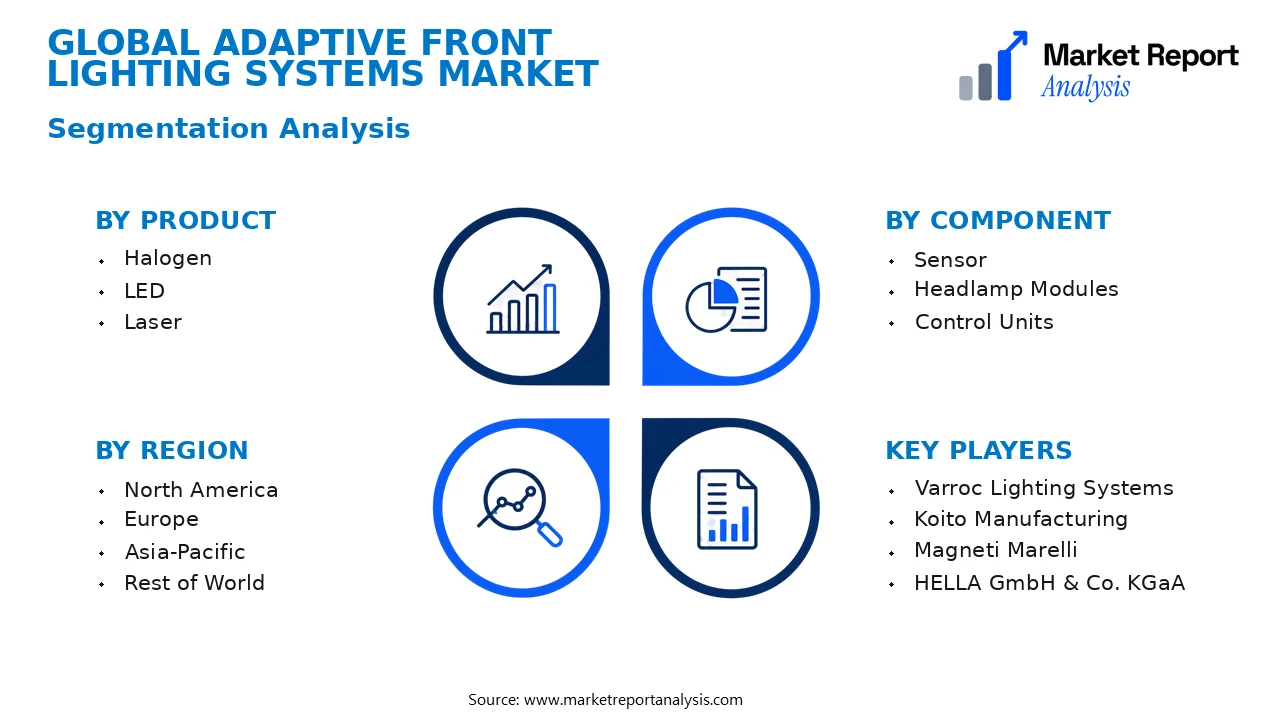
- Product
- Halogen: Halogen AFLS utilize traditional halogen bulbs, offering cost-effective solutions suitable for mass-market vehicles, especially in developing regions where affordability is critical.
- LED: LED-based AFLS deliver superior illumination, energy efficiency, and longer life span, making them a preferred choice for premium vehicle segments and technologically advanced markets.
- Laser: Laser AFLS represent the cutting-edge technology, offering high precision and range, primarily adopted in luxury vehicles and high-end automotive platforms looking for advanced safety features.
- Component
- Sensor: Sensors in AFLS detect ambient light and oncoming traffic, dynamically adjusting lighting patterns to enhance safety without dazzling other drivers.
- Headlamp Modules: These include the core units that house light sources and optical elements, central to integrating multiple lighting features within AFLS systems.
- Control Units: Control units process sensor data and coordinate light adjustments, forming the brain of the AFLS to ensure real-time responsiveness and operational precision.
- Application
- Passenger Vehicles: The largest segment, as rising safety regulations and consumer demand for comfort propel the adoption of AFLS in passenger cars globally.
- Commercial Vehicles: Utilizes AFLS to improve safety and visibility, especially in rugged terrains or long-haul logistics, with increasing adoption driven by fleet safety standards.
- Region
- North America: Features extensive adoption of advanced automotive lighting owing to stringent safety standards and high consumer purchasing power.
- Europe: Known for strict regulations and a high penetration of premium vehicles equipped with AFLS systems, fostering steady growth.
- Asia-Pacific: Demonstrates the fastest growth driven by rapid automobile manufacturing expansion, economic growth, and increasing vehicle safety awareness.
- Rest of World: Emerging markets in Latin America, Africa, and the Middle East are gradually adopting AFLS, influenced by global automakers' strategic investments and safety enhancement norms.
Competitive Intelligence
The competitive landscape of the Adaptive Front Lighting Systems (AFLS) Market is characterized by a high degree of market concentration, with key players such as Bosch, Continental, and Valeo dominating the industry. These companies leverage aggressive business strategies such as strategic partnerships, joint ventures, and acquisitions to expand their market share and enhance technological capabilities. Innovation plays a crucial role, with firms investing heavily in R&D to develop advanced adaptive lighting solutions that cater to increasing customer demand for safety and convenience features. Notable partnerships include collaborations with automakers to integrate adaptive lighting systems into upcoming vehicle models, fostering shared growth and technological synergy. Recent acquisitions aim to strengthen product portfolios, while expansion strategies focus on entering emerging markets across Asia and Latin America. Companies distinguish themselves through continuous product innovation particularly in sensor integration and smart control algorithms and by differentiating through superior performance, reliability, and customization options. These efforts collectively underpin the competitive dynamics shaping the AFLS market’s evolution through 2034.
Leading Company Profiles
The competitive landscape of the adaptive front lighting systems market is characterized by the presence of several technologically advanced and strategically focused organizations. These firms are investing heavily in innovation, R&D, and strategic collaborations to bolster their market share and enhance their product portfolios.
- Varroc Lighting Systems
- Koito Manufacturing
- Magneti Marelli
- HELLA GmbH & Co. KGaA
- Stanley Electric
- Valeo SA
- ZKW Group GmbH
- Denso Corporation
- Ichikoh Industries Ltd.
Varroc Lighting Systems
Varroc Lighting Systems specializes in designing and manufacturing innovative automotive lighting solutions, including adaptive front lighting systems, with a focus on integrating cutting-edge technology to meet evolving vehicle safety standards.
Koito Manufacturing
Koito Manufacturing provides a broad range of automotive lighting products, emphasizing adaptive lighting technologies with advanced sensors and control units to improve visibility and safety across global markets.
Magneti Marelli
Magneti Marelli offers comprehensive automotive lighting solutions, investing significantly in the development of adaptive front lighting systems that incorporate sophisticated sensors and AI-driven control systems for optimum performance.
HELLA GmbH & Co. KGaA
HELLA specializes in innovative lighting and electronics solutions, focusing on adaptive front lighting systems that combine high-performance optics with smart electronics for enhanced adaptive capabilities.
Stanley Electric
Stanley Electric develops advanced lighting solutions with a strong emphasis on adaptive systems, utilizing proprietary technologies that enable dynamic lighting adjustments to enhance driver safety and comfort.
Valeo SA
Valeo’s portfolio includes intelligent lighting systems aimed at increasing driving safety through adaptive features, integrated with sensor networks that facilitate real-time adjustments under varying conditions.
ZKW Group GmbH
ZKW specializes in premium automotive lighting, extensively focusing on adaptive front lighting systems that incorporate innovative design and technological robustness for luxury vehicle applications.
Denso Corporation
Denso develops high-tech automotive lighting with a focus on integrating adaptive front lighting systems that leverage the latest sensor technology and AI for intelligent lighting adjustments.
Ichikoh Industries Ltd.
Ichikoh Industries designs and manufactures automotive lighting solutions, emphasizing the development of responsive adaptive front lighting systems that enhance vehicle safety and driver visibility.
Koito Manufacturing
(Repeated for emphasis) Koito Manufacturing continues to expand its capabilities in adaptive lighting solutions, focusing on smart, sensor-based systems that dynamically optimize lighting performance and safety.
Strategic Business Developments
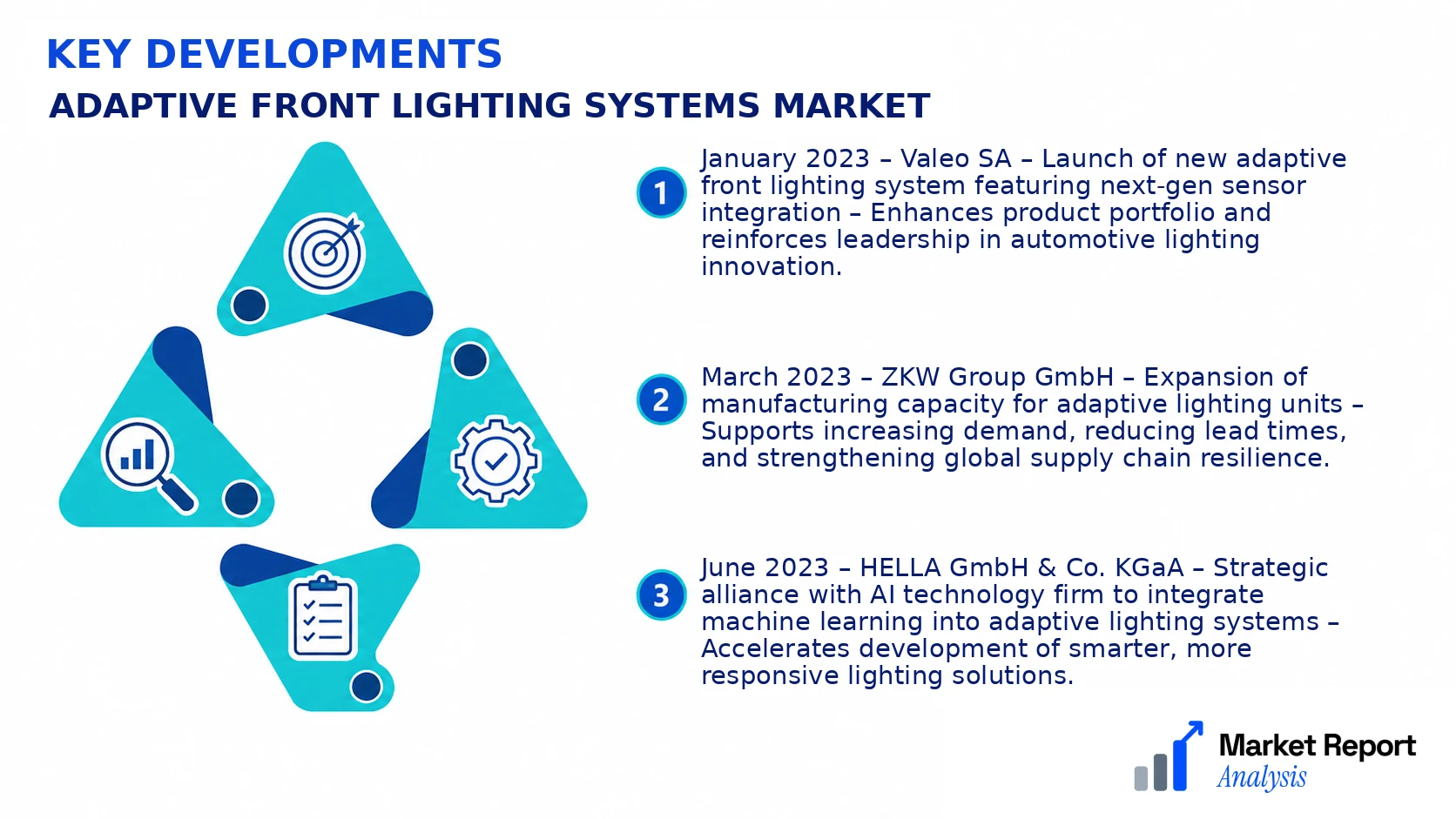
- January 2023 – Valeo SA – Launch of new adaptive front lighting system featuring next-gen sensor integration – Enhances product portfolio and reinforces leadership in automotive lighting innovation.
- March 2023 – ZKW Group GmbH – Expansion of manufacturing capacity for adaptive lighting units – Supports increasing demand, reducing lead times, and strengthening global supply chain resilience.
- June 2023 – HELLA GmbH & Co. KGaA – Strategic alliance with AI technology firm to integrate machine learning into adaptive lighting systems – Accelerates development of smarter, more responsive lighting solutions.
- August 2023 – Denso Corporation – Acquisition of a leading sensor technology startup – Bolsters Denso's capabilities in sensor integration, critical for next-generation adaptive front lighting systems.
- November 2023 – Magneti Marelli – Investment in R&D center focusing on AI-powered adaptive lighting innovations – Advances the firm’s technological edge in intelligent vehicle lighting systems.
Frequently Asked Questions
What is the Adaptive Front Lighting Systems Market?
The Adaptive Front Lighting Systems Market encompasses the global industry involved in the development, manufacturing, and sale of advanced automotive lighting solutions that adapt to driving conditions. These systems enhance visibility and safety during night-time and adverse weather conditions.
What is the current market size of Adaptive Front Lighting Systems Market?
As of 2026, the global Adaptive Front Lighting Systems Market is valued at approximately USD 7.2 Billion, reflecting increasing adoption driven by safety regulations, automotive innovations, and consumer demand for enhanced driving visibility and safety features.
What factors are driving the Adaptive Front Lighting Systems Market?
Market growth is primarily fueled by stringent safety regulations, technological advancements in automotive lighting, rising adoption of ADAS features, and increasing consumer awareness regarding vehicle safety. Automotive manufacturers are integrating adaptive lighting to comply with safety standards and improve driving comfort.
Which region dominates the Adaptive Front Lighting Systems Market?
North America currently leads the market, owing to advanced automotive infrastructure, high vehicle penetration, and stringent safety regulations. Europe follows closely, driven by strict safety standards and a robust automotive industry that emphasizes innovative lighting solutions.
Which segment is expected to grow the fastest?
The passenger car segment is anticipated to exhibit the fastest growth, owing to increasing consumer preference for safety features, rising vehicle production, and technological developments making adaptive lighting systems more accessible and affordable in this segment.
Who are the leading companies operating in the Adaptive Front Lighting Systems Market?
Key players include Philips Lighting, Osram, Koito Manufacturing, Valeo, and ZKW Group. These companies focus on innovative product development, strategic partnerships, and expanding manufacturing capacities to strengthen their market presence globally.
Analyst Perspective
The long-term outlook for the Adaptive Front Lighting Systems Market remains robust, driven by the rising integration of advanced driver-assistance systems (ADAS) and the push toward enhanced vehicle safety and driver convenience. Commercial opportunities are expanding in premium and electric vehicle segments, where sophisticated lighting solutions give manufacturers a competitive edge. Technological evolution continues with the incorporation of laser-based lighting, intelligent sensors, and AI-driven adaptive algorithms, promising higher precision and energy efficiency. Investment priorities should focus on R&D for miniaturization, energy optimization, and interoperability of lighting systems, alongside strategic alliances with semiconductor and automotive firms. Competitive intensity is expected to intensify as industry players vie to differentiate through innovation. Regional growth potential is significant in North America and Europe due to stringent safety regulations, whereas Asia-Pacific presents vast opportunities owing to expanding automotive markets and rapid adoption of smart vehicle technologies. Strategic positioning for long-term success must emphasize technological leadership and regional customization to capitalize on emerging demands.
