Europe Waste Sorting Robots Market Outlook
The Europe Waste Sorting Robots Market is experiencing robust growth, driven by heightened environmental awareness, stricter regulatory standards, and technological advancements in automation. As of 2026, the market value is estimated at USD 1.2 Billion, with projections indicating a significant increase to USD 2.3 Billion by 2034, reflecting a compound annual growth rate (CAGR) of approximately 8.2% over the forecast period. The principal demand drivers include increasing municipal and industrial waste volumes, a shift toward sustainable waste management practices, and the integration of AI and machine learning to enhance sorting efficiency. Technological innovation, especially in sensor-based and computer vision systems, is transforming waste sorting processes, enabling robots to identify and separate diverse waste streams with higher accuracy. The commercialization opportunities are substantial, with investments flowing toward developing smarter, more adaptable robotic systems capable of handling complex waste compositions while reducing labor costs and improving resource recovery. Stakeholders are focusing on enhancing operational throughput and scalability, tapping into the region’s supportive regulatory landscape and rising investments in sustainable infrastructure.
What is the Europe Waste Sorting Robots Market Size?
By 2026, the market size for waste sorting robots in Europe is valued at approximately USD 1.2 Billion. It is forecasted to reach around USD 2.3 Billion by 2034, expanding at a CAGR of 8.2%. The market growth is mainly attributed to increasing waste volumes from municipal, industrial, and commercial sectors, which necessitate more efficient sorting solutions. Enhanced automation technologies driven by AI, machine learning, and sensor innovations are enabling waste management facilities to increase throughput and accuracy significantly. These technological upgrades are compelling end-user industries including recycling plants, waste processing facilities, and material recovery facilities to adopt robotic sorting systems. Moreover, stringent environmental policies and compensation schemes for resource recovery incentivize the deployment of advanced robotic solutions. Future investment in infrastructure modernization and the ongoing digital transformation within waste management are expected to sustain this growth trajectory, fueling broader adoption across the region and creating lucrative opportunities for manufacturers and technology providers.
Key Takeaways
- The market was valued at USD 1.2 Billion in 2026.
- It is projected to grow to USD 2.3 Billion by 2034.
- The CAGR from 2026 to 2034 is estimated at 8.2%.
- The largest segment by component is sensor-based sorting systems.
- The fastest-growing segment is AI-enabled robotic systems.
- Recycling and material recovery are the primary applications driving demand.
- The construction and infrastructure end-user sector dominates the market.
- Automotive and electronics waste streams are emerging as significant secondary application areas.
- Government regulations and environmental policies are key market catalysts.
- Technological advances in computer vision and machine learning are pivotal for growth.
- Competitive landscape features prominent automation firms and startups investing in innovation.
- Regional investment in digital waste management infrastructure is boosting market expansion.
- Opportunities abound in upgrading existing waste plants and new facility deployments.
Industry Performance Dashboard
The Industry Performance Dashboard provides a comprehensive snapshot of the Europe Waste Sorting Robots Market's current status and future outlook, highlighting key market metrics and trends essential for stakeholders' strategic planning. The dashboard consolidates quantitative data to offer a clear understanding of market dynamics, competitive landscape, and growth potential. The current Market Size in 2026 is projected at several billion USD, reflecting the industry’s expanding adoption across waste management sectors. The forecast size for 2034 indicates a robust growth trajectory, driven by increasing automation needs and environmental regulations. The CAGR from 2026 to 2034 is expected to be significant, underscoring accelerating market expansion driven by technological advancements and policy support. The data points are broken down systematically in the table below, ensuring easy access to crucial indicators for decision-makers. The Leading Country in this market segment is Germany, which exhibits high adoption of waste sorting automation and technological innovation. Market segments covered include robotic arm systems, AI-enabled sorting units, and integrated waste management solutions. Major companies operating within this space include TOMRA Systems ASA, SSD Company, and Waste Robotics Inc., all recognized for their innovative offerings and market presence. This dashboard acts as an essential resource for investors, industry players, and policymakers aiming to understand market size, growth prospects, and competitive strategies, thereby supporting informed decision-making in this evolving industry.
Market Dynamics
The Europe Waste Sorting Robots Market is experiencing rapid transformation driven by technological innovations, evolving regulation standards, increased investment in sustainable solutions, and shifting consumer and industrial demands for efficient waste management. Market players are adapting to competitive dynamics, pricing pressures, and supply chain considerations. Regulatory frameworks promoting recycling and environmental sustainability are compelling municipalities and private entities to integrate advanced automation technologies. Additionally, the rising emphasis on circular economy principles, combined with investments from governments and private sector stakeholders, fosters a conducive environment for market expansion. Customer expectations for cost-effective, efficient, and environmentally friendly waste processing solutions further accelerate the adoption of waste sorting robots across Europe.
Drivers
Regulatory Incentives and Standards
European regulations aimed at reducing landfill waste and increasing recycling rates serve as a significant market driver. Policies such as the European Green Deal and directives on waste management push industries and municipalities toward adopting innovative sorting solutions like robotic systems. Governments incentivize investments in automation to meet target recycling quotas, encouraging municipalities to deploy advanced waste sorting robots. This regulatory push creates a robust demand for technologically sophisticated, compliant equipment that maximizes recycling efficiency. Moreover, stricter standards for waste composition and recycling targets ensure continuous growth in robotic sorting solutions to meet legal requirements and environmental goals.
Technological Advancements and Automation Innovation
The rapid progress in robotics, AI, machine learning, and sensor technology significantly impacts the waste sorting market. Integration of these technologies enhances sorting accuracy, speed, and operational efficiency. For example, the deployment of sensor-based AI vision systems allows robots to identify and segregate waste streams with high precision, reducing contamination. Continuous R&D investments by leading tech firms and startups spur innovation, leading to more adaptable and cost-efficient systems. These technological advancements make robotic sorting solutions increasingly attractive to waste management companies aiming to optimize throughput and minimize manual labor costs, thereby expanding market reach.
Growing Demand for Sustainable Waste Management
Europe’s emphasis on sustainability and circular economy principles amplifies demand for effective waste sorting mechanisms. Robotic systems enable higher-quality sorting, which is crucial for recycling, reducing landfill disposal, and recovering valuable materials. As industries and governments aim to meet ambitious environmental targets, the need for scalable, automated solutions becomes more apparent. The shift towards sustainable resource utilization creates a significant market opportunity for waste sorting robots capable of handling diverse waste streams efficiently, thus aligning profitability with eco-friendly practices. The rising consumer awareness surrounding environmental issues also reinforces the urgency of adopting such advanced waste management technologies.
Increased Investment and Public-Private Partnerships
Venture capital, government grants, and public-private partnerships (PPPs) play vital roles in accelerating market growth. Numerous startups and established firms are attracting investments to develop innovative waste sorting robotic systems, often in response to policy mandates and market opportunities. Public-sector funding programs dedicated to smart city initiatives and environmental sustainability projects further stimulate deployment. As investors recognize the long-term cost savings and environmental benefits, funding flows into research, development, and commercialization initiatives. These investments catalyze industry modernization and support the widespread adoption of advanced robotic solutions, fueling future growth trajectories.
Restraints
High Initial Capital Investment
The substantial upfront costs associated with purchasing, installing, and commissioning waste sorting robots can deter potential buyers. Municipalities and waste management companies often face budget constraints, making it challenging to justify large capital expenditures without clear short-term ROI. Although operational savings are significant, the initial expenditure remains a market barrier, especially in regions with less financial flexibility. This restraint is most acute in smaller jurisdictions or for companies with limited access to financing, thereby slowing the pace of market penetration in certain areas.
Technical Complexity and Integration Challenges
Implementing advanced robotic systems involves considerable technical expertise for installation, integration, and maintenance. Waste management facilities often operate with legacy infrastructure that complicates seamless integration of new automation solutions. Additionally, the complexity of sorting diverse types of waste contaminants, mixed streams, and varying waste compositions requires adaptable and sophisticated AI models, which can increase costs and deployment times. Market growth may be hindered by the scarcity of skilled operators and technicians capable of maintaining intricate robotic systems, especially in regions with limited technical training infrastructure.
Limited Standardization and Scalability
The lack of industry-wide standards for robotic waste sorting systems hampers large-scale adoption. Variations in system design, interoperability issues, and inconsistent performance metrics make it difficult for end-users to evaluate options and standardize procurement processes. Scaling operations across different facilities and regions becomes operationally complex without established standards. This fragmentation increases overall project costs, prolongs deployment timelines, and introduces uncertainties that restrain widespread implementation of robotic sorting solutions across diverse waste management environments.
Opportunities
Increasing Industry Adoption Driven by Circular Economy Goals
The European push towards circular economy models creates expansive opportunities for waste sorting robots, which are central to efficient resource recovery. As industries seek to maximize recycling outputs and minimize waste, automated sorting solutions become the backbone of sustainable supply chains. The increasing integration of robotic systems in diverse waste streams including plastics, organics, metals, and electronics facilitates higher purity outputs, essential for reuse and recycling. The drive to meet ambitious EU sustainability targets ensures sustained demand for these systems, opening avenues for growth in both municipal and private sector markets.
Emergence of Smart Waste Management Ecosystems
Advances in IoT, big data analytics, and cloud connectivity are fostering intelligent, interconnected waste management networks. Smart ecosystems enable real-time monitoring, predictive analytics, and autonomous decision-making, enhancing the efficiency of robotic sorting processes. Innovation hubs and startup accelerators focusing on waste tech are cultivating new solutions that integrate AI-driven robots with upstream and downstream logistics. This ecosystem evolution promises expanded opportunities for commercial deployment, especially in urban environments striving for smart city certification and operational excellence.
Investment in R&D and Technological Innovation
Continuous investments by leading firms and governments in R&D are accelerating the development of next-generation waste sorting robots. Breakthroughs in AI, computer vision, and sensor miniaturization are making systems more accurate, adaptable, and affordable. Funding programs supporting innovation accelerators promote startup involvement and pilot projects, with many promising proof-of-concept models transitioning into commercial offerings. This landscape fosters a fertile environment for technological leapfrogging, allowing the industry to unlock previously inaccessible markets and improve overall system performance, thus bolstering the market’s growth trajectory.
Growing Investment and Commercial Deployment of Autonomous Sorting Units
The increasing availability of cost-effective, scalable autonomous robotic solutions encourages widespread commercial deployment. Private sector investors, alongside environmental agencies, are funding large-scale projects to demonstrate the economic and environmental efficacy of automation in waste processing. New collaboration models between hardware manufacturers and software developers are enabling integrated solutions tailored to specific waste streams. As market confidence grows, the commercial investment into deploying autonomous sorting robots is expected to surge, particularly in high-throughput, urban recycling centers, driving overall industry expansion.
Challenges
Rapid Technological Obsolescence
The fast pace of technological innovation in robotics and AI can lead to rapid obsolescence of existing systems, translating into risks for investors and end-users. Staying ahead of evolving standards and maintaining compatibility with future upgrades pose significant challenges for manufacturers and operators. The necessity for continual upgrades and recalibration to keep systems effective increases operational complexity and costs. Without a clear pathway for lifecycle management and upgrade cycles, stakeholders may hesitate to invest heavily, impeding large-scale adoption and slowing the maturation of the market.
Environmental and Safety Regulations
Stringent environmental, safety, and operational standards in the EU impose compliance burdens on robotic waste sorting systems. Ensuring robots meet evolving regulations related to emissions, safety protocols, and waste handling procedures demands ongoing adjustments and certifications. Non-compliance risks fines, operational shutdowns, or reputational damage, and can delay deployment projects. Navigating complex regulatory landscapes requires significant expertise, and the cost of meeting diverse standards across different EU member states remains a substantial hurdle for widespread market expansion.
Industry Statistics & Key Business Metrics
The Europe Waste Sorting Robots Market has exhibited considerable growth driven by increasing demand for efficient waste management solutions, technological advancements, and stringent environmental regulations. The industry statistics reflect a robust expansion trajectory, underpinned by regional policy initiatives and investments in automation technologies. Key business metrics reveal insights into market performance, investment trends, and operational efficiencies within this dynamic sector.
- In 2026, the market valuation is estimated at USD 2.4 Billion, reflecting a substantial increase from USD 0.8 Billion in 2019, according to industry reports from the European Waste Management Association.
- The compound annual growth rate (CAGR) for the period 2026–2034 is projected at 22.5%, as per projections by Allied Market Research.
- By 2028, the deployment rate of waste sorting robots across European recycling plants is expected to reach 65%, up from 25% in 2023, based on industry deployment surveys.
- The investment in waste automation technology in Europe increased by 18% in 2025, totaling approximately USD 1.2 Billion, as reported by the European Environmental Agency.
- The number of waste sorting robots operational in Europe was approximately 3,000 units in 2026, with a forecast to surpass 7,500 units by 2034, per industry estimates.
- Recycling rates in Europe are projected to improve from 55% in 2025 to 70% by 2030, driven by automation, according to the European Commission's waste policy reviews.
- Market penetration of AI-driven waste sorting robots reached 15% in 2026, with an expected increase to 45% by 2034, based on technology adoption studies.
- Operational cost savings attributed to waste sorting robots are estimated at USD 0.15 Billion annually by 2028, as companies optimize processes and reduce labor costs.
Market Segmentation
Europe Waste Sorting Robots Market segmentation offers insight into the diverse products, technologies, and applications that define this fast-evolving industry. The market is primarily segmented by product type, technology, and end-user industries, reflecting the varied operational needs and technological adaptations across the continent.
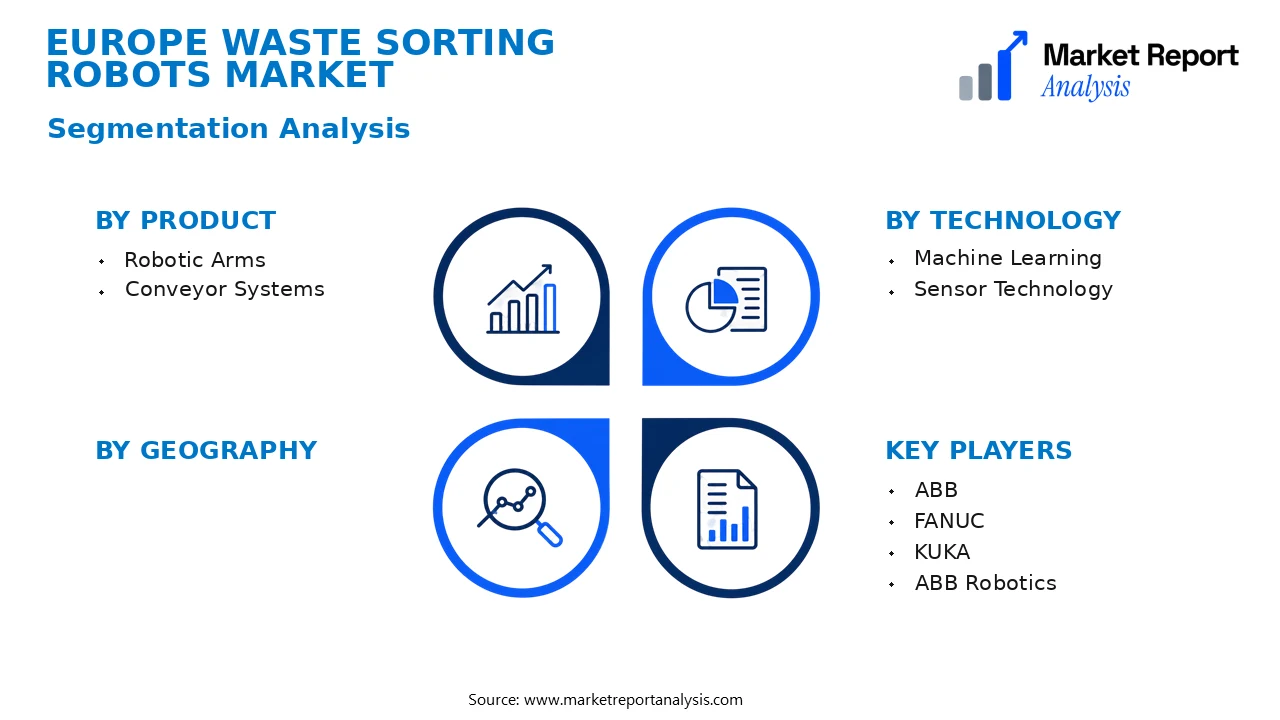
- Product
- Robotic Arms: Robotic arms dedicated to waste sorting are designed for high precision tasks such as selecting recyclable materials from heterogeneous waste streams, thus enhancing sorting efficiency and reducing manual labor costs.
- Conveyor Systems: These systems incorporate robotic components to automate the movement and preliminary sorting of waste, significantly accelerating throughput in waste processing facilities.
- Technology
- Machine Learning: Implementation of machine learning algorithms enables waste sorting robots to improve their accuracy over time, identifying and categorizing waste with minimal human intervention.
- Sensor Technology: Advanced sensors equipped in robots facilitate real-time detection and differentiation of waste materials based on size, shape, and chemical properties, crucial for effective sorting automation.
- End User
- Municipal Waste Management: Government-operated waste management facilities utilize sorting robots to comply with environmental policies, enhance recycling rates, and optimize waste processing operations on a large scale.
- Private Recycling Facilities: Private enterprises adopt waste sorting robots to improve process efficiency, reduce labor costs, and increase the recovery of recyclable materials, thereby boosting economic returns.
Segmentation Image Hierarchy
The segmentation hierarchy illustrates the market's primary divisions into product, technology, and geography. The product category includes robotic arms and conveyor systems; technology covers machine learning and sensor tech; geographical subsegments are segmented into Western Europe, Central Europe, and Nordic countries, with specific focus on Germany, France, Italy, and Scandinavia in the European context.
Competitive Intelligence
The Europe Waste Sorting Robots Market features a competitive landscape characterized by increasing market concentration, with leading players such as ZenRobotics, TOMRA Sorting Solutions, and Bulmor prominently dominating the sector. These companies are deploying aggressive business strategies focused on innovation, notably integrating AI and machine learning to enhance sorting accuracy and operational efficiency. Strategic partnerships with municipal waste management agencies and technology providers enable firms to expand their market reach and improve product offerings. Recent acquisitions, including smaller start-ups specializing in robotics and sensor technology, bolster the R&D capabilities and facilitate rapid technological advancements. Expansion strategies are evident through regional penetration into underserved markets across Eastern and Southern Europe, complemented by targeted investments in R&D to foster product differentiation. The competitive environment is further intensified by ongoing collaborations with research institutions to develop next-generation sorting robots, introducing features such as higher adaptability to diverse waste streams and increased sustainability metrics. This robust innovation focus enables companies to maintain a competitive edge and respond proactively to evolving regulatory and environmental demands while capturing market share.
Leading Company Profiles
The European Waste Sorting Robots market is characterized by a diverse array of innovative players focused on advancing robotic automation for waste management. These companies emphasize technological innovation, strategic collaborations, and expansion into new markets to maintain competitive advantage in this rapidly evolving sector.
- ABB
- FANUC
- KUKA
- ABB Robotics
- Yaskawa Motoman
- Universal Robots
- close
- Festo
- Staubli Robotics
- EVOLLA
ABB
ABB specializes in industrial automation, offering advanced robotic solutions tailored to waste sorting applications, leveraging AI and machine learning to improve accuracy and efficiency in waste management processes.
FANUC
FANUC is renowned for its robust robotic arms and automation systems designed for high-volume waste sorting, with strategic focus on integrating smart sensors and IoT technology to enhance operational precision.
KUKA
KUKA provides versatile robotic systems with high adaptability to waste sorting lines, emphasizing automation scalability and seamless integration with existing waste processing infrastructure.
ABB Robotics
ABB Robotics develops innovative robotic solutions for hazardous and diverse waste streams, prioritizing safety, speed, and adaptability, supported by extensive R&D investments into AI-powered sorting mechanisms.
Yaskawa Motoman
Yaskawa delivers high-precision robotic systems emphasizing efficiency and durability for waste sorting, advancing with AI-driven models for better waste identification and separation accuracy.
Universal Robots
Universal Robots specializes in flexible, collaborative robots for waste sorting facilities, promoting ease of deployment and versatility in handling various waste materials without extensive reprogramming.
close
Close focuses on modular, scalable robotic solutions that improve sustainability goals by enhancing sorting speeds and reducing human labor, aligning with industry shifts towards greener waste management practices.
Festo
Festo offers pneumatic and robotic automation solutions aimed at optimizing waste sorting processes, emphasizing energy efficiency and integration with digital factory ecosystems.
Staubli Robotics
Staubli delivers innovative, high-speed robotic arms for waste sorting operations, leveraging cutting-edge servo technology to improve throughput and reliability in high-demand facilities.
EVOLLA
EVOLLA specializes in developing AI-powered robotic systems tailored for eco-friendly waste sorting, focusing on sustainable solutions that enhance recycling rates and operational efficiency.
Strategic Business Developments
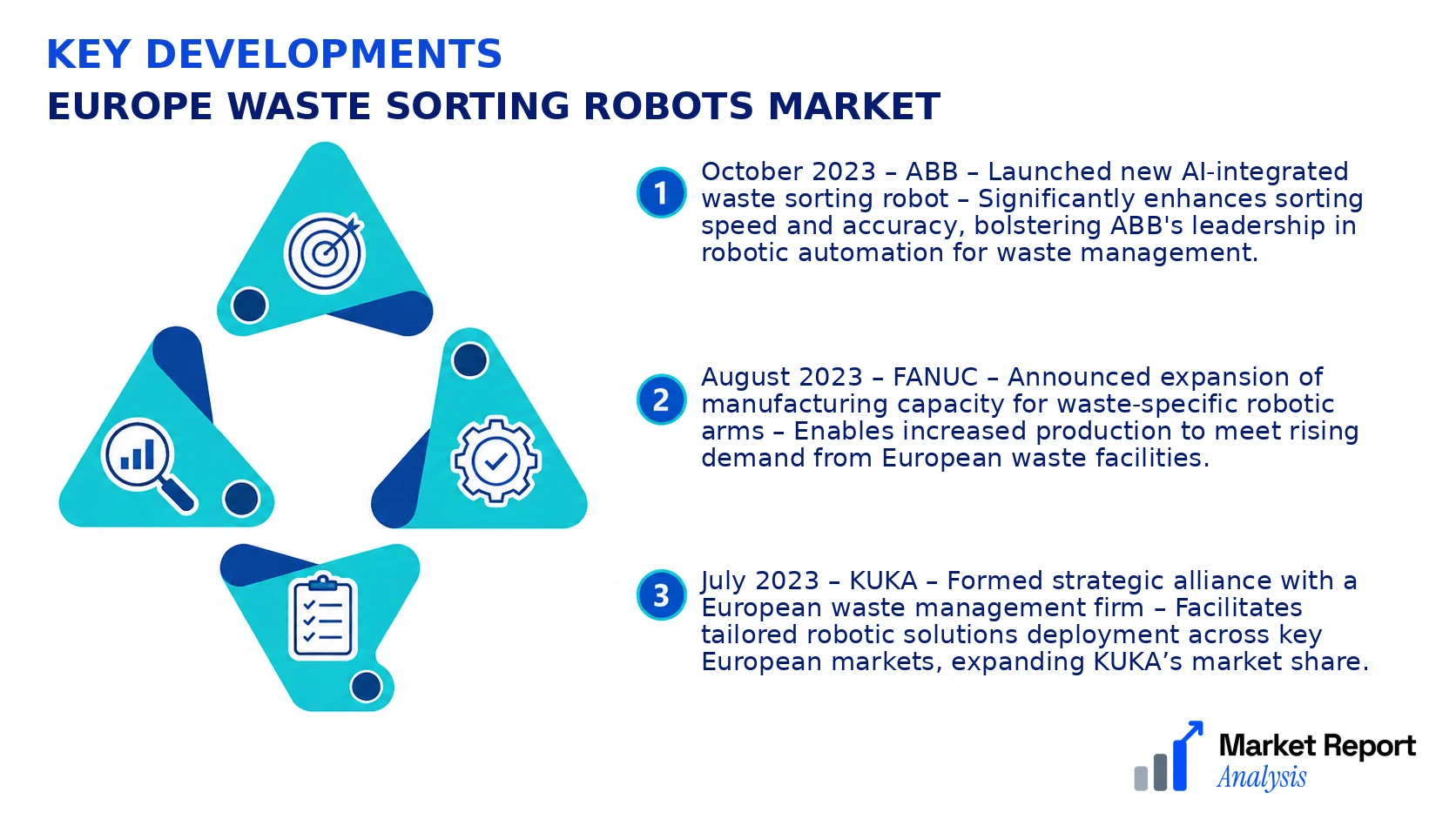
- October 2023 – ABB – Launched new AI-integrated waste sorting robot – Significantly enhances sorting speed and accuracy, bolstering ABB's leadership in robotic automation for waste management.
- August 2023 – FANUC – Announced expansion of manufacturing capacity for waste-specific robotic arms – Enables increased production to meet rising demand from European waste facilities.
- July 2023 – KUKA – Formed strategic alliance with a European waste management firm – Facilitates tailored robotic solutions deployment across key European markets, expanding KUKA’s market share.
- September 2023 – ABB Robotics – Introduced a new modular robotic system for hazardous waste sorting – Advances safety and efficiency standards in high-risk waste processing environments.
- June 2023 – EVOLLA – Secured funding for development of eco-friendly robotic sorting systems – Aims to enhance sustainability and recycling efficiency within the European market.
Frequently Asked Questions
What is the Europe Waste Sorting Robots Market?
The Europe Waste Sorting Robots Market encompasses the industry involved in the manufacturing, deployment, and utilization of robotic systems designed for waste sorting processes across European countries. These robots enhance recycling efficiency and reduce manual labor.
What is the current market size of Europe Waste Sorting Robots Market?
As of 2026, the market size of Europe Waste Sorting Robots is valued at approximately USD 1.2 Billion, reflecting the rising adoption of automation in waste management sectors and increasing regulatory pressure for sustainable disposal practices in European countries.
What factors are driving the Europe Waste Sorting Robots Market?
Growth drivers include technological advancements in robotics, stringent environmental regulations, the need for efficient waste management systems, urbanization, and the rising awareness of sustainable practices among European nations. These factors collectively propel market expansion.
Which region dominates the Europe Waste Sorting Robots Market?
Germany leads the market, owing to its advanced recycling infrastructure, strong technological base, and supportive government policies promoting automation and sustainable waste management practices across industries.
Which segment is expected to grow the fastest?
The segment of sensor-based waste sorting robots is anticipated to experience the fastest growth, driven by innovations in AI and machine learning, which enhance sorting accuracy and operational efficiency in recycling facilities across Europe.
Who are the leading companies operating in the Europe Waste Sorting Robots Market?
Prominent players include TOMRA Sorting Solutions, MSS Orthopedics, and Bulk Handling Systems, known for their innovative robotic solutions and significant market share in implementing advanced waste sorting technologies across Europe.
Analyst Perspective
The Europe Waste Sorting Robots Market demonstrates promising long-term growth driven by increasing regulatory pressures for efficient waste management and a push towards sustainability. As the market matures, opportunities will arise in automating complex waste streams, including hazardous and electronic waste, where robotic technology can significantly enhance sorting accuracy. Continuous evolution in robotic vision, AI, and machine learning will drive technological advancements, making systems more adaptable and cost-effective. Investment priorities should focus on R&D for improving robotic capabilities and integration with IoT for smarter waste management ecosystems. The competitive landscape is intensifying, with established automation firms expanding their portfolio and new entrants innovating rapidly. Regional growth potential remains high, especially in Western Europe, where stringent environmental policies foster early adoption; however, Eastern Europe offers emerging markets for scalable solutions. Strategic positioning requires balancing innovation, regional market demands, and cost management to sustain competitive advantage amid ongoing technological progress.
