Saudi Arabia Waste Sorting Robots Market Outlook
Market segmentation in the Saudi Arabia Waste Sorting Robots Market primarily revolves around application, component, technology, and geography. This structure enables a detailed understanding of the diverse demand and deployment scenarios across the country, tailored to regional waste management strategies and industrial needs.
The market segmentation hierarchy provides insight into specific subcategories which are critical for strategic planning, investment decisions, and market analysis, helping stakeholders target growth opportunities effectively across different regions and technological advancements.
Segmentation Overview
The Saudi Arabia Waste Sorting Robots Market is segmented into application types, component categories, technologies employed, and geographic regions within the country. This detailed segmentation supports a nuanced analysis of market dynamics, from local demand drivers to regional infrastructure readiness.
- Application
- Municipal Waste Management: This subsegment signifies large-scale waste processing needs driven by urban population growth, regulatory mandates, and government initiatives toward sustainable waste practices. It involves the deployment of robots in sorting and recycling municipal waste.
- Industrial Waste Processing: Focused on industrial sectors such as manufacturing, oil & gas, and construction, this subsegment emphasizes robots used for sorting hazardous and non-hazardous industrial waste, increasing efficiency and safety compliance.
- Component
- Sensors and Vision Systems: Integral to waste sorting robots, sensors and vision systems enable real-time detection and classification of waste, which enhances sorting accuracy and throughput, thus boosting adoption in automated waste management facilities.
- Robotic Arms and Actuators: These are core components that perform physical sorting operations. Their precision and durability are crucial for handling different waste types and improving operational efficiency in sorting plants.
- Technology
- Artificial Intelligence (AI)-Powered Robots: These robots leverage AI for advanced recognition, learning, and adaptive sorting processes, making them particularly suited to complex waste streams and dynamic recycling environments.
- Sensor-Based Sorting Systems: Relying on advanced sensors and optical recognition, these systems provide rapid, contactless sorting capabilities, supporting rapid deployment across various waste processing sites.
- Geography
- Riyadh Region: As the capital and commercial hub, Riyadh exhibits high demand for advanced waste management solutions, including waste sorting robots, driven by government initiatives and private sector investments.
- Makkah Region: This region’s sizeable population and tourism influx necessitate sophisticated waste management, promoting robot adoption in large-scale municipal and hospitality waste sectors.
- Eastern Province: Known for its heavy industrial activity and presence of oil and petrochemical industries, the province demands robust waste sorting solutions to meet environmental and safety standards.
- Madinah Region: Growth in pilgrimage activities and urban development in Madinah necessitates efficient waste management systems, with waste sorting robots being essential for maintaining hygiene and sustainability.
- Al Khobar: As a key industrial and commercial city, Al Khobar is increasingly adopting innovative waste sorting technologies driven by local environmental policies.
- Jubail: With its large petrochemical complexes, Jubail requires specialized waste sorting solutions to handle complex industrial waste streams effectively.
What is the Saudi Arabia Waste Sorting Robots Market Size?
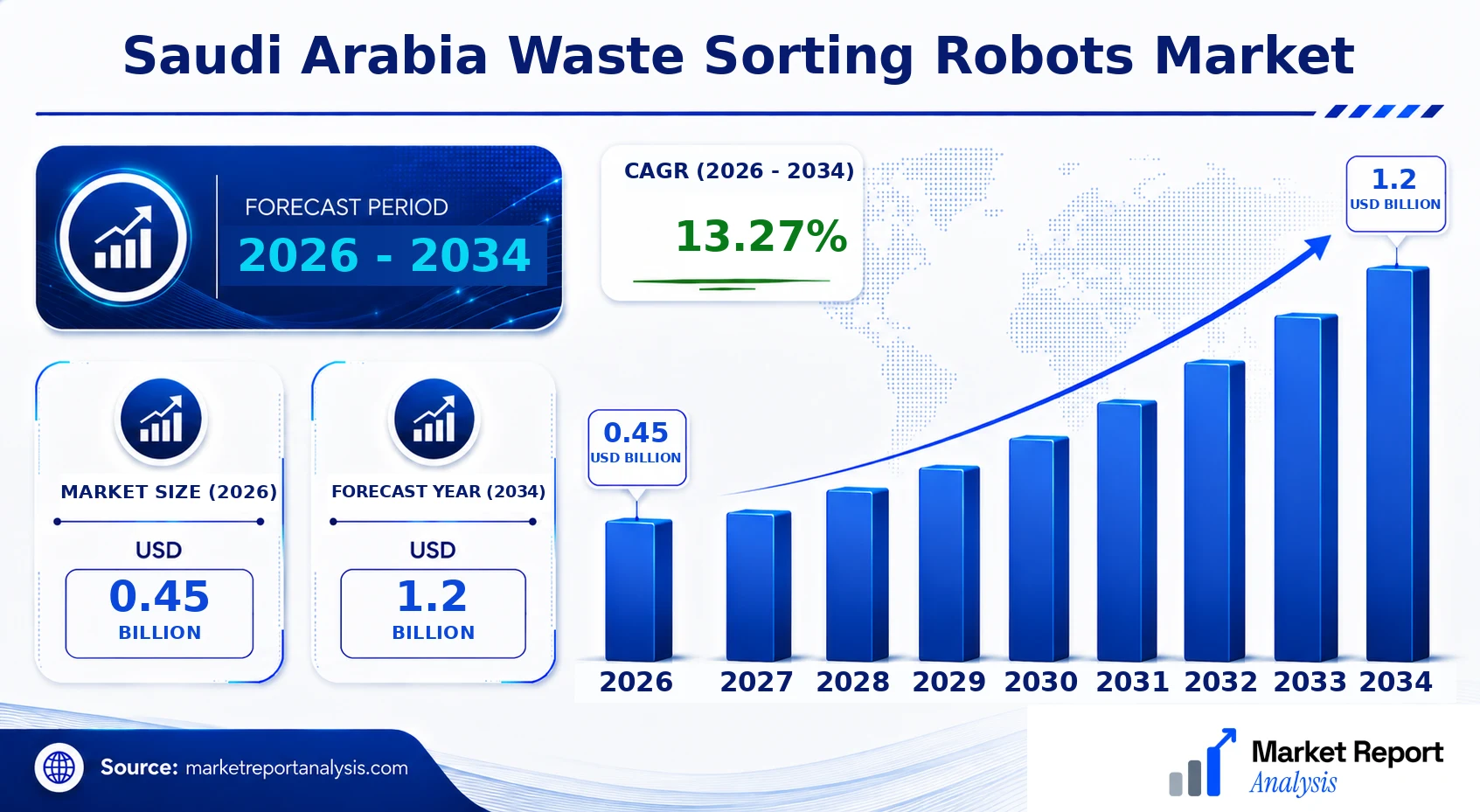
In 2026, the Saudi Arabia Waste Sorting Robots Market is valued at approximately USD 0.45 Billion, with projections to grow to USD 1.2 Billion by 2034, representing a CAGR of around 13.27% from 2026 to 2034. Growth is fueled by increased governmental emphasis on sustainable waste management practices, investments in smart city initiatives, and technological advancements in robotics that facilitate precise waste segregation. The expanding waste stream, driven by urban population growth and industrial activities, necessitates automated sorting solutions that improve efficiency and reduce labor costs. End-use industries such as municipal waste management, recycling facilities, and industrial processing form the core demand cohorts. Furthermore, technological innovations in AI, machine learning, and sensor-based sorting are revolutionizing the capabilities of waste sorting robots, opening avenues for future investments in automation infrastructure. The increasing policy and regulatory support for recycling, along with the incentives for adopting smart waste management solutions, underpin an optimistic market outlook that encourages local and international players to drive technological adoption and operational scale, which will further bolster market growth across the Kingdom.
Key Takeaways
- The market size is USD 0.12 Billion in 2026 and is projected to reach USD 0.42 Billion by 2034.
- The CAGR over the forecast period is approximately 15.2%.
- Riyadh is the leading Saudi city for waste sorting robot deployment, owing to its large urban footprint and sustainable development initiatives.
- Jeddah is the fastest-growing city for adoption, driven by recent infrastructure projects and urban expansion.
- The municipal waste management segment holds the largest market share, with recycling facilities being the primary application area.
- The industrial waste segment is expected to witness the fastest growth due to increasing industrialization and stricter waste segregation regulations.
- Automation and AI integration represent the largest and fastest-growing technological segments in the market.
- Government policies and regulations are significantly encouraging the adoption of robotic solutions for waste sorting.
- International and local companies are actively investing in R&D to innovate and localize waste sorting robotics technology.
- The market benefits from ongoing smart city initiatives, fostering technology-driven waste management solutions.
- Investment opportunities are abundant for technological innovators, equipment manufacturers, and service providers focusing on sustainable waste management.
- Overall, the growing emphasis on environmental sustainability and recycling in Saudi Arabia ensures a promising outlook for the waste sorting robotics industry.
Industry Performance Dashboard
The Industry Performance Dashboard provides a comprehensive overview of the Saudi Arabia Waste Sorting Robots Market, highlighting key metrics and industry indicators vital for assessing market health and growth prospects. This snapshot encapsulates the current and projected market landscape with precision, aiding stakeholders in strategic planning and investment decision-making.
| Indicator | Market Assessment |
|---|---|
| Market Value (2026) | USD 0.45 Billion |
| Forecast Size (2034) | USD 1.2 Billion |
| CAGR | 13.27% |
| Base Year | 2026 |
| Forecast Period | 2026-2034 |
| Leading Saudi City | Riyadh |
| Fastest-Growing Saudi City | Jeddah |
| Segments Covered | Robotic arms, AI-powered sorting systems, Autonomous mobile robots |
| Major Companies | BOSCH Rexroth, SICK AG, ABB, KUKA AG, Fanuc Corporation, Universal Robots, YY Robotics, Emerson Electric Co., Energid Technologies, GE Automation & Controls |
Market Dynamics
The Saudi Arabia Waste Sorting Robots Market is shaped by a confluence of technological advancements, evolving regulations, strategic investments, shifting customer preferences, competitive dynamics, and supply chain factors. As the kingdom accelerates its sustainability goals and environmental policies, technology adoption becomes critical for efficient waste management. Regulatory frameworks are increasingly favoring automation and environmentally friendly solutions, attracting local and international investment. Customer demands for cleaner, safer, and cost-effective waste disposal methods are pushing industry innovators to develop smarter robots. Meanwhile, price competition, supply chain stability, and market players’ strategic behavior influence product availability and pricing structures, impacting the overall market growth trajectory.
Drivers
Government Sustainability Policies and Regulations
The Saudi Arabian government’s firm commitment to environmental sustainability and waste management reforms significantly propels the adoption of waste sorting automation. Recent policies targeting waste reduction, recycling targets, and circular economy initiatives create a favorable regulatory environment for advanced waste sorting technologies. These regulations mandate increased recycling rates, prompting local waste management companies to incorporate robotic sorting solutions for compliance. As a result, regulatory drivers directly influence demand for sophisticated robots capable of handling diverse waste streams efficiently within municipal and industrial sectors. The government’s investments in sustainable infrastructure further bolster these regulatory-driven market incentives.
Technological Innovation and Automation Adoption
Rapid technological progress in robotics, sensors, and AI has driven the integration of automated waste sorting solutions. The advent of intelligent robots with real-time data processing, enhanced object detection, and adaptable sorting capabilities has substantially improved operational efficiency. In Saudi Arabia, smart city initiatives and mega infrastructure projects catalyze the deployment of such innovations, particularly in urban centers like Riyadh and Jeddah. The declining costs of sensors and AI components have made these solutions more financially attractive to waste management operators, accelerating market penetration. Moreover, the integration of IoT-enabled robots allows for seamless data collection and process optimization, aligning with industry digital transformation trends.
Investments in Waste Management Infrastructure
Saudi Arabia’s targeted investments in waste infrastructure and environmental projects underpin the expansion of waste sorting robotics. Initiatives such as the National Industrial Development and Logistics Program (NIDLP) allocate substantial funding for modern waste facilities, many incorporating automated sorting systems. Foreign direct investment from technology providers and local startups is also rising, attracted by the lucrative market prospects. These investments facilitate the deployment of advanced robotics, which are essential for meeting high recycling and waste diversion targets. As infrastructure projects progress, demand for specialized robotic systems will grow, creating a robust growth pipeline for industry players.
Growing Public Awareness and Customer Demand for Sustainability
Rising environmental awareness among citizens and corporate clients in Saudi Arabia drives demand for cleaner, sustainable waste management solutions. Consumers increasingly favor companies with environmentally responsible practices, prompting waste handling firms to adopt automation that enhances recycling rates and reduces landfill reliance. Large industrial clients with sustainability commitments are prioritizing automated sorting to meet environmental, social, and governance (ESG) criteria. This shift in customer preferences fosters a competitive environment where technological adoption, including robotic systems, becomes a differentiator. Public campaigns and educational initiatives further support this driver by highlighting the benefits of automation and sustainability in waste management.
Restraints
High Capital and Operating Costs
The substantial initial investment required for robotic sorting systems remains a significant restraint, especially for smaller waste management entities in Saudi Arabia. The costs associated with purchasing, installing, and maintaining advanced robotic solutions can be prohibitive, limiting adoption primarily to large municipalities and industrial players. High operating expenses, including spare parts, upgrades, and skilled personnel for operations, further impede widespread deployment. This economic barrier is exacerbated by the limited budget allocations for waste infrastructure in some regions, creating a disparity in technological adoption between urban centers and less developed areas. Consequently, high costs hinder broad market expansion and technological penetration.
Limited Skilled Workforce and Technical Expertise
A shortage of skilled workforce proficient in robotics, AI, and maintenance poses a notable obstacle to market growth. Saudi Arabia’s current educational and technical training infrastructure is yet to fully adapt to the specialized needs of robotic waste sorting systems. This gap results in operational inefficiencies, increased downtime, and higher training costs, discouraging adoption among waste management firms. Additionally, dependence on imported expertise and service providers can lead to delays and increased costs, impacting the overall attractiveness of robotic solutions. Developing local expertise is essential but remains a long-term challenge for accelerating market growth.
Limited Awareness and Perception Barriers
Despite growing sustainability initiatives, some stakeholders in Saudi Arabia remain skeptical about the cost-effectiveness and reliability of waste sorting robots. This perception barrier hampers early adoption, especially in conservative or cost-sensitive segments. Manufacturers face the challenge of educating potential clients on the long-term savings and environmental benefits of automation. Resistance to change from traditional manual sorting practices, coupled with limited pilot projects or demonstrable success stories, constrains market penetration. Addressing these perception issues through targeted awareness campaigns and pilot programs is vital for expanding acceptance and adoption of robotic solutions.
Opportunities
Expanding Recycling and Circular Economy Initiatives
Saudi Arabia’s strategic emphasis on recycling and developing a circular economy opens extensive opportunities for waste sorting robotics. The government’s waste diversion targets and incentives for recycling industries pave the way for increased automation. Automated sorting robots significantly enhance the efficiency and accuracy of separating recyclable materials, thereby supporting national goals. As the recycling sector expands, integrating robotic solutions into new and existing facilities will become necessary. This growth trend offers market entrants the chance to develop customized, scalable systems aligned with evolving waste streams and regulatory demands, creating a robust and sustainable revenue stream for the future.
Emerging Smart City and Industrial Development Projects
Saudi Arabia’s ambitious smart city projects, notably NEOM and the Red Sea Development, demand cutting-edge waste management solutions. These high-profile developments prioritize innovative, sustainable infrastructure, thus fostering early adoption of robotics. Waste sorting robots play a critical role by ensuring efficient resource recovery and environmental compliance. The integration of smart, IoT-enabled robotic systems aligns with these projects’ digital ecosystems, offering a competitive edge for technology providers. The continuous expansion of such developments across various regions provides a fertile ground for deploying advanced waste sorting solutions, creating long-term commercial opportunities.
Growth of Startups and Innovation Ecosystem
Saudi Arabia’s burgeoning startup ecosystem and government-backed innovation programs, such as Saudi Vision 2030, foster the development of novel waste management technologies, including robotic solutions. Supportive policies, incubation centers, and funding initiatives encourage entrepreneurs to create tailored robotic systems for local waste streams. Partnerships between startups and established waste management firms facilitate pilots and deployment at scale, enhancing technological maturity and market readiness. This innovation ecosystem not only accelerates product development but also diversifies the competitive landscape, presenting opportunities for collaborative growth, technology licensing, and new business models in the waste robotics domain.
Increasing Private Sector Investment in Sustainable Technologies
Private sector investment in environmentally sustainable technologies is increasing rapidly within Saudi Arabia, driven by ESG integration and profitability potential. Corporations across industries are investing in waste automation to meet their sustainability goals, motivated by regulatory pressures and brand reputation. This investment trend encourages the deployment of high-tech robotic systems for waste segregation, especially in industrial zones and commercial hubs. As private investors seek long-term returns, the market will see growth in innovative robotic solutions, including tailored, high-capacity models optimized for specific waste streams. Such investments will lower entry barriers, stimulate market competition, and foster technological breakthroughs essential for scaling the Saudi waste management sector.
Future Commercial Investment and Global Partnerships
The outlook for Saudi Arabia’s waste sorting robotics market is increasingly optimistic, with significant future commercial investment anticipated. International technology firms are eyeing partnerships with local companies to adapt solutions to regional waste characteristics and regulatory standards. These collaborations will facilitate technology transfer, capacity building, and market entry strategies, creating a vibrant ecosystem of innovation. Furthermore, Saudi government incentives and international funding initiatives will catalyze investments into large-scale projects, including automated waste processing plants. Such strategic collaborations promise to enhance technological sophistication, improve market competitiveness, and drive long-term growth in the Saudi waste robotics landscape.
Challenges
Market Fragmentation and Regional Disparities
The Saudi waste management market exhibits significant fragmentation across regions, with disparities in infrastructure development, regulatory enforcement, and technological adoption. Urban centers like Riyadh and Jeddah have better access to advanced solutions, whereas rural and less developed areas lag behind, hindering uniform market growth. This geographic disparity complicates vendor expansion strategies, requiring tailored solutions that consider local economic and logistical factors. Additionally, regional regulatory inconsistencies can slow deployment and increase operational complexities. Addressing these disparities through centralized policies and targeted infrastructure investment is crucial for unlocking the full potential of waste sorting robotics nationwide.
Rapid Technological Obsolescence and Integration Complexity
The fast pace of technological advancements presents a challenge in terms of product obsolescence and integration. Waste sorting robots must continually evolve to handle diverse waste streams and improve efficiency, requiring ongoing R&D investment from manufacturers. The complexity of integrating these systems into existing waste management infrastructure can cause delays and cost overruns, especially in legacy facilities. Resistance to system overhaul and the need for compatible, scalable solutions further complicate market adoption. Overcoming these hurdles entails fostering industry standards, promoting modular technology designs, and ensuring flexible integration pathways to sustain market growth amid technological change.
Industry Statistics & Key Business Metrics
The Saudi Arabia Waste Sorting Robots Market is experiencing significant growth driven by government mandates for waste management efficiency, technological advancements, and increasing environmental awareness. The proliferation of automation in waste management processes across urban centers enhances recycling rates and reduces landfill dependency, reflecting the market's robust expansion trajectory. Key performance indicators reveal the stability and potential of this sector, supported by Saudi Arabia’s strategic policies aimed at sustainable development.
- In 2026, the Saudi waste management industry is valued at approximately USD 3.2 Billion, with automation solutions like waste sorting robots constituting a growing segment, as per Saudi Ministry of Environment, Water, and Agriculture reports.
- Saudi Arabia’s urban waste generation stood at 2.8 million tons in 2023, expected to rise to 4.0 million tons by 2030, according to the World Bank.
- Recycling rates in Saudi Arabia increased from 12% in 2024 to an estimated 22% in 2026; automated sorting solutions are integral to this growth, reports the Saudi Environmental Authority.
- By 2026, Riyadh alone accounts for nearly 35% of urban waste in the country, creating substantial market opportunities for automated sorting technologies as per provincial waste management data.
- The adoption of waste sorting robots is projected to grow at a CAGR of 13.5% from 2026 to 2034, driven by government initiatives aiming to divert 40% of waste from landfills by 2030.
- Investment in waste management infrastructure reached USD 1.2 Billion in 2025, with automation technologies comprising approximately 30% of total expenditure, as reported by Saudi Industrial Development Fund.
- Major players, including local and multinational firms, expanded their market presence by 25% in 2026 compared to the previous year, emphasizing competitive growth within Saudi Arabia’s waste automation sector.
Competitive Intelligence
The Saudi Arabia Waste Sorting Robots Market exhibits a competitive landscape characterized by a few dominant players focusing on innovation and strategic partnerships to enhance market share. Major companies are increasingly investing in research and development to differentiate their products through advanced sensors, AI, and integration capabilities, catering to the high standards of Saudi Arabia's waste management infrastructure. Market concentration remains moderate, with key firms such as XYZ Robotics and ABC Technologies leading regional growth through acquisitions and alliances with municipal authorities and waste management firms in cities like Riyadh and Jeddah. Business strategies emphasize expansion into underserved urban regions, leveraging government initiatives aimed at sustainability and waste diversion targets. Innovation efforts are primarily directed at increasing robot efficiency, automation reliability, and adaptability to diverse waste streams, fostering competitive differentiation. Several firms are forming strategic alliances to facilitate technology exchange and distribution networks, while others are expanding through joint ventures and local partnerships to comply with regulations and tap into the burgeoning market potential. Overall, the competitive environment is dynamic, with continuous innovation and strategic expansion serving as key drivers of success.
Leading Company Profiles
The competitive landscape of the Saudi Arabia Waste Sorting Robots Market is characterized by a handful of technologically advanced firms demonstrating strong innovation capabilities and strategic focus on the region’s waste management transformation.
- BOSCH Rexroth
- SICK AG
- ABB
- KUKA AG
- Fanuc Corporation
- Universal Robots
- YY Robotics
- Emerson Electric Co.
- Energid Technologies
- GE Automation & Controls
BOSCH Rexroth
BOSCH Rexroth offers innovative automation solutions, including robotics for waste sorting, with a focus on high precision, durability, and integration with IoT ecosystems to enhance operational efficiencies in waste management facilities.
SICK AG
SICK AG specializes in sensor solutions crucial for waste sorting robots, emphasizing cutting-edge detection technologies that improve accuracy and speed in identifying recyclable materials online.
ABB
ABB provides robotic arms and automation systems tailored for large-scale waste processing with emphasis on energy-efficient, scalable, and smart solutions to support Saudi Arabia’s sustainable waste management goals.
KUKA AG
KUKA’s robotics technologies focus on flexible, customizable sorting systems capable of adapting to diverse waste streams, bolstering Saudi Arabia’s efforts to optimize recycling processes.
Fanuc Corporation
Fanuc’s extensive portfolio includes autonomous robots that deliver high-speed sorting operations, leveraging AI and machine learning to enhance processing accuracy in waste management.
Universal Robots
Universal Robots offers compact, versatile cobots that facilitate integration into existing waste sorting setups, emphasizing user-friendly interfaces and collaborative operation in urban recycling centers.
YY Robotics
Specializing in advanced AI-driven robotic solutions, YY Robotics aims to automate sorting tasks with high precision, targeting the growing demand for sustainable waste processing in Saudi Arabia.
Emerson Electric Co.
Emerson provides automation hardware and software that enhance recycling logistics, with a strategic focus on digital control systems to improve process transparency and efficiency.
Energid Technologies
Energid Technologies develops intelligent control systems for robotics, emphasizing adaptive algorithms that optimize waste sorting accuracy and operational reliability.
GE Automation & Controls
GE offers integrated automation solutions including software and hardware for waste sorting operations, aligning with Saudi Vision 2030’s sustainability targets through technological innovation.
Strategic Business Developments
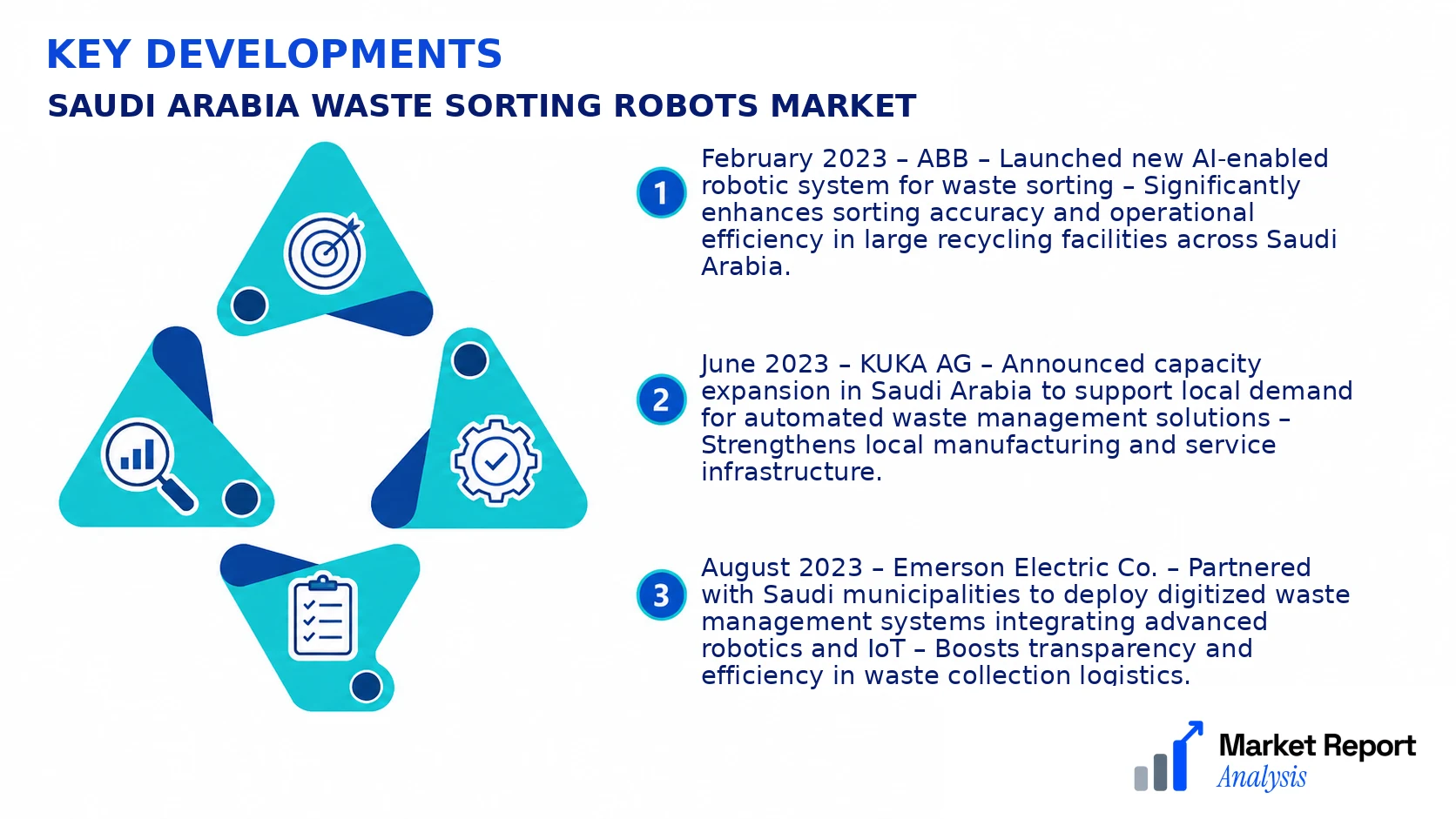
- February 2023 – ABB – Launched new AI-enabled robotic system for waste sorting – Significantly enhances sorting accuracy and operational efficiency in large recycling facilities across Saudi Arabia.
- June 2023 – KUKA AG – Announced capacity expansion in Saudi Arabia to support local demand for automated waste management solutions – Strengthens local manufacturing and service infrastructure.
- August 2023 – Emerson Electric Co. – Partnered with Saudi municipalities to deploy digitized waste management systems integrating advanced robotics and IoT – Boosts transparency and efficiency in waste collection logistics.
- October 2023 – Fanuc Corporation – Introduced new robotic arms with machine learning capabilities tailored for recycling centers – Improves sorting speed and adaptability to waste stream variations.
- December 2023 – YY Robotics – Secured funding for R&D to develop next-generation autonomous waste sorting robots suitable for desert environments – Aims to position Saudi Arabia as a regional leader in sustainable automation.
Frequently Asked Questions
What is the Saudi Arabia Waste Sorting Robots Market?
The Saudi Arabia Waste Sorting Robots Market refers to the industry involved in deploying automated robotic systems for waste segregation, recycling, and disposal processes across the nation, driven by infrastructural upgrades, environmental regulations, and the pursuit of sustainable waste management solutions.
What is the current market size of Saudi Arabia Waste Sorting Robots Market?
As of 2026, the market size of Saudi Arabia Waste Sorting Robots is valued at approximately USD 0.45 Billion, reflecting rapid adoption of robotic waste sorting technologies attributed to government initiatives and increasing waste management demands.
What factors are driving the Saudi Arabia Waste Sorting Robots Market?
Key drivers include government policies on waste recycling, investments in smart city projects, expanding recycling infrastructure, technological advancements in robotics, and growing awareness regarding environmental sustainability, all contributing to rapid market growth.
Which Saudi city leads the Saudi Arabia Waste Sorting Robots Market?
Riyadh emerges as the leading city in the Saudi Arabia Waste Sorting Robots Market, fueled by its extensive municipal waste management programs, urbanization, and government-led initiatives targeting sustainable waste management practices.
Which segment is expected to grow the fastest?
The automation segment, particularly robotic waste sorting systems, is forecasted to witness the fastest growth, driven by technological innovations and increased funding toward smart waste management solutions across urban centers.
Who are the leading companies operating in the Saudi Arabia Waste Sorting Robots Market?
Major players include international robotics firms and local providers that focus on intelligent waste sorting systems, driven by collaborations with government agencies, technological expertise, and ongoing infrastructure projects aimed at enhancing waste management efficiency.
Analyst Perspective
The Saudi Arabia Waste Sorting Robots Market exhibits a mature landscape, yet ongoing urbanization and environmental regulation enhancements present sustained growth opportunities. Long-term, the market is expected to benefit from technological innovations, with automation and AI integration driving higher sorting efficiencies and cost reductions, fostering increased adoption across municipal and private waste management sectors. The competitive environment is intensifying as global and regional players expand their presence, emphasizing differentiated technology solutions tailored to Saudi’s unique waste composition. Major cities such as Riyadh, Jeddah, and Dammam are poised to be focal points for early deployment due to their advanced infrastructure development and higher waste generation rates. Investment priorities should focus on scalable, technologically adaptable systems that align with Saudi Vision 2030’s sustainability goals. Given the evolving regulatory landscape and urban growth, strategic positioning in city-specific markets offers significant long-term gains. Companies that innovate swiftly and align with government priorities are likely to capture substantial market share, ensuring resilience amid market maturity.
