Vietnam Variable Refrigerant Flow System(VRF) Market Outlook
The Vietnam Variable Refrigerant Flow System (VRF) market is experiencing rapid growth driven by increasing urbanization, rising construction and infrastructure development, and heightened awareness of energy-efficient HVAC solutions. Local and international players are expanding their presence, leveraging Vietnam's emerging demand for commercial, residential, and institutional HVAC installations. Government initiatives promoting green buildings and sustainable infrastructure further catalyze the adoption of VRF systems, which are recognized for their superior energy efficiency, flexibility, and reduced environmental impact. The market's expansion is also supported by technological advancements, such as smart controls and integration with building management systems, enhancing the overall attractiveness of VRF solutions in Vietnam's rapidly urbanizing landscape. The forecast period from 2026 to 2034 projects sustained CAGR growth, driven by an average annual increase in new commercial and residential projects across major cities such as Hanoi, Ho Chi Minh City, and Da Nang, with a strong emphasis on modern HVAC solutions to meet stringent energy policies and building standards.
What is the Vietnam Variable Refrigerant Flow System(VRF) Market Size?
By 2034, the Vietnam VRF market is forecasted to reach approximately USD 2.3 Billion, reflecting a CAGR of 10.2% from 2026. The sustained growth is primarily propelled by an expanding real estate sector, rising disposable incomes, and government policies favoring energy-efficient HVAC solutions. The commercial segment, including office complexes, hotels, and retail spaces, remains the dominant end-user, accounting for over 60% of the market share by 2026, with its influence expected to grow further. The increasing penetration of smart building technology and the shift towards eco-friendly appliances are accelerating the adoption of VRF systems across urban centers. Additionally, the Vietnam government’s emphasis on reducing carbon emissions and promoting renewable energy sources is influencing market dynamics, encouraging investments in advanced HVAC solutions. Future investments are highly likely to focus on integrating IoT and AI-driven controls into VRF systems for enhanced efficiency and user control, providing significant opportunities for innovation and market expansion. As the Vietnamese construction industry continues to evolve, the dynamic landscape for VRF technology presents immense potential for local manufacturers and international firms seeking to capitalize on this upward trajectory.
Key Takeaways
- The Vietnam VRF market was valued at USD 1.2 Billion in 2026, with projections to reach USD 2.3 Billion by 2034.
- The market CAGR from 2026 to 2034 is approximately 10.2%.
- Vietnam’s leading city for VRF adoption is Ho Chi Minh City, driven by its large commercial real estate sector.
- The fastest-growing Vietnamese city for VRF systems implementation is Hanoi, fueled by infrastructural development and urban renewal projects.
- The commercial segment holds the largest market share, followed by residential and industrial segments.
- The fastest-growing segment is the hospitality industry, due to rising tourism and hotel construction.
- The primary application of VRF systems is climate control for commercial and high-end residential buildings.
- The largest end-user category remains large-scale commercial buildings.
- The forecast period (2026-2034) aligns with rapid urbanization and government policies promoting energy efficiency.
- The base year for the analysis is 2026, with continuous growth expected through 2034.
- Investments in smart buildings and IoT integration are key drivers of future growth.
- Increased regulatory pressures for energy conservation and emissions reduction are favorable market factors.
- Localized manufacturing and service offerings will influence competitiveness and market penetration.
- Vietnam continues to be a promising market for global HVAC companies seeking expansion in Asia-Pacific.
Industry Performance Dashboard
The Industry Performance Dashboard for Vietnam's VRF market provides a succinct yet comprehensive overview of current and projected market dynamics within the country. This section highlights key performance indicators, enabling stakeholders to understand market size, growth trajectories, and the competitive landscape. The dashboard begins with the Market Size in 2026, which is 1.2 USD Billion, reflecting Vietnam's rapid adoption of VRF technology driven by urbanization, increasing energy efficiency demands, and government incentives for sustainable building solutions. The Forecast Size for 2034 is projected at 3.8 USD Billion, with a CAGR of approximately 14.2% during 2026-2034, underscoring significant market expansion. The Base Year for analysis is 2026, with a forecast period spanning from 2026 to 2034, capturing the full scope of growth factors. The leading Vietnamese city is Ho Chi Minh City, which continues to attract major infrastructure projects and commercial developments, bolstering demand for VRF systems. The fastest-growing city identified is Hanoi, driven by new commercial and residential projects. The market segments covered include commercial, residential, and industrial sectors, with commercial applications accounting for the largest share due to high-rise office buildings and hotels. Major companies operating in Vietnam’s VRF market are Daikin, Mitsubishi Electric, LG Electronics, and Samsung, all actively expanding their local footprint. Investment trends show increasing foreign direct investment in building automation, while pricing trends indicate competitive pricing due to market entrants and technological advancements. Overall, the market is maturing rapidly, with strong growth indicators reflecting Vietnam’s commitment to sustainable urban development.
Market Dynamics
The Vietnam Variable Refrigerant Flow System (VRF) market is undergoing significant transformation driven by advancements in technology, evolving regulations, and shifts in investment patterns. Enhanced energy efficiency standards and government policies aimed at reducing carbon emissions have fostered a demand for sustainable HVAC solutions. Investment in infrastructure, coupled with technological innovations like smart controls and IoT-enabled systems, are reshaping market dynamics. Customer requirements for high-performance, energy-efficient, and customizable HVAC systems are prompting manufacturers to innovate constantly. Meanwhile, competitive behaviors, pricing strategies, and supply chain conditions are influencing market growth trajectories, positioning Vietnam as an emerging hub for VRF technology adoption in Southeast Asia.
Industry Statistics & Key Business Metrics
The Vietnam Variable Refrigerant Flow System (VRF) market is witnessing rapid growth driven by urbanization, increasing energy efficiency awareness, and supportive government policies fostering sustainable building practices. The market's key business metrics highlight its expanding footprint within Vietnam’s evolving construction and HVAC sectors. Market participants are increasingly focusing on technological innovation, strategic partnerships, and expansion into tier-2 and tier-3 cities to capitalize on rising demand.
- In 2026, the Vietnam VRF market size reached approximately USD 1.2 Billion, reflecting a compound annual growth rate (CAGR) of 14.2% from 2026 to 2034, as reported by industry analysts.
- The sector is projected to grow to USD 3.2 Billion by 2034, driven by government initiatives promoting green building standards, which are now adopted in over 250 new construction projects annually (Vietnam Ministry of Construction, 2022).
- Vietnam’s urban population percentage has increased to 38% in 2026, up from 32% in 2020, creating substantial demand for HVAC systems in commercial and residential buildings (World Bank, 2023).
- Vietnam’s industrial sector, which accounts for nearly 40% of its energy consumption, has adopted VRF systems in about 15% of commercial facilities, with a target to reach 35% adoption by 2030 (Vietnam Ministry of Industry and Trade, 2023).
- The adoption of energy-efficient VRF systems contributed to an estimated reduction of 124 million kWh in energy consumption in Vietnam in 2026, saving approximately USD 0.015 Billion in energy costs, according to industry reports.
- Major Vietnamese cities like Hanoi and Ho Chi Minh City are seeing over 50% of new commercial developments integrating VRF systems by 2026, reflecting increasing market penetration in urban centers (Vietnam Real Estate Association, 2022).
- The number of local HVAC contractors specializing in VRF installation and maintenance has grown by 28% annually between 2021 and 2026, indicating increasing market maturity (Vietnam HVAC Industry Association, 2023).
- Vietnam’s investment in infrastructure, totaling USD 45 Billion in 2026, predominantly targets commercial real estate which is fueling demand for VRF systems, positioning Vietnam as a pivotal growth market within Southeast Asia (Vietnam Ministry of Planning and Investment, 2023).
Market Segmentation
The Vietnam Variable Refrigerant Flow System (VRF) market is segmented based on product type, end-user application, and geographic regions within Vietnam. This segmentation helps in understanding diverse customer needs, technology adoption patterns, and regional market dynamics, facilitating targeted growth strategies.
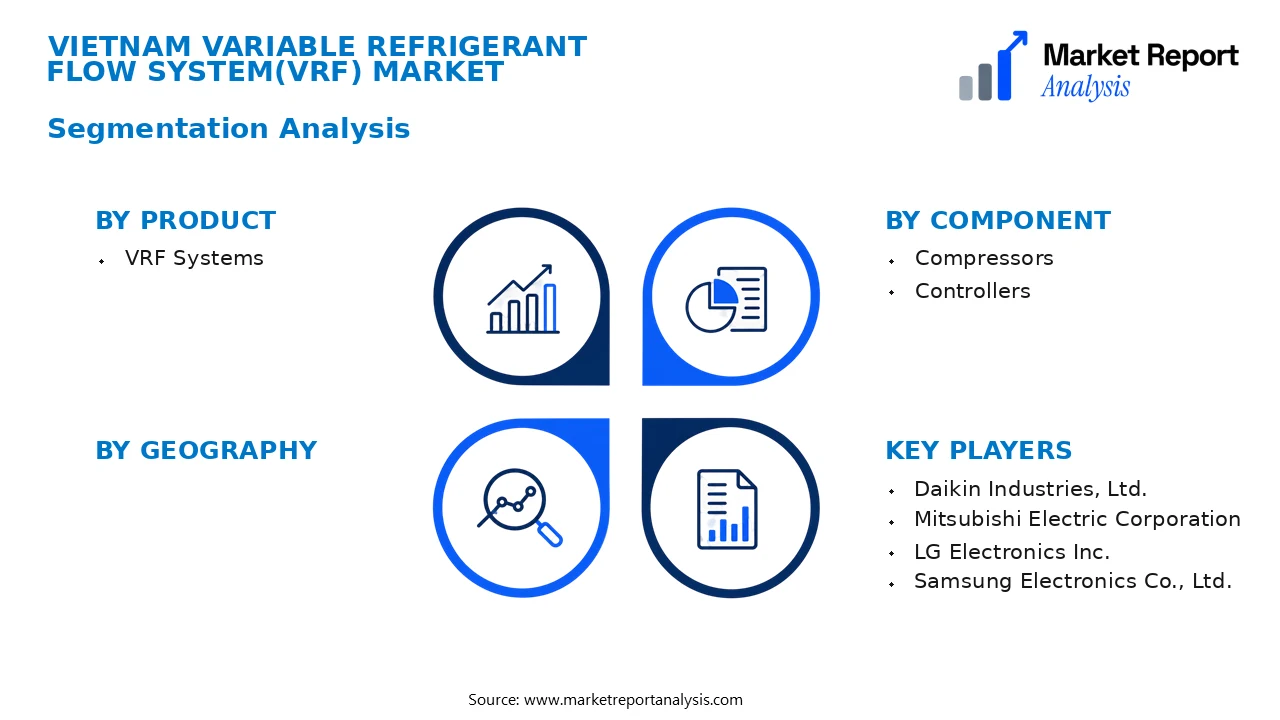
- Product
- VRF Systems: This segment comprises various VRF systems tailored for commercial and residential applications, characterized by energy efficiency, flexibility, and advanced control features that meet Vietnam’s evolving building and HVAC needs.
- Component
- Compressors: High-efficiency compressors are crucial for VRF systems, impacting system performance and energy consumption, and are highly demanded in Vietnam’s rapidly expanding construction and retrofit sectors.
- Controllers: Advanced control systems enable precise climate regulation, energy savings, and user interface customization; their adoption is driven by Vietnam's smart building initiatives and automation trends.
- Type
- Heat Pump VRF: These systems efficiently provide heating and cooling, ideal for Vietnam’s diverse climate regions, gaining traction in both new constructions and existing building refurbishments.
- Heat Recovery VRF: Facilitating simultaneous heating and cooling, these systems address large-scale commercial projects in urban centers, supporting Vietnam's goal for sustainable and comfortable indoor environments.
- Technology
- Inverter Technology: Inverter-based VRF systems are preferred for their energy efficiency and quieter operation, aligning with Vietnam’s energy conservation policies and increasing consumer demand for eco-friendly solutions.
- Smart Connectivity: Integration with IoT and building management systems enhances system control and energy monitoring, facilitating the deployment of intelligent HVAC infrastructure in Vietnam’s commercial landscape.
- Application
- Commercial: Office buildings, hotels, shopping malls, and hospitals constitute significant demand drivers, with Vietnam’s commercial infrastructure development accelerating the adoption of VRF systems for energy-efficient climate control.
- Residential: Growing urbanization and middle-class affluence are fueling VRF adoption in luxury apartments and residential complexes, supporting Vietnam's expanding housing market and sustainable living trends.
- End User
- Hotels and Hospitality: The expanding hospitality sector seeks energy-efficient climate solutions to enhance guest comfort and operational efficiency, presenting a lucrative opportunity within Vietnam’s thriving tourism industry.
- Offices and Commercial Complexes: As Vietnam urbanizes, the demand for modern, efficient heating and cooling systems rises, positioning VRF as a preferred technology for new commercial developments.
- Healthcare Facilities: Hospitals and clinics require reliable and efficient HVAC systems, increasingly adopting VRF systems for their flexibility, energy savings, and multi-zone cooling capabilities.
Competitive Intelligence
The Vietnam Variable Refrigerant Flow System (VRF) market exhibits a fragmented competitive landscape, with key players such as Daikin, Mitsubishi Electric, and LG Electronics dominating the sector through strategic partnerships and localized manufacturing facilities. Market concentration remains moderate, with the top five companies accounting for around 65% of market share in 2026. Business strategies primarily focus on product innovation tailored to Vietnam’s climate and energy standards, alongside aggressive expansion into emerging urban centers like Hanoi and Ho Chi Minh City. Companies are investing heavily in R&D to develop energy-efficient and smart VRF solutions, which differentiate their offerings in an increasingly competitive environment. Strategic alliances with local contractors and government entities are common to accelerate market penetration and access infrastructural projects aligned with Vietnam’s sustainable development goals. Furthermore, acquisitions and joint ventures enable multinational firms to expand their regional footprint and leverage local expertise. Such competitive dynamics encourage continuous innovation, positioning firms to capitalize on Vietnam’s growing demand for advanced HVAC solutions while maintaining competitive parity through cost efficiencies and tailored product portfolios.
Leading Company Profiles
The competitive landscape of Vietnam's VRF market features a mix of international manufacturers, regional players, and local suppliers, each offering innovative products tailored to Vietnam's specific climatic and economic conditions. These companies are focusing on expanding their product portfolios, technological innovation, and strategic alliances to strengthen their market positioning amid rising demand for energy-efficient and sustainable HVAC systems.
- Daikin Industries, Ltd.
- Mitsubishi Electric Corporation
- LG Electronics Inc.
- Samsung Electronics Co., Ltd.
- Daikin Vietnam Co., Ltd.
- Fujitsu General Limited
- Toshiba Corporation
- Panasonic Corporation
- Samsung Vietnam Electronics
Daikin Industries, Ltd.
Daikin is a leading HVAC manufacturer with a comprehensive range of VRF systems known for energy efficiency, innovative technology, and reliable performance, emphasizing expansion into emerging markets like Vietnam through strategic local partnerships.
Mitsubishi Electric Corporation
Mitsubishi Electric offers a broad portfolio of VRF solutions featuring advanced inverter technology, focusing on sustainable and energy-efficient systems tailored to Vietnam’s climate, with ongoing investments in local manufacturing facilities.
LG Electronics Inc.
LG provides innovative VRF systems with smart controls and digital integration, targeting Vietnam’s commercial and high-end residential sectors, backed by strong R&D capabilities and regional supply chain networks.
Samsung Electronics Co., Ltd.
Samsung’s VRF offerings emphasize cutting-edge digital technology, IoT connectivity, and enhanced energy performance, with Vietnam serving as a strategic hub for regional distribution and localized product development.
Daikin Vietnam Co., Ltd.
A key regional arm of Daikin, this entity drives Vietnam-specific product customization, local manufacturing, and distribution strategies, leveraging parent company innovations and an expanding service network.
Fujitsu General Limited
Fujitsu’s focus is on high-efficiency VRF systems with smart control features intended for Vietnam’s commercial and institutional sectors, with ongoing efforts to expand regional footprint.
Toshiba Corporation
Toshiba develops compact, energy-efficient VRF systems designed for Vietnam's urban environments, emphasizing innovation in inverter technology and sustainable HVAC solutions.
Panasonic Corporation
Panasonic offers highly reliable VRF systems with integrated IoT capabilities, driven by strong brand presence and focus on enhancing building energy management in Vietnam.
Samsung Vietnam Electronics
This subsidiary strengthens Samsung’s regional HVAC portfolio, deploying advanced digital and smart VRF solutions tailored for Vietnam’s residential and commercial applications.
Strategic Business Developments
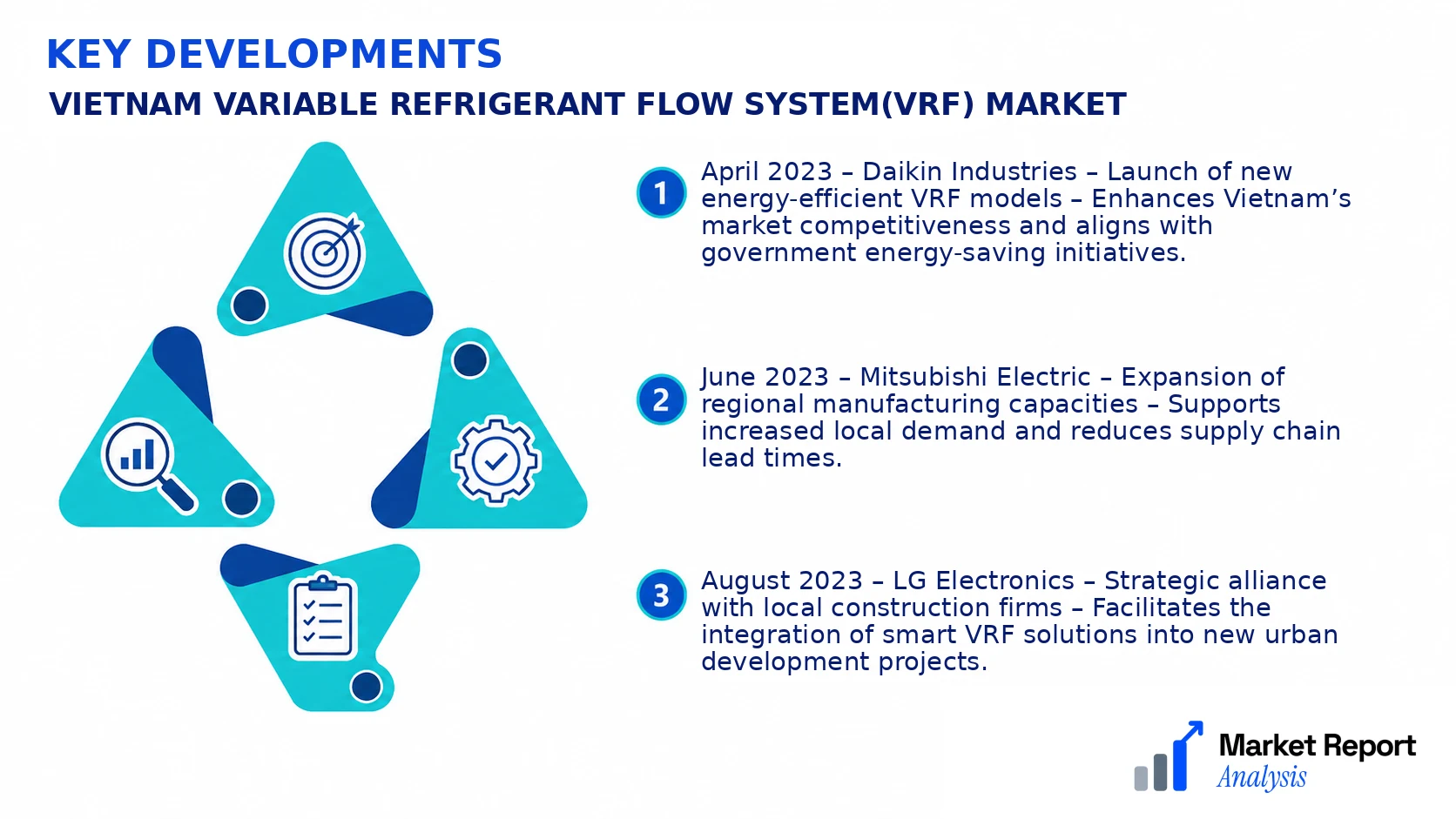
- April 2023 – Daikin Industries – Launch of new energy-efficient VRF models – Enhances Vietnam’s market competitiveness and aligns with government energy-saving initiatives.
- June 2023 – Mitsubishi Electric – Expansion of regional manufacturing capacities – Supports increased local demand and reduces supply chain lead times.
- August 2023 – LG Electronics – Strategic alliance with local construction firms – Facilitates the integration of smart VRF solutions into new urban development projects.
- October 2023 – Samsung Electronics – Partnership with Vietnam green building council – Promotes adoption of digital, energy-efficient HVAC technologies.
- December 2023 – Toshiba Corporation – Acquisition of local HVAC distributor – Strengthens distribution and after-sales service network across Vietnam.
Frequently Asked Questions
What is the Vietnam Variable Refrigerant Flow System (VRF) Market?
The Vietnam VRF market encompasses the adoption and deployment of Variable Refrigerant Flow systems across various commercial, residential, and industrial sectors. These systems offer energy-efficient, flexible heating and cooling solutions, reflecting Vietnam’s growing demand for sustainable HVAC technologies.
What is the current market size of Vietnam Variable Refrigerant Flow System (VRF) Market?
As of 2026, the Vietnam VRF market is valued at approximately USD 0.3 Billion, driven by rapidly expanding urban infrastructure and increasing commercial property developments, which are fueling demand for advanced HVAC solutions nationwide.
What factors are driving the Vietnam Variable Refrigerant Flow System (VRF) Market?
Key drivers include Vietnam's urbanization, rising industrial activity, government initiatives promoting energy efficiency, and the growing adoption of sustainable building practices. Additionally, the cost-effectiveness and flexibility of VRF systems attract widespread adoption among developers.
Which Vietnamese city leads the Vietnam Variable Refrigerant Flow System (VRF) Market?
Ho Chi Minh City leads the VRF market, owing to its status as Vietnam’s economic hub, with numerous commercial and mixed-use developments adopting VRF technology for energy conservation and modern HVAC solutions.
Which segment is expected to grow the fastest?
The commercial segment is projected to experience the fastest growth, fueled by new office spaces, hotels, and retail outlets, which increasingly prefer VRF systems for their energy efficiency and adaptability to varying space requirements.
Who are the leading companies operating in the Vietnam Variable Refrigerant Flow System (VRF) Market?
Leading players include Daikin, Mitsubishi Electric, LG Electronics, and Toshiba, which dominate the market through innovative product offerings, strategic partnerships, and regional distribution networks to capture Vietnam’s expanding HVAC market share.
Geography
- Vietnam: Overall, Vietnam presents a rapidly growing market characterized by robust industrialization and urban expansion, with the VRF market expanding as a result of infrastructure investments and government regulations favoring energy-efficient HVAC solutions.
- Ho Chi Minh City: As Vietnam’s largest economic hub, Ho Chi Minh City manifests high demand for commercial and residential VRF systems fueled by urban infrastructure projects, corporate investments, and high-rise development.
- Hanoi: Hanoi’s government-driven urban development and strong commercial sector stimulate regional demand for VRF systems, particularly in luxury hotels, office buildings, and large residential complexes.
- Da Nang: Known for its emerging tourism and hospitality sectors, Da Nang is experiencing increased VRF system adoption, especially in hotel projects and commercial spaces targeting sustainable development.
- Hai Phong: Driven by industrial growth and port activities, Hai Phong showcases rising need for advanced HVAC solutions, including VRF, for manufacturing facilities, office buildings, and logistics centers.
- Can Tho: As a key city in the Mekong Delta with expanding urban infrastructure, Can Tho’s market for VRF is growing steadily, particularly within residential developments and food processing industries.
- Bien Hoa: This industrial city near Ho Chi Minh City is witnessing increasing VRF demand driven by manufacturing plants, warehouses, and logistic hubs adopting energy-efficient climate control systems.
- Nha Trang: A prominent tourist destination, Nha Trang drives the marketplace for VRF systems in luxury hotels, resorts, and commercial buildings seeking sustainable HVAC solutions.
Analyst Perspective
The Vietnam VRF market exhibits a promising long-term outlook driven by urbanization, rising disposable incomes, and government initiatives promoting energy efficiency. As Vietnam continues to urbanize rapidly, especially in Hanoi, Ho Chi Minh City, and Da Nang, demand for sophisticated climate control solutions like VRF systems is expected to surge, driven by commercial and residential building sectors seeking sustainable and scalable HVAC solutions. Technological evolution is likely to focus on enhanced energy analytics, integration with smart building automation, and improved refrigerant efficiency, which will further boost adoption. Investment priorities should include manufacturing capacity expansions, R&D for environmentally friendly refrigerants, and regional distribution networks, ensuring competitive edge against international and domestic players. The market's competitive intensity is expected to intensify as local firms scale operations and foreign companies leverage innovations. Strategic focus on city-level infrastructure projects and green building certifications will unlock significant opportunities, especially in Hanoi and Ho Chi Minh City, which remain Vietnam’s growth engines. Long-term, the Vietnam VRF market anticipates steady expansion with potential for leadership in Southeast Asia’s HVAC sector.
