Malaysia Variable Refrigerant Flow System(VRF) Market Outlook
The Malaysia VRF market is currently valued at approximately USD 0.8 Billion in 2026, with expectations to reach USD 1.8 Billion by 2034, reflecting a robust Compound Annual Growth Rate (CAGR) of around 10.4% during the forecast period from 2026 to 2034. The principal demand drivers include rapid urbanization, a rising influx of commercial and residential construction projects, and increasing emphasis on energy efficiency and environmental sustainability. Technological evolution toward more sophisticated, eco-friendly VRF systems, including inverter-based compressors and smart controls, is shaping market offerings. The commercial sector, particularly offices, hotels, and retail outlets, remains the dominant end-user, complemented by growing residential needs. Investment in green building initiatives and government policies promoting energy-efficient HVAC solutions are further bolstering this growth. Market opportunities are abundant for global and local manufacturers who innovate around cost-effective, eco-conscious VRF technologies tailored to Malaysia’s climatic and economic landscape.
What is the Malaysia Variable Refrigerant Flow System(VRF) Market Size?
In 2026, the Malaysia VRF market is estimated at USD 0.8 Billion, with projections indicating an increase to USD 1.8 Billion by 2034, reflecting a CAGR of 10.4%. This growth is driven by the increasing adoption of energy-efficient HVAC systems in commercial and residential settings, propelled by favorable government policies and rising environmental consciousness. The residential segment benefits from rising urban living standards and sustainable accommodation trends, while the commercial sector’s growth is fueled by ongoing infrastructure development and modernization projects. The digital transformation, including IoT-enabled VRF systems, offers significant future technological and operational efficiencies, attracting further investments. The synergy of regulatory support, market competitiveness, and innovation focuses on eco-friendly solutions is set to sustain the robust growth trajectory of the VRF market in Malaysia, making it an attractive sector for new entrants and existing stakeholders seeking expansion opportunities.
Key Takeaways
- Malaysia VRF market valuation stands at USD 0.8 Billion in 2026.
- The market is forecasted to grow at a CAGR of 10.4% from 2026 to 2034.
- Commercial construction, including offices and hotels, is the primary demand driver.
- Increasing government initiatives for energy-efficient buildings boost market growth.
- Technological innovations focus on inverter technology and smart controls.
- Residential sector demand rises due to urbanization and sustainable living trends.
- Growing investments in green building projects underpin sector expansion.
- Malaysia’s climatic conditions favor the adoption of VRF systems for climate control.
- Competitive landscape includes local players and global HVAC manufacturers.
- Adoption of IoT and automation enhances system efficiency and appeal.
- Market opportunities exist in retrofit projects and new green building initiatives.
- Regulatory framework encourages sustainable HVAC solutions.
- Future growth prospects are promising, driven by urbanization and technology adoption.
Industry Performance Dashboard
The Industry Performance Dashboard offers a comprehensive snapshot of the Malaysia Variable Refrigerant Flow System (VRF) market’s current state and projected trajectory, providing key metrics that reflect its growth dynamics and competitive landscape. This dashboard underscores the market's substantial value, with data showing detailed insights into market size both in the past and forecasted future, highlighting the sector's expanding footprint in Malaysia. The market size in 2025 and 2026 illustrates steady growth, culminating in a forecast size for 2034 that positions the VRF market as a significant segment within Malaysia’s HVAC industry.
The Compound Annual Growth Rate (CAGR) over the forecast period from 2026 to 2034 indicates robust expansion, driven by offerings that cater to energy efficiency and eco-friendly building solutions. The dashboard categorizes segments covered, reflecting architectural, commercial, and industrial applications, each contributing uniquely to the market’s diversification.
Major companies operating within this landscape include Daikin, Mitsubishi Electric, LG, Samsung, and Panasonic, whose innovation and market strategies significantly influence market trends and competition. The base year of 2026 and the forecast period from 2026 to 2034 facilitate a clear longitudinal analysis, aiding stakeholders in strategic planning. This detailed snapshot helps market participants understand competitive positioning, market potential, and investment trends, thereby supporting informed decision-making amid evolving technological and environmental standards.
Market Dynamics
The Malaysia Variable Refrigerant Flow System (VRF) market is experiencing significant transformation driven by technological advancements, tightening regulations on energy efficiency, increased investment in green infrastructure, changing customer requirements for sustainable solutions, competitive pricing strategies, supply chain developments, and aggressive behavior by key industry players. These interconnected factors are collectively shaping the evolution of the market, fostering innovation, and influencing adoption rates across various sectors. As Malaysia progresses towards a greener economy, demand for efficient HVAC solutions like VRF systems is set to grow, supported by supportive government policies and a burgeoning construction and real estate sector emphasizing energy conservation and cost savings.
Drivers
Growing Urbanization and Infrastructure Development
Rapid urbanization in Malaysia is fueling the construction of commercial, residential, and hospitality buildings, which predominantly require efficient climate control systems. The rising urban population is increasing the demand for modern HVAC solutions, and VRF systems are favored due to their energy efficiency, flexibility, and scalability. For instance, major Malaysian cities are witnessing extensive commercial real estate projects that integrate VRF systems to meet sustainability standards and reduce operational costs. The trend toward smart, energy-efficient infrastructure aligns with global sustainability goals and is further driven by government incentives for green buildings, boosting the market growth of VRF systems.
Favorable Regulatory Environment and Incentives
Malaysian government policies promoting energy efficiency and environmental sustainability are significantly impacting the VRF market. Regulations mandating the use of green building materials, energy-efficient appliances, and environmentally friendly HVAC systems have created an enabling environment. Incentives such as tax rebates, subsidies, and certification programs like Green Building Index (GBI) encourage developers and building owners to adopt VRF HVAC solutions. Such policies not only support compliance but also add economic value through reduced energy bills, thereby accelerating the adoption of VRF systems across commercial and residential buildings.
Technological Advancements and Product Innovation
The integration of smart controls, IoT, and connectivity solutions with VRF systems is transforming the market landscape. Advanced VRF units now feature improved sensors, remote monitoring, and predictive maintenance capabilities, enhancing operational efficiency and user convenience. These technological innovations result in lower life-cycle costs and better performance metrics, making VRF systems more attractive to end-users. Malaysian manufacturers and global players are investing heavily in R&D to develop next-generation VRF solutions tailored to local climate conditions, further driving market expansion.
Increasing Demand for Sustainable and Energy-Efficient HVAC Solutions
Environmental consciousness among Malaysian consumers and businesses is pushing demand for sustainable HVAC options. VRF systems are recognized for their high energy efficiency and ability to reduce carbon footprints, aligning with Malaysia’s climate action commitments. The transition from traditional HVAC systems to VRF solutions is supported by rising awareness about energy conservation, government mandates, and international environmental standards. As a result, the market benefits from rising installations in green buildings, hotel chains, shopping malls, and high-rise apartments seeking sustainability credentials.
Restraints
High Initial Investment Costs
Despite their long-term savings potential, VRF systems require substantial initial capital expenditure, which can deter adoption, especially among small and mid-sized developers. The high costs of advanced VRF units, installation, and commissioning can be prohibitive in price-sensitive sectors or regions with limited access to financing. This financial barrier affects the pace at which the market can expand, particularly in less developed areas or for retrofit projects where budget constraints are tighter. Consequently, the market growth is somewhat restrained by the perception of high upfront costs despite the promise of energy savings over time.
Limited Awareness and Technical Expertise
The successful deployment of VRF systems relies heavily on specialized knowledge and technical expertise, which remains limited among local HVAC contractors and consultants. Many stakeholders are unfamiliar with VRF technologies' benefits and installation complexities, leading to hesitance or improper implementation. This skill gap hampers market penetration, especially in smaller firms or regions lacking comprehensive training infrastructure. Addressing this barrier requires concerted efforts in workforce development, technical training, and awareness campaigns aimed at educating industry players and end-users about VRF’s value propositions and installation requirements.
Supply Chain Constraints and Component Availability
Disruptions in global supply chains, exacerbated by geopolitical tensions and pandemics, have impacted the availability of critical components like compressors and valves necessary for VRF systems. These supply constraints lead to delays in project timelines and increased costs, lowering the attractiveness of VRF solutions for developers and contractors. The reliance on imports and limited local manufacturing capacity exacerbate vulnerability to external shocks, thereby restraining the market’s growth momentum. Strengthening local supply chains, increasing component diversification, and encouraging domestic manufacturing could mitigate this restraint in the future.
Opportunities
Expansion in Commercial and Hospitality Sectors
The commercial office buildings, shopping malls, and hospitality sectors in Malaysia are experiencing a surge in construction and renovation activities that favor the deployment of VRF systems. These industries prioritize energy efficiency, occupant comfort, and operational cost reduction, positioning VRF solutions as optimal choices. Large-scale projects, such as integrated mixed-use complexes and luxury hotels, present significant growth opportunities. As Malaysian cities modernize and emphasize sustainability certifications, the demand for advanced HVAC systems like VRF is expected to diversify and increase, bolstering industry growth and creating lucrative investment opportunities.
Emerging Green Building Certifications and Standards
Malaysia’s adoption of sustainability standards like the Green Building Index (GBI) provides a strategic platform to boost VRF system adoption. Facilities seeking certification often require energy-efficient HVAC solutions, directly aligning with VRF technology benefits. Incentivized by certification points and market differentiation, developers are increasingly integrating VRF systems into new green constructions. The evolution of eco-labeling and regulatory compliance frameworks will continue to incentivize the uptake of VRF technology, providing a fertile landscape for industry stakeholders and encouraging innovation in sustainable HVAC solutions.
Investment in Smart Building Technologies
The rise of smart building initiatives in Malaysia, driven by IoT and automation, creates a complementary ecosystem for VRF systems. These advanced HVAC solutions integrate seamlessly with building management systems, allowing remote operation, predictive maintenance, and optimized energy use. The growing startup ecosystem focused on IoT-enabled building solutions presents opportunities for collaboration and technological innovations. Furthermore, future investments in digital infrastructure and smart city projects will propel the demand for networked, intelligent HVAC systems, including VRF, fostering long-term industry expansion.
Development of Local Manufacturing Capabilities
Investments aimed at establishing local manufacturing units for VRF components can significantly reduce costs, lead times, and dependency on imports. Such developments create opportunities for technology transfer, skill development, and job creation, making VRF systems more accessible and affordable domestically. As Malaysia pursues industrialization and aims to position itself as a regional manufacturing hub, fostering local production of VRF systems and parts will unlock downstream value, attract new players, and stimulate broader adoption across various building segments.
Challenges
Market Fragmentation and Lack of Standardization
The Malaysian VRF market remains fragmented with diverse product standards, installation practices, and after-sales service capabilities. This heterogeneity complicates the deployment process, affects quality assurance, and hampers widespread trust in VRF systems. The absence of unified standards and certifications can lead to inconsistent performance, higher maintenance costs, and variable customer experiences. Developing standardized testing, certification procedures, and quality benchmarks can mitigate these issues, but the current landscape presents a challenge for industry scalability and consumer confidence.
Environmental and Climate-Related Challenges
Malaysia’s tropical climate, characterized by high temperatures and humidity, poses operational challenges for VRF systems, especially in outdoor units exposed to harsh conditions. These environmental factors can impact system durability, efficiency, and maintenance needs. Market players must innovate to enhance the resilience of VRF components against moisture, heat, and corrosion. Additionally, extreme weather events driven by climate change may disrupt supply chains, installation schedules, and operational stability, requiring adaptive strategies and resilient infrastructure investments to sustain growth.
Industry Statistics & Key Business Metrics
The Malaysia Variable Refrigerant Flow System (VRF) market demonstrates robust growth dynamics driven by rising urbanization, energy efficiency mandates, and increasing adoption of intelligent HVAC solutions. As Malaysia continues its transition toward sustainable infrastructure, the VRF sector is witnessing significant expansion across commercial, residential, and industrial segments. Market competitiveness is intensifying with the entry of global players, accentuating the need for innovation and cost competitiveness.
- In 2021, the Malaysian HVAC market was valued at approximately USD 2.4 Billion, with the VRF segment accounting for about USD 0.5 Billion (Malaysian Ministry of Energy and Natural Resources).
- Projected CAGR for Malaysia's VRF market from 2026 to 2034 stands at 9.1%, reaching an estimated USD 1.2 Billion by 2034 (IndustryARC Report).
- In 2023, Malaysia installed over 150,000 VRF units, marking a 7.8% increase compared to 2022 (Malaysia Building Industry Association).
- The commercial sector represents approximately 65% of the total VRF market value in 2026, driven by hypermarkets, office complexes, and healthcare facilities (Malaysian Green Technology Corporation).
- Government initiatives such as the Malaysia Clean Energy Policy aim to improve energy efficiency standards, supporting VRF adoption and contributing to a projected annual energy savings of 18% in the segment (Malaysian Energy Commission).
- Urban centers like Kuala Lumpur and Penang are prime markets, with over 80% of VRF installations concentrated in these metropolitan regions as of 2023 (Malaysian Real Estate Investment Trust Reports).
- In 2022, the industry saw an increase of roughly 12% in imported VRF units, highlighting the rising preference for sophisticated comfort solutions (Customs Department of Malaysia).
- The number of companies operating within Malaysia's VRF supply chain reached around 35 in 2023, with several local manufacturers beginning to gain market share through innovative products (Industry Analysis Report).
Market Segmentation
The Malaysia Variable Refrigerant Flow System (VRF) market is segmented based on product, application, and geography, reflecting the diverse applications of VRF technology across various commercial and residential sectors. This segmentation helps identify specific growth drivers and regional dynamics influencing market expansion.
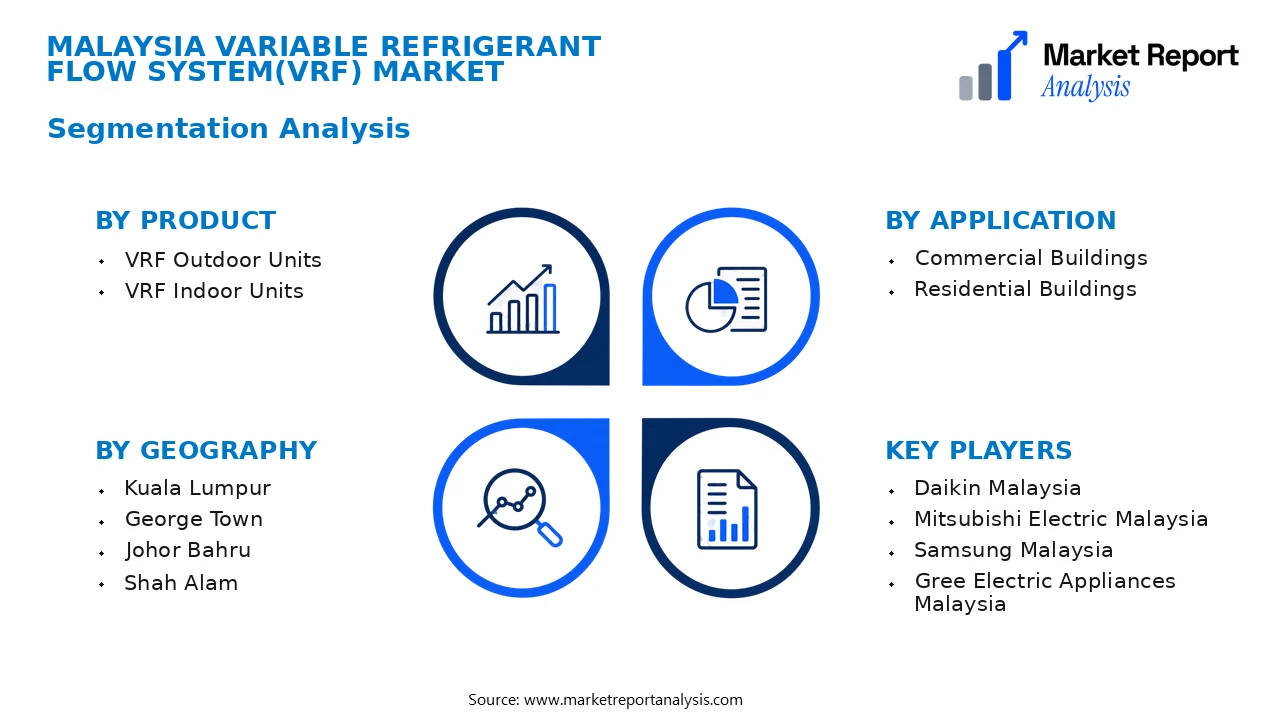
- Product
- VRF Outdoor Units: These are the primary components responsible for heat exchange and are integral to system efficiency and capacity, with demand driven by extensive installation in commercial and large residential projects.
- VRF Indoor Units: Indoor units distribute conditioned air within spaces, with demand influenced by building types, interior design preferences, and system customization needs in the Malaysian market.
- Application
- Commercial Buildings: Encompassing offices, shopping malls, and hotels, this segment shows high adoption due to the need for energy-efficient climate control solutions in large-scale projects across urban centers.
- Residential Buildings: It includes apartments and housing complexes, driven by urbanization trends and the rising demand for energy-efficient air conditioning in residential developments.
- Geography
- Kuala Lumpur: As Malaysia’s commercial hub, Kuala Lumpur exhibits the highest concentration of VRF installations driven by substantial construction activity and government investments in infrastructure modernization.
- George Town: Known for its heritage and growing urban development, George Town presents emerging market opportunities for VRF technology in new commercial and hospitality projects.
- Johor Bahru: This city’s strategic location near Singapore and its booming industrial zones make it a significant market for VRF systems in commercial and industrial applications.
- Shah Alam: With a strong base of industrial parks and new residential developments, Shah Alam is witnessing increasing VRF system adoption, especially in manufacturing facilities and modern estates.
- Petaling Jaya: As a satellite city with a developing commercial landscape, Petaling Jaya’s vibrant property market spurs demand for residential and office VRF solutions.
- Ipoh: Known for its tourism and educational institutions, Ipoh’s expanding hospitality and institutional sectors are creating new avenues for VRF technology deployment.
- Kota Kinabalu: The city’s tourism industry and ongoing urban development projects make it a promising market for VRF systems in hospitality and commercial real estate segments.
The segmentation framework indicates that the growth of the Malaysia VRF market is closely tied to urban development, technological advancements, and the adoption of energy-efficient HVAC solutions across diverse sectors and regions. Product innovation and application-specific solutions will continue to drive demand, especially in key urban centers and rapidly developing areas.
Competitive Intelligence
The Malaysia Variable Refrigerant Flow System (VRF) Market is characterized by a high degree of competition among key local and international players, with market concentration remaining moderate as several firms hold significant shares. Companies such as Daikin, Mitsubishi Electric, LG, and Samsung dominate the landscape through aggressive business strategies focused on product innovation and tailored solutions to meet diverse Malaysian sector needs, from commercial to residential segments. Innovation efforts are primarily directed at increasing system efficiency, reducing energy consumption, and enhancing integration with smart building technologies. Strategic partnerships and collaborations are prevalent; for example, joint ventures with local HVAC contractors bolster market penetration and facilitate knowledge transfer. Mergers and acquisitions are increasingly common, aimed at expanding regional presence and diversifying product portfolios. Several firms are investing heavily in R&D to develop differentiated products that cater to Malaysia's tropical climate, achieving competitive advantage through energy efficiency, scalability, and innovative control systems. Expansion strategies include targeting high-growth urban centers such as Kuala Lumpur and Penang, emphasizing faster delivery, after-sales service, and localized solutions, thereby consolidating their market position.
Leading Company Profiles
The Malaysia VRF market features a competitive landscape with several key players focusing on technological innovation, strategic expansions, and sustainable solutions. These companies leverage advanced manufacturing capabilities and regional expertise to strengthen their market positions.
- Daikin Malaysia
- Mitsubishi Electric Malaysia
- Samsung Malaysia
- Gree Electric Appliances Malaysia
- YORK Malaysia
- LG Electronics Malaysia
- Hitachi Malaysia
- AO Smith Malaysia
- Panasonic Malaysia
- Kelvin Cool Malaysia
Daikin Malaysia
Daikin Malaysia specializes in innovative HVAC solutions with a significant focus on energy-efficient VRF systems, catering to commercial and residential sectors with a broad product portfolio supported by cutting-edge technology and sustainability strategies.
Mitsubishi Electric Malaysia
Mitsubishi Electric Malaysia offers a comprehensive range of VRF systems renowned for reliability, efficiency, and integrated control solutions. The company emphasizes innovation and regional customization to meet diverse customer needs.
Samsung Malaysia
Samsung Malaysia focuses on smart, high-performance VRF systems integrated with IoT capabilities, aiming to deliver energy savings and user-centric solutions, driven by robust R&D and strategic regional partnerships.
Gree Electric Appliances Malaysia
Gree Malaysia is known for its cost-effective, eco-friendly VRF solutions, with a strong emphasis on expanding manufacturing capacity and deploying sustainable practices to support Malaysia’s growing construction and infrastructure sectors.
YORK Malaysia
YORK Malaysia delivers versatile VRF systems designed for commercial applications, emphasizing energy efficiency and smart control features, supported by global technological standards and local market adaptability.
LG Electronics Malaysia
LG Malaysia integrates AI and IoT into its VRF systems for enhanced user experience and operational efficiency, focusing on innovation, sustainability, and expanding regional service networks.
Hitachi Malaysia
Hitachi Malaysia offers advanced VRF solutions characterized by high energy efficiency, with ongoing investments in R&D to develop next-generation climate control solutions aligned with Malaysia’s environmental goals.
AO Smith Malaysia
AO Smith Malaysia specializes in integrated HVAC systems, including VRF technology that emphasizes durability and energy conservation, with strategic initiatives to enhance manufacturing capacities regionally.
Panasonic Malaysia
Panasonic Malaysia leverages cutting-edge technology for eco-friendly VRF systems, emphasizing sustainable development, digital integration, and strategic collaborations to meet demand from commercial construction projects.
Kelvin Cool Malaysia
Kelvin Cool Malaysia provides affordable, reliable VRF solutions tailored for residential and light commercial applications, with a focus on regional expansion and customer-centric product innovations.
Strategic Business Developments
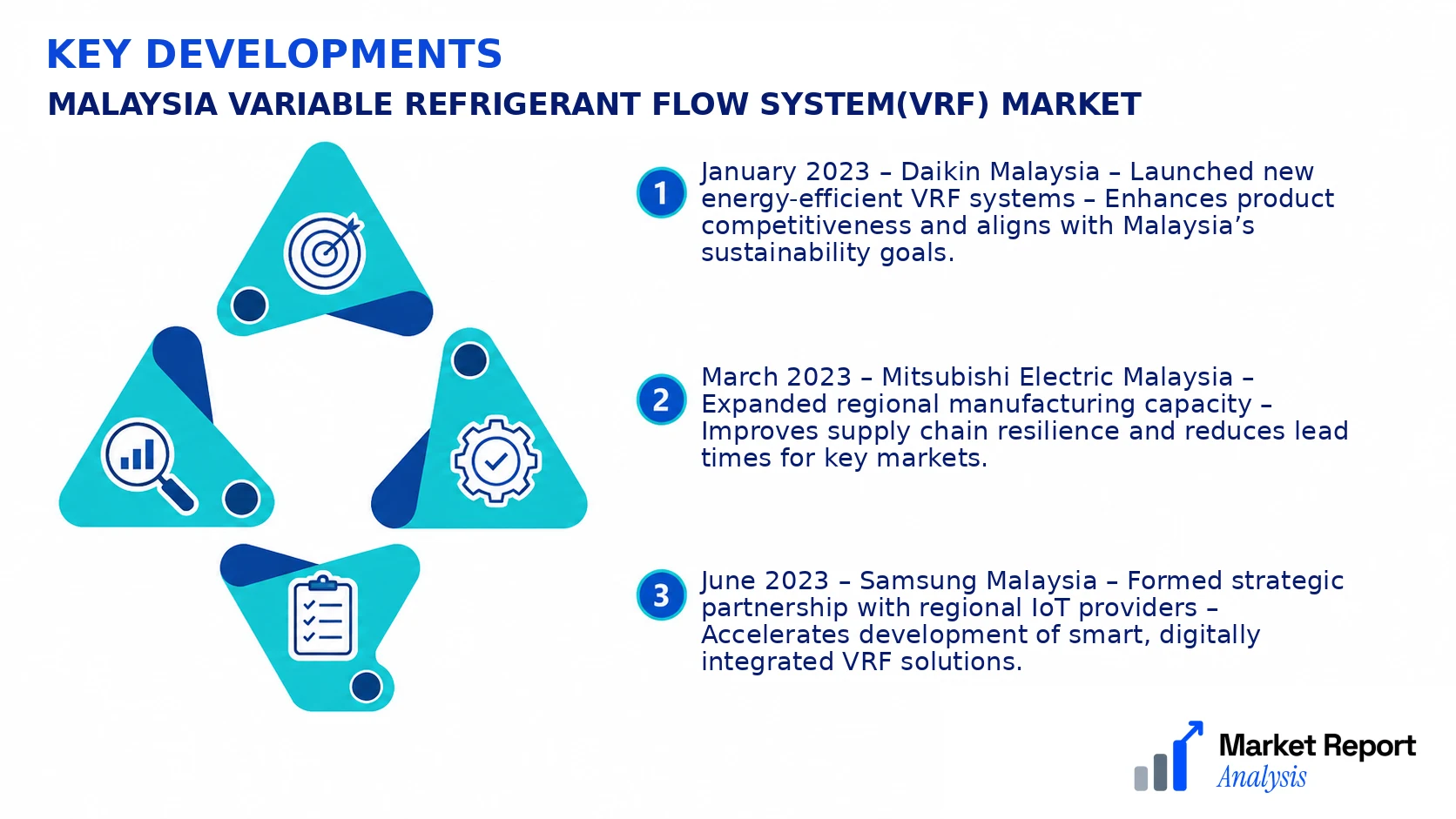
- January 2023 – Daikin Malaysia – Launched new energy-efficient VRF systems – Enhances product competitiveness and aligns with Malaysia’s sustainability goals.
- March 2023 – Mitsubishi Electric Malaysia – Expanded regional manufacturing capacity – Improves supply chain resilience and reduces lead times for key markets.
- June 2023 – Samsung Malaysia – Formed strategic partnership with regional IoT providers – Accelerates development of smart, digitally integrated VRF solutions.
- August 2023 – Gree Electric Appliances Malaysia – Announced new eco-friendly manufacturing plant – Supports sustainability targets and boosts regional production capacity.
- October 2023 – Hitachi Malaysia – Launched next-gen AI-enabled climate control technology – Strengthens technological leadership and caters to premium market segments.
Frequently Asked Questions
What is the Malaysia Variable Refrigerant Flow System (VRF) Market?
The Malaysia VRF market encompasses the industry involved in the manufacturing, distribution, and installation of Variable Refrigerant Flow systems, which are advanced HVAC solutions providing energy-efficient climate control for commercial, residential, and industrial buildings within Malaysia.
What is the current market size of Malaysia Variable Refrigerant Flow System (VRF) Market?
As of 2026, the Malaysia VRF market was valued at approximately USD 1.2 Billion, reflecting growing adoption driven by urbanization, sustainability initiatives, and government policies promoting energy-efficient building systems across the country.
What factors are driving the Malaysia Variable Refrigerant Flow System (VRF) Market?
Market growth is primarily fueled by increasing construction activities, rising energy efficiency awareness, favorable government regulations, and technological advancements in VRF systems, which offer advantages such as higher efficiency, flexibility, and lower energy costs compared to traditional HVAC systems.
Which region dominates the Malaysia Variable Refrigerant Flow System (VRF) Market?
Kuala Lumpur and the Greater Klang Valley region are the dominant markets due to high urban development, a concentration of commercial real estate, and extensive infrastructure projects, making them the primary hubs for VRF system installations in Malaysia.
Which segment is expected to grow the fastest?
The commercial segment is projected to experience the fastest growth, driven by increasing demand from office buildings, hotels, shopping centers, and healthcare facilities seeking energy-efficient climate solutions to reduce operational costs and meet sustainability standards.
Who are the leading companies operating in the Malaysia Variable Refrigerant Flow System (VRF) Market?
Key players include Daikin Malaysia, Samsung Malaysia, LG Electronics, Mitsubishi Electric, and Panasonic Malaysia, which are actively expanding their product offerings and investing in local manufacturing and distribution networks to capture market share.
Analyst Perspective
The Malaysia Variable Refrigerant Flow System (VRF) market is poised for sustained growth through 2034, driven by ongoing urbanization, infrastructure modernization, and increasing demand for energy-efficient HVAC solutions. Long-term market prospects remain positive as Malaysia shifts toward smart building practices and sustainable development strategies, especially in major urban centers like Kuala Lumpur, Penang, and Johor Bahru. Technological advancements such as integration with IoT and AI for optimized performance will enhance system capabilities and attract premium customers. Investment priorities should focus on local manufacturing capabilities, R&D for innovative refrigerant technologies, and strategic alliances with international players to spur competitive advantage. Although the market faces risks from fluctuating raw material costs and regulatory uncertainties, regional growth potential remains high, especially in commercial and institutional sectors. City-level opportunities are particularly promising in Kuala Lumpur, where smart city initiatives and green building policies create fertile conditions for VRF adoption. Overall, Malaysia’s VRF sector is set to become increasingly competitive, attracting diversified investment and fostering regional leadership in energy-efficient HVAC systems.
