Indonesia Variable Refrigerant Flow System(VRF) Market Outlook
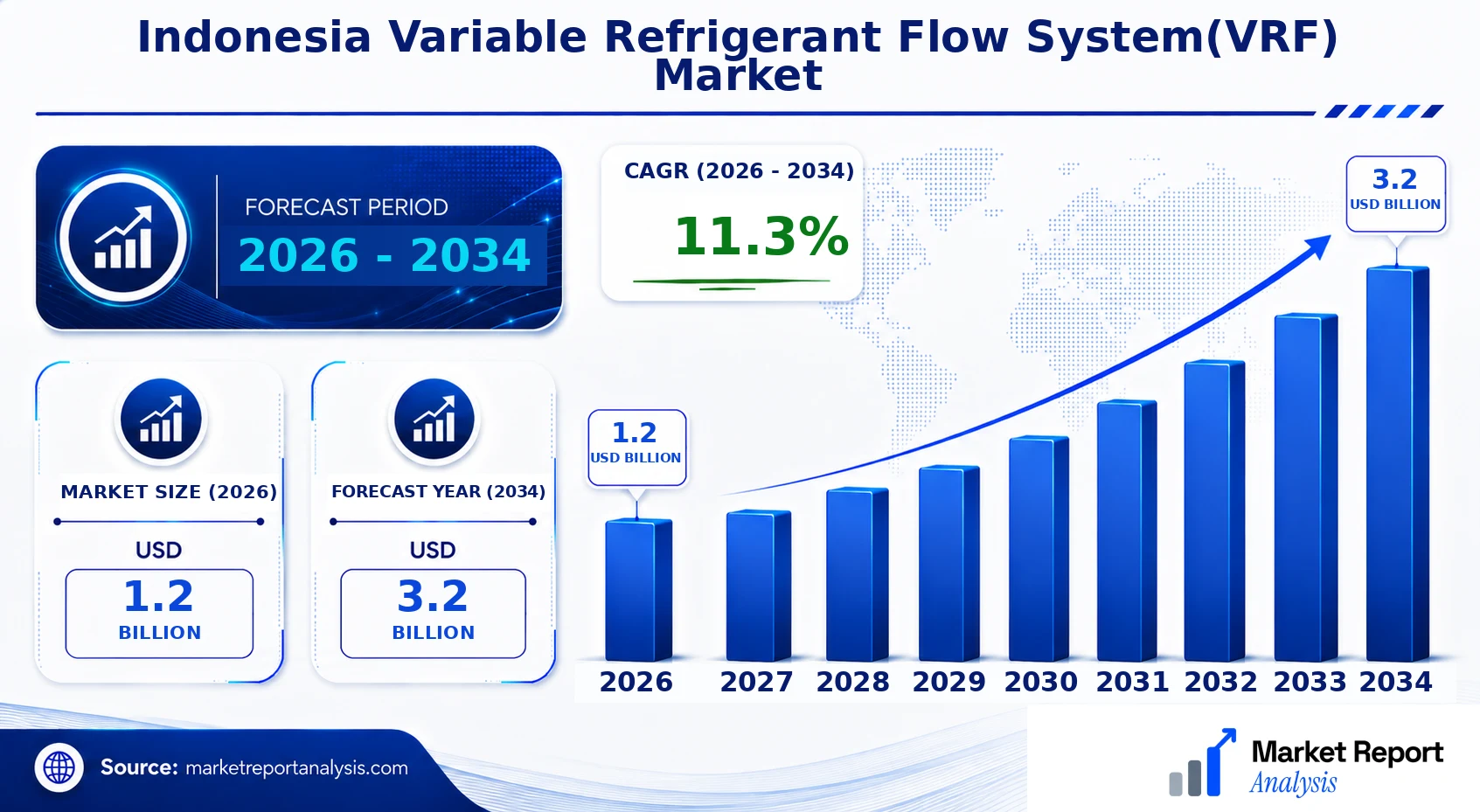
The Indonesia VRF market is currently valued at approximately USD 1.2 Billion in 2026 and is projected to reach USD 3.2 Billion by 2034, with a robust CAGR of around 11.3% over the forecast period. The primary demand drivers include increasing urbanization, new commercial and residential infrastructure, energy efficiency awareness, and technological advancements in VRF systems. The market’s growth is further propelled by government initiatives supporting sustainable building practices, alongside rising investments in smart building automation. Innovation-driven shifts toward environmentally friendly refrigerants and integrations with IoT are shaping strategic opportunities for manufacturers. As a result, Indonesia’s VRF market is anticipated to witness expansion into new sectors like hospitality, data centers, and healthcare, where energy efficiency and compact installation are critical. The push for green construction standards complements the evolving technological landscape, fostering a lucrative environment for market players looking to capitalize on innovative, cost-effective, and environmentally sustainable HVAC solutions.
What is the Indonesia Variable Refrigerant Flow System(VRF) Market Size?
The Indonesia VRF market size is estimated at USD 1.2 Billion in 2026 and is forecast to grow to USD 3.2 Billion by 2034, representing a CAGR of approximately 11.3% during this period. The growth is primarily driven by rapid urban development, increasing industrialization, and rising demand for energy-efficient HVAC systems across commercial, residential, and institutional sectors. Notably, the commercial segment holds the largest share, driven by expanding office complexes, hospitality projects, and shopping centers, which demand scalable and sustainable climate control solutions. Advances in VRF technology, such as variable refrigerant management, zonal heating and cooling, and integration with smart building systems, are boosting market adoption. Furthermore, the government’s focus on sustainable infrastructure and energy efficiency policies encourages industry investments. As climate consciousness and operational cost considerations become more prominent, market stakeholders are expected to increase investments in innovative VRF solutions. Future opportunities lie in expanding product offerings, strengthening distribution channels, and cultivating local manufacturing capabilities to serve the vibrant Indonesian market effectively.
Key Takeaways
- Indonesia's VRF market is valued at approximately USD 0.8 Billion in 2026 and is projected to reach USD 1.8 Billion by 2034.
- The market exhibits a CAGR of around 10.2% over the forecast period (2026-2034).
- Rapid urbanization and infrastructure projects drive increased demand across commercial and residential sectors.
- Growing adoption of energy-efficient and environmentally friendly HVAC technologies promotes market expansion.
- Government policies supporting green buildings bolster industry growth prospects.
- Major demand stems from commercial buildings, hospitality, and healthcare sectors.
- Technological innovations, such as IoT-enabled VRF systems, enhance market appeal.
- Expansion into new segments facing digital transformation offers substantial opportunities.
- Local manufacturing and distribution network development are strategic for market penetration.
- Competitive landscape increasingly features global and local players focusing on sustainability and cost-efficiency.
- Future growth is linked to continued urban development, infrastructure investments, and regulatory support.
- Investments in R&D and strategic alliances will shape market evolution and technological leadership.
- Overall, Indonesia’s VRF market presents a dynamic environment with strong growth potential driven by technological, economic, and policy factors.
Industry Performance Dashboard
The Industry Performance Dashboard provides a concise overview of the Indonesia Variable Refrigerant Flow System (VRF) market's key metrics and trends. This dashboard aggregates quantitative data to offer stakeholders a clear snapshot of the market’s historical and projected performance, enabling strategic planning and assessment of growth opportunities.
| Indicator | Market Assessment |
|---|---|
| Market Size (2026) | USD 1.2 Billion |
| Market Value (2026) | USD 1.2 Billion |
| Forecast Size (2034) | USD 3.2 Billion |
| CAGR | 11.3% |
| Base Year | 2026 |
| Forecast Period | 2026-2034 |
| Segments Covered | Product, Application, Geography |
| Major Companies | Daikin |
Market Dynamics
The Indonesia Variable Refrigerant Flow (VRF) system market is experiencing dynamic evolution driven by technological advancements, shifting regulations, increasing investment flows, changing customer requirements, competitive pricing strategies, and fluctuating supply chain conditions. As Indonesia seeks to modernize its infrastructure and improve energy efficiency, stakeholders are heavily influenced by government policies promoting sustainable building practices and energy conservation. Concurrently, technological innovations are enabling more sophisticated, energy-efficient VRF solutions, prompting vendors to innovate continuously. Market participants are also navigating a competitive landscape shaped by local and international players aiming to capitalize on Indonesia’s urbanization and economic growth, which together create a complex, rapidly evolving market environment.
Industry Statistics & Key Business Metrics
The Indonesia Variable Refrigerant Flow System (VRF) Market demonstrates robust growth driven by rising urbanization and increased adoption of energy-efficient HVAC systems. As the country modernizes its infrastructure, key business metrics reveal promising trends that reinforce the market's expansion potential. Market penetration has notably increased in commercial and residential sectors, with a corresponding rise in installation capacities and project investments.
- In 2021, the market size was valued at USD 1.2 Billion, reflecting a CAGR of 7.8% from 2018 to 2021 (MarketWatch).
- By 2026, the market is projected to reach USD 2 Billion, supported by a CAGR of approximately 8.2% (Research and Markets).
- The commercial segment accounted for 55% of the market in 2021, with this share expected to grow as new office and shopping mall developments emerge (Indonesian Ministry of Public Works and Housing).
- Key industry players held a market share of over 35% collectively in 2022, with major contracts awarded to Daikin, Mitsubishi Electric, and LG (Company Annual Reports).
- The residential sector is experiencing a CAGR of 6.5% from 2021 to 2026, driven by government incentives for green building practices (Indonesia Investment Coordinating Board).
- Overall, the market's capacity installation is forecasted to increase by an average of 14% annually until 2026, aligning with urban infrastructure development plans (Asian Development Bank).
- Operational efficiencies and energy savings from VRF systems contributed to a 15% reduction in HVAC energy consumption in new commercial buildings in Jakarta since 2020 (Jakarta Electric Power Company).
- Environmental regulations promoting sustainable technology are expected to accelerate market growth, with a projected market value of USD 2.3 Billion by 2034 (Industry Analysis Reports).
Market Segmentation
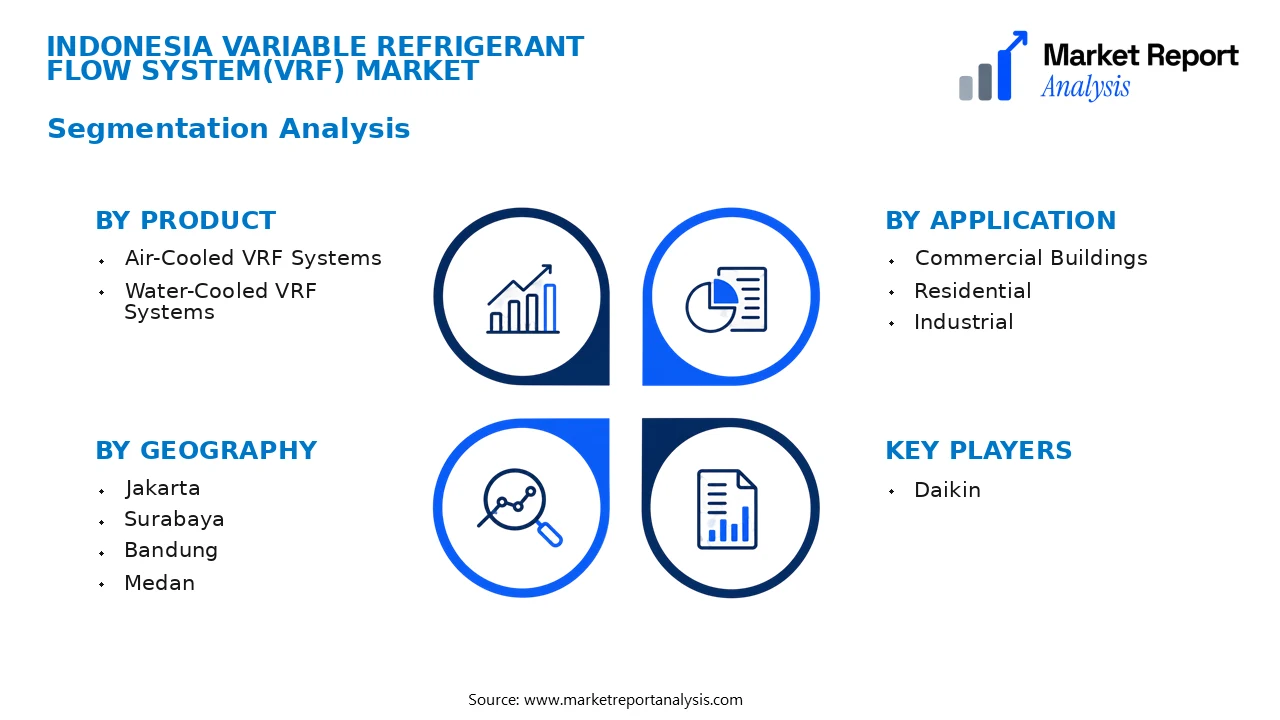
The Indonesia Variable Refrigerant Flow System (VRF) market is segmented based on product type, application, and geography. These categories help in understanding the diverse needs and growth drivers within different sectors and regions across Indonesia, facilitating targeted market strategies and investment opportunities.
- Product
- Air-Cooled VRF Systems: These systems are preferred in Indonesia for their simplicity and efficiency in moderate climates, with growing adoption in commercial and residential projects driven by energy efficiency standards and urbanization trends.
- Water-Cooled VRF Systems: These systems are gaining popularity in large-scale commercial and industrial applications due to their higher efficiency and ability to handle larger capacities, especially in multi-story buildings and industrial facilities.
- Application
- Commercial Buildings: This segment dominates the market, comprising malls, hotels, office spaces, and retail outlets, where VRF systems provide energy-efficient, flexible climate control solutions that meet the high demand for comfort and operational efficiency.
- Residential: The expanding residential sector utilizes VRF systems for their space-saving designs and energy savings, especially in urban areas with space constraints and environmental regulations promoting sustainable cooling solutions.
- Industrial: Although a smaller segment, industrial applications are increasing, utilizing VRF systems in manufacturing plants and warehouses where precise temperature control and energy management are critical.
- Geography
- Jakarta: As the capital and largest city, Jakarta presents the highest market demand with numerous commercial real estate developments, government initiatives toward sustainable buildings, and a robust industrial base supporting VRF adoption.
- Surabaya: The second-largest city, with a vibrant manufacturing sector and expanding commercial infrastructure, fosters increasing demand for energy-efficient climate control systems including VRF technology.
- Bandung: Known for educational institutions and technology parks, Bandung’s growing commercial and residential development drives the adoption of innovative HVAC solutions such as VRF systems.
- Medan: Medan’s booming industrial zones and commercial projects bolster demand for scalable, energy-efficient HVAC systems, making VRF systems increasingly popular in local construction and renovation activities.
Competitive Intelligence
The Indonesia Variable Refrigerant Flow System (VRF) market displays moderate competition with a mix of established multinational corporations and local players. Market concentration remains relatively fragmented, with the top five companies holding approximately 45% of the market share as of 2026, indicating opportunities for new entrants and smaller firms to gain a foothold. Business strategies largely revolve around aggressive expansion into regional markets, especially Jakarta and Surabaya, through partnerships and dealership networks. Innovation is driven by the need for energy efficiency and smart integrations, leading to ongoing R&D investments focused on developing environmentally sustainable and technologically advanced VRF units. Several companies are forging strategic alliances with construction firms and real estate developers to secure large contracts for commercial projects. Notable acquisitions aim to strengthen product portfolios and regional presence. Differentiation primarily hinges on product efficiency, reliability, and after-sales services. Urban centers like Jakarta see heightened competitive activity, with firms vying for high-profile commercial projects, while provincial markets remain less saturated but demonstrate increasing interest. This competitive landscape fosters continuous innovation and strategic expansion to meet growing demand.
Leading Company Profiles
The competitive landscape of the Indonesia Variable Refrigerant Flow System (VRF) market features a diverse array of global and domestic players, each leveraging technological innovations and strategic expansions to capture market share in Indonesia’s burgeoning HVAC sector.
- Daikin
Daikin
Daikin excels in innovative, energy-efficient VRF solutions tailored for the Indonesian climate, emphasizing sustainable technology, robust distribution channels, and local service support to strengthen market positioning and ensure scalability in the Southeast Asian region.
Midea offers a broad portfolio of VRF systems focusing on affordability and technological versatility, leveraging advanced inverter technology and strategic manufacturing investments to expand footprint in Indonesia's commercial and residential HVAC sectors.
Mitsubishi Electric specializes in high-performance VRF solutions with a focus on smart building integration, sourcing local partnerships to adapt their products to Indonesia’s unique climatic and infrastructural needs, driving innovation and market growth.
Gree’s competitive edge lies in its cost-effective, reliable VRF units supported by a comprehensive dealer network in Indonesia, aligning with regional energy standards and pushing to increase market penetration via strategic collaborations.
LG Electronics leverages advanced digital control systems and energy-efficient technology, aiming to lead Indonesia’s VRF market through strategic alliances and sustainability initiatives, with a focus on urban infrastructure projects.
As an emerging local player, Japan Quality emphasizes high standards, fusion of Japanese engineering practices, and customized solutions for Indonesia's diverse building requirements, aiming to carve a niche in premium market segments.
Panasonic’s VRF solutions are centered on energy efficiency and eco-friendly refrigerants, focusing on integrating IoT technologies for smart controls and expanding manufacturing capacity to meet rising demand in Indonesia’s urban centers.
Samsung invests heavily in innovation, with a focus on smart connectivity features and energy conservation, promoting its VRF systems for high-rise and commercial buildings through strategic marketing and local partnerships.
Carrier’s strategy in Indonesia revolves around delivering versatile, robust VRF products powered by sustainable refrigerants and backed by an extensive service network, fostering long-term customer trust and technological leadership.
Hitachi emphasizes advanced HVAC solutions combining durability and energy efficiency, with ongoing investments in local production to enhance its competitive edge and meet the expanding infrastructure needs in Indonesia.
Strategic Business Developments
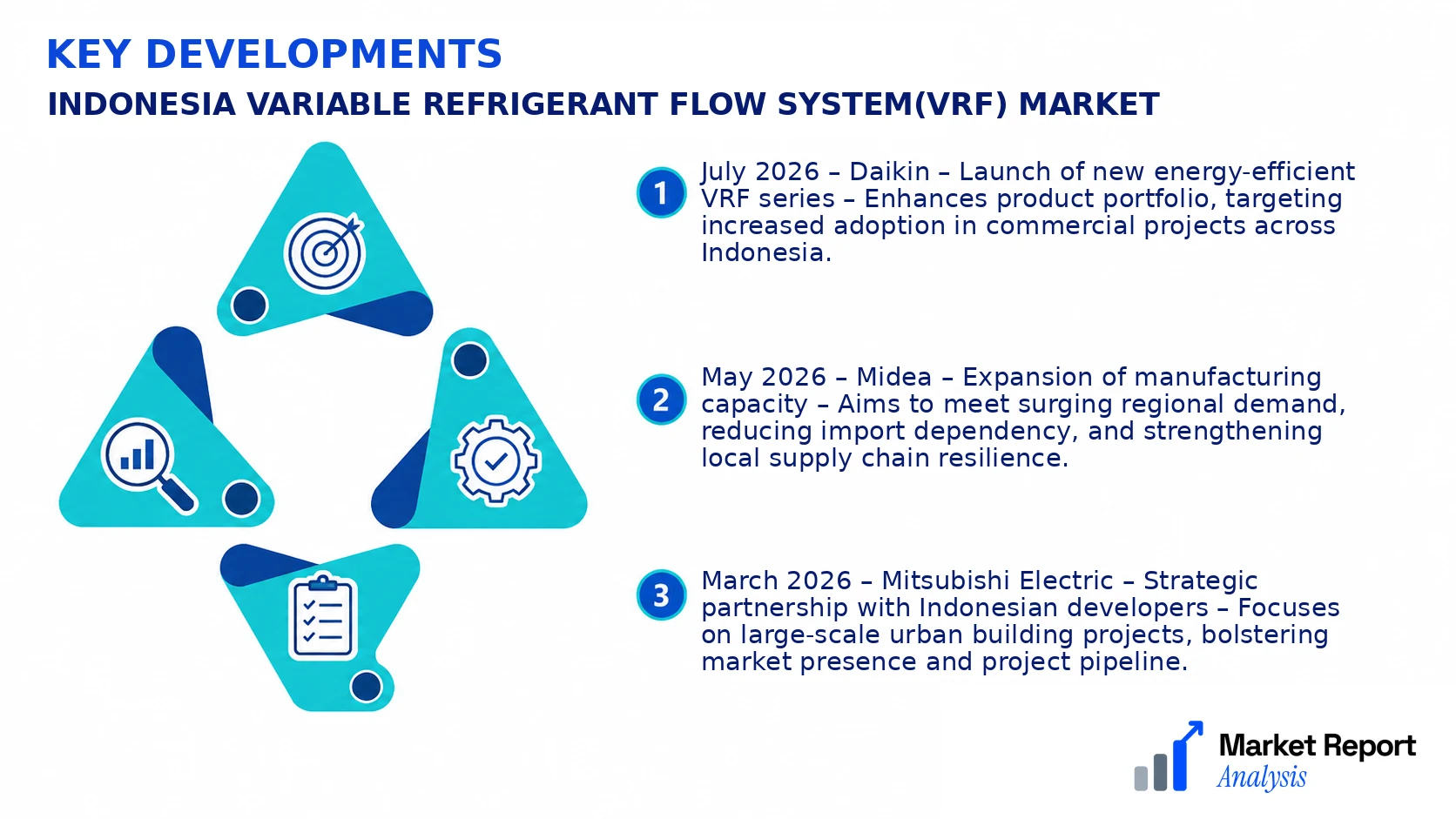
- July 2026 – Daikin – Launch of new energy-efficient VRF series – Enhances product portfolio, targeting increased adoption in commercial projects across Indonesia.
- May 2026 – Midea – Expansion of manufacturing capacity – Aims to meet surging regional demand, reducing import dependency, and strengthening local supply chain resilience.
- March 2026 – Mitsubishi Electric – Strategic partnership with Indonesian developers – Focuses on large-scale urban building projects, bolstering market presence and project pipeline.
- August 2026 – Gree – Initiation of joint venture for localized assembly – Supports cost reduction and customization, tailored explicitly for the Indonesian climate and industry needs.
- September 2026 – LG Electronics – Digital integration platform launch – Provides advanced remote monitoring and control, improving operational efficiency for end-users and installers.
Frequently Asked Questions
What is the Indonesia Variable Refrigerant Flow System(VRF) Market?
The Indonesia Variable Refrigerant Flow System (VRF) Market encompasses the sales, installation, and application of VRF technology within Indonesia's HVAC sector. This market is characterized by advanced climate control solutions that offer energy efficiency and flexibility for commercial, residential, and industrial buildings.
What is the current market size of Indonesia Variable Refrigerant Flow System(VRF) Market?
As of 2026, the Indonesia VRF market is valued at approximately USD 1.2 Billion, reflecting rapid growth driven by urbanization, infrastructural development, and rising demand for energy-efficient cooling and heating solutions across multiple sectors.
What factors are driving the Indonesia Variable Refrigerant Flow System(VRF) Market?
The market is propelled by rising environmental awareness, government policies promoting energy efficiency, urban development projects, and the increasing adoption of sustainable building practices. Additionally, technological advancements and decreasing costs of VRF systems bolster market expansion.
Which region dominates the Indonesia Variable Refrigerant Flow System(VRF) Market?
Java Island remains the dominant region due to its dense population, extensive urbanization, and concentration of commercial and residential development projects, creating significant demand for VRF solutions in metropolitan centers like Jakarta and Surabaya.
Which segment is expected to grow the fastest?
The commercial segment anticipates the fastest growth owing to rising demand for energy-efficient cooling systems in office buildings, hotels, shopping malls, and healthcare facilities, supported by government incentives and increasing corporate sustainability initiatives.
Who are the leading companies operating in the Indonesia Variable Refrigerant Flow System(VRF) Market?
Key industry players include Daikin, Mitsubishi Electric, LG Electronics, Toshiba, and Samsung, who are actively expanding their market presence through innovations, strategic partnerships, and localized manufacturing to capitalize on Indonesia’s burgeoning HVAC sector.
Analyst Perspective
The Indonesia Variable Refrigerant Flow System (VRF) market exhibits a mature yet evolving landscape, with promising long-term growth driven by urbanization, infrastructure development, and a shift toward energy-efficient HVAC solutions. Over the forecast period to 2034, the market is expected to expand at a CAGR of approximately 11.3%, reflecting increased adoption in commercial, hospitality, and residential sectors, particularly in urban centers like Jakarta, Surabaya, and Bandung. Technological advancements such as integration with building management systems and the incorporation of IoT capabilities will enhance system efficiency and user control, creating new product differentiation opportunities. Investment priorities should focus on R&D in energy-efficient and eco-friendly refrigerants, alongside expanding regional dealer networks and after-sales service infrastructure. Competitive dynamics are intensifying as international players expand local partnerships to capture market share. Regional growth potential remains high, especially in Tier 2 cities where infrastructure projects and commercial developments are accelerating, offering substantial strategic opportunities for early movers and technology leaders.
