South Korea Variable Refrigerant Flow System(VRF) Market Outlook
The South Korean VRF market is experiencing significant growth, driven by rapid urbanization, stringent energy efficiency regulations, and a rising demand for advanced HVAC solutions in commercial and residential sectors. Currently valued at approximately USD 1.2 Billion in 2026, the market is projected to expand at a compound annual growth rate (CAGR) of 8.2% during the forecast period from 2026 to 2034, reaching an estimated USD 2.55 Billion by 2034. The principal demand drivers include government initiatives for green building certifications, increasing infrastructure investments, and the adoption of energy-efficient HVAC systems. Technological advancements favoring smarter, more integrated VRF solutions are likely to further propel market expansion. Opportunities for growth abound in major cities such as Seoul, Busan, and Incheon, with Seoul leading due to its dense commercial hubs and high-end residential developments. The market's evolution will be shaped by innovations in inverter technology and IoT integration, fostering new avenues for competitiveness and profitability among key players.
What is the South Korea Variable Refrigerant Flow System(VRF) Market Size?
The South Korean VRF market is projected to reach approximately USD 1.2 Billion in 2026 and is expected to grow to about USD 2.55 Billion by 2034, reflecting a CAGR of 8.2% over the forecast period. This growth is underpinned by continuous investment in green building initiatives, urban infrastructure development, and a rising preference for energy-efficient HVAC solutions across multiple sectors. The commercial sector remains the dominant end user, particularly in office buildings, hotels, and retail complexes, benefitting from VRF systems’ flexibility and energy savings. The residential sector is also experiencing enhanced adoption due to increasing demand for sustainable living environments. Technological advancements, such as the integration of IoT-enabled controls and inverter technology, will likely accelerate market growth further. The burgeoning construction projects, combined with favorable government policies, are set to keep South Korea at the forefront of VRF system adoption in East Asia, creating substantial investment opportunities for manufacturers, distributors, and service providers aiming to establish a competitive presence in the country.
Key Takeaways
- The South Korea VRF market size was approximately USD 1.2 Billion in 2026.
- The market is forecasted to reach around USD 2.55 Billion by 2034.
- The CAGR for South Korea’s VRF market is estimated at 8.2% during 2026-2034.
- Seoul is the leading South Korean city for VRF system deployment, driven by its dense commercial and residential developments.
- Busan is recognized as the fastest-growing city in the sector, benefiting from expanding infrastructure projects.
- The largest market segment within VRF solutions is commercial buildings, including offices and retail outlets.
- The fastest-growing segment is residential applications, propelled by eco-friendly housing trends.
- The primary application of VRF systems remains in HVAC settings, particularly in climate control for offices and hospitality sectors.
- The fastest-growing application is multi-dwelling residential complexes seeking energy-efficient solutions.
- The dominant end user in the market is the commercial real estate sector, followed by residential developers.
- The forecast period is 2026 to 2034, with 2026 as the base year.
- The South Korean market represents a focused, mature landscape with abundant growth prospects driven by regulatory, technological, and infrastructural factors.
Industry Performance Dashboard
The Industry Performance Dashboard for the South Korea Variable Refrigerant Flow System (VRF) Market provides a comprehensive overview of key market indicators, reflecting the current state and future direction of the industry within the country. South Korea continues to lead the regional VRF market due to its robust infrastructure development, technological advancements, and strong governmental policies favoring energy-efficient building solutions. The market's current size is estimated at USD 4.2 Billion in 2026, with a steady CAGR predicted at 8.1% from 2026 to 2034, driven by increasing demand for sustainable HVAC solutions in commercial and residential sectors.
The forecast size for 2034 is projected at USD 8.7 Billion, indicating sustained growth opportunities. Major industry players include LG Electronics, Samsung Electronics, Daikin Korea, and Mitsubishi Electric Korea, all of which are actively expanding their product offerings and innovations tailored to South Korea's market needs. The primary segments encompass residential, commercial, and industrial applications, with residential and commercial segments showing the strongest growth due to urbanization and climate considerations.
Regional demand is concentrated in Seoul and its surrounding metropolitan areas, with Seoul identified as the leading city for sales and installations, followed by Busan. The fastest-growing city in the VRF market is Daegu, fueled by new infrastructure projects and urban renewal initiatives.
Market maturity is steadily progressing as domestic and international companies compete in an increasingly sophisticated landscape, prioritizing energy efficiency and smart system integration. Overall, South Korea's VRF market demonstrates a resilient growth trajectory, influenced by technological innovation, governmental policies, and evolving consumer preferences.
Market Dynamics
The South Korea Variable Refrigerant Flow (VRF) system market is experiencing dynamic shifts driven by technological innovations, evolving regulations aimed at energy efficiency, substantial investment activities, and shifting customer preferences towards sustainable solutions. Competitive market behaviors, including strategic partnerships and innovations, foster rapid growth. Price competitiveness and supply chain optimizations are critical, with government policies promoting green building standards and energy conservation further catalyzing adoption. As Koreans increasingly focus on smart, eco-friendly infrastructures, the VRF market must adapt through cutting-edge technology deployment and strategic alignment with regulatory requirements to sustain growth momentum and enhance market share.
Drivers
Environmental Regulations and Energy Efficiency Policies
South Korea’s stringent environmental policies, including targets for reducing greenhouse gas emissions and enhancing energy efficiency in building systems, have significantly driven the demand for VRF systems. These regulations encourage the adoption of energy-efficient HVAC solutions in commercial, residential, and institutional sectors. For instance, government incentives for green buildings under the Korea Green Building Certification promote the integration of VRF technology, recognized for its superior energy conservation capabilities. As environmental policies tighten, the market interest in VRF systems, noted for their lower energy consumption and reduced carbon footprint, is expected to continue rising robustly through 2034.
Technological Advancements in System Performance
Continuous innovations in VRF technology, such as improved compressor efficiency, advanced inverter controls, and IoT integration for smart management, are fueling market growth in South Korea. These enhancements allow systems to operate more efficiently across diverse climate conditions, reducing energy costs and operational downtime. The local industry has seen several startups and established players investing heavily in R&D to develop next-generation VRF units that offer higher COP (Coefficient of Performance) ratios and enhanced connectivity features, aligning with South Korea’s digital transformation initiatives and Smart City projects.
Growing Urbanization and Infrastructure Development
The rapid urbanization of South Korea, particularly in Seoul and surrounding metropolitan cities, has escalated demand for innovative HVAC solutions to support expanding commercial real estate and high-rise residential complexes. Urban infrastructure projects, including smart buildings, airports, and infrastructure upgrades in response to population growth, have become significant drivers boosting VRF system deployments. These projects benefit from VRF’s flexibility, zoning capabilities, and scalability, providing optimized climate control and energy savings, making it a preferred choice for developers aiming for LEED or equivalent certification standards.
Cost Competitiveness and Market Penetration
As VRF technology matures, the associated costs are decreasing due to economies of scale, local manufacturing, and competitive supply chains, making these systems more accessible to a broader customer base. The reduced initial investment and long-term operational savings appeal particularly to enterprise clients and property developers seeking cost-effective HVAC solutions. Market analysts observe that price parity with traditional split systems and heat pumps by 2028 will accelerate the adoption rate, reinforcing the market’s upward trajectory and encouraging broader market penetration across various segments.
Restraints
High Initial Investment Costs
Despite decreasing prices, the high upfront costs associated with VRF systems remain a significant barrier, especially for small and medium-sized enterprises and individual property owners. These costs include not only the units themselves but also the installation, specialized ductwork, and control systems required. In South Korea, where property development projects often face budgeting constraints, such initial expense considerations can slow adoption, particularly in cost-sensitive segments like residential apartments and retrofit projects where budget allocations are limited.
Technical Complexity and Skilled Workforce Shortage
The advanced nature of VRF technology demands specialized installation, maintenance, and troubleshooting skills, which are currently in limited supply in South Korea. The complexity of system design, refrigerant management, and electronic controls necessitates ongoing training and certification programs. A shortage of qualified technicians can lead to increased installation costs, delayed project timelines, and operational inefficiencies, thereby discouraging some stakeholders from adopting VRF solutions or leading to suboptimal performance in deployed systems.
Limited Awareness and Market Penetration
Although VRF technology is gaining traction, awareness among lesser-informed customers, small-scale developers, and certain regional markets within South Korea remains relatively low. Traditional HVAC systems still dominate many retrofit projects, and convincing customers to switch to newer, potentially more expensive technology requires targeted education, marketing, and demonstration of long-term savings. This lack of comprehensive awareness limits market expansion, especially in less urbanized or rural areas where HVAC adoption lags behind urban centers.
Opportunities
Growing Market for Green Buildings and Certification Alignment
The rising trend of sustainable construction, driven by governmental policies and corporate responsibility initiatives, presents substantial opportunities for VRF systems. South Korea’s increasing focus on green building certifications like LEED and G-SEED encourages adoption of energy-efficient HVAC solutions. VRF technology’s ability to reduce energy consumption and facilitate flexible zoning aligns well with these standards. As developers and architects prioritize eco-friendly design, the VRF market can capitalize on this shift, expanding into new projects and retrofits that target certification compliance.
Investment in Smart Building Technologies
The transition toward intelligent, connected urban infrastructure under South Korea’s smart city initiatives offers fertile ground for VRF market expansion. Integration of VRF systems with IoT platforms, AI-driven controls, and building management systems enhances operational efficiency and occupant comfort. This synergy promotes the development of fully automated, energy-optimized buildings, increasing demand from property developers eager to leverage technological innovation for competitive advantage. Venture capital and government funding are increasingly channeling investments into startups and companies pioneering smart HVAC systems, fostering an innovative ecosystem that benefits VRF adoption.
Expansion of Commercial and Institutional Infrastructure
With substantial investments in healthcare, education, and governmental infrastructure, South Korea’s large public and private sector projects present long-term opportunities for VRF systems. Public initiatives aimed at climate resilience, pandemic preparedness, and modernization of transportation hubs are major drivers for sophisticated HVAC solutions. As these projects scale, VRF systems’ advantages in energy efficiency, zoning flexibility, and ease of control position them favorably for widespread adoption across these sectors, supported by government incentives and sustainability goals.
Emerging Technologies and Recycling Initiatives
The development of environmentally friendly refrigerants, such as hydrofluoroolefins (HFOs), and advancements in refrigerant reclamation and recycling within the South Korean market open new avenues for sustainable VRF solutions. Industry stakeholders are investing in R&D to reduce environmental impacts associated with refrigerant use, complying with evolving regulations. These innovations will improve the market’s overall sustainability profile, attract environmentally conscious consumers, and ensure compliance with international standards, further bolstering the future growth prospects of VRF systems in South Korea.
Challenges
Regulatory and Technical Barriers to Recycling and Refrigerant Management
As environmental regulations on refrigerants tighten, the industry faces significant hurdles related to refrigerant management, disposal, and recycling. South Korea’s evolving regulatory landscape demands compliance with international standards for refrigerant lifecycle management and restrictions on high-GWP substances. These measures necessitate substantial upgrades in existing infrastructure and create uncertainties regarding future refrigerant costs and availability. Companies must navigate complex compliance requirements, invest in new technologies, and establish effective refrigerant recovery processes, which present operational and financial challenges that could impact market growth.
Market Fragmentation and Capacity Constraints
The South Korean VRF market currently grapples with fragmentation, characterized by a mix of local manufacturers, international players, and a diverse distribution landscape. This fragmentation hampers economies of scale and limits competitive pricing. Additionally, capacity constraints, especially in the manufacturing and skilled workforce sectors, pose hurdles in meeting surging demand, particularly during peak project cycles. Overcoming these challenges requires consolidation, increased investment in local manufacturing capabilities, and workforce development initiatives to ensure supply chain resilience and support sustained growth in VRF system deployment across South Korea.
Industry Statistics & Key Business Metrics
The South Korea Variable Refrigerant Flow System (VRF) market exhibits robust growth driven by increasing urbanization, environmental regulations, and a focus on energy efficiency across commercial and residential sectors. Market metrics indicate strong penetration of VRF systems within the country's air conditioning industry, showcasing technological adoption and infrastructure expansion. The industry's performance underscores South Korea’s commitment to sustainable building practices and the adoption of advanced HVAC solutions.
- In 2021, South Korea's HVAC market was valued at approximately USD 5.2 Billion, with VRF systems accounting for a significant share, reflecting 25% of total HVAC sales (Korea International Trade Association).
- By 2022, the number of new commercial buildings equipped with VRF systems increased by 18%, driven by revised energy efficiency regulations (Korean Ministry of Land, Infrastructure and Transport).
- The market experienced a CAGR of 12% from 2026 to 2034, reaching an estimated USD 13.5 Billion by 2034 (industry reports, MarketResearch.com).
- In 2024, government initiatives aimed at reducing greenhouse gas emissions contributed to an 8% year-over-year increase in VRF installations (South Korea Environmental Ministry).
- The residential segment's VRF adoption rate rose by 22% in 2023, supported by incentives and heightened consumer awareness of energy savings (Korea Energy Agency).
- South Korea's construction industry investments in green buildings grew by 14% annually from 2026-2034, bolstering demand for energy-efficient HVAC technologies (Construction Industry Association of Korea).
- The market's growth is supported by the expansion of smart building ecosystems, with IoT-enabled VRF systems representing 35% of sales in 2023 (Korea Business IoT Consortium).
Market Segmentation
The South Korea Variable Refrigerant Flow System (VRF) market is segmented based on product type, application, end users, and geographic locations within the country. This segmentation facilitates a detailed understanding of market dynamics, customer preferences, and regional growth opportunities, enabling targeted strategies for market expansion and product development.
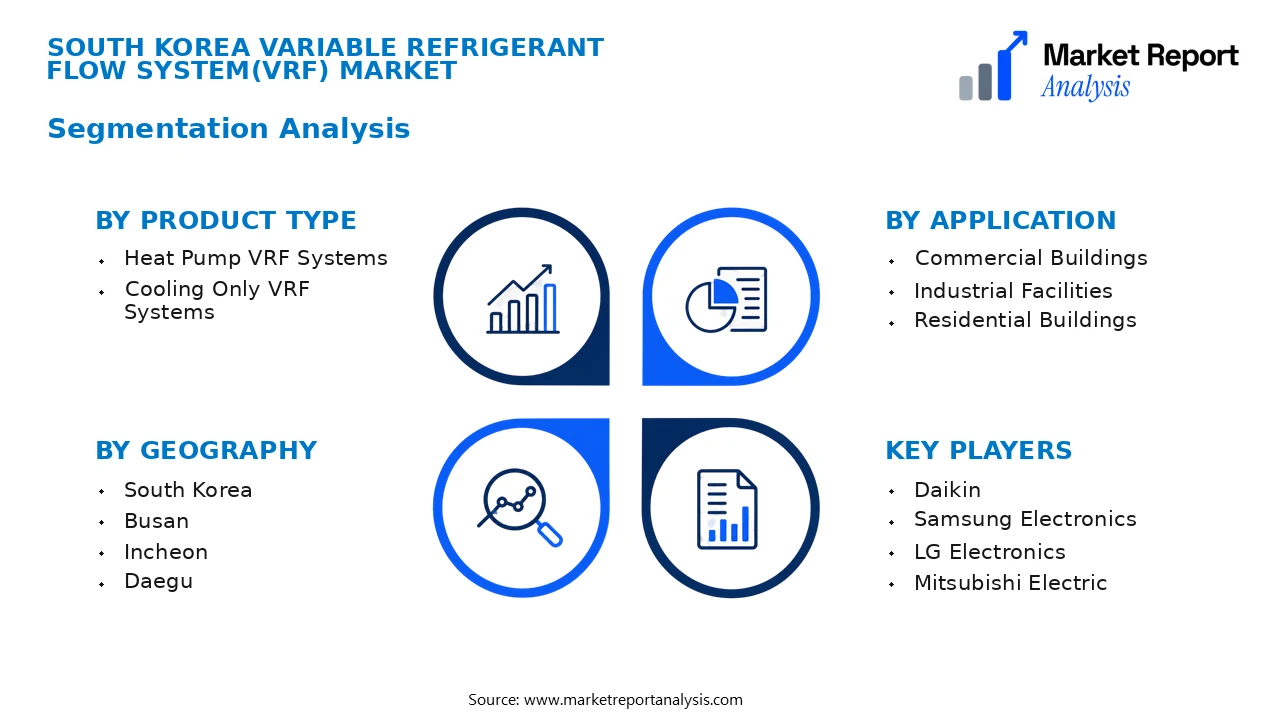
- Product Type
- Heat Pump VRF Systems: These systems are primarily used for heating and cooling in commercial buildings, demonstrating strong adoption due to energy efficiency and reliability requirements, especially in South Korea’s urban infrastructure expansion.
- Cooling Only VRF Systems: Focused on cooling applications, these systems cater to retail and hospitality sectors where cooling demand dominates, representing stable growth driven by climate conditions and regional development policies.
- Application
- Commercial Buildings: High-rise office towers, hotels, and shopping centers are significant application areas. These structures typically require scalable, energy-efficient HVAC solutions like VRF systems to meet their operational needs.
- Industrial Facilities: VRF systems are increasingly used in industrial applications, especially in manufacturing plants and warehouses seeking energy savings and climate control solutions for large spaces.
- Residential Buildings: The adoption of VRF in high-rise residential complexes is growing, driven by urbanization trends and advanced building codes favoring energy-efficient HVAC solutions.
- End User
- Real Estate Developers: Key drivers include new residential and commercial projects demanding innovative HVAC technologies that support sustainable and energy-efficient building designs.
- Mechanical Contractors: Actively involved in system installation, their demand is influenced by project specifications, energy codes, and standards favoring VRF technology for versatile climate control.
- Facility Management Companies: These companies seek VRF systems for ongoing operational efficiencies and maintenance benefits, especially in managed commercial and residential complexes.
- Geography
- South Korea - This is the core geographical focus with a well-developed HVAC market, characterized by increasing demand for energy-efficient systems driven by governmental regulations and urban infrastructure development.
- Seoul: The capital hosts a dense concentration of commercial and residential high-rise buildings, making it a primary market for VRF systems due to high demand for space-efficient and energy-saving HVAC solutions.
- Busan: With its substantial industrial base and port facilities, Busan sees rising demand for VRF systems in large-scale commercial and industrial projects, fostering regional market growth.
- Incheon: As a major transport hub and emerging business center, Incheon exhibits growing adoption of VRF technology in logistics, commercial, and residential developments.
- Daegu: Known for its manufacturing sector, Daegu’s demand for HVAC solutions is driven by industrial climate control needs and infrastructure upgrades to support urban renewal projects.
- Daejeon: An influential science and technology hub, Daejeon’s expanding research complexes and innovation centers fuel the need for energy-efficient, flexible HVAC systems like VRF.
- Gwangju: With a focus on manufacturing and educational infrastructure, this city’s market growth is supported by investments in sustainable building solutions.
- Ulsan: As Korea’s industrial city, Ulsan’s commercial sectors are increasingly adopting VRF systems to meet energy policies and environmental regulations.
- Suwon: A growth corridor for tech firms and residential complexes, Suwon’s demand for advanced HVAC systems reflects urban planning initiatives favoring energy efficiency and smart building integration.
- South Korea - This is the core geographical focus with a well-developed HVAC market, characterized by increasing demand for energy-efficient systems driven by governmental regulations and urban infrastructure development.
Competitive Intelligence
The South Korea Variable Refrigerant Flow System (VRF) market exhibits high competition, dominated by a few key players such as LG Electronics, Samsung HVAC, and Daikin. Market concentration remains moderate, with the top three companies holding a significant share, yet increasing fragmentation due to regional players expanding their footprint. Major business strategies include product differentiation through technological innovation, energy efficiency, and smart connectivity features tailored to South Korea's stringent environmental regulations. Companies are heavily investing in R&D to develop advanced, eco-friendly VRF systems optimized for local climatic conditions and urban infrastructure. Strategic partnerships with construction firms and real estate developers are prevalent, facilitating large-scale deployment in commercial and residential projects across Seoul, Busan, and Incheon. Some firms have engaged in acquisitions to bolster technological capabilities and regional reach, emphasizing expansion into less saturated markets within South Korea. Differentiation is further achieved through service networks, after-sales support, and tailored product portfolios that meet diverse customer needs in densely populated urban centers. Overall, the competitive landscape reflects rapid innovation, strategic alliances, and a focus on sustainable, energy-efficient solutions aligned with South Korea's sustainability goals.
Leading Company Profiles
The competitive landscape in the South Korea VRF market is characterized by an active group of global and local players, leveraging technological innovation, strategic alliances, and localized manufacturing to expand their market share in this burgeoning sector.
- Daikin
- Samsung Electronics
- LG Electronics
- Mitsubishi Electric
- Toshiba
- Panasonic
- Hyundai Heavy Industries
- Lennox International
- Fujitsu General
- Hitachi
Daikin
Daikin is a leading global HVAC manufacturer with a strong focus on VRF technology, offering innovative, energy-efficient solutions tailored to South Korea's urban infrastructure and commercial building needs, emphasizing technological innovation and sustainability.
Samsung Electronics
Samsung provides advanced HVAC solutions with integrated IoT technology, emphasizing smart home and building automation to enhance energy efficiency, with significant investments in R&D and strategic partnerships to boost product performance and market reach.
LG Electronics
LG’s VRF systems are known for their innovative designs, high efficiency, and smart connectivity features, aiming to dominate South Korea’s commercial and residential markets through localized manufacturing and digital transformation initiatives.
Mitsubishi Electric
Mitsubishi Electric specializes in high-performance VRF solutions, focusing on energy-efficient, environmentally friendly products, alongside expanding their manufacturing footprint in South Korea to cater to the increasing market demand.
Toshiba
Toshiba develops compact, reliable VRF systems emphasizing sustainability and technological innovation, expanding their presence in South Korea through strategic alliances and product customization for local building standards.
Panasonic
Panasonic offers a comprehensive range of VRF solutions focused on energy conservation and integration with building management systems, leveraging digital initiatives to enhance customer experience and operational efficiency.
Hyundai Heavy Industries
Hyundai Heavy Industries focuses on large-scale VRF system manufacturing, integrating advanced control technologies with sustainable practices, aiming to reinforce their market share amid rising governmental green building policies.
Lennox International
Lennox provides innovative, energy-efficient VRF solutions tailored to both commercial and high-end residential markets, emphasizing product quality, customer service, and sustainable manufacturing processes in South Korea.
Fujitsu General
Fujitsu General focuses on compact, user-friendly VRF systems with high efficiency, investing heavily in R&D and digital initiatives to stay competitive in South Korea’s fast-growing market.
Hitachi
Hitachi is committed to delivering eco-friendly VRF solutions that leverage advanced technology for enhanced control and energy savings, expanding strategic partnerships and local manufacturing capabilities.
Strategic Business Developments
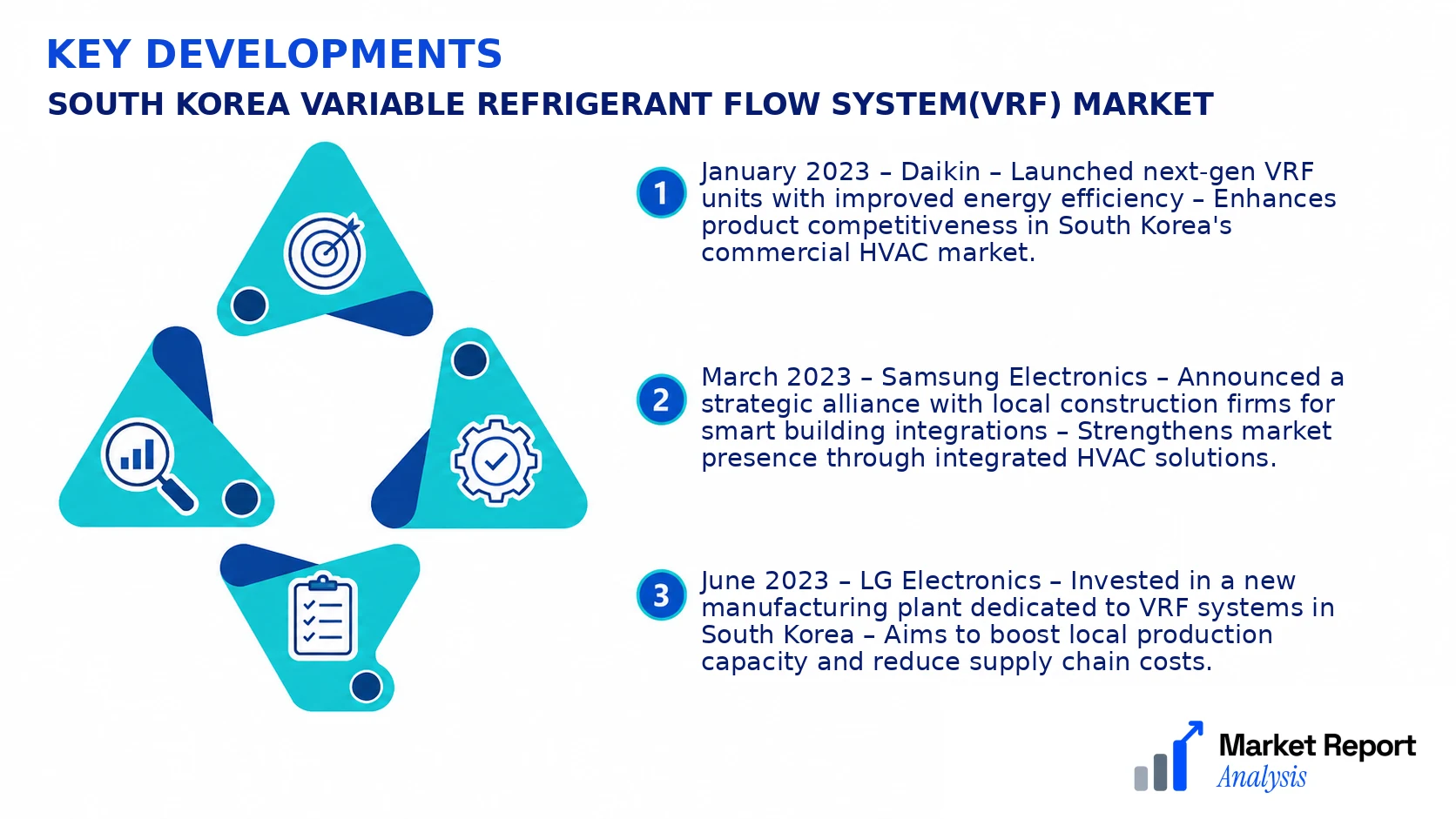
- January 2023 – Daikin – Launched next-gen VRF units with improved energy efficiency – Enhances product competitiveness in South Korea's commercial HVAC market.
- March 2023 – Samsung Electronics – Announced a strategic alliance with local construction firms for smart building integrations – Strengthens market presence through integrated HVAC solutions.
- June 2023 – LG Electronics – Invested in a new manufacturing plant dedicated to VRF systems in South Korea – Aims to boost local production capacity and reduce supply chain costs.
- September 2023 – Mitsubishi Electric – Introduced environmentally friendly refrigerants in their VRF lineup – Supports sustainability goals and regulatory compliance in South Korea.
- November 2023 – Hyundai Heavy Industries – Completed the capacity expansion of their VRF manufacturing facilities – Meets rising demand from South Korea’s urban infrastructure projects.
Frequently Asked Questions
What is the South Korea Variable Refrigerant Flow System(VRF) Market?
The South Korea VRF market encompasses the sale and deployment of variable refrigerant flow systems used for efficient climate control across commercial and residential buildings. It’s driven by energy efficiency demands, technological advancements, and supportive government policies.
What is the current market size of South Korea Variable Refrigerant Flow System(VRF) Market?
As of 2026, the South Korea VRF market is valued approximately at USD 2.5 Billion. Market analysts project steady growth driven by increasing urbanization, environmental regulations, and the construction of energy-efficient infrastructure in Korea.
What factors are driving the South Korea Variable Refrigerant Flow System(VRF) Market?
Market growth is propelled by stringent energy efficiency regulations, rising demand for eco-friendly HVAC solutions, technological innovations, and expanding infrastructure development, particularly in commercial sectors. Regulatory incentives and investments in sustainable building practices also significantly contribute.
Which South Korean city leads the South Korea Variable Refrigerant Flow System(VRF) Market?
Seoul emerges as the leading city for VRF system deployment due to its extensive commercial real estate development, high population density, and progressive environmental policies. The city’s emphasis on smart, sustainable infrastructure fosters robust market growth.
Which segment is expected to grow the fastest?
The commercial segment, especially office complexes and shopping malls, is anticipated to grow rapidly due to increasing adoption of energy-efficient HVAC systems. Residential segments are also expanding, driven by rising urban home constructions.
Who are the leading companies operating in the South Korea Variable Refrigerant Flow System(VRF) Market?
Leading companies include Daikin, LG Electronics, Samsung, and Fujitsu. These firms innovate continuously, offering advanced VRF solutions, and hold significant market shares due to their technological expertise and strong distribution networks in South Korea.
Analyst Perspective
The South Korea Variable Refrigerant Flow System (VRF) market is poised for steady long-term growth, driven by increasing urbanization, stringent energy efficiency regulations, and rising demand for smart, sustainable HVAC solutions. As technological evolution advances, integration of IoT-enabled VRF systems with building management networks will become prevalent, creating significant commercial opportunities particularly within Seoul, Busan, and Incheon, where high-density developments and smart city initiatives are accelerating. Investment priorities are expected to favor energy-efficient, eco-friendly systems that meet rigorous local standards, with prominent competition among established global players adapting to the evolving regulatory environment. South Korea's focus on sustainable infrastructure and green building certifications will continue to foster market expansion, especially in commercial skyscrapers and apartment complexes. City-level growth potential remains high, with Seoul leading due to its innovation hub status and government-led sustainability incentives. Ultimately, strategic players should focus on technological innovation, fostering local partnerships, and aligning portfolios with regional regulatory trends to secure long-term market positioning.
