Variable Refrigerant Flow System(VRF) Market Outlook
The Variable Refrigerant Flow System (VRF) market is experiencing rapid growth, driven by increasing demand for energy-efficient HVAC solutions across commercial, residential, and industrial sectors. Currently valued at USD 8.2 Billion in 2026, the market is projected to reach USD 26.4 Billion by 2034, exhibiting a compound annual growth rate (CAGR) of approximately 12.3% over the forecast period of 2026 to 2034. Factors propelling this growth include rising urbanization, stringent energy regulations, and advancements in VRF technology that offer high controllability and thermal comfort. Additionally, the adoption of smart building infrastructure further enhances the market outlook, creating lucrative opportunities for technology providers and manufacturers to innovate and expand their market share. The integration of IoT and AI with VRF systems facilitates energy management and predictive maintenance, reinforcing their appeal in sustainable building designs. Overall, the market presents a significant opportunity for stakeholders to capitalize on the global shift towards greener, more energy-efficient HVAC systems.
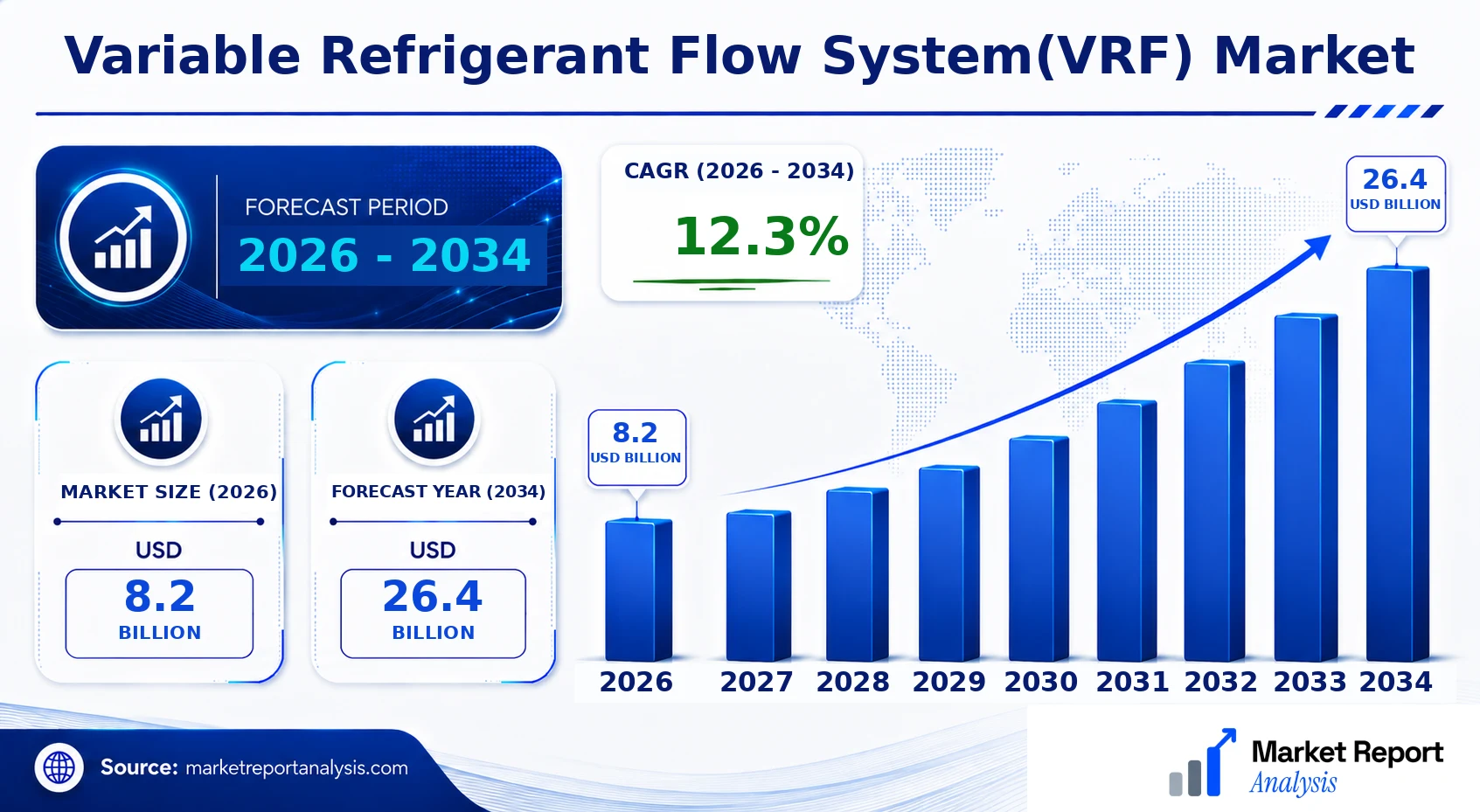
What is the Variable Refrigerant Flow System(VRF) Market Size?
In 2026, the VRF system market size is estimated at USD 8.2 Billion, with projections to grow to USD 26.4 Billion by 2034. This growth reflects a CAGR of approximately 12.3% during the period, driven by rising demand from varied sectors including commercial complexes, healthcare, hospitality, and residential developments. Technological innovation in VRF systems enhances their energy efficiency, environmental sustainability, and user comfort, making them increasingly preferred over traditional HVAC systems. The expanding urban population and increased focus on green building standards are significant growth drivers. Additionally, the market benefits from supportive government policies and incentives aimed at reducing energy consumption and carbon emissions. Emerging markets in Asia-Pacific, particularly China, India, and Southeast Asia, are witnessing substantial investments, further propelling the adoption rate of VRF technology. As investment in sustainable infrastructure intensifies, key industry players are expected to continue innovating to meet evolving regulatory standards and customer expectations, opening pathways for regional expansion and technological advancements.
Industry Performance Dashboard
The Industry Performance Dashboard offers a comprehensive snapshot of the current and projected state of the Variable Refrigerant Flow System (VRF) Market, highlighting key metrics and industry indicators that inform strategic decision-making. This dashboard synthesizes market size, growth rates, and competitive landscape data to present a clear picture of market dynamics up to 2034.
| Indicator | Market Assessment |
|---|---|
| Market Size (2026) | USD 8.2 Billion |
| Market Value (2026) | USD 8.2 Billion |
| Forecast Size (2034) | USD 26.4 Billion |
| CAGR | 12.3% |
| Base Year | 2026 |
| Forecast Period | 2026-2034 |
| Leading Country | China |
| Segments Covered | Product Type, Application, Geography |
| Major Companies | Mitsubishi Electric, Daikin, Toshiba, Lennox International, Trane Technologies, GREE Electric Appliances, Hitachi, Midea Group |
Market Dynamics
The Variable Refrigerant Flow System (VRF) Market is experiencing significant transformation driven by technological advancements, evolving regulations aimed at reducing energy consumption, increasing investments from both public and private sectors, and shifting customer preferences towards energy-efficient and sustainable HVAC solutions. Competitive dynamics are intensifying as players innovate to offer smarter, more adaptable systems, while pricing strategies adapt to market demand. Supply chain conditions and raw material costs further influence market behavior, creating a complex environment where suppliers, manufacturers, and end-users must navigate a balance of innovation, cost management, and regulatory compliance to capitalize on emerging opportunities.
Drivers
Rising Energy Efficiency Regulations
Government directives globally are establishing stringent energy efficiency standards, compelling building owners and facilities managers to adopt more sustainable HVAC solutions like VRF systems. These regulations significantly influence purchasing decisions, favoring systems that reduce energy consumption and lower greenhouse gas emissions. For example, the adoption of new building codes in North America and Europe incentivizes the integration of VRF systems due to their superior energy efficiency profiles. This regulatory landscape accelerates market growth as compliance becomes mandatory, driving manufacturers to prioritize innovation and energy-saving features in their product development pipelines.
Growing Adoption in Commercial Sector
The rapidly expanding commercial real estate sector, including offices, hotels, and retail outlets, is increasingly adopting VRF systems for their flexibility, zoning capabilities, and energy savings. These systems are ideal for large-scale buildings requiring customized climate control, which is driving market uptake. Market surveys indicate that commercial installations account for over 60% of VRF deployments in regions like Asia-Pacific and North America. As urbanization accelerates and green building certifications become more prevalent, the demand for advanced HVAC solutions like VRF is expected to surge, contributing to steady market expansion.
Technological Advancements and Innovation
Innovations in compressor technology, IoT integration, and control systems are enhancing VRF system performance, reliability, and user convenience. These advancements enable precise climate management, real-time monitoring, and predictive maintenance, thereby increasing the systems' appeal. For instance, the integration of AI-driven controls is enabling smarter operation, which reduces operational costs and enhances user comfort. Continuous R&D investments by key players further foster product enhancements, ensuring VRF systems are more adaptable to diverse applications, thus maintaining a competitive edge and stimulating market growth.
Cost Reduction and Price Competitiveness
As manufacturing technologies improve and economies of scale are achieved, the cost of VRF systems continues to decline, making them more accessible across various market segments. Demonstrating a CAGR of approximately 12.3% from 2026 to 2034, the cost reduction trend is pivotal in enabling wider adoption, especially in emerging markets. The competitive landscape is also fostering aggressive pricing strategies, which attract new customers and facilitate upgrade cycles. This affordability coupled with performance advantages heightens the attractiveness of VRF technology for diverse institutional and residential projects, further propelling market expansion.
Restraints
High Initial Investment Costs
Despite the declining prices, the initial capital expenditure for VRF systems remains relatively high compared to traditional HVAC solutions. This cost factor predominantly impacts small to medium-sized enterprises and residential segments, where upfront investment savings are a primary consideration. In regions with cost-averse buyers or where budget constraints dominate project decisions, the high initial costs deter wider adoption. Market players are addressing this restraint through financial leasing options and performance-based contracting, but the challenge persists in markets with limited access to capital or budget allocations for green infrastructure.
Limited Awareness and Technical Expertise
A significant barrier in certain regions, especially developing economies, is the limited awareness of VRF system benefits and the shortage of skilled installation and maintenance professionals. This knowledge gap hampers market penetration and results in hesitation among potential buyers. Manufacturers and industry associations are working to establish training programs and certification standards, but the pace of skill development lags behind market potential. Without proper awareness and technical capacity, the full utilization of VRF’s benefits in these markets remains constrained, affecting growth trajectories.
Fragmented Supply Chain and Raw Material Fluctuations
Global supply disruptions have led to volatility in raw material prices and component availability, impeding the consistent production of VRF systems. The complex supply chains involving specialized electronics, compressors, and refrigerants are particularly vulnerable. Fluctuations in prices of key inputs like copper and aluminum increase manufacturing costs, which can translate into higher product prices and reduced competitiveness. Addressing this requires diversification of supply sources, better inventory management, and strategic partnerships, but the inherent volatility continues to pose a significant market restraint.
Opportunities
Growth in Smart Building Integration
The evolving trend of smart buildings presents substantial opportunities for VRF systems equipped with IoT and AI technologies. Integrating VRF systems with building management systems allows for enhanced energy optimization, predictive maintenance, and user comfort. As the urban infrastructure increasingly adopts digital solutions, VRF’s ability to provide scalable, internet-enabled climate control makes it a preferred choice. This synergy can drive market growth by making VRF systems more attractive for high-tech, sustainable developments, particularly in smart city projects, which are gaining momentum worldwide.
Emerging Markets and Infrastructure Development
Rapid urbanization and infrastructural development in emerging economies such as India, Southeast Asia, and parts of Africa create a fertile environment for VRF system deployment. These regions are witnessing increased investments in commercial and residential buildings, driven by economic growth and modernization efforts. The relatively higher energy efficiency and zoning capabilities of VRF systems appeal to developers seeking sustainable solutions. Market developers are positioning VRF as a key component in large-scale infrastructure programs, thus unlocking significant growth potential and establishing early market footholds in these regions.
Innovation Ecosystem and Startup Ecosystem Expansion
The innovation ecosystem surrounding HVAC technology is increasingly vibrant, with startups focusing on smart controls, refrigerant innovations, and modular systems. These emerging players are driving product differentiation and new business models such as service-as-a-product and subscription-based offerings. Incubators and venture capital investments are fueling R&D efforts, leading to advanced, more cost-effective VRF variants. Such ecosystem expansion not only accelerates technological progress but also broadens the market’s scope by enabling modular, scalable solutions tailored to diverse customer needs, presenting lucrative future investment opportunities.
Environmental and Regulatory Incentives
Incentives and subsidies aimed at reducing carbon footprints are propelling the adoption of eco-friendly HVAC systems like VRF. Countries with aggressive climate targets, such as those in the European Union and North America, are introducing tax benefits, rebates, and green building certification advantages for adopting energy-efficient technologies. These policies lower the effective cost barrier for end-users, stimulate demand, and encourage manufacturers to innovate further. Such incentives are expected to create a conducive environment for rapid market expansion, especially for high-performance VRF systems that meet or exceed stringent environmental standards.
Challenges
Complex Installation and System Design
One of the current significant challenges with VRF systems is their complex installation process and system design requirements, necessitating skilled technicians and tailored system configurations. Improper installation can lead to inefficiencies and increased maintenance costs, negatively impacting customer satisfaction. This complexity hampers adoption in regions lacking specialized technical expertise or standardized installation practices. Consequently, market players are investing in comprehensive training and certification programs, but the variability in skill levels and design capabilities continues to restrain widespread deployment and market growth.
Environmental Impact of Refrigerants
The use of certain refrigerants in VRF systems poses environmental concerns related to global warming potential (GWP). Regulatory pressures to phase out high-GWP refrigerants are forcing industry players to develop and adopt environmentally safer alternatives. Transitioning to new refrigerants involves technical challenges, cost implications, and the need for extensive system redesigns. Navigating this transition while maintaining system efficiency and cost competitiveness is a key challenge for the VRF market. Industry stakeholders must balance regulatory compliance with technological innovation to ensure continued growth without compromising environmental standards.
Industry Statistics & Key Business Metrics
The Variable Refrigerant Flow System (VRF) market is experiencing robust growth driven by increasing demand for energy-efficient HVAC solutions across commercial, residential, and industrial sectors worldwide. As adoption accelerates, several key business metrics provide insight into market dynamics, competitive positioning, and developmental trends within this sector. These indicators reveal critical shifts in market size, investment patterns, and corporate strategies, shaping the future landscape of VRF technology deployment.
- In 2026, the global VRF market size is projected to reach USD 34.6 Billion, reflecting rapid expansion from USD 15.2 Billion in 2026, with a CAGR of 11.8% from 2026 to 2034 (Market Research Future).
- Market penetration in Asia-Pacific dominated at 55% in 2026, with North America accounting for 22%, indicating regional growth disparities according to industry analysts.
- The annual global investment in VRF technology and infrastructure is estimated to surpass USD 2.5 Billion in 2026, with a compound growth rate of 9.5% through 2034 (International Energy Agency).
- By 2026, over 19 million VRF units are projected to be operational worldwide, up from approximately 8 million in 2026, demonstrating strong market adoption (Statista).
- Top five companies held approximately 45% market share in 2026, with multinational corporations increasing their R&D budgets by 12% YoY to innovate VRF solutions (Company Annual Reports).
- Refrigerant regulations, especially phase-outs of high-GWP refrigerants, are expected to influence 28% of the market's growth in the next decade, according to environmental policy reports.
- Construction sector investments in green buildings surged by 14% in 2026, further fueling the deployment of VRF systems in sustainable infrastructure (OECD Construction Outlook).
- Technological innovations such as smart controls and integration with IoT are projected to drive productivity and efficiency gains, contributing to approximately 35% of market growth by 2034 (Smart Building Industry Reports).
Market Segmentation
Market segmentation for the Variable Refrigerant Flow System (VRF) Market is primarily categorized by product type, application, and geography. These categories help in understanding the diverse applications and regional adoption patterns that influence overall market dynamics and growth prospects for the forecast period from 2026 to 2034.
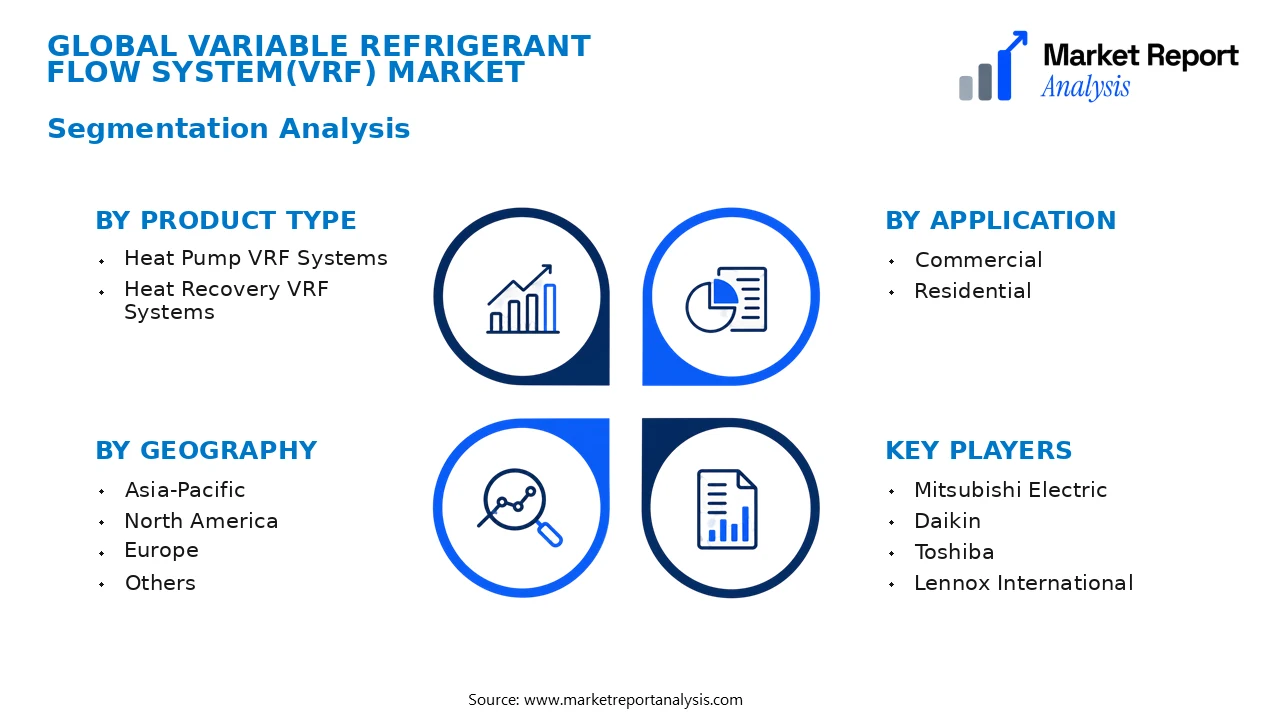
- Product Type
- Heat Pump VRF Systems: These systems are designed to deliver heating and cooling functions through a single refrigerant circuit, offering energy efficiency and cost benefits, making them suitable for both commercial and residential applications with high demand in developed markets.
- Heat Recovery VRF Systems: Incorporating advanced technology, these systems enable simultaneous heating and cooling using shared refrigerant loops, primarily adopted in large commercial complexes seeking energy efficiency and operational flexibility.
- Application
- Commercial: The commercial sector, including offices, retail outlets, and hotels, forms a significant demand driver owing to the need for scalable, energy-efficient climate control solutions in large spaces with diverse temperature requirements.
- Residential: As urbanization accelerates and energy efficiency initiatives grow, residential applications of VRF systems are expanding, especially in high-income urban areas seeking sustainable and compact HVAC solutions.
- Geography
- Asia-Pacific: The fastest-growing region, driven by rapid urbanization, technological adoption, and supportive government policies, especially in China, Japan, and India, which together account for a significant market share.
- North America: Characterized by high adoption of energy-efficient systems and stringent environmental regulations, North America shows robust growth, particularly in the United States and Canada where commercial infrastructure modernization is prominent.
- Europe: Europe’s market is driven by a strong focus on sustainability and energy-efficient building technologies, with key markets including Germany, France, and the UK leading regional demand.
- Others: The Middle East and Africa, along with Latin America, exhibit emerging demand driven by infrastructure development projects and increasing awareness about energy-efficient HVAC systems.
Competitive Intelligence
The Variable Refrigerant Flow System (VRF) market is characterized by intense competition among top players such as Mitsubishi Electric, Daikin, LG Electronics, Samsung, and Fujitsu. The market displays a moderate to high concentration, with the leading firms capturing a substantial share through strategic collaborations and brand differentiation. Major companies are focusing on product innovation to enhance energy efficiency, adapt to smart building integration, and expand modular designs that cater to diverse building types. Partnerships with real estate developers and building automation firms are pivotal for market penetration, while acquisitions of regional players strengthen global footprints. Companies are aggressively investing in R&D to develop next-generation VRF units that prioritize sustainability, reduced operational costs, and ease of installation. Expansion strategies include entering emerging markets in Asia-Pacific and Latin America, supported by government incentives for energy-efficient systems. Differentiation is achieved through technological advancements like AI-powered controls and environmentally friendly refrigerants, positioning market leaders to secure competitive advantage in the evolving landscape.
Leading Company Profiles
The competitive landscape of the Variable Refrigerant Flow System (VRF) market is characterized by a mix of established multinational corporations and innovative technology providers. These companies compete primarily through product innovation, technological advancements, strategic collaborations, and regional expansion strategies to capture a larger share of the rapidly growing global VRF market.
- Mitsubishi Electric
- Daikin
- Toshiba
- Lennox International
- Trane Technologies
- GREE Electric Appliances
- Hitachi
- Midea Group
Mitsubishi Electric
Mitsubishi Electric specializes in advanced VRF system technology, focusing on energy efficiency and smart integration solutions to enhance building management systems, aligning with global trends towards sustainable and smart infrastructure development.
Daikin
Daikin leads innovation in VRF technology with an emphasis on environmentally friendly refrigerants and energy-efficient systems, supported by expansive global R&D and manufacturing facilities that enable rapid deployment of cutting-edge solutions.
Samsung HVAC offers a broad portfolio of VRF products known for their compact design, innovative heat recovery systems, and connectivity features, targeting commercial high-rise and large-scale residential projects worldwide.
Toshiba
Toshiba provides technologically advanced VRF systems that emphasize reliability, user-friendly interfaces, and energy optimization, with strategic focus on expanding its market share in emerging Asia-Pacific markets.
Lennox International
Lennox International specializes in high-efficiency VRF units tailored for North American commercial and industrial applications, with ongoing investments in product innovation and customer service enhancements.
Trane Technologies
Trane leverages its expertise in climate control systems to innovate in VRF technology, focusing on sustainability, integrated control solutions, and expanding digital ecosystem capabilities for smart HVAC management.
GREE Electric Appliances
GREE is rapidly expanding its VRF product lines, emphasizing affordability, durability, and technological adaptability, with strategic acquisitions to strengthen its global presence in emerging markets.
Hitachi
Hitachi develops high-efficiency VRF systems with a focus on seamless integration with building automation systems, enhanced by its robust global manufacturing network and sustainability commitments.
Midea Group
Midea invests heavily in R&D to develop innovative VRF solutions that prioritize energy conservation and IoT connectivity, supporting its expansion in both mature and emerging markets.
Pengfei Group specializes in manufacturing comprehensive HVAC solutions, including VRF systems tailored for large-scale industrial projects, with continuous technological upgrades to meet global standards.
Strategic Business Developments
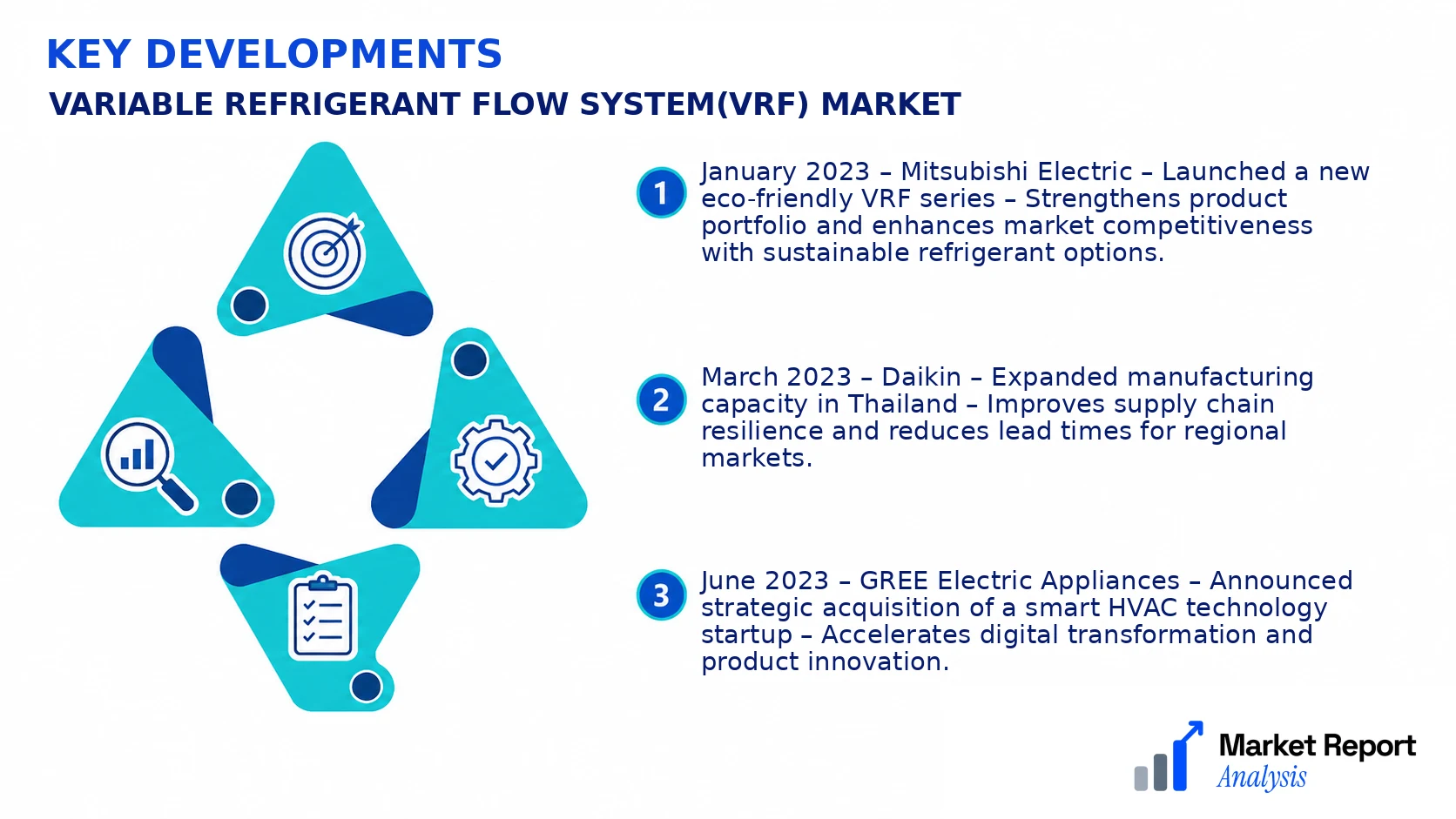
- January 2023 – Mitsubishi Electric – Launched a new eco-friendly VRF series – Strengthens product portfolio and enhances market competitiveness with sustainable refrigerant options.
- March 2023 – Daikin – Expanded manufacturing capacity in Thailand – Improves supply chain resilience and reduces lead times for regional markets.
- June 2023 – GREE Electric Appliances – Announced strategic acquisition of a smart HVAC technology startup – Accelerates digital transformation and product innovation.
- September 2023 – Lennox International – Partnered with a global energy company for deploying high-efficiency VRF solutions in commercial buildings – Promotes energy savings and sustainability.
- December 2023 – Trane Technologies – Launched an integrated remote monitoring platform for VRF systems – Enhances customer service and system efficiency management.
Frequently Asked Questions
What is the Variable Refrigerant Flow System(VRF) Market?
The Variable Refrigerant Flow System(VRF) Market represents the global industry for advanced HVAC systems that utilize variable refrigerant flow technology to provide efficient, flexible cooling and heating solutions across commercial, residential, and industrial applications. Its innovative design allows for precise temperature control and energy savings.
What is the current market size of Variable Refrigerant Flow System(VRF) Market?
As of 2026, the global VRF market is valued at approximately USD 8.2 Billion, reflecting steady growth driven by increasing adoption in commercial building projects and rising focus on energy-efficient HVAC solutions worldwide.
What factors are driving the Variable Refrigerant Flow System(VRF) Market?
Key growth drivers include mounting demand for energy-efficient and environmentally friendly HVAC technologies, rapid urbanization, increasing infrastructure investments, and stringent government regulations advocating sustainable building practices, all propelling the adoption of VRF systems globally.
Which region dominates the Variable Refrigerant Flow System(VRF) Market?
Asia-Pacific currently leads the VRF market, driven by significant infrastructure developments in countries like China and India, along with favorable government policies promoting green building initiatives and energy savings in the region.
Which segment is expected to grow the fastest?
The commercial segment is anticipated to witness the fastest growth, owing to expanding corporate offices, shopping malls, and hospitality constructs that require versatile, energy-efficient climate control solutions provided by VRF systems.
Who are the leading companies operating in the Variable Refrigerant Flow System(VRF) Market?
Major players include Daikin Industries, Mitsubishi Electric, LG Electronics, Samsung Electronics, and Panasonic Corporation, distinguished by innovative product portfolios, global presence, and strategic partnerships that enhance market competitiveness.
Key Takeaways:
- The global VRF market is projected to reach USD 54.9 Billion by 2034, growing at a CAGR of approximately 6.3% from 2026 to 2034.
- Market growth is primarily driven by rising demand in commercial and residential sectors for energy-efficient HVAC solutions.
- Asia-Pacific markets, especially China, India, and Southeast Asia, are experiencing significant adoption and investment in VRF technology.
- Technological innovations, such as IoT and AI integration, are enhancing system efficiency and predictive maintenance capabilities.
- Stringent energy regulations worldwide are encouraging the shift towards greener HVAC systems, including VRF solutions.
- Growing urbanization and smart building initiatives are creating ample opportunities for market expansion.
- Developments in VRF system technology are focusing on sustainability, reduce operational costs, and improving thermal comfort.
- Market players are increasingly adopting strategic collaborations and acquisitions to strengthen their market presence.
- New product launches emphasize energy savings, ease of installation, and interoperability with building management systems.
- The competitive landscape is becoming more fragmented, with leading companies competing on innovation and pricing.
- Government policies and incentives supporting energy efficiency are key factors boosting market demand.
- Future investments are expected to focus on high-performance, eco-friendly VRF systems tailored to regional and client-specific needs.
Analyst Perspective
The long-term outlook for the Variable Refrigerant Flow System (VRF) market remains robust, driven by ongoing technological advancements and increased demand for energy-efficient HVAC solutions globally. Commercial opportunities are expanding, particularly in smart building integrations and sustainable infrastructure initiatives, which demand innovative, scalable VRF configurations. As technology evolves, significant improvements in system efficiency, control precision, and ease of installation are expected, encouraging wider adoption across both residential and commercial sectors. Investment priorities should focus on R&D to enhance system intelligence and connectivity features, alongside strategic acquisitions to cement market positioning. Competitive intensity is intensifying as major HVAC players diversify their portfolios to include advanced VRF systems, fostering innovation-driven rivalry. Regionally, Asia-Pacific continues to exhibit the highest growth potential due to urbanization and infrastructure investments, while North America and Europe are expected to lead in premium, smart, and integrated VRF solutions. Long-term, market players must balance innovation with regional customization to sustain leadership in this evolving landscape.
