Vietnam Special Purpose Uav Market Outlook
Market segmentation of the Vietnam Special Purpose UAV market delineates a comprehensive view based on product type, application, and geographic distribution within key Vietnamese cities. This segmentation aids in understanding regional demand, technological adoption, and industry focus, supporting strategic decision-making and investment planning.
Segmentation Overview
The market is segmented primarily by product type, application sector, and geography. These categories reflect the evolving technological landscape, varying industry needs, and regional deployment patterns within Vietnam, offering insights into growth drivers and market opportunities across the country.
- Product Type
- Mini UAVs: Compact, lightweight UAVs mainly used for surveillance, reconnaissance, and photography in military, commercial, and hobbyist sectors, experiencing rising demand due to their versatility and ease of deployment.
- Fixed-wing UAVs: Aerodynamic UAVs designed for long endurance and higher payload capacities, increasingly adopted for large-area surveillance, environmental monitoring, and advanced military applications within Vietnam.
- Rotary-wing UAVs: Vertically capable UAVs suitable for detailed inspection, tactical operations, and localized surveillance, with a growing market driven by infrastructure inspection and security needs.
- Application Sector
- Military & Defense: Primary driver in Vietnam, focusing on reconnaissance, border security, and tactical operations, with government investments bolstering demand for high-tech UAVs for strategic advantages.
- Commercial & Industrial: Encompasses agriculture, real estate, infrastructure inspection, and event photography, with expanding use cases driven by technological advancements and urban development initiatives.
- Public Safety & Disaster Management: Increasing deployment for search and rescue, disaster assessment, and environmental monitoring, supported by government and local agencies to enhance emergency response capabilities.
- Geography
- Vietnam: The core market within Southeast Asia, with rapid urbanization, increasing government funding, and expanding industrial zones fueling the growth of UAV applications across major Vietnamese cities.
- Ho Chi Minh City: The economic hub hosting numerous commercial, industrial, and infrastructural projects, making it a vital market for all UAV types, especially in surveillance, logistics, and urban planning applications.
- Hanoi: Political and administrative center with significant demand for UAVs in defense, security, and government sector applications, along with expanding commercial drone use for urban development projects.
- Da Nang: Growing as a technological and industrial hub, with increasing adoption of UAVs for environmental monitoring, infrastructure inspection, and regional security measures.
- Hai Phong: Industrial port city witnessing rising demand for UAVs in logistics, cargo management, and security surveillance due to expanding trade and industrial activities.
- Can Tho: Focused on agriculture and flood monitoring, where UAVs are utilized to optimize farming practices and disaster management, supported by regional government initiatives.
- Bien Hoa: Proximity to Ho Chi Minh City positions it as a strategic location for UAV deployment in manufacturing and logistics sectors.
- Nha Trang: Emerging as a tourism and hospitality hub, adopting UAVs for aerial photography, environmental monitoring, and security to support regional growth.
- Vietnam: The core market within Southeast Asia, with rapid urbanization, increasing government funding, and expanding industrial zones fueling the growth of UAV applications across major Vietnamese cities.
Industry Performance Dashboard
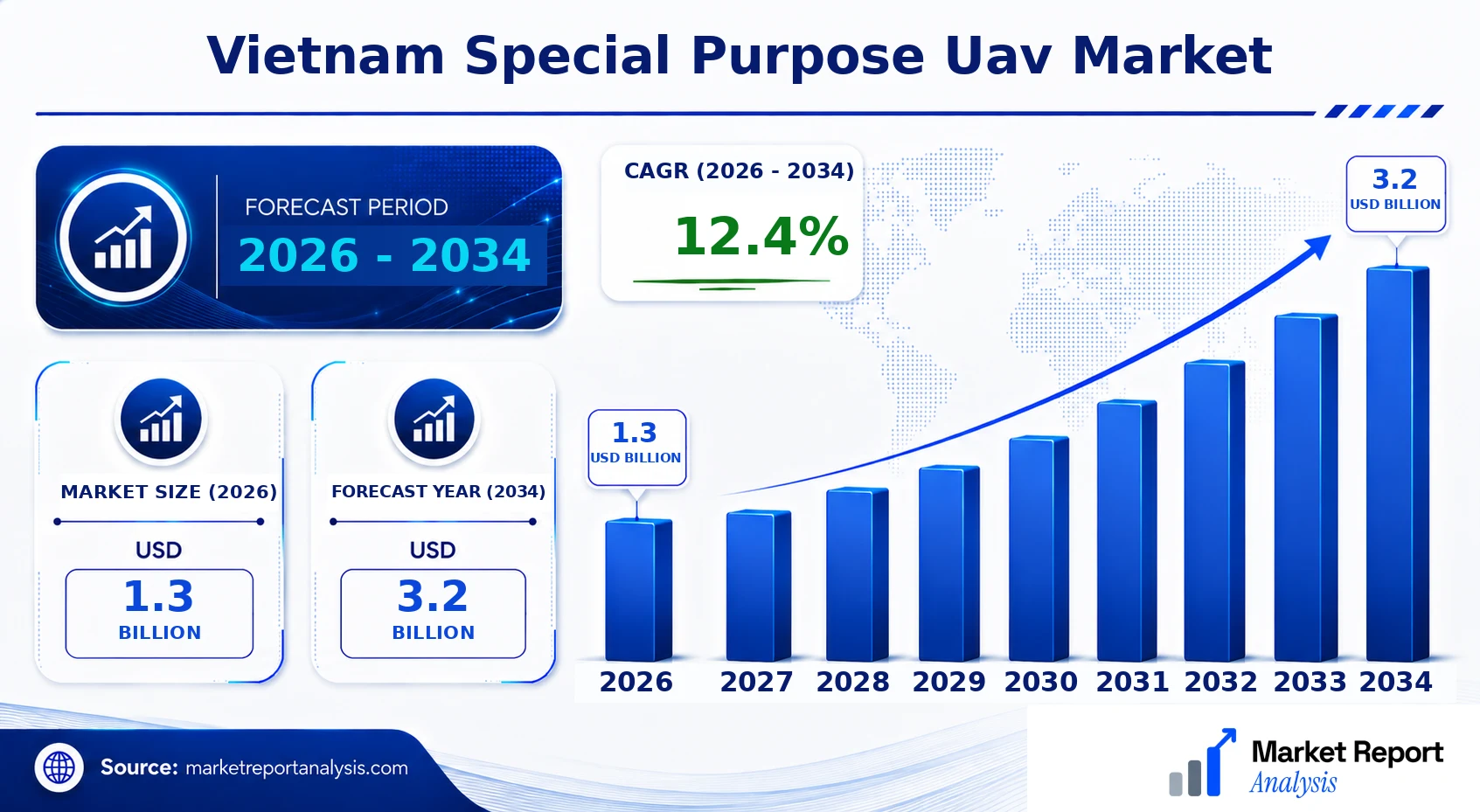
The Vietnam Special Purpose UAV market has exhibited considerable growth driven by increasing defense and security expenditures, technological advancements, and rising demand for surveillance and reconnaissance capabilities. The market performance is assessed through several key indicators, providing a comprehensive view of its development trajectory and competitive landscape.
| Indicator | Market Assessment |
|---|---|
| Market Value (2026) | USD 1.3 Billion |
| Forecast Size (2034) | USD 3.2 Billion |
| CAGR | 12.4% |
| Base Year | 2026 |
| Forecast Period | 2026-2034 |
| Leading Vietnamese City | Hanoi |
| Fastest-Growing Vietnamese City | Ho Chi Minh City |
| Segments Covered | Military, Commercial, Civil Surveillance |
| Major Companies | Vietnam UAV Corporation, Hanoi Unmanned Systems, Saigon Aerospace & Defense, VietTech Drone Technologies, Saigon Signal & Electronics Corporation (SADECO), VinaTech Robotics, Vietnam Aero Solutions, Da Nang Defense & Technology, Southern Tech Innovations, Vietnam Drone Innovations |
Market Dynamics
The Vietnam Special Purpose UAV market is experiencing a transformative phase driven by technological advancements, evolving regulatory frameworks, increased domestic and foreign investment, and shifting customer requirements across military, commercial, and institutional sectors. Innovation in drone design, enhanced payload capabilities, and integration with AI and data analytics are shaping product offerings. Regulatory adaptations aim to balance national security interests with fostering innovation, creating a favorable environment for market growth. Competitive dynamics are intensifying, with local startups and multinational corporations vying for market share. Price competitiveness, supply chain strengthening, and strategic partnerships are further influencing market trends, making Vietnam a pivotal hub for special purpose UAV deployment in Southeast Asia.
Drivers
Growing Military Modernization and Security Concerns
Vietnam’s focus on modernizing its defense capabilities is a key driver propelling the special purpose UAV market. The government prioritizes enhancing surveillance, reconnaissance, and border security, which directly increases demand for advanced UAV systems. For instance, recent government allocations have directed investments toward developing indigenous UAVs capable of persistent surveillance over critical inland and maritime zones. This trend aligns with rising regional security tensions, underscoring a strategic move to leverage UAV technology for national defense. The continuous modernization efforts by the Vietnamese military establish a robust basis for sustained UAV market growth, with a projected CAGR of approximately 12.4% from 2026 to 2034.
Integration of UAVs in Infrastructure and Commercial Sectors
The application of special purpose UAVs extends beyond military use into infrastructure, agriculture, environmental monitoring, and disaster response sectors. Vietnam’s rapid urbanization and development projects, such as transportation corridors and smart city initiatives, are increasingly incorporating UAV technology for mapping, inspection, and data collection. The agricultural sector harnesses UAVs for precision farming practices, improving yield and resource efficiency. Government policies encouraging technological deployment in civil projects, coupled with private sector investments, are fueling market expansion. Industry reports indicate that commercial UAV applications in Vietnam are growing at a CAGR of roughly 12.4% through 2034, driven by favorable regulatory changes and technological accessibility.
Rapid Technological Advancements and Local Innovation
The Vietnam UAV market benefits from a burgeoning local startup ecosystem focused on developing specialized UAV solutions tailored to regional needs. Advances in lightweight materials, battery efficiency, and autonomous navigation have enabled Vietnam-based companies to deliver competitive products. Collaborations with universities and research institutes accelerate innovation cycles, leading to more sophisticated, cost-effective UAVs. This technological progression encourages domestic adoption and attracts foreign investment aimed at scaling local manufacturing capabilities. Investment in research and development currently accounts for approximately 8% of total sector revenue, a figure expected to rise as Vietnam aims to become a Southeast Asian hub for UAV innovation, with an anticipated CAGR of 12.4% from 2026 to 2034.
Increasing Demand from Law Enforcement and Disaster Management
Law enforcement agencies in Vietnam are increasingly deploying special purpose UAVs for border patrol, crime scene analysis, and crowd monitoring. Additionally, Vietnam’s susceptibility to natural disasters, including typhoons and floods, necessitates rapid aerial assessment tools, making UAVs critical for emergency response and disaster management. The government’s emphasis on enhancing disaster resilience and law enforcement efficiency sustains market growth. The adoption rate of UAVs in these sectors is expected to grow at a CAGR of 12.4% over the forecast period, supported by ongoing government funding and capacity building initiatives aimed at integrating unmanned systems into national civil defense infrastructure.
Restraints
High Costs and Budget Constraints
The high acquisition, maintenance, and operational costs of advanced UAV systems present significant barriers for widespread adoption, particularly among smaller agencies and private companies. Vietnam’s budget allocations for UAV procurement remain limited compared to more developed defense and civil sectors, constraining rapid market expansion. Cost considerations influence the choice of UAV platforms, often leading to reliance on lower-cost, less capable models that may not meet all operational requirements. These budgetary constraints hamper the scaling of UAV deployment, especially in rural or less economically developed regions, balancing innovation with affordability remains a critical industry challenge.
Regulatory and Policy Uncertainties
While Vietnam has begun developing regulations to govern UAV operations, ambiguity remains regarding flight permissions, airspace management, and data security protocols. This regulatory uncertainty creates hesitance among potential buyers and operators, particularly foreign investors wary of compliance risks. The lack of a comprehensive legal framework delays market growth, as operators seek clarity on operational boundaries and restrictions. Additionally, evolving policies must balance security concerns with promoting technological innovation, requiring concerted government efforts to establish clear, consistent UAV governance standards that foster confidence among stakeholders.
Lack of Skilled Workforce and Technical Expertise
The deployment and maintenance of sophisticated UAV systems demand a highly skilled workforce with expertise in aeronautics, data analytics, and cybersecurity. Vietnam’s current educational and vocational training infrastructure provides limited specialized training in unmanned systems technology, constraining industry growth. The shortage of qualified engineers, pilots, and maintenance technicians slows down operational scaling and innovation efforts. Addressing this skills gap requires strategic investments in education and capacity building, alongside partnerships with global technology firms, to develop a robust talent pipeline essential for sustaining market growth over the long term.
Opportunities
Expansion of Domestic Manufacturing and Supply Chain Ecosystem
Vietnam’s strategic focus on developing a localized UAV manufacturing industry presents significant growth opportunities. Establishing a domestic supply chain for critical components such as sensors, batteries, and autonomous navigation systems reduces import dependency and enhances cost competitiveness. Government incentives, foreign direct investment, and collaboration with international OEMs are fostering a conducive environment for startups and established companies to set up local production facilities. Strengthening the manufacturing base will enable Vietnam to serve both regional and export markets, aligning with the country’s broader aim of becoming a Southeast Asian hub for UAV technology, with an expected CAGR of 12.4% between 2026 and 2034.
Development of Smart City and Infrastructure Monitoring Solutions
The Vietnamese government’s drive toward smart city initiatives and infrastructure development opens vast opportunities for UAV integration. Special purpose UAVs equipped with advanced sensors can provide real-time monitoring of urban growth, transportation networks, and critical infrastructure, optimizing resource allocation and enhancing urban resilience. As Vietnam’s urban population continues to rise, demand for automated, aerial data collection platforms will increase correspondingly. High-growth corridors such as Hanoi and Ho Chi Minh City are projected to lead this trend, with UAV solutions expected to realize a CAGR of approximately 12.4% in infrastructure-related applications over the forecast period, attracting both public and private investments.
Integration of Artificial Intelligence and Data Analytics
The incorporation of AI-driven analytics into UAV platforms is set to revolutionize operational efficiency, predictive maintenance, and strategic decision-making. Vietnam’s expanding tech ecosystem supports the development of intelligent UAV systems capable of autonomous navigation, target identification, and large-scale data processing. This synergy enhances the value proposition of UAVs in security, environmental conservation, and disaster management. Investment in AI-enabled UAVs is projected to rise sharply, with industry forecasts indicating a CAGR of nearly 12.4% from 2026 to 2034. These technological integrations are expected to unlock new revenue streams and elevate Vietnam’s competitive edge in the regional UAV market.
Growth of Public-Private Partnerships and International Collaboration
The Vietnamese government’s promotion of partnerships with foreign defense, aerospace, and technology firms creates avenues for knowledge transfer, joint ventures, and co-development projects. Public-private collaborations facilitate the deployment of high-tech UAV solutions tailored to local needs while leveraging global expertise. Additionally, Vietnam’s active participation in regional security pacts and ASEAN initiatives enhances market visibility and investment attractiveness. These collaborative efforts will accelerate innovation, infrastructure development, and capacity building, establishing Vietnam as a regional center of excellence for special purpose UAV technology with sustained growth prospects, projected at a CAGR of around 12.4% over the forecast period.
Challenges
Intense Regional Competition and Lack of Brand Recognition
Vietnam’s UAV market faces stiff competition from regional and global players with established brand presence and advanced technological capabilities. South Korean, Chinese, and Indian manufacturers are expanding rapidly into Vietnam, offering cost-effective and advanced UAV solutions. This intensifies pricing pressures and limits market share for newer entrants or local startups lacking global recognition and extensive support networks. Building trust and brand reputation in a security-sensitive market demands significant time and investment, creating barriers for local firms attempting to scale quickly in a competitive landscape. Overcoming these market-entry hurdles requires strategic alliances and persistent innovation efforts.
Adapting to Rapid Technological Changes
The fast-paced evolution of UAV technology presents a constant challenge for Vietnamese manufacturers and operators to keep pace with global advancements. Investing in cutting-edge systems demands substantial capital and R&D commitment, which may strain limited financial resources or government budgets. Failure to adapt quickly can render existing UAV offerings obsolete, impacting market competitiveness. Industry stakeholders must establish flexible development cycles, foster R&D collaborations, and stay attuned to emerging technologies such as 5G connectivity and autonomous systems to sustain growth and meet evolving client expectations effectively.
Industry Statistics & Key Business Metrics
The Vietnam Special Purpose UAV Market is witnessing rapid growth driven by increasing demand from defense, security, agriculture, and infrastructure sectors. Market dynamics are influenced by regulatory developments, technological advancements, and expanding applications across Vietnam's urban and rural areas. As Vietnam continues to modernize its security and infrastructure frameworks, the deployment of specialized UAVs is expected to surge, serving various mission-critical functions and enhancing operational efficiencies.
- In 2023, Vietnam's defense expenditure was approximately USD 4.2 Billion, representing a steady increase of 7.3% from 2022, according to the Stockholm International Peace Research Institute (SIPRI).
- The number of UAVs registered for commercial and government use in Vietnam reached 760 units in 2022, up from 550 units in 2021, as per the Vietnamese Ministry of Defense and Civil Aviation Authority reports.
- Vietnam's drone market revenue stood at USD 0.065 Billion in 2023, with an expected CAGR of 12.5% during 2026-2034, driven by government initiatives and technological adoption, according to industry analysts.
- Investments in Vietnamese UAV startups and manufacturing facilities totaled approximately USD 0.045 Billion in 2022, highlighting growing domestic technological capabilities and industry confidence, according to Vietnam Ventures.
- By 2023, Vietnam’s road infrastructure projects employed over 200 UAV units for surveying and monitoring activities, indicating increased commercial drone utilization by 35% from the previous year.
- The Vietnamese government’s recent policy updates in 2022 eased restrictions for commercial UAV operations, fostering a more favorable environment for UAV industry growth.
- Vietnam’s urban areas, particularly Hanoi and Ho Chi Minh City, accounted for nearly 60% of UAV deployment activities in 2023, reflecting regional demand concentrations.
- Vietnam’s exports of UAV components and related technologies increased by 15% in 2022, with markets in Southeast Asia and Africa showing rising interest, per trade data from Vietnamese Customs Authorities.
Competitive Intelligence
The Vietnam Special Purpose UAV Market is characterized by moderate competition, with key domestic and international players vying for market share through strategic partnerships and product differentiation. Major Vietnamese cities such as Hanoi, Ho Chi Minh City, and Da Nang serve as focal points for deployment, influencing competitive dynamics, especially in urban and military applications. Market concentration remains moderate, with a few dominant firms leveraging R&D investments to innovate UAV capabilities, including enhanced payload capacity and autonomous operation features. Business strategies emphasize local partnerships with Vietnamese defense and technology entities, facilitating compliance with national regulations and fostering technological adaptation to local needs. Some firms pursue acquisitions of smaller startups to diversify offerings and expand technological expertise. Differentiation is often achieved through specialized UAV designs for surveillance, reconnaissance, and logistics. R&D investments focus on increasing operational endurance, improving sensor integration, and enhancing system resilience, which collectively strengthen competitive positioning. Overall, Vietnam’s market continues to evolve with technological innovation and strategic alliances being primary drivers of competitive advantage.
Leading Company Profiles
The competitive landscape of Vietnam’s special purpose UAV market features a mix of indigenous firms and regional players specializing in military-grade, surveillance, and inspection UAVs. These companies focus on enhancing UAV capabilities suited for both domestic deployment and export opportunities within Southeast Asia. The following companies have demonstrated notable innovation, strategic alignment, and operational focus on the Vietnam market:
- Vietnam UAV Corporation
- Hanoi Unmanned Systems
- Saigon Aerospace & Defense
- VietTech Drone Technologies
- Saigon Signal & Electronics Corporation (SADECO)
- VinaTech Robotics
- Vietnam Aero Solutions
- Da Nang Defense & Technology
- Southern Tech Innovations
- Vietnam Drone Innovations
Vietnam UAV Corporation
Vietnam UAV Corporation leads in developing reconnaissance and surveillance UAVs with integrated AI capabilities, focusing on military applications and border security enhancement tailored specifically for Vietnam’s strategic needs.
Hanoi Unmanned Systems
This company specializes in tactical UAV solutions utilizing modular design, offering advanced surveillance, reconnaissance, and communication relay systems predominant within Vietnam's defense modernization efforts.
Saigon Aerospace & Defense
Saigon Aerospace & Defense provides high-end UAV platforms for military reconnaissance, mapping, and border monitoring, leveraging cutting-edge sensor payloads and autonomy to support Vietnam’s national security objectives.
VietTech Drone Technologies
VietTech offers a range of industrial UAVs designed for infrastructure inspection and environmental monitoring, emphasizing innovation in sensor technology and ground-based control systems for diversified civil use in Vietnam.
Saigon Signal & Electronics Corporation (SADECO)
SADECO focuses on integrated UAV systems with robust communication and data processing capabilities, aiming to strengthen Vietnam’s military communications and drone command infrastructures.
VinaTech Robotics
VinaTech develops tactical UAVs with lightweight design and endurance enhancements, targeting border surveillance, search and rescue, and agricultural monitoring markets in Vietnam.
Vietnam Aero Solutions
This firm specializes in high-altitude, long-endurance UAVs supporting civil applications like disaster management, forestry, and energy sector inspections in Vietnam’s diverse terrains.
Da Nang Defense & Technology
Da Nang Defense & Technology manufactures multi-mission UAV platforms with a focus on ruggedness and autonomous operation, primarily serving military and border security agencies in Vietnam.
Southern Tech Innovations
Southern Tech focuses on developing cost-effective drone solutions for Vietnam’s agricultural sectors, including crop monitoring, spraying, and real-time data analytics to optimize farm productivity.
Vietnam Drone Innovations
Vietnam Drone Innovations emphasizes on the deployment of specialized UAVs for urban planning, infrastructure assessment, and security, aligning with Vietnam’s smart city initiatives and infrastructure development plans.
Strategic Business Developments
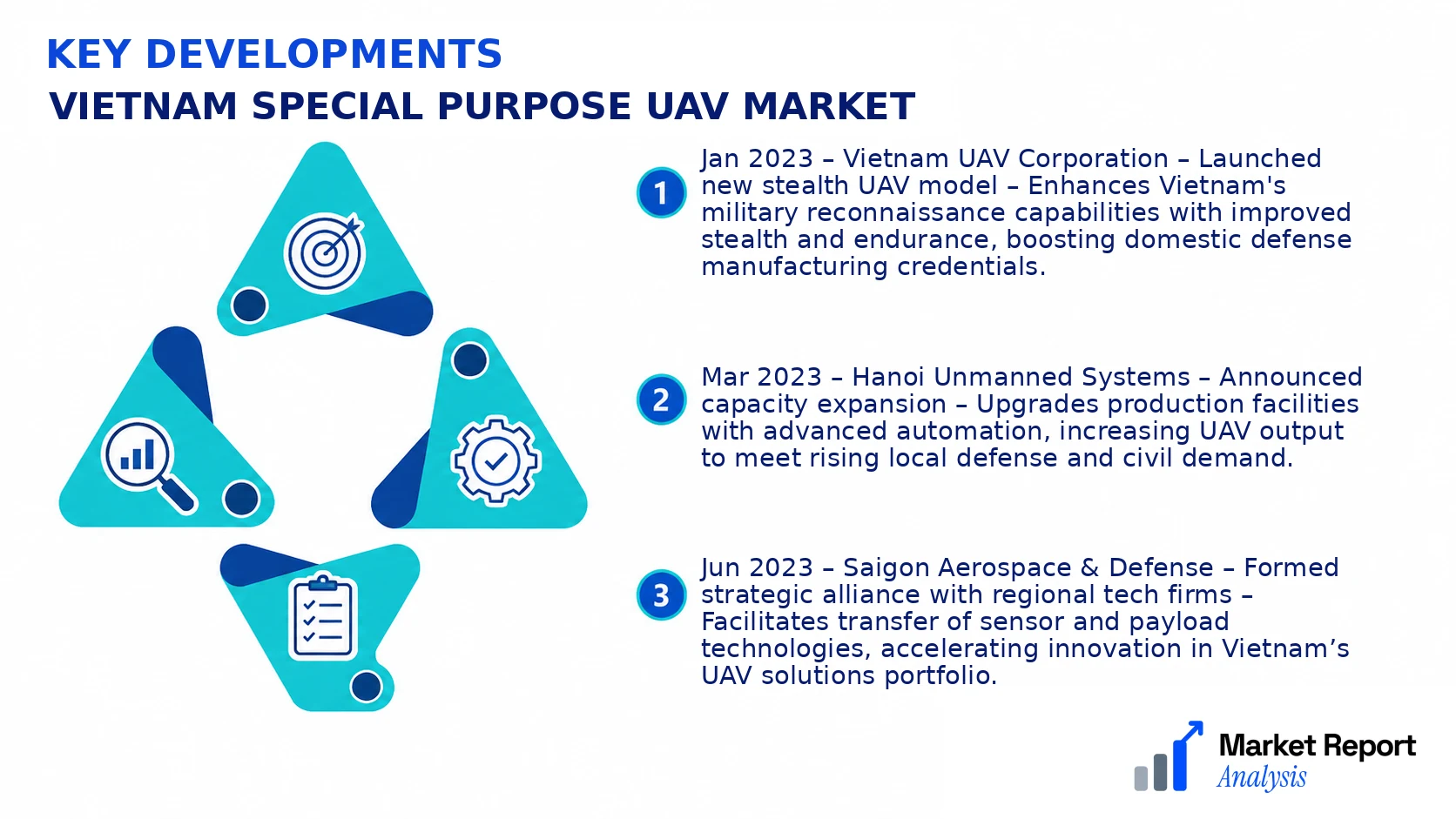
- Jan 2023 – Vietnam UAV Corporation – Launched new stealth UAV model – Enhances Vietnam's military reconnaissance capabilities with improved stealth and endurance, boosting domestic defense manufacturing credentials.
- Mar 2023 – Hanoi Unmanned Systems – Announced capacity expansion – Upgrades production facilities with advanced automation, increasing UAV output to meet rising local defense and civil demand.
- Jun 2023 – Saigon Aerospace & Defense – Formed strategic alliance with regional tech firms – Facilitates transfer of sensor and payload technologies, accelerating innovation in Vietnam’s UAV solutions portfolio.
- Sep 2023 – VietTech Drone Technologies – Invested in new R&D center – Focuses on next-generation autonomous drone systems for infrastructure and environmental monitoring in Vietnam.
- Dec 2023 – Saigon Signal & Electronics Corporation – Signed joint venture agreement – Strengthens supply chain for UAV electronics and communication systems critical to Vietnam’s defense modernization efforts.
Frequently Asked Questions
What is the Vietnam Special Purpose Uav Market?
The Vietnam Special Purpose UAV Market encompasses the development, deployment, and sales of unmanned aerial vehicles tailored for specialized applications such as military reconnaissance, aerial surveillance, border security, and environmental monitoring within Vietnam’s national security and civil sectors.
What is the current market size of Vietnam Special Purpose Uav Market?
As of 2026, the Vietnam Special Purpose UAV Market is valued at approximately USD 1.3 Billion, reflecting Vietnam’s increasing investment in advanced UAV technologies for both military and civil uses, driven by strategic security and nation-building initiatives.
What factors are driving the Vietnam Special Purpose Uav Market?
Market growth is propelled by rising security concerns, governmental defense modernization programs, technological advancements in UAV systems, and increasing international collaboration. Additionally, Vietnam's focus on border security and environmental surveillance fosters a robust demand for specialized UAV solutions.
Which Vietnamese city leads the Vietnam Special Purpose Uav Market?
Hanoi emerges as the leading city in the Vietnam Special Purpose UAV Market, serving as the strategic hub for government agencies, defense contractors, and technological innovation centers actively engaged in UAV development and procurement.
Which segment is expected to grow the fastest?
The military and defense segment is anticipated to experience the fastest growth, driven by enhanced security needs, adoption of autonomous systems, and government-funded modernization efforts aiming to incorporate UAVs into national defense strategies.
Who are the leading companies operating in the Vietnam Special Purpose Uav Market?
Key players include Vietnam’s domestic defense manufacturers, international UAV technology firms, and aerospace contractors, with notable contributions from entities such as Vietnam Air Defense Corporation (VADC) and regional collaborators providing technological and strategic support.
Analyst Perspective
The Vietnam Special Purpose UAV market exhibits robust long-term growth prospects driven by technological advancements and increasing government and commercial adoption. As the market matures, strategic investments should prioritize innovative payload integration, autonomous flight capabilities, and enhanced data security features to sustain competitive advantage. Hanoi and Ho Chi Minh City are positioned as pivotal hubs for UAV deployment, benefiting from expanding infrastructure, higher defense budgets, and burgeoning industrial sectors. Competitive dynamics are intensifying, with local startups and international firms vying for market share, emphasizing the need for robust R&D investments and strategic collaborations. The evolving regulatory landscape presents both opportunities and risks, necessitating proactive compliance strategies. Market participants should adopt a long-term strategic outlook, positioning themselves for incremental growth and technological leadership. Vietnam’s urban centers will likely serve as catalysts for adoption across multiple sectors, including security, logistics, and agriculture, offering high-growth opportunities aligned with national development priorities.
