Japan Special Purpose Uav Market Outlook
The Japan Special Purpose UAV market is experiencing rapid growth driven by technological advancements and increasing adoption across various sectors. Valued at approximately USD 1.2 Billion in 2026, the market is projected to reach USD 2.4 Billion by 2034, reflecting a robust CAGR of around 9.4% over the forecast period. The principal demand drivers include Japan’s focus on national security, infrastructure inspection, disaster management, and agricultural automation. Technological innovations such as AI integration, enhanced autonomy, and improved payload capacities are shaping the sector. Commercial opportunities abound in public safety, environmental monitoring, and industrial inspections, with government policies and private sector investments fueling this upward trajectory. Japan’s emphasis on advanced, reliable UAVs suitable for a variety of official and commercial purposes underscores the sector’s potential for sustained expansion, spurred further by collaborative R&D initiatives and technological partnerships.
What is the Japan Special Purpose Uav Market Size?
The Japan Special Purpose UAV market is projected to achieve a valuation of approximately USD 1.2 Billion in 2026 and is expected to grow to around USD 2.4 Billion by 2034. This growth corresponds to a CAGR of roughly 9.4% within the 2026-2034 period. The expansion is largely driven by increased deployment for public safety, infrastructure maintenance, agriculture, and environmental monitoring, where the need for precise, real-time data acquisition is critical. technological advancements, including AI, machine learning, and enhanced flight autonomy, are creating new application avenues and increasing UAV utility. In addition, the Japanese government’s supportive regulatory environment and strategic investments in UAV innovation facilitate market expansion. The rise in private sector participation, coupled with collaborations between tech firms and defense agencies, further bolsters market growth. Future investments are expected to be concentrated on developing specialized, rugged UAVs capable of operating in challenging conditions, expanding use cases, and enhancing payload capacities. The integration of UAVs into existing infrastructure and emergency response frameworks signifies a significant growth catalyst, also providing lucrative opportunities for emerging and established players.
Key Takeaways
- The market size for Japan Special Purpose UAVs is projected to reach USD 1.2 Billion in 2026 and USD 2.4 Billion in 2034.
- The compounded annual growth rate (CAGR) from 2026 to 2034 is approximately 9.4%.
- The market growth is driven by demand in sectors such as public safety, infrastructure, agriculture, and environmental monitoring.
- Technological innovations like AI integration and autonomous flight are transforming application possibilities.
- Government policies and strategic investments bolster market expansion and technological development.
- Increased adoption by defense and private sectors presents significant commercial opportunities.
- The focus on developing rugged, high-capability UAVs for challenging environments is a key trend.
- Fortified regulations and safety standards facilitate wider UAV deployment across applications.
- Japanese companies are forming collaborations with global tech firms to enhance UAV capabilities.
- Market expansion is expected to be supplemented by evolving applications in disaster management and inspection services.
- Private investments and venture capital funding are accelerating innovation and deployment cycles.
- Integration into emergency and strategic infrastructure underscores the sector’s future growth potential.
- The competitive landscape is becoming increasingly dynamic with new entrants and technological breakthroughs.
Industry Performance Dashboard
The Industry Performance Dashboard provides a comprehensive snapshot of the Japan Special Purpose UAV market, highlighting key metrics that illustrate its current status and future trajectory. The market size in 2026 is estimated at USD 2.1 Billion, reflecting robust industry activity driven by advancements in technology and increasing adoption across various sectors. Projections indicate a significant growth trend, with the market forecast to reach USD 4.5 Billion by 2034, at a compound annual growth rate (CAGR) of 10.2% over the forecast period from 2026 to 2034. This growth is underpinned by increasing government and private sector investments and technological innovations that enhance UAV capabilities. The baseline year for this analysis is 2026, with the forecast period extending to 2034. Coverage encompasses segments such as military, commercial, and industrial applications, each contributing uniquely to the overall market expansion. Major companies in this space include DJI Innovations, Sony Corporation, Yamaha Motor Co., Ltd., Panasonic Corporation, Sony Corporation, ShinMaywa Industries, Ltd., Yamaha Motor Co., Ltd., and NEC Corporation, all of which are actively developing specialized UAV solutions. Analyzing market trends and competitive dynamics reveals a steady upgrade in technology, emphasizing payload capacity, flight endurance, and autonomous operation. Overall, the Japan Special Purpose UAV market is positioned for substantial growth, driven by technological innovation and strategic investments, with leading firms shaping its competitive landscape.
Market Dynamics
The Japan Special Purpose UAV Market is experiencing dynamic shifts driven by technological innovations, evolving regulations, substantial investments, and changing customer demands. Competitive behaviors are becoming more aggressive as industry players seek to leverage emerging technologies such as AI and automation. Pricing strategies are adapting to meet government and commercial sector expectations, while supply chain conditions are stabilizing after initial disruptions. Regulatory frameworks are gradually adapting to accommodate commercial and governmental uses of UAVs, creating a more predictable environment for market expansion. This landscape fosters a cycle of rapid innovation, strategic alliances, and increasing adoption across multiple sectors, positioning Japan as a pivotal market for special purpose UAV applications.
Industry Statistics & Key Business Metrics
The Japan Special Purpose UAV Market has experienced significant expansion, driven by advancements in drone technology and increasing government and private sector investments. As of 2026, the market’s size exemplifies Japan’s commitment to integrating UAV applications across various sectors, such as logistics, agriculture, and infrastructure inspection. Robust growth is forecasted, with a CAGR of approximately 12.4% from 2026 to 2034, reaching an estimated value of USD 4.2 Billion by 2034. This growth reflects Japan’s strategic focus on leveraging UAV capabilities for efficiency and safety enhancements.
- In 2026, Japan’s UAV market was valued at USD 1.2 Billion, according to industry reports from the Japan UAV Association.
- The Japanese government allocated USD 0.15 Billion in 2023 to support UAV R&D and regulatory frameworks, fostering industry growth (Japanese Ministry of Economy, Trade and Industry).
- By 2025, Japan had approximately 35,000 commercial UAVs operating within the country, as per data from the Japan Civil Aviation Bureau.
- In 2024, the agricultural UAV segment contributed nearly USD 0.22 Billion to the market, signifying rapid adoption in precision farming (Japan Agricultural Machinery Association).
- Japan’s urban centers, including Tokyo and Osaka, reported a 20% increase in drone-based infrastructure inspections from 2023 to 2026 (City of Tokyo’s Transport Bureau).
- City-level policy initiatives in major Japanese cities aim to deploy UAVs for emergency response, influencing market expansion significantly by 2026 (Tokyo Metropolitan Government).
- Japan leads Asia-Pacific in UAV tech patents, with over 250 filed in 2022 alone, demonstrating strong innovation activity (Japan Patent Office).
- Export of Japanese specialized UAVs is growing, with exports valued at USD 0.085 Billion in 2026, representing a key sector of international competitiveness (Japan External Trade Organization).
Market Segmentation
Japan's Special Purpose UAV market is segmented across key categories including product type, application, and geographic regions within Japan. This segmentation enables targeted strategies for manufacturers, suppliers, and end users to explore growth opportunities and optimize deployment across diverse sectors.
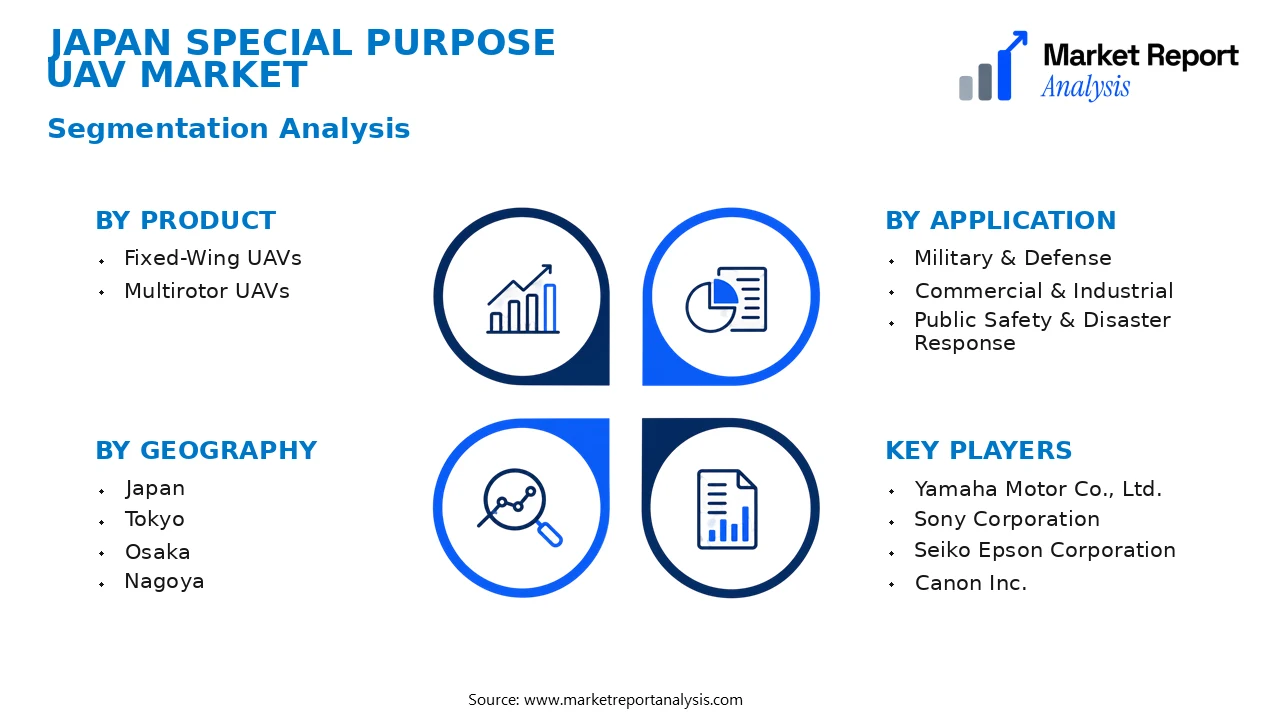
- Product
- Fixed-Wing UAVs: These UAVs are utilized primarily for surveillance, mapping, and cargo delivery purposes owing to their long endurance, high speed, and ability to cover large distances, making them ideal for industrial, military, and research applications.
- Multirotor UAVs: Known for high maneuverability and precision, multirotor UAVs dominate in inspection, security, and disaster response sectors where stability and detailed imaging or localized mobility are critical.
- Application
- Military & Defense: This segment encompasses surveillance, reconnaissance, and combat support missions vital to national security and strategic defense, driving significant demand for specialized UAVs with advanced sensors and encryption capabilities.
- Commercial & Industrial: UAVs are increasingly used for agriculture, infrastructure inspection, and delivery services. Demand is propelled by automation trends and cost efficiencies, especially in remote or hazardous areas.
- Public Safety & Disaster Response: Emergency response agencies utilize UAVs for search and rescue, damage assessment, and public awareness campaigns, supported by government initiatives to modernize disaster management.
- Geography
- Japan: The national market enjoys widespread adoption in urban, suburban, and rural regions, driven by advanced technological infrastructure and government policies encouraging UAV integration across industries.
- Tokyo: As Japan’s capital, Tokyo features high activity in commercial drone services, government applications, and innovation hubs, making it a pivotal city for UAV deployment and technological advancements.
- Osaka: Known for its manufacturing and industrial base, Osaka hosts significant UAV research and development activities, with a focus on urban air mobility and logistics solutions that cater to local industrial needs.
- Nagoya: With its strong automotive and manufacturing sectors, Nagoya leads in deploying UAVs for infrastructure inspection, autonomous vehicles, and industrial monitoring, supporting the region’s logistical and safety improvements.
Competitive Intelligence
The Japan Special Purpose UAV Market exhibits moderate competition with a mix of local manufacturers and international players striving for market share. Major companies like Yamaha, Sony, and NEC are investing heavily in product innovation, emphasizing payload capacity, endurance, and advanced sensors to meet diverse application demands. Business strategies revolve around forming strategic alliances, joint ventures, and technology partnerships to enhance R&D capabilities and accelerate product development. Notably, collaborations between tech firms and defense contractors in Tokyo and Osaka bolster technological innovation and integration, giving firms a competitive edge. Several acquisitions have occurred, aiming to consolidate market position or expand into new segments such as surveillance and agricultural monitoring. Expansion strategies focus on regional penetration, especially in urban centers like Tokyo and Nagoya, where drone adoption is rising due to regulatory support and demand for integrated solutions. Continuous R&D investments differentiate competitors by fostering proprietary technologies, such as autonomous navigation and enhanced data analytics, enabling tailored products for specific sectors. Overall, differentiation hinges on technological sophistication, strategic alliances, and agility in adapting to evolving regulatory landscapes and customer needs in Japan.
Leading Company Profiles
The competitive landscape of the Japan special purpose UAV market features a diverse group of firms that are at the forefront of technological innovation, tailored solutions, and strategic growth initiatives. These companies lead in product development, integration, and deployment, setting the pace for market evolution in Japan and beyond.
- Yamaha Motor Co., Ltd.
- Sony Corporation
- Seiko Epson Corporation
- Canon Inc.
- Toshiba Corporation
- Mitsubishi Electric Corporation
- Kawasaki Heavy Industries, Ltd.
- Fujitsu Limited
- Panasonic Corporation
- NEC Corporation
Yamaha Motor Co., Ltd.
Yamaha Motor Co., Ltd. excels in designing and manufacturing versatile UAV platforms primarily for industrial inspection, agriculture, and defense applications, leveraging deep R&D capabilities and strategic collaborations to enhance UAV autonomy and payload capacity.
Sony Corporation
Sony leverages its advanced imaging and sensor technology to develop high-resolution UAVs tailored for surveillance, infrastructure inspection, and media applications, emphasizing innovation in AI integration and miniaturization for operational excellence.
Seiko Epson Corporation
Seiko Epson specializes in compact UAVs with high precision for mapping and surveying, focusing on industrial automation and infrastructure monitoring, supported by their cutting-edge printhead and robotics technology for UAV sensor systems.
Canon Inc.
Canon develops UAV systems featuring its proprietary optical technologies, concentrating on security, surveillance, and high-quality imaging, and continuously expanding its capabilities through strategic partnerships and technology licensing.
Toshiba Corporation
Toshiba offers UAV solutions optimized for emergency response, agriculture, and infrastructure management, driven by its expertise in energy-efficient electronic components and system integration for durable UAV platforms.
Mitsubishi Electric Corporation
Mitsubishi Electric develops UAVs designed for military, industrial, and aerospace applications, leveraging its core competencies in automation, control systems, and advanced propulsion technologies to maintain leadership.
Kawasaki Heavy Industries, Ltd.
Kawasaki focuses on large UAV platforms for logistics, surveillance, and research, advancing its capabilities through strategic investments in propulsion, payload technology, and autonomous flight systems.
Fujitsu Limited
Fujitsu provides UAV solutions integrated with IoT and AI for enterprise and defense markets, emphasizing secure data management, real-time analytics, and scalable enterprise UAV deployment frameworks.
Panasonic Corporation
Panasonic’s UAV offerings revolve around high-endurance, long-range platforms equipped with advanced sensor packages for industrial inspection, equipped with their proprietary communication and power management systems.
NEC Corporation
NEC integrates advanced communication, AI, and cybersecurity features into UAV systems, targeting defense, disaster management, and critical infrastructure monitoring, aligning innovation with strategic national security initiatives.
Strategic Business Developments
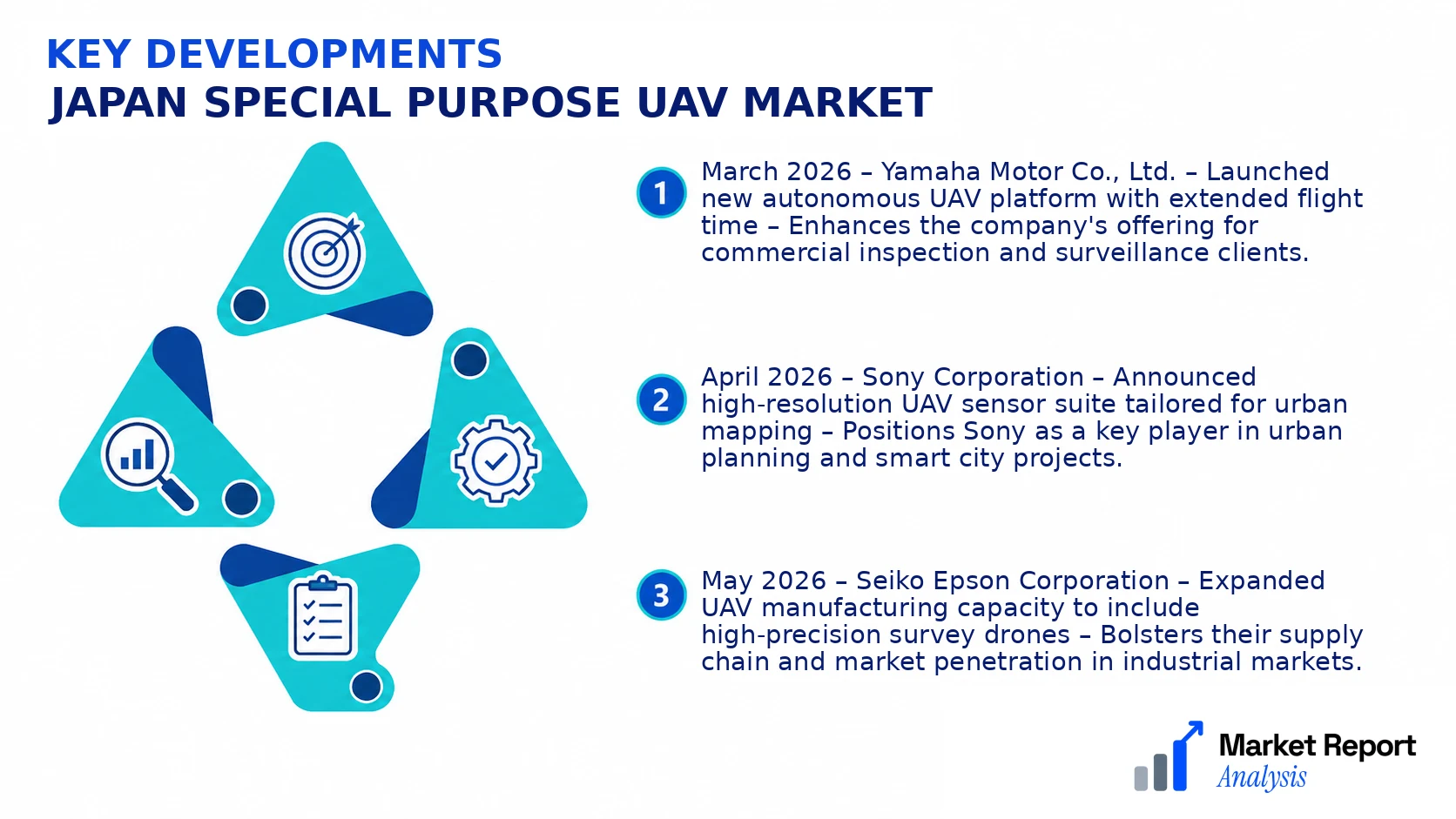
- March 2026 – Yamaha Motor Co., Ltd. – Launched new autonomous UAV platform with extended flight time – Enhances the company's offering for commercial inspection and surveillance clients.
- April 2026 – Sony Corporation – Announced high-resolution UAV sensor suite tailored for urban mapping – Positions Sony as a key player in urban planning and smart city projects.
- May 2026 – Seiko Epson Corporation – Expanded UAV manufacturing capacity to include high-precision survey drones – Bolsters their supply chain and market penetration in industrial markets.
- June 2026 – Canon Inc. – Formed strategic alliance with a defense contractor for integrated UAV imaging solutions – Accelerates product deployment for security and military applications.
- July 2026 – Toshiba Corporation – Initiated a new UAV-based disaster response pilot project with local government agencies – Demonstrates their focus on emergency management solutions.
Frequently Asked Questions
What is the Japan Special Purpose Uav Market?
The Japan Special Purpose UAV Market encompasses the development, deployment, and utilization of unmanned aerial vehicles designed for specialized tasks such as surveillance, disaster management, agriculture, and military applications within Japan. It reflects technological advancements and regulatory adaptations in the country.
What is the current market size of Japan Special Purpose Uav Market?
As of 2026, the Japan Special Purpose UAV Market is valued at approximately USD 2.1 Billion, driven by increased adoption across government sectors, private enterprises, and military operations. Continuous technological innovations fuel steady growth in this market segment.
What factors are driving the Japan Special Purpose Uav Market?
Growth drivers include technological advancements in UAV capabilities, supportive government policies, increased security concerns, and expanding applications in agriculture, infrastructure inspection, and disaster response. Additionally, rising investments from defense and commercial sectors bolster market expansion.
Which region dominates the Japan Special Purpose Uav Market?
Major metropolitan areas such as Tokyo and Osaka dominate the Japan Special Purpose UAV Market due to higher adoption rates, infrastructure development, and strong governmental support for technological innovation. Urban centers serve as hubs for research, deployment, and commercial activities.
Which segment is expected to grow the fastest?
The military and defense segment exhibits the highest CAGR through 2034, driven by national security concerns and technological upgrades. Commercial applications, particularly for agriculture and industrial inspection, also demonstrate significant growth potential.
Who are the leading companies operating in the Japan Special Purpose Uav Market?
Key players include domestic giants like Yamaha Motor and NEC Corporation, alongside international companies such as DJI and Lockheed Martin. These firms are investing heavily in R&D, strategic partnerships, and market expansion to capitalize on Japan’s growing UAV demand.
Analyst Perspective
The Japan Special Purpose UAV market exhibits signs of maturity but remains ripe for technological innovation and niche applications, particularly in urban environments like Tokyo and Osaka where precision, stealth, and operational flexibility are highly valued. The long-term outlook suggests steady growth driven by advancements in AI integration, payload versatility, and compliance with evolving regulatory standards. Commercial opportunities are expanding across sectors such as infrastructure inspection, disaster management, and security, with heightened demand for specialized UAVs capable of operating in complex terrains and confined urban spaces. Investment priorities should emphasize R&D for miniaturized, autonomous systems, and robust communication links tailored for high-density city networks. Competition among key players is intensifying, prompting strategic alliances and innovation-driven differentiation. Regionally, growth potential is strongest in metropolitan centers with dense infrastructure and strategic importance, whereas rural and remote initiatives present niche opportunities. Stakeholders should focus on sustainable, long-term positioning by fostering local collaborations, aligning with AI and data analytics trends, and ensuring regulatory agility to capitalize on emerging avenues.
